The A u t o m a t i c Acquisition of Frequencies of Verb
Subcategorization Frames from Tagged Corpora
Akira Ushioda, David A. Evans, Ted Gibson, Alex Waibel Computational Linguistics Program
Carnegie Mellon University Pittsburgh, PA 15P13-3890
aushioda @icl. cmu. edu
A b s t r a c t
We describe a mechanism for automatically acquiring verb subcategorization frames
and their frequencies in a large corpus. A tagged corpus is first partially parsed to
identify noun phrases and then a finear grammar is used to estimate the appropri-
ate subcategorization frame for each verb token in the corpus. In an experiment
involving the identification of six fixed subcategorization frames, our current system showed more than 80% accuracy. In addition, a new statistical approach substan- tially improves the accuracy of the frequency estimation.
1
Introduction
When we construct a grammar, there is always a trade-off between the coverage of the grammar and the ambiguity of the grammar. If we hope to develop an efficient high- coverage parser for unrestricted texts, we must have some means of dealing with the combinatorial explosion of syntactic ambiguities. While a general probabilistic optimiza- tion technique such as the Inside-Outside algorithm ([Baker, 1979], [Lauri and Young, 1990], [Jelinek el ai., 1990], [Carroll and Charniak, 1992]) can be used to reduce ambi- guity by providing estimates on the applicability of the context-free rules in a grammar (for example), the algorithm does not take advantage of lexical information, including such information as verb subcategorization frame preferences. Discovering or acquiring lexically-sensitive linguistic structures from large corpora may offer an essential comple- mentary approach.
Verb subcategorization (verb-subcat) frames represent one of the most important ele- ments of grammatical/lexical knowledge for efficient and reliable parsing. At this stage in the computational-linguistic exploration of corpora, dictionaries are still probably more re- liable than automatic acquisition systems as a source of subcategorization (subcat) frames for verbs. The Oxford Advanced Learners Dictionary (OALD) [Hornby, 1989], for exam- ple, uses 32 verb patterns to describe a usage of each verb for each meaning of the verb. However, dictionaries do not provide quantitative information such as how often each verb is used with each of the possible subcat frames. Since dictionaries are repositories, primarily, of what is possible, not what is most likely, they tend to contain information about rare usage [de Marken, 1992]. But without information about the frequencies of the subcat frames we find in dictionaries, we face the prospect of having to treat each frame as equiprobable in parsing. This can lead to serious inefficiency. We also know that the frequency of subcat frames can vary by domain; frames that are very rare in one domain can be quite common in another. If we could automatically determine the frequencies of subcat frames for domains, we would be able to tailor parsing with domain-specific
heuristics. Indeed, it would be desirable to have a subcat dictionary for each possible domain.
This paper describes a mechanism for automatically acquiring subcat frames and their frequencies based on a tagged corpus. The method utilizes a tagged corpus because (i) we don't have to deal with a lexical ambiguity (ii) tagged corpora in various domains are becoming readily available and (iii) simple and robust tagging techniques using such corpora recently have been developed ([Church, 1988], [Brill, 1992]).
Brent reports a method for automatically acquiring subcat frames but without fre- quency measurements ([Brent and Berwick, 1991], [Brent, 1991]). His approach is to count occurrences of those unambiguous verb phrases that contain no noun phrases other than pronouns or proper nouns. By thus restricting the "features" that trigger identifi- cation of a verb phrase, he avoids possible errors due to syntactic ambiguity. Although the rate of false positives is very low in his system, his syntactic features are so selective that most verb tokens fail to satisfy them. (For example, verbs that occurred fewer than 20 times in the corpus tend to have no co-occurrences with the features.) Therefore his approach is not useful in determining verb-subcat frame frequencies.
To measure frequencies, we need, ideally, to identify a subcat frame for each verb token in the corpus. This, in turn, requires a full parse of the corpus. Since manually parsed corpora are rare and typically small, and since automatically parsed corpora contain m a n y errors (given current parsing technologies), an alternative source of useful linguistic structure is needed. We have elected to use partially parsed sentences automatically derived from a lexically-tagged corpus. The partial parse contains information about minimal noun phrases (without P P attachment or clausal complements). While such derived information about linguistic structure is less accurate and complete than that available in certified, hand-parsed corpora, the approach promises to generalize and to yield large sample sizes. In particular, we can use partially parsed corpora to measure verb-subcat frame frequencies.
2
M e t h o d
The procedure to find verh-subcat frequencies, automatically, is as follows.
(1) Make a list of verbs out of the tagged corpus. (2) For each verb on the list (the "target verb"),
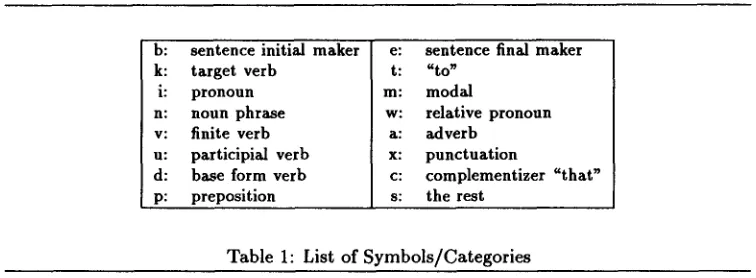
(2.1) Tokenize each sentence containing the target verb in the following way: All the noun phrases except pronouns are tokenized as "n" by a noun phrase parser and all the rest of the words are also tokenized following the schmema in Table 1. For example, the sentence "The corresponding mental-state verbs do not follow [target verb] these rules in a straightforward way" is transformed to a sequence of tokens "bnvaknpne'.
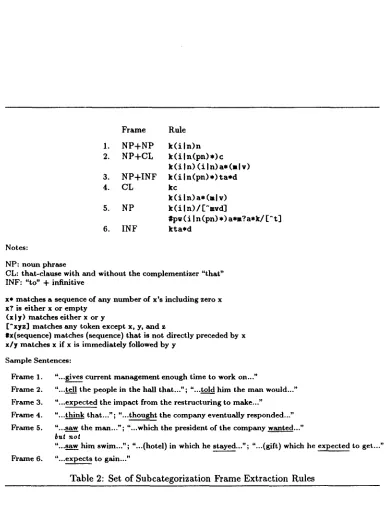
(2.2) Apply a set of subcat extraction rules to the tokenized sentences. These rules are written as regular expressions and they are obtained through the examina- tion of occurrences of a small sample of verbs in a training text.
Note that in the actual implementation of the procedure, all of the redundant oper- ations are eliminated. Our NP parser also uses a finite-state g r a m m a r . It is designed
b: sentence initial maker k: target verb
i: p r o n o u n n: n o u n phrase v: finite verb u: participial verb d: base form verb p: preposition
e: sentence final maker t: "to"
m : m o d a l
w : r e l a t i v e p r o n o u n a: adverb
x: p u n c t u a t i o n
c: complementizer "that" s: t h e r e s t
Table 1: List of Symbols/Categories
especially to support identification of verb-subcat frames. One of its special features is that it detects time-adjuncts such as "yesterday", "two months ago", or "the following day", and eliminates them in the tokenization process. For example, the sentence "He told the reporters the following day that..." is tokenized to "bivnc..." instead of "bivnnc...".
3
E x p e r i m e n t o n W a l l S t r e e t J o u r n a l C o r p u s
We used the above method in experiments involving a tagged corpus of Wall Street Journal (WSJ) articles, provided by the Penn Treebank project. Our experiment was limited in two senses. First, we treated all prepositional phrases as adjuncts. (It is generally difficult to distinguish complement and adjunct PPs.) Second, we measured the frequencies of only six fixed subcat frames for verbs in non-participle form. (This does not represent an essential shortcoming in the method; we only need to have additional subcat frame extraction rules to accommodate participles.)
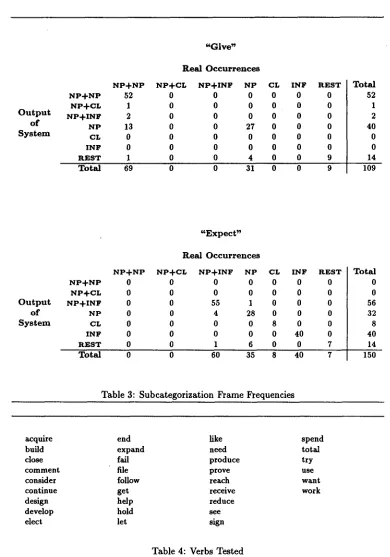
We extracted two sets of tagged sentences from the WSJ corpus, each representing 3- MBytes and approximately 300,000 words of text. One set was used as a training corpus, the other as a test corpus. Table 2 gives the list of verb-subcat frame extraction rules obtained (via examination) for four verbs "expect", "reflect", "tell", and "give", as they occurred in the training corpus. Sample sentences that can be captured by each set of rules are attached to the list. Table 3 shows the result of the hand comparison of the automat!cally identified verb-subcat frames for "give" and "expect" in the test corpus. The tabular columns give actual frequencies for each verb-subcat frame based on man- ual review and the tabular rowsgive the frequencies as determined automatically by the system. The count of each cell ([i, j]) gives the number of occurrences of the verb that are assigned the i-th subcat frame by the system and assigned the j - t h frame by manual review. The frame/column labeled "REST" represents all other subcat frames, encom- passing such subcat frames as those involving wh-clauses, verb-particle combinations (such as "give up"), and no complements.
Despite the simplicity of the rules, the frequencies for subcat frames determined under automatic processing are very close to the real distributions. Most of the errors are attributable to errors in the noun phrase parser. For example, 10 out of the 13 errors in the [NP,NP+NP] cell under "give" are due to noun phrase parsing errors such as the misidentification of a N - N sequence (e.g., *"give [NP government officials rights] against the press" vs. "give [NP government officials] [NP rights] against the press").
[image:3.612.105.483.93.232.2]Notes:
NP: n o u n p h r a s e
Frame
1. N P + N P
2. NP+CL
3. N P T I N F 4. CL
5. N P
6. INF
R u l e
k ( i l n ) n k ( i l n ( p n ) * ) c k ( i l n ) ( i l n ) a * ( m l v ) k ( i l n ( p n ) * ) t a * d
k ¢
k ( i l n ) a * ( m l v ) k ( i l n ) / [ ' m v d ]
# p w ( i l n ( p n ) * ) a * m ? a * k / [ ' t ] k t a * d
CL: t h a t - c l a u s e w i t h a n d w i t h o u t t h e c o m p l e m e n t i z e r " t h a t " INF: "to" + infinitive
x* m a t c h e s a s e q u e n c e of a n y n u m b e r of x ' s i n c l u d i n g zero x x? is e i t h e r x or e m p t y
[image:4.612.101.488.78.585.2]( x l y ) m a t c h e s e i t h e r x or y
[ ' x y z ] m a t c h e s a n y t o k e n e x c e p t x, y, a n d z
I x ( s e q u e n c e ) m a t c h e s (sequence) t h a t is n o t directly p r e c e d e d by x x / y m a t c h e s x if x is i m m e d i a t e l y followed by y
S a m p l e Sentences:
F r a m e 1. F r a m e 2. F r a m e 3. ~ r a m e 4. F r a m e 5.
F r a m e 6.
"...gives c u r r e n t m a n a g e m e n t e n o u g h t i m e to work on..."
"...tel_.._l t h e people in t h e hall that..." ; "...tol__.d h i m t h e m a n would..." "...expected t h e i m p a c t f r o m t h e r e s t r u c t u r i n g to make..."
" . . . t h l n k t h a t . . . " ; " . . . t h o u g h t t h e c o m p a n y e v e n t u a l l y responded..." "...sa__.E t h e m a n . . . " ; "...which t h e p r e s i d e n t of t h e c o m p a n y wanted..."
but n o t
"...sa__~ h i m swim..."; "...(hotel) in which he stayed..."; "...(gift) which h e e x p e c t e d to get..." "...expects to gain..."
Table 2: Set of Subcategorization Frame Extraction Rules
N P - t - N P N P + C L
Output
N P + I N Fo f N P
S y s t e m CL I N F R E S T T o t a l
" G i v e "
R e a l O c c u r r e n c e s
N P + N P N P + C L N P + I N F N P CL I N F R E S T
52 0 0 0 0 0 0
l 0 0 0 0 0 0
2 0 0 0 0 0 0
13 0 0 27 0 0 0
0 0 0 0 0 0 0
0 0 0 0 0 0 0
1 0 0 4 0 0 9
69 0 0 31 0 0 9
T o t a l 52 1 2 40 0 0 14 109
N P + N P N P + C L O u t p u t N P + I N F
o f N P
S y s t e m CL I N F R E S T T o t a l
" E x p e c t "
R e a l O c c u r r e n c e s
N P + N P N P + C L N P + I N F N P CL I N F R E S T
0 0 0 0 0 0 0
0 0 0 0 0 0 0
0 0 55 1 0 0 0
0 0 4 28 0 0 0
0 0 0 0 8 0 0
0 0 0 0 0 40 0
0 0 1 6 0 0 7
T o t a l 0 0 56 32 8 40 14
0 0 60 35 8 40 7 150
T a b l e 3: S u b c a t e g o r i z a t i o n F r a m e F r e q u e n c i e s
acquire end like
build e x p a n d need
close fail produce
c o m m e n t file prove
consider follow reach
continue get receive
design help reduce
develop hold see
elect let sign
s p e n d t o t a l try use w a n t work
Table 4: Verbs Tested
[image:5.612.95.485.83.640.2]T H I S P A G E I N T E N T I O N A L L Y L E F T B L A N K
N u m b e r o f V e r b s
1 0 - -
6 - -
i
3 - -
< S
I l IV I
5 - 1 0 1 0 - 1 5 1 5 - 2 0 2 0 - 2 5 2 5 - 3 0 3 0 - 3 5 3 4 - - 4 0 4 0 - 4 5
E r r o r Rate (070)
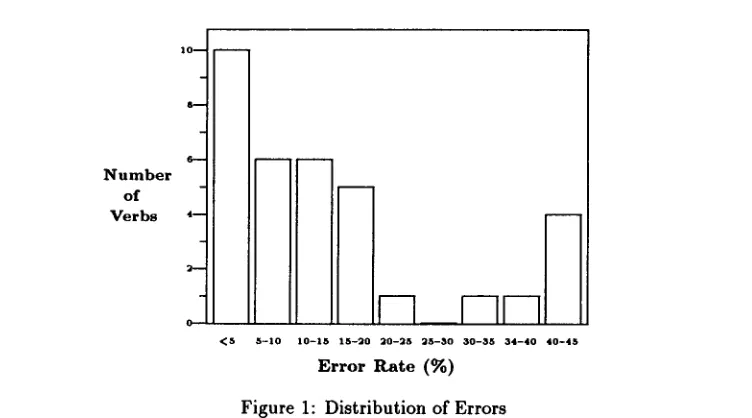
Figure 1: Distribution of Errors
T o measure the total accuracy of the system, we randomly chose 33 verbs from the 300 most frequent verbs in the test corpus (given in Table 4), automatically estimated the subcat frames for each occurrence of these verbs in the test corpus, and compared the results to manually determined subcat frames.
T h e overall results are quite promising. T h e total number of occurrences of the 33 verbs in the test corpus (excluding participle forms) is 2,242. O f these, 1,933 were assigned correct subcat frames by the system. (The 'correct'-assignment counts always appear in the diagonal cells in a comparison table such as in Table 3.) This indicates an overall accuracy for the method of 86%.
If we exclude the subcat frame " R E S T " from our statistics, the total number of oc- currences of the 33 verbs in one of the six subcat frames is 1,565. O f these, 1,311 were assigned correct subcat frames by the system. This represents 8 3 % accuracy.
For 30 of the 33 verbs, both the first and the second (if any) most frequent subcat frames as determined by the system were correct. For all of the verbs except one ("need"), the most frequent frame was correct.
Figure 1 is a histogram showing the number of verbs within each error-rate zone. In computing the error rate, we divide the total 'off-diagonal'-cell counts, excluding the counts in the " R E S T " column, by the total cell counts, again excluding the " R E S T " col- u m n margin. Thus, the off-diagonal cell counts in the " R E S T " row, representing instances where one of the six actual subcat frames was misidentified as "REST", are counted as errors. This formula, in general, gives higher error rates than would result from simply dividing the off-diagonal cell counts by the total cell counts.
Overall, the most frequent source of errors, again, was errors in noun phrase boundary detection. T h e second most frequent source was misidentification of infinitival 'purpose' clauses, as in "he used a crowbar to open the door". "To open the door" is a 'purpose' adjunct modifying either the verb phrase "used a crowbar" or the main clause "he used a crowbar". But such adjuncts are incorrectly judged to be complements of their main verbs
[image:7.612.102.478.104.313.2]by the subcat frame extraction rules in Table 2. In formulating the rules, we assumed that a 'purpose' adjunct appears effectively randomly and much less frequently than infinitival complements. This is true for our corpus in general; but some verbs, such as "use" and "need", appear relatively frequently with 'purpose' infinitivals. In addition to errors from parsing and 'purpose' infinitives, we observed several other, less frequent types of errors. These, too, pattern with specific verbs and do not occur randomly across verbs.
4
Statistical Analysis
For most of the verbs in the experiment, our method provides a good measure of subcat frame frequencies. However, some of the verbs seem to appear in syntactic structures that cannot be captured by our inventory of subcat frames. For example, "need" is frequently used in relative clauses without relative pronouns, as in "the last thing they need". Since this kind of relative clauses cannot be captured by the rules in Table 2, each occurrence of these relative clause causes an error in measurement. It is likely that there are many other classes of verbs with distinctive syntactic preferences. If we try to add rules for each such class, it will become increasingly difficult to write rules that affect only the target class and to eliminate undesirable rule interactions.
In the following sections, we describe a statistical method which, based on a set of training samples, enables the system to learn patterns of errors and substantially increase the accuracy of estimated verb-suhcat frequencies.
4 . 1 G e n e r a l S c h e m e
The method described in Section 2 is wholly deterministic; it depends only on one set of subcat extraction rules which serve as filters. Instead of treating the system output for each verb token as an estimated subcat frame, we can think of the output as one feature associated with the occurrence of the verb. This single feature can be combined, statistically, with other features in the corpus to yield more accurate characterizations of verb contexts and more accurate subcat-frame frequency estimates. If the other fea- tures are capturable via regular-expression rules, they can also be automatically detected in the manner described in the Section 2. For example, main verbs in relative clauses without relative pronouns may have a higher probability of having the feature "nnk", i.e.,
"(NP)(NP)(VERB)".
More formally, let Y be a response variable taking as its value a subeat frame. Let
X1, X2,..., XN
be explanatory variables. Each Xi is associated with a feature expressed by one or a set of regular expressions. If a feature is expressed by one regular expression (R), the value of the feature is 1 if the occurrence of the verb matches R and 0 otherwise. If the feature is expressed by a set of regular expressions, its value is the label of the regular expression that the occurrence of the verb matches. The set of regular expressions in Table 2 can therefore be considered to characterize one explanatory variable whose value ranges from ( N P + N P ) to (REST).Now, we assume that a training corpus is available in which all verb tokens are given along with their subcat frames. By running our system on the training corpus, we can automatically generate a (N + 1)-dimensional contingency table. Table 3 is an example of a 2-dimensional contingency table with X = <OUTPUT OF SYSTEM> and Y = <REAL OCCURRENCES>. Using loglinear models [Agresti, 1990], we can derive fitted values of
each cell in the (N + 1)-dimensional contingency table. In the case of a saturated model, in which all kinds of interaction of variables up to (N + 1)-way interactions are included, the raw cell counts are the Maximum Likelihood solution. The fitted values are then used to estimate the subcat frame frequencies of a new corpus as follows.
First, the system is run on the new corpus to obtain an N-dimensional contingency table. This table is considered to be an X1 - X2 . . . XN-marginal table. What we are aiming at is the Y margins that represent the real subcat frame frequencies of the new corpus. Assuming that the training corpus and the new corpus are homogeneous (e.g., reflecting similar sub-domains or samples of a common domain), we estimate the Y margins using Bayes theorem on the fitted values of the training corpus as follows:
E ( Y = k IX1 - X2 . . . XS~ marginal table of the new corpus)
= ~ . . . Z J ~ , i ~ . . . i N + P ( Y = k l X 1 = i l , X ~ = i 2 , ' " , X N = i N )
il i2 iN
= ~ ' " ~ J V ~ , i , . . . i , ~ + P ( X I = i l ' X 2 = i ~ ' ' ' " X N = i N I Y = k ) P ( Y = k )
il i2 iN
= E Z ,N÷
Ek, J~ili~...iNk'
il 12 iN
where ~ i i l i ~ . . . i . + is the cell count of the X1 - X2 . . . X N marginal table of the new corpus obtained as the system output, and .h411i2...iN~ is the fitted value of the (N + 1)- dimensional contingency table of the training corpus based on a particular loglinear model.
4 . 2 L e x i c a l H e u r i s t i c s
The simplest application of the above method is to use a 2-way contingency table, as in Table 3. There are two possibilities to explore in constructing a 2-way contingency table. One is to sum up the cell counts of all the verbs in the training corpus and produce a single (large) general table. The other is to construct a table for each verb. Obviously the former approach is preferable if it works. Unfortunately, such a table is typically too general to be useful; the estimated frequencies based on it are less accurate than raw system output. This is because the sources of errors, viz., the distribution of off-diagonal cell counts of 2-way contingency tables, differ considerably from verb to verb. The latter approach is problematic if we have to make such a table for each domain. However, if we have a training corpus in one domain, and if the heuristics for each verb extracted from the training corpus are also applicable to other domains, the approach may work.
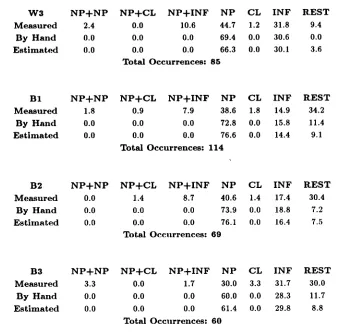
To test the latter possibility, we constructed a contingency table for the verb from the test corpus described in the Section 3 that was most problematic (least accurately estimated) among the 33 verbs--"need". Note that we are using the test corpus described in the Section 3 as a training corpus here, because we already know both the measured frequency and the hand-judged frequency of "need" which are necessary to construct a contingency table. The total occurrence of this verb was 75. To smooth the table, 0.1 is added to all the cell counts. As new test corpora, we extracted another 300,000 words of tagged text from the WSJ corpus (labeled "W3") and also three sets of 300,000 words of tagged text from the Brown corpus (labeled "BI", "B2", and "B3"), as retagged under the
[image:9.612.115.465.219.373.2]W 3 M e a s u r e d
B y H a n d E s t i m a t e d
N P + N P N P + C L N P + I N F N P C L I N F R E S T 2.4 0.0 10.6 44.7 1.2 31.8 9.4 0.0 0.0 0.0 69.4 0.0 30.6 0.0 0.0 0.0 0.0 66.3 0.0 30.1 3.6
T o t ~ O c c u r r e n c e s : 8 5
B1 M e a s u r e d
B y H a n d
E s t i m a t e d
N P + N P N P + C L N P + I N F N P C L I N F R E S T 1.8 0.9 7.9 38.6 1.8 14.9 34.2 0.0 0.0 0.0 72.8 0.0 15.8 11.4 0.0 0.0 0.0 76.6 0.0 14.4 9.1
T o t ~ O c c u r r e n c e s : l l 4
B2 M e a s u r e d
B y H a n d E s t i m a t e d
N P + N P N P + C L N P + I N F N P C L I N F R E S T 0.0 1.4 8.7 40.6 1.4 17.4 30.4 0.0 0.0 0.0 73.9 0.0 18.8 7.2 0.0 0.0 0.0 76.1 0.0 16.4 7.5
T o t a l O c c u r r e n c e s : 6 9
B 3
M e a s u r e d B y H a n d
E s t i m a t e d
N P + N P N P + C L N P + I N F N P C L I N F R E S T 3.3 0.0 1.7 30.0 3.3 31.7 30.0 0.0 0.0 0.0 60.0 0.0 28.3 11.7 0.0 0.0 0.0 61.4 0.0 29.8 8.8
T o t a l O c c u r r e n c e s : 6 0
Table 5: Statistical E s t i m a t i o n ( U n i t = %) for the Verb "Need"
P e n n T r e e b a n k tagset. All the t r a i n i n g a n d test corpora were r e v i e w e d - - a n d j u d g e d - - b y hand.
T a b l e 5 gives the frequency d i s t r i b u t i o n s based on the system o u t p u t , h a n d judge- m e n t , a n d statistical analysis. (As before, we take the h a n d j u d g e m e n t to be the gold s t a n d a r d , the actual frequency of a p a r t i c u l a r frame.) After the Y m a r g i n s are statisti- cally e s t i m a t e d , the least e s t i m a t e d Y values less t h a n 1.0 are t r u n c a t e d to 0. (These are considered to have appeared due to the s m o o t h i n g . )
In all of the test corpora, the m e t h o d gives very accurate frequency d i s t r i b u t i o n es- timates. Big gaps between the a u t o m a t i c a l l y - m e a s u r e d a n d m a n u a l l y - d e t e r m i n e d fre- quencies of "NP" a n d " R E S T " are shown to be s u b s t a n t i a l l y reduced t h r o u g h the use of statistical e s t i m a t i o n . T h i s result is especially encouraging because tile heuristics o b t a i n e d in one d o m a i n are shown to be applicable to a considerably different d o m a i n . Further- more, by c o m b i n i n g more feature sets a n d m a k i n g use of m u l t i - d i m e n s i o n a l analysis, we can expect to o b t a i n more accurate e s t i m a t i o n s .
[image:10.612.118.456.112.444.2]5
C o n c l u s i o n a n d F u t u r e D i r e c t i o n
We have demonstrated that by combining syntactic and statistical analysis, the frequencies of verb-subcat frames can be estimated with high accuracy. Although the present system measures the frequencies of only six subcat frames, the method is general enough to be extended to m a n y more frames. The traditional application of regular expressions as rules for deterministic processing has self-evident limitations since a linear g r a m m a r is not powerful enough to capture general linguistic phenomena. The statistical method we propose uses regular expressions as filters for detecting specific features of the occurrences of verbs and employs multi-dimensional analysis of the features based on loglinear models and Bayes Theorem.
We expect that by identifying other useful syntactic features we can further improve the accuracy of the frequency estimation. Such features can be regarded as characterizing the syntactic context of the verbs, quite broadly. The features need not be linked to a local verb context. For example, a regular expression such as " w [ ' v e x ] * k " can be used to find cases where the target verb is preceded by a relative pronoun such that there is no other finite verb or punctuation or sentence final period between the relative pronoun and the target verb.
If the syntactic structure of a sentence can be predicted using only syntactic and lexical knowledge, we can hope to estimate the subcat frame of each occurrence of a verb using the context expressed by a set of features. We thus can aim to extend and refine this method for use with general probabilistic parsing of unrestricted text.
6
A c k n o w l e d g e m e n t s
We thank Teddy Seidenfeid, Jeremy York, and Alex Franz for their comments and dis- cussions with us. We remain, of course, solely responsible for any errors or inadequacies in the paper.
R e f e r e n c e s
[Agresti, 1990] A. Agresti.
Categorical Data Analysis.
New York, NY: John Wiley and Sons, 1990.[Baker, 1979] J. Baker. "Trainable G r a m m a r s for Speech Recognition". In D.II. Klatt and J.J. Wolf (eds.),
Speech Communication Papers for the 97th Meeting of lhe Acoustic
Society of America,
1979, pp. 547-550.[Brent, 1'991] M.R. Brent. "Automatic Acquisition of Subcategorization Frames from Untagged Text".
Proceedings of the 29th Annual Meeting of the ACL,
1991.[Brent and Berwick, 1991] M.R. Brent and R.C. Berwick. "Automatic Acquisition of Sub- categorization Frames from Tagged Text". In
Proceedings of the DARPA Speech and
Natural Language Workshop,
Morgan Kaufmann, 1991.[Brill, 1992] E. Brill. "A Simple Rule-Based Part of Speech Tagger". In
Proceedings of
the DARPA Speech and Natural Language Workshop,
Morgan Kaufmann, 1992.[Carroll and Charniak, 1992] G. Carroll and E. Charniak. "Learning Probabilistic De-
pendency Grammars from Labelled Text". In
Working Notes of the Symposium on
Probabilistic Approaches to Natural Language,
AAAI Fall Symposium Series, 1992.
[Church, 1988] K.W. Church. "A Stochastic Parts Program and Noun Phrase Parser
for Unrestricted Text". In
Proceedings of the Second Conference on Applied Natural
Language Processing,
1988.
[de Marken, 1992] C.G. de Mareken. "Parsing the LOB Corpus". In
Proceedings of the
gSth Annual Meeting of the ACL,
1990, pp. 243-251.
[Hornby, 1989] A.S. Hornby, (ed.).
Oxford Advanced Learner's Dictionary of Current
English.
Oxford, UK: Oxford University Press, 1989.
[Jelinek
et al.,
1990] F. Jelinek, L.D. Lafferty, and R.L. Mercer.
Basic Method of Proba-
bilistic Context Free Grammars.
Technical Report RC 16374 (72684), IBM, Yorktown
Heights, NY 10598, 1990.
[Lauri and Young, 1990] K. Lari and S.J. Young. "The Estimation of Stochastic Context-
Free Grammars Using the Inside-Outside Algorithm".
Computer Speech and Language,
4, 1990, pp. 35-56.