Natural Language Inference from Multiple Premises
Alice Lai1 Yonatan Bisk2 Julia Hockenmaier1
1Department of Computer Science, University of Illinois at Urbana-Champaign 2Paul G. Allen School of Computer Science & Engineering, Univ. of Washington [email protected],[email protected],[email protected]
Abstract
We define a novel textual entailment task that requires inference over mul-tiple premise sentences. We present a new dataset for this task that mini-mizes trivial lexical inferences, empha-sizes knowledge of everyday events, and presents a more challenging setting for textual entailment. We evaluate several strong neural baselines and analyze how the multiple premise task differs from standard textual entailment.
1 Introduction
Standard textual entailment recognition is con-cerned with deciding whether one statement (the hypothesis) follows from another statement (the premise). However, in some situations, multiple independent descriptions of the same event are available, e.g. multiple news articles describing the same story, social media posts by different people about a single event, or multiple witness reports for a crime. In these cases, we want to use multiple independent reports to infer what really happened.
We therefore introduce a variant of the standard textual entailment task in which the premise text consists of multiple independently written sen-tences, all describing the same scene (see exam-ples in Figure 1). The task is to decide whether the hypothesis sentence 1) can be used to describe the same scene (entailment), 2) cannot be used to describe the same scene (contradiction), or 3) may or may not describe the same scene (neutral). The main challenge is to infer what happened in the scene from the multiple premise statements, in some cases aggregating information across multi-ple sentences into a coherent whole.
Premises:
1. Two girls sitting down and looking at a book.
2. A couple laughs together as they read a book on a train. 3. Two travelers on a train or bus reading a book together. 4. A woman wearing glasses and a brown beanie next to
a girl with long brown hair holding a book.
Hypothesis:
Women smiling. ⇒ENTAILMENT
Premises:
1. Three men are working construction on top of a building. 2. Three male construction workers on a roof working
in the sun.
3. One man is shirtless while the other two men work on construction.
4. Two construction workers working on infrastructure, while one worker takes a break.
Hypothesis:
A man smoking a cigarette. ⇒NEUTRAL Premises:
1. A group of individuals performed in front of a seated crowd.
2. Woman standing in front of group with black folders in hand.
3. A group of women with black binders stand in front of a group of people.
4. A group of people are standing at the front of the room, preparing to sing.
Hypothesis:
A group having a meeting. ⇒CONTRADICTION Figure 1: The Multiple Premise Entailment Task
Similar to the SICK and SNLI datasets (Marelli et al., 2014;Bowman et al.,2015), each premise sentence in our data is a single sentence describ-ing everyday events, rather than news paragraphs as in the RTE datasets (Dagan et al.,2006), which require named entity recognition and coreference resolution. Instead of soliciting humans to write new hypotheses, as SNLI did, we use simplified versions of existing image captions, and use a word overlap filter and the structure of the deno-tation graph of Young et al. (2014) to minimize the presence of trivial lexical relationships. 2 Related Standard Entailment Tasks In the following datasets, premises are single sen-tences drawn from image or video caption data
that describe concrete, everyday activities. The SICK dataset (Marelli et al., 2014) con-sists of 10K sentence pairs. The premise sentences come from the FLICKR8K image caption corpus
(Rashtchian et al.,2010) and the MSR Video Para-phrase Corpus (Agirre et al.,2012), while the hy-potheses were automatically generated. This pro-cess introduced some errors (e.g. “A motorcycle is riding standing up on the seat of the vehicle”) and an uneven distribution of phenomena across en-tailment classes that is easy to exploit (e.g. nega-tion (Lai and Hockenmaier,2014)).
The SNLI dataset (Bowman et al., 2015) con-tains over 570K sentence pairs. The premises come from the FLICKR30K image caption corpus
(Young et al., 2014) and VisualGenome (Krishna et al.,2016). The hypotheses were written by Me-chanical Turk workers who were given the premise and asked to write one definitely true sentence, one possibly true sentence, and one definitely false sentence. The task design prompted work-ers to write hypotheses that frequently parallel the premise in structure and vocabulary, and therefore the semantic relationships between premise and hypothesis are often limited to synonym/hyponym lexical substitution, replacement of short phrases, or exact word matching.
3 The Multiple Premise Entailment Task In this paper, we propose a variant of entail-ment where each hypothesis sentence is paired with an unordered set of independently written premise sentences that describe the same event. The premises may contain overlapping infortion, but are typically not paraphrases. The ma-jority of our dataset requires consideration of mul-tiple premises, including aggregation of informa-tion from multiple sentences.
This Multiple Premise Entailment (MPE) task is inspired by the Approximate Textual Entailment (ATE) task ofYoung et al.(2014). Each item in the ATE dataset consists of a premise set of four cap-tions from FLICKR30K, and a short phrase as the
hypothesis. The ATE data was created automati-cally, under the assumption that items are positive (approximately entailing) if the hypothesis comes from the same image as the four premises, and negative otherwise. However, Young et al. found that this assumption was only true for just over half of the positive items. For MPE, we also start with four FLICKR30K captions as the premises and a
related/unrelated sentence as the hypothesis, but we restrict the hypothesis to have low word over-lap with the premises, and we collect human judg-ments to label the items as entailing, contradictory, or neutral.
4 The MPE Dataset
The MPE dataset (Figure1) contains 10,000 items (8,000 training, 1,000 development and 1,000 test), each consisting of four premise sentences (captions from the same FLICKR30K image), one
hypothesis sentence (a simplified FLICKR30K
caption), and one label (entailment, neutral, or contradiction) that indicates the relationship be-tween the set of four premises and the hypothesis. This label is based on a consensus of five crowd-sourced judgments. To analyze the difference be-tween multiple premise and single premise entail-ment (Section5.2), we also collected pair label an-notations for each individual premise-hypothesis pair in the development data. This section de-scribes how we selected the premise and hypoth-esis sentences, and how we labeled the items via crowdsourcing.
4.1 Generating the Items
Hypothesis simplification The four premise sentences of each MPE item consist of four orig-inal FLICKR30K captions from the same image.
Since complete captions are too specific and are likely to introduce new details that are not entailed by the premises, the hypotheses sentences are sim-plified versions of FLICKR30K captions. Each
hy-pothesis sentence is either a simplified variant of the fifth caption of the same image as the premises, or a simplified variant of one of the captions of a random, unrelated image.
Our simplification process relies on the denota-tion graph ofYoung et al.(2014), a subsumption hierarchy over phrases, constructed from the cap-tions in FLICKR30K. They define a set of
normal-ization and reduction rules (e.g. lemmatnormal-ization, dropping modifiers and prepositional phrases, re-placing nouns with their hypernyms, extracting noun phrases) to transform the original captions into shorter, more generic phrases that are still true descriptions of the original image.
any of the premises. This ensures that the simpli-fied hypothesis cannot be trivially obtained from a premise via the same automatic simplification pro-cedure. Therefore, we avoid some obvious seman-tic relationships between premises and hypothesis, such as hypernym replacement, dropping modi-fiers or PPs, etc.
Limiting lexical overlap Given the set of sim-plified, restricted hypotheses, we further restrict the pool of potential items to contain only pair-ings where the hypothesis has a word overlap ≤
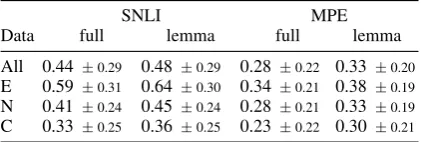
0.5 with the premise set. We compute word over-lap as the fraction of hypothesis tokens that appear in at least one premise (after stopword removal). This eliminates trivial cases of entailment where the hypothesis is simply a subset of the premise text. Table 1 shows that the mean word overlap for our training data is much lower than SNLI.
SNLI MPE
Data full lemma full lemma
All 0.44 ±0.29 0.48±0.29 0.28 ±0.22 0.33±0.20 E 0.59 ±0.31 0.64±0.30 0.34 ±0.21 0.38±0.19 N 0.41 ±0.24 0.45±0.24 0.28 ±0.21 0.33±0.19 C 0.33 ±0.25 0.36±0.25 0.23 ±0.22 0.30±0.21
Table 1: Mean word overlap for full training data and each label, original and lemmatized sentences. MPE has much lower word overlap than SNLI.
Data selection From this constrained pool of premises-hypothesis pairings, we randomly sam-pled 8000 items from the FLICKR30K
train-ing split for our traintrain-ing data. For test and development data, we sample 1000 items from FLICKR30K test and 1000 from dev. The
hy-potheses in the training data must be associated with at least two captions in the FLICKR30K train
split, while the hypotheses in dev/test must be as-sociated with at least two captions in the union of the training and dev/test, and with at least one caption in dev/test alone. Since the test and dev splits of FLICKR30K are smaller than the training
split, this threshold selects hypotheses that are rare enough to be interesting and frequent enough to be reasonable sentences.
4.2 Assigning Entailment Labels
Crowdsourcing procedure For each item, we solicited five responses from Crowdflower and Amazon Mechanical Turk as to whether the hy-pothesis was entailed, contradictory, or neither
given a set of four premises. Instructions are shown in Table2. We provided labeled examples to illustrate the kinds of assumptions we expected. Entailment labels We assume three labels (en-tailment, neutral, contradiction). For en(en-tailment, we deliberately asked annotators to judge whether the hypothesis could very probably describe the same scene as the premises, rather than specifying that the hypothesis mustdefinitelybe true, as Bow-man et al. (2015) did for SNLI. Our instructions align with the standard definition of textual entail-ment: “T entails H if humans reading T would typ-ically infer that H is most likely true” (Dagan et al.,
2013). We are not only interested in what is logi-cally required for a hypothesis to be true, but also in what human readers assume is true, given their own world knowledge.
Final label assignment Of the 10,000 items for which we collected full label annotations, 90% had a majority label based on the five judgments, including 16% with a 3-2 split between entailment and contradiction. The remaining 10% had a 2-2-1 split across the three classes. We manually ad-judicated the latter two cases. As a result, 82% of the final labels in the dataset correspond to a majority vote over the judgments (the remaining 18% differ due to our manual correction). The re-leased dataset contains both our final labels and the crowdsourced judgments for all items.
Image IDs Premises in the our dataset have cor-responding image IDs from FLICKR30K. We are
interested in the information present in linguis-tic descriptions of a scene, so our labels reflect the textual entailment relationship between the premise text and the hypothesis. Future work could apply multi-modal representations to this task, with the caveat that the image would likely resolve many neutral items to either entailment or contradiction.
5 Data Analysis 5.1 Statistics
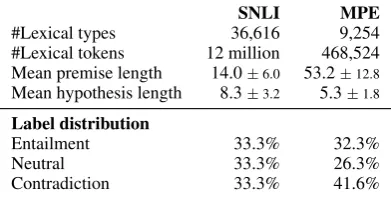
The dataset contains 8000 training items, 1000 de-velopment items, and 1000 test items. Table 3
shows overall type and token counts and sentence lengths as well as the label distribution.
Instructions:
We will show you four caption sentences that describe the same scene, and one proposed sentence. Your task is to decide whether or not the scene described by the four captions can also be described by the proposed sentence.
The four captions were written by four different people. All four people were shown the same image, and then wrote a sentence describing the scene in this image. Therefore, there may be slight disagreements among the captions. The images are photographs from Flickr that show everyday scenes, activities, and events. You will not be given the image that the caption writers saw.
Process:
Read the four caption sentences and then read the proposed sentence. Choose 1 of 3 possible responses to the question
Can the scene described by the four captions also be described by the proposed sentence?
Yes: The scene described by the captions can definitely (or very probably) be described by the proposed sentence. The proposed sentence may leave out details that are mentioned in the captions. If the proposed sentence describes something that is not mentioned in the captions, it is probably safe to assume the extra information is true, given what you know from the captions. If there are disagreements among the captions about the details of the scene, the proposed sentence is consistent with at least one caption.
Unknown: There is not enough information to decide whether or not the scene described by the captions can be described by the proposed sentence. There may be scenes that can be described by the proposed sentence and the captions, but you don’t know whether this is the case here.
No: The scene described by the captions can probably not be described by the proposed sentence. The proposed sentence and the captions either contradict each other or describe what appear to be two completely separate events.
Table 2: The annotation instructions we provided to Crowdflower and Mechanical Turk annotators.
SNLI MPE
#Lexical types 36,616 9,254
#Lexical tokens 12 million 468,524 Mean premise length 14.0±6.0 53.2±12.8 Mean hypothesis length 8.3±3.2 5.3±1.8
Label distribution
Entailment 33.3% 32.3%
Neutral 33.3% 26.3%
Contradiction 33.3% 41.6%
Table 3: Type and token counts, sentence lengths, and label distributions for training data.
class, 0.42 for neutral, and 0.78 for contradiction. That is, on average, four of the five crowdsourced judgments agree with the final label for the entail-ment and contradiction items, whereas for the neu-tral items, only an average of two of the five orig-inal annotators assigned the neutral label, and the other three were split between contradiction and entailment.
5.2 MPE vs. Standard Entailment
Multiple premise entailment (MPE) differs from standard single premise entailment (SPE) in that each premise consists of four independently writ-ten senwrit-tences about the same scene. To understand how MPE differs from SPE, we used crowdsourc-ing to collect pairwise scrowdsourc-ingle-premise entailment labels for each individual premise-hypothesis pair in the development data. Each consensus label is based on three judgments.
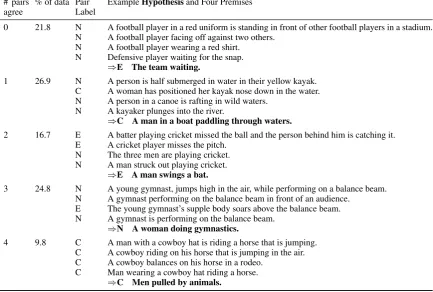
In Table 4, we compare the full MPE entail-ment labels (bold⇒E,⇒N,⇒C), to the four pair
SPE labels (E, N, C). The number of SPE labels that agree with the MPE label yields the five cat-egories in Table4, ranging from the most difficult case where none of the SPE labels agree with the MPE label (21.8% of the data) to the simplest case where all four SPE labels agree with the MPE la-bel (9.8% of the data).
We observe that a simple majority voting scheme over the gold standard SPE labels would not be sufficient, since it assigns the correct MPE label to only 34.6% of the development items (i.e. those cases where three or four SPE pairs agree with the MPE label). We also evaluate a slightly more sophisticated voting scheme that applies the following heuristic (here,E,N,Care the number of SPE labels of each class):
IfE > C, predict entailment. Else ifC > E, predict contradiction. Otherwise, predict neutral.
indi-# pairs
agree % of data PairLabel ExampleHypothesisand Four Premises
0 21.8 N
N N N
A football player in a red uniform is standing in front of other football players in a stadium. A football player facing off against two others.
A football player wearing a red shirt. Defensive player waiting for the snap. ⇒E The team waiting.
1 26.9 N
C N N
A person is half submerged in water in their yellow kayak. A woman has positioned her kayak nose down in the water. A person in a canoe is rafting in wild waters.
A kayaker plunges into the river.
⇒C A man in a boat paddling through waters.
2 16.7 E
E N N
A batter playing cricket missed the ball and the person behind him is catching it. A cricket player misses the pitch.
The three men are playing cricket. A man struck out playing cricket. ⇒E A man swings a bat.
3 24.8 N
N E N
A young gymnast, jumps high in the air, while performing on a balance beam. A gymnast performing on the balance beam in front of an audience.
The young gymnast’s supple body soars above the balance beam. A gymnast is performing on the balance beam.
⇒N A woman doing gymnastics.
4 9.8 C
C C C
A man with a cowboy hat is riding a horse that is jumping. A cowboy riding on his horse that is jumping in the air. A cowboy balances on his horse in a rodeo.
Man wearing a cowboy hat riding a horse. ⇒C Men pulled by animals.
Table 4: MPE examples that illustrate the difference between pair labels and the full label. We include one example for each category, based on the number of pair labels that agree with the full label, and indicate the size of each category as a percentage of the development data.
cates that the team may be waiting. Moreover, the simple majority voting would work on the fourth example but fail on the second example, while the more sophisticated voting scheme would work on the second example and fail on the fourth.
5.3 Semantic Phenomena
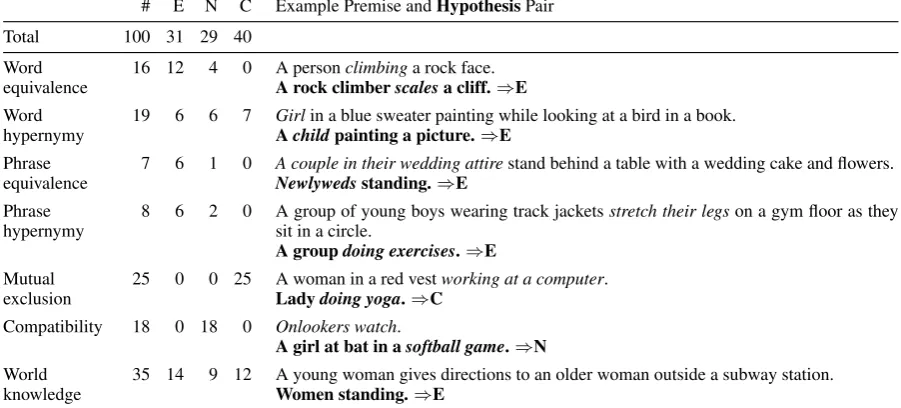
We used a random sample of 100 development items to examine the types of semantic phenom-ena that are useful for inference in this dataset. We categorized each item by type of knowledge or reasoning necessary to predict the correct label for the hypothesis given the premises. An item be-longs to a category if at least one premise in that item exhibits that semantic phenomenon in rela-tion to the hypothesis, and an item may belong to multiple categories. For each category, Table
5 contains its frequency, an illustrative example containing the relevant premise, and the distribu-tion over entailment labels. We did our analysis on full items (four premises and the correspond-ing hypothesis), but the examples in Table5have been simplified to a single premise for simplicity.
Word equivalence Items in this category con-tain a pair of equivalent words (synonyms or para-phrases). The word in the hypothesis can be ex-changed for the word in the premise without sig-nificantly changing the meaning of the hypothesis. Word hypernymy These items involve lexical hypernyms: someone who is a man is also a person (entailment), but a person may or may not be a man (neutral), and somebody who is a man is not a child (contradiction).
Phrase equivalence These items involve equiv-alent phrases, i.e. synonyms or paraphrases. The phrase in the hypothesis can be replaced by the phrase in the premise without significantly chang-ing the meanchang-ing of the hypothesis.
Phrase hypernymy Items in this category in-volve a specific phrase and a general phrase: the more general phrase “doing exercises” can refer to multiple types of exercises in addition to “stretch-ing their legs.”
# E N C Example Premise andHypothesisPair
Total 100 31 29 40
Word
equivalence 16 12 4 0 A personA rock climberclimbingscalesa rock face.a cliff.⇒E
Word
hypernymy 19 6 6 7 GirlAchildin a blue sweater painting while looking at a bird in a book.painting a picture.⇒E
Phrase
equivalence 7 6 1 0 A couple in their wedding attireNewlywedsstanding.⇒E stand behind a table with a wedding cake and flowers.
Phrase
hypernymy 8 6 2 0 A group of young boys wearing track jacketssit in a circle. stretch their legson a gym floor as they
A groupdoing exercises.⇒E
Mutual
exclusion 25 0 0 25 A woman in a red vestLadydoing yoga.⇒Cworking at a computer.
Compatibility 18 0 18 0 Onlookers watch.
A girl at bat in asoftball game.⇒N
World
knowledge 35 14 9 12 A young woman gives directions to an older woman outside a subway station.Women standing.⇒E
Table 5: Analysis of 100 random dev items. For each phenomenon, we show the distribution over labels and an example. The label is indicated with E, N, C. We use color and underlining to indicate the relevant comparisons. The indicated span of text is part of the necessary information to predict the correct label, but may not be sufficient on its own.
actions that are mutually exclusive, i.e. cannot be performed simultaneously by the same agent (“Two doctors perform surgery” vs. “Two sur-geons are having lunch”).
Compatibility The opposite of mutual exclusion is compatibility: two actions that can be performed simultaneously by the same agent (e.g. “A boy flying a red and white kite” vs. “A boy is smiling”).
World knowledge These items require extra-linguistic knowledge about the relative frequency and co-occurrence of events in the world (not over-lapping with the mutual exclusion or compatibility phenomena). A human reader can infer that chil-dren in a potato sack race are having fun (while a marathon runner competing in a race might not be described as having fun).
5.4 Combining Information Across Premises In addition to the semantic phenomena we have just discussed, the data presents the challenge of how to combine information across multiple premises. We examined examples from the de-velopment data to analyze the different types of information aggregation present in our dataset. Coreference resolution This case requires cross-caption coreference resolution of entity mentions from multiple premises and the hy-pothesis. In this example, a human reader can
recognize that “two men” and “two senior citi-zens” refer to the same entities, i.e. the “two older men” in the hypothesis. Given that information, the reader can additionally infer that the two older men on the street are likely to be standing.
1. Two men in tan coats exchange looks on the city sidewalk. 2. Two senior citizens talking on a public street.
3. Two men in brown coats on the street. 4. Two men in beige coats, talking.
Two older men stand. ⇒ENTAILMENT
Event resolution This case requires resolving various event descriptions from multiple premises and the hypothesis. In the following example, a human reader recognizes that the man is sitting on scaffolding so that he can repair the building, and therefore he is doing construction work.
1. A man is sitting on a scaffolding in front a white building. 2. A man is sitting on a platform next to a building ledge. 3. A man looks down from his balcony from a stone building. 4. Repairing the front of an old building.
that “woman” and “young child” (also “person”) refer to the same entity.
1. A person in a green jacket and pants appears to be digging in a wooded field with several cars in the background. 2.A young child in a green jacket rakes leaves. 3. A young child rakes leaves in a wooded area. 4. A woman cleaning up a park.
A woman standing in the forest. ⇒ENTAILMENT Scene resolution These examples require the reader to build a mental representation of the scene from the premises in order to assess the probabil-ity that the hypothesis is true. In the first example, specific descriptions – a jumping horse, a cow-boy balancing, a rodeo – combine to assign a high probability that the specific event described by the hypothesis is true.
1. A man with a cowboy hat is riding a horse that is jumping. 2. A cowboy riding on his horse that is jumping in the air. 3. A cowboy balances on his horse in a rodeo.
4. Man wearing a cowboy hat riding a horse.
An animal bucking a man. ⇒ENTAILMENT In the next example, the hypothesis does not contradict any individual premise sentence. How-ever, a reader who understands the generic scene described knows that the very specific hypothesis description is unlikely to go unmentioned. Shirt-lessness would be a salient detail in the this scene, so the fact that none of the premises mention it means that the hypothesis is likely to be false.
1. A young couple sits in a park eating ice cream as children play and other people enjoy themselves around them. 2. Couple in park eating ice cream cones with three other adults and two children in background.
3. A couple enjoying ice cream outside on a nice day. 4. A couple eats ice cream in the park.
A shirtless man sitting. ⇒CONTRADICTION In the final example, the premises present a somewhat generic description of the scene. While some premises lean towards entailment (a woman and a man indiscussion could be having a work meeting) and others lean towards contradiction (two people conversing outdoors at a restaurant are probably not working), none of them contain over-whelming evidence that the scene entails or con-tradicts the hypothesis. Therefore, the hypothesis is neutral given the premises.
1. A blond woman wearing a gray jacket converses with an older man in a green shirt and glasses while sitting on a restaurant patio.
2. A blond pony-tailed woman and a gray-haired man con-verse while seated at a restaurant’s outdoor area.
3. A woman with blond hair is sitting at a table and talking to a man with glasses.
4. A woman discusses something with an older man at a table outside a restaurant.
A woman doing work. ⇒NEUTRAL
6 Models
We apply several neural models from the entail-ment literature to our data. We also present a model designed to handle multiple premises, as this is unique to our dataset.
LSTM In our experiments, we found that the conditional LSTM (Hochreiter and Schmidhuber,
1997) model ofRockt¨aschel et al. (2016) outper-formed a Siamese LSTM network (e.g. Bow-man et al. (2015)), so we report results using the conditional LSTM. This model consists of two LSTMs that process the hypothesis conditioned on the premise. The first LSTM reads the premise. Its final cell state is used to initialize the cell state of the second LSTM, which reads the hypothesis. The resulting premise vector and hypothesis vec-tor are concatenated and passed through a hidden layer and a softmax prediction layer. When han-dling four MPE premise sentences, we concate-nate them into a single sequence (in the order of the caption IDs) that we pass to the first LSTM. When we only have a single premise sentence, we simply pass it to the first LSTM.
Word-to-word attention Neural attention mod-els have shown a lot of success on SNLI. We evaluate the word-to-word attention model of
Rockt¨aschel et al. (2016).1 This model learns a
soft alignment of words in the premise and hy-pothesis. One LSTM reads the premise and pro-duces an output vector after each word. A second LSTM, initialized by the final cell state of the first, reads the hypothesis one word at a time. For each wordwtin the hypothesis, the model produces
at-tention weights αt over the premise output
vec-tors. The final sentence pair representation is a nonlinear combination of the attention-weighted representation of the premise and the final out-put vector from the hypothesis LSTM. This final sentence pair representation is passed through a softmax layer to compute the cross-entropy loss. Again, when training on MPE, we concatenate the premise sentences into a single sequence as input to the premise LSTM.
Premise-wise sum of experts (SE) The previ-ous models all assume that the premise is a single sentence, so in order to apply them naively to our dataset, we have to concatenate the four premises.
Training Class LSTM SE Attention
SNLI only 52.6 55.9 55.0
E 85.8 71.5 81.7
N 8.4 21.6 16.4
C 55.7 62.0 54.5
MPE only 53.5 56.3 53.9
E 63.1 61.3 48.3
N 39.2 30.2 30.6
C 53.5 66.5 71.2
SNLI+MPE 60.4 60.0 64.0
E 65.1 65.4 75.9
N 40.9 42.7 32.8
C 67.2 65.1 71.5
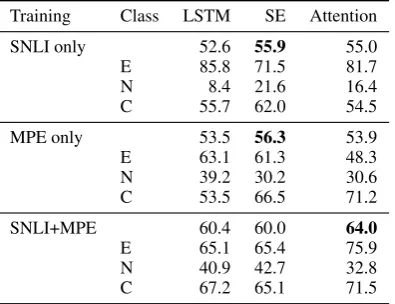
Table 6: Entailment accuracy on MPE (test). SE is best when training only on SNLI or MPE. Atten-tion is best when training on SNLI+MPE.
To capture what distinguishes our task from stan-dard entailment, we also consider a premise-wise sum of experts (SE) model that makes four in-dependent decisions for each premise paired with the hypothesis. This model can adjust how it pro-cesses each premise based on the relative predic-tions of the other premises.
We apply the conditional LSTM repeatedly to read each premise and the hypothesis, producing four premise vectorsp1... p4 and four hypothesis
vectors h1 ... h4 (conditioned on each premise).
Each premise vector pi is concatenated with its
hypothesis vector hi and passed through a
feed-forward layer to produce logit predictionli. We
sum l1 ... l4 to obtain the final prediction, which
we use to compute the cross-entropy loss.
When training on SNLI, we apply the condi-tional LSTM only once to read the premise and hypothesis and produce p1 and h1. We pass the
concatenation of p1 and h1 through the
feedfor-ward layer to producel1, which we use to compute
the cross-entropy loss.
7 Training Details
For the LSTM and SE models, we use 300d GloVe vectors (Pennington et al.,2014) trained on 840B tokens as the input. The attention model uses word2vec vectors (Mikolov et al., 2013) (replac-ing with GloVe had almost no effect on perfor-mance). We use the Adam optimizer (Kingma and Ba,2014) with the default configuration. We train each model for 10 epochs based on convergence on dev. For joint SNLI+MPE training, we use the same parameters and pretrain for 10 epochs on SNLI, then train for 10 epochs on MPE. This was
the best joint training approach we found.
When training on SNLI, we use the best pa-rameters reported for the word-to-word attention model.2 When training on MPE only, we set
dropout, learning rate, and LSTM dimensionality as the result of a grid search on dev.3
8 Experimental Results 8.1 Overall Performance
Table 6 contains the test accuracies of the mod-els from Section6: LSTM, sum of experts (SE), and word-to-word attention under three training regimes: SNLI only, MPE only, and SNLI+MPE.
We train only on SNLI to see whether mod-els can generalize from one entailment task to the other. Interestingly, the attention model’s ac-curacy on MPE is higher after training only on SNLI than training on MPE, perhaps because it requires much more data to learn reasonable at-tention weighting parameters.
When training on SNLI or MPE alone, the best model is SE, the only model that handles the four premises. It is not surprising that the LSTM model performs poorly, as it is forced to reduce a very long sequence of words to a single vector. The LSTM performs on par with SE when training on SNLI+MPE, but our analysis (Section5.3) shows that their errors are quite different.
The attention model trained on SNLI+MPE has the highest accuracy overall. We reason that pre-training on SNLI is necessary to learn reason-able parameters for the attention weights before training on MPE, a smaller dataset where word-to-word inferences may be less obvious. When trained only on MPE, the attention model per-forms much worse than SE, with particularly low accuracy on entailing items.
We implemented a model that adds attention to the SE model, but it overfit on SNLI and could not match other models’ accuracy, reaching only about 58% on dev compared to 59-63%. Future work will investigate other approaches to combin-ing the benefits of the SE and attention models. 8.2 Performance by Pair Agreement
To get a better understanding of how our task dif-fers from standard entailment, we analyze how
2Dropout: 0.8, learning rate: 0.001, vector dim: 100, batch size: 32
Accuracy on SPE-MPE agreement subsets
# pairs agree 0 1 2 3 4
% of data 21.8 26.9 16.7 24.8 9.8
LSTM 57.3 57.6 60.5 67.1 63.3
SE 59.6 58.0 63.3 62.9 66.3
Attention 65.6 57.6 62.9 68.3 70.4 Table 7: Accuracy for each model (trained on SNLI+MPE) on the dev data subsets that have 0–4 SPE labels that match the MPE label (Table4).
performance is affected by the number of premises whose SPE label agrees with the MPE label. Ta-ble 7 shows the accuracy of each SNLI+MPE-trained model on the dev data grouped by SPE-MPE label agreement (as in Table4).
The attention model has the highest accuracy on three of five categories, including the most diffi-cult category where none of the SPE labels match the MPE label. SE has the highest accuracy in the remaining two categories. The attention model demonstrates large gains in the easiest categories, perhaps because there is less advantage to aggre-gating individual premise predictions (as SE does) and more cases where attention weighting of in-dividual words is useful. On the other hand, the attention model also does well on the most dif-ficult category, indicating that it may be able to partially aggregate premises by increasing atten-tion weights on phrases from multiple sentences. Attention and SE exhibit complementary strengths that we hope to combine in future work.
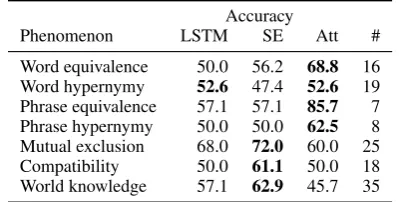
8.3 Performance by Semantic Phenomenon Table 8 shows the performance of the three SNLI+MPE-trained models over semantic phe-nomena, based on the 100 annotated dev items (see Section5.3and Table5). It may not be infor-mative to analyze performance on smaller classes (e.g. phrase equivalence and phrase hypernymy), but we can still look at other noticeable differences between models.
Although the attention model outperformed both LSTM and SE models in overall accuracy, it is not the best in every category. Both SE and attention have access to the same information, but the attention model does better on items that con-tain relationships like hypernyms and synonyms for both words and short phrases. The SE model is best at mutual exclusion, compatibility, and world knowledge categories, e.g. knowing that a man who isrestingis notkayaking, and a brideis not also a cheerleader. In cases that require
analy-Accuracy
Phenomenon LSTM SE Att #
Word equivalence 50.0 56.2 68.8 16 Word hypernymy 52.6 47.4 52.6 19 Phrase equivalence 57.1 57.1 85.7 7 Phrase hypernymy 50.0 50.0 62.5 8 Mutual exclusion 68.0 72.0 60.0 25 Compatibility 50.0 61.1 50.0 18 World knowledge 57.1 62.9 45.7 35
Table 8: Accuracy for each semantic phenomenon on 100 dev items. While attention was the best model overall, it does not have the highest accu-racy for all phenomena.
sis of mutually exclusive or compatible events, a model like SE has an advantage since it can rein-force its weighted combination prediction by ex-amining each premise separately.
9 Conclusion
We presented a novel textual entailment task that involves inference over longer premise texts and aggregation of information from multiple independent premise sentences. This task is an important step towards a system that can create a coherent scene representation from longer texts, such as multiple indepen-dent reports. We introduced a dataset for this task (http://nlp.cs.illinois.edu/ HockenmaierGroup/data.html) which presents a more challenging, realistic entailment problem and cannot be solved by majority voting or related heuristics. We presented the results of several strong neural entailment baselines on this dataset, including one model that aggregates information from the predictions of separate premise sentences. Future work will investigate aggregating information at earlier stages to address the cases that require explicit reasoning about the interaction of multiple premises.
Acknowledgments
References
Eneko Agirre, Mona Diab, Daniel Cer, and Aitor Gonzalez-Agirre. 2012. Semeval-2012 task 6: A pi-lot on semantic textual similarity. InProceedings of the First Joint Conference on Lexical and Computa-tional Semantics-Volume 1: Proceedings of the main conference and the shared task, and Volume 2: Pro-ceedings of the Sixth International Workshop on Se-mantic Evaluation, pages 385–393. Association for Computational Linguistics.
Samuel R. Bowman, Gabor Angeli, Christopher Potts, and Christopher D. Manning. 2015. A large anno-tated corpus for learning natural language inference. In Proceedings of the 2015 Conference on Empiri-cal Methods in Natural Language Processing, pages 632–642.
Ido Dagan, Oren Glickman, and Bernardo Magnini. 2006. The PASCAL recognising textual entail-ment challenge. In Proceedings of the First In-ternational Conference on Machine Learning Chal-lenges: Evaluating Predictive Uncertainty Visual Object Classification, and Recognizing Textual En-tailment, MLCW’05, pages 177–190, Berlin, Hei-delberg. Springer-Verlag.
Ido Dagan, Dan Roth, Mark Sammons, and Fabio Mas-simo Zanzotto. 2013. Recognizing textual entail-ment: Models and applications. Synthesis Lectures on Human Language Technologies, 6(4):1–220. Sepp Hochreiter and J¨urgen Schmidhuber. 1997. Long
short-term memory. Neural Comput., 9(8):1735–
1780.
Diederik P. Kingma and Jimmy Ba. 2014. Adam: A method for stochastic optimization. InInternational Conference on Learning Representations (ICLR). Ranjay Krishna, Yuke Zhu, Oliver Groth, Justin
John-son, Kenji Hata, Joshua Kravitz, Stephanie Chen, Yannis Kalantidis, Li-Jia Li, David A Shamma, Michael Bernstein, and Li Fei-Fei. 2016. Visual genome: Connecting language and vision using
crowdsourced dense image annotations.
Alice Lai and Julia Hockenmaier. 2014. Illinois-LH: A denotational and distributional approach to seman-tics. InProceedings of the 8th International Work-shop on Semantic Evaluation (SemEval 2014), pages 329–334.
Marco Marelli, Stefano Menini, Marco Baroni, Luisa Bentivogli, Raffaella Bernardi, and Roberto Zam-parelli. 2014. A SICK cure for the evaluation of compositional distributional semantic models. In
Proceedings of the Ninth International Conference on Language Resources and Evaluation (LREC-2014).
Tomas Mikolov, Ilya Sutskever, Kai Chen, Greg S Cor-rado, and Jeff Dean. 2013. Distributed representa-tions of words and phrases and their compositional-ity. InAdvances in neural information processing systems, pages 3111–3119.
Jeffrey Pennington, Richard Socher, and Christo-pher D. Manning. 2014. GloVe: Global vectors for
word representation. InEmpirical Methods in
Nat-ural Language Processing (EMNLP), pages 1532– 1543.
Cyrus Rashtchian, Peter Young, Micah Hodosh, and Julia Hockenmaier. 2010. Collecting image annota-tions using Amazon’s Mechanical Turk. In Proceed-ings of the NAACL HLT 2010 Workshop on Creating Speech and Language Data with Amazon’s Mechan-ical Turk, pages 139–147. Association for Computa-tional Linguistics.
Tim Rockt¨aschel, Edward Grefenstette, Karl Moritz Hermann, Tomas Kocisky, and Phil Blunsom. 2016. Reasoning about entailment with neural attention. InInternational Conference on Learning Represen-tations (ICLR).
Peter Young, Alice Lai, Micah Hodosh, and Julia Hockenmaier. 2014. From image descriptions to
vi-sual denotations. Transactions of the Association