
Brain Computer interfacing using ‘teleKr’ for
Adaptive Desktop Environment (ADE)
Sandra A R1, Reshma Varghese K2, Sreelakshmi Nandakumar3
B.Tech, Dept. of CSE, Sahrdaya College of Engineering & Technology, Kodakara, Kerala, India1,2,3
ABSTRACT: The Brain Computer Interface (BCI), also called as Mind Machine Interface (MMI), or in other cases
called as Brain Machine Interface (BMI), is a direct communication link or a communication pathway between the human brain and an external device. In case of the BCI system, user’s communication channels do not rely on peripheral nerves and muscles. Brain computer interface (BCI) systems offer communication and control capabilities to people with severe disabilities. BCI’s use electroencephalographic (EEG) signals recorded from scalp to control computer cursor movement, select letters or icons on the screen, etc.; but there exist other invasive methods too to record the brain’s activity. One example of BCI application is the EEG-based brain-controlled mobile robots that can serve as powerful aids for severely disabled people, especially people with “locked in” syndrome in their daily life, to help them move voluntarily and communicate with the external world.
KEYWORDS: Brain Computer Interfaces, BCI survey, Electroencephalography, Computer displays, BCI general
description, Reliability, Accuracy.
I. INTRODUCTION
At the first international meeting on Brain-Computer Interface (BCI) technology in 1999, BCI was defined as an input mechanism that “must not depend on the brain’s normal output pathways of peripheral nerves and muscles” [1]; commands are acquired directly from the user’s brain, so this input modality works even for people who are severely paralysed and would otherwise be unable to communicate or interact with the outside world [2]. Brain activity can be acquired invasively through surgical implants, or noninvasively through a variety of methods. For a more comprehensive explanation of the principles of BCI systems, see [3].
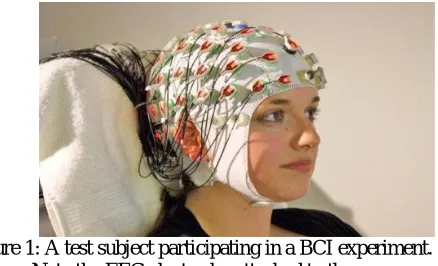
Early research into BCI technology has focused primarily on its medical applications [4]. However, relatively recently, the field of BCI has developed to the point where applications for healthy users are starting to enter the realm of possibility [5]. An example of an area that is showing promise for BCI for healthy users is computer games [6, 7, 8]. Much research has been done and is still being done, and there are many different methods for BCI [9]. In this method, electrodes placed on the scalp pick up the brain’s electrical activity (see figure 1). For this reason, systems using EEG are the focus of this paper.
Figure 1: A test subject participating in a BCI experiment. Note the EEG electrodes attached to the cap.
BCI systems can be subdivided into two categories; those that acquire ‘Endogenous Potentials’ (EnP) and
Transducer’ and ‘Endogenous Transducer’ [9]). The reason for the focus on EnP is that it requires no external stimulus whatsoever; the brain activity that is used in the BCI system is generated internally by the user. This is in contrast to ExP, where control signals are used to generate easy to detect potentials to establish, for instance, which part of a screen the user is looking at. In these situations, the users’ brain activity that is used by the BCI is not internally, but externally induced.. The most commonly used non-invasive method for acquiring signals from the brain, in both research and real-life situations, is Electroencephalography (EEG) [6, 10]. EnP is brain activity generated voluntarily by the user. An example of this that is the often used Imagined Movement (IM) [7, 11]. This modality is distinct from what can be called ‘Exogenous potentials’, or activity induced in the user’s brain by the BCI system specifically to create easily detectable patterns to be used in the BCI application.
The reason for the focus on EnP is that it requires no external stimulus whatsoever; the brain activity that is used in the BCI system is generated internally by the user. This is in contrast to ExP, where control signals are used to generate easy to detect potentials to establish, for instance, which part of a screen the user is looking at. In these situations, the users’ brain activity that is used by the BCI is not internally, but externally induced.
Because the field of BCI is so active, a survey it would be both interesting and useful, especially if specific success factors can be identified. If it is known which approaches are achieving good results, this knowledge can help future researchers in determining their approach.
II. BCISYSTEMBASICPRINCIPLE
A. General description
A BCI uses brain signals to control a device or to adjust the communication between user and a device [12]. Figure 2 shows the basic design and operation mode/concept of BCI. During embryonic development and after that throughout later life, the CNS (Central Nervous System) neurons and synapses continually change to acquire new behaviors and to maintain the already acquired ones. Such CNS plasticity underlies acquisition of standard skills such as locomotion andspeech and more specialized skills as well, and it responds to and is guided by the results achieved [12].
Figure 2: The BCI system-basic concept
The BCI translates this features recorded from the scalp or from the cortex into commands that will operate a
brain signals for BCI. They can be divided in two categories: 1) noninvasive record methods; 2) invasive record methods. The noninvasive recording methods include: recording of electrical or magnetic fields (like electroencephalography [EEG], magnetoencephalography [MEG]), functional magnetic resonance imaging [fMRI] [18], positron emission tomography [PET], infrared [IR] imaging, near-infrared spectroscopy [NIRS], fetal magnetoencephalography [fMEG], single photon emission computed tomography [SPECT] [13]
Other BCI researchers have used invasive record methods: electrocorticography [ECoG] or microelectrode arrays [MEAs] [13]. A typical example of EEG based BCI is the robotic wheelchair, where a desired location is selected from a list of predefined locations using a P300 BCI, and then the autonomous system will drive the wheelchair to the desired location, in a known environment, but the user is able to stop the wheelchair at any time [20].
B. Signal Acquisition:
EEG signals can be collected with electrodes placed on the scalps surface. The most widely used electrodes
are silver/silver chloride (Ag/AgCl) because their low cost, low contact impedance, and relatively good stability. Using Ag/AgCl electrodes requires removing outer skin layer and filling gel between electrodes and scalp (that is why this kind of electrodes are called “wet” electrodes). These operations take long time and are uncomfortable to users. Some researchers have been exploring “dry” electrodes, which do not need to use gel and skin cleaning. The main disadvantage of existing dry electrodes is that the acquired EEG signals are worse than those acquired with conventional electrodes due to the increase of contact impedance [15].
C. Signal processing:
The acquired signals are first preprocessed in order to remove artifacts such as power line noise, electrocardiogram (ECG), electrooculogram (EOG), electromyogram (EMG), etc. and any body movement. Features are then extracted from the preprocessed signals. Finally, the classifier translates these extracted features into commands that subjects desire to output [15]. A BCI records brain signals and processes this signals to produce device commands. This signal processing has two stages: The first stage is feature extraction, (calculation of the values of specific features of the signals). The feature extraction stage must focus on features that encode the user’s intent, and extract those features as accurately as possible. The second stage is the translation algorithm: features are translated into device commands.
III. APPLICATIONS
In the beginning BCI technology was developed as a communication device for the “locked-in” users, but the range of research has increased to include non-medical applications too; today even first commercial products are available for home users. As a result, new disciplines enter the BCI community, and new researches are introduced. It is important to mention that a good performance of a BCI system for healthy participants does not necessarily mean good performance for the disabled population.
A. Device control
One of the most important desire in developing BCI’s was to give users, who lost full control of their limbs, access to devices and communication with the other people. Users can already benefit from BCI devices, like mentioned above, even if it has limited speed, accuracy and efficiency yet. For healthy users a BCI nowadays cannot act as a competitive source of control signals due to its limitation in bandwidth and accuracy compared to the standard muscular control. Healthy users could also benefit from either additional control channels or hands free control offered by BCI [17]. Assistive robots can provide support for disabled people in daily and professional life, thus creating a growing demand for them [21]. Some other special interfaces like sip-and-puff systems, single switches, and eye-tracking systems have been proposed. However, these interfaces do not work for some severely disabled people with illnesses such as the amyotrophic lateral sclerosis (ALS), multiple sclerosis (MS), or strokes. As a result, even autonomous robots are not yet able to transport severely disabled users to desired locations.
B. Communication
People with amyotrophic lateral sclerosis (ALS), multiple sclerosis (MS), or stroke need to communicate their
controlling a cursor on the screen, selecting letters from a virtual keyboard, browsing internet, etc. A communication example is the example of the event-related potential (ERP)-based brain computer interfacing (BCI), which is an effective basic communication method; but collecting all the calibration data for the experiment, and the classifier trainings - all this detracts from the amount of time allocated for real online communication. If the calibration time can be reduced, there will remain more time for additional online use, potentially lower fatigue, and even improved performance [22].
C. User state monitoring
User-machine interfaces in the future will need to understand user’s current state and user’s intentions or commands. These future implementations will require systems to gather and interpret information on mental states such as emotions, attention, workload stress, and even mistakes [12]
D. Training and education
A lot of aspects of training are related to the brain and its plasticity. Measuring this plasticity and the afferent changes in the brain can help to improve training methods in general. Indicators like learning state and rate of progress are useful for automated training systems and virtual instructors. Currently, this application area is in a theoretical phase with limited experimental evidence [12].
E. Gaming and entertainment
The entertainment industry is very often the front runner in introducing new concepts - among others in human-computer interaction for consumers. In the last few years new games have been developed that are exclusively for use with an EEG headset by companies like Neurosky, Emotiv, Uncle Milton, Mind Games, Mattel, Microsoft, Hitachi, Sega Toys, IBM, etc. [12]
F. Safety and security
EEG alone or combined EEG could realize the support of the detection of abnormal behaviour and suspicious
objects. An observer or multiple observers are watching CCTV and using EEG with eye movements together might help to identify potential targets that otherwise may not be noticed consciously [12].
IV. CONCLUSION
Brain-computer interface (BCI) is a cornerstone research is only beginning to crack the electrical information encoding the information in a human subject’s thought. It is especially appealing to severely paralysed patients, since motor ability is no longer a prerequisite for this communication. It has not only introduced new dimensions in machine control but the researchers round the globe are still exploring the possible uses of such applications. The main motto of analysis of EEG Signal based brain– computer interface (BCI) is to allow an individual with severe motor disabilities to have effective control over devices such as computers, speech synthesizers, assistive appliances and neural prostheses. Such an interface would increase an individual’s independence, leading to an improved quality of life and reduced social costs. Numerous studies haves shown that, using EEG, healthy and motor impaired individuals can control devices without using muscles.
REFERENCES
[1] JR Wolpaw, N Birbaumer, WJ Heetderks, DJ McFarland, PH Peckham, G Schalk, E Donchin, LA Quatrano, CJ Robinson, and TM Vaughan. Brain-computer interface technology: A review of the first international meeting. IEEE Transactions on Rehabilitation Engineering, 8(2):164–173, 2000.
[2] GM Friehs. Brain-machine and brain-computer interfaces. Stroke, 35:2702–2705, Sep 2004.
[3] S Mason and G Birch. A general framework for brain-computer interface design. IEEE Transactions on Neural Systems and Rehabilitation . . . , 11(1):70–85, March 2003.
[4] MA Lebedev and MAL Nicolelis. Brain–machine interfaces: past, present and future. TRENDS in Neurosciences, 29(9):536–546, Jul 2006. [5] T Ebrahimi, J.-M Vesin, and G Garcia. Brain-computer interface in multimedia communication. Signal Processing Magazine, IEEE, 20(1):14–
24, Mar 2003.
[6] A Nijholt. Bci for games: A ’state of the art’ survey. Entertainment Computing-Icec 2008: 7th International Conference, Pittsburgh, Pa, USA, September 25-27, 2008, Proceedings, pages 225–228, 2008.
[7] A Lecuyer, F Lotte, RB Reilly, R Leeb, M Hirose, and ´ M Slater. Brain-computer interfaces, virtual reality, and videogames. IEEE Computer, 41(10):66–72, 2008.
[8] SH Fairclough. Bci and physiological computing for computer games: Differences, similarities & intuitive control. CHI 2008, Apr 2008. [9] SG Mason, A Bashashati, M Fatourechi, KF Navarro, and GE Birch. A comprehensive survey of brain interface technology designs. Ann
[10] E Niedermeyer and F Da Silva. Electroencephalography: basic principles, clinical applications, and related fields. books.google.com, page140,Jan2004.
[11] B Blankertz, G Curio, and KR Muller. Classifying single trial eeg: Towards brain computer interfacing. Advances in Neural Information Processing Systems, 1:157–164, 2002
[12] R. Pavitrakar, “Survey of Brain Computer Interaction”, in International Journal of Advanced Research in Electrical, Electronics and Instrumentation Engineering, Vol. 2, Issue 4, April 2013.
[13] H. J. Hwang, S. Kim, S. Choi, C. H. Im, “EEG-Based BrainComputer Interfaces: A Thorough Literature Survey”, Intl. Journal of Human– Computer Interaction, 2013, pp. 814–826.
[14] ] B. Grainman, B. Allison, G. Pfurtscheller, “Brain computer interfaces”, The Frontiers Collection, Springer, 2010, pp. 31.
[15] L. Bi, X. A. Fan, Y. Liu, “EEG-Based Brain-Controlled Mobile Robots: A Survey,” IEEE Transaction on human-machine systems, vol. 43, no. 2, March 2013, pp. 161.
[16] Vashisht, Dr. T. V. Prasad, Dr. S. V. A. V. Prasad, “Technology boon: EEG based brain computer interface - a survey,” International Journal of Computer Science and Mobile Computing, IJCSMC, Vol. 2, Issue. 4, April 2013, pp. 447 – 454
[17] Nijholt, et. al. “Brain–computer interfacing for intelligent systems,” IEEE Intell. Syst., vol. 23, no. 3, May/Jun. 2008, pp. 72– 79.
[18] N. Weiskopf, et. al. “Principles of a brain–computer interface (BCI) based on real-time functionalmagnetic resonance imaging (fMRI),” IEEE Trans. Biomed. Eng., vol. 51, no. 6, June 2004, pp. 966–970.
[19] G. Pfurtscheller and F. H. Lopes da Silva, “Event-related EEG/MEG synchronization and desynchronization: Basic principles,” Clin. Neurophysiol., vol. 110, no. 11, Nov. 1999, pp. 1842–1857.
[20] X. Perrin, R. Chavarriaga, F. Colas, R. Siegwart, and J. d. R. Mill´an, “Brain-coupled interaction for semi-autonomous navigation of an assistive robot,” Robot. Autonom. Syst., vol. 58, no. 12, 2010, pp. 1246–1255.
[21] Ferreira, R. L. Silva, W. C. Celeste, T. F. Bastos, and M. S. Filho, “Human–machine interface based on muscular and brain signals applied to a robotic wheelchair,” J. Phys.: Conf. Ser., vol. 90, no. 1, 2007, pp. 1–8.
![Figure 2 shows the basic design and operation mode/concept of BCI. During embryonic development and after that A BCI uses brain signals to control a device or to adjust the communication between user and a device [12]](https://thumb-us.123doks.com/thumbv2/123dok_us/1627865.1202744/2.595.185.445.465.633/figure-operation-concept-embryonic-development-signals-control-communication.webp)
