©
DOI: 10.1534/genetics.104.037077
Effects of Natural Selection on Interpopulation Divergence at
Polymorphic Sites in Human Protein-Coding Loci
Austin L. Hughes,*
,1Bernice Packer,
†,‡Robert Welch,
†,‡Andrew W. Bergen,
‡Stephen J. Chanock
‡,§and Meredith Yeager
†,‡*Department of Biological Sciences, University of South Carolina, Columbia, South Carolina 29208,†Intramural Research Support Program, SAIC-Frederick, NCI-FCRDC, Frederick, Maryland 21702,‡Core Genotyping Facility, Division of Cancer Epidemiology
and Genetics, National Cancer Institute, National Institutes of Health, Bethesda, Maryland 20892-4605 and §Section on Genomic Variation, Pediatric Oncology Branch, National Cancer Institute,
National Institutes of Health, Gaithersburg, Maryland 20892-4605 Manuscript received October 1, 2004
Accepted for publication January 3, 2005
ABSTRACT
To develop new strategies for searching for genetic associations with complex human diseases, we analyzed 2784 single-nucleotide polymorphisms (SNPs) in 396 protein-coding genes involved in biological processes relevant to cancer and other complex diseases, with respect to gene diversity within samples of individuals representing the three major historic human populations (African, European, and Asian) and with respect to interpopulation genetic distance. Reduced levels of both intrapopulation gene diversity and interpopula-tion genetic distance were seen in the case of SNPs located within the 5⬘-UTR and at nonsynonymous SNPs, causing radical changes to protein structure. Reduction of gene diversity at SNP loci in these categories was evidence of purifying selection acting at these sites, which in turn causes a reduction in interpopulation divergence. By contrast, a small number of SNP sites in these categories revealed unusually high genetic distances between the two most diverged populations (African and Asian); these loci may have historically been subject to divergent selection pressures.
I
N the human genome, a large number of single-nucleo- protein structure by causing changes to functionally tide polymorphisms (SNPs) are believed to be in important amino acid residues or on gene expression protein-coding genes (estimated to be between 50,000 by altering regulation (Kimura and Ohta 1974; Neiand 250,000) (Brookes 1999;Grayet al.2000;Risch 1987). Estimation of gene diversity (heterozygosity) at 2000;Schorket al.2000;Chanock2001;Lohnmueller 1442 SNP sites in an ethnically diverse sample of humans
et al. 2003). Such SNPs seem a promising source of revealed consistently reduced gene diversities at sites candidate genes for understanding the genetic contribu- where SNPs caused amino acid changes, particularly those tion to complex diseases such as cancer and heart disease, predicted to be disruptive to protein structure (Hughes
especially when the protein is known to play a role in et al.2003). Since SNPs are almost always biallelic, a rela-biological processes relevant to the disease of interest. tively low gene diversity at a given SNP site (i.e., the site Because ⬎7 million SNPs have been reported in the at which the polymorphism occurs, which may also be public database (dbSNP, build 120), it is desirable to referred to as a “SNP locus”; seeHugheset al.2003) is develop methods of sifting through this information to equivalent to a low allelic frequency of the less common find likely candidates for disease association (Sunyaev of the two alleles. The reduction of gene diversity at these
et al.2001;WangandMoult2001;NgandHenikoff SNP sites, in comparison to SNPs in the same genes not
2002;Ramenskyet al.2002;BotsteinandRisch2003; affecting protein structure, is evidence that purifying
Fleming et al. 2003; Freudenberg-Hua et al. 2003; selection has reduced the population allelic
frequen-Hugheset al.2003;Stitzelet al.2003). cies of deleterious SNP alleles. This in turn suggests Evidence of the action of purifying selection at a given that slightly deleterious mutations are widespread in locus is evidence that a deleterious allele is present (Zhao the human population and that examination of the
pat-et al.2003). Purifying selection is the form of natural terns of SNP diversity across protein-coding loci can help selection that acts to eliminate selectively deleterious guide the search for disease-associated SNPs (Hughes mutations. For example, purifying selection is expected et al.2003).
to act against mutations that have deleterious effects on In addition to its effects on allelic frequencies within
populations, natural selection is expected to affect the extent of divergence in gene frequency between
popula-1Corresponding author:Department of Biological Sciences, University
tions. Therefore, when samples are derived from
histori-of South Carolina, Coker Life Sciences Bldg., 700 Sumter St.,
Colum-bia, SC 29208. E-mail: [email protected] cally distinct subpopulations, examination of the pattern
TABLE 1 of interpopulation divergence at SNP sites potentially
pro-vides a novel source of information about past natural Average genetic distance (D
A⫾SE) between human
selection that can be useful in guiding the search for populations based on 2784 SNP loci
candidate loci in disease-association studies. Furthermore,
interpopulation divergence may provide evidence not European Asian
only of purifying selection but also of positive selection
African 0.0286⫾0.0008 0.0314⫾0.0009
leading to allele frequency divergence between popula- European 0.0182⫾0.0006
tions.
To exploit information on interpopulation diver-gence as a source of information regarding natural
se-SNPs were classified with respect to their location and effect
lection at SNP sites, we performed a comparison
be-on protein functibe-on as follows: (1) SNPs located in the 5⬘
-tween human populations of allelic frequencies at 2784 noncoding region outside the 5⬘-UTR, (2) SNPs located in SNPs from 396 protein-coding loci. These loci were cho- the 5⬘-UTR, (3) SNPs in the 3⬘-noncoding region outside the sen because they are involved in fundamental biological 3⬘-UTR, (4) SNPS in the 3⬘-UTR, (5) SNPs in introns, (6) synonymous SNPs in exons, (7) nonsynonymous SNPs in exons
processes (including development, the cell cycle, and
causing a conservative amino acid change, and (8)
nonsynony-immunity) believed to be relevant to cancer and other
mous SNPs in exons causing a radical change. Radical
nonsyn-complex human diseases (Packeret al.2004). The SNPs onymous changes included a small number of cases (N⫽5) were restricted to known genes and heavily biased to- where a SNP introduced a stop codon and a larger number of ward exons, intron-exon borders, and regulatory re- cases causing an amino acid replacement involved two amino acids with a pairwise stereochemical difference⬎3.0 according
gions within 5 kb of the start or end of the open reading
toMiyataet al.’s (1979) scale (based on amino acid residue
frames. Because of the availability of a greater number
volume and polarity). Otherwise, missense SNPs were
catego-of SNPs in the 5⬘-untranslated region (UTR) of genes rized as conservative.Miyataet al.’s (1979) is one of many than in our previous sample (Hugheset al. 2003), we scales that measure chemical distance between amino acids, were able to test for purifying selection on these sites, all of which are significantly correlated with one another. Use of other scales in preliminary analyses yielded similar results
some of which may be expected to be subject to
func-to those usingMiyataet al.’s (1979) scale. Previous analyses
tional constraint due to their role in the regulation of
of gene diversity at a smaller number of SNP sites from the
gene expression. same population showed a similar pattern in the case of
non-sense SNPs and radical nonsynonymous SNPs (Hugheset al. 2003); therefore, the two were combined in a single category
MATERIALS AND METHODS in the present analyses.
Samples:Allele frequency data for 2784 SNP sites were taken from the SNP500 database (Packeret al.2004). This database
RESULTS is based on bidirectional sequence determination of each SNP
in 102 unrelated individuals from the Coriell Institute for
The average genetic distances between Africans and
Medical Research (Camden, NJ; http://locus.umdnj.edu/
Europeans and between Africans and Asians were
sig-nigms/). On the basis of self-described ethnicity, these
individ-uals were assigned to four populations: 31 non-Hispanic Cau- nificantly greater than that between Europeans and
casians, 24 African/African-Americans, 24 of Pacific Rim heri- Asians (paired t-test;P ⬍ 0.001), as is expected given tage, and 23 Hispanic. Because the “Hispanic” classification the African origin of modern humans (Nei and Liv-does not correspond to a major geographically defined
histori-shits1989;TishkoffandVerrelli2003) (Table 1). The
cal subdivision of the human population, it was not included
average genetic distance between Africans and Asians
in the analyses reported in this article. The other three groups
are referred to in the following as, respectively, European, was significantly greater than that between Africans and
African, and Asian. SNPs for analysis were chosen within or Europeans (pairedt-test;P⫽0.001). Because the Afri-close to genes, and the selection of genes and SNPs for analysis can and Asian populations showed the greatest pairwise was drawn from publicly available databases. For details of
genetic distance, we focused particular attention on the
sequencing methodology seePackeret al.(2004) andHughes
distribution of genetic distances between these
popula-et al.(2003). Allelic frequency data for all SNPs are available
at http://snp500cancer.nci.nih.gov. tions for different functional categories of SNPs. Statistical analyses:Gene diversity (heterozygosity) at a SNP In the African-Asian comparison, striking differences site was estimated by 1⫺兺i⫽1x2i, wherenis the number of were seen among functional SNP categories with respect
alleles and xi is the population frequency of the ith allele
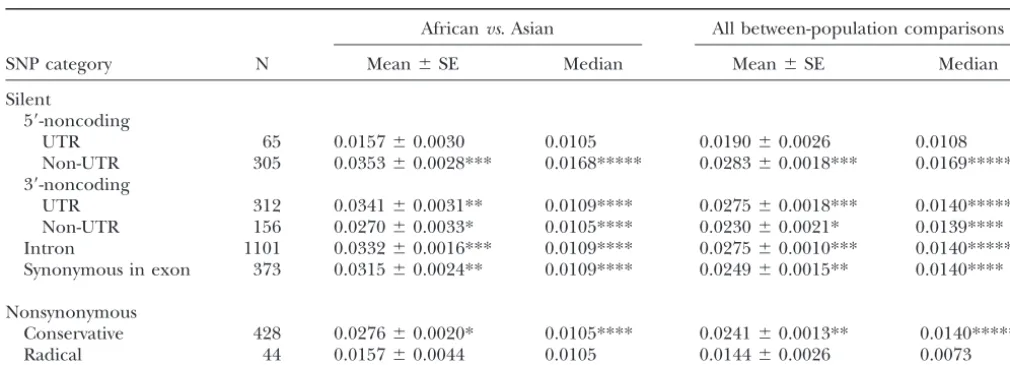
to genetic distance (d) (Table 2). Radical
nonsynony-(Nei1987, p. 177). For a given biallelic SNP site, the allelic
mous SNPs and SNPs in the 5⬘-UTR showed the lowest
frequency divergence between each pair of subpopulations
was computed using the formula meandvalues (Table 2). For every category except SNPs in the 5⬘-UTR, the meandwas significantly higher than
d⫽1⫺[(x1y1)1/2⫹(x2y2)1/2] ,
that for radical nonsynonymous SNPs (Table 2). A
simi-wherex1andy1are the frequencies of the first allele in each lar pattern was seen in the case of nonparametric tests, of the two subpopulations, respectively, andx2andy2are the
in which all categories except 5⬘-UTR showed significant
frequencies of the second allele in each of the two
subpopula-differences from radical nonsynonymous SNPs (Table
tions, respectively. The average ofdover all loci is the average
con-TABLE 2
Mean (⫾SE) and median genetic distance (d) values at SNP loci in different functional categories
Africanvs. Asian All between-population comparisons
SNP category N Mean⫾SE Median Mean⫾SE Median
Silent
5⬘-noncoding
UTR 65 0.0157⫾0.0030 0.0105 0.0190⫾0.0026 0.0108
Non-UTR 305 0.0353⫾0.0028*** 0.0168***** 0.0283⫾0.0018*** 0.0169******
3⬘-noncoding
UTR 312 0.0341⫾0.0031** 0.0109**** 0.0275⫾0.0018*** 0.0140*****
Non-UTR 156 0.0270⫾0.0033* 0.0105**** 0.0230⫾0.0021* 0.0139****
Intron 1101 0.0332⫾0.0016*** 0.0109**** 0.0275⫾0.0010*** 0.0140*****
Synonymous in exon 373 0.0315⫾0.0024** 0.0109**** 0.0249⫾0.0015** 0.0140****
Nonsynonymous
Conservative 428 0.0276⫾0.0020* 0.0105**** 0.0241⫾0.0013** 0.0140*****
Radical 44 0.0157⫾0.0044 0.0105 0.0144⫾0.0026 0.0073
Tests of the hypothesis that meandequals that for radical nonsynonymous SNP loci (t-test): *P⬍0.05; **P⬍0.01; ***P⬍ 0.001. Tests of the hypothesis that mediandequals that for radical nonsynonymous SNP loci (Mann-Whitney test): ****P⬍ 0.05; *****P⬍0.01; ******P⬍0.001.
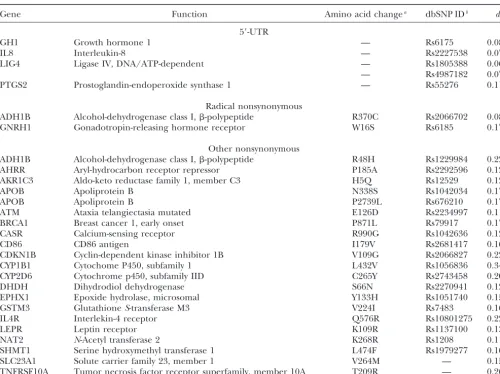
servative nonsynonymous SNPs was identical to that for standard deviations (SD) above the mean for the cate-gory]. Also included are cases of conservative nonsynon-radical nonsynonymous SNPs, the Mann-Whitney test
(which is based on average ranks) showed a significant ymous SNPs for which the genetic distance between African and Asian populations was ⬎2 SD above the difference in location between the former two
catego-ries and radical nonsynonymous SNPs (Table 2). mean for that category (Table 4). In any of these cases it is possible that the high interpopulation distance is Meand between populations (i.e., the mean of
Afri-can-European, African-Asian, and European-Asian com- due to chance, whether random genetic drift or sam-pling error. On the other hand, it is possible that in parisons) likewise showed the lowest mean and median
at least some of these cases, differentiation between values in the case of radical nonsynonymous SNPs
(Ta-populations has been driven by natural selection. ble 2). The values for the 5⬘-UTR were not significantly
different from those for radical nonsynonymous SNPs, but all other categories showed significant differences
DISCUSSION
from radical nonsynonymous SNPs in both parametric
and nonparametric tests (Table 2). In previous analyses with the same study populations,
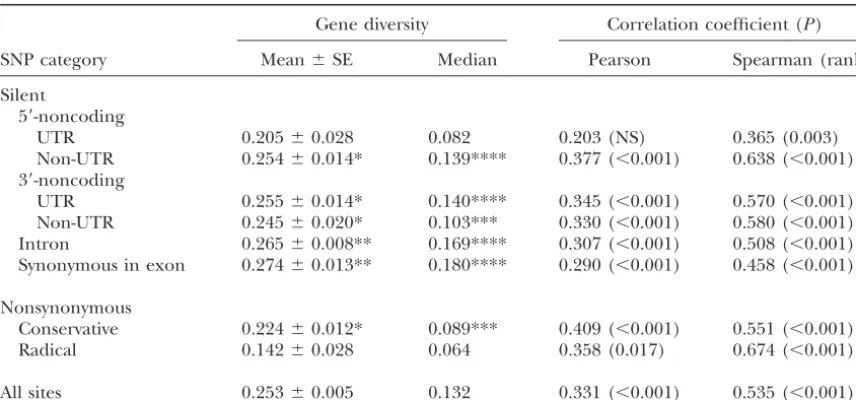
As in our previous analyses (Hugheset al.2003), we we found significantly reduced gene diversity in the case found differences among SNP categories with respect of radical nonsynonymous SNP loci in comparison with to gene diversity (heterozygosity) (Table 3). Mean gene other SNP categories in the same genes (Hugheset al. diversity was lowest in the case of radical nonsynony- 2003). Since the gene diversity at radical nonsynony-mous SNPs, and mean gene diversities for all categories mous SNPs was reduced in comparison to silent SNPs except the 5⬘-UTR differed significantly from that for in the same genes, the likely cause of reduced gene diver-radical nonsynonymous SNPs (Table 3). Median gene sity at the former is purifying selection (Hughes et al.
diversities showed an identical pattern (Table 3). We 2003); that is, natural selection acting to remove deleteri-computed correlation coefficients, both the Pearson ous mutations (KimuraandOhta1974;Nei1987). Simi-correlation coefficient and the nonparametric Spear- lar results were reported by Sunyaev et al. (2001), man correlation coefficient, betweendand gene diver- Freudenberg-Huaet al.(2003), andZhaoet al.(2003). sity for each SNP category (Table 3). In most cases, In this study, examining twice as many SNPs as in our the correlation coefficients were modest but statistically previous study, we found evidence of purifying selection
significant (Table 3). not only at radical nonsynonymous SNPs, but also at
TABLE 3
Mean (⫾SE) and median gene diversity values and correlations between gene diversity and genetic distance at SNP loci in different functional categories
Gene diversity Correlation coefficient (P)
SNP category Mean⫾SE Median Pearson Spearman (rank)
Silent
5⬘-noncoding
UTR 0.205⫾0.028 0.082 0.203 (NS) 0.365 (0.003)
Non-UTR 0.254⫾0.014* 0.139**** 0.377 (⬍0.001) 0.638 (⬍0.001) 3⬘-noncoding
UTR 0.255⫾0.014* 0.140**** 0.345 (⬍0.001) 0.570 (⬍0.001)
Non-UTR 0.245⫾0.020* 0.103*** 0.330 (⬍0.001) 0.580 (⬍0.001) Intron 0.265⫾0.008** 0.169**** 0.307 (⬍0.001) 0.508 (⬍0.001) Synonymous in exon 0.274⫾0.013** 0.180**** 0.290 (⬍0.001) 0.458 (⬍0.001)
Nonsynonymous
Conservative 0.224⫾0.012* 0.089*** 0.409 (⬍0.001) 0.551 (⬍0.001)
Radical 0.142⫾0.028 0.064 0.358 (0.017) 0.674 (⬍0.001)
All sites 0.253⫾0.005 0.132 0.331 (⬍0.001) 0.535 (⬍0.001)
Tests of the hypothesis that mean gene diversity equals that for radical nonsynonymous SNP loci (t-test): *P⬍0.01; **P⬍0.001. Tests of the hypothesis that median gene diversity equals that for radical nonsynonymous SNP loci (Mann-Whitney test): ***P⬍0.05; ****P⬍0.01.
acting similarly in two populations to reduce frequency al. 2003). Indeed, constructing a random sample of se-quences from the entire human species raises numerous of a deleterious allele, the reduction in frequency will
be similar in both populations, causing similar allele practical difficulties. The present methods, on the other hand, because they depend on comparisons between frequencies in the two populations. As a result, the
ge-netic distance between populations will be reduced at SNPs of different categories across the same set of genes, do not depend on the assumption of a random sample. a locus subject to purifying selection in both populations
in comparison to a locus that is subject to random ge- The population frequencies of the lower-frequency allele at SNP sites in the categories (5⬘-UTR and radical netic drift in both populations.
Thus, our results demonstrate the utility of examining nonsynonymous SNPs) that showed evidence of purify-ing selection were typically in the range of 1–10%.Wong
interpopulation divergence as a simple strategy for
iden-tifying SNP sites subject to purifying selection that thus et al.(2003) similarly reported numerous nonsynonymous SNPs with similar allelic frequencies in a sample of 114 are candidates for complex disease associations. Note
that, in the present case, the numbers of individuals human genes. These frequencies are at least an order of magnitude higher than those of human genes causing examined in each population were modest. Thus, this
approach holds promise for providing an efficient severe Mendelian diseases, such as cystic fibrosis or Hun-tington’s chorea (McKusickandFrancomano 1997). method for identifying SNPs subject to purifying
selec-tion when available resources limit the number of indi- This in turn suggests that the selection coefficients at many of these SNP sites are smaller than those at loci viduals that can be examined.
Moreover, the methods used here are more readily associated with severe disease.
Evidence of such mild purifying selection can be used applicable to the study of SNP sites than are such widely
used tests for natural selection as those ofTajima(1989) to identify candidate loci for association with complex diseases, since SNPs associated with complex diseases andFuandLi(1993). The latter tests are more
applica-ble to sequencing studies than to SNP studies because are expected to be slightly deleterious, unlike the highly deleterious genes associated with Mendelian diseases. they examine all polymorphic sites across a gene. In the
case of SNP studies certain polymorphic sites may be Thus, if nonsynonymous SNPs or SNPs in the 5⬘-UTR show lower gene diversity than other SNPs in the same unknown and thus may not be ascertained. Lack of
ascertainment of certain SNPs is not a problem for the genes, these are potential candidates for complex dis-ease-association studies (Hugheset al.2003). In addi-present method because known SNPs are compared
within other known SNPs in different functional catego- tion, the present results suggest that nonsynonymous SNPs or SNPs in the 5⬘-UTR that show low levels of ries ascertained for the same set of genes. Furthermore,
the methods of Tajima (1989) and Fu andLi (1993) interpopulation divergence are potential candidates for complex disease-association studies.
assume a random sample of the population and are very
TABLE 4
5ⴕ-UTR and radical synonymous SNPs with unusually large (⬎2 standard deviations above meandvalue for category) genetic distance between African and Asian populations
Gene Function Amino acid changea dbSNP IDb d
5⬘-UTR
GH1 Growth hormone 1 — Rs6175 0.087
IL8 Interleukin-8 — Rs2227538 0.079
LIG4 Ligase IV, DNA/ATP-dependent — Rs1805388 0.066
— Rs4987182 0.076
PTGS2 Prostoglandin-endoperoxide synthase 1 — Rs55276 0.110
Radical nonsynonymous
ADH1B Alcohol-dehydrogenase class I,-polypeptide R370C Rs2066702 0.087
GNRH1 Gonadotropin-releasing hormone receptor W16S Rs6185 0.176
Other nonsynonymous
ADH1B Alcohol-dehydrogenase class I,-polypeptide R48H Rs1229984 0.225
AHRR Aryl-hydrocarbon receptor repressor P185A Rs2292596 0.122
AKR1C3 Aldo-keto reductase family 1, member C3 H5Q Rs12529 0.122
APOB Apoliprotein B N338S Rs1042034 0.177
APOB Apoliprotein B P2739L Rs676210 0.177
ATM Ataxia telangiectasia mutated E126D Rs2234997 0.115
BRCA1 Breast cancer 1, early onset P871L Rs79917 0.172
CASR Calcium-sensing receptor R990G Rs1042636 0.121
CD86 CD86 antigen I179V Rs2681417 0.162
CDKN1B Cyclin-dependent kinase inhibitor 1B V109G Rs2066827 0.223
CYP1B1 Cytochome P450, subfamily 1 L432V Rs1056836 0.346
CYP2D6 Cytochrome p450, subfamily IID C265Y Rs2743458 0.209
DHDH Dihydrodiol dehydrogenase S66N Rs2270941 0.126
EPHX1 Epoxide hydrolase, microsomal Y133H Rs1051740 0.152
GSTM3 GlutathioneS-transferase M3 V224I Rs7483 0.160
IL4R Interlekin-4 receptor Q576R Rs10801275 0.226
LEPR Leptin receptor K109R Rs1137100 0.137
NAT2 N-Acetyl transferase 2 K268R Rs1208 0.116
SHMT1 Serine hydroxymethyl transferase 1 L474F Rs1979277 0.162
SLC23A1 Solute carrier family 23, member 1 V264M — 0.158
TNFRSF10A Tumor necrosis factor receptor superfamily, member 10A T209R — 0.260
aSingle-letter amino acid code is used; amino acid positions are numbered as in the primary translation product. bIdentification (ID) number in the public SNP database, dbSNP (Sherryet al.2001).
chosen because of their potential involvement in cancer lecular evolution. This theory predicts that, when the effective population size is small, slightly deleterious or other complex diseases (Packer et al.2004). Thus,
they included loci encoding proteins involved in funda- alleles behave as if selectively neutral and thus can drift to higher than expected frequencies in large popula-mental cellular processes, many of which are expected
to be subject to strong purifying selection because of tions (Ohta 1976). There is substantial evidence that the human population has undergone an expansion stringent functional constraints. On the other hand,
they also included a large number of loci encoding beginning in the Pleistocene, and thus that our species has a bottlenecked population history (Harpendinget
cytokines and other immune system proteins, which are
known to evolve rapidly at the amino acid level and thus al.1998;Marthet al.2003). Slightly deleterious alleles that drifted to high frequencies during the bottleneck appear to be subject to a relatively low level of functional
constraint (Murphy1993;Hughes1997). Further stud- phase are expected to decrease gradually in frequency as effective population size increases and purifying selec-ies will be required to determine whether the frequency
of sites subject to purifying selection in our data set tion becomes more effective. SNPs in the 5⬘-UTR and radical nonsynonymous SNPs showed a reduction in differs from that in a random set of human
protein-coding loci. gene diversity in comparison with other SNPs from the
same set of genes that is consistent with this prediction. The existence of slightly deleterious alleles subject to
purifying selection yet nonetheless occurring at rather By contrast, a number of SNPs in the 5⬘-UTR and a number of nonsynonymous SNPs showed very high high frequencies in the human population is consistent
popula-tions (Table 4). Although these high values might be listed in Table 4 can be tested further by examining allelic frequencies in larger samples and also by testing due to genetic drift or stochastic error, it is possible that
at least some of these represent cases where positive for associations between polymorphism at these loci and selection has acted to favor different phenotypes in dif- observable phenotypes. Thus, the computation of ge-ferent human populations. Interestingly, these cases in- netic distances between populations at SNP sites pro-clude immune system genes (IL8 and LIG4), hormones vides a simple strategy for identifying SNPs that may have and hormone receptors (GH1 and GNRH1), and meta- been subject to directional selection over the course bolic enzymes (e.g., ADH1B and CYP1B1), which might of human evolution, which can complement strategies plausibly be subject to different selective pressures in based on statistics such as FST (Akey et al. 2002) and
different environments. linkage disequilibrium (Schneideret al.2003) or
statis-Published studies on several SNPs identified in our tics based on the pattern of sequence variability (
Bam-study provide an important context for assessing the shadandWooding2003).
utility of this strategy. For example, a well-characterized This project has been funded in part with federal funds from the SNP (rs4073), which lies in the proximal promoter of National Cancer Institute, National Institutes of Health (NIH), under IL8, has been reported to alter the regulation of the IL8 contract no. NO1-CO-12400. Partial support was provided by NIH
grant GM43940 to A.L.H.
gene and has been associated with two major infectious disease outcomes, resistance to tuberculosis and severity of respiratory syncytial virus (RSV) infection (Hull et
al.2001;Choiet al.2002;Maet al.2003). Interestingly, LITERATURE CITED
the association between IL8 and RSV has been shown
Akey, J. M., G. Zhang, K. Zhang, L. JinandM. D. Shriver, 2002
in Europeans but not in Koreans, where the distribution Interrogating a high-density SNP map for signatures of natural of variant alleles is markedly shifted. Similarly, IL4R selection. Genome Res.12:1805–1814.
Bamshad, M., andS. P. Wooding, 2003 Signatures of natural
selec-has been associated with RSV infection in European
tion in the human genome. Nat. Rev. Genet.4:89–111.
children but not in Korean children—again suggesting Bernig, T., J. G.Taylor, B.Staats, C. B.Fosterand M.Yeager, that variants in IL8 or IL4R, or perhaps in additional 2004 Sequence analysis of the mannose binding lectin (MBL2) gene reveals a high degree of heterozygosity with evidence of
genes, may contribute to the observed differences
be-selection. Genes Immun.5:461–476.
tween populations even for SNPs in which a functional Botstein, D., andN. Risch, 2003 Discovering genotypes underlying difference between alleles has been demonstrated (Hoebee human phenotypes: past successes for Mendelian disease, future approaches for complex disease. Nat. Genet.33(Suppl.): 228–
et al. 2003). Several other notable examples include
237.
studies byRockmanet al.(2003) in which they provide
Brookes, A. J., 1999 The essence of SNPs. Gene234:177–186.
evidence that natural selection has led to different allelic Chanock, S., 2001 Candidate genes and single nucleotide
polymor-phisms (SNPs) in the study of human disease. Dis. Markers19:
frequencies in human populations at a SNP locus in the
89–98.
promoter of another cytokine, IL4, and Bernig et al.
Choi, E., H. J. Lee, T. W. YooandS. J. Chanock, 2002 A common
(2004) in which they show different frequencies of func- haplotype of interleukin 4 gene is associated with severe respira-tionally significant haplotypes for the MBL2 gene. tory syncytial virus disease in Korean children. J. Infect. Dis.186:
1207–1211.
A metabolic gene exhibiting SNPs with high
interpop-Fleming, M. A., J. D. Potter, C. J. Ramirez, G. K. Ostranderand
ulation differences is the ADH1B gene, which exhibits E. A. Ostrander, 2003 Understanding misssense mutations in both radical (R370C) and conservative (R48H) nonsyn- theBRCA1gene: an evolutionary approach. Proc. Natl. Acad.
Sci. USA100:1151–1156.
onymous SNPs with high interpopulation divergence. In
Freudenberg-Hua, Y., J. Freudenberg, N. Kluck, S. Cichon, P. particular,Osieret al.(2002) considered the frequency Proppinget al., 2003 Single nucleotide variation analysis in 65 divergence between East Asian and other human popu- candidate genes for CNS disorders in a representative sample of
the European population. Genome Res.13:2271–2276.
lations at the R48H SNP, which exhibits the highest
Fu, Y.-X., andW.-H. Li, 1993 Statistical tests of neutrality of
muta-Fst observed among 86 unlinked sites in 33 worldwide tions. Genetics133:693–709.
populations (Osieret al.2002), too high to be explain- Gray, I. C., D. A. CampbellandN. G. Spurr, 2000 Single nucleotide polymorphisms as tools in human genetics. Human Mol. Genet.
able by genetic drift alone. A group of metabolic genes
9:2403–2408.
exhibiting SNPs with high interpopulation differences Hammer, M. F., F. Blackmer, D. Garrigan, M. W. Nachmanand are those involved in oxidation of benzo[␣]pyrene, in- J. A. Wilder, 2003 Human population structure and its effect on sampling Y chromosome sequence variation. Genetics164:
cluding CYP1B1, DHDH, and EPHX1, each exhibiting
1495–1509.
a conservative nonsynonymous SNP with a significant
Harpending, H. C., M. A. Batzer, M. Gurven, L. B. Jorde, A. R. interpopulation difference (Table 4). In particular, Rogerset al., 1998 Genetic traces of ancient demography. Proc.
Natl. Acad. Sci. USA95:1961–1967.
CYP1B1, with a SNP (L432V) with the highest
interpop-Hoebee, B., E. Rietveld, L. Bont, M. Oosten, H. M. Hodemaekers ulation difference in the samples examined in this study,
et al., 2003 Association of severe respiratory syncytial virus
bron-has SNPs with well-characterized population differences, chiolitis with interleukin-4 and interleukin-4 receptor alpha
poly-morphisms. J. Infect. Dis.187:2–11.
e.g., ad of 0.223 in a sample of 111 and 120 individuals
Hughes, A. L., 1997 Rapid evolution of immunoglobulin C2
do-with African and Asian ancestry, respectively (Mammenet
mains expressed in immune system cells. Mol. Biol. Evol.14:1–5.
al.2003). Hughes, A. L., B. Packer, R. Welch, A. W. Bergen, S. J. Chanock
et al., 2003 Widespread purifying selection at polymorphic sites
in human protein-coding loci. Proc. Natl. Acad. Sci. USA100: et al., 2002 A global perspective on genetic variation at the ADH gene reveals unusual patterns of linkage disequilibrium. Am. J. 15754–15757.
Hum. Genet.71:84–99.
Hull, J., H. Ackerman, K. Isles, S. Usen, M. Pinderet al., 2001
Packer, B., M. Yeager, B. Staats, R. Welch, A. Crenshawet al., Unusual haplotypic structure of IL8, a susceptibility locus for a
2004 SNP500Cancer: a public resource for sequence validation common respiratory virus. Am. J. Hum. Genet.69:413–419.
and assay development for genetic variation in candidate genes.
Kimura, M., and T. Ohta, 1974 On some principles governing
Nucleic Acids Res.32:D528–D532. molecular evolution. Proc. Natl. Acad. Sci. USA71:2848–2852.
Ramensky, V., P. BorkandS. Sunyaev, 2002 Human
non-synony-Lohnmueller, K. E., C. L. Pearce, M. Pike, E. S. LanderandJ. N.
mous SNPs: server and survey. Nucleic Acids Res.30:3894–3900.
Hirschhorn, 2003 Meta-analysis of genetic association studies
Risch, N. J., 2000 Searching for genetic determinants for the new supports a contribution of common variants to susceptibility to
millennium. Nature405:847–856. common disease. Nat. Genet.33:177–182.
Rockman, M. V., M. W. Hahn, N. Soranzo, D. B. Goldsteinand
Ma, X., R. A. Reich, J. A. Wright, H. R. Tooker, L. D. Teeteret
G. A. Wray, 2003 Positive selection on a human-specific
tran-al., 2003 Association between interleukin-8 gene alleles and
scription factor binding site regulating IL4 expression. Curr. Biol. human susceptibility to tuberculosis disease. J. Infect. Dis.188:
13:2118–2123. 349–355.
Schneider, J. A., M. S. Pungliya, J. Y. Choi, R. Jiang, X. J. Sunet Mammen, J. S., G. S.Pittman, Y.Li, F.Abou-Zahr, B. A.Bejjaniet
al., 2003 DNA variability of human genes. Mech. Ageing Dev.
al., 2003 Single amino acid mutations, but not common poly- 124:17–25.
morphisms, decrease the activity of CYP1B1 against (-)benzo[a]- Schork, N. J., D. FallinandS. Lanchbury, 2000 Single nucleotide pyrene-7R-trans-7,8-dihydrodiol. Carcinogenesis24:1247–1255. polymorphisms and the future of genetic epidemiology. Clin.
Marth, G., G. Shuler, R. Yeh, R. Davenport, R. Agarwalaet al., Genet.58:250–264.
2003 Sequence variations in the public human genome data Sherry, S. T., M.-H. Warc, M. Kholodov, J. Baler, E. M. Smigielski reflect a bottlenecked population history. Proc. Natl. Acad. Sci. et al., 2001 dbSNP: the NCBI database of genetic variation.
USA100:376–381. Nucleic Acids Res.29:308–311.
McKusick, V. A., andC. A. Francomano, 1997 Mendelian Inheritance Stitzel, N. O., Y. Y. Tseng, D. Pervouchine, D. Goddeau, S. Kasif in Man: A Catalog of Human Genes and Genetic Disorders, Ed. 12. et al., 2003 Structural location of disease-associated single-nucle-Johns Hopkins University Press, Baltimore. otide polymorphisms. J. Mol. Biol.327:1021–1030.
Sunyaev, S., V. Ramensky, I. Koch, W. Lathe, III,A. S. Kondrashov Miyata, T., S. Miyazawaand T. Yasunaga, 1979 Two types of
et al., 2001 Prediction of deleterious human alleles. Hum. Mol. amino acid substitution in protein evolution. J. Mol. Evol.12:
Genet.10:591–597. 219–236.
Tajima, F., 1989 Statistical method for testing the neutral mutation
Murphy, P. M., 1993 Molecular mimicry and the generation of host
hypothesis by DNA polymorphism. Genetics123:585–595. defense protein diversity. Cell72:823–826.
Tishkoff, S. A., andB. C. Verrelli, 2003 Patterns of human genetic
Nei, M., 1987 Molecular Evolutionary Genetics. Columbia University
diversity: implications for human evolutionary history and dis-Press, New York.
ease. Annu. Rev. Hum. Genet.4:293–340.
Nei, M., andG. Livshits, 1989 Genetic relationships of Europeans,
Wang, Z., andJ. Moult, 2001 SNPs, protein structure, and disease. Asians and Africans and the origin of modernHomo sapiens.Hum.
Hum. Mutat.17:263–270. Hered.39:276–281.
Wong, G. K.-S., Z. Yang, D. A. Passey, M. Kibukawa, M. Paddocket Ng, P. C., andS. Henikoff, 2002 Accounting for human
polymor-al., 2003 A population threshold for functional polymorphisms. phisms predicted to affect protein function. Genome Res. 12:
Genome Res.13:1873–1879.
436–446. Zhao, Z., Y.-X. Fu, D. Hewett-EmmettandE. Boerwinkle, 2003
Ohta, T., 1976 Role of very slightly deleterious mutations in molecu- Investigating single nucleotide polymorphism (SNP) density in lar evolution and polymorphism. Theor. Popul. Biol.10:254–275. the human genome and its implications for molecular evolution.
Ohta, T., 2002 Near-neutrality in evolution of genes and gene regu- Gene312:207–213. lation. Proc. Natl. Acad. Sci USA99:16134–16137.