Big Data Privacy Preservation and Security
Protection
Dhanashri Varute1,Dr. Arti Mohanpurkar2
Department of Computer Engineering, D.Y.Patil’s School of Engineering and Technology, Lohegaon, India
HOD, Department of Computer Engineering, D.Y.Patil’s School of Engineering and Technology, Lohegaon, India
.
ABSTRACT: Big data is a term utilized for huge informational indexes that have more changed and complex structure. These attributes normally correspond with extra troubles in storing, examining and applying further methods or extricating outcomes. Notwithstanding, there is a conspicuous inconsistency between the security and privacy of big data and across the utilization of big data. This paper concentrates on privacy and security worries in big data. There has been various security safeguarding systems created for security insurance at various stages (for instance, data storage, data generation, and data processing) of a big data life cycle. The objective of this paper is to give the privacy protection and security in big data.
KEYWORDS: Big data, Privacy and security, Fingerprint, Relational Database, Data Partitioning, Slicing, Generalization, SQL Injection.
I. INTRODUCTION
Privacy and security concerns:
Privacy and security as far as big data is a critical issue. Big data security display is not recommended in case of complex applications because of which it gets crippled as a matter of course. Be that as it may, in its nonattendance, data can simply be traded off effectively. Accordingly, this area concentrates on the privacy and security issues. Privacy- Data privacy is the benefit to have some control over how the individual data is gathered and utilized. Data privacy is the limit of an individual or gathering to prevent data about themselves from getting to be noticeably known to individuals other than those they give the data to. One genuine client privacy issue is the recognizable proof of individual data amid transmission over the Web.
Security is the act of protecting data and data resources using innovation, procedures and preparing from:-Unauthorized access, Disclosure, Disruption, Modification, Inspection, Recording, and Destruction. Privacy versus security Data privacy is centered around the utilization and administration of individual data—things like setting up approaches set up to guarantee that shoppers' close to home data is being gathered, shared and used in proper ways. Security focuses more on shielding data from malevolent assaults and the abuse of stolen data for benefit. While security is major for ensuring data, it's not adequate for tending to privacy.
II. LITERATURE SURVEY
would be created than these days [11]. To be sure, IoT is one of the significant main thrusts for big data examination [9]. In the present computerized world, where loads of data is put away in big data's, the examination of the databases can give the chances to take care of big issues of society like healthcare and others. Smart energy big data analytics is also a very complex and challenging topic that share many common issues with the generic big data analytics. Smart energy big data involve extensively with physical processes where data intelligence can have a huge impact to the safe operation of the systems in real-time [12]. This can also be useful for marketing and other commercial companies to grow their business. As the database contains the personal information, it is vulnerable to provide the direct access to researchers and analysts. Since in this case, the privacy of individuals is leaked, it can cause threat and it is also illegal. The paper is based on research not ranging to a specific timeline. As the references suggest, research papers range from as old as 1998 to papers published in 2016. Also, the number of papers that were retrieved from the keyword based search can be verified from the presence of references based on the keywords. “Privacy and security concerns” section discusses of privacy and security concerns in big data and “Privacy requirements in big data” section covers the Privacy requirement in big data. “Big data privacy in data generation phase”, “Big data privacy in data storage phase” and “Big data privacy preserving in data processing” sections discusses about big data privacy in data generation, data storage, and data processing Phase. “Privacy Preserving Methods in Big Data” section covers the privacy preserving techniques using big data. “Recent Techniques of Privacy Preserving in Big Data” section presents some recent techniques of big data privacy and comparative study between these techniques.
bending. Distinctive methodologies and sorts of watermarking calculations for numeric social databases are recommended in (Khataeimaragheh, and Rashidi, 2010; Huang, Yue, Chen, He, Chen, 2009; Manjula, Settipalli, 2010; Hamadou, Sun, Shah, Gao, 2011). In (Manjula, Settipalli, 2010), a watermarking procedure versatile to added substance assault is proposed. A novel model is appeared in (Kamran, and Farooq, 2013) to consequently characterize client requirements for any information mining dataset to accomplish data safeguarding. A mystery gathering parameter is utilized for gathering the important lines and the nearby and worldwide convenience limitations are connected. The arrangement capability of the elements and a few different attributes are protected with the end goal that the mining of the datasets is not influenced. Watermark security is likewise guaranteed by checking the framework against the assaults. Some current overviews (Halder, Pal, and Cortesi, 2010; Mohanpurkar and Joshi, 2011) exhibit a survey of a few watermarking methods which apply diverse ways to deal with accomplish possession insurance. A couple of systems have endeavored fingerprinting of social databases and a not very many have guaranteed for conspiracy secure fingerprinting. Imprints are embedded in same places of various duplicates and furthermore perform bit-level stamping which have an indistinguishable detriments from said before in this segment. At the point when concentrate is on copyright security of Electronic Medical Records (EMRs) (Kamran, and Farooq, 2012) at that point the blunder inclusion ought not damage the convenience imperatives as it might bring about misdiagnosis of the malady. This misdiagnosis may prompt immense money related misfortune because of unseemly treatment and in the most pessimistic scenario, death toll as well. Thus data conservation by entirely holding fast to the predetermined ease of use requirements is basic on account of EMR copyright assurance. Appropriately, a novel plan proposed in (Waghmode, and Mohanpurkar, 2014) and (Mohanpurkar, and Joshi, 2015b) manages numeric databases without essential key and grouping measurements assume an imperative part. The procedure utilized as a part of (Gursale, and Mohanpurkar, 2014) and (Mohanpurkar, and Joshi, 2015a) is the place the essential key in the social databases shapes an essential info. In the strategy in exhibit paper essential key is of awesome significance. The impact of applying the novel unique mark addition procedure on (Mohanpurkar, and Joshi, 2015b) is expounded in (Mohanpurkar, and Joshi, 2015c). Agreement evasion is made conceivable in the proposed framework due to a remarkable unique mark installing strategy connected which is clarified in detail in additionally segments. The proposed framework is in this way found to give multi-crease benefits.
III. PROBLEM STATEMENT
To design and implement a system that can provide privacy and security to overall system in HDFS environment. With the data privacy system prevents the data from various attacks for sensitive information breaches and with the security system provides copyright protection along with traitor identification (if any).
IV. SYSTEM ARCHITECTURE
Distributed computing is creating as a viable model for engaging speedy time-to-respond in due order regarding present day vast scale data concentrated applications. The benefits of this model join capable asset usage, improved execution, and ease of use through customized resource booking, bit, and data organization. Continuously, the MapReduce structure is used for acknowledging distributed computing bases, which modifies the application change prepare for exceedingly versatile figuring bases. Arranging a MapReduce setup includes numerous execution essential diagram decisions, for instance, center point handle compel and limit confine, choice of record structure, plan and distributing of data, and decision of framework topology, to name a couple. Likewise, a typical setup may incorporate tuning of numerous parameters to separate perfect execution. Aside from some site-specific encounters, for e.g. Google's MapReduce system this setup space is by and large unexplored. Regardless, assessing how applications would perform on specific MapReduce setups is fundamental, especially to optimize existing setups and building new ones. In this work, we get a diversion approach to manage examine the impact of diagram choices in MapReduce setups. We are stressed with how decisions over gathering plot, run-time parameters, multi-inhabitance and application design impact application execution. We build up an exact test framework, MRPerf, to totally get the diverse diagram parameters of a MapReduce setup. MRPerf can gauge the impact of various parts on application execution, and also get the capricious coordinated efforts between the components. We foresee that MRPerf will be used by masters and experts to perceive how their MapReduce applications will bear on a particular setup, and how they can improve their applications and stages. The general target is to empower MapReduce sending by methods for usage of MR-Perf as a feedback instrument that gives exact parameter tuning, instead of the surviving erroneous experimentation approach.
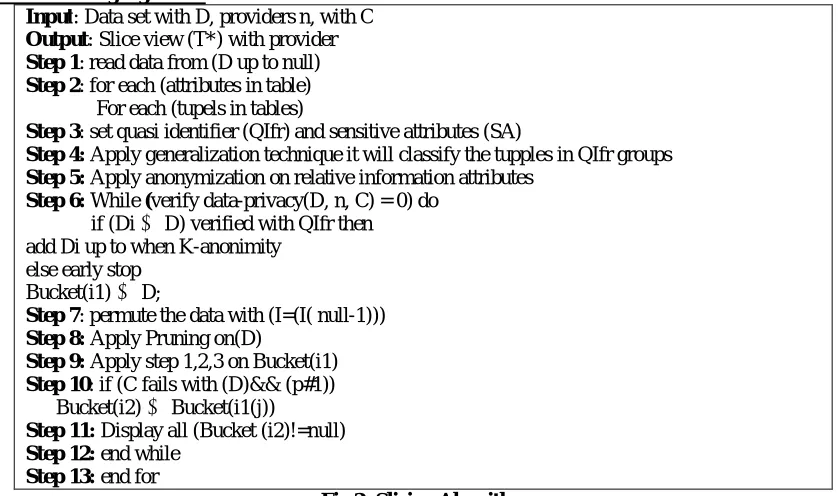
The proposed framework is composed and executed to safeguard the privacy of an individual data and give security to that data in distributed database framework utilizing cutting calculation. Cutting calculation segments the data both on a level plane and vertically and safeguards preferable data utility over speculation and can be utilized for participation revelation assurance utilizing HDFS structure. This framework additionally utilizes fingerprint as security approach. At the point when data proprietor give the data in the meantime we will include a few fillers into the touchy characteristics from genuine data and make it complex which can't use for produce Foundation Information (BK) too sham copyright moreover.
Algorithm 1: Slicing algorithm
Input: Data set with D, providers n, with C Output: Slice view (T*) with provider Step 1: read data from (D up to null) Step 2: for each (attributes in table) For each (tupels in tables)
Step 3: set quasi identifier (QIfr) and sensitive attributes (SA)
Step 4: Apply generalization technique it will classify the tupples in QIfr groups Step 5: Apply anonymization on relative information attributes
Step 6: While (verify data-privacy(D, n, C) = 0) do if (Di D) verified with QIfr then add Di up to when K-anonimity
else early stop Bucket(i1) D;
Step 7: permute the data with (I=(I( null-1))) Step 8: Apply Pruning on(D)
Step 9: Apply step 1,2,3 on Bucket(i1) Step 10: if (C fails with (D)&& (p#1)) Bucket(i2) Bucket(i1(j))
Step 11: Display all (Bucket (i2)!=null) Step 12: end while
Step 13: end for
Algorithm 2: Data Partitioning Algorithm
The dataset DB is a database relation as DB= (Pk, A0,….,An-1), where Pk is the primary key and A0, An-1 are n
attributes. The dataset DB is divided in m non-overlapping partitions by using hashing technique stated in Equation (1) as {P0,...., Pm-1} such that for any of two partitions Pi∩Pj={}, where i ≠ j. The data partitioning algorithm (Kamran,
2013) as shown in fig. 6.6 is applied to partition the dataset into groups. For each tuple t є DB, the MAC is computed to
assign tuples to the respective partitions by using hash function H as:
Partition (r) = H (Ks|| H (t.Pk||Ks )) % m…………...(1)
Here, ‘t.Pk’ is the primary key of tuple t, ‘H()’ is secure hash function and ‘||’ is the concatenation operator and Ks is the
owner’s secret key. The hashing technique is used for dividing the dataset into m partitions. Hash method for partitioning maps data to partitions based on a hashing algorithm chosen applies to the partitioning key that is identified. The hashing algorithm evenly distributes rows among partitions, giving partitions approximately the same size. Hash partitioning is the ideal method for distributing data evenly across devices. Hash partitioning is also an easy-to-use alternative to range partitioning, especially when the data to be partitioned is not historical or has no obvious partitioning key.
Input: Dataset DB, Seceret key Ks, Number of
Partitions m
Output: Partitioned data P0,…,Pm-1
Steps:
1. For each tuple t є DB.
2. Do partition r using equation (1) 3. Insert r into Pr
4. end for
5. returnP0,….,Pm-1
Fig 3: Data Partitioning Algorithm
Algorithm 3: Threshold Computation Algorithm
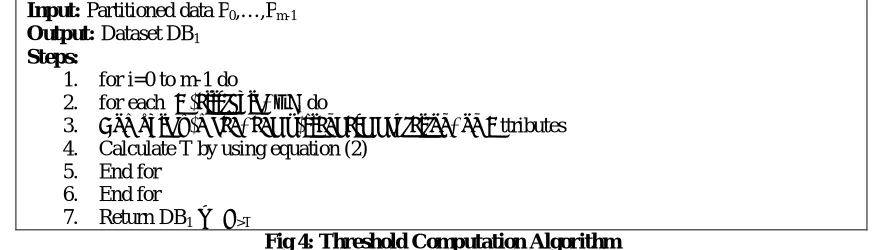
The threshold value is computed using Equation (2) where µ is the mean and σ is the standard deviation of values of
attributes A in DB.
T = ƒ *µ+ σ ………(2)
The confidence factor ‘ƒ’ which can have the value between 0 and 1which is kept secret because of which it becomes difficult to guess the selected tuples. For each attribute the threshold is calculated. The attributes of a tuple having value above its corresponding threshold computed is selected for marking and union of such selected tuples is taken into consideration to form DB1.
Input: Partitioned data P0,…,Pm-1
Output: Dataset DB1
Steps:
1. for i=0 to m-1 do
2. for each A(attribute) є Pi do
3. Compute µ(mean) and σ(standard deviation) on Attributes 4. Calculate T by using equation (2)
5. End for 6. End for
7. Return DB1← R>T
Fig 4: Threshold Computation Algorithm
Algorithm 4: Hash-Value Computation Algorithm
Tuples having even hash values are selected from the data set DB1. The MD5 hash function is applied to the data set
DB1 using Equation (3) and dataset DB2 is obtained. This step further reduces the size of the dataset selected for
Even value (r) = H (Ks|| r.Pk) % 2 …………. (3)
Input: Dataset DB1
Output: Dataset DB2
Steps:
1. for each r є DB1 do
2. Calculate even value r using equation (3) 3. If r==0 then
4. Insert r into DB2
5. Else do not consider tuple for fingerprinting 6. End if
7. End for 8. Return DB2
Fig 5: Hash-Value Computation Algorithm
Algorithm 5: Fingerprint Insertion Algorithm
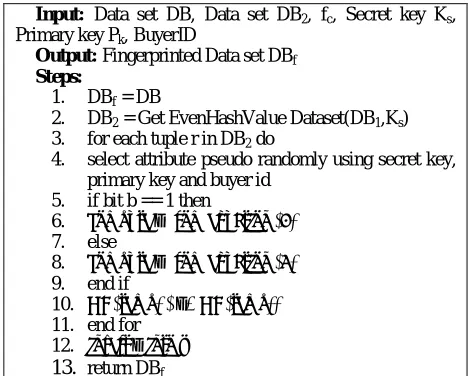
The tardos generated fingerprint bits b1,b2,.., bn are inserted in the each partition Pi. By using algorithm given in fig. 6 the
fingerprint is inserted into a dataset. Fingerprint embedding function (FI) is used to convert dataset DB into fingerprinted database DBf.
FI : (DB,fc) → DBf ………….(4)
Fingerprinting function FI for ith row and jth column is
FI= ηij + vij …………(5)
Where, ij is one instance of modification which is performed on the tuple ith row in jth column, computed according to b bit. If b bit is equal to one, then ηij, subject to constraints Uc ,on data value vij of an attribute as
ηij= α% of vij,with α > 0 …….(6)
and if b bit is equal to zero, then
ηij= α% of vij,with α < 0 …….(7)
where, α is fixed for every fingerprinted tuple and is defined by data owner/admin ad used in fingerprint decoding phase. Usability constraints are defined in terms of mean and standard deviation of attributes of DB. These two measures remain approximately the same before and after fingerprinting the data.
Data manipulation vector (∆) is used to keep the record of transformation from DB to DBfby adding the parameter η in every
encoding step. The output data set DBf is then made available for buyer. Algorithm in fig 6 represents steps involved in embedding
fingerprint into dataset.
Input: Data set DB, Data set DB2, fc, Secret key Ks,
Primary key Pk, BuyerID
Output: Fingerprinted Data set DBf
Steps:
1. DBf = DB
2. DB2 = Get EvenHashValue Dataset(DB1,Ks)
3. for each tuple r in DB2 do
4. select attribute pseudo randomly using secret key, primary key and buyer id
5. if bit b == 1 then
6. compute η from equation (6) 7. else
8. compute η from equation (7) 9. end if
10. DB(temp) ( η+ DB(temp)) 11. end for
12. insert η into ∆ 13. return DBf
Algorithm 6: Generation of Fingerprint Bits
Fingerprint is generated by using Trados code. Fingerprinting is used to trace the guilty users who redistribute an unauthorized data. Fingerprints should be inserted into dataset such that location of it should not be revealed to traitor. A Collusion Attack, where more than two pirates compare their copies and build their own copy as they want is important and needed to be handled. For example, Consider 3 fingerprint values m1 = 0110, m2 = 1000, and m3 =1110
used for 3 buyers b1, b2 and b3 respectively. Buyer b1 and b2 compare their respective copies and modify it to build a copy where it di ers. So, the fabricated fingerprint is 1110 which is actually the fingerprint for buyer b3. So it can
happen that buyer b1 and b2 actually collude to pirate the database but user b3 is identified as victim after detection. To
avoid accusation of such innocent users collusion-secure codes have been designed like Boneh and shaw scheme code[1998], Tardos Scheme of B.Skoric, S. Katzenbeisser, and M. Celik [2008]. Out of these Tardos scheme is better because-
1. Codewords have small length as compared to other Schemes. 2. Number of users need not be pre-defined.
3. Implementation is e cient and simple.
Following are the steps to generate Tardos Fingerprinting code: Two Phase Process:
1. First distributor choose the codewords distribution.
2. Fingerprinting matrix BT is built. The rows of the matrix BT are the codewords embedded into the copies that the users receive.
Phase 1:
In this phase the distributor picks a random variable for the code construction. The distributor does it in the following way:
1. The distributor picks some suitable parameter tp where tp=1/(300c)
2. The distributor computes the parameter
t1p = arcsin (sqrt(tp)) …………(8)
For all 1 ≤ i ≤ N the distributor picks ri uniformly at random from the interval [t1p,π /2- t1p]. The distributor puts pi=
sin2ri, where 1 ≤ i ≤ N and thus tp≤ pi ≤ 1 - tp.
Phase 2:
Fingerprinting matrix BT is built. The entries of BT are such that P[BT(j,i)=1] = pi and P[BT(j,i)=0] = 1 -pi.
Where, j denotes the number of user j = 1, ..., n and i denotes the code length i = 1,... l. Fig. 7: Tardos Code Generation
V. RESULT AND DISCUSSION
Table 1 shows the output of system after execution of slicing algorithms. Slicing will provide the better security than existing approach.
ID Name Gender Zip
Code
Qualifi-cation
Age
128 ***** female *****
5
***** [26-50]
129 ***** male *****
8
***** [26-50]
130 ***** female *****
5
***** [26-50]
131 ***** male *****
6
***** [0-25]
Fig.8: Data Slicing Performance
Fig.9: Data Slicing Performance on Hadoop
Attribute Before
Fingerprin-ting Mean
After
Fingerprint-ing Mean
Differen-ce
First 68.8076 68.8097 0.0021 Second 70.2106 70.2189 0.0083 Third 67.5071 67.5127 0.0056 Fourth 69.8714 69.8898 0.0184 Fifth 68.4989 68.5051 0.0062
Table 2: Mean of Attribute values before and after fingerprint insertion
Fig .11 : System performance measure proposed vs existing
Fig.11 shows overall system performance using Hadoop and using normal system.
VI. CONCLUSION AND FUTURE ENHANCEMENT
Data is anonymized by removing the personal details to preserve the privacy of users. It indicates that it would not be possible to identify an individual only from the anonymized data. However, due to the availability of huge volumes of data and powerful data analytic tools, the existing anonymization techniques are becoming increasingly ineffective. In big data scenarios, anonymization needs to be more than just masking or generalizing certain fields. One needs to carefully analyze if the anonymized data are vulnerable to any attacks. For that, different attack models and information loss metric for big data anonymization is studied. Moreover, a Fingerprinting approach is used which can provide security against the ownership theft as well as it also helps trace the traitor if any unauthorized copy is found. In case of relational databases, insertion of fingerprint bit can change numeric data to some extent. This change in numeric data may not lead to loss in knowledge from database. The proposed insertion algorithm is independent primary key and it can efficiently trace the traitor.
Future Enhancement
The proposed architecture can be developed on hadoop base system with cube materialization and mapreduce with multi cloud environment. Also subset of holistic measures that are partially algebraic and propose the technique of value partitioning to make them easy to compute in parallel can be identified. Design algorithms that partition the cube lattice into batch areas to effectively exploit both the parallel processing power of MapReduce and the pruning power of cube materialization algorithms. Further the ability to surface interesting cube groups as part of the cube computation process can be demonstrated. Experiments over real and synthetic data show that MR-Cube algorithm efficiently distributes the computation workload across the machines and is able to complete cubing tasks at a scale where prior algorithms fail.
0 50 100 150 200
100000 200000 300000 400000
Without Hadoop
REFERENCES
[1] Mehmood A, Natgunanathan I, Xiang Y, Hua G, Guo S. “Protection of big data privacy”. In: IEEE translations and content mining are permitted for academic research. 2016.
[2] Abadi DJ, Carney D, Cetintemel U, Cherniack M, Convey C, Lee S, Stone-braker M, Tatbul N, Zdonik SB. “Aurora: a new model and architecture for data stream management”. VLDB J. 2003;12(2):120–39.
[3] Kolomvatsos K, Anagnostopoulos C, Hadjiefthymiades S. “An efficient time optimized scheme for progressive analytics in big data”. Big Data Res. 2015;2(4):155–65.
[4] Big data at the speed of business, [online]. http://www-01.ibm.com/soft-ware/data/bigdata/2012.
[5] Manyika J, Chui M, Brown B, Bughin J, Dobbs R, Roxburgh C, Byers A. “Big data: the next frontier for innovation, competition, and productivity”. New York: Mickensy Global Institute; 2011. p. 1–137.
[6] Gantz J, Reinsel D. “Extracting value from chaos”. In: Proc on IDC IView. 2011. p. 1–12.
[7] Tsai C-W, Lai C-F, Chao H-C, Vasilakos AV. “Big data analytics: a survey”. J Big Data Springer Open J. 2015.
[8] Jain P, Pathak N, Tapashetti P, Umesh AS. “Privacy preserving processing of data decision tree based on sample selection and singular value decomposition”. In: 39th international conference on information assurance and security (lAS). 2013.
[9] Qin Y, et al. “When things matter: a survey on data-centric internet of things”. J Netw Comp Appl. 2016;64:137–53.
[10] Fong S, Wong R, Vasilakos AV. “Accelerated PSO swarm search feature selection for data stream mining big data”. In: IEEE transactions on services computing, vol. 9, no. 1. 2016.
[11] Middleton P, Kjeldsen P, Tully J. “Forecast: the internet of things, worldwide”. Stamford: Gartner; 2013.
[12] Hu J, Vasilakos AV. “Energy Big data analytics and security: challenges and opportunities”. IEEE Trans Smart Grid. 2016;7(5):2423–36. [13] Agrawal, R., Haas, P., & Kiernan, J. (2003). “Watermarking Relational Data: Framework, Algorithms and Analysis”. The VLDB Journal,
12(2), 157–169. doi:10.1007/s00778-003-0097-x
[14] Blayer, O., & Tassa, T. (2008). “Improved versions of Tardos’ Fingerprinting scheme. Designs, Codes and Cryptography”, 48(1), 79–103. http://www.openu.ac.il/home/tamirtassa/ Publications/tardos.pdf doi:10.1007/ s10623-008-9200-z
[15] Boneh, D., & Shaw, J. (1998). “Collusion – Secure Fingerprinting for Digital Data”. IEEE Transactions on Information Theory, 44(5), 1897 – 1905.
[16] Gursale, N., & Mohanpurkar, A. (2014). “A Robust, Distortion Minimization Fingerprinting Technique for Relational Database”. International Journal on Recent and Innovation Trends in Computing and Communication. 2(6), 1737 – 1741.
[17] Gursale, N., & Mohanpurkar, A. (2014). “A Robust, Distortion Minimization Fingerprinting Technique for Relational Database”. International Journal on Recent and Innovation Trends in Computing and Communication. 2(6).1737 – 1741.
[18] Halder, R., Pal, S., & Cortesi, A. (2010). “Watermarking Techniques for Relational Databases: Survey, Classification and Comparison”. Journal of Universal Computer Science, 16(21), 3164–3190.
[19] Hamadou, A., Sun, X., Shah, S. A., & Gao, L. (2011). “A Hybrid Watermarking Scheme for Relational Databases Copyright Protection and Tamper Proofing”. International Journal of Advancements in Computing Technology, 3(8), 18–28. doi:10.4156/ijact.vol3.issue8.3
[20] Huang, K., & Yue, M., Chen, He, Y., Chen, X. (2009). “A Cluster-Based Watermark Technique for Relational Database”. Proceedings of the First International Workshop on Database Technology and Applications (pp. 107110). doi:10.1109/DBTA.2009.38
[21] Kamran, M., & Farooq, M. (2012). “An Information-Preserving Watermarking Scheme for Right Protection of EMR Systems”. IEEE Transactions on Knowledge and Data Engineering, 24(11), 1950–1962. doi:10.1109/ TKDE.2011.223
[22] Kamran, M., & Farooq, M. (2013). “A Formal Usability Constraints Model for Watermarking of Outsourced Datasets”. IEEE Transactions On Information Forensics And Security, 8(6), 1061–1072. doi:10.1109/ TIFS.2013.2259234
[23] Kamran, M., Suhail, S., & Farooq, M. (2013). “A Robust, Distortion Minimizing Technique for Watermarking relational Databases Using Once-for-all Usability Constraints”. IEEE Transactions on Knowledge and Data Engineering, 25(12), 2694–2707. doi:10.1109/TKDE.2012.227 Khataeimaragheh,
[24] H., & Rashidi, H. (2010). “A Novel Watermarking Scheme For Detecting And Recovering Distortions In Database Tables”. International Journal of Database Management Systems, 2(3), 1–11. doi:10.5121/ ijdms.2010.2301
[25] Lafaye, J., Gross-Amblard, D., Constantin, C., & Guerrouani, M. (2008). “WATERMILL: An Optimized Fingerprinting System for Databases under Constraints”. IEEE Transactions on Knowledge and Data Engineering, 20(4), 532–546. doi:10.1109/TKDE.2007.190713
[26] Li, Y., Swarup, V., & Jajodia,S. (2005). Fingerprinting Relational Database: Schemes and specialities. IEEE Transactions on Dependable and Secure Computing, 2(1), 34-45.
[27] Mahmoud E. F., Horng, S., Lai, J. L., Run R. S., Chen, R. J., & Khan, M. K. (2012). “A Blind reversible method for watermarking relational databases based on a time-stamping protocol”. Expert Systems with Applications, 39, 3185-3196.
[28] Manjula, R., Settipalli, N., (2010) “A new Relational Watermarking Scheme Resilient to Additive Attacks”. International Journal of Computer Applications, 10(5),1-7.
[29] Mohanpurkar, A., & Joshi, M. (2011). “Applying Watermarking For Copyright Protection, Traitor Identification And Joint ownership: A Review”. Presented atInternational IEEE Conference WICT 2011 (pp. 1018-1023). doi:10.1109/WICT.2011.6141387
[31] Mohanpurkar, A., & Joshi, M. (2015a). “A Fingerprinting Technique for Numeric Relational Databases with Distortion Minimization”.International Conference on Computing Communication Control and Automation., IEEE DOI , 655-660. doi:10.1109/ICCUBEA.2015.134
[32] Mohanpurkar, A., & Joshi, M. (2015b). “Fingerprinting Numeric Databases with Information Preservation and Collusion Avoidance”. International Journal of Computer Applications, 130(5), 13-18.
[33] Mohanpurkar, A., & Joshi, M. (2015b). “Fingerprinting Numeric Databases with Information Preservation and Collusion Avoidance”. International Journal of Computer Applications (0975 – 8887). 130(5).13-18.
[34] Mohanpurkar, A., & Joshi, M. (2015c). “The Effect of the Novel Anti-Collusion Fingerprinting Scheme on the Knowledge from Numeric Databases”. International Journal of Scientific and Engineering Research, 6(12), 334 – 338.
[35] Mohanpurkar, A., & Joshi, M. (2015c). “The Effect of the Novel Anti-Collusion Fingerprinting Scheme on the Knowledge from Numeric Databases”. International Journal of Scientific and Engineering Research. 6(12). ISSN 2229-5518. 334 – 338.
[36] Shehab, M., Bertino, E., & Ghafoor, A. (2008). “Watermarking Relational Databases Using Optimization Based Techniques”. IEEE Transactions on Knowledge and Data Engineering, 20(1), 116–129. doi:10.1109/ TKDE.2007.190668
[37] Sion, R. Atallah, M., & Prabhakar, S. (2004). “Rights Protection for Relational Data”. IEEE Transaction on Knowledge and Data Engineering, 16(12), 1509-1525.
[38] Skoric, B., Tatiana, U., Vladimirova, T. U., Celik, M., & Talstra, J. C. (2008). “Tardos Fingerprinting is Better Than we Thought”. IEEE Transactions on Information Theory, 54(8), 3663–3676. doi:10.1109/TIT.2008.926307
[39] Tardos, G. (2008). “Optimal Probabilistic Fingerprint Codes”, Journal of ACM, 55(2). Article, 10, 10–24.
[40] Uzun, E., Stephenson, B. (2008). “Security of Relational Databases in Business Outsourcing”. HP Laboratories HPL-2008-168, 1-21. [41] Varsha Waghmode, V., & Mohanpurkar. (2014). “A. Collusion Avoidance in Fingerprinting Outsourced Relational Databases with Knowledge