Performance Evolution of Zero Effluent
Discharge System for H-Acid Manufacturing
Unit
Mayur Sanandiya1
Lecturer, Department of Environmental Engineering, Shri K.J.Polytechnic, Bharuch, Gujarat, India1
ABSTRACT: H-Acid (1-Amino, 8-Naphtol, 3-6 disulphonic acid) is a dye intermediate chemical, used as a coupler/
reactant in manufacturing of dyes. It is mostly manufactured by Small and Medium-sized entrepreneurs (SMEs) with a production capacity between 10 to 100 tonnes per month. H-acid plants, are being promoted in India as a potential foreign exchange earners. These plants generates highly concentrate acidic effluent stream in the volume of 22-24 liters / kg of product, having High COD and TDS values as mother liquor. The mother liquor waste water generated is passed through crystallizer to recover Glauber salt that is reused in H-acid manufacturing and acidic waste water will be neutralized. The neutralized effluent is passed through the multiple effect evaporator, to condensate at 10 litres/kg, which is reused back in the process for hot water wash /cooling tower. The concentrate mother liquor having specific gravity 1.3-1.35, is incinerated. In addition, the presence of toxic naphthalene-based dye intermediates in the wastewater made it non-biodegradable.The present system results in recovery of Glauber salt, reduction of salt in wastewater to smoothen the MEE operation and reuse of condensate water from MEE reducing the water requirement.
KEYWORDS:Chemical Oxygen Demand (C.O.D.), Reuse, Recycle, Recovery, Evaporation, Molecular Weight (M.W.),
Mother Liquor (M.L.)
I. INTRODUCTION
II. MANUFACTURING PROCESS OF H-ACID
In actual production technology, hardly 40% of H-Acid is converted from Naphthalene. The process stage wise Raw material conversion [2] as per table:1 and Mass Balance Diagram as per Figure:1
Table: 1Stage wise Raw Material Conversion Sr.
No .
Process
Stage Conversion
1. Sulpho-nation
78 % of Naphthalene to 3,6,8-Tri Sulphonic Acid 2. Nitration 92 % of 3,6,8-Tri
Sulphonic Acid to 1-Nitro 3,6,8-Trisulphonic Acid 3.
Neutrali-zation
98 % of 1-Nitro 3,6,8-Tri Sulphonic Acid to 1-Nitro 3,6,8-Sodium Salt of Naphthalene Tri Sulphonic Acid
4. Gypsum Filtration
99.5 % of 1-Nitro 3,6,8-Sodium Salt of
Naphthalene Tri Sulphonic Acid
5. Reduc-tion
97 % of 1-Nitro 3,6,8-Sodium Salt of
Naphthalene Tri Sulphonic Acid to 1-Nitro 3,6,8- Naphthalene Tri Sulphonic Acid (Koch Acid)
6. Alkali Fusion
65 % of Koch Acid to 1- Amino 3,6- Naphthalene Disulphonic Acid of Sodium Salt
7. Isolation 99.5 % of 1- Amino 3,6- Naphthalene Disulphonic Acid of Sodium Salt 8. Filtration 96 % of 1- Amino 3,6-
Naphthalene Disulphonic Acid of Sodium Salt 9.
Centri-fuge
98.5 % of 1- Amino 3,6- Naphthalene Disulphonic Acid of Sodium Salt 1
0.
Drying 97 % of 1- Amino 3,6- Naphthalene Disulphonic
III. BRIEF DESCRIPTION ABOUT ETP AND CHARACTERISTICS OF WASTEWATER
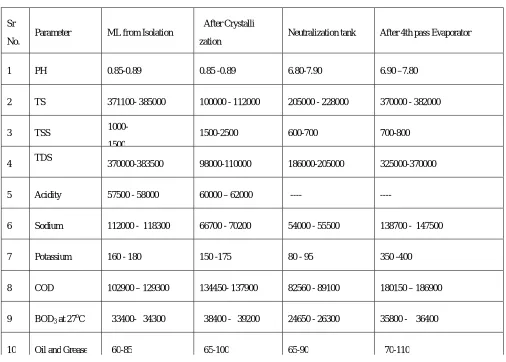
An Effluent Treatment Plant (ETP) is a unit plant, where various physical, biological and chemical processes are used to change the properties of the waste water by removing harmful substances in order to turn it into a type of water that can be safely discharged into the environment. Table 2 shows details of ETP plant unit from which this data is collected and Figure:2 shows total effluent (wastewater) generated per day. The wastewater coming out of H-Acid industries have very high toxicity as well as environmental degradation potential [3],[4]. Wastewater is characterized in terms of its physical, chemical and biological composition. The principal physical properties and the chemical and biological constitution of wastewater are reported in Table 3.
Figure:2 Water Balance Diagram
Table :2 ETP Units
Sr. No. Name of Unit
Dimension in meter
No. Of unit Length Width Height
1 Collection tank 3.0 3.0 4.0 1
2 Neutralization tank 3.0 3.0 4.0 1
3 Filter press (48 plates) --- --- --- 1
4 Holding tank 10.0 10.0 3.0 1
5 M.S. Holding tank (20 cu.m. ) --- --- ---- 2
6 Four effect Evaporator capacity (5000 l/hr) --- --- --- 1
Table : 3 The Characteristics of Effluent (all parameters are measure in mg/L except pH)
Experiment done as per standard producer.
IV.METHODSTOACHIEVEZERODISCHARGENORMSFORH-ACID
The detailed scientific study should be verified with the present installed equipments as under to achieve zero discharge of effluent:
1. Wastewater Strength reduction
a. Recovery of byproducts by use of Crystallizer. 2. Wastewater Volume reduction
a. Reduction in volume of wastewater by use of Multiple Effect Evaporator. 3. Complete Thermal Distraction.
Sr
No.
Parameter ML from Isolation
After Crystalli
zation
Neutralization tank After 4th pass Evaporator
1 PH 0.85-0.89 0.85 -0.89 6.80-7.90 6.90 –7.80
2 TS 371100- 385000 100000 - 112000 205000 - 228000 370000 - 382000
3 TSS 1000- 1500
1500-2500 600-700 700-800
4 TDS 370000-383500 98000-110000 186000-205000 325000-370000
5 Acidity 57500 - 58000 60000 – 62000 ---- ----
6 Sodium 112000 - 118300 66700 - 70200 54000 - 55500 138700 - 147500
7 Potassium 160 - 180 150 -175 80 - 95 350 -400
8 COD 102900 – 129300 134450- 137900 82560 - 89100 180150 – 186900
9 BOD3 at 27oC 33400- 34300 38400 - 39200 24650 - 26300 35800 - 36400
1. Wastewater Strength reduction
a. BY-PRODUCT RECOVERY:
This is the utopian aspect of industrial –waste treatment, the one phase of the entire problem, which may lead to economic gain. All wastes contain by-products, the exhausted material used in the process. Since some wastes are very difficult to treat at low cost, it is advisable for the industrial management concerned to consider the possibility of the building a recovery plant which will produce a marketable by-product and at the same time solve a troublesome waste problem. From the wastewater of H-Acid, Gluaber salt (Sodium Sulphate) is recovered through Crystallizer. Due to recovery of Gluaber salt (G-salt) strength of wastewater is reduce also volume of wastewater is reduce.
CRYSTALLIZER:
Principle: Crystallization is the formation of solid particles within a homogeneous phase. It may occur as the formation of the solid particles in a vapor, as solidification from a liquid melt, or as crystallization from liquid solution.
G-salt recovered by using Crystallizer: During manufacturing process of H-Acid Sodium Sulphate (G-Salt) is formed which is in soluble form. Sodium sulphate is recovered from Crystallizer which can be reused in process itself.
G-Salt ( Na2SO4.10H2O ) formed during reduction stage[1],[5],[6]:
Na 2CO3 + H2SO4 Na2SO4.10H2O + H2CO3
M.W. 106 M.W. 98 M.W. 322 M.W. 62
G-Salt formed = 322 X 750 = 2278 Kg/ t of Hacid 106
G-Salt (Na2SO4.10H2O ) formed during Isolation stage:
2NaOH + H2SO4 Na2SO4.10H2O
M.W. 80 M.W. 98 M.W. 322
G-Salt formed = 322 X 1450 =5836 Kg/ t of H acid 80
Total G-Salt formed = (2278 + 5836) = 8114Kg / t of H-Acid
G-Salt recovery is about 60%. So G-Salt recovered = 8114X 0.6 = 4868 Kg/ t of H-Acid Volume of effluent 23600 Kg/ t of H-Acid & Sp.Gr. 1.2
So Volume of effluent = 23600 / 1.2 = 19667 19700 L / t of H-Acid Volume reduction of effluent 4500 L due to recovery of G-Salt.
Net acidic volume for treatment after recovery of G-Salt = 19700 – 4500 = 15200 L / t of H-Acid
2. Wastewater Volume reduction[7]:
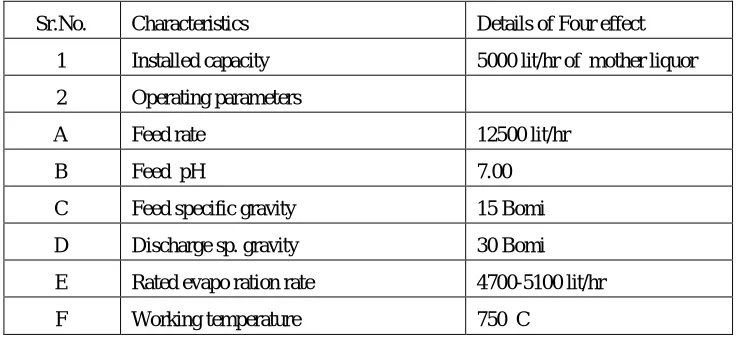
To reduce the volume of wastewater to be incinerated, Multiple Effect Evaporator is used. The main benefit of evaporator is the reduction of wastewater and the condensation from the evaporator, which is used as boiler feed water. Detailed regarding Multiple Effect Evaporator is shown in Table:4.
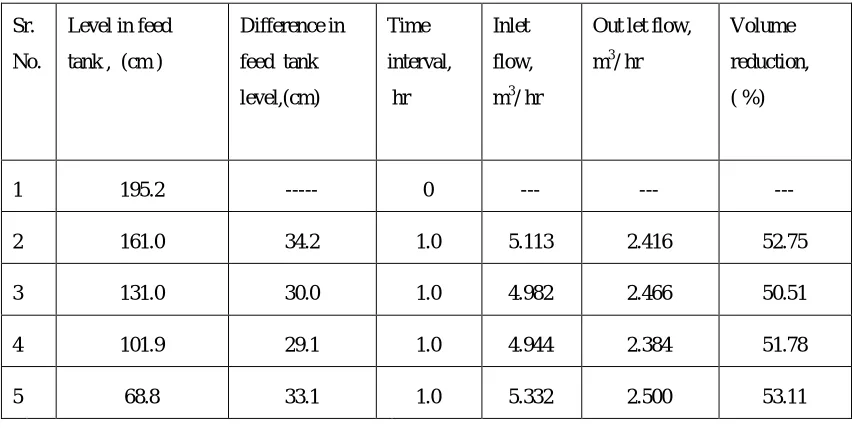
Procedure for measurement of Outlet Discharge rate of liquid from Four effect evaporator: To measure the outlet from four effect evaporator a 100 L capacity bucket is used. Total time required to fill bucket is find out by stopwatch and noted time (Table:5). The industry has installed incinerator of capacity about 6000 L / hr. So an attempt is find out actual incineration rate of incinerator. The data regarding incineration rate (Table 6) [8] and dimension of M.L. tank are mention below :
Dimension of M.L. tank:
Part-1 4.5 L(m) X 1.2 W(m) X 0.6 D(m), Part-2 3.4 L (m) X 1.2 W (m) X 1.7 D(m)
Hazardous (Solid waste generation) [9],[10] The effluent has very low pH, the acidic effluent has to be
neutralized to meet the standard set by G.P.C.B. for pH minimum as 6.5. For neutralization of wastewater
about 850 Kg Hydrated lime is used which produces sludge in the form of gypsum. Hence, sludge generation in
form of Gypsum will be as under [1],[5],[6]:
Ca(OH)2 H2SO4 CaSO4
.
2H2O
--- + --- ---
74 98 172
= 172 x 850 74
= 1975 Kg Say 2000 Kg/ t of H-Acid.
OR 2100 Kg to 2200 Kg Wet Cake basis 5 % to 10 % Moisture.
Table : 4 Details regarding Four Effect Evaporator
Sr.No. Characteristics Details of Four effect
1 Installed capacity 5000 lit/hr of mother liquor
2 Operating parameters
A Feed rate 12500 lit/hr
B Feed pH 7.00
C Feed specific gravity 15 Bomi
D Discharge sp. gravity 30 Bomi
E Rated evapo ration rate 4700-5100 lit/hr
Table : 5Level Measurement in Feed Tank of Four Effect Evaporator
Sr.
No.
Level in feed
tank , (cm )
Difference in
feed tank
level,(cm)
Time
interval,
hr
Inlet
flow,
m3/ hr
Out let flow,
m3/ hr
Volume
reduction,
( %)
1 195.2 --- 0 --- --- ---
2 161.0 34.2 1.0 5.113 2.416 52.75
3 131.0 30.0 1.0 4.982 2.466 50.51
4 101.9 29.1 1.0 4.944 2.384 51.78
5 68.8 33.1 1.0 5.332 2.500 53.11
Table : 6 Measurement of level in M.L. tank for Incineration Rate
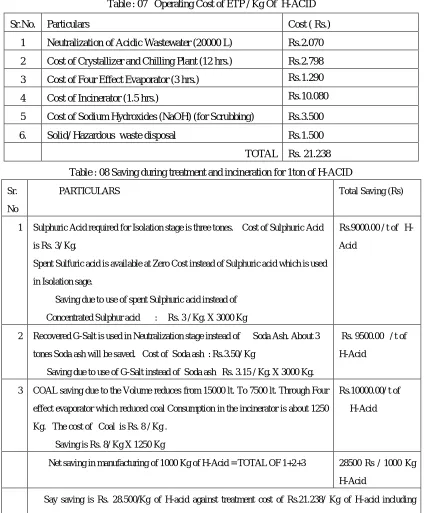
Effluent Treatment Plant (ETP) operation cost comes around 21.23 INR per Kgs of H-acid. Here cost of incineration is the highest and cost of the four effect evaporator is low (Table 7). As per table 8, if we consume spent Sulphuric acid from the process itself, it will save the cost. If we use recovered G-salt than consumption of soda ash will be reduced, which will reduce the cost and will be more environment friendly. Coal consumption for incineration will be reduced because of multiple effect evaporators. Hence total savings is going to be increased due to above measures. During Incineration Air pollution is generated is controlled by providing scrubbing system to achieve norms of C..P.C.B [4], [11].
Sr.
No.
Time
(hour )
Level in ML tank,( m)
M.L. incinerated,
L/ hr Difference of Level in part-1 Difference of Level in part-2
1 1:00 0.320 0.731 4710
2 1:00 0.342 0.713 4756
3 1:00 0.301 0.752 4693
Table : 07 Operating Cost of ETP / Kg Of H-ACID
Sr.No. Particulars Cost ( Rs.)
1 Neutralization of Acidic Wastewater (20000 L) Rs.2.070
2 Cost of Crystallizer and Chilling Plant (12 hrs.) Rs.2.798
3 Cost of Four Effect Evaporator (3 hrs.) Rs.1.290
4 Cost of Incinerator (1.5 hrs.) Rs.10.080
5 Cost of Sodium Hydroxides (NaOH) (for Scrubbing) Rs.3.500
6. Solid/ Hazardous waste disposal Rs.1.500
TOTAL Rs. 21.238
Table : 08 Saving during treatment and incineration for 1ton of H-ACID
Sr.
No
PARTICULARS Total Saving (Rs)
1 Sulphuric Acid required for Isolation stage is three tones. Cost of Sulphuric Acid
is Rs. 3/ Kg.
Spent Sulfuric acid is available at Zero Cost instead of Sulphuric acid which is used
in Isolation sage.
∴Saving due to use of spent Sulphuric acid instead of
Concentrated Sulphur acid : Rs. 3 / Kg. X 3000 Kg
Rs.9000.00 / t of
H-Acid
2 Recovered G-Salt is used in Neutralization stage instead of Soda Ash. About 3
tones Soda ash will be saved. Cost of Soda ash : Rs.3.50/ Kg
∴ Saving due to use of G-Salt instead of Soda ash Rs. 3.15 / Kg. X 3000 Kg.
Rs. 9500.00 / t of
H-Acid
3 COAL saving due to the Volume reduces from 15000 lt. To 7500 lt. Through Four
effect evaporator which reduced coal Consumption in the incinerator is about 1250
Kg. The cost of Coal is Rs. 8 / Kg .
∴Saving is Rs. 8/ Kg X 1250 Kg
Rs.10000.00/ t of
H-Acid
Net saving in manufacturing of 1000 Kg of H-Acid = TOTAL OF 1+2+3 28500 Rs / 1000 Kg
H-Acid
Say saving is Rs. 28.500/Kg of H-acid against treatment cost of Rs.21.238/ Kg of H-acid including
V. CONCLUSION
Based on the detailed study carried out and details presented above following conclusion have been drawn: 1. Average quantity of wastewater generation is 24 KL/ T of H-acid.
2. The G-salt recovery reduces the volume of wastewater by 4500 L.
3. The wastewater volume reduction achieved in Four Effect Evaporator is 7500 L.
4. The incinerator operates at 78% efficiency as the incineration rate is determined is 4700L/hr against the rated capacity of 6000L/hr.
5. The operating cost of installed facilities to achieve Zero discharge works out to be Rs. 21.238/ Kg of H-acid. 6. The quantity of sludge generated to achieve Zero discharge is 2.1 T/ T of H-acid.
REFERENCES
[1] Norman Donaldson, The Chemistry and Technology of Naphthalene Compounds, Edward Arnold ( Publishers ) Ltd.
[2] Warren L. McCabe, Julian C. Smith, Peter Harriott, Unit Operation of Chemical Engineering , Fifth Edition,1993, McGRAW –Hill, INC. [3] Nelson l. Nemerow, Industrial Water Pollution, Addison-Wesley Publishing Company.
[4] http://cpcb.nic.in/Industry-Specific-Standards/Effluent/DyeandDye_Inter_Indus.pdf.
[5] Sawyer, Clair N., McCarty, Chemistry for Environmental Engineering, Fourth Edition, 2003. [6] B I Bhatt, S M Vora, Stochiometry, Third Edition, 1996, Tata Mcgraw Hill, New Dehli
[7] Trivedi R. K., " Low Cost and Energy Saving Technologies for Water and Wastewater Treatment"Journal of Industrial Pollution Control 23(2) (2007) pp 403-411.
[8] http://www.handymath.com/cgi-bin/circlevali25.cgi
[9] Charles A. Wents, Hazardous Waste Management, Second Edition,1995, McGREW- Hill, inc.