Importance of Communication for Effective
Implementation of ITIL
®
Change
Management
Shivakumar N
Part-Time Research Scholar, Department of Policy Planning and Educational Research, National Institute of Technical Teachers Training & Research (NITTTR), Chennai, India
ABSTRACT: Communication ensures right people have the right information at the right time and supports change management’s process goals. Communications is at its most effective when individuals involved in different stages of Change Management are targeted with tailored communications. Clearly defining the role of Change Manager, a detailed Communication Plan, and Change Management interfaces with other Information Technology Infrastructure Library (ITIL®) service management processes across the service lifecycle will help to improve the communication for effective implementation of ITIL® Change Management.
KEYWORDS: ITIL®, Change Management, Communication, Change Manager I. INTRODUCTION
IT Service Management is concerned with delivering and supporting IT services that are appropriate to the business requirements of the organization. ITIL® provides a comprehensive, consistent and coherent set of best practices for IT Service Management processes. IT service providers are striving to improve the quality of the service, but at the same time they are also trying to reduce the costs or, at a minimum, maintain costs at the current level. The ITIL® Change Management is aimed at lessening risks of impact, exposure as well as disruption to business services. Effective ITIL® Change Management protects both the business services and facilitates easy changes without the unnecessary control or bureaucracy.
In today’s fast-moving market, the ability to easily and appropriately handle change is even more important than before; that is why IT organizations need to implement and automate best practices for the entire end-to-end Change Management lifecycle. Only those IT organizations that embrace this disciplined approach to change management will be able to deliver the operational agility essential for service excellence [1][2]. For implementing a change successfully, communication is the key and one of the most complex parameters as it involves an exchange of ideas and feelings with people in an organization through various mediums.
II. WHAT IS CHANGE MANAGEMENT
Type of changes
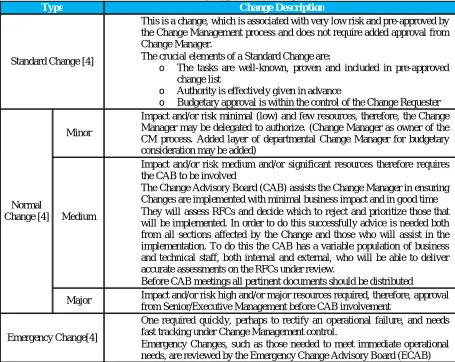
Whatever maybe the type of change, in the absence of sufficient two-way conversation or effective communication across all the levels, the change effort may fail to meet its objectives. If a communication plan is designed efficiently and clearly, it helps in building awareness and in getting the subsequent support in the entire team. The organisation / business need to ensure that appropriate procedures and communication are available to cover the different types of change requests.
Change Types
Table 1: Change Type and its description
Type Change Description
Standard Change [4]
This is a change, which is associated with very low risk and pre-approved by the Change Management process and does not require added approval from Change Manager.
The crucial elements of a Standard Change are:
o The tasks are well-known, proven and included in pre-approved change list
o Authority is effectively given in advance
o Budgetary approval is within the control of the Change Requester
Normal Change [4]
Minor
Impact and/or risk minimal (low) and few resources, therefore, the Change Manager may be delegated to authorize. (Change Manager as owner of the CM process. Added layer of departmental Change Manager for budgetary consideration may be added)
Medium
Impact and/or risk medium and/or significant resources therefore requires the CAB to be involved
The Change Advisory Board (CAB) assists the Change Manager in ensuring Changes are implemented with minimal business impact and in good time
They will assess RFCs and decide which to reject and prioritize those that will be implemented. In order to do this successfully advice is needed both from all sections affected by the Change and those who will assist in the implementation. To do this the CAB has a variable population of business and technical staff, both internal and external, who will be able to deliver accurate assessments on the RFCs under review.
Before CAB meetings all pertinent documents should be distributed
Major Impact and/or risk high and/or major resources required, therefore, approval from Senior/Executive Management before CAB involvement
Emergency Change[4]
One required quickly, perhaps to rectify an operational failure, and needs fast tracking under Change Management control.
sending inconsistent signals or not communicating enough; dictating change without communicating the benefits (Prosci, [7]).
The Change Manager is responsible for reviewing submitted RFCs, scheduling CAB meetings, authorizing changes, updating change records, coordinating the build/test/implementation of changes, reviewing implemented changes, producing reports, and improving the change process.
The Change Manager using a Forward Schedule of Changes (FSC) or Change Schedule will communicate to all stakeholders upcoming changes that may impact them. The FSC along with projected service outages (PSO), or expected deviations in service availability, will be taken into consideration when coordinating change implementation. Release and Deployment will be responsible for implementation and coordination of training needs.
Forward Schedule of Changes (FSC) – A forward schedule of changes is a listing of upcoming changes which are be scheduled and communicated to other IT service management processes and to the rest of the company. The forward schedule of changes shows the changes that have been approved and given a date for implementation.
The Projected Service Outages (PSO) contains details of changes to agreed SLAs and service availability because of the currently planned FSC in addition to planned downtime from other causes such as planned maintenance and data backup. These documents are agreed with the relevant customers within the business, with service level management, with the service desk and with availability management. Once agreed, the service desk should communicate any planned additional downtime to the user community at large, using the most effective methods available.
IV.COMMUNICATION PLAN
The change management process Communication Plan describes how information will be handled during the change management life-cycle. It ensures right people have the right information at the right time and supports change management’s process goals.
It includes:
Describing how timely, relevant information will be delivered to key stakeholders to quickly remove roadblocks, resolve issues and minimize the impact of change within the organization.
Detailing the communication necessary to facilitate a smooth transition for staff with minimal disruption to daily organizational operations.
Demonstrating how the change management process activities will be communicated so that it fosters enthusiasm and obtains buy-in across the organization.
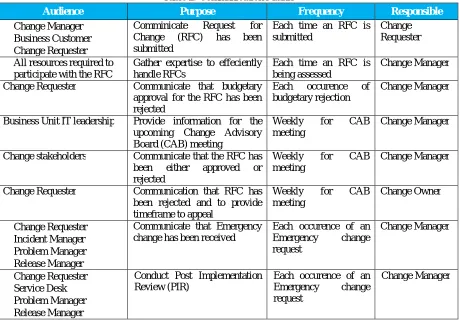
Communication Matrix: The details of the Communication Plan are provided in matrix format to facilitate use of the information.
Table 2: Communication Matrix
Audience Purpose Frequency Responsible
Change Manager
Business Customer
Change Requester
Comminicate Request for Change (RFC) has been submitted
Each time an RFC is submitted
Change Requester All resources required to
participate with the RFC
Gather expertise to effeciently handle RFCs
Each time an RFC is being assessed
Change Manager Change Requester Communicate that budgetary
approval for the RFC has been rejected
Each occurence of budgetary rejection
Change Manager
Business Unit IT leadership Provide information for the upcoming Change Advisory Board (CAB) meeting
Weekly for CAB meeting
Change Manager
Change stakeholders Communicate that the RFC has been either approved or rejected
Weekly for CAB meeting
Change Manager
Change Requester Communication that RFC has been rejected and to provide timeframe to appeal
Weekly for CAB meeting
Change Owner
Change Requester
Incident Manager
Problem Manager
Release Manager
Communicate that Emergency change has been received
Each occurence of an Emergency change request
Change Manager
Change Requester
Service Desk
Problem Manager
Release Manager
Conduct Post Implementation Review (PIR)
Each occurence of an Emergency change request
Change Manager
V. INTER - RELATED ITIL® PROCESSES
For effective communication, Change Management interfaces with other ITIL® service management processes across the service lifecycle. The key processes are:
a) Problem Management
Some of the benefits of implementing a CMDB for Change Management are:
Enforcement of consistent communication between Customers and IT
Effective management of RFC's and Configuration Items
Standardized procedures for managing Change Control across disciplines
Reduced unplanned work due to cascading impacts of changes
Coordinated planning of changes across IT organization
c) Release and Deployment Management
Change Management manages the change and coordinates the build, test and implementation with the release and deployment process. These two processes are so integrated that they should look like one process because of the handoffs. This helps with serviced orientation and removing process silos or what is known as the “throw it over the fence” approach to implementation. Release Manager should send advanced communication of release to all stakeholders. Communication should include:
Proposed date of Release
Purpose of Release
d) IT Service Continuity Management
In an effort to minimize and manage risks that can negatively impact the business, IT Service continuity ensures necessary IT services are resumed within their minimum agreed to service levels. Regular review of the whole BCP is needed. For IT this is required whenever there is a significant change to any component of production systems/services. Such changes should be done through ITIL® Change Management and communicated to the ITIL®Service Continuity Manager so as to assess impact before implementation.
e) Security Management
Each change that occurs will be evaluated for its impact on security. From an ITIL® perspective, the ISMS addresses: Security policy and supporting policies; Security plan; Security organizational structure; Management of security risks; Communication strategy and plan for security.
f) Knowledge Management
Helps ensure decision support for changes. This includes coordination and collaboration with other process areas for evolving data, information and knowledge for service oriented decisions.
VI.RECOMMENDATIONS
Ensure that all stakeholders receive appropriate and timely communication about change so that they are aware and ready to adopt and support the change
VII. CONCLUSION
Communications plans needs to cater to all stakeholders impacted by the change and ensure that the entire IT staff is kept informed on changes and developments on a consistent basis and in a way which creates value to each of the teams. Since change is ongoing, automating change processes, notifications and communications will help streamline the change process and motivate buy-in.
Whatever solution is adopted, based on organizational structure and ITIL® maturity, the secret of the success of the interfaces between various key ITIL® Processes lies in good communication and involvement between the organization and the service management functions. An effective communication channel should be established as soon as possible between the organization and the service management functions.
REFERENCES
[1.] Rob Addy, “Effective IT Service Management: To ITIL and Beyond” Springer, Berlin, 1st edition, pp.89-91, 2007.
[2.] Technology Brief: “Change Management: A CA Service Management Process Map”, http://www.ca.com/files/technologybriefs/change_mgmt _tb.pdf , 2011
[3.] EduTech Wiki, “Change Management", http://edutechwiki.unige.ch/en/Change management, 2010
[4.] Arvind Rongala, “Importance of IT Communications in ITIL Implementation”, https://www.invensislearning.com/blog/importance-of-it-communications-in-itil-implementation/, 2015
[5.] Office of Government Commerce:, “Service Transition”, The Stationary Office, London, United Kingdom, pp 46-50, 2007 [6.] Kotter, J.P., “Leading change: Why transformation efforts fail”, Harvard Business Review, March-April, pp.59-67, 1995
[7.] Prosci, “Best Practices in Change Management”, Prosci Benchmarking Report. Loveland, CO: Learning Center Publications. p. 4-17, 2003 [8.] Elving, W. J.L., “ The role of communication in organizational change”, Corporation Communication, An International Journal, Vol.10,
pp129-138, 2005
[9.] Soltani, E., Lai, P. & Mahmoudi, V. “Managing Change Initiatives: Fantasy or Reality? The Case of Public Sector Organisations”, Total Quality Management & Business Excellence, 18(1), pp. 153-179, 2007