More Powerful Tests from Confidence Interval
PValues
Roger L. Berger
Department of Statistics
North Carolina State University
Raleigh, NC 27695-8203
December 20, 1995
Institute of Statistics Mimeo Series No. 2281
Abstract
In this article, the problem of comparing two independent binomial populations is considered. It is shown that the test based on the confidence intervalpvalue of Berger
and Boos (1994) often is uniformly more powerful than the standard unconditional test. This test also requires less computational time.
KEY WORDS: Binomial, Confidence interval, Contingency table, Homogeneity test, Independence,P value, 22 table.
1
INTRODUCTION
The problem of comparing two binomial proportions has been considered for many years. The most commonly used test is Fisher’s Exact Test (Fisher, 1935), a conditional test. Barnard(1945, 1947) proposed an unconditional test for this problem. Although uncon-ditional tests are usually more powerful than conuncon-ditional tests, they are computationally much more complex. But recent advances in computing have made unconditional tests practical, and they are beginning to appear in statistical software packages such as
StatXact 3 for Windows. In this article it is shown that unconditional tests based on the confidence interval
p
value of Berger and Boos (1994) are often uniformly more powerful than the standard unconditional tests.and the success probability is
p
1. The sample size forY
isn
and the success probabilityis
p
2. The binomial probability mass function ofX
will be denoted byb
(x
;m;p
1)=C
m
x
p
x
1(1?p
1)m
?x
; x
=0
;:::;m;
where
C
x
m
=m
!=x
!=
(m
?x
)! is the binomial coefficient. Similarly,b
(y
;n;p
2)will denote the
binomial probability mass function of
Y
. The sample space of(X;Y
) will be denoted byX =f0
;:::;m
gf0;:::;n
g. X contains(m
+1)(n
+1) points.This kind of data is often displayed in a 22 contingency table as follows.
yes no
Population 1
X
m
?X
m
Population 2
Y
n
?Y
n
R
=X
+Y t
?R t
=m
+n
In this table, upper case letters denote random variables and lower case letters denote known constants fixed by the sampling scheme. So,
t
is the total sample size, andR
is the observed number of successes. Conditional inference is based on the conditional distribution ofX
andY
, given the observed marginalR
=r
=x
+y
.Consider the problem of testing
H
o
:p
1 =p
2 versus
H
a
:p
1< p
2:
(1)
Exact tests for this problem will be considered. The sizes of the tests are computed using the exact binomial distributions, not normal or chi-squared approximations. The standard Neyman-Pearson paradigm of restricting consideration to level-
tests and then comparing the powers of these tests will be followed. For a specified error probability, all tests considered are level- tests. Tests that are liberal, that sometimes have type-I error probabilities that are greater than, are not considered. However, the tests do not have sizes exactly equal to the specified. Because of the discrete nature of this data, equality can (usually) be achieved only with a randomized test. Because randomized tests are not of any practical interest, this article considers only nonrandomized tests.this debate. The purpose of this article is not to continue this debate. Rather, suffice it to say that this article is relevant to those situations in which the unconditional analysis is appropriate.
2
USUAL UNCONDITIONAL TEST
Barnard (1945, 1947) first proposed an unconditional test for this problem. Because of the computational difficulty of unconditional tests, they were not widely used until recently. NOw, computing technology makes the use of unconditional tests feasible.
A commonly used unconditional test is the the
Z
test proposed by Suissa and Shuster (1985) and Haber (1986). Define theZ
-pooled statistic (score statistic) asZ
(x;y
)=^
p
2?p
^1 r^
p
(1?p
^)1
m
+1
n
;
where
p
^1 =x=m
,p
^2 =y=n
, andp
^= (x
+y
)=
(m
+n
), the pooled estimate ofp
1 =p
2 =p
under
H
o
. Then, thep
value for testing (1), using the test statisticZ
, isp
Z
(x;y
)= sup0
p
1P
p
?Z
(X;Y
)Z
(x;y
)= sup
0
p
1X
(
a;b
)2R
Z(
x;y
)b
(a
;m;p
)b
(b
;n;p
);
(2)
where
R
Z
(x;y
) = f(a;b
) : (a;b
) 2 X andZ
(a;b
)Z
(x;y
)g. Thep
value is the maximumprobability under
H
o
of observing a value of the test statistic equal to or more extreme than the value observed in the data. This is a standard definition of ap
value, such as is found in Bickel and Doksum (1977, Section 5.2.B). Rejection ofH
o
if and only ifp
Z
defines a level- test of (1). The calculation of the supremum in (2) must bedone numerically. Typically there is no simple formula for this value. This numeric maximization has been the cause of the computational difficulty of unconditional tests.
3
CONFIDENCE INTERVAL P VALUE
Berger and Boos (1994) proposed a new method of computing a
p
value. In the problem of comparing two binomial proportions, ifH
o
is true,p
=p
1=p
2 is a nuisance parameter.Let
C
(x;y
)denote a 100(1?)% confidence interval forp
calculated from the data(x;y
)and Pearson (1934) interval based on
X
+Y
, a binomial(m
+n;p
) random variable ifp
1 =p
2 =p
. This interval is easily computed from the formulaa
a
+(b
?a
+1)F
2(
b
?a
+1);
2a;=
2p
(
a
+1)F
2(
a
+1);
2(b
?a
);=
2b
?a
+(a
+1)F
2(
a
+1);
2(b
?a
);=
2(3)
where
a
=x
+y
,b
=m
+n
, andF
;;=
2is the upper 100(=
2)percentile of anF
distributionwith
and degrees of freedom.The confidence interval
p
value, based on the statisticZ
is defined byp
C
(x;y
) = supp
2C
(
x;y
)P
p
?Z
(X;Y
)Z
(x;y
)+
= 0 @ sup
p
2C
(
x;y
)X
(
a;b
)2R
Z(
x;y
)b
(a
;m;p
)b
(b
;n;p
) 1 A+
;
where
R
Z
(x;y
) is the same as in the definition ofp
Z
.p
C
differs fromp
Z
in that thesupremum is taken over the confidence interval
C
(x;y
) rather than over the wholerange 0
p
1, and the error probability is added to the supremum. If = 0,p
C
is the same as
p
Z
. Berger and Boos (1994) showed that this modification of the usual definition of ap
value yields a validp
value. That is, the test that rejectsH
o
if and only ifp
C
(X;Y
) is an unconditional level- test. The error probability is specified by theexperimenter. Different values of
yield differentp
values and tests. In this article, =:
001 is used (as suggested by Berger and Boos).Berger and Boos proposed the confidence interval based
p
value for two reasons. The first is computational. In bothp
Z
andp
C
, the function to be maximized is the same. The maximization over the smaller set,C
, can be much simpler. The second is statistical. Having observed the data, we should be able to estimatep
and should not need to consider values ofp
that are completely unsupported by the data. Inp
C
, only those “plausible” values that are in the confidence interval are considered.This article points out that the confidence interval
p
value can have a third advan-tage. It can produce tests with higher power than the usualp
value. And, remember, this is achieved with less computational effort.4
EXAMPLE
An enumeration of
p
Z
(x;y
) for all the sample points in X shows that the point(
x;y
) = (23;
15) has the largest value ofp
Z
(x;y
) that is less than or equal to =:
10.Z
(23;
15)=1:
454 andp
Z
(23;
15)=:
0823. The sample point with the next smaller valueof
Z
is (x;y
) = (0;
1) withZ
(0;
1) = 1:
407 andp
Z
(0;
1) =:
1548. So (0;
1), or any othersample point with a smaller value of
Z
, is not in the level=:
10 rejection region basedon
p
Z
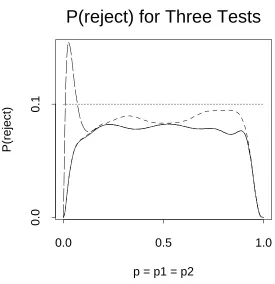
.Let the p value functionfor a sample point(
x;y
)be defined byZ
(p
;x;y
)=X
(
a;b
)2R
Z(
x;y
)b
(a
;m;p
)b
(b
;n;p
):
(4)
The
p
value function is the function that is maximized in calculatingp
Z
andp
C
. In Figure 1,Z
(p
; 23;
15) (solid line) andZ
(p
; 0;
1) (long dashed line) are shown.Z
(p
; 23;
15)<
:
10 = for all values ofp
. Its maximum value isp
Z
(23;
15) =:
0823 which occurs atp
=:
524. Becausep
Z
(23;
15) is the largestp
value not exceeding =:
10, .0823 is alsothe actual size of the level
=:
10 test constructed usingp
Z
. The addition of the singlesample point (0
;
1) to the rejection region causes a large spike to appear inZ
(p
; 0;
1).The maximum of
Z
(p
; 0;
1)isp
Z
(0;
1)=:
1548 which occurs atp
=:
026. It is not unusualfor the addition of a single sample point with
x
+y
close to 0 orm
+n
to create a spikelike this.
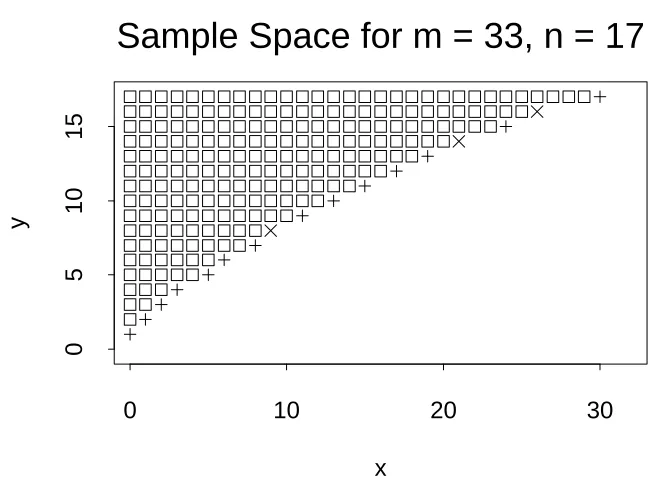
In Figure 2, the sample points in X with
p
Z
(x;y
):
10 are marked by 2’s. Theseare the elements of the level
=:
10 rejection region defined byp
Z
. Because the actualsize of this test is only .0823, not too close to
=:
10, it seems possible that some morepoints, some of the points marked by ’s and +’s, for example, might be added to this
rejection region and the resulting test could still be level
=:
10. The points markedby+’s and ’s are the points that satisfy the “convexity” property of Barnard (1947). It
would take a great deal of computation to try each point individually, then try pairs or triples of points, to determine points that could be added. But the use of the confidence interval
p
value easily identifies some points that can be added.Consider(
x;y
)=(21;
14)withZ
(21;
14)=1:
368. There are four sample points withZ
(21;
14)< Z
(x;y
)< Z
(23;
15), namely,Z
(0;
1) = 1:
407,Z
(26;
16) = 1:
401,Z
(9;
8) =1
:
399, andZ
(3;
4)=1:
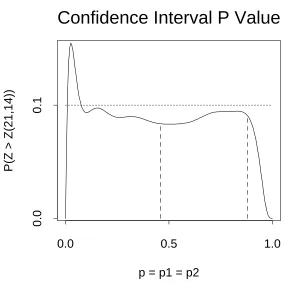
394. Thep
value functionZ
(p
; 21;
14)is shown in Figure 3. Themaximum of this function, .1549, is greater than .10 because
Z
(0;
1)> Z
(21;
14). Butcalcu-P(reject) for Three Tests
p = p1 = p2
P(reject)
0.0
0.5
1.0
0.0
0.1
Figure 1:
P
(reject) for three rejection regions defined by fZ
Z
(23;
15)g (solid line),f
Z
Z
(0;
1)g(long dashes), and fp
C
:
10g(short dashes).lated from the data (
x;y
) = (21;
14). Using (3), this confidence interval is [:
459;:
881].These confidence limits are shown in Figure 3. The maximum of
Z
(p
; 21;
14) overthis interval is .0946 and this maximum occurs at
p
=:
830. Therefore,p
C
(21;
14) =:
0946+ =:
0946+:
0010 =:
0956. Because,p
C
(21;
14):
10, (21;
14) is in the level =:
10 rejection region defined byp
C
. In addition, two other points are in the level =:
10 rejection region defined byp
C
. These are (26;
16) withp
C
(26;
16) =:
0949 and(9
;
8) withp
C
(9;
8)=:
0906. These three added points are the points marked with’s inFigure 2.
Because the rejection region of the level
=:
10 test defined byp
Z
is a propersubset of the rejection region of the level
=:
10 test defined byp
C
, the test defined byp
C
is uniformly more powerful.The probability of the level
=:
10 rejection region defined byp
C
, that is, theSample Space for m = 33, n = 17
x
y
0
10
20
30
0
5
10
15
Figure 2: 2’s are sample points in level
=:
10 test defined byp
Z
. +’s and ’s aresample points that might be added. ’s are three points added by test defined by
p
C
.is graphed in Figure 1 with a short dashed line. This probability is less than .10 for all values of
p
, because this is a level =:
10 test. But this probability is much closer to.10 than the probability of the rejection region for the Suissa and Shuster test defined by
p
Z
. The actual size of thep
C
test is .0946, the maximum of this function.5
CONSISTENCY OF IMPROVEMENT
In the previous section it was shown that, for
=:
10 and (m;n
) = (33;
17), thecon-fidence interval
p
value defines a uniformly more powerful, level- test than the usual unconditionalp
value. The question arises as to the generality of this phenomenon. To investigate this we enumerated the level- rejection regions defined byp
Z
andp
C
for =:
10, .05 and .01 for each of nine different sample sizes, (m;n
) = (10;
10), (13;
7),(16
;
4), (25;
25), (33;
17), (40;
10), (50;
50), (65;
35), and (80;
20). These sample sizesConfidence Interval P Value
p = p1 = p2
P(Z > Z(21,14))
0.0
0.5
1.0
0.0
0.1
Figure 3: Confidence interval
p
valuep
C
(21;
14) =:
0956 is the maximum ofZ
(p
; 21;
14)+:
001 over the 99.9% confidence interval [:
459;:
881].Z
(p
; 21;
14) is thefunction shown and the confidence interval is marked by vertical lines.
In 15 out of the 27 cases, the rejection region defined by
p
Z
is a proper subset of the rejection region defined byp
C
. So the confidence intervalp
value defines a uniformly more powerful, level-test. In another 9 out of the 27 cases, the rejection regions defined by the twop
values are exactly the same. In one case, =:
01 and (m;n
) = (50;
50),neither rejection region contained the other and the power functions of the two tests crossed. In the remaining two cases.
=:
01 and (m;n
) = (13;
7) and (25;
25), therejection region defined by
p
C
is a proper subset of the rejection region defined byp
Z
, andp
Z
defines a uniformly more powerful test. The power functions for the nine tests with=:
10 are described more fully by Berger (1994).all cases, the computation required for
p
C
is less than that required forp
Z
.The reason that the rejection region defined by
p
C
usually contains the rejection region defined byp
Z
is the following fact. If there is no sample point in X such that ?< p
Z
(x;y
), then every sample point withp
Z
(x;y
) also satisfiesp
C
(x;y
).That is, every sample point in the level-
rejection region defined byp
Z
is also in the level- rejection region defined byp
C
. This fact is true because, ifp
Z
(x;y
) , thenp
Z
(x;y
)?, and, hence,p
C
(x;y
) = supp
2C
(
x;y
)P
p
?Z
(X;Y
)Z
(x;y
)+
sup
0
p
1P
p
?Z
(X;Y
)Z
(x;y
)+
=
p
Z
(x;y
)+(
?)+=:
When
is small compared to, as with the =:
001 recommended by Berger and Boos(1994) that is used in this article, it often happens that there is no sample point with
?< p
Z
(x;y
) . In such cases the test defined byp
C
will be at least as powerfulas the test defined by
p
Z
. Note, this property applies in general to confidence intervalp
values, not just this problem and this test statisticZ
.6
OTHER TEST STATISTICS
Other statistics besides
Z
(x;y
), such as the likelihood ratio test statistic andp
^2 ?p
^1,can be used to test (1). Santner and Duffy (1989, Exercises 5.11 and 5.12), Haber (1987), and Mart´in and Silva (1994) list several possible statistics. The experience with
Z
suggests that if another statistic is used, the confidence intervalp
value might provide improved power over the usual unconditionalp
value.The power comparisons of Haber (1987) and Mart´in and Silva (1994) suggest that the two statistics
Z
(x;y
) andB
(x;y
)=min(
n;x
+y
) Xa
=y
C
x
m
+y
?a
C
na
C
tx
+y
produce tests with the highest power. The statistic
B
(x;y
)was first proposed by BoschlooFisher’s Exact Test (Fisher, 1935). Here,
B
(x;y
) is not used as ap
value, but, rather, asa statistic to order the sample points. Small values of
B
(x;y
)give evidence forH
a
so theunconditional
p
value based onB
(x;y
)isp
B
(x;y
)= sup0
p
1P
p
?B
(X;Y
)B
(x;y
)= sup
0
p
1X
(
a;b
)2R
B(
x;y
)b
(a
;m;p
)b
(b
;n;p
);
where
R
B
(x;y
)=f(a;b
): (a;b
)2X andB
(a;b
)B
(x;y
)g. The confidence intervalp
valuebased on
B
is defined as in (4), namely,p
CB
(x;y
)= 0 @ supp
2C
(
x;y
)X
(
a;b
)2R
B(
x;y
)b
(a
;m;p
)b
(b
;n;p
) 1 A+
:
Berger (1994) found that the
p
value functionB
(p
;x;y
) tends to be flatter thanZ
(p
;x;y
), especially for unequal sample sizes. This agrees with Mart´in and Silva’s(1994) finding that the unconditional test based on
B
usually has higher power than the test based onZ
, especially whenm
6=n
. So there is less room for improvement ofBoschloo’s test. But, Berger (1994) found that, as with
p
Z
andp
C
, the confidence intervalp
value,p
CB
, usually defined a test that was the same or uniformly more powerful than the test defined byp
B
.In comparing the tests based on the two confidence interval
p
values, Berger (1994) did not find a clear preference. Usually the power functions of these two tests crossed with one test having higher power for some parameter values and the other having higher power for other parameter values. Usually, the power function defined byp
CB
was higher on a majority of the parameter space.In their power comparison of tests for (1), Mart´in and Silva (1994) considered two computationally intensive tests they called
M
andM
0.
M
is the test proposed by Barnard (1945, 1947), andM
0is a simplified version of
M
. Both methods involve construction of a rejection region by adding one sample point at a time, with a good deal of computation required to determine which point is added next. Mart´in and Silva report thatM
0and
M
require about 10 and 85 times the computation time required byp
Z
orp
B
, respectively. But,M
andM
0do provide some improvement in power. In this article it has been shown that confidence interval
p
values provide an improvement in power overp
Z
orp
B
, but withlesscomputation. It remains to be determined if the improvement in power provided by
p
C
orp
CB
is comparable to the improvement provided byM
07
CONCLUSIONS
Confidence interval
p
values can improve the power of standard unconditional tests for comparing two binomial populations. They also require less computational effort. Thus, they offer a promising new method for the analysis of 22 tables.Similar, but less extensive, comparisons have have been made for two-sided tests. The results are qualitatively the same. The confidence interval
p
value often defines a more powerful test than the standardp
value.XUN2X2 is a FORTRAN program that will compute the standard and confidence interval
p
values discussed in this article. The program will also perform uncondi-tional tests for multinomial, rather than two independent binomials, 2 2 tables.XUN2X2 may be obtained by sending the one line message “get exact from general” to [email protected].
References
Barnard, G. A. (1945). A new test for 22 tables. Nature, 156:177.
Barnard, G. A. (1947). Significance tests for 22 tables. Biometrika, 34:123–138.
Berger, R. L. (1994). Power comparison of exact unconditional tests for comparing two binomial proportions. Technical Report 2266, North Carolina State University Statis-tics Department.
Berger, R. L. and Boos, D. D. (1994).
P
values maximized over a confidence set for the nuisance parameter. Journal of the American Statistical Association, 89:1012–1016.Bickel, P. J. and Doksum, K. A. (1977).Mathematical Statistics: Basic Ideas and Selected Topics. Holden-Day, San Francisco.
Boschloo, R. D. (1970). Raised conditional level of significance for the 22-table when
testing the equality of two probabilities. Statistica Neerlandica, 24:1–35.
Fisher, R. A. (1935). The logic of inductive inferences. Journal of the Royal Statistical Society, Series A, 98:39–54.
Greenland, S. (1991). On the logical justification of conditional tests for two-by-two contingency tables. American Statistician, 45:248–251.
Haber, M. (1986). An exact unconditional test for the 22 comparative trial.Psychological
Bulletin, 99:129–132.
Haber, M. (1987). A comparison of some conditional and unconditional exact tests for 22 contingency tables. Communications in Statistics–Simulation and Computation,
16:999–1013.
Little, R. J. A. (1989). Testing the equality of two independent binomial proportions.
American Statistician, 43:283–288.
Mart´in Andr´es, A. and Silva Mato, A. (1994). Choosing the optimal unconditioned test for comparing two independent proportions.Computational Statistics and Data Anal-ysis, 17:555–574.
McDonald, L. L., Davis, B. M., and Milliken, G. A. (1977). A nonrandomized uncondi-tional test for comparing two proportions in 22 contingency tables. Technometrics,
19:145–157.
Mehta, C. and Patel, N. (1995). StatXact 3 for Windows: User Guide. Cytel Software, Cambridge, MA.
Santner, T. J. and Duffy, D. E. (1989). The Statistical Analysis of Discrete Data. Springer-Verlag, New York.
Suissa, S. and Shuster, J. J. (1985). Exact unconditional sample sizes for the 22