Implementation of DNA algorithm and Image
Steganography for Data Security
Akash Pardhi, Prof. Ram Joshi
Student, Department of CE, Indira College of Engineering and Management, Parandwadi, Pune, Savitribai Phule Pune
University Pune India.
Department of CE, Indira College of Engineering and Management, Parandwadi, Pune, Savitribai Phule Pune
University Pune India.
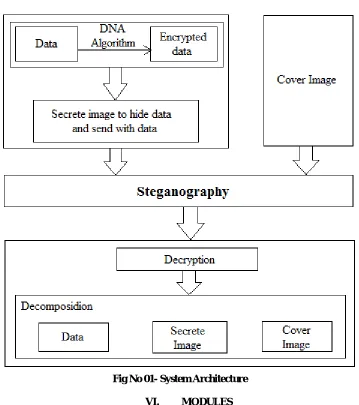
ABSTRACT:The rapid development in information technology needs the secure transmission of confidential data which gets a great deal of attention. The information could be accessed by the unauthorized user for malicious purpose. Therefore, it is necessary to apply effective encryption/decryption methods to enhance data security. On other hand to secured and convenient data transmission over internet, steganography is one of leading technologies being used around the globe for long time. With inclusion of newer cover media and stronger algorithms we can deal with the latest attacks. DNA steganography is one such name.In Implementation of DNA algorithm and Image Steganography for Data Security,first we encrypt data with the help of DNA algorithm and then we select secrete image which we want to transfer with data and that secrete image is also used to hide encrypted data. Second we hide data and secrete image by cover image with the help of ImageSteganography. DNA encoding is one of the most secure encryption and decryption technique. By using DNA algorithm we perform encryption and decryption operation.
KEYWORDS: DNA, Image Steganography, logistic map,DNA algebra, LSB, DNA components, PSNR, DNA Algorithm.
I. INTRODUCTION
II. LITERATURE SURVEY
Mohammad Reza Najaf Torkaman, Pourya Nikfard, Nazanin Sadat Kazazi, Mohammad Reza Abbasy and S. Farzaneh Tabatabaiee(2011) have represent Improving Hybrid Cryptosystems with DNA Steganography[1].The author proposes new cryptography protocol based on DNA steganography to reduce the usage of public cryptography to exchange session key. In this protocol session key between sender and receiver is hidden by DNA data hiding technique. Therefore, the attackers are not aware of transmission of session key through unsecure channel.
Hayam Mousa, Kamel Moustafa, Waiel Abdel-Wahed and MohiyHadhoud(2011) have proposed Data Hiding Based on Contrast Mapping Using DNA Medium[2].The author applies reversible information hiding scheme on deoxyribo nucleic acid sequence by using the reversible contrast mapping technique. The reversible property makes the secret data hidden in anywhere in deoxyribo nucleic acid without altering the functionalities because the original deoxyribo nucleic acid sequence can be recovered exactly in our scheme.
Meenakshi S Arya, Nikita Jain, Jai Sisodia and NukulSehga(2011) have developed DNA Encoding Based Feature Extraction for Biometric Watermarking[3].The author represents secure the digital code of a watermark (which is an offline handwritten signature) by using the characteristics of DNA. The watermarked image is embedded into the image as binary information and further encrypted as DNA sequences and these DNA sequences (after being grouped as tri - nucleotide sequences called codons) then attached to particular proteins or amino acids to enhance redundancy of our secret data. Similarly during decryption the DNA coded data is converted into binary by using base conversion and this binary information is then used to reform the hidden data.
Suman Chakraborty and Prof. Samir Kumar Bandyopadhyay(2012) have represents Two Stages Data-Image Steganography Using DNA Sequence[5].The author introduces a method in which Secret information is hidden within the Cover image and Cover image is hidden within DNA sequence. The two steps steganography approachis used where Secret information has been hidden in more depth than general steganography approach. Due to approach unauthorized person may consider Cover image as Secret information. This is a great advantage with respected to security.
Akanksha Agrawal, AkanshaBhopale, Jaya Sharma, Meer Shizan Ali, DivyaGautam(2012) has represents Implementation of DNA algorithm for secure voice communication[10].The author proposed a secure and computationally feasible encryption/decryption algorithm based on DNA components. This algorithm includes the four major DNA components which are serving the purpose of translating the received voice commands from the text form to an uncanny form, thus providing the secure voice communication by preventing eavesdropping and pilfering of data in a punctilious way. The main scope of this paper is to propose an algorithm to protect voice messages and making it secure using recent DNA algorithm.
Advantage:
1) Improve security.
2) No any information is revealed to the attacker.
Overview of DNA:
DNA, or deoxyribonucleic acid, is the hereditary material in humans and almost all other organisms. Nearly every cell in a person’s body has the same DNA. Most DNA is located in the cell nucleus (where it is called nuclear DNA), but a small amount of DNA can also be found in the mitochondria (where it is called mitochondrial DNA or mtDNA). The information in DNA is made up of four bases which combine to form chains. These bases include two purines (Adenine and Guanine) and two pyrimidines (Cytosine and Thymine).These are commonly referred to as A, G, C and T respectively.
DNA encoding:
DNA encoding is a binary coding scheme by which we can represent the 4 nucleotides by 2bit/3bit equivalent codes. The number of possible coding patterns is 4! = 24. One such is- A = 0(00), T = 1(01), C = 2(10), G = 3(11) [3].
Codon:
Triplets of consecutive bases in a base sequence are called codons. There are 43 = 64 possible codons. Each codon encode for one of the 20 amino acids, used in the proteins synthesis, except TAA, TAG and TGA, indicate codon STOP.
Image Steganography:
Steganography is the practice of concealing a file, message, image, or video within another file, message, image, or video. The word steganography combines the Greek words steganos meaning "covered, concealed, or protected", and graphing meaning "writing". The advantage of steganography over cryptography alone is that the intended secret message does not attract attention to itself as an object of scrutiny. Plainly visible encrypted messages—no matter how unbreakable—arouse interest, and may in themselves be incriminating in countries where encryption is illegal. Thus, whereas cryptography is the practice of protecting the contents of a message alone, steganography is concerned with concealing the fact that a secret message is being sent, as well as concealing the contents of the message.
V. PROPOSED ARCHITECTURE
Fig No 01- System Architecture
VI. MODULES
1) User:
provides better security than others. The advantage is that DNA has a huge storing capacity, but on the other hand practically using the implementations requires a lot of time. Performance of the algorithm is tested against several visual and statistical attacks and parameterized in terms of both security and capacity.
REFERENCES
[1] Mohammad Reza Najaf Torkaman, PouryaNikfard, Nazanin Sadat Kazazi, Mohammad Reza Abbasy and S. FarzanehTabatabaiee, “Improving Hybrid Cryptosystems with DNA Steganography”, DEIS 2011, pp. 42-52, 2011.
[2] H. Shiu, K. Ng, J.F. Fnag, R. Lee and C. Huang, “Data hiding methods based upon DNA sequences,” Information of Sciences, vol. 180, no. 11, pp. 2196-2208, 2010.
[3] HayamMousa, KamelMoustafa, Waiel Abdel-Wahed and MohiyHadhoud, “Data Hiding Based on Contrast Mapping Using DNA Medium”, The International Arab Journal of Information Technology, Vol. 8, No. 2, pp. 147-154, 2011.
[4] Meenakshi S Arya, Nikita Jain, Jai Sisodia and NukulSehgal, “DNA Encoding Based Feature Extraction for Biometric Watermarking”, International Conference on Image Information Processing (ICIIP 2011), 2011.
[5] Samir Kumar Bandyopadhyay and SumanChakraborty, “IMAGE STEGANOGRAPHY USING DNA SEQUENCE”, Asian Journal Of Computer Science And Information Technology, vol. 1, No.2, pp. 50 52, 2011.
[6] SumanChakraborty and Prof. Samir Kumar Bandyopadhyay, “Two Stages Data-Image Steganography Using DNA Sequence”. International Journal of Engineering Research and Development, Volume 2, Issue 7, PP. 69-72, August 2012.
[7] SumanChakraborty, Sudipta Roy and Prof. Samir K. Bandyopadhyay, “Image Steganography Using DNA Sequence and Sudoku Solution Matrix”, International Journal of Advanced Research in Computer Science and Software Engineering, Volume 2, Issue 2, February 2012. [8] AmalKhalifa and Ahmed Atito, “High-Capacity DNA-based Steganography”, The 8th Internationa.l Conference on INFOrmatics and
Systems (INFOS2012), Bio-inspired Optimization Algonthms and Their Applications Track, May, 2012.
[9] Mohammad Reza Abbasy, PouryaNikfard, Ali Ordi and Mohammad Reza Najaf Torkaman, “DNA Base Data Hiding Algorithm”, International Journal on New Computer Architectures and Their Applications (IJNCAA), vol. 2, No. 1, pp. 183-192, 2012.