ISSN(Online): 2319-8753
ISSN (Print): 2347-6710
I
nternational
J
ournal of
I
nnovative
R
esearch in
S
cience,
E
ngineering and
T
echnology
(An ISO 3297: 2007 Certified Organization)
Website: www.ijirset.com
Vol. 6, Issue 6, June 2017
Studies on Concrete Involving use of Waste
Glass Powder and Cement Kiln Dust as a
Partial Replacement in Cement
Aukib Nazir Seh 1, Er Ravi Kumar 2
M.Tech Student (Structural Engineering), Department of Civil Engg. SDDIET, Golpur Panchkula, Haryana, India1
Assistant Professor, Department of Civil Engg. SDDIET, Golpur Panchkula, Haryana, India2
ABSTRACT: Concrete industry is one of the largest consumers of natural resources due to which sustainability of concrete industry is under threat. The environmental and economic concern is the biggest challenge concrete industry is facing. In this paper, the issues of environmental and economic concern are addressed by the use of waste glass powder and cement kiln dust as partial replacement of cement in concrete. The waste glass powder comprises the main constituent of silica and cement kiln dust consists of calcium oxide which are both responsible for binding or we can say having pozzolanic property. Cement were replaced by waste glass powder as , 10%, 20% and 30% by weight and 10% (constant) of cement kiln dust by weight for M-20 mix. The composite of cement were tested for consistency, setting time, compressive strength and soundness. The concrete specimens were tested for compressive strength, splitting tensile strength, flexural strength and alkalinity test each at 7 days & 28 days of age and the results obtained were compared with those of normal concrete. The results concluded the permissibility of using waste glass powder as partial replacement of cement up to 20% by weight for particle size of 75µm (10% retained in said sieve) and CKD of 10% (constant) for the mix shows Neglible decrease in compressive and flexural strength but shows the improvement in split tensile strength with age by addition of these wastes. Now in this chapter we are using CKD and waste glass powder with the limiting percentage to study the behaviour of concrete to make it economical, durable and sustainable.
KEYWORDS: Waste, Alkali-silica reaction, Partial replacement, Cement Kiln Dust, Waste Glass powder, Split Tensile strength.
I. INTRODUCTION
ISSN(Online): 2319-8753
ISSN (Print): 2347-6710
I
nternational
J
ournal of
I
nnovative
R
esearch in
S
cience,
E
ngineering and
T
echnology
(An ISO 3297: 2007 Certified Organization)
Website: www.ijirset.com
Vol. 6, Issue 6, June 2017
gel-like structure (ASR gel). This gel can absorb water and swell inside the microstructure of the concrete. This swelling causes internal stresses. When these internal stresses exceed the strength limit of concrete, then severe cracking and damage can occur. Reduction of the size of glass, witnessed no alkali-silica reaction. The susceptibility of glass to alkali implies that coarse glass or glass fibres could undergo ASR in concrete, possibly with deleterious effects. However, the fine ground glass is an effective ASR-suppressant, preventing ASR damage to the concrete. A large quantity of dust, commonly known as cement kiln dust (CKD), is produced during the production of Portland cement. The bulk of this dust, mostly with high alkali contents, filled land with a significant financial loss to the local cement industry in terms of the value of raw materials, processing, energy consumption during pre-processing, dust collection and Disposal (Daous, 2004). Al-Mabrook (2010) et al studied the ability of using CKD in mortar and hollow cement bricks. The percentages of CKD were 10%, 20%, 30%, 40% and 50% replacing cement. The best results of compressive strength were in mixtures containing 30% CKD. The absorption precents were within the limit of standard specifications for all mixtures. By using the chemical analysis of samples taken from all mixtures, it was concluded that: (a) there was an increase in C3S with the increase of CKD in mixtures, and that led to an increase in compressive strength at early ages. (b) there was a decrease in C2S associated with the increase in C3S.Thus the cement kiln dust should be used as minimum as possible. While CKD has a high Calcium Oxide (CaO) content, Waste glass powder has a high Silica (SiO2) content, both CaO and SiO2 are essential chemicals in the hydration of cement and production of cementitious materials for binding of aggregates in concrete. CKD can be used with fly ash and ground granulated blast furnace slag up to 15% by mass of cementations material and in ground granulated blast furnace slag cements up to 10% by mass of cementitious material (Detwiler et al., 1996). The alkali-silca reaction can be controlled by addition of more silica content in the mix so the silica content is increased here by addition of glass in blend from 10% to 30%.
II. MATERIAL AND COLLECTION
Cement, water and Aggregates: Concrete is prepared by mixing various constituents like cement, aggregates, water etc. which are economically available. Ordinary Portland cement of 43 grades having specific gravity of 3.01 conforming to IS 8112 was used throughout the work. The natural sand used in this research work was from Dera Bassi Punjab confirming zone II as per BIS 383-1960. This sand were sieved through 4.75mm sieve to remove the particles coarser than 4.75mm before used in concrete. Crushed stone coarse aggregate was taken from crushing plant located near Derabassi, Punjab, India. Maximum size of coarse aggregate was 10 mm. Fineness modulus 2.67, specific gravity 2.66 and water absorption 2% of coarse aggregate were determined as per procedure laid in BIS: 2386 Part III- 1963.
Composition of OPC, Cement Kiln Dust ,Waste Glass Powder
Components % SiO2 AL2O3 Fe2O3 CaO MgO SO3 K2O Na2O Na2O3
CL-OPC 20.6 4.5 3.6 62.5 2.6 2.7 0.5 - 0.2 0.01 CKD 15.8 3.6 2.8 63.8 1.9 1.7 3.0 - 0.3 1.1
WGP 70.42 1.90 1.25 - 10.1 - 0.32 14.02 -
-Table 1
Cement Kiln Dust: - CKD, also known as cement bypass dust, is a by-product of the manufacturing of OPC produced by the dry process. It is generated during the calcining process in the kiln. As the raw materials are heated in the kiln, dust particles are produced and then carried out with the exhaust gases at the upper end of the kiln. These gases are cooled and accompanying dust particles are captured by dust collection systems. Cement kiln dust (CKD) is a fine, powdery material, portions of which contain some reactive calcium oxide, depending on the location within the dust
collection system. The dust is sieved in 90 μm sieve and used 10% constant by weight during the whole investigation. The CKD used was obtained from freshly deposited heaps of the waste at the Khyber Cement production plant. The CKD is off white to cream in colour and the oxide composition is presented is in Table 1
ISSN(Online): 2319-8753
ISSN (Print): 2347-6710
I
nternational
J
ournal of
I
nnovative
R
esearch in
S
cience,
E
ngineering and
T
echnology
(An ISO 3297: 2007 Certified Organization)
Website: www.ijirset.com
Vol. 6, Issue 6, June 2017
Waste Glass Powder:- Waste glass available locally in shops is been collected and made into glass powder of size. Glass waste is very hard material. Before adding glass powder in the concrete it has to be powdered to desired size of
75μm. In this studies glass powder ground in ball/ pulverized for a period of 30 to 60 minutes resulted in particle sizes
less than size 150 and sieved in 75 μm IS sieve. The physical, chemical properties and chemical composition are presented in the Table 1
III. EXPERIMENTALPROGRAM
Experiments were conducted on concrete prepared by partial replacement of cement by cement kiln dust and waste
glass powder of particle size 75μm. The addition to the cement The cement kiln dust was replaced 10% (constant) by
weight and the waste glass powder was replaced by 10%, 20% and 30% of the binder and the mix design was prepared.
The physical and chemical characteristic was studied and the chemical components of the glass powder used in the concrete were also determined by XRF (IIker Bekir Topcu and Mehmet Canbaz, 2004) [14]. Cement with cement kiln dust and glass powder with their said percentages was tested for compressive strength, consistency, fineness and setting time these mixes were casted in different moulds for tests. Six moulds were casted for compressive strength testing and three moulds for other testing specimens and their average values were calculated for final results.
Characteristic Properties Of Cement
S.No Characteristics Experimental value
With 10% CKD
Specified value as per IS:8112-1989
1. Consistency of cement (%) 30.25 29.55 ---2. Specific gravity 3.01 3.05 3.15
3. Initial setting time (minutes) 39 42 >30
4. Final setting time (minutes) 380 389 <600
5. Compressive strength (N/mm²)
1. 3 days 2. 7 days 3. 28 days
24.90 35.80 47.90
23.95 36.33 47.65
>23 >33 >43
6. Soundness (mm) 2.01 2.25 10
7. Fineness of cement 2.1 2.19 10 Table 1
The addition of CKD added to cement up to 10% doesn’t affect the properties of cement. It acts as a pure cement with no addition of any blend.
Mix design: The mix design was proposed by using Indian standard of for control concrete. the grade was M20 . The mixture was prepared with the cement content of 392kg/m3 and water to cement ratio of 0.50 for severe conditions as IS
456-2000 (Table 5). The mix proportion of material is 1:2.52:3.15 as in table 2 and 3 on trails as per IS 10262-2009. The natural fine aggregates were used. The use of waste glass (0%, 10%, 20% &30%) and CKD of constant 10% were used during the mix in the percentage intervals of waste glass powder. Chemical admixture is not used here. The silica alkali reaction is controlled by pozzolan contained in waste glass powder. The more the silica content in concrete mix results the reduction in silica-alkali reaction.
ISSN(Online): 2319-8753
ISSN (Print): 2347-6710
I
nternational
J
ournal of
I
nnovative
R
esearch in
S
cience,
E
ngineering and
T
echnology
(An ISO 3297: 2007 Certified Organization)
Website: www.ijirset.com
Vol. 6, Issue 6, June 2017
Mix proportion of M20 concrete with OPC ,CKD & WGP
Water Cement FA CA
191.6 kg/m3 265.61+84.26(WGP)+42.13(CKD)=392 kg/m3 988.65 kg/m3 1236.24 kg/m3
0.48~0.50 1 2.52 3.15
Table 2
WGP% CKD% Water
Kg/m3
Cement Kg/m3
F-A Kg/m3
C-A Kg/m3
WGP Kg/m3
CKD Kg/m3
0 0 191.5 392 988.65 1236.24 0 0 0 10 191.5 352.8 988.65 1236.24 0 39.2 10 10 191.5 313.6 988.65 1236.24 39.2 39.2 20 10 191.5 274.4 988.65 1236.24 78.4 39.2 30 10 191.5 235.2 988.65 1236.24 117.6
Table 3
Casting and Curing Of Specimen
The ingredients of concrete were mixed in 0.06 m3 capacity mixer. Weighed quantities of cement, sand, WGP and CKD were dry mixed until uniform colour was obtained without any cluster of cement, sand, CKD and WGP. Then weighed quantity of coarse aggregate was added and mixed in dry state until homogenous mixture was obtained. Measured quantity of water was added and ingredients were mixed in the mixer. All the moulds were oiled before casting the specimens. The specimens were de-moulded after 24 1 hrs. of adding water to concrete mixture. After demoulding the specimens were cured in water at room temperature.
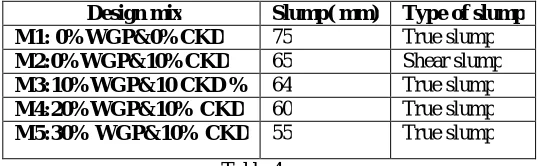
Workability test: Workability is the property of freshly mixed concrete that determines the ease with which it can be properly mixed, placed, consolidated and finished without segregation. The workability of fresh concrete was measured by means of the conventional slump test as per IS; 1199(1989). Before the fresh concrete was cast into moulds, the slump value of the fresh concrete was measured using slump cone. In this project work, the slump value of fresh concrete was maintained in the range of 50mm to 100 mm.
Slump test:
Design mix Slump( mm) Type of slump
M1: 0%WGP&0%CKD 75 True slump
M2:0%WGP&10%CKD 65 Shear slump
M3:10%WGP&10 CKD % 64 True slump
M4:20%WGP&10% CKD 60 True slump
M5:30% WGP&10% CKD 55 True slump
ISSN(Online): 2319-8753
ISSN (Print): 2347-6710
I
nternational
J
ournal of
I
nnovative
R
esearch in
S
cience,
E
ngineering and
T
echnology
(An ISO 3297: 2007 Certified Organization)
Website: www.ijirset.com
Vol. 6, Issue 6, June 2017
Graph I Fig 1 Slump test
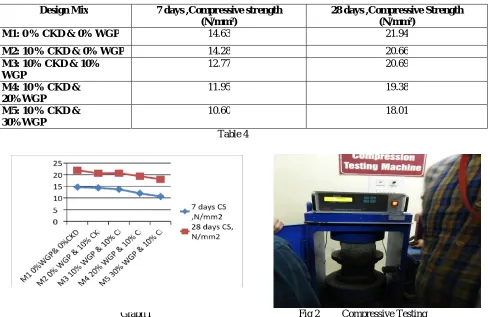
Durability tests: The concrete prepared with various percentage replacement of cement with 10% constant cement kiln dust and 10%, 20%&30% waste glass powder was cured under normal condition and were tested at 7 days and 28 days for determining compressive, tensile and flexural strength and were compared with the reference concrete shown below:
Compressive strength test: As perIS: 516-1959.
Design Mix 7 days ,Compressive strength (N/mm²)
28 days ,Compressive Strength (N/mm²)
M1: 0 % CKD & 0% WGP 14.63 21.94
M2: 10 % CKD & 0% WGP 14.28 20.66
M3: 10% CKD & 10% WGP
12.77 20.69
M4: 10 % CKD & 20%WGP
11.95 19.38
M5: 10 % CKD & 30%WGP
10.60 18.01
Table 4
ISSN(Online): 2319-8753
ISSN (Print): 2347-6710
I
nternational
J
ournal of
I
nnovative
R
esearch in
S
cience,
E
ngineering and
T
echnology
(An ISO 3297: 2007 Certified Organization)
Website: www.ijirset.com
Vol. 6, Issue 6, June 2017
Flexural strength test: As per IS: 516-1959
Design mix 7 days, Flexural Strength ,N/mm2 (N/mm2)
28 days ,Flexural Strength (N/mm2)
M1: 0%WGP& 0%CKD 2.35 3.22
M2: 0% WGP & 10% CKD 2.20 3.09
M3:10% WGP & 10% CKD 2.21 3.05
M4: 20% WGP & 10% CKD 2.14 3.06
M5: 30% WGP & 10% CKD 2.04 3.02
Table 5
Graph II
Fig 3 Flexural testing
Split tensile strength test: As per IS: 5816-1999.
Design mix 7days Split Tensile Strength , (N/mm2)
28 days Split Tensile Strength, (N/mm2)
M1: 0%WGP& 0%CKD 1.51 2.22
M2: 0% WGP & 10% CKD 1.51 2.18
M3: 10% WGP & 10% CKD 1.49 2.20
M4: 20% WGP & 10% CKD 1.48 2.15
M5: 30% WGP & 10% CKD 1.40 1.98
Table 6
ISSN(Online): 2319-8753
ISSN (Print): 2347-6710
I
nternational
J
ournal of
I
nnovative
R
esearch in
S
cience,
E
ngineering and
T
echnology
(An ISO 3297: 2007 Certified Organization)
Website: www.ijirset.com
Vol. 6, Issue 6, June 2017
Graph III Fig 4 Split Tensile Testing
Alkalinity test: After 28 days curing the specimen are taken out from curing tank. Specimens are dried in oven at 105°C for 24 hours. The dry specimens are cooled to room temperature. Dry specimens are broken and separated the
mortar from the concrete. Then the mortar is grinded into powder form. The powdered mortar is sieved in 150μ. 10 gm.
of mortar is taken and it is diluted in 50ml distilled water and completely stirred it. Then the pH meter immerse Into the solution and pH value of the solution is noted Fig.5. The general pH value of the solution and the level of Inducing corrosion in the concrete was noted and the results are shown:
Alkalinity test results
Fig 5 Alkalinity test
IV. RESULTSANDDISCUSSION
The compressive strength test on both conventional and waste glass and cement kiln dust added concrete was performed on standard compression testing machine of 3000kN capacity, as per IS: 516-1959. Totally 60 numbers of cubical specimens of size 150 x 150 x150 mm was casted and tested for the compressive strength at the age of 7 days and 28 days. Each of the compressive strength test data corresponds to the mean value of the compressive strength of six cubes. At 7 days the glass powder shows strength of 11.95 N/mm2 at 20% cement replacement of WGP and 10 % Mix Ph value
M1 12.65
M2 12.70
M3 12.46
M4 12.49
ISSN(Online): 2319-8753
ISSN (Print): 2347-6710
I
nternational
J
ournal of
I
nnovative
R
esearch in
S
cience,
E
ngineering and
T
echnology
(An ISO 3297: 2007 Certified Organization)
Website: www.ijirset.com
Vol. 6, Issue 6, June 2017
at the age of 7 days and 28 days shows gradually decrement of strength but was observed to a consistent value. The experimental investigations show that by the partial replacement of CKD (10%) and WGP(10%) , the flexural strength decrease by 6% % also when partially replaced cement (20%) and (10%) of WGP and CKD respectively, it decreases up to 5% also when the cement is partially replaced by 30 % WGP and with 10% of CKD it decreases the flexural strength by 7%. Thus there is also a gradual decrease in minor proportion in flexural strength with addition of these wastes in concrete. The split tensile strength shows a little variation with addition of cement kiln dust and waste glass powder. This experimental investigation shows that with addition of 10 % CKD & 0% WGP there is no change in the tensile strength with age but when we add the percentage of blend there is a gradual or little which is negligible decrease in split tensile strength up to mix M4 but M5 i.e;30% WGP & 10% CKD shows the abrupt change in strength with decrease about 11%. But overall the split tensile strength doesn’t too much effected by addition of cement kiln dust and waste glass powder up to mix M4.The pH value observed from the alkalinity test showed that the specimen tested found to be more alkaline and hence more resistant towards corrosion.
V. CONCLUSIONSANDRECOMENDATIONS
Conclusions:
I. The compressive strength of concrete decrease slightly up to 6% with addition of waste glass powder up to 20% by keeping cement kiln dust percentage constant at 10% during the whole investigation but when waste glass powder is added beyond the 20% i.e., 30% and above the compressive strength shows an abrupt change and lowering the compressive strength 11%. At 10% CKD & 20% WGP in concrete shows the Neglible strength parameters in compression with respect the control mix.
II. The flexural strength of concrete decreases up to 5% when a constant amount CKD of 10% & 20% WGP were used but when the percentage of WGP increased to 30% as a partial replacement in cement in concrete by keeping the CKD constant by weight during the whole investigation the strength decreases up to 7%.Flexural strength decrease occur with addition of CKD & WGP with a limiting value that can be considered Neglible reduction by saving the 30% of cement in a nominal mix M20.
III. The split tensile strength shows factional change with respect control mix. The tensile strength decreases fractionally by addition of CKD and WGP in concrete by weight as a partial replacement in cement. The reduction in mixes M2, M3, M4 & M5 occurred 2% ,1% 4%& 11% respectively. The reduction in M3 and M4 concluded that there is slight reduction in split tensile strength also.
IV. The workability of concrete decreases by addition of these wastes (CKD & WGP) thus makes a concrete of low workability of range 25-75mm slump.
V. The alkalinity test shows that cement with cement kiln dust 10% and waste glass powder 30 % of size less than 75 in cement concrete is more alkaline and is resistant to the corrosion.
VI. The addition of glass in concrete with 10% cement kiln dust kept constant shows that addition of silica content in concrete increases with respect to calcium content thus enhances the silica-alkali reaction.
Recommendations:
The concrete mix in this research can be used as plain nominal concrete construction as it shows a negligible strength and durability decrement and is almost economically suitable for construction industry.
ISSN(Online): 2319-8753
ISSN (Print): 2347-6710
I
nternational
J
ournal of
I
nnovative
R
esearch in
S
cience,
E
ngineering and
T
echnology
(An ISO 3297: 2007 Certified Organization)
Website: www.ijirset.com
Vol. 6, Issue 6, June 2017
VII. ACKNOWLEDGEMENT
The author is thankful to Er Ravi Kumar, Assistant Professor, Department of Civil Engineering, SDDIET Barwala Haryana. Who helped and guided the whole work.
REFERENCES
[1] T. S. Serniabat, M. N. N. Khan, M. F. M. Zain Use of Waste Glass as Coarse Aggregate in Concrete: A Possibility towards Sustainable Building Construction Vol:8, No:10, 2014
[2] Irshad Ali Behaviour of Concrete by using Waste Glass Powder and Fly Ash as a Partial Replacement of Cement ISSN: 2278-0181 Vol. 4 Issue 05, May-2015
[3] Jitender and Prof. Archana Tiwari
[4] K. V Ramana1, Shaik Summaiya Samdani2Study on Influence of Crushed Waste Glass on Properties of Concrete, ISSN (Online): 2319-7064 2013
[3] Mehta P.K (2001) “Reducing the Environmental Impact Concrete”. Concrete International [2] C Meyer, concrete and sustainable development, Special publications ACI206.2002.
[4] C Meyer, concrete and sustainable development, Special publications ACI206.2002.
[5] Beneficial Uses Of Cement Kiln Dust by: Ieee-Ias Cement Industry Committee Wayne S. Adaska, P.E., Director, Public Works, Portland Cement association Donald H. Taubert, Director, Promotion & Technical Service, Capitol Cement Presented at 2008 IEEE/PCA50th Cement Industry Technical Conf., Miami,FL, May 19-22, 2008
[6] P.S Mane Deshmukh and R.Y. Mane Deshmukh “Comparative study of waste glasspowder utilized in concrete” international journal of science and research (IJSR),Vol. 3,December 12, 2014, pp 1457-1458
[7] Klemm, W.A., Cement Kiln Dust: A Look at its Uses and Characteristics, Proceedings of the 29th International Cement Seminar, Rock Product, San Francisco, California, U.S.A., 1993.
[8] Satham Hussain and Rama Mohan Rao. P experimental studies on concrete containing cement Kiln dust and fly ash Vol 6.No.2 2014 ,2014 [9] Parvaiz Soroushain –towards board use of recycled glass on MSU campus,Michan State University ,2012
[10] C Meyer , N Egosi , C Andela –concrete with waste glass as aggregate and re use of Glass Cullet,Dhir ,Dyer and Limbachiya editors proceedings of international Symposium concrete technology unit of ASCE and university of Dundee 19-20-2001
[11] G. Vijay Kumar , H. Vishaliny, D. Govinda Rajulu :“Studies on Glass Powder as Partial Replacement of Cement in Concrete Production”, 3(2), 153-157, 2013.
[12] Malek Batayneh, Iqbal Marie, Ibrahim Asi, “ Use of Selected wasteMaterials in Concrete Mixes”, Waste Management, vol. 27, 2007
[13] Mageswari.L.M and B.Vidivelli, “ The use of Sheet Glass Powder as Fine Aggregate [12] Replacement in Concrete”, the open Civil Engineering Journal, vol:4,65-71, 2010.
[14] IIker Bekir Topcu and Mehmet canbaz, “ Properties of concrete with glass “, Cement and Concrete Research, vol:34,267-274,2004