DOI: 10.1534/genetics.109.109728
Molecular and Genetic Analyses of Four Nonfunctional
S
Haplotype
Variants Derived from a Common Ancestral
S
Haplotype
Identified in Sour Cherry (
Prunus cerasus
L.)
Tatsuya Tsukamoto,*
,1Nathanael R. Hauck,*
,2Ryutaro Tao,
†Ning Jiang* and Amy F. Iezzoni*
,3*Department of Horticulture, Michigan State University, East Lansing, Michigan 48824 and†Laboratory of Pomology, Graduate School of Agriculture, Kyoto University, Kyoto 606-8502, Japan
Manuscript received September 14, 2009 Accepted for publication November 6, 2009
ABSTRACT
Tetraploid sour cherry (Prunus cerasus) has an S-RNase-based gametophytic self-incompatibility (GSI) system; however, individuals can be either self-incompatible (SI) or self-compatible (SC). Unlike the situation in the Solanaceae, where self-compatibility accompanying polyploidization is often due to the com-patibility of heteroallelic pollen, the genotype-dependent loss of SI in sour cherry is due to the compatibility of pollen containing two nonfunctional S haplotypes. Sour cherry individuals with the S4S6S36aS36bgenotype are predicted to be SC, as only pollen containing both nonfunctionalS36aandS36b haplotypes would be SC. However, we previously found that individuals of this genotype were SI. Here we describe four nonfunctionalS36variants. Our molecular analyses identified a mutation that would confer loss of stylarS function for one of the variants, and two alterations that might cause loss of pollenS function for all four variants. Genetic crosses showed that individuals possessing two nonfunctionalS36 haplotypes and two functionalShaplotypes have reduced self-fertilization due to a very low frequency of transmission of the one pollen type that would be SC. Our finding that the underlying mechanism limiting successful transmission of genetically compatible gametes does not involve GSI is consistent with our previous genetic model for Prunus in which heteroallelic pollen is incompatible. This provides a unique case in which breakdown of SI does not occur despite the potential to generate SC pollen genotypes.
G
AMETOPHYTIC self-incompatibility (GSI) is awidespread mechanism in flowering plants that prevents self-fertilization and promotes out-crossing (De Nettancourt 2001). In GSI plants, pollen tube growth is arrested if there is a match between the genes at theS-locus that control pollen and stylar specificity. The gene controlling stylar specificity in the Solana-ceae, RosaSolana-ceae, and Plantaginaceae is known to encode a ribonuclease (S-RNase) (for a review see McClure 2009), while the gene controlling pollen specificity encodes an F-box protein [S haplotype-specific F-box
protein (SFB) orS-locus F-box protein (SLF)] (Laiet al. 2002; Entaniet al. 2003; Ushijimaet al. 2003; Sijacicet al. 2004). As these two specificity genes are tightly linked and recombination between these two genes has never been observed (Ikeda et al. 2005), these two S-locus specificity genes are collectively termed theShaplotype. Characterization of theShaplotype is most advanced in Prunus (Rosaceae) due to the small physical size of the Shaplotype region and the close proximity of the stylarS(S-RNase) and pollenS(SFB) genes (Entaniet al. 2003; Ushijimaet al. 2003; Yamaneet al. 2003b; Ikeda et al. 2005). Within Prunus, sweet cherry (Prunus avium) and sour cherry (P. cerasus) represent a model diploid– tetraploid series that has been used to investigate the effects of polyploidy on GSI. Tetraploid sour cherry is considered to have arisen through hybridization be-tween sweet cherry and tetraploid ground cherry (P. fruticosa) (Oldenand Nybom1968). Like sweet cherry, sour cherry exhibits an S-RNase-based GSI system (Yamaneet al. 2001; Haucket al. 2002; Tobutt et al. 2004) and interspecific crossing studies have demon-strated that sour cherry shares eight sweet cherry S haplotypes:S1,S4,S6,S9,S12,S13,S14, andS16(Bosˇkovic´ et al. 2006; Haucket al. 2006a,b; Tsukamotoet al. 2006, 2008). However, in contrast to sweet cherry, natural sour
Supporting information is available online at http://www.genetics.org/ cgi/content/full/genetics.109.109728/DC1.
Sequence data from this article have been deposited with the EMBL/ GenBank Data Libraries under accession nos. EU042127 (S36aRNase), EU042128 (S36b RNase), EU042129 (S36b2 RNase), EU042130 (S36b3 RNase), EU042131 (SFB36a), EU042132 (SFB36b obtained from S36b
haplotype), EU042133 (SFB36b obtained from S36b2 haplotype), and EU042134 (SFB36bobtained fromS36b3haplotype).
1Present address:School of Plant Sciences, University of Arizona, Tucson, AZ 85721.
2Present address:Department of Biological Sciences, Butler University, Indianapolis, IN 46208.
3Corresponding author:Department of Horticulture, A342-B Plant and Soil Sciences Bldg., Michigan State University, East Lansing, MI 48824. E-mail: [email protected]
cherry selections include both self-incompatible (SI) and self-compatible (SC) types. A genetic model dem-onstrating that the genotype-dependent loss of SI in sour cherry is due to the accumulation of a minimum of two nonfunctionalShaploytpes within a single individ-ual was developed and validated (Haucket al. 2006b). These nonfunctionalShaplotypes were characterized as either pollen-part mutants or stylar-part mutants, de-pending on whether the pollenSor stylarSspecificity was disrupted. In Prunus, pollen-part and stylar-part mutants are denoted by a prime symbol ‘‘9’’ or a subscribed ‘‘m,’’ respectively, following theShaplotype number (Tsukamotoet al. 2006). Molecular character-izations of five of the nonfunctionalShaplotypes from sour cherry characterized to date support the genetic results because mutations were identified that affected the S-RNase and/or SFB. These changes in coding or regulatory regions included mutations within the S-RNase and/or SFB causing premature stop codons, transposable element insertions within SFB and up-stream of the S-RNase, and a 23-bp deletion in a conserved region of theS-RNase (Yamaneet al. 2003a; Haucket al. 2006a; Tsukamotoet al. 2006).
According to the genetic model, termed the ‘‘one-allele-match model,’’ sour cherry pollen is rejected if one or both of the functionalS haplotypes in the 2x pollen grain match anShaplotype in the style (Hauck et al. 2006b). Therefore, only pollen containing two nonfunctionalShaplotypes would be SC; thus, a sour cherry genotype is SC if it has a minimum of two nonfunctional S haplotypes. We previously tested the one-allele-match model using 92 sour cherry selections from four progeny populations (Haucket al. 2006b). For all the progeny except three, their S genotype correctly predicted whether they were SI or SC. The three progeny individuals that were the exception all had the same genotype:S4S6SaSd. These individuals were predicted to be SC as the Sa and Sd haplotypes were shown to be nonfunctional in genetic studies and therefore SaSd pollen should be SC. However, these progeny were classified as SI on the basis of observations of self-pollen tube growth in the styles. TheSaandSd haplotypes were originally distinguished on the basis of different RFLP fragment sizes using anS-RNaseprobe; the HindIII fragment sizes for Sa and Sd differed by 200 bp, 6.4-kb and 6.2-kb, respectively (Yamane et al. 2001; Haucket al. 2002). However, partialS-RNaseandSFB sequences from theSaandSdhaplotypes were identical (N. R. Hauckand A. F. Iezzoni, unpublished results), suggesting that Saand Sdrepresented different muta-tions of the sameShaplotype. Therefore, we hypothe-sized that the SI phenotype of theS4S6SaSdindividuals resulted from complementary pistil S and pollen S mutations in the nonfunctionalSaandSdhaplotypes, thus behaving genetically as one functionalShaplotype. We previously reported that heteroallelic sour cherry pollen containing two different functional pollen S
haplotypes is incompatible (Haucket al. 2006b). This finding is counter to the well-documented phenome-non in the Solanaceae where SC accompanying poly-ploidization is frequently due to the SC of heteroallelic pollen (Lewis1943; Golzet al. 1999, 2001; Tsukamoto et al. 2005; Xueet al. 2009). Therefore, models explain-ing the molecular basis of self-recognition in Prunus and the Solanaceae must be consistent with these differing genetic expectations. Recently, Huang et al. (2008) reported competitive interaction in a SC selec-tion of tetraploidP. pseudocerasus, raising the possibility that the SC mechanism between these two tetraploid Prunus species could be different. However, although the data in Huang et al. (2008) are consistent with heteroallelic pollen being SC, homoallelic pollen (e.g., S1S1, S5S5, or S7S7) was not shown to be successful in compatible crosses and unsuccessful in incompatible ones. Therefore, it is possible that the SC in P. pseudocerasus could be caused by mutations in other genes critical for the SI reaction. Because of the importance of these differing genetic expectations for understanding S-RNase-based GSI, we sought to in-vestigate our previously identified exceptions to the one-allele-match model. Specifically, our objective was to test our prior hypothesis that the nonfunctional Sa andSdhaplotypes interact in a complementary manner and therefore behave together genetically as a single functional S haplotype. In this work, the Sa and Sd haplotypes were renamed S36a and S36b, respectively, following the order of previously publishedShaplotypes (Tsukamoto et al. 2008; Vaughan et al. 2008) for reasons explained in the results.
MATERIALS AND METHODS
Plant material and DNA extraction: Twenty-one sour cherry cultivars and 6 SI sweet cherry cultivars were used in this study (Table 1). These cultivars were grown at the Michigan State University Clarksville Horticultural Ex-perimental Station (Clarksville, MI). Young leaves were col-lected in the spring, frozen in liquid nitrogen, lyophilized, and stored at 20° until use. Genomic DNA was isolated from lyophilized leaves according to the method of Ikeda et al. (2004b). Extracted leaf DNA was treated with RNase A (Roche, Mannheim, Germany) and was used for PCR and fosmid library construction.
Southern blotting: Total DNA was isolated from young leaves by the cetyltrimethylammonium bromide (CTAB) method described by Stockingeret al. (1996). Genomic DNA blot analysis was performed as described by Hauck et al. (2001). Probe cDNA was prepared from the PCR-amplified fragment of theS6-RNasecDNA from sweet cherry and radio-labeled with [32P]dCTP as described by Haucket al. (2001).
fosmid libraries were screened at 60°with a mixture of DIG– dUTP-labeled S6-RNase and SFB6 probes, as previously de-scribed (Ushijimaet al. 2001). The DIG-labeledS6-RNaseand SFB6probes were obtained by PCR labeling using a PCR DIG probe synthesis kit (Roche) with Pru-C2 and PCE-R primers (Taoet al.1999; Yamaneet al.2001) and SFB-C1F (Ikedaet al. 2004a) and SFB-C4R primers (Yamane et al.2003c), respec-tively. The S haplotype of each positive fosmid clone was determined by PCR with theS-RNaseconsensus primer pair (Pru-C2 and PCE-R), which detects length differences for the second intron of theS-RNase. Positive clones were also checked for the presence of SFBusing PCR with the SFBconsensus primer pair (SFB-C1F and SFB-C2R) (Ikeda et al. 2004a). S-RNaseandSFBallele-specific primer pairs were also used to verify theShaplotypes. Fosmid DNAs were prepared using the WizardPlusMinipreps DNA purification kit (Promega, Mad-ison, WI).
DNA sequencing: Sequencing was carried out at the Michigan State University Research Technology Support
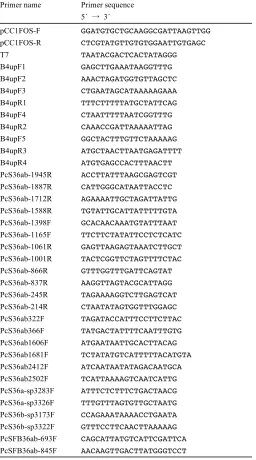
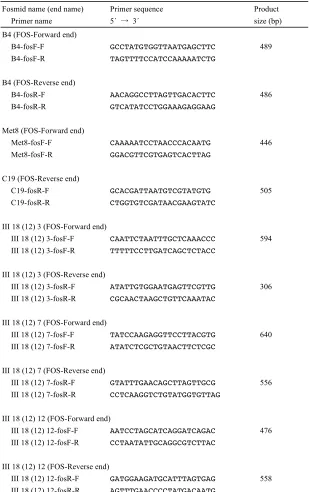
Facility. The fosmid clones were sequenced by primer walking using the primers Pru-T2, Pru-C2, Pru-C2R (Tsukamotoet al. 2006), PCE-F (Tsukamotoet al. 2006), PCE-R, C4R, Pru-C5, S36ab322F, and S36ab366F (supporting information, Table S1) for theS-RNases, and SFB-C1F, SFB-C2R, SFB-C5F, and FB3R (Ikedaet al.2005) for theSFBs. The flanking regions for theS-RNases of theS36variants were sequenced using end-specific primers (Table S1). To determine the nucleotide sequences of the fosmid (FOS)-forward and FOS-reverse ends of the S36 variants fosmid clones, pCC1FOS-F, pCC1FOS-R, and T7 primers were used (Table S1). End-specific primer pairs forS36fosmid clones were also designed to determine the overlaps between fosmid clones (Table S2).
PCR amplification:PCR was conducted in a volume of 25ml containing 50 ng of template DNA, 20 mmTris–HCl (pH 8.4), 50 mmKCl, 3 mmMgCl2, 200mmdNTP, 0.8mmeach primer, and 0.625 units ofTaqDNA polymerase (Invitrogen, Carlsbad, CA). The PCR program was 35 cycles of denaturation at 94°for 30 sec, an annealing step (see Table 2 for temperature) for
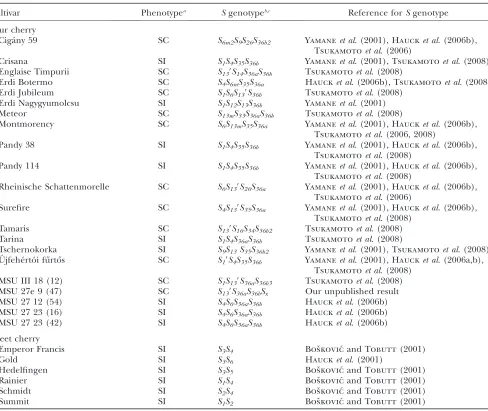
TABLE 1
Pollination phenotypes andSgenotypes for 21 sour cherry and 6 sweet cherry cultivars used in this study
Cultivar Phenotypea Sgenotypeb,c Reference forSgenotype
Sour cherry
Ciga´ny 59 SC S6m2S9S26S36b2 Yamaneet al. (2001), Haucket al. (2006b),
Tsukamotoet al. (2006)
Crisana SI S1S4S35S36b Yamaneet al. (2001), Tsukamotoet al. (2008)
Englaise Timpurii SC S139S14S36aS36b Tsukamotoet al. (2008)
Erdi Botermo SC S4S6mS35S36a Haucket al. (2006b), Tsukamotoet al. (2008)
Erdi Jubileum SC S1S6S139S36b Tsukamotoet al. (2008)
Erdi Nagygyumolcsu SI S1S12S13S36b Yamaneet al. (2001)
Meteor SC S13mS33S36aS36b Tsukamotoet al. (2008)
Montmorency SC S6S13mS35S36a Yamaneet al. (2001), Haucket al. (2006b),
Tsukamotoet al. (2006, 2008)
Pandy 38 SI S1S4S35S36b Yamaneet al. (2001), Haucket al. (2006b),
Tsukamotoet al. (2008)
Pandy 114 SI S1S4S35S36b Yamaneet al. (2001), Haucket al. (2006b),
Tsukamotoet al. (2008)
Rheinische Schattenmorelle SC S6S139S26S36a Yamaneet al. (2001), Haucket al. (2006b), Tsukamotoet al. (2006)
Surefire SC S4S139S35S36a Yamaneet al. (2001), Haucket al. (2006b),
Tsukamotoet al. (2008)
Tamaris SC S139S16S34S36b2 Tsukamotoet al. (2008)
Tarina SI S1S4S36aS36b Tsukamotoet al. (2008)
Tschernokorka SI S9S13S35S36b2 Yamaneet al. (2001), Tsukamotoet al. (2008)
U´ jfehe´rto´i fu}rto}s SC S19S4S35S36b Yamaneet al. (2001), Haucket al. (2006a,b), Tsukamotoet al. (2008)
MSU III 18 (12) SC S1S139S36aS36b3 Tsukamotoet al. (2008)
MSU 27e 9 (47) SC S139S36aS36bSx Our unpublished result
MSU 27 12 (54) SI S4S6S36aS36b Haucket al. (2006b)
MSU 27 23 (16) SI S4S6S36aS36b Haucket al. (2006b)
MSU 27 23 (42) SI S4S6S36aS36b Haucket al. (2006b)
Sweet cherry
Emperor Francis SI S3S4 Bosˇkovic´ and Tobutt(2001)
Gold SI S3S6 Haucket al. (2001)
Hedelfingen SI S3S5 Bosˇkovic´ and Tobutt(2001)
Rainier SI S1S4 Bosˇkovic´ and Tobutt(2001)
Schmidt SI S2S4 Bosˇkovic´ and Tobutt(2001)
Summit SI S1S2 Bosˇkovic´ and Tobutt(2001)
a
Self-incompatible (SI) and self-compatible (SC).
b
S36a,S36b, andS36b2were previously termed asSa,Sd, andSa, respectively.S36b2andS36b3are mutated types ofS36b.
c
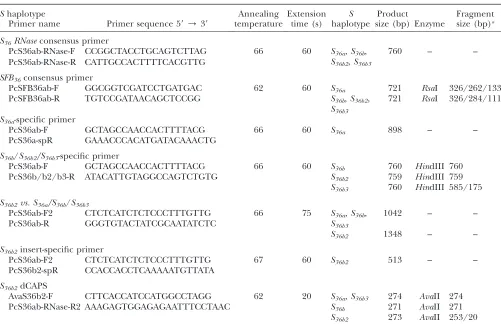
30 sec, and extension at 72°(see Table 2 for the extension time), with an initial denaturing step at 94°for 2 min 30 sec and a final extension at 72°for 7 min. To discriminateS36b2from otherS36variants, the derived cleaved amplified polymorphic sequence (dCAPS) primer (Neff et al. 1998), AvaS36b2-F (Table 2), was designed using dCAPS finder 2.0 (Neffet al. 2002). Five microliters of PCR products was digested for 4 hr at 37°in 20ml total volume with 3 units of the appropriate restriction endonuclease. PCR products and digested PCR products were resolved on 2.0–3.0% agarose gels and stained with ethidium bromide.
RT–PCR:Total RNA was isolated from styles at the balloon stage of flower development and from pollen grains as described elsewhere (Taoet al.1999). Total RNA was treated with DNaseI (Roche) to avoid contamination of genomic DNA before being used for all RT-related studies. One microgram of RNA was used for first-strand cDNA synthesis by SuperScript II RNase H Reverse Transcriptase (Invitrogen) with oligo(dT) primer following the manufacturer’s protocol. For S-RNase expression, allele-specific primers, PcS36ab-RNase-F and PcS36ab-RNase-R (Table 2) were used to amplify the fourS36 RNase variants. PCR conditions were identical to those de-scribed by Taoet al.(1999). ForSFBexpression, allele-specific primers, PcSFB36ab-F and PcSFB36ab-R (Table 2) were used to amplify the fourSFB36variants. Total pollen RNA was used as a negative control to confirm the absence of contamination from genomic DNA. Expression of theactingene was used as a reference with the primers ActF1 and ActR1 (Yamane et al. 2003a). PCR conditions were identical to those described by Ushijimaet al.(2004). PCR products were separated on a 1.5% agarose gel and stained with ethidium bromide.
39RACE ofSFB36variants:One microgram of pollen RNA
from the sour cherry selections MSU 27e 9 (47) and Tamaris (Table 1) was used for first-strand cDNA synthesis by Super-Script II RNase H Reverse Transcriptase (Invitrogen) with the oligo(dT)-adaptor primer (59-TTTTTTTTTTTTTTTTTGACC GGCAGCAAAATGTTGCAGC-39) following the manufacturer’s protocol. PcSFB36ab-F and the adaptor primer (59-TGACCG GCAGCAAAATGTTGCAGC-39) were used to amplify the two SFB36variants (SFB36aand/orSFB36b). The resulting PCR prod-ucts were recovered from the gel using the QIAquick gel extraction kit (Qiagen, Hilden, Germany) and ligated into the pJET1.2 vector using the CloneJET PCR cloning kit (Fermen-tas, Burlington, Canada). Colony PCR was performed for 13 clones with the PcSFB36ab-F and PcSFB36ab-R primers, and the PCR products were digested withRsaI to distinguishSFB36a clones fromSFB36bclones. One clone for eachSFB36variant was sequenced using pJET1.2 vector-specific primers that were supplied with the CloneJET PCR cloning kit (Fermentas). Two SFB36allele-specific primers, 693F and PcSFB36ab-845F, were also used for sequencing (Table S1).
RT–PCR of poly(A)1
pollen RNA: Seven micrograms of pollen RNA of MSU 27e 9 (47) was separated into poly(A)1
and poly(A) pollen RNA using the Oligotex mRNA mini kit (Qiagen). One hundred nanograms of poly(A)1and poly(A)
pollen RNA were used for first-strand cDNA synthesis by SuperScript II RNase H reverse transcriptase (Invitrogen). First-strand cDNAs of theSFB36variants,SFB139, and theactin gene were synthesized using the PcSFB36ab-R, PcSFB13-R (Tsukamoto et al. 2006), and ActR1 primers, respectively.
Amplification of theSFB36variants,SFB139, and theactingenes utilized the primer pairs PcSFB36ab-F and PcSFB36ab-R, PcSFB13-F (Tsukamoto et al. 2006) and PcSFB13-R, and ActF1 and ActR1, respectively. PCR products were cloned and sequenced as described above.
RESULTS
Molecular characterization of the fourS36haplotype variants: To determine whether the S36a and S36b haplotypes had complementary alterations in S-RNase andSFB, these genes were cloned from fosmid libraries generated from two SC cultivars: Rheinische Schatten-morelle (RS) (S6S139S26S36a) and U´ jfehe´rto´i fu}rto}s (UF) (S19S4S35S36b), respectively. The nucleotide sequences of the relevant clones revealed that theS36aRNasediffered from that of theS36bRNaseby one nucleotide mismatch in the second intron (Figure 1).SFB36aandSFB36b dif-fered by eight nucleotides and their deduced amino acids had only five amino acid differences (Figure 2). The high sequence similarity between theS36aandS36b haplotypes suggests that they may be derived from the same ancestralShaplotype.
A comparison of the S36aand S36bRNases with other
functional cherry S-RNases did not reveal any molecular alterations that are known to disrupt S-RNase activity (Figure S1). However, the amino acid sequences of the S36a and S36b RNases were longer than the majority
of the other functional cherry S-RNases in the region just before the conserved C5 region (Figure S1). It is unlikely that the length is the cause of the loss of function of the S36aand S36bRNases because the sour
cherry S33 RNase, whose amino acid sequence is one
residue longer than the S36a and S36b RNases in this
hypervariable region, is functional (Tsukamoto et al. 2008).
The amino acid sequences of SFB36aand SFB36bwere
compared with other functional cherry SFBs (Figure 2 and Figure S2). All the functional cherry SFBs identified to date have a conserved lysine (K), a conserved tyrosine (Y), and a conserved glycine (G) at positions 53, 188, and 214, respectively. In contrast, both SFB36a and
SFB36b have isoleucine (I), phenylalanine (F), and
serine (S) residues at positions 53, 188, and 214, respectively. Although there are three conserved amino acids in cherry, only one of them, the tyrosine residue at position 188 (Figure S3), is conserved in all known functional SFBs from Prunus species. This amino acid may thus be critical for the function (seediscussion).
Because the sequence analysis of the S-RNase and SFB for the S36a and S36b haplotypes failed to identify any
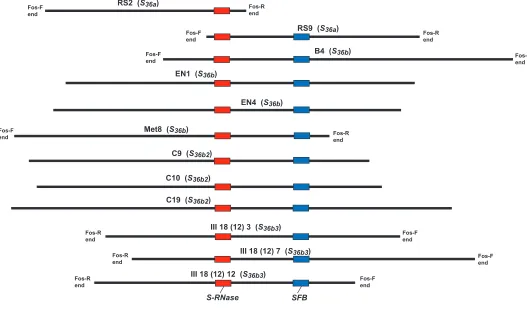
molecular alternation that could be conclusively linked to a loss of specificity function, we compared the regions flanking the two specificity genes. These two haplotypes were already known to have a differentialHindIII cut site yielding RFLP products that differ by 200 bp (Figure 3) (Yamaneet al. 2001). In total, 7829 and 8217 bp of the upstream and downstream flanking regions of the S-RNase of S36a and S36b haplotypes, respectively, were determined through multiple rounds of primer walking (Figure 4; see Figure S4 and Table S1 for the fosmid clones and primers used for sequencing). The S36aandS36bsequences each had one conservedHindIII
site inS36a was at 3934/3935 bp downstream from the S36aRNasestart codon, whereas the HindIII site inS36b was at 3668/3669 bp downstream from theS36b RNase start codon. This differential cut site resulted in the differentHindIII fragment sizes for theS36aRNaseand S36bRNase: 6071 and 5807 bp, respectively.
Identification and characterization of the S36b2 haplotype: A common forward primer (PcS36ab-F, located in the homologous sequence downstream of the S36aand S36b RNases) and two Shaplotype-specific reverse primers (PcS36a-spR and PcS36b/b2/b3-R, located 3400 bp downstream from the S-RNase start codon) were designed to distinguish between theS36a
andS36bhaplotypes (Table 2 and Figure 4). Fragment sizes of 898 and 760 bp were amplified from theS36aand S36bhaplotypes (Figure 5, A and B), respectively. When these primers were tested against an array of sour cherry selections, the S genotypes for two selections contra-dicted our previous results. Ciga´ny 59 and Tscherno-korka were reported to have the S36a (Sa) haplotype (Yamaneet al. 2001); however, theS36a-specific primers failed to amplify a fragment from these cultivars. In-stead, theS36b-specific primers amplified a fragment of the expected size (Figure 5, A and B). To further investigate theS36haplotypes in Ciga´ny 59 and Tscher-nokorka, a fosmid library from Ciga´ny 59 was generated and screened to identify theS-RNaseandSFB. These two genes were sequenced from three Ciga´ny 59S36clones. The S36RNasevariant from Ciga´ny 59 differed from the S36b RNase by a 1-bp substitution (G/A) in the conserved region C2, causing a premature stop codon (Figure 1) and thereby providing an explanation for the loss of function for this unique S36 haplotype. This additionalS36haplotype variant in Ciga´ny 59 was named S36b2. The flanking regions of the S36b2 RNase were sequenced, revealing a 307-bp insertion between 752 and 1058 bp upstream of the S36b2RNasethat was not present in the upstream regions of theS36bRNaseof UF or the S36a RNase of RS (Figure 4 and Figure S5). Therefore, after HindIII digestion, the size of the fragment containing the S36b2RNase is 6097 bp, close to the length (6071 bp) of theS36aRNase. This explains why theS36b2of Ciga´ny 59 was thought to beS36a(Sa) by Yamaneet al. (2001). The nucleotide sequence of the SFBobtained from theS36b2haplotype was identical to that from theS36bhaplotype; therefore, we also used the nomenclatureSFB36bto refer to theSFBfrom theS36b2 haplotype.
Identification and characterization of the S36b3 haplotype: Another sour cherry selection, MSU III 18 (12), also tested positive for the presence of the S36b haplotype by PCR withS36b-specific primers (Figure 5B); however, MSU III 18 (12) did not have the S36bRNase HindIII fragment (5.8 kb). Instead, the observed HindIII fragment (4.8 kb, Figure 3) was smaller than expected for theS36bhaplotype (5.8 kb), suggesting that MSU III 18 (12) might contain an additional variant of theS36bhaplotype,S36b3. To investigate this possibility, a fosmid library was generated from MSU III 18 (12) for molecular analysis of theS36b3haplotype. Three clones, each containing the S-RNase and SFB of the S36b3 haplotype, were obtained and sequenced. The amino acid sequence of the S-RNase was identical to that ofS36b (Figure 1); however, the second intron exhibited five nucleotide differences and one indel (Figure 1). Upon sequencing the regions flanking theS36b3RNaseof MSU III 18 (12), a 1-bp substitution (A/G) was identified at 2727 bp downstream of the S36b3 RNase.This substitu-tion led to anotherHindIII cut site between 2725 and 2726 bp (Figure 4 and Figure S6) and therefore explains Figure 3.—Southern blot analysis. Genomic DNAs
di-gested withHindIII were hybridized with theS6RNasecDNA probe radiolabeled with [32P]dCTP. Circles, asterisks, and an
why theHindIII digestion fragment from MSU III 18 (12) was 4871 bp (Figure 4). The SFB nucleotide sequence was identical to that of theS36bhaplotype. As the nucleotide sequences of theSFBs from both theS36b and the S36b3 haplotype were identical, we used the nomenclatureSFB36bto refer to both.
Development of molecular markers to distinguish among the S36 variants: The S36b/S36b2/S36b3-specific primer pair, PcS36ab-F and Pc36b/b2/b3-R, amplified an760-bp product of the expected size forS36b,S36b2, andS36b3(Figure 5B). Since the PCR product from MSU III 18 (12) contained an additional HindIII site, this primer pair works as a cleaved amplified polymorphic
sequence (CAPS) (Konieczny and Ausubel 1993)
marker to distinguish S36b3 from S36b and S36b2. The PCR product of S36b3 was cut by HindIII into two fragments of 585 and 175 bp, whereas those of S36b andS36b2were uncut (Figure 5G).
AvaII, only the PCR product obtained from the S36b2 haplotype was cut into 253- and 20-bp fragments (Figure 5H). Using these primers, Tschernokorka was deter-mined to also haveS36b2(Figure 5, C–E and H).
Expression of S-RNase and SFBfor the S36 variants:
To test whether the S-RNase and SFB from the S36 variants were transcribed, RT–PCR was preformed. For the S36a RNase, the expected 760-bp fragment was amplified from Montmorency genomic DNA (Figure 6A). Smaller fragments (210 bp) for theS36aandS36b RNases, which reflect the splicing of the second intron (555 bp), were obtained from cDNAs from Montmorency (S6S13mS35S36a), RS (S6S139S26S36a), and UF (S19S4S35S36b). Likewise, the expected fragment corresponding to SFB36a was amplified from Montmorency (with S36a), and the expected fragments corresponding to SFB36b were amplified from Pandy 114 (S1S4S35S36b), UF (S19S4 S35S36b), and Ciga´ny 59 (S6m2S9S26S36b2) (Figure 6B). These results suggested that, despite the nonfunction-ality of theS36aandS36b haplotypes, bothS-RNase and SFBare transcribed.
In the four S36 variants described, a small non-autonomousHelitronelement was identified 38 bp down-stream of theSFBstop codon. This element is 306 bp in
length and contains a GC-rich stem loop, which is typical forHelitronelements (Kapitonovand Jurka2001). The GC-rich stem loop is followed by an AT-rich region with the sequence TTTTTTTAAAAATAAAA, in which AAT AAA is the putative poly(A) signal. To test whether the insertion of this element impacts transcription termina-tion or polyadenylatermina-tion, 39 RACE was performed for SFB36afrom MSU 27e 9 (47) (S139S36aS36bSx) and forSFB36b from both MSU 27e 9 (47) and Tamaris (S139S16S34S36b2). The 950-bp RT–PCR products (data not shown) that were amplified with an adaptor primer and PcSFB36ab-F located within the SFB were cloned. To distinguish SFB36a clones from SFB36b clones, colony PCR was performed with PcSFB36ab-F and PcSFB36ab-R. Since the PCR products from SFB36a and SFB36b contain different RsaI sites, RsaI digestion was used to distin-guish these twoSFBs (Table 2). Six and five clones for SFB36aandSFB36b, respectively, were obtained from MSU 27e 9 (47), and two SFB36b clones were obtained from Tamaris (Figure S7). Among them, 27e 9 (47)-8, 27e 9 (47)-3, and Tamaris-1 were selected for SFB36a,SFB36b, and SFB36b, respectively, and their sequences were determined. The poly(A) tail was located 11 bp down-stream of the putative stop codon in 27e 9 (47)-8 and TABLE 2
PCR primer pairs designed to descriminate between the mutatedShaplotypes and their wild types
Shaplotype
Primer name Primer sequence 59/39
Annealing temperature
Extension time (s)
S haplotype
Product
size (bp) Enzyme
Fragment size (bp)a
S36RNaseconsensus primer
PcS36ab-RNase-F CCGGCTACCTGCAGTCTTAG 66 60 S36a,S36b,
S36b2,S36b3
760 – –
PcS36ab-RNase-R CATTGCCACTTTTCACGTTG
SFB36consensus primer
PcSFB36ab-F GGCGGTCGATCCTGATGAC 62 60 S36a 721 RsaI 326/262/133
PcSFB36ab-R TGTCCGATAACAGCTCCGG S36b,S36b2,
S36b3
721 RsaI 326/284/111
S36a-specific primer
PcS36ab-F GCTAGCCAACCACTTTTACG 66 60 S36a 898 – –
PcS36a-spR GAAACCCACATGATACAAACTG
S36b/S36b2/S36b3-specific primer
PcS36ab-F GCTAGCCAACCACTTTTACG 66 60 S36b 760 HindIII 760
PcS36b/b2/b3-R ATACATTGTAGGCCAGTCTGTG S36b2 759 HindIII 759
S36b3 760 HindIII 585/175
S36b2vs. S36a/S36b/S36b3 PcS36ab-F2
PcS36ab-R
CTCTCATCTCTCCCTTTGTTG GGGTGTACTATCGCAATATCTC
66 75 S36a,S36b,
S36b3
1042 – –
S36b2 1348 – –
S36b2insert-specific primer
PcS36ab-F2 CTCTCATCTCTCCCTTTGTTG 67 60 S36b2 513 – –
PcS36b2-spR CCACCACCTCAAAAATGTTATA
S36b2dCAPS
AvaS36b2-F CTTCACCATCCATGGCCTAGG 62 20 S36a,S36b3 274 AvaII 274
PcS36ab-RNase-R2 AAAGAGTGGAGAGAATTTCCTAAC S36b 271 AvaII 271
S36b2 273 AvaII 253/20
a
Tamaris-1 and 34 bp downstream of the stop codon in 27e 9 (47)-3 (Figure S8). This suggests that at least some of theSFB36mRNAs are polyadenylated, and the mature mRNAs end before theHelitronelement.
To investigate whether a short distance between the stop codon and the poly(A) tail might affect SFB function, we examined SFB mRNA sequences derived from Prunus species that are available in GenBank. Twelve nonredundant mRNA sequences were retrieved and the distance between the poly(A) tail and the stop codon ranged from 11 to 318 bp. Notably, the poly(A) tail
of SFB1 mRNA of P. mume (GenBank accession no.
AB101440), derived from a functionalSFBgene (Yamane et al. 2003c), is only 11 bp from the stop codon of the relevant open reading frame. As a result, it does not seem likely that, for SFB, a short distance between the stop codon and the poly(A) tail leads to nonfunctionality.
The relative abundance of SFB36 mRNA with a
was not amplified using the poly(A)1 mRNA whereas
SFB139-specific andactin-specific RT–PCR products were amplified from the poly(A)1
mRNA. In contrast, a SFB36-specific RT–PCR product was amplified using poly(A) mRNA (Figure 6C). This suggests that the majority of SFB36 transcripts are not associated with a poly(A) tail. The three products amplified from the poly(A)1
mRNA that were of smaller than expected size (721 bp)—frA, frB, and frC—were sequenced and de-termined to have high identity (99%) with theP. persica Hakuto 18S ribosomal RNA (GenBank accession no. AY179530) (Figure S9). As a result, these small fragments were derived from nonspecific amplification.
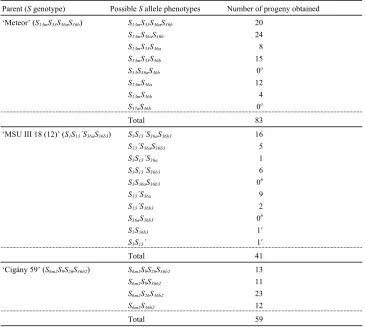
Genetic behavior of theS36haplotype variants:The functionality of theShaplotypes identified were tested using progeny populations derived from self-pollination. In these populations, each S haplotype tested should segregate in both the eggs and the pollen grains in an expected 1:1 ratio. Therefore, if an S haplotype is functional in the style and pollen, the pollen with that Shaplotype would be incompatible, and the frequency of thatShaplotype in the progeny should be 1/2, as in the eggs. However, if anShaplotype has lost either pollen or stylar function, the pollen carrying it would be compat-ible and it would be expected to be present in the
progeny in a 3:1 ratio. Using this strategy, we previously determined that theS36ahaplotype (Sa) in Montmorency, RS, and Surefire and the S36bhaplotype (Sd) in UF are nonfunctional (Haucket al. 2006b).
We further tested the functionality of theS36aandS36b haplotypes using self-pollinated progenies of Meteor and MSU III 18 (12) (Table 3). TheS36aandS36b hap-lotypes in these two selections segregated in a 3:1 ratio, indicating that theseShaplotypes are nonfunctional. In Meteor, only pollen containing the S13m, S36a, and/or S36bwould be capable of self-fertilization as itsS33has been shown to be functional (Tsukamotoet al. 2008). The S36b3 haplotype from MSU III 18 (12) was also determined to be nonfunctional as the segregation fits a 3:1 ratio, not a 1:1 one (Table 3). For this selection, only types containing S139, S36a, and/or S36b3 would be capable of self-fertilization as S1was shown to be func-tional and segregates in a 1:1 ratio (data not presented). For Ciga´ny 59, theS9andS26haplotypes were previously shown to be functional (Haucket al. 2006b); therefore, the only SC pollen type would beS6m2S36b2(Table 3). All the progeny resulted from this pollen type, indicating that theS36b2haplotype is also nonfunctional.
Although all four S36 haplotype variants were de-termined in genetic tests to be nonfunctional, sequenc-Figure 6.—RT–PCR for theS36 variants. (A) Style RT–PCR with PcS36ab-RNase-F and PcS36ab-RNase-R primers to detect expression of the S36 RNase variants. (B) Pollen RT–PCR with PcSFB36ab-F and PcSFB36-R primers to de-tect the expression of theSFB36variants. Expres-sion of the actingene was used as a reference. Lane abbreviations are the following: C59, Ci-ga´ny 59; Mon, Montmorency; P114, Pandy 114; RS, Rheinische Schattenmorelle; UF, U´ jfehe´rto´i fu}rto}s. (C) RT–PCR with poly(A)1
ing conclusively revealed the molecular basis of this loss of function for only the S36b2 RNase (premature stop codon). In addition, the RT–PCR results suggested that the S-RNase and the SFB from the S36a and S36b hap-lotypes are transcribed. This left open the possibility thatS36aS36b(SaSd) pollen could be incompatible due to complementation between a functional S-RNase and a nonfunctional SFB or vice versa (Haucket al. 2006b). For example, ifS36ahas a nonfunctional S-RNase and S36b has a nonfunctional SFB, it is conceivable that S36aS36bpollen would be incompatible in aS36aS36bstyle due to the presence of a functional S36b RNase and
functional SFB36a. To test this possibility, we reciprocally
crossed UF and Montmorency. Among the 38 progeny of UF3Montmorency, theS36ahaplotype was present in 31 individuals (Table 4). This indicates that Montmo-rency pollen with theS36ahaplotype was compatible in the UF style containing the S36b haplotype. In the reciprocal cross, theS36bhaplotype was present in 39 of the 60 progeny. Therefore, UF pollen with the S36b haplotype was compatible in the Montmorency style containing theS36ahaplotype (Table 4). Taken together, these results disprove our previous hypothesis of
com-plementation between a functional S-RNase and a non-functional SFB.
Evidence for a lack of successful gametes with two S36 homologs: Genetic studies were conducted to test other hypotheses for why sour cherry individuals with two functionalShaplotypes and two nonfunctionalS36 haplotype variants were SI. We hypothesized that either (1) pollen grains and eggs containing twoS36haplotype variants are not formed during meiosis or (2) the presence of these two S haplotypes results in a lethal gamete. To explore these possibilities, we took advan-tage of the interfertility of sweet and sour cherry that resulted in triploid progeny, simplifying our ability to determine the gametes from the tetraploid sour cherry parent. Each sour cherry parent used had two S36 variants (either S36aS36b or S36aS36b3) and two other S haplotypes (S13mS33,S139S14,S1S4,S1S139, orS4S6 identi-fied as Sx1Sx2 in Table 5 and Table 6). For each interspecific cross, there should be 12 or 6 progeny genotypes, depending on whether theSx1orSx2in the sour cherry parent matched none or one of theS hap-lotypes in the sweet cherry parent. For example, the sour cherry S4S6S36aS36b should produce the following six TABLE 3
Segregation ofS36a,S36b,S36b2, andS36b3in self-pollinated progeny to determine the functionality of eachShaplotype
Segregation ofShaplotypes
Shaplotype
being tested Parent (Sgenotype)
No. of progeny observeda
Observed ratio (present:absent)
Expected ratiob
(present:absent) x2 P-value
S36a Meteor (S13mS33S36aS36b) 83 64: 19 1:1 24.4 ,0.0001
3:1 0.197 0.6573
MSU III 18 (12) (S1S139S36aS36b3) 41 31: 10 1:1 10.8 0.001
3:1 0.008 0.9282
S36b Meteor (S13mS33S36aS36b) 83 63: 20 1:1 22.3 ,0.0001
3:1 0.036 0.8492
S36b2 Ciga´ny 59 (S6m2S9S26S36b2) 59 59: 0 1:1 59.0 ,0.0001
1:0 — —
S36b3 MSU III 18 (12) (S1S139S36aS36b3) 41 30: 11 1:1 8.8 0.003
3:1 0.073 0.7868
a
Complete progenyS-allele segregation data are presented in Table S3.
b
A 1:1 ratio is expected if theShaplotype is fully functional, resulting in pollen rejection. A nonfunctionalShaplotype would not result in pollen rejection; therefore, theShaplotype would be transmitted to the progeny at a frequency.50%.
TABLE 4
Genetic behavior betweenS36aandS36bin reciprocal crosses
No. of progeny observed
Segregation ratio of pollen-derivedS36 haplotype in the progeny
Parents (Sgenotype) S36haplotype Present:absent Expected ratio
UF (S19S4S35S36b)3Montmorency (S6S13mS35S36a) 38 S36a 31: 7 0:1a
Montmorency (S6S13mS35S36a)3UF (S19S4S35S36b) 60 S36b 39:21 0:1
a
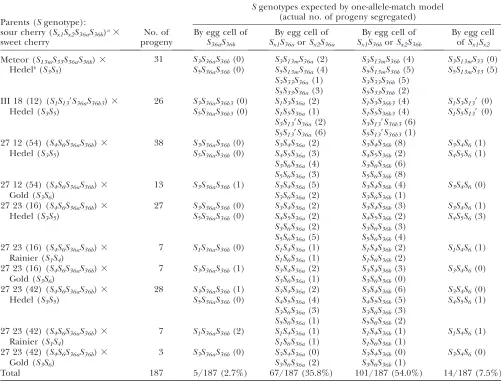
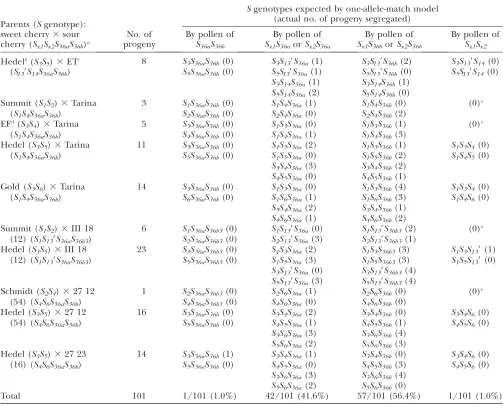
gamete types: S4S6, S4S36a, S4S36b, S6S36a, S6S36b, and S36aS36b. This would result in 12 progeny types if the sweet cherry parent did not have theS4orS6allele or in 6 progeny types if the sweet cherry parent had theS4or S6 allele (in which case pollen grains containing the matchingS-allele would be incompatible). A total of 187 progeny were genotyped from 10 sour3 sweet cherry crosses (Table 5). The vast majority of the progeny were formed from sour cherry eggs that contained only oneS36variant. Only 5 (2.7%) and 14 (7.5%) progeny resulted from eggs with two or zero S36 variants, re-spectively. The presence of these 5 progeny resulting fromS36aS36beggs indicates that these eggs are not lethal. A total of 101 progeny were S genotyped from 10 sweet3sour cherry crosses (Table 6). Only one progeny individual resulted from a sour cherry pollen grain with theS36aandS36bhaplotypes,e.g., the progeny individual S3S36aS36b, obtained from the cross between
Hedelfin-gen and MSU 27 23 (16). This indicates that S36aS36b pollen is not lethal; instead, it is either rarely formed or uncompetitive compared with pollen of otherS geno-types. This result is consistent with the genetic data from 86 and 41 progeny individuals from self-pollination of Meteor and MSU III 18 (12), respectively, where there was no evidence for progeny resulting from a pollen gamete with two S36 haplotypes (Table S3). This conclusion also provides an explanation for why the sour cherry cultivar Tarina (S1S4S36aS36b) is SI. In this case, the only SC pollen type,S36aS36b, rarely contributes to fruit and seed set (Figure 7).
Only 1 of the 101 progeny individuals from the sweet3 sour cherry crosses resulted from a pollen grain that had no S36 variants (Table 6). This successful Sx1Sx2 sour cherry pollen was S1S139. The lack of any progeny resulting from the Sx1Sx2pollen typesS139S14,S1S4, and S4S6is unlikely to be solely due to the lethality or lack of TABLE 5
Pollinations to test for the presence ofS36aS36beggs in sour3sweet cherry crosses
Parents (Sgenotype):
sour cherry (Sx1Sx2S36aS36b)a3
sweet cherry
No. of progeny
Sgenotypes expected by one-allele-match model (actual no. of progeny segregated)
By egg cell of S36aS36b
By egg cell of Sx1S36aorSx2S36a
By egg cell of Sx1S36borSx2S36b
By egg cell ofSx1Sx2
Meteor (S13mS33S36aS36b)3
Hedelb(S3S5)
31 S3S36aS36b(0) S3S13mS36a(2) S3S13mS36b(4) S3S13mS33(0) S5S36aS36b(0) S5S13mS36a(4) S5S13mS36b(5) S5S13mS33(5)
S3S33S36a(1) S3S33S36b(5) S5S33S36a(3) S5S33S36b(2) III 18 (12) (S1S139S36aS36b3)3
Hedel (S3S5)
26 S3S36aS36b3(0) S1S3S36a(2) S1S3S36b3(4) S1S3S139(0) S5S36aS36b3(0) S1S5S36a(1) S1S5S36b3(4) S1S5S139(0)
S3S139S36a(2) S3S139S36b3(6) S5S139S36a(6) S5S139S36b3(1) 27 12 (54) (S4S6S36aS36b)3
Hedel (S3S5)
38 S3S36aS36b(0) S3S4S36a(2) S3S4S36b(8) S3S4S6(1)
S5S36aS36b(0) S4S5S36a(3) S4S5S36b(2) S4S5S6(1) S3S6S36a(4) S3S6S36b(6)
S5S6S36a(3) S5S6S36b(8) 27 12 (54) (S4S6S36aS36b)3
Gold (S3S6)
13 S3S36aS36b(1) S3S4S36a(5) S3S4S36b(4) S3S4S6(0)
S3S6S36a(2) S3S6S36b(1) 27 23 (16) (S4S6S36aS36b)3
Hedel (S3S5)
27 S3S36aS36b(0) S3S4S36a(2) S3S4S36b(3) S3S4S6(1)
S5S36aS36b(0) S4S5S36a(2) S4S5S36b(2) S4S5S6(3) S3S6S36a(2) S3S6S36b(3)
S5S6S36a(5) S5S6S36b(4) 27 23 (16) (S4S6S36aS36b)3
Rainier (S1S4)
7 S1S36aS36b(0) S1S4S36a(1) S1S4S36b(2) S1S4S6(1)
S1S6S36a(1) S1S6S36b(2) 27 23 (16) (S4S6S36aS36b)3
Gold (S3S6)
7 S3S36aS36b(1) S3S4S36a(2) S3S4S36b(3) S3S4S6(0)
S3S6S36a(1) S3S6S36b(0) 27 23 (42) (S4S6S36aS36b)3
Hedel (S3S5)
28 S3S36aS36b(1) S3S4S36a(2) S3S4S36b(6) S3S4S6(0)
S5S36aS36b(0) S4S5S36a(4) S4S5S36b(5) S4S5S6(1) S3S6S36a(3) S3S6S36b(3)
S5S6S36a(1) S5S6S36b(2) 27 23 (42) (S4S6S36aS36b)3
Rainier (S1S4)
7 S1S36aS36b(2) S1S4S36a(1) S1S4S36b(1) S1S4S6(1)
S1S6S36a(1) S1S6S36b(1) 27 23 (42) (S4S6S36aS36b)3
Gold (S3S6)
3 S3S36aS36b(0) S3S4S36a(0) S3S4S36b(0) S3S4S6(0)
S3S6S36a(2) S3S6S36b(1)
Total 187 5/187 (2.7%) 67/187 (35.8%) 101/187 (54.0%) 14/187 (7.5%)
competitiveness of all these pollen types. Instead, the rarity ofSx1Sx2gametes and gametes with twoS36variants most likely results from preferential meiotic pairing of the S36 variant chromosomes. Therefore, our data suggest that when two variants of theS36haplotype are present in a sour cherry individual, the two chromosomes carrying the S36 haplotypes preferentially pair (Figure S10, A and B), resulting in only four gamete types (Figure S10C). However, when only oneS36variant is present in an individual, this S36 variant-containing chromosome can pair with any of the other three chromosomes (Figure S10, D–I), resulting in six gamete types (Figure S10J). For example, Haucket al. (2006b) reported that
RS (S6S139S26S36a) could form six types of gametes:S6S26, S139S36a,S6S36a,S139S26,S6S139, andS26S36a(Figure S10J).
DISCUSSION
According to the one-allele-match model, three sour cherry individuals with theS4S6S36aS36bgenotype [MSU 27 12 (54), MSU 27 23 (16), and MSU 27 23 (42)] should be SC due to the compatibility of S36aS36b pollen. Our previous finding that these individuals were SI provided an exception to this model. Using crosses, we demon-strated a very low transmission ofS36aS36bgametes to their self-pollinated offspring. Therefore, self-fertilization was TABLE 6
Pollination to test for the presence ofS36aS36bpollen in sweet3sour cherry crosses
Parents (Sgenotype): sweet cherry3sour cherry (Sx1Sx2S36aS36b)a
No. of progeny
Sgenotypes expected by one-allele-match model (actual no. of progeny segregated)
By pollen of S36aS36b
By pollen of Sx1S36aorSx2S36a
By pollen of Sx1S36borSx2S36b
By pollen of Sx1Sx2
Hedelb(S3S5)3ETc
(S139S14S36aS36b)
8 S3S36aS36b(0) S3S139S36a(1) S3S139S36b(2) S3S139S14(0) S5S36aS36b(0) S5S139S36a(1) S5S139S36b(0) S5S139S14(0)
S3S14S36a(1) S3S14S36b(1) S5S14S36a(2) S5S14S36b(0) Summit (S1S2)3Tarina
(S1S4S36aS36b)
3 S1S36aS36b(0) S1S4S36a(1) S1S4S36b(0) (0)e
S2S36aS36b(0) S2S4S36a(0) S2S4S36b(2) EFd(S3S4)3Tarina
(S1S4S36aS36b)
5 S3S36aS36b(0) S1S3S36a(0) S1S3S36b(1) (0)e
S4S36aS36b(0) S1S4S36a(1) S1S4S36b(3) Hedel (S3S5)3Tarina
(S1S4S36aS36b)
11 S3S36aS36b(0) S1S3S36a(2) S1S3S36b(1) S1S3S4(0)
S5S36aS36b(0) S1S5S36a(0) S1S5S36b(2) S1S4S5(0)
S3S4S36a(3) S3S4S36b(2) S4S5S36a(0) S4S5S36b(1) Gold (S3S6)3Tarina
(S1S4S36aS36b)
14 S3S36aS36b(0) S1S3S36a(0) S1S3S36b(4) S1S3S4(0)
S6S36aS36b(0) S1S6S36a(1) S1S6S36b(3) S1S4S6(0)
S3S4S36a(2) S3S4S36b(1) S4S6S36a(1) S4S6S36b(2) Summit (S1S2)3III 18
(12) (S1S139S36aS36b3)
6 S1S36aS36b3(0) S1S139S36a(0) S1S139S36b3(2) (0)e
S2S36aS36b3(0) S2S139S36a(3) S2S139S36b3(1) Hedel (S3S5)3III 18
(12) (S1S139S36aS36b3)
23 S3S36aS36b3(0) S1S3S36a(2) S1S3S36b3(3) S1S3S139(1)
S5S36aS36b3(0) S1S5S36a(3) S1S5S36b3(3) S1S5S139(0) S3S139S36a(0) S3S139S36b3(4)
S5S139S36a(3) S5S139S36b3(4) Schmidt (S2S4)327 12
(54) (S4S6S36aS36b)
1 S2S36aS36b3(0) S2S6S36a(1) S2S6S36b(0) (0)e
S4S36aS36b3(0) S4S6S36a(0) S4S6S36b(0) Hedel (S3S5)327 12
(54) (S4S6S36aS36b)
16 S3S36aS36b(0) S3S4S36a(2) S3S4S36b(0) S3S4S6(0)
S5S36aS36b(0) S4S5S36a(1) S4S5S36b(1) S4S5S6(0)
S3S6S36a(3) S3S6S36b(4) S5S6S36a(2) S5S6S36b(3) Hedel (S3S5)327 23
(16) (S4S6S36aS36b)
14 S3S36aS36b(1) S3S4S36a(1) S3S4S36b(0) S3S4S6(0)
S5S36aS36b(0) S4S5S36a(0) S4S5S36b(3) S4S5S6(0)
S3S6S36a(3) S3S6S36b(4) S5S6S36a(2) S5S6S36b(0)
Total 101 1/101 (1.0%) 42/101 (41.6%) 57/101 (56.4%) 1/101 (1.0%)
a
Sx1andSx2areShaplotypes other thanS36a,S36bandS36b3.
b
Hedel, Hedelfingen.
cET, Englaise Timpurii. dEF, Emperor Francis.
eZero progeny were expected and none were obtained as
restricted, not by GSI or lethality, but by the very low frequency of transmission of the only pollen type that would be SC, a unique case where, despite the presence of two nonfunctionalShaplotypes, the breakdown of SI in Prunus essentially does not occur. In this special case, the presence of two nonfunctional S36 variants is not enough for sour cherry to be SC, and another non-functionalShaplotype is needed. Three SC sour cherry cultivars—Englaise Timpurii (S139S14S36aS36b), Meteor (S13mS33S36aS36b), and MSU III 18 (12) (S1S139S36aS36b3)— represent examples of this, as they each have a third nonfunctionalShaplotype.
For all the previously studiedS haplotype combina-tions and several isozyme loci (Beaver and Iezzoni 1993; Bosˇkovic´et al. 2006; Haucket al. 2006b), gamete types resulting from homologous and less frequently homeologous pairing were observed. In contrast, the rare occurrence of gametes with two S36 variants is unique, suggesting preferential pairing of the chromo-somes containing theS36haplotypes.S36a,S36b, andS36b2 have been identified in the sour cherry progenitorP. fruticosa(T. Tsukamotoand A. F. Iezzoni, unpublished results), but not in the sweet cherry progenitor, suggest-ing that theS36variants are derived fromP. fruticosaand thus would be on chromosomes that would preferen-tially pair at meiosis. This is in contrast to the otherS haplotypes in sour cherry (S1,S4,S6,S9,S12,S13,S14, and S16) that have all been identified in sweet cherry. Since the underlying mechanism limiting successful fertiliza-tion by gametes with twoS36haplotypes does not involve
GSI, our findings support the one-allele-match model for genetic control of SI and SC in sour cherry. The incompatibility of 2xpollen in Prunus distinguishes GSI in Prunus from that in the Solanaceae. Specifically, the incompatibility and compatibility of heteroallelic pollen in Prunus (sour cherry) and the Solanaceae, respec-tively, must be considered when developing functional models to explain the allele specificity of the incompat-ibility reaction.
Sequence analyses found no unambiguous primary defect leading to loss of function for theS36a,S36b, and S36b3 haplotypes. We were also unable to find a func-tionalS36haplotype in cherry for comparison. However, sequence analysis of the S36 variants provides some useful hints for future functional tests. Since all theS36 variants are nonfunctional, it is possible that the mutation(s) responsible for loss of function arose before the divergence of the different variants. If so, this mutation should be present in all the variants. A candidate could be the replacement of the amino acid residue at position 188 (from tyrosine to phenylalanine) of the SFB protein. This replacement is a change from a polar to a nonpolar residue. Furthermore, this tyrosine residue is conserved in all other known functional SFB proteins, suggesting that it might be important for function and that its mutation might cause malfunction of the protein. However, there is currently no bio-chemical or molecular evidence supporting the impor-tance of this tyrosine residue in SFB function.
A second possible explanation for the nonfunction-ality of the S36 variants is the presence of a non-autonomous Helitron element 38 bp downstream of the stop codon of SFB in all four S36 variants, which does not abolish the initiation of transcription. Eukary-otic genes usually are associated with imprecise termi-nation of transcription; however, they require AATAAA [AAUAAA in mRNA, the poly(A) signal] for polyadeny-lation. This signal is not present in the 38 bp upstream of the Helitron element. However, it is present in the Helitron sequence, after a GC-rich stem loop and a region composed of consecutive T’s, which are known to cause pausing of RNA polymerase and unwinding of RNA–DNA helices. Accordingly, some transcripts may not have the poly(A) signal. If few transcripts are polyadenylated, this may significantly affect the life span of the mRNA and the generation of the protein. Our results support this possibility in that the vast majority of S36 transcripts do not have a poly(A) tail, suggesting that the presence of the Helitron element interferes with the polyadenylation process. This may significantly affect the life span of the SFBmRNA and the generation of the protein. However, the real cause for the loss of function for theS36variants awaits future biochemical analysis to test whether the absence of the poly(A) tail is responsible for the nonfunctionalS36 hap-lotype. Interestingly, Helitron elements also seem to be involved in structural rearrangements of the Arabidopsis Figure 7.—Schematic diagram of self-pollination of the
Slocus (Sherman-Broyleset al.2007), suggesting that this element might have a widespread role in the evo-lution of self-compatibility.
We thank Ravishankar Palanivelu of the University of Arizona for the use of his laboratory for the RACE experiment. This work was supported by a grant (no. 2004-01543) from the U. S. Department of Agriculture Cooperative State Research, Education and Extension Service–National Research Initiative–Plant Genome Program.
LITERATURE CITED
Beaver, J. A., and A. F. Iezzoni, 1993 Allozyme inheritance in
tet-raploid sour cherry (Prunus cerasusL.). J. Am. Soc. Hortic. Sci.
118:873–877.
Bosˇkovic´, R. I., and K. R. Tobutt, 2001 Genotyping cherry
culti-vars assigned to incompatibility groups by analyzing stylar ribonu-cleases. Theor. Appl. Genet.103:475–485.
Bosˇkovic´, R. I., B. Wolfram, K. R. Tobutt, R. Cerovic and T.
Sonneveld, 2006 Inheritance and interaction of
incompatibil-ity alleles in the tetraploid sour cherry. Theor. Appl. Genet.112:
315–326.
De Nettancourt, D., 2001 Incompatibility and Incongruity in Wild
and Cultivated Plants.Springer-Verlag, Berlin.
Entani, T., M. Iwano, H. Shiba, F.-S. Che, A. Isogai et al.,
2003 Comparative analysis of the self-incompatibility (S-) locus region ofPrunus mume: identification of a pollen-expressed F-box gene with allelic diversity. Genes Cells8:203–213.
Golz, J. F., V. Su, A. E. Clarkeand E. Newbigin, 1999 A molecular description of mutations affecting the pollen component of the
Nicotiana alata Slocus. Genetics152:1123–1135.
Golz, J. F., H.-Y. Oh, V. Su, M. Kusaba and E. Newbigin, 2001 Genetic analysis ofNicotianapollen-part mutants is consis-tent with the presence of an S-ribonuclease inhibitor at the
Slocus. Proc. Natl. Acad. Sci. USA98:15372–15376.
Hauck, N. R., A. F. Iezzoni, H. Yamaneand R. Tao, 2001 Revisiting theS-allele nomenclature in sweet cherry (Prunus aviumL.) using RFLP profiles. J. Am. Soc. Hortic. Sci.126:654–660.
Hauck, N. R., H. Yamane, R. Taoand A. F. Iezzoni, 2002 Self-compatibility and inSelf-compatibility in tetraploid sour cherry (Prunus cerasusL.). Sex. Plant Reprod.15:39–46.
Hauck, N. R., K. Ikeda, R. Taoand A. F. Iezzoni, 2006a The mu-tatedS1-haplotype in sour cherry has an alteredS-haplotype spe-cific F-box protein gene. J. Hered.97:514–520.
Hauck, N. R., H. Yamane, R. Taoand A. F. Iezzoni, 2006b Accu-mulation of nonfunctional S-haplotypes results in the break-down of gametophytic self-incompatibility in tetraploid Prunus.
Genetics172:1191–1198.
Huang, S.-X., H.-Q. Wu, Y.-R. Li, J. Wu, S.-J. Zhanget al., 2008 Com-petitive interaction between two functionalS-haplotypes confers self-compatibility on tetraploid Chinese cherry (Prunus pseudocer-asusLindl. CV. Nanjing Chuisi). Plant Cell Rep.27:1075–1085. Ikeda, K., B. Igic, K. Ushijima, H. Yamane, N. R. Haucket al., 2004a Primary structural features of theShaplotype-specific F-box pro-tein,SFB, inPrunus.Sex. Plant Reprod.16:235–243.
Ikeda, K., A. Watari, K. Ushijima, H. Yamane, N. R. Haucket al., 2004b Molecular markers for the self-compatibleS49-haplotype, a pollen-part mutant in sweet cherry (Prunus aviumL.). J. Am. Soc. Hortic. Sci.129:724–728.
Ikeda, K., K. Ushijima, H. Yamane, R. Tao, N. R. Haucket al., 2005 Link-age and physical distances between theS-haplotypeS-RNaseandSFB
genes in sweet cherry. Sex. Plant Reprod.17:289–296.
Kapitonov, V. V., and J. Jurka, 2001 Rolling-circle transposons in
eukaroyotes. Proc. Natl. Acad. Sci. USA98:8714–8719.
Konieczny, A. and F. Ausubel, 1993 A procedure for mapping
Ara-bidopsismutations using co-dominant ecotype-specific PCR-based markers. Plant J.4:403–410.
Lai, Z., W. Ma, B. Han, L. Liang, Y. Zhanget al., 2002 An F-box gene linked to the self-incompatibility (S) locus ofAntirrhinum
is expressed specifically in pollen and tapetum. Plant Mol. Biol.
50:29–42.
Lewis, D., 1943 Physiology of incompatibility in plants. III. Autote-traploids. J. Genet.45:171–185.
McClure, B., 2009 Darwin’s foundation for investigating self-incompatibility and the progress toward a physiological model for S-RNase-based SI. J. Exp. Bot.60:1069–1081.
Neff, M. M., J. D. Neff, J. Choryand A. E. Pepper, 1998 dCAPS, a simple technique for the genetic analysis of single nucleotide polymorphisms: experimental applications inArabidopsis thaliana
genetics. Plant J.14:387–392.
Neff, M. M., E. Turkand M. Kalishman, 2002 Web-based primer design for single nucleotide polymorphism analysis. Trends Genet.18:613–615.
Nunes, M. D. S., R. A. M. Santos, S. M. Ferreira, J. Vieiraand C.
Vieira, 2006 Variability patterns and positively selected sites
at the gametophytic self-incompatibility pollenSFBgene in a wild self-incompatible Prunus spinosa (Rosaceae) population. New Phytol.172:577–587.
Olden, E. J., and N. Nybom, 1968 On the origin ofPrunus cerasusL. Hereditas59:327–345.
Sherman-Broyles, S., N. Boggs, A. Farkas, P. Liu, J. Vrebalovet al.,
2007 Slocus genes and the evolution of self-fertility in Arabidop-sis thaliana.Plant Cell19:94–106.
Sijacic, P., X. Wang, A. L. Skirpan, Y. Wang, P. E. Dowd et al.,
2004 Identification of the pollen determinant of S-RNase-mediated self-incompatibility. Nature429:302–305.
Stockinger, E. J., C. A. Mulinix, C. M. Long, T. S. Brettinand A. F.
Iezzoni, 1996 A linkage map of sweet cherry based on RAPD
analysis of a microspore-derived callus culture population. J. Hered.87:214–218.
Tao, R., H. Yamane, A. Sugiura, H. Murayama, H. Sassaet al., 1999 Molecular typing ofS-alleles through identification, char-acterization and cDNA cloning for S-RNases in sweet cherry. J. Am. Soc. Hortic. Sci.124:224–233.
Tobutt, K. R., R. Bosˇkovic´, R. Cerovic, T. Sonneveldand D. Ruzic,
2004 Identification of incompatibility alleles in tetraploid spe-cies sour cherry. Theor. Appl. Genet.108:775–785.
Tsukamoto, T., T. Ando, H. Watanabe, E. Marchesiand T.-H. Kao,
2005 Duplication of theS-locus F-box gene is associated with breakdown of pollen function in anS-haplotype identified in a natural population of self-incompatible Petunia axillaris. Plant Mol. Biol.57:141–153.
Tsukamoto, T., N. R. Hauck, R. Tao, N. Jiangand A. F. Iezzoni,
2006 Molecular characterization of three non-functional S -haplotypes in sour cherry (Prunus cerasus). Plant Mol. Biol.62:
371–383.
Tsukamoto, T., D. Potter, R. Tao, C. P. Vieira, J. Vieiraet al.,
2008 Genetic and molecular characterization of three novel
S-haplotypes in sour cherry (Prunus cerasusL.). J. Exp. Bot.59:
3169–3185.
Ushijima, K., H. Sassa, R. Tao, H. Yamane, A. M. Dandekaret al.,
1998 Cloning and characterization of cDNAs encoding S -RNases in almond (Prunus dulcis): primary structure features and sequence diversity of theS-RNases in Rosaceae. Mol. Gen. Genet.260:261–268.
Ushijima, K., H. Sassa, M. Tamura, M. Kusaba, R. Tao et al.,
2001 Characterization of theS-locus region of almond (Prunus dulcis): analysis of a somaclonal mutant and a cosmid contig for anShaplotype. Genetics158:370–386.
Ushijima, K., H. Sassa, A. M. Dandekar, T. M. Gradziel, R. Tao
et al., 2003 Structural and transcriptional analysis of the self-incompatibility locus of almond: identification of a pollen-expressed F-box gene with haplotype-specific polymorphism. Plant Cell15:771–781.
Ushijima, K., H. Yamane, A. Watari, E. Kakehi, K. Ikedaet al.,
2004 TheShaplotype-specific F-box protein gene,SFB, is defec-tive in self-compatible haplotypes ofPrunus aviumandP. mume.
Plant J.39:573–586.
Vaughan, S. P., R. I. Bosˇkovic´, A. Gisbert-Climent, K. Russell
and K. R. Tobutt, 2008 Characterization of novel S-alleles from cherry (Prunus aviumL.). Tree Genet. Genomes4:531– 541.
Xue, Y., Y. Zhang, Q. Yang, Q. Li, Z. Chenget al., 2009 Genetic fea-tures of a pollen-part mutation suggest an inhibitory role for the
Antirrhinumpollen self-incompatibility determinant. Plant Mol. Biol.70:499–509.
Yamane, H., R. Tao, A. Sugiura, N. R. Hauckand A. F. Iezzoni,
tetra-ploid sour cherry (Prunus cerasus). J. Am. Soc. Hortic. Sci.126:
661–667.
Yamane, H., K. Ikeda, N. R. Hauck, A. F. Iezzoni and R. Tao,
2003a Self-incompatibility (S) locus region of the mutatedS6 -haplotypes of sour cherry (Prunus cerasus) contains a functional pollenSallele and a non-functional pistilSallele. J. Exp. Bot.54:
2431–2434.
Yamane, H., K. Ikeda, K. Ushijima, H. Sassaand R. Tao, 2003b A
pollen-expressed gene for a novel protein with an F-box motif that is very tightly linked to a gene for S-RNase in two species
of cherry, Prunus cerasus andP. avium.Plant Cell Physiol.44:
764–769.
Yamane, H., K. Ushijima, H. Sassaand R. Tao, 2003c The use ofS
haplotype-specific F-box protein gene, SFB, as a molecular marker forS-haplotypes and self-compatibility in Japanese apri-cot (Prunus mume). Theor. Appl. Genet.107:1357–1361.
Supporting Information
http://www.genetics.org/cgi/content/full/genetics.109.109728/DC1
Molecular and Genetic Analyses of Four Nonfunctional
S
Haplotype Variants Derived from a Common Ancestral
S
Haplotype Identified in Sour Cherry (
Prunus cerasus
L.)
Tatsuya Tsukamoto, Nathanael R. Hauck, Ryutaro Tao, Ning Jiang
and Amy F. Iezzoni
T. Tsukamoto et al.
!!!!FIGURE!S1.—Amino!acid!sequence!alignment!of!S36a!and!S36b!RNases!obtained!from!sour!cherry!and!that!of!functional!S-RNases!from!
sweet!and!sour!cherry.!!The!alignment!was!generated!by!DNASIS!version!3.5!(Hitachi!Software!Engineering!Co.!Ltd.,!Tokyo,!Japan).!!Gaps!
are!marked!by!dashes.!!Conserved!amino!acids!are!shown!on!a!darkened!background.!!The!five!conserved!regions,!C1,!C2,!C3,!RC4,!and!C5!
(USHIJIMA!et!al.!1998),!are!marked!with!solid!boxes,!and!the!hypervariable!region,!RHV!(USHIJIMA!et!al.!1998),!reported!in!the!rosaceous!
S-RNases!is!marked!with!a!dotted!box.!!S-RNases!used!for!the!alignment!are!eleven!S-RNases!from!sweet!cherry!(P.!avium)!!(PaS1-RNase:!
AB028153,!PaS3-RNase:!AB010306,!PaS4-RNase:!AB028154,!PaS5-RNase:!AJ298314,!PaS6-RNase:!AB010305,!PaS7-RNase:!EU035974,!
PaS12-RNase:!AY259115,!PaS13-RNase:!DQ385842,!PaS23-RNase:!AY259114,!PaS24-RNase:!AY259112,!PaS25-RNase)!and!four!from!sour!
cherry!(P.!cerasus)!(PcS26-RNase:!EU035975,!PcS33-RNase:!EU054325,!PcS34-RNase:!EU054326,!and!PcS35-RNase:!EU054327).!!
2!SI T.!Tsukamoto!et!al.
PcS36a-RNase 1 MVTLKSSLAFLVLAFALFLCFIMSTGDGSYDYFQFVQQWPPATCSLS-RTPCYKPRPPQIFTIHGLWPSNYSNPKRPSNCRGSLFDSRKV 89 PcS36b-RNase 1 MVTLKSSLAFLVLAFALFLCFIMSTGDGSYDYFQFVQQWPPATCSLS-RTPCYKPRPPQIFTIHGLWPSNYSNPKRPSNCRGSLFDSRKV 89 PaS1-RNase 1 MAMLKSSLAFLVLAFAFFFCYVMSSG--SYDYFQFVQQWPPTNCRVRIKRPCSKPRPLQNFTIHGLWPSNYSNPTKPSNCNGSKYEDRKV 88 PaS3-RNase 1 MAMLKSSLSFLVLGFAFFLCFIISAGDGSYVYFQFVQQWPPTTCRVQKK--CSKPRPLQNFTIHGLWPSNYSNPTMPSNCNGSRFKKELL 88 PaS4-RNase 1 MAILKSTLAFLVLAFAFFICYVMSSG--SYDYFQFVQQWPPTNCRVR-NKPCTKPRPLQNFTIHGLWPSNYSNPRMPSKCTGSLFNFRKV 87 PaS5-RNase 1 MAMLKSSLALLVLAFAFFFCYVMSSG--SYDYFQFVQQWPPTNCRVRTK--CSNPRPLQYFTIHGLWPSNYSNPKMPSNCIGSQFNESKV 86 PaS6-RNase 1 MAMLKSSPAFLVLAFAFFLCFIMSNG--SYVYFQFVQQWPPTNCRVRIKRPCSSPRPLQYFTIHGLWPSNYSNPRMPSNCTGPQFK-RIL 87 PaS7-RNase 1 MAMLKSSLAFLVLAFAFFLCFIMSTG--SYDYFQFVQQWPPTNCRVRIKQPCSNPRPLQYFTIHGLWPSNYSNPTMPSNCIGSQFEWRKL 88 PaS12-RNase 1 MGMLKSSLAFLVLAFAFFLCFIMSAGDGSYDYFQFVQQWPPTNCRVRIKRPCSNPRPLQYSTIHGLWPSNYSNPTKPSNCNGLKFEAKKL 90 PaS13-RNase 1 MAMLKPSLAFLVLAFAFFLCFIMSTG--SYVYFQFVQQWPPTTCRLSSK-PSHQHRPFQRFTIHGLWPSNYSNPRKPSNCNGSQFDDRKV 87 PaS23-RNase 1 MAILNSTLAFLVLAFAFFFCYVMSSG--SYDYFQFVQQWPPTNCRVRIKRPCSNPRPLQYFTIHGLWPSNYSNPTMPSNCNGTQFKMQNL 88 PaS24-RNase 1 MSMLKSSLAFLVLAFVFFLCFIMSTG--SYVYFQFVQQWPPATC-IRSNKPCSKHRPLQIFTIHGLWPSNYSNPRMPSNCTGPQFK-RIL 86 PaS25-RNase 1 MGMLKSSVAFLVLAFAFFFCYVMSSG--SYDYFQFVQQWPPTNCRVRIKRPCSNPRPLQNFTIHGLWPSNYSNPTMPSNCAGSEFKERKL 88 PcS26-RNase 1 MAMLKSSPAFLVLAFAFFFCFIMSTSTGSYVYFQFVQQWPTTTCILRKK--CSQPRPLQIFTIHGLWPSNYSNPTRPSNCIGSQFNFTKV 88 PcS33-RNase 1 MGMLKSSLAFLVLAFAFFLCFIMSTGDGSYNYFQFVQQWPPTTCTVRKK--CSKARPLQIFTIHGLWPSNYSNPTMPSNCNGSQFNFTKV 88 PcS34-RNase 1 MAMLKSSLACLVLAFAFFFCYVMSSG--SYEYFQFVQQWPPTNCRVRIKRPCSKPRPLQNFTIHGLWPSNYSNPTKPSNCNGSKYEDRKV 88 PcS35-RNase 1 MAMLKLSLAFDVLAFVFFLCFIMSTG--SYQYFLFVQQWPPTTCAVR-KKPCYQNPPSKIFTIHGLWPSNYSKNAWVANCNGTRFSNS-L 86 C1!!!!!!!!!!!!!!!!!!!!!!!!!!!!!!!!!!!!!!!!!!!!!!!!!!!!!C2!!!!!!!!!!!!!!!!!!!!!!!!!!!!!!!!!!!!!!RHV PcS36a-RNase 90 YPQLRLNLKISWPNVKSGNDTEFWESEWNKHGRCSEQTLNQMQYFERSDEMWNSYNITEILKKAQIVPNATRTWKYSDILSPIKAATNTT 179 PcS36b-RNase 90 YPQLRLNLKISWPNVKSGNDTEFWESEWNKHGRCSEQTLNQMQYFERSDEMWNSYNITEILKKAQIVPNATRTWKYSDILSPIKAATNTT 179 PaS1-RNase 89 YPKLRSKLKRSWPDVESGNDTRFWEGEWNKHGRCSEQTLNQMQYFEISHDMWVSYNITEILKNASIVPHPTQKWSYSDIVSPIKTATKRT 178 PaS3-RNase 89 SPRMQSKLKISWPNVVSSNDTKFWESEWNKHGTCSEQTLNQVQYFEISHEMWNSFNITDILKNASIVPHPTQTWKYSDIVSAIQSKTQRT 178 PaS4-RNase 88 YPQLRSDLKISWPDVESGNDTRFWESEWNKHGRCSEASLNQMQYFERSHAMWISYNITEILKNASIVPSATKNWTYSDIVSPIKRATKRT 177 PaS5-RNase 87 YPRLRSKLRISWPDVESGNDTKFWGDEWNKHGTCSQRILNQFQYFERSQQMWRSYNITNILKKAQIVPNATQTWSYSDIVSPIKTATNRT 176 PaS6-RNase 88 SPQLRSKLQTSWPDVESGNDTKFWESEWNKHGTCSKETLNQMQYFERSYAMWMSYNITEILKNASIVPHPTQTWKYSDIVAPIKAATKRT 177 PaS7-RNase 89 YPHMRSKLKISWPDVESGNDTKFWEGEWNKHGTCSVEKLNQMQYFERSYAMWRSYNITKILQNASIVPSTTRTWTYSDIVSPIKAATGRT 178 PaS12-RNase 91 SPEMQTKLKKSWPDVESGNDTKFWEGEWNKHGKCSEQTLNQMQYFERSFAMWKSYNITEILKNASIVPHPTQTWKYSDIASPIKAVTKTT 180 PaS13-RNase 88 YPDLRSDLKRSWPDVEGGNDTKFWEGEWNKHGKCSEQTLNQFQYFERSHDMWMSYNITEVLKNASIVPNAKQRWKYSDIVSPIKGATGRT 177 PaS23-RNase 87 FPYLRSRLKMSWPDVESGNDTKFWEGEWNKHGTCSERILNIMQYFQRSQAMWKSHNITEILKNASIVPHPTQTWKYSDIVSPIKSATGRT 178 PaS24-RNase 87 SPQLRSKLQTSWPDVESGNDTKFWESEWNKHGTCSKETLNQMQYFERSYAMXMSYNITEILKNASIVPHPTQTWKYSDIVAPIKAATKRT 176 PaS25-RNase 89 SPKLRSKLKRSWPDVESGNDPRFWEGEWSKHGKCSEQTLNQMQYFQRSHEMWQSFNITEILRNASIVPHPTQTWTYSDIVSPIKAVTQTT 178 PcS26-RNase 89 YPHMRTKLKRAWPDVESGNDTKFWEGEWNKHGTCSEERLNQMQYFERSYAMWRSFNISEILKNASIVPSATQKWSYSDIVAPIKAATKRT 178 PcS33-RNase 89 SPQLRADLERSWPDVESGNDTRFWEGEWNKHGTCSEQTLNQMQYFQRSYAMWRSYNISKILKNASIVPHPTQTWTYSDIVSAIKAVTQTT 178 PcS34-RNase 89 YPKLRSKLKRSWPDVESGNDTRFWEGEWNKHGRCSEQTLNQMQYFEVSHDMWLSYNITEILRNASIVPHPTRTWTYSDIVSPIKAATKRT 178 PcS35-RNase 87 SPALESKLKKSWPDVESGNDTDFWGREWNKHGTCSEQTLDQELYFQRSHIIWKAFNITNILQNAKILPTGSK-WDYADIASPIKTVTTKM 175 RHV!!!!!!!!!!!!!!!!!!!!!!!!!!!!!!!!!!!!!!!!!!!!!!!!!!!C3!!!!!!!!!!!!!!!!!!!!!!!!!!!!!!!!!!!!!!!!!!!!!!!!!!!!!!RC4