CopyrightÓ2009 by the Genetics Society of America DOI: 10.1534/genetics.108.099614
Evolution of New Disease Specificity at a Simple Resistance Locus in a
Crop–Weed Complex: Reconstitution of the
Lr21
Gene in Wheat
Li Huang,* Steven Brooks,
†Wanlong Li,
‡John Fellers,
§James C. Nelson** and Bikram Gill
‡,1*Department of Plant Sciences and Plant Pathology, Montana State University, Bozeman, Montana 59717-3150,†U. S. Department of Agriculture–Agricultural Research Service, Dale Bumpers National Rice Research Center, Stuttgart, Arkansas 72160,‡Department
of Plant Pathology, Wheat Genetic and Genomic Resources Center, Kansas State University, Manhattan, Kansas 66506-5502,
§U. S. Department of Agriculture–Agricultural Research Service–Plant Science and Entomology Research Unit, Department of
Plant Pathology, Kansas State University, Manhattan, Kansas 66506-5502 and**Department of Plant Pathology, Kansas State University, Manhattan, Kansas 66506-5502
Manuscript received December 11, 2008 Accepted for publication April 3, 2009
ABSTRACT
The wheat leaf-rust resistance geneLr21was first identified in an Iranian accession of goatgrass,Aegilops tauschiiCoss., the D-genome donor of hexaploid bread wheat, and was introgressed into modern wheat cultivars by breeding. To elucidate the origin of the gene, we analyzed sequences ofLr21andlr21alleles from 24 wheat cultivars and 25 accessions ofAe. tauschii collected along the Caspian Sea in Iran and Azerbaijan. Three basic nonfunctionallr21haplotypes, H1, H2, and H3, were identified.Lr21was found to be a chimera of H1 and H2, which were found only in wheat. We attempted to reconstitute a functionalLr21 allele by crossing the cultivars Fielder (H1) and Wichita (H2). Rust inoculation of 5876 F2progeny revealed a single resistant plant that proved to carry the H1H2 haplotype, a result attributed to intragenic recombination. These findings reflect how plants balance the penalty and the necessity of a resistance gene and suggest that plants can reuse ‘‘dead’’ alleles to generate new disease-resistance specificity, leading to a ‘‘death–recycle’’ model of plant-resistance gene evolution at simple loci. We suggest that selection pressure in crop–weed complexes contributes to this process.
P
LANTS possess large numbers of resistance genes (R gene) as a part of an elaborate plant defense system. In different plants, anR-gene locus may consist of a single-copy (simple) or of multiple copies of R genes (complex) in clusters as a result of gene du-plication events. This dudu-plication is considered as the birth of anRgene.Rgenes are necessary for plants to respond to pathogen attacks and to survive when pathogens are in the environment. Mutations, gene conversion, and recombination were found to be the means to create new specificities for various pathogens (for review, Leister2004). However, anR gene could bring a penalty when the pathogen is absent (Stahl et al. 1999). In such a case, plants have better fitness when they get rid of theR-gene function. In nature, the presence of different pathogens maintains the diversity ofR-gene specificities. So far, there is no report on the fates of nonfunctionalRgenes.In native agricultural ecosystems, wild plants often grow as weeds intermixed with or adjacent to their crop
relatives. Extensive gene flow occurs between wild and domesticated forms, spawning numerous crop landraces adapted to diverse environments and occasionally new species. Common (hexaploid or bread) wheat (Triticum aestivum L., 2n ¼ 6x ¼42, genome formula AABBDD) arose from such a process by hybridization of domesti-cated tetraploid wheat (T. turgidum L., 2n ¼ 4x ¼ 28, AABB) with goatgrass (Aegilops tauschiiCoss., 2n¼2x¼14, DD) growing as a weed in farmers’ fields along the Caspian Sea in Iran ca. 8000 years ago (Kihara 1944; McFaddenand Sears1946; Nesbittand Samuel1998). Because of the pivotal importance of Ae. tauschii in wheat evolution and crop improvement, Kiharaet al. (1965) gathered extensive collections from Iran, Afgha-nistan, and adjacent regions. They suggested that Caspian Iran was the center of the genetic diversity of Ae. tauschii, a proposition later confirmed by molecular-marker analysis (Lubbers et al. 1991), as well as of resistance to leaf rust. Nine named and 12 new leaf-rust resistance genes have been documented inAe. tauschii, and many more remain to be identified (Gill et al. 2008). Leaf rust, a scourge of wheat since before Roman times, is caused by the fungusPuccinia triticina(Eriks). It attacks mainly the leaf blade, producing small, elliptical, orange-red pustules on the upper surface, causing premature defoliation that results in as much as a 40% yield loss (McIntoshet al. 1995).
Supporting information is available online athttp://www.genetics.org/ cgi/content/full/genetics.108.099614/DC1.
Sequence data from this article have been deposited with the EMBL/ GenBank Data Libraries under accession nos. FJ876280-FJ876295.
1Corresponding author:Department of Plant Pathology, Wheat Genetic
and Genomic Resources Center, Kansas State University, Manhattan, KS 66506-5502. E-mail: [email protected]
One Ae. tauschii accession, TA1599, collected in Caspian Iran, carries a gene named Lr21 that confers resistance to all knownP. triticinaraces.Lr21, transferred to wheat in the 1970s (Rowland and Kerber 1974; McIntoshet al. 1995), was recently cloned (Huanget al. 2003) and shown to be a simple (single-copy) locus en-coding a nucleotide-binding site–leucine-rich repeats (NBS–LRR) protein of 1080 amino acids. Here we report how a simple locus such asLr21evolved novel resistance specificities in a unique crop–weed system and how frag-ments of nonfunctional alleles could be reused in this process.
MATERIALS AND METHODS
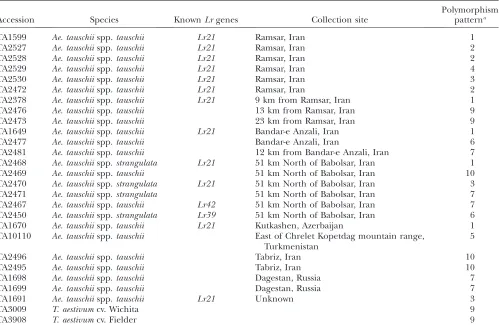
Plant materials: Twenty-five accessions ofAe. tauschiiwere used for this study (Table 1). Of these, 12 are theLr21carriers identified from the entire collection of 528 accessions of Ae. tauschiicollected over a large geographic area representing its genetic diversity and maintained by the Wheat Genetic and Genomic Resources Center (WGGRC) at Manhattan, Kansas. Additional Lrgenes are present in two accessions: Lr39in TA2450 andLr42in TA2467. The remaining accessions carry no knownLrgenes and are susceptible to leaf rust in the field. Among the 13lr21 accessions, 5 were sampled at the same collection sites as theLr21accessions, 3 were collected along
the Caspian Sea of Iran within 51 km of theLr21accessions, and the remaining 5 were from places where no Lr21 accessions were found.
Of 24 wheat cultivars (Table 1 andTable S1) with thelr21 allele that were tested for polymorphism using the KSUD14-STS marker, a PCR-based molecular marker that distinguishes Lr21fromlr21(Huanget al. 2003), ‘‘Fielder,’’ a spring wheat,
and ‘‘Wichita,’’ a winter wheat, were chosen for this study. WGRC7 is a wheat germplasm developed by WGGRC (http:// www.k-state.edu/wgrc/) by direct crossing Wichita with Ae. tauschiiaccession TA1649 and then backcrossing with Wichita twice (Rauppet al. 1983).
One dicot species, Arabidopsis thaliana, and five cereal species, barley (Hordeum vulgare), oat (Avena sativa), rye (Secale cereale), maize (Zea mays), and rice (Oryza sativa) were chosen on the basis of the evolutionary time line to assess the approximate age of theLr21locus.
DNA manipulation and sequence analysis:DNA isolation, digestion, blotting, and Southern hybridization followed the protocols described by Qiet al. (2004). Several pairs of primers
were designed on the basis of coding regions and flanking sequences ofLr21fromAe. tauschiiaccession TA1649. Primers Sta (TTGTGATGGAGAAACGAGTGGCC) and Tor (CGGAC GAGTAGTTCTTTCAGGA) were designed to amplify the entire gene and 397-bp flanking regions (Figure 1). Each full-length allele was amplified by long-range PCR using Herculase-enhanced DNA polymerase (Stratagene, La Jolla, CA) from genomic DNA of each accession. The PCR products were then cloned directly using the pGEM-T easy system TABLE 1
Triticum and Aegilops accessions used for sequencing ofLr21andlr21alleles
Accession Species KnownLrgenes Collection site
Polymorphism patterna
TA1599 Ae. tauschiispp.tauschii Lr21 Ramsar, Iran 1
TA2527 Ae. tauschiispp.tauschii Lr21 Ramsar, Iran 2
TA2528 Ae. tauschiispp.tauschii Lr21 Ramsar, Iran 2
TA2529 Ae. tauschiispp.tauschii Lr21 Ramsar, Iran 4
TA2530 Ae. tauschiispp.tauschii Lr21 Ramsar, Iran 3
TA2472 Ae. tauschiispp.tauschii Lr21 Ramsar, Iran 2
TA2378 Ae. tauschiispp.tauschii Lr21 9 km from Ramsar, Iran 1
TA2476 Ae. tauschiispp.tauschii 13 km from Ramsar, Iran 9
TA2473 Ae. tauschiispp.tauschii 23 km from Ramsar, Iran 9
TA1649 Ae. tauschiispp.tauschii Lr21 Bandar-e Anzali, Iran 1
TA2477 Ae. tauschiispp.tauschii Bandar-e Anzali, Iran 6
TA2481 Ae. tauschiispp.tauschii 12 km from Bandar-e Anzali, Iran 7
TA2468 Ae. tauschiispp.strangulata Lr21 51 km North of Babolsar, Iran 1
TA2469 Ae. tauschiispp.tauschii 51 km North of Babolsar, Iran 10
TA2470 Ae. tauschiispp.strangulata Lr21 51 km North of Babolsar, Iran 3
TA2471 Ae. tauschiispp.strangulata 51 km North of Babolsar, Iran 7
TA2467 Ae. tauschiispp.tauschii Lr42 51 km North of Babolsar, Iran 7
TA2450 Ae. tauschiispp.strangulata Lr39 51 km North of Babolsar, Iran 6
TA1670 Ae. tauschiispp.tauschii Lr21 Kutkashen, Azerbaijan 1
TA10110 Ae. tauschiispp.tauschii East of Chrelet Kopetdag mountain range, Turkmenistan
5
TA2496 Ae. tauschiispp.tauschii Tabriz, Iran 10
TA2495 Ae. tauschiispp.tauschii Tabriz, Iran 10
TA1698 Ae. tauschiispp.tauschii Dagestan, Russia 7
TA1699 Ae. tauschiispp.tauschii Dagestan, Russia 7
TA1691 Ae. tauschiispp.tauschii Lr21 Unknown 3
TA3009 T. aestivumcv. Wichita 9
TA3908 T. aestivumcv. Fielder 9
a
(Promega, Madison, WI). First, vector primers SP6 and T7 were used to sequence the ends of each clone. Internal primers were designed later on the basis of the sequences obtained from previous primers. At least three clones from each accession were sequenced from both directions. All the sequences were assembled using MacVector 6.5.3 (Oxford Molecular, Madison, WI). Primers Sta3 (TGGCTAATGCAGT GGGCACGG) and D14-R (GGACATTAGGCGATGCTTTGAA TTC) were used to amplify the NBS region of the alleles (Figure 1). The marker KSUD14-STS was designed on the basis of a 105- or 88-bp insertion/deletion (indel) in the first intron of theLr21(Figure 1). A 1.36-kb fragment from this region is a signature of theLr21, while a 1465-or 1448-bp fragment with a 105- or 88-bp insertion is a tag oflr21. Other sizes of fragments amplified with KSUD14-STS representLr21paralogs (Figure 2, A and B).
Gene expression study: Expression of the Lr21and lr21 alleles was characterized by modified quantitative RT–PCR (Kashkushet al. 2003). The mRNA was isolated from leaf
tissues with or without inoculation of the pathogen iso-late PRTUS6 using MicroPoly(A) Pure (Ambion, Austin, TX). First-strand cDNAs were synthesized using oligo(dT) primer and second-strand cDNAs were amplified with gene-specific primers.Lr21 orlr21 were amplified with D14-F (CGAGAT TGGTCCTATGAGGTGGT) and D14-R (Figure 1). Actin gene expression was used for normalization for the expression study. F (GGTATCGTGAGCAACTGGGATG) and Actin-R (GTGAAGGAGTAACCTCTCTCGGTG) were used to am-plify a 383-bp fragment. PCR was performed under the following conditions: 95°for 4 min and 12 cycles each with 95° for 30 sec, 60° for 30 sec, and 72° for 1.5 min. The amplicons were separated by electrophoreses on 1% agarose gels, transferred to Hybond-N1
membranes (Amersham
Bio-sciences, Piscataway, NJ), and probed with KSUD14 or the actin gene.
RESULTS
TheLr21NBS–LRR family in cereal species: Hybrid-ization of theLr21NBS region to wheat, rye, barley, and oat revealed multiple bands (Figure 3), indicating that lr21homologs are present elsewhere in the genome and that theLr21NBS–LRR family is shared by this group of grasses with a basic chromosome number of 7. No signal was detected in maize, rice, and Arabidopsis (Figure 3), indicating that Lr21 homologs are absent in these Figure 1.—Gene structure and primer
loca-tion of theLr21andlr21alleles. The enlarged re-gions show the major differences between the lr21-Wichita and the lr21-Fielder. A-terminus, amino terminus; NBS, nucleotide-binding site; LRR, leucine-rich repeats; and C terminus, car-boxy terminus; 59-UTR, 59-untranslated region.
Figure2.—Polymorphism survey of Ae. tauschiibased on
the KSUD14-STS marker. (A) Four patterns (1–4) were re-vealed among 12Lr21accessions. The 1.36-kb fragment (in-dicated by an arrow) is a tag of Lr21, and other size fragments are Lr21 paralogs. (B) Six patterns (5–10) were identified among the 13lr21 accessions, none of which has the 1.36-kb fragment.
Figure 3.—Southern hybridization of genomic DNAs
di-gested with restriction enzymeXbaI and probed with KSUD14 (NBS region of Lr21). The hybridization stringency amounted to 80% homology.
species. Primers designed on the basis of theLr21NBS region were able to amplify fragments from rye, barley, and oat by PCR. Sequencing of the amplicons showed 95–98% similarity to theLr21NBS sequence (File S1). BLASTn searches against the finished rice genome sequence revealed eight rice homologs withE-values.
20 and identity from 57 to 70%, consistent with the failure of hybridization. None of the homologs were detected on rice chromosome 5, which is homeologous to the wheat group 1 chromosomes including 1D, where the Lr21 locus resides. Southern hybridization with probe KSUD14, a part of theLr21gene, revealed two Lr21paralogs located on the short arm of chromosome 1D in theLr21donor accession ofAe. tauschii(Huang et al. 2003). Two cosmid clones carrying the paralogs were identified. Full-length sequencing of the paralogs showed them to be NBS–LRR-like sequences with 80% identity toLr21in the NBS region (File S2) and only
50% identity in the rest of the gene.
Only oneLr21allele was identified:Of 528 accessions representing the geographic diversity ofAe. tauschiithat were screened against a mixture of leaf-rust pathogens, 158 were found to be resistant at the seedling stage. The resistant accessions were tested with the Lr21-specific marker KSUD14-STS, and 12 were found to carry the Lr21allele. All 12 had been collected along the Caspian Sea in Iran and Azerbaijan within a range of 675 km (Figure 4 and Table 1). They shared an identical 1.36-kb fragment at the Lr21 locus but were polymorphic at paralogous loci, with four patterns revealed by marker KSUD14-STS (Figure 2A). Amplification, cloning, and alignment of the Lr21 sequences showed that all 12 accessions carry an identical allele at theLr21locus.
The lr21 alleles are pseudogenes: To elucidate the mechanisms underlying the origin ofLr21function, we characterized nonfunctional lr21 alleles from 13 Ae. tauschiiaccessions (Figure 4 and Table 1) and twoAe. tauschii-derivedlr21alleles present in the D genome of
two hexaploid wheat cultivars (Table 1). On the basis of KSUD14-STS genotyping in Ae. tauschii, six different polymorphic patterns were observed, but none con-tained the 1.36-kb fragment (Figure 2B). On the basis of sequencing, 11 differentlr21alleles were identified from the 13 Ae. tauschii accessions, of which TA2467, TA2473, and TA2481 carried the same allele (Figure 5, and Figure S1). The wheat D-genome alleles lr21-f (Fielder) and lr21-w (Wichita) were not detected in the sampled Ae. tauschii accessions. The sequences of the 11 lr21 Ae. tauschii and two wheat D-genome lr21 alleles revealed a spectrum of the accumulated variation at this locus (Figure 5). There were 36 single-nucleotide polymorphisms (SNPs), none introducing a stop codon and only 11 representing nonsynonymous substitutions. There were also 15 indels, 3 of which caused frameshifts that introduced premature stop codons. With reference to theLr21sequence, indel 3 (a 2-bp deletion at position 1761) was present in all lr21alleles except lr21-f and Figure4.—The sampling sites and geographic distribution
of the 25Ae. tauschiiaccessions used in this study. Twelve ac-cessions (in boldface italic type) are theLr21carriers.
Figure5.—Sequence variation among tested alleles ofLr21andlr21. Position numbers are based on theLr21sequence and are
lr21-TA1699. This deletion introduced an early stop codon, which resulted in a putative 151-aa peptide. Similarly, indel 10, a 1-bp deletion at position11773, was identified only in thelr21-fallele, which encodes a putative 380-aa peptide. Indel 12 was a 4-bp deletion at 13195 identified in 12 lr21alleles, including the lr21-TA1699 allele. Each lr21 allele carried one or two of these three indels and was thus a nonfunctional pseudogene.
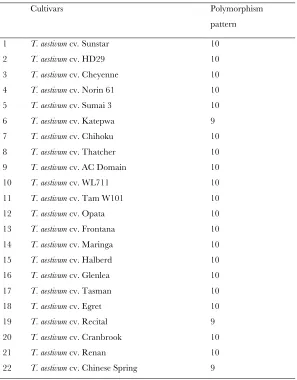
The two distinct lr21 alleles found in the wheat D genome, lr21-w and lr21-f, were identified from chro-mosome 1D of Wichita and Fielder, respectively (Figure 1). Thelr21-wandlr21-falleles were distributed among the other 22 sampled wheat cultivars (Table S1) without bias as to winter or spring habit. Both encoded trun-cated proteins, resulting from a 2-bp indel at position 1761 in lr21-w and a 1-bp indel at 11773 in lr21-f (Figure 5), and thus were pseudogenes.
The Lr21 allele is a recombined allele of recent origin: Sequences from the NBS and part of the 39 regions of the gene from rye, barley, and oat revealed that the 2-bp insertion at indel 3 (position 1761) (Figure 6B) and nucleotides G at position11864, T at position 14161, and C at position 14170 are shared among the three outgroup species. The presence in the lr21-f allele of this 2-bp insertion at indel 3 and the ancestral SNPs (Figure 6B) support its ancestral char-acter. Sequence comparisons suggested that the 13 different lr21 alleles were derived from three basic haplotypes and were subsequently modified by point mutation and insertion/deletion events (Figure 5 and Figure S1). We designated allelelr21-fas haplotype H1, lr21-was haplotype H2, and lr21-TA2467as haplotype H3. The Lr21 allele appears to be a chimera derived from intragenic recombination between H1 and H2
(Figure 5 andFigure S1), followed by the deletion of a 105-bp segment within the first intron, and was designated H1H2105.The putative crossover site lies between
posi-tions 1762 and 11772. The recombined allele could encode a full 1080-aa protein and would be free of both the 2-bp (in H2) and the 1-bp (in H1) deletions. Another chimeric haplotype, H2H1, appeared in thelr21-TA2477 allele, a putative product of reciprocal recombination carrying the 2-bp deletion (Figure 5 andFigure S1), and the lr21 protein product of this allele is truncated. The remaininglr21alleles are suggested to have been derived from the H3 haplotype as shown in the supplemental data (Figure S1). All of thelr21alleles are present as truncated pseudogenes but are transcribed as revealed by RT–PCR (Figure S2), suggesting that their promoters are still functioning.
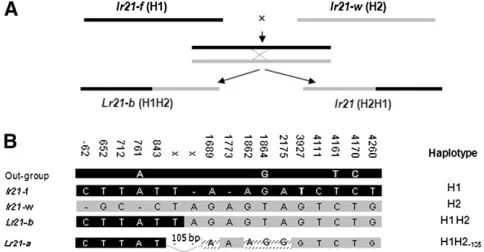
A functional allele can be created from two dead alleles:To test the hypothesis thatLr21could originate from two dead (nonfunctional) alleles, we crossed wheat cultivars Wichita (H2) and Fielder (H1) (Figure 6A) and screened 5876 F2progeny in the greenhouse
using the leaf-rust isolate PRTUS6. One plant, a putative recombinant designated as F/W-R, was identified on the basis of having an infection type lower than that of both parents. The critical region between1762 and11772 was PCR amplified from the F/W-R plant, cloned, and sequenced. Six of nine clones had sequences identical to H2. The other three had sequences identical to H1 from the 59-end to position1843 and thereafter were identical to H2 (Figure 6B). These data indicated that F/W-R was heterozygous at the Lr21locus for H2 and H1H2 haplotypes. The recombinant H1H2 was identi-cal to theLr21of theAe. tauschiigene (Lr21-ain Figure 6B) except for a 105-bp insertion derived from H2 and four substitutions: G to A at positions11689 and11862, T to G at position11864, and A to G at position12175 (Figure 5 and Figure 6B). The presence of this insertion and the four SNPs showed that the reconstitutedLr21-b functional allele was created in this cross. The 105-bp sequence lies in the first intron of the gene, and the deletion or insertion of this fragment does not change the length of the peptide encoded by the gene. Two of four substitutions are synonymous, while the one at position11862 changes a methionine to a valine (both neutral and nonpolar), and the second at12175 changes the acidic polar aspartic acid to the neutral nonpolar glycine. However, the reconstituted allele Lr21-b still confers resistance to the same pathogen isolate, indicating that the amino-acid changes at these positions do not change the function of the protein. The F/W-R plant was selfed. Fifty progenies were tested for a reaction to leaf-rust isolate PRTUS6. Progeny testing revealed that resistance to the leaf-rust isolate was conferred by a single dominant gene (Figure 7). Ten resistance and 10 susceptible plants were selected for genotyping using the critical region of the Lr21-b. The result suggested that the resistance was conferred by theLr21-ballele.
Figure 6.—(A) A crossing scheme for reconstituting a
functional Lr21 allele from two nonfunctional alleles. (B) The indel and SNPs that are shared among the three out-group species rye, barley, and oat and the region in which in-tragenic recombination between H1 and H2 resulted in the chimerical alleleLr21-b. Lr21-a is the allele identified from Ae. tauschii. Position numbers are based on theLr21sequence. In A and B, solid areas correspond to haplotype H1, represent-ing allelelr21-ffrom cultivar Fielder, and shaded areas corre-spond to H2, representing lr21-w from Wichita. Hatching indicates SNPs that distinguishLr21-bfromLr21-a.
DISCUSSION
We selected theLr21gene for map-based cloning.10 years ago because the gene was identified in a dozenAe. tauschiiaccessions spread over a large area in Caspian Iran. Our hypothesis was that Lr21 was probably a complex locus and was spawning new specificities as a result of unequal crossing over similar to theRp1locus of maize (Hulbertet al.2001). It was surprising when molecular cloning revealedLr21to be a simple, single-copy locus (Huanget al.2003). After investigating the sequence variation at the Lr21 locus in the 12 Lr21 -carrier tauschii accessions and the 15 lr21alleles in a sample oftauschiiand bread wheat accessions, our re-sults showed an unexpected monomorphism at theLr21 locus among the 12Lr21-carriers. The sequence data revealedLr21to be a chimeric allele, providing possible clues to its recent origin through intragenic recombi-nation. This hypothesis was experimentally verified by the recovery of a functional allele in the progeny of a cross between two susceptible parents. These results have important implications about the age of theLr21 locus, its origin, evolution, and fixation in the context of the crop–weed coevolutionary process as distinct from resistance evolution in wild populations; these aspects of this study are discussed below.
An ancient locus with a young allele of Lr21 NBS– LRR: The evolutionary time line indicates that wheat diverged from rice and maize 65 MYA, from barley
14 MYA, and from rye7 MYA (Huanget al. 2002). Compared to 80% identity with its paralogs (File S2), Lr21 shared .95% identity with barley, oat, and rye homologs in the NBS region (File S1). Since, in general, orthologous genes in different species are more similar in sequence to one another than paralogous copies within a species (Michelmoreand Myers1998; Hulbertet al. 2001), it is plausible thatLr21is an ancient locus shared by wheat, barley, and oat. However, its restricted geographic
distribution and DNA-level monomorphism strongly suggest that theLr21allele ofAe. tauschiioriginated more recently in a single event. In this scenario, it most likely spread by rare cross-pollination amongAe. tauschii pop-ulations, farming activity, and commerce of wheat grains contaminated with goatgrass seeds.
Chimeric origin ofLr21:Ae. tauschiiis a self-pollinated species with an outcrossing rate of,5%. The presence in the wheat D genome of the H1 and H2 haplotypes indicates that these alleles were present inAe. tauschii (donor of the wheat D genome), growing alongside domesticated tetraploid wheat. It thus appears thatAe. tauschii parents carrying H1 and H2 or similar haplo-types were involved in hybridization events leading to the origin of bread wheatca. 8000 years ago and that bread wheat originated in at least two independent hybridiza-tion events (Talbert et al. 1998). As H1 and H2 haplotypes were detected only in bread wheat, our failure to detectAe. tauschii accessions carrying haplo-types H1 and H2 most probably was due to limited sampling. Alternatively, these haplotypes may be extinct inAe. tauschiiand preserved only in wheat.
The molecular mechanism underlying the origin of Lr21function may be associated with its location at the most distal point of the chromosome 1D short arm, a recombination hot spot (Spielmeyeret al. 2000; Qiet al. 2004). We previously reported one intragenic recombi-nation event between positions61 and11354 involving alleles Lr21 and lr21-w in a sample of 332 F2 plants
(Huanget al. 2003). It involved a conversion tract of a minimum of 191 bp and a maximum of 1415 bp of DNA fromlr21-wtoLr21, rendering the latter ineffective. We have now experimentally reconstituted Lr21 through another intragenic recombination event. In addition, one H2H1 haplotype, an obvious product of intragenic recombination, was detected in a small sample of 13lr21 alleles. These findings suggest that recombination events Figure 7.—Infection types of
have occurred multiple times at theLr21locus and that the evolutionary history ofLr21has been shaped by its location in a high-recombination region.
‘‘Birth–recycle’’ at the Lr21 locus: The presence of only one functional allele among an assortment of nonfunctional alleles at theLr21locus suggests the cost of carrying the resistance allele in the absence of virulent pathogen strains. Two evolutionary classes of NBS–LRR genes have been characterized. One supports the so-called ‘‘arms race’’ model represented by theL locus of flax (Elliset al. 1999) and theRPP13locus of Arabidopsis (Rose et al. 2004), which contain large numbers of different functional alleles and a high degree of variation in the regions responsible for specificity. The other class, consistent with a ‘‘trench warfare’’ model, is represented by the RPM1 (Stahl et al. 1999) and RPS2 (Mauricio et al. 2003) loci of Arabidopsis in which variation is low with no evidence of diversifying selection between functional and nonfunc-tional forms. The funcnonfunc-tional RPM1 allele has been shown to impose a penalty in the absence of the pathogen. Complete deletion is one way to remove the deleterious effect of an allele such as RPM1. An al-ternative way is truncation, as seen with thelr21alleles. Our discovery suggests a ‘‘death–recycle’’ model of plant-resistance gene evolution at simple loci. A ‘‘birth-and-death’’ process similar to that of the vertebrate major histocompatibility complex, T-cell receptor, and immu-noglobulin genes has been proposed to explain the evo-lution of resistance genes at complex loci (Michelmore and Myers1998). At a simple locus, there is no ‘‘birth’’ associated with gene duplication. A functional allele may become ineffective because of mutation or defeat by a new race of the pathogen and then may be reused in the creation of a new functional allele at that locus. Our results have confirmed that plants can reuse nonfunc-tional alleles to create new resistance specificity. The recycling of lr21 hints at the potential usefulness of truncated alleles. New resistances similar to Lr21 that occurred in nature may also arise in plant breeding programs more often than recognized because of exten-sive selection pressure for rare new disease specificities in segregating populations subjected to disease epidemics.
The wheat–goatgrass complex and the fixation of Lr21:Ae. tauschiiaccessions carrying the functionalLr21 allele are predominant in regions where agriculture was practiced, to the point where at one location, Ramsar, Iran, all collected accessions carried this allele (Figure 4 and Table 1). This predominance would be expected if some evolutinary process in the crop–weed agroecosys-tem led to fixation of a new disease-resistance specificity created by a rare recombination event inlr21. Agricul-tural practice favors crop monoculture, or a single variety planted over large areas for long periods of time. This often leads to much higher rust-disease pressure in wheat fields than in wildAe. tauschiipopulations, which harbor mixtures of different rust-resistance genes or
even several leaf-rust resistance genes in a single accession (Gill et al. 2008). We propose that leaf-rust epidemics in a crop monoculture imposed selection pressure on goatgrass populations in or near wheat fields. A plant carrying the Lr21 allele would have a fitness advantage in an environment with high leaf-rust inoculum. In this model, the crop–weed complex coevolutinary process was critical to the selection and retention of theLr21gene inAe. tauschiipopulations.
It appears that native agricultural ecosystems, located in Vavilovian world centers of crop plant origin, are virtual outdoor laboratories for the creation of genetic variation. Other ‘‘new’’ genes spawned by such ecosys-tems may well be of the same worldwide economic significance as Lr21. The example presented here argues for the careful preservation of the native agri-cultural ecosystems in the face of modern agriagri-cultural practices because the success of modern plant breeding hinges on the extensive use of genetic variation present in land races and in wild relatives of crop plants.
We are grateful to Scot Hulbert, Frank White, and Eduard Akhunov for critical review of the manuscript. This research was supported by the Kansas Wheat Commission and a U. S. Department of Agriculture– Cooperative State Research, Education, and Extension Service special grant to the Wheat Genetic and Genomic Resources Center. This is contribution 07-305-J from the Kansas Agricultural Experiment Station, Manhattan, Kansas.
LITERATURE CITED
Ellis, J. G., G. J. Lawrence, J. E. Luck and P. N. Dodds, 1999 Identification of regions in alleles of the flax rust resis-tance geneLthat determine differences in gene-for-gene speci-ficity. Plant Cell11:495–506.
Gill, B. S., L. Huang, V. Kuraparthy, W. J. Raupp, D. L. Wilson
et al., 2008 Alien genetic resources for wheat leaf rust resis-tance, cytogenetic transfer, and molecular analysis. Aust. J. Agric. Res.59:197–205.
Huang, S., A. Sirikhachornkit, X. Su, J. Faris, B. S. Gillet al., 2002 Genes encoding plastid acetyl-CoA carboxylase and 3-phosphoglycerate kinase of the Triticum/Aegilops complex and the evolutionary history of polyploid wheat. Proc. Natl. Acad. Sci. USA99:8133–8138.
Huang, L., S. A. Brooks, W. Li, J. P. Fellers, H. N. Tricket al., 2003 Map-based cloning of leaf rust resistance geneLr21from the large and polyploid genome of bread wheat. Genetics164: 655–664.
Hulbert, S. H., C. A. Webb, S. M. Smithand Q. Sun, 2001 Resistance gene complexes: evolution and utilization. Annu. Rev. Phytopathol. 39:285–312.
Kashkush, K., M. Feldmanand A. A. Levy, 2003 Transcriptional activation of retrotransposons alters the expression of adjacent genes in wheat. Nat. Genet.33:102–106.
Kihara, H., 1944 Discovery of the DD-analyser, one of the ancestors ofTriticum vulgare.Agric. Hortic.19:13–14 (in Japanese). Kihara, H., K. Yamashita, and M. Tanaka, 1965 Results of the Kyoto
University Scientific Expedition to the Karakoram and Hindukush. Kyo-to University, KyoKyo-to, Japan.
Leister, D, 2004 Tandem and segmental gene duplication and re-combination in the evolution of plant disease resistance genes. Trends Genet.20:116–122.
Lubbers, E. L., K. S. Gill, T. S. Coxand B. S. Gill, 1991 Variation of molecular markers among geographically diverse accessions of
Triticum tauschii.Genome34:354–361.
Mauricio, R., E. A. Stahl, T. Korves, D. Tian, M. Kreitmanet al., 2003 Natural selection for polymorphism in the disease
resistance gene Rps2 of Arabidopsis thaliana. Genetics 163: 735–746.
McFadden, E. S., and E. R. Sears, 1946 The origin ofTriticum spelta and its free-threshing hexaploid relatives. J. Hered. 37:81–89, 107–116.
McIntosh, R. A., C. R. Wellingsand R. F. Park, 1995 Wheat Rusts:
An Atlas of Resistance Genes.Kluwer Academic Publishers, Boston. Michelmore, R. W., and B. C. Meyers, 1998 Clusters of resistance genes in plants evolve by divergent selection and a birth-and-death process. Genome Res.8:1113–1130.
Nesbitt, M., and D. Samuel, 1998 Wheat domestication: archaeo-botanical evidence. Science279:1431.
Qi, L. L., B. Echalier, S. Chao, G. R. Lazo, G. E. Butler et al., 2004 A chromosome bin map of 16,000 expressed sequence tag loci and distribution of genes among the three genomes of polyploid wheat. Genetics168:701–712.
Raupp, W. J., L. E. Browderand B. S. Gill, 1983 Leaf rust resis-tance inAegilops squarrosa: its transfer and expression in common wheat (Triticum aestivumL.). Phytopathology73:818.
Rose, L. E., P. D. BittnerEddy, C. H. Langley, E. B. Holub, R. W. Michelmoreet al., 2004 The maintenance of extreme amino
acid diversity at the disease resistance gene,RPP13, inArabidopsis thaliana.Genetics166:1517–1527.
Rowland, G. G., and E. R. Kerber, 1974 Telocentric mapping in hexaploid wheat of genes for leaf rust resistance and other char-acters derived fromAegilopssquarrosa. Can. J. Genet. Cytol.16: 137–144.
Spielmeyer, W., O. Moullet, A. Laroche and E. S. Lagudah, 2000 Highly recombinogenic regions at seed storage protein loci on chromosome 1DS ofAegilops tauschii, the D-genome do-nor of wheat. Genetics155:361–367.
Stahl, E. A., G. Dwyer, R. Mauricio, M. Kreitmanand J. Bergelson, 1999 Dynamics of disease resistance polymorphism at theRpm1
locus of Arabidopsis. Nature400:667–671.
Talbert, L. E., L. Y. Smithand N. K. Blake, 1998 More than one origin of hexaploid wheat is indicated by sequence comparison of low-copy DNA. Genome41:402–407.
Supporting Information
http://www.genetics.org/cgi/content/full/genetics.108.099614/DC1
Evolution of New Disease Specificity at a Simple Resistance Locus
in a Crop
–W
eed Complex: Reconstitution of the
Lr21
Gene in Wheat
Li Huang, Steven Brooks, Wanlong Li, John Fellers, James C. Nelson and Bikram Gill
L. Huang et al.
2 SI
FILE S1
Alignment of NBS regions among Lr21 of Ae. tauschii and homologs of other species
Lr21_NBS_tauschii GTTGGTGTCACAACTTATCAGGTACATCCAATTTCGTCGCCCACTCCTCATCTTATATAT Lr21_NBS_rye GTTGGTGTCACAACTTATCAGGTACATCCAATTTCGTCGCCCACTCCTCATCTTATATAT Lr21_NBS_oat GTTGGTGTCACAACTTATCAGGTACATCCAATTTCGTCGCCCACTCCTCATCTTATATAT Lr21_NBS_barley GGTGGTGTCACAACTTATCAGGTACATCCAATTTCGTCGCCCACTCCTCATCTTATATAT * **********************************************************
Lr21_NBS_tauschii ATGTACTCTATATACATGTAAAAGCTCTCCGTCCATGTGTTAAGAAAGATTCTTTTCTGA Lr21_NBS_rye ATGTACTCTATATACATGTAAAAGCTCTCCGTCCATGTGTTAAGAAAGATTCTTTTCTGA Lr21_NBS_oat ATGTACTCTATATACATGTAAAAGCTCTCCGTCCATGTGTTAAGAAAGATTCTTTTCTGA Lr21_NBS_barley ATGTACTCTATATACATGTAAAAGCTCTCCGTCCATGTGTTAAGAAAGATTCTTTTCTGA ************************************************************
Lr21_NBS_tauschii ACTTTATGTGTCATGCATCGTACTACAATATCTTTCTAATCCGTTACTATGATAATGAGA Lr21_NBS_rye ACTTTATGTGTCATGCATCGTACTACAATATCTTTCTAATCCGTTACTATGATAATGAGA Lr21_NBS_oat ACTTTATGTGTCATGCATCGTACTACAATATCTTTCTAATCCGTTACTATGATAATGAGA Lr21_NBS_barley ACTTTATGTGTCATGCATCGTACTACAATATCTTTCTAATCCGTTACTATGATAATGAGA ************************************************************
Lr21_NBS_tauschii GTAATACTAATTATCTTATTTGACATCAGTCATTGAGGTCAACAAAGAAAACCTGTATTT Lr21_NBS_rye GTAATACCAATTATCTTATTTGACATCAGTCATTGAGGTCAACAAAGAAAACCTGTATTT Lr21_NBS_oat GTAATACTAATTATCTTATTTGACATCAGTCATTGAGGTCAACAAAGAAAACCTGTATTT Lr21_NBS_barley GTAATACTAATTATCTTATTTGACATCAGTCATTGAGGTCAACAAAGAAAACCTGTATTT ******* ****************************************************
Lr21_NBS_tauschii GAAAAAAAAATGTGATCCATACGATAGATGGACAATATAGTTATCATTATCATATTTCCC Lr21_NBS_rye GAAAAAAAAATGTGATCCATACGATAGATGGACAATATAGTTATCATTATCATATTTCCC Lr21_NBS_oat GAAAAAAAAATGTGATCCATACGATAGATGGACAATATAGTTATCATTATCATATTTCCC Lr21_NBS_barley GAAAAAAAAATGTGATCCATACGATAGATGGACAATATAGTTATCATTATCATATTTCCC ************************************************************
Lr21_NBS_tauschii TTGTTTATTATTTACACTTTAATACTATTTCTAATAGATAGAATAGACATGTGACAGACA Lr21_NBS_rye TTGTTTATTATTTACACTTTAATACTATTTCTAATAGATAGAATAGACATGTGACAGACA Lr21_NBS_oat TTGTTTATTATTTACACTTTAATACTATTTCTAATAGATAGAATAGACATGTGACAGACA Lr21_NBS_barley TTGTTTATTATTTACACTTTAATACTATTTCTAATAGATAGAATAGACATGTGACAGACA ************************************************************
Lr21_NBS_tauschii TACCCATTTGAGATTTTGCATCTTGCAGGAGAATGCCACTGCATTGGATGTTGTCCTTAC Lr21_NBS_rye TACCCATTTGAGATTTTGCATCTTGCAGGAGAATGCCACTGCATTGGATGTTGTCCTTAC Lr21_NBS_oat TACCCATTTGAGATTTTGCATCTTGCAGGAGAATGCCACTGCATTGGATGTTGTCCTTAC Lr21_NBS_barley TACCCATTTGAGATTTTGCATCTTGCAGGAGAATGCCACTGCATTGGATGTTGTCCTTAC ************************************************************
Lr21_NBS_tauschii TGCTATCTCAAGATGGAACTTGAATAAAAGA---ATAGAGAAGGTACAAAGTA Lr21_NBS_rye TGCTATCTCAAGATGGAACTTGAATAAAAGAATAGAGAAGAATAGAGAAGGTACAAAGTA Lr21_NBS_oat TGCTATCTCAAGATGGAACTTGAATAAAAGA---ATAGAGAAGGTACAAAGTA Lr21_NBS_barley TGCTATCTCAAGATGGAACTTGAATAAAAGA---ATAGAGAAGGTACAAAGTA ******************************* *******************
Lr21_NBS_tauschii CCATCAGCGAAGTGACGAAGTCACCGCTCTTGGGCACGGCAAGCAAGAGTGCACCAGACG Lr21_NBS_rye CCATCAGCGAAGTGACGAAGTCACCGCTCTTGGGCACGGCAAGCAAGAGTGCACCAGACG Lr21_NBS_oat CCATCAGCGAAGTGACGAAGTCACCGCTCTTGGGCACGGCAGGCAAGAGTGCACCAGACG Lr21_NBS_barley CCATCAGCGAAGTGACGAAGTCACCGCTCTTGGGCACGGCAAGCAAGAGTGAACCAGACG ***************************************** ********* ********
Lr21_NBS_tauschii ATATTGCTAACAAGAATAGGAGTAGAATTAGAACTGCTAGCAAGCGGAAGGTATTTGGTC Lr21_NBS_rye ATATTGCTAACAAGAATAGGAGTAGAATTAGAACTGCTAGCAAGCGGAAGGTATTTGGTC Lr21_NBS_oat ATATTGCTAACAAGAATAGGAGTAGAATTAGAACTGCTAGCAAGCGGAAGGTATTTGGTC Lr21_NBS_barley ATATTGCTAACAAGAATAGGAGTAGAATTAGAACTGCTAGCAAGCGGAAGGTATTTGGTC ************************************************************
L. Huang et al. 3 SI
********************************************** *** **** ****
indel 3
Lr21_NBS_tauschii GCAAGCTCAAGTGCTGATCCATGTTACTCAGTGATTGGTATATATGGTGTTGCTGGGTCT Lr21_NBS_rye GCAAGCTCAAGTGCTGATCCATGTTACTCAGTGATTGGTATATATGGTGTTGCTGGGTCT Lr21_NBS_oat GCAAGCTCAAGTGCTGATCCATGTTACTCAGTGATTGGTATATATGGTGTTGCTGGGTCT Lr21_NBS_barley GCAAGCTCAAGTGCTGATCCATGTTACTCAGTGATTGGTATATATGGTGTTGCTGGGTCT ************************************************************
Lr21_NBS_tauschii GGGAAGACCACGTTTGCAGGATATATTCAAGATTACATAAAGGAGGAATGCAAGGATGAG Lr21_NBS_rye GGGAAGACCACGTTTGCAGGATATATTCAAGATTACATAAAGGAGGAATGCAAGGATGAG Lr21_NBS_oat GGGAAGACCACGTTTGCAGGATATATTCAAGATTACATAAAGGAGGAATGCAAGGATGAG Lr21_NBS_barley GGGAAGACCACGTTTGCAGGATATATTCAAGATTACATAAAGGAGGAATGCAAGGATGAG ************************************************************
Lr21_NBS_tauschii AAACTTTTCGACACCATCATGTGCATTCATGTGACTGAAACTTTCAGTGTGGATGATATA Lr21_NBS_rye AAACTTTTCGACACCATCATGTGCATTCATGTGACTGAAACTTTCAGTGTGGATGATATA Lr21_NBS_oat AAACTTTTCGACACCATCATGTGCATTCATGTGACTGAAACTTTCAGTGTGGATGATATA Lr21_NBS_barley AAACTTTTCGACACCATCATGTGCATTCATGTGACTGAAACTTTCAGTGTGGATGATATA ************************************************************ 1864
Lr21_NBS_tauschii TTT-CATGAAATGCTGAAGTATATTACCGGAGATAGTCACTCCAATATTTCAGATCGTGG Lr21_NBS_rye TTT-CATGAAATGCTGAAGTATATTACCGGAGATAGTCACTCCAATATTTCAGATCGTGG Lr21_NBS_oat TTT-CATGAAATGCTGAAGTATATTACCGGAGATAGTCACTCCAATATTTCAGATCGTGG Lr21_NBS_barley TTTTCATGAAATGCTGAAGTATATTACCGGAGATAGTCACTCCAATATTTCAGATCGTGG *** ********************************************************
Lr21_NBS_tauschii GGCTCTAGATAAGAAGTTGAAGGAAGCATTGTGTGGCAAACGTTTCTTCTTGATATTGGA Lr21_NBS_rye GGCTCTAGATAAGAAGTTGAAGGAAGCATTGTGTGGCAAACGTTTCTTCTTGATATTGGA Lr21_NBS_oat GGCTCTAGATAAGAAGTTGAAGGAAGCATTGTGTGGCAAACGTTTCTTCTTGATATTGGA Lr21_NBS_barley GGCTCTAGATAAGAAGTTGAAGGAAGCATTGTGTGGCAAACGTTTCTTCTTGATATTGGA ************************************************************
Lr21_NBS_tauschii TGATCTCTGGGTGAAAAACAAGAATGACCAACACCTAGAGGAGCTAATCTCTCCACTCAA Lr21_NBS_rye TGATCTCTGGGTGAAAAACAAGAATGACCAACACCTAGAGGAGCTAATCTCTCCACTCAA Lr21_NBS_oat TGATCTCTGGGTGAAAAACAAGAATGACCAACACCTAGAGGAGCTAATCTCTCCACTCAA Lr21_NBS_barley TGATCTCTGGGTGAAAAACAAGAATGACCAACACCTAGAGGAGCTAATCTCTCCACTCAA ************************************************************
Lr21_NBS_tauschii TGTTGGGCTGAAAGGAAGCAAAATCCTGGTGACGGCTCGAACAAAAGAAGCAGCTGGAGC Lr21_NBS_rye TGTTGGGCTGAAAGGAAGCAAAATCCTGGTGACGGCTCGAACAAAAGAAGCAGCTGGAGC Lr21_NBS_oat TGTTGGGCTGAAAGGAAGCAAAATCCTGGTGACGGCTCGAACAAAAGAAGCAGCTGGAGC Lr21_NBS_barley TGTTGGGCTGAAAGGAAGCAAAATCCTGGTGACGGCTCGAACAAAAGAAGCAGCTGGAGC ************************************************************
Lr21_NBS_tauschii TCTGGGTGCCGATAAATTTATTGAAATGCCTGATTTGGATGAGGATCAGTACTTGGCGAT Lr21_NBS_rye TCTGGGTGCCGATAAATTTATTGAAATGCCTGATTTGGATGAGGATCAGTACTTGGCGAT Lr21_NBS_oat TCTGGGTGCCGATAAATTTATTGAAATGCCTGATTTGGATGAGGATCAGTACTTGGCGAT Lr21_NBS_barley TCTGGGTGCCGATAAATTTATTGAAATGCCTGATTTGGATGAGGATCAGTACTTGGCGAT ************************************************************
Lr21_NBS_tauschii GTTTATGCATTATGCGCTAAGTGGTACAAGAGTTGCCCTTCAAGAATTTGAACAAGTTGG Lr21_NBS_rye GTTTATGCATTATGCGCTAAGTGGTACAAGAGTTGCCCTTCAAGAATTTGAACAAGTTGG Lr21_NBS_oat GTTTATGCATTATGCGCTAAGTGGTACAAGAGTTGCCCTTCAAGAATTTGAACAAGTTGG Lr21_NBS_barley GTTTATGCATTATGCGCTAAGTGGTACAAGAGTTGCCCTTCAAGAATTTGAACAAGTTGG ************************************************************
Lr21_NBS_tauschii GAGAGAGATTGCCAAAAAACTACACCGATCACCTATTGCAGCAGTAACAGTTGCAGGACG Lr21_NBS_rye GAGAGAGATTGCCAAAAAACTACACCGATCACCTATTGCAGCAGTAACAGTTGCAGGACG Lr21_NBS_oat GAGAGAGATTGCCAAAAAACTACACCGATCACCTATTGCAGCAGTAACAGTTGCAGGACG Lr21_NBS_barley GAGAGAGATTGCCAAAAAACTACACCGATCACCTATTGCAGCAGTAACAGTTGCAGGACG ************************************************************
L. Huang et al.
4 SI
FILE S2
Alignment between NBS regions of Lr21 and Lr21 paralog-1. Identities = 1593/1965 (81%)
Lr21-paralog-1 1 ACACACTCATTTGAGATTTTGCTTCTTGCAGGAGCATGCCACTGCGTTTGATTTTGTACT 60 ||| || ||||||||||||||| ||||||||||| |||||||||| || ||| |||| || Lr21_NBS 1 ACATACCCATTTGAGATTTTGCATCTTGCAGGAGAATGCCACTGCATTGGATGTTGTCCT 60
Lr21-paralog-1 61 TACTGCAATCCCAAGACGGAGTTTAAAGAAAAGAATTGAGAAGGTAGAAAGCACCATCAG 120 |||||| ||| ||||| ||| || || |||||||| ||||||||| |||| |||||||| Lr21_NBS 61 TACTGCTATCTCAAGATGGAACTTGAATAAAAGAATAGAGAAGGTACAAAGTACCATCAG 120
Lr21-paralog-1 121 TGAAGTGAAGAAGTATCTGCTCTTAGGCACAGCAAGCAAGAGTGCGCCGAATGATATTGT 180 ||||||| ||||| | |||||| ||||| |||||||||||||| || | ||||||| Lr21_NBS 121 CGAAGTGACGAAGTCACCGCTCTTGGGCACGGCAAGCAAGAGTGCACCAGACGATATTGC 180
Lr21-paralog-1 181 CAACAAGAACAGGAGCAGAATCAKAACTGCTAGCAAGCGGAAGGTATTTGGCCGAGAGGC 240 |||||||| ||||| ||||| | ||||||||||||||||||||||||||| ||||||| Lr21_NBS 181 TAACAAGAATAGGAGTAGAATTAGAACTGCTAGCAAGCGGAAGGTATTTGGTCGAGAGGG 240
Lr21-paralog-1 241 GTTCCGCGATAGTATCATGGCAAAGCTCCGTGAGA---CAT----CACCGAGCTC 288 | | || ||| |||||||| || ||| ||||||| ||| || | ||||| Lr21_NBS 241 GCTGCGTGATCATATCATGGTAAGGCTTCGTGAGATACCAGAGCATGATGCAGCAAGCTC 300
Lr21-paralog-1 289 GGGTACTGGTCCATGTTACTCGGTGATTGGCATATATGGTGTTGCAGGGTCTGGGAAGAC 348 || ||| |||||||||||| |||||||| |||||||||||||| |||||||||||||| Lr21_NBS 301 AAGTGCTGATCCATGTTACTCAGTGATTGGTATATATGGTGTTGCTGGGTCTGGGAAGAC 360
Lr21-paralog-1 349 TACCTTTGCACGATACACCTGAGATTACATAGAGGAGGAATGCAAGGAGGAGAAACTTTT 408 || |||||| |||| | |||||||||| |||||||||||||||| ||||||||||| Lr21_NBS 361 CACGTTTGCAGGATATATTCAAGATTACATAAAGGAGGAATGCAAGGATGAGAAACTTTT 420
Lr21-paralog-1 409 TGACACCACCATGTGCATTCATGTTTCGGAGACTTTCAGTGTCGATGATATATTTCATGA 468 ||||||| ||||||||||||||| | || ||||||||||| ||||||||||||||||| Lr21_NBS 421 CGACACCATCATGTGCATTCATGTGACTGAAACTTTCAGTGTGGATGATATATTTCATGA 480
Lr21-paralog-1 469 AATGCTGAAGGATATTACCGGAGATCGGCACTCCCATATTTCAGATCATGAGGAGCTTGA 528 |||||||||| |||||||||||||| | |||||| |||||||||||| || || || || Lr21_NBS 481 AATGCTGAAGTATATTACCGGAGATAGTCACTCCAATATTTCAGATCGTGGGGCTCTAGA 540
Lr21-paralog-1 529 AGAGAAGTTGAAGAAAGAATTGCATGGCAAACGTTTCTTTTTGATATTGGATGATCTCTG 588 ||||||||||| ||| |||| ||||||||||||||| |||||||||||||||||||| Lr21_NBS 541 TAAGAAGTTGAAGGAAGCATTGTGTGGCAAACGTTTCTTCTTGATATTGGATGATCTCTG 600
Lr21-paralog-1 589 GGTGAAGACCAAGAACGACCCACAACTGGAGGAACTAATCTCTCCACTTAATGTTGGGAT 648 |||||| | |||||| |||| ||| || ||||| |||||||||||||| ||||||||| | Lr21_NBS 601 GGTGAAAAACAAGAATGACCAACACCTAGAGGAGCTAATCTCTCCACTCAATGTTGGGCT 660
Lr21-paralog-1 649 GACAGGAAGCAAAATCTTGGTAACGGCTCGAACAATAGTTGCAACTAGAGCTCTGTGTGA 708 || ||||||||||||| |||| ||||||||||||| || ||| || |||||||| ||| Lr21_NBS 661 GAAAGGAAGCAAAATCCTGGTGACGGCTCGAACAAAAGAAGCAGCTGGAGCTCTGGGTGC 720
L. Huang et al. 5 SI
Lr21-paralog-1 769 TTATGCACTGGGCGGCACAAGCGTTGCTGATGAAAAAGAATTTATATGAGTTGGGCGGGT 828 |||||| || | || ||||| ||||| | |||||||| | ||||||| | | Lr21_NBS 781 TTATGCGCTAAGTGGTACAAGAGTTGCCCTT---CAAGAATTTGAACAAGTTGGGAGAGA 837
Lr21-paralog-1 829 GATTGCAGAAAAGCTACACCAATCACCTATTGCAGCCGTAGTAGTGGCAGGACGGCTTGG 888 |||||| |||| ||||||| ||||||||||||||| ||| ||| |||||||||||||| Lr21_NBS 838 GATTGCCAAAAAACTACACCGATCACCTATTGCAGCAGTAACAGTTGCAGGACGGCTTGG 897
Lr21-paralog-1 889 GACAAACCCAGATATCAAGTTTTGGAAAAATGCTGCAAACCATGAAATGTTGAATGACAC 948 | |||||||| |||||| ||||||||||||| |||||| | ||| ||||||||| |||| Lr21_NBS 898 GGCAAACCCAAATATCAGTTTTTGGAAAAATGTTGCAAAGCTTGACATGTTGAATTACAC 957
Lr21-paralog-1 949 CATGGATGCTCTTTGGTGGAGCTATCGGCCGCTCAATCCGGACATCAGGCGTTGCTTTGA 1008 |||||||||||||||||||||||||| || ||| |||||||||| ||||| |||||||| Lr21_NBS 958 CATGGATGCTCTTTGGTGGAGCTATCAGCAGCTTGATCCGGACATTAGGCGATGCTTTGA 1017
Lr21-paralog-1 1009 ATTCTGCAATACATTCCCCCGAAGATCGAAGTTGAGAAGGGATGGGTTAATTCGTCTGTG 1068 |||||||| || |||||| ||| || || || || || ||| | || ||||| Lr21_NBS 1018 ATTCTGCAGTATTTTCCCCAGAAAATTCAAACTGGAAAAAGACCAATTAGTCCGCCTGTG 1077
Lr21-paralog-1 1069 GATAGCGCAAGGGTTTGTAAAGAGCAGTTGTGCAACAGAGGACATGGAAGATGTAGCTGA 1128 || ||| ||||| |||||||||| |||||||||||| ||||| ||||||||||| || || Lr21_NBS 1078 GACAGCACAAGGATTTGTAAAGACCAGTTGTGCAACGGAGGAGATGGAAGATGTTGCCGA 1137
Lr21-paralog-1 1129 GGGCTACATTCAAGAGTTAATGTCATGCTCATTTATGCAACAAGAAGTAGATGATTCCTC 1188 ||||||||||||||||||| |||||||||||||| ||||| || ||| | || | || Lr21_NBS 1138 GGGCTACATTCAAGAGTTAGTGTCATGCTCATTTCTGCAAGAAAAAGGAACTGGT---TC 1194
Lr21-paralog-1 1189 TGAAGAAGAATACTTCACAGTTCATGATCTGCTGCATGATTTATTAGCCAAGGTTGCTGG 1248 || | || | || ||| ||||||||||| ||||||||||||||| |||||||||||| Lr21_NBS 1195 TGGCGTTGATCATTTTACAATTCATGATCTGTTGCATGATTTATTAGTCAAGGTTGCTGG 1254
Lr21-paralog-1 1249 TAGTGATTGCTTCAGAATTGAGAATACAAGGAGCCACAGAGGAGAAGGCTGGAAGGAAGA 1308 | ||||||||||||||| ||||||| | |||| | ||||||| || | ||||| Lr21_NBS 1255 AAATGATTGCTTCAGAATCGAGAATAGATGGAGTAAACAAGGAGAA---TGCCAAGAAGA 1311
Lr21-paralog-1 1309 AGTCCCTCGAGATGTCCGCCATCTTTTTGTTCAGAATTATGATGGAGAATTGATAACTAA 1368 ||||||||||||||||| ||||||||||||||||| |||||||| |||||||| || | Lr21_NBS 1312 TGTCCCTCGAGATGTCCGTCATCTTTTTGTTCAGAAGTATGATGGGGAATTGATTACCAG 1371
Lr21-paralog-1 1369 GAAGATCCTTGGATTGGAAAATATACGCACTCTCATCATTGATGTTGTTCAAAGGGACAC 1428 |||||||||||||||||||||| ||||||||||||| ||| |||||| || | | | Lr21_NBS 1372 GAAGATCCTTGGATTGGAAAATTTACGCACTCTCATTATTTGTGTTGTCGAAGAGAATAG 1431
Lr21-paralog-1 1429 ACCAGTTGAGGAAAAAGTCATTGAGAGTATATGCAAGAGGCTGCCAAAATTGCGGGTACT 1488 ||||||||||||||| |||||||||||||| ||| |||||||| || ||||||||||| Lr21_NBS 1432 ACCAGTTGAGGAAAAGGTCATTGAGAGTATGTGCGTGAGGCTGCTGAAGTTGCGGGTACT 1491
Lr21-paralog-1 1489 AGCCGTTGCTTTCAGCAATAA---CCTTT----CTGGAATCTGGGAAATTAAGTTCTCGG 1541 ||| ||||||||| ||| || || || | | |||| | | |||||||| || Lr21_NBS 1492 GGCCATTGCTTTCAACAAAAAATGCCGTTCAACCAGCAATCCCAGTGA-TAAGTTCTTGG 1550
L. Huang et al.
6 SI
Lr21-paralog-1 1602 CATGCTATGTAACTTTACCAAGCGCACTAACGAAACTTCACCATATCCAGTTGCTAGATT 1661 ||| | || | ||| ||||| |||||| | ||||||| |||||||||| ||||||||| Lr21_NBS 1611 ACTGCAAGGTTATTTTGCCAAGTGCACTAGCTAAACTTCTCCATATCCAGCTGCTAGATT 1670
Lr21-paralog-1 1662 TTTACTTGGCTAACATGTTGGAATTCCCCT---TTGTTGACCTTGTCAACTTGCGGCACA 1718 || | | || || | ||| || ||| || ||||||| ||||||||||||||| Lr21_NBS 1671 TTGGTCTTGGCAAAATTTCGGATTTTACCTGTGCTGCTGACCTTATCAACTTGCGGCACA 1730
Lr21-paralog-1 1719 TGTTCTGCAGTGGAGACTGGAAATTCCCTAACTTGGGCAGGCTGATATCACTCCAAACGC 1778 | |||||| ||| || || || |||||| | |||| ||||| ||||| |||| Lr21_NBS 1731 TATTCTGC--TGG-GATGTGAGCTTTCCTAACATAGGCACGCTGAGCTCACTTCAAAGAA 1787
Lr21-paralog-1 1779 TACCAGGCTTCACAGTAAGCAATGAACAGGGTTATGAGATAAGGCAGCTGAGGGACCTAA 1838 |||| ||||| |||| |||||||||||||||||||||| || || |||||||| | Lr21_NBS 1788 TACCCTTCTTCAGGCTAAGGAATGAACAGGGTTATGAGATAAAACAACTTAGGGACCTGA 1847
Lr21-paralog-1 1839 ACAAGCTTCGTGGCAGACTGTACATCGATGGCCTTGAAAATGTTAAAAGCAAGGAGGAAG 1898 ||||| ||||||||| ||| || ||||| ||||||||||||||||||||||||||| Lr21_NBS 1848 ACAAGATTCGTGGCATGCTGGTGGTCAATGGCTTTGAAAATGTTAAAAGCAAGGAGGAAG 1907
Lr21-paralog-1 1899 CTCTTGAAGCCAATCTAGCTGCCAAGGAACGGCTCACAGATCTGA 1943 ||||||||||||||||||||||||||||| ||||||| || |||| Lr21_NBS 1908 CTCTTGAAGCCAATCTAGCTGCCAAGGAAAGGCTCACGGAACTGA 1952
_________________________________________________________________________________________________ ---
Alignment between NBS regions of Lr21 and Lr21 paralog-2. Identities = 115/145 (79%)
Lr21-paralog-2 AAGATGTTCCCAGAGACGTTCGCCATCTTTTTGTTCAGAGTTATGATGCAGCATTGATTA 158 ||||||| || |||| || || |||||||||||||||| ||||||| | |||||||| Lr21_NBS AAGATGTCCCTCGAGATGTCCGTCATCTTTTTGTTCAGAAGTATGATGGGGAATTGATTA 1367
Lr21-paralog-2 CAGGGAAGATTCTTGTATTGGAAAATTTACACACACTCGTCATTTATAGTGTTGGAGGGG 218 | ||||||| |||| |||||||||||||| ||| ||| | |||| | ||| | || | Lr21_NBS CCAGGAAGATCCTTGGATTGGAAAATTTACGCACTCTCATTATTTGTGTTGTCGAAGAGA 1427
Lr21-paralog-2 ATACAACAGTTGAGGAAATAGTCAT 243 ||| | |||||||||||| ||||| Lr21_NBS ATAGACCAGTTGAGGAAAAGGTCAT 1452
Identities = 49/59 (83%),
L. Huang et al. 7 SI
L. Huang et al.
8 SI
FIGURE S2.— Expression patterns of Lr21 and lr21
L. Huang et al. 9 SI
TABLE S1
Wheat cultivars tested for the lr21 locus
Cultivars Polymorphism pattern
1 T. aestivum cv. Sunstar 10
2 T. aestivum cv.HD29 10
3 T. aestivum cv. Cheyenne 10
4 T. aestivum cv. Norin 61 10
5 T. aestivum cv. Sumai 3 10
6 T. aestivum cv. Katepwa 9
7 T. aestivum cv. Chihoku 10
8 T. aestivum cv. Thatcher 10
9 T. aestivum cv. AC Domain 10
10 T. aestivum cv. WL711 10
11 T. aestivum cv. Tam W101 10
12 T. aestivum cv. Opata 10
13 T. aestivum cv. Frontana 10
14 T. aestivum cv. Maringa 10
15 T. aestivum cv. Halberd 10
16 T. aestivum cv. Glenlea 10
17 T. aestivum cv. Tasman 10
18 T. aestivum cv. Egret 10
19 T. aestivum cv. Recital 9
20 T. aestivum cv. Cranbrook 10
21 T. aestivum cv. Renan 10