Electronic Thesis and Dissertation Repository
4-4-2011 12:00 AM
A Descriptive Study Utilizing Grounded Theory: The
A Descriptive Study Utilizing Grounded Theory: The
Moral-Reasoning Process of Coaches
Reasoning Process of Coaches
David M. Telles-Langdon
University of Western Ontario
Supervisor
Dr. Ellen Singleton
The University of Western Ontario
Graduate Program in Education
A thesis submitted in partial fulfillment of the requirements for the degree in Doctor of Philosophy
© David M. Telles-Langdon 2011
Follow this and additional works at: https://ir.lib.uwo.ca/etd
Recommended Citation Recommended Citation
Telles-Langdon, David M., "A Descriptive Study Utilizing Grounded Theory: The Moral-Reasoning Process of Coaches" (2011). Electronic Thesis and Dissertation Repository. 133.
https://ir.lib.uwo.ca/etd/133
This Dissertation/Thesis is brought to you for free and open access by Scholarship@Western. It has been accepted for inclusion in Electronic Thesis and Dissertation Repository by an authorized administrator of
A DESCRIPTIVE STUDY UTILIZING GROUNDED THEORY: THE MORAL-REASONING PROCESS OF COACHES
(Spine title: A descriptive study utilizing grounded theory)
(Thesis format: monograph)
by:
David M. Telles-Langdon
Graduate Program in Education
A dissertation submitted in partial fulfilment of the Requirements for the degree of
Doctor of Philosophy
School of Graduate and Postdoctoral Studies The University of Western Ontario
London, Ontario, Canada
ii
UNIVERSITY OF WESTERN ONTARIO
SCHOOL OF GRADUATE AND POSTDOCTORAL STUDIES
CERTIFICATE OF EXAMINATION
Supervisor
______________________________ Dr. Ellen Singleton
Supervisory Committee
______________________________ Dr. Aniko Varpalotai
______________________________ Dr. Chunlei Lu
Examiners
______________________________ Dr. Robert Macmillan
______________________________ Dr. Allen Pearson
______________________________ Dr. Angela Schneider
______________________________ Dr. David Malloy
The dissertation by
David Michael Telles-Langdon
entitled:
A Descriptive Study Utilizing Grounded Theory:
The Moral-Reasoning Process of Coaches
is accepted in partial fulfilment of the requirements for the degree of
Doctor of Philosophy
iii
ABSTRACT AND KEYWORDS
As an interested reader of the educational literature on moral development I have
become intrigued by the significance of moral-reasoning in sport. After nearly four
decades of coach education in Canada concern is being voiced about the apparent erosion
of moral values amongst many coaches or, at the very least, their moral ambivalence. A
database search of the literature and research findings on moral development generally
espouses some sort of stage theory (Haan, 1977; Kohlberg, 1958; Weiss, 1987). Through
a separate line of inquiry one can find an interest in understanding how coaches learn.
Gilbert and Trudel (1999) have researched extensively the impact of experiential learning
(Kolb, 1984) and critical reflection (Schön, 1991) on the learning process specifically
related to coaching. The intersection of these two lines of research leads to the question
of how the moral-reasoning of coaches, in competitive situations, is mediated by the
specific sport-based context of their experience.
This study utilized the varied cartographic visual mapping techniques developed
by Clarke (2005) and described as situational maps, relational analyses, social
worlds/arenas maps, etc., which provided the method for analysing the data from
interviews and artefacts. Participants’ experiences were explored using self-identified
challenging moral dilemmas through a qualitative methodology employing the grounded
theory method following the situational analysis (Clarke, 2005) theoretical framework.
Grounded theory by its very design is a conceptual framework. Situational analysis
provides some structural concepts that, thanks to Clarke (2005), now exist in the
iv
The results indicate that the seemingly eclectic approach to moral-reasoning
exhibited by coaches is in fact a complex system of analysis that leads to solutions. The
process considers public perception, concepts of universal opportunity as well as short
and long-term impact on the specific sport as well as the sport community as a whole.
Based the results I was able to develop a model explaining the moral-reasoning employed
by the participants in this study. Further research may determine if this can be
generalized to a broader segment of the coaching profession. I hope that this model will
help coach educators develop better programs to teach coaches about making moral
decisions.
Key words: Developmental athlete; Ethics; Grounded theory; Morality;
v
ACKNOWLEDGMENTS
Part of the rite of passage through a graduate program always seems to involve
hurdles but the hurdling process seems to intensify for Ph.D. students as they reach for
the pinnacle of academic achievement. Selecting, a research topic, a research
methodology, committee members, and finding a supervisor would all qualify as hurdles.
Half way through my PhD program the Graduate Chair informed me that my assigned
supervisor had been removed as a member of the graduate faculty and would therefore be
unable to continue as my supervisor and that I should endeavour to find someone new.
I owe a debt of gratitude to my supervisor Dr. Ellen Singleton and her colleague
Dr. Aniko Varpalotai who took me on after I spent eighteen months in limbo. They have
guided me over the remaining hurdles for which I am eternally grateful. Dr. Chunlei Lu
from Brock University rounded out my committee, has acted as the external member, and
who’s attention to detail has certainly strengthened this study.
I would also like to acknowledge other significant contributors to my doctoral
education. My Dean, at the University of Winnipeg, Dr. David Fitzpatrick without whose
encouragement I would not have considered graduate studies. Dr. Fiona Blakie (Joint
PhD program chair) and Dr. Carol Beynon (Western’s Chair of Graduate studies), who
helped me negotiate the transfer to Western following the loss of my original assigned
supervisor. Dr. Robert Macmillan and Dr. Allen Pearson evaluated my research proposal
and I want to thank them for their preliminary advice and for being brave enough to
return and participate in my final examination. Also, to my cohort colleagues and the
faculty members who taught the courses, thank you all for helping me to shed the bonds
vi
Finally, I must thank all the participants in this study who agreed to be
interviewed and freely shared their personal stories, were honest and candid about the
many challenging moral dilemmas they faced while coaching. They have provided
insights that I hope will be further analyzed and critiqued in subsequent publications. It is
my hope that the information that they made available will provide coach educators with
some of the insights they need to create educational programs for coaches that will
vii
DEDICATION
I dedicate this dissertation to my wife Sharlene who, a dozen years ago,
convinced me that a final attempt at academia was worthwhile. Since the first day of
classes she has steadfastly supported, and more importantly, believed in me. I cannot
thank her enough for the years of sacrifice it has taken to raise our children while I have
spent their childhood as a working student.
I hope my family, Sharlene, Sara and Neill have enjoyed the parts of the journey
they have shared with me, from participating in undergraduate classes, travelling to
Victoria BC for two summers, travelling to southern Ontario for another two summers, to
their involvement in my current work teaching and researching at The University of
viii
EPIGRAPH
It matters little, what you feel, or what you think.
ix
TABLE OF CONTENTS
CERTIFICATE OF EXAMINATION ... ii
ABSTRACT AND KEYWORDS ...iii
ACKNOWLEDGMENTS ... v
DEDICATION... vii
EPIGRAPH ...viii
LIST OF FIGURES ...xiii
LIST OF TABLES ... xiv
LIST OF TABLES ... xiv
CHAPTER 1 RATIONALE AND PURPOSE ... 1
The View from the Cheap Seats ... 1
Context of the Study ... 3
Situating the Researcher ... 4
Ethical Inquiry and Methodological Underpinnings... 6
Relationship to Existing Work... 8
Purpose of the Study... 9
Definitions used in the study ... 9
Coaching Experience ... 9
Developing Athletes ... 10
Competitive Situation ... 10
Ethics and Morality ... 11
Moral-reasoning... 11
The Research Question and Research Problem... 11
Summary... 13
CHAPTER 2 THEORETICAL FOUNDATION... 15
Moral Philosophy... 15
Aretaic Ethics ... 15
Deontology ... 16
Teleology ... 16
Sport Philosophy ... 17
The Value of Sport... 18
x
Summary... 22
CHAPTER 3 LITERATURE REVIEW... 24
Situating the Study in the Literature ... 24
Theories on Moral Development ... 25
Application to Sport... 28
Delimiting the Research ... 29
Moral-reasoning and Ethicacy... 31
Background for the Research Question... 32
Summary... 35
CHAPTER 4 RESEARCH METHODOLOGY... 37
The Qualitative Researcher ... 39
Method ... 40
Grounded Theory Method ... 40
Situating the Proposed Method in the Methodology ... 41
Philosophical Underpinning... 43
Epistomology ... 44
Ontology... 45
Axiology ... 45
The Metamorphosis of Grounded Theory... 46
Situational Analysis ... 49
Purposive Sampling ... 51
Participants... 52
Data Collection... 53
Interview Questions ... 54
Data Analysis... 57
Ethical considerations... 61
Summary... 62
CHAPTER 5 DATA ANALYSIS ... 64
Embodiment and Situatedness of the Researcher... 68
Transitioning Through the Analysis to the Findings... 72
Situational Analysis ... 74
Situational Mapping ... 75
xi
Open coding... 77
Relational Analysis... 78
Ordered Situational Maps... 80
Axial coding ... 81
Social Worlds/Arenas Mapping... 81
Selective coding ... 86
The four primary thematic elements emerging from the situational analysis .... 87
The Participant’s Voiced Views... 88
Holistic athlete development ... 91
Relationships ... 94
Substance use... 98
Selection processes ... 100
Ethical Perspectives from the Situational Analysis. ... 103
Aretaic perspective... 104
Holistic athlete development ... 105
Parental involvement... 106
Gender issues... 109
Teleological perspective... 111
Relationships ... 111
Parental involvement... 113
Deontological perspective... 114
Substance use... 114
Athlete selection ... 115
Parental involvement... 117
Summary... 119
CHAPTER 6 THEORETICAL MODEL: DISCUSSION AND IMPLICATIONS 121 Positional Analysis ... 122
General Deductions Drawn from the Findings ... 123
The Conceptual Model ... 125
Why a Model? ... 128
The Complexity of the Model... 129
Three Ethical Tests ... 129
The Publicity Test ... 130
xii
Impact Test... 130
Contribution to Theory ... 130
A New Lens on Moral-reasoning... 131
Directions for Further Research... 134
Limitations of the Study ... 137
Sampling Limitations ... 139
Limitations of the Researcher... 139
Research Decisions... 140
Implications for Coaching Practice... 141
Summary... 142
REFERENCES... 143
APPENDICES... 155
Appendix A (Interview Guide) ... 155
Appendix B (Letter of Information)... 156
Appendix C (Consent Form)... 158
Appendix D (Ethics Consent)... 159
Appendix E (Permissions) ... 160
xiii
LIST OF FIGURES
Figure 1. The Ethical Reasoning Continuum... 9
Figure 2. The Competency Circle (adapted from Kolb, 1984, p. 96). ... 22
Figure 3. Sport Contexts Continuum (adapted from Bergmann Drewe, 2003)... 32
Figure 4. Venn Diagram Indicating Commonalities... 33
Figure 5. An Adaptation of Schatzman’s (1991) Original Model... 47
Figure 6. Dimensional Analysis: Explanatory Matrix (Robrecht, 1995, p. 174)... 48
Figure 7. Explanatory Matrix (Kools, et al., 1996, p. 318)... 49
Figure 8. Practical argumentation – an overview (Loland, 2002, p. 37)... 55
Figure 9. Abstract Situational Map example. ... 77
Figure 10. Relational Analysis example (Relationships). ... 79
Figure 11. Ordered Situational Map example... 80
Figure 12. Social Worlds/Arenas map. ... 82
xiv
LIST OF TABLES
Table 1. The Three Ethical Approaches (adapted from Pojman, 1999)... 15 Table 2. Five Levels of Interpersonal Morality (adapted from Haan, 1977)... 27 Table 3. Interview Guide (based on Charmaz, 2003a; Rest & Narv ez, 1994;
CHAPTER 1
RATIONALE AND PURPOSE
The View from the Cheap Seats
As media interest increases in amateur sport, inappropriate coaching practices
have come to light and coaches’ inability to explain their moral choices have been
exposed to the public. Society often struggles to understand why seemingly good people
do bad things. More narrowly, I am questioning why seemingly good coaches make poor
choices. The brawl on November 23, 2007 in Guelph, Ontario at the conclusion of an
eight year olds’ hockey game in which parents and coaches participated is a clear
example of this issue (Ormsby, 2007). As a researcher interested in the moral-reasoning
process undertaken by coaches at many different levels of experience and expertise, I
could not help wondering: “What were they thinking?”
Increasingly, coaches are faced with questions of a moral nature from sport
administrators, athletes and parents (Bergmann Drewe, 1999a) that they are ill prepared
to answer. Although discourse over moral dilemmas is enlightening and enriching for
scholars, most coaches are looking for guidance and simple applicable guidelines or
frameworks from which to make such judgements. Ethical philosophy is a topic that
holds little interest for most sport participants and many results oriented parents, teachers,
and coaches would rather focus on sport-specific technical education. Ethical philosophy
is also often too cumbersome to permit the timely decision-making required to solve
many ethical sport dilemmas (Haan, Aerts, & Cooper, 1985). For the most part, the
myriad ethical choices we make in our lives are made after considerable reflection and, in
often requires coaches to make moral decisions within seconds without any reflection
and/or consultation. Kirby, Greaves and Hankivsky (2000) suggested:
The sporting world is particularly vulnerable to…abuses because it is an
environment characterized by close relationships…not unlike other relationships
of trust, dependency and authority which exist between physicians/therapists and
patients, teachers and students, and clergy and members of their congregation. (p.
124)
They opine that coaches also need to be held to a higher moral standard than the general
public and highlight the need to develop an alternative ethical framework designed for
coaches that outlines these higher standards, as distinct from that which currently exist in
society.
However, creating an alternative ethical framework is only the initial step in an
overall paradigmatic shift. Coaches certainly need to familiarize themselves with the new
framework, but they also need sufficient time and opportunity to practice the application
of new moral-reasoning skills, reflect on the experience, and continue learning. Coaches
can best build these new skills through experiential learning (Kolb, 1984) and critical
reflection (Schön, 1991) on outcomes. In addition, before an alternative ethical
framework can be developed we need to understand the existing ethical framework, if
one exists. My research has been an attempt to uncover the moral-reasoning employed by
coaches when they make ethical decisions and how that moral-reasoning is mediated
through experience and across various coaching contexts, such as the age or gender of the
Involvement in sport, especially for coaches, challenges and complicates moral-reasoning
more than many other familial activities, due to the introduction of competition and the
modern media’s portrayal of the value of winning.
Sport is plagued with problems of moral-reasoning that reflect, in part, the moral
fibre of the coach as well as of the participants. Coaches are faced with the responsibility
of understanding, interpreting, and communicating to the parents and athletes, the value
system of the sport program within which they function. Those in positions of leadership
must possess a strong sense of priorities, purpose and morals for themselves and their
program if we are to effectively reduce moral harm to the participants and ultimately to
the sport.
Context of the Study
In conjunction with the Coaching Association of Canada’s complete revision of
the National Coaching Certification Program (NCCP), a membership based organization,
Coaches of Canada, was created to professionalize coaching.
In an effort to stem the tide of bad publicity surrounding coaching because of
inappropriate coaching practices, the Canadian federal government, through a task
force, recommended the professionalization of coaching. Coaches of Canada has
emerged as the organization that will help make this happen. The organization is
eligible to grant the professional designation of Chartered Professional Coach
(Ch.P.C.). However, deciding to be a profession is one thing; achieving the public
acceptance and benefits accorded to practitioners with professional status similar
to those in other vocations poses a challenge. (Telles-Langdon & Spooner, 2006,
In the early years, Coaches of Canada was challenged to “take a leadership role in
developing an educational program to address the specific needs of major Games
coaches” (Telles-Langdon, 1999, p. 36), with a focus on ethical practice. Coaches of
Canada rose to this challenge by creating a code of ethics and a code of conduct. Robert
Butcher and Angela Schneider (1998) suggested codes of conduct “will be educational
and [act] as a guide to decision-making” (p. 9). Unfortunately, little is known about the
process in which coaches engage when making complex ethical decisions or about the
moral foundation on which these decisions are based.
Coach education programs in Canada have ramped up ethics education and even
provincial governments have engaged external contractors to provide additional training
and evaluation beyond that mandated by the NCCP. Unfortunately, before they can
develop a functional education and evaluation of moral-reasoning, they must ascertain the
starting point for the education rather than speculate about how best to achieve these
goals. Otherwise this additional imposition on coaches may simply be seen as political
posturing to assuage media concerns rather than a concrete move toward modifying
coaching behaviours.
Situating the Researcher
As Richardson (2001) suggests: “No writing is untainted by human hands” (p.
34). Hence, with this project, I cannot ignore my many years of experience as an athlete,
a coach, a coach educator, an official (referee), and a parent; rather this experience
enhanced my participation in the research process as an observer who has experienced
the phenomena under study. This acknowledgment of voice coupled with a critical
moral-reasoning underlying coaching decisions mediated by experience across various
coaching contexts.
For more than thirty-five years, I have been a certified coach through the NCCP.
For the latter twenty-five of those years, I have played the dual roles of coach educator
and coach evaluator and have actively participated in the NCCP’s evolution. Conducting
educational clinics and providing evaluations from coast to coast to some 7000 coaching
candidates has provided me with considerable insight into the existing education
program, including its strengths and weaknesses.
Conducting research through a qualitative methodology should “enable the
researcher to develop a substantive theory that meets the criteria for doing ‘good’
science” (Strauss & Corbin, 1990, p. 31). Recognizing that, as the researcher, my views
have impacted this study and may intercede in my role as an instrument in the project, I
also had to accept that the presence of my views could not be avoided and should be seen
as a contribution to the research process rather than detracting from it. Contrary to the
basic tenet that a researcher must be detached and objective, this investigation viewed the
researcher’s personal experiences as a vital component. Such a divergent methodological
facet is important for understanding and relating to the participant’s experiences. My own
life experience, specifically that which is within the scope of the research, is immediately
accessible in a way no other participant’s is and it should be recognized that my “own
experiences are also possibly experiences of others” (van Manen, 1997, p. 54). It is from
this acknowledgement of voice that some of the perspectives emerged. Depending on the
order to understand fully the situation. I was then able to use my own experience as an
additional comparator in data analysis.
Ethical Inquiry and Methodological Underpinnings
At the beginning of a research project, before a discussion of the research method,
the theoretical framework should be articulated to substantiate how the research question
emerged. What is most important about the use of a theoretical framework for research is
the logical connection of the theory to the research question and the study’s design.
This study is underpinned by axiology, the branch of philosophy that is directed to
the study of values, ethics, and aesthetics. It is guided by such questions as: What is
good? What is right? What is virtuous? and, What is beautiful? These same questions
bestow the moral responsibility and become the primary consideration of qualitative
inquiry. Lincoln and Guba (2003) include axiology in a discussion of the qualitative
research paradigm as it “would move constructivists closer to participative inquirers” (p.
265), which is my hope with this project. McNamee and Parry (1998) claim it is
important to “connect the ways in which different kinds of knowledge embody different
kinds of value” (p. 81) hence my interest in the significance of experience and context in
the approach coaches take to moral-reasoning.
Moral development in sport has historically been researched from two
fundamental theoretical approaches, social learning theory which suggests that people
learn through observation and that learning occurs within a social context (Bandura,
1977) and the structural developmental approach spawned from Piaget’s (1932) work
that considers how internal structures process external development (Haan, 1977;
structural developmentalist. The structural developmental approach sees moral-reasoning
as a distinct, but integral, component in moral development.
Moral development research in sport has, until now, concentrated primarily on
hypothetical moral issues often occurring during sport competition,to measure reasoning.
It was not clear to me that participants would always extract the intended meaning from
the hypothetical moral stories if it had not also been part of their personal experience.
Patton (2002) suggests that a personal experience refers to direct experience with the
phenomena of interest as opposed to second-hand experience. It was important
throughout this study that the issues discussed during the interviews pertained to
situations that could actually occur for the participant, on and off the court or playing
field, but always in their role as coach. I advocate for the self-identified moral dilemma as
a more realistic way to study the moral-reasoning of coaches as self-identified moral
dilemmas involve practical contextualized everyday experiences that engagesuch values
as trust, friendship, honesty, responsibility and so on.
In my search for a qualitative method to follow when conducting this research, I
was drawn to grounded theory (Glaser & Strauss, 1967). As a novice researcher,
grounded theory offered the most promising approach to my investigation of
self-identified moral dilemmas as a means of exploring how coaches’ values affected their
moral reasoning. At the outset it remained uncertain as to whether coaches would
self-identify moral dilemmas associated with sport occurringoutside the competitive setting.
Lacking this information would have limited my understanding of coaches’ sensitivity to
To have general applicability, a theory must “accumulate a vast number of diverse
qualitative ‘facts’ on many different situations in the area” (Glaser & Strauss, 1967, p.
243). Though no claim can be made to generalizing this sample to all populations of
coaches, an investigation of the moral-reasoning processes has the potential to add
significant knowledge to the broader field of coaching leadership.
Relationship to Existing Work
Although some ethics research has been conducted with high-performance
athletes, particularly with regard to cheating and performance enhancement through the
use of banned ergogenic substances (Kirkwood, 2002, 2004; Simon, 2007), very little
research on moral decision-makinghas been conducted with coaches, specifically with
those coaches of developing athletes. My interest is in studying how experience mediates
the moral-reasoning coaches employ when making ethical decisions within a competitive
sporting context, particularly decisions made in the absence of clear guidelines (rules)
governing conduct. Conn and Gerdes (1998) suggest that the bottom line with regard to
sport ethics rests with the Golden Rule, which asserts, treat others in the way you would
like to be treated. However, I would contend that this position should be viewed as
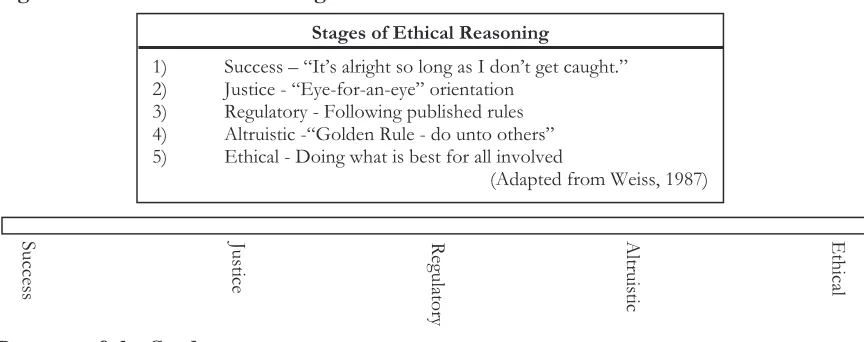
merely a point on a continuum of ethical reasoning (see Figure 1.). Understanding the
scope of the entire continuum as well as movement across it is critical to fully understand
! " # $
% & '
( ) " $ * *
+& # , - . /01
&
Figure 1. The Ethical Reasoning Continuum.
Purpose of the Study
The purpose of this research is to investigate how experience mediates each
participant coach’s moral-reasoning in competitive sport situations. Using a grounded
theory research method, this study provides a focussed view of how the moral-reasoning
of coaches in competitive situations may bemediated by the specific sport-based context
of their experience. It was important to state at the outset that my desire to conduct this
research was not influenced in any way by my personal affiliation with various sport
organizations, but was driven by a passionate interest in understanding how a coach’s
moral-reasoning is mediated by the values gained throughtheir experience and the
contexts in which they have coached. Any given piece of research may reveal as much
about the researched community as it does about the phenomenon being studied and
broader application of the results to the sport community may emerge over time.
Definitions used in the study
Coaching Experience
Coaching experience is acquired over time. However, it is important to
differentiate one year of experience repeated over ten years from ten years of
experienced learning. I wanted the participants to have a minimum of ten years
experience. As part of the purposive sampling process (Creswell, 2003), an evaluation of
their engagement in experiential learning (Kolb, 1984) and reflective practice (Schön,
1987) was conducted to determine their suitability.
Developing Athletes
From an educational standpoint, coaches have the greatest impact on
developmental athletes who are in the associative stage of learning (Fitts & Posner,
1967). These athletes are beyond sport initiation, but they have not yet developed
autonomous skills. This is the point at which coaches have the greatest opportunity to
impact behaviour. With an interest toward instilling appropriate moral values in athletes,
it is important to understand their coaches’ ethical perspectives.
Competitive Situation
From a coach’s perspective, a competitive situation is distinct from a training
situation. A training situation is a common, almost daily occurrence in which an athlete is
systematically prepared for competition. Although we expect coaches to act morally
during training, this situation has been studied extensively with respect to performance
enhancing substances, ergogenic aids and overtraining as well as a host of psychological
issues. I was interested in examining coaches’ moral-reasoning during competitive
situations that have temporal restrictions and include an emotional dimension related to
the potential outcome. This temporal urgency coupled with the emotional dimension was
a key component of my research, as I believe these two together significantly impact the
values employed during the moral-reasoning process to an extent that can only be
Ethics and Morality
There is much confusion around the terms ethics and morality. Loland (2002)
suggests that ethics “is derived from the Greek éthos which refers to habit or custom” (p.
17). Morality, on the other hand, “can be understood as [the]…values of a group of
people” (p. 18). Pojman (1999) makes the following distinction: Ethics is the process
humans use to determine the morality of an action or behaviour whereas morality is
concerned with the rightness and wrongness of an action. It is an abstract term used to
describe correct behaviour or actions in absolute terms. An ethical person uses a process
to determine the morality of their behaviour.
Moral-reasoning
Moral development is delineated by stages, often linked to growth and
development, whereas moral-reasoning is a process used to make ethical decisions.
Furthermore, Loland’s (2002) practical argumentation (Figure 8. on pg. 55) was used to
quantify the level of cognition used for moral-reasoning and improved my ability to
capture a coach’s thought process, explain their reasoning and justification for their
actions in a much more salient fashion than was available with purely outcome
based-research.
The Research Question and Research Problem
This research project was intended to increase knowledge and provide greater
understanding about the impact of context specific experience in mediating the
The research question is:
How is the moral-reasoning of coaches, in competitive situations, mediated by the
specific sport-based context of their experience?
I conducted my study by examining the moral-reasoning process of coaches who
work primarily with developmental athletes1. I wanted to determine if coaches used a
consistent recognizable moral-reasoning process. I think it is important to understand the
moral-reasoning process of those coaches in a position to have the greatest influence over
athletes. Research suggests that parents are the primary influence for beginning athletes,
but coaches become the primary influence of developmental athletes (LeBlanc &
Dickson, 1996). If one is to affect behavioural changes it is important to target athletes in
the cognitive and associative phases of learning, because their performance becomes
autonomous, little adaptation would be anticipated (Ericsson, Krampe, & Tesch-Rhömer,
1993; Fitts & Posner, 1967), therefore, it was important to focus the research on the
coaches of those developmental athletes.
Researching moral-reasoning had to be conducted as a qualitative endeavour since
quantitative methods are inadequate to capture the multifaceted nature of axiological
(value based) philosophy. Values held by people (including coaches) are difficult to
evaluate with quantitative measures. Qualitative methods are ideally suited to this sort of
study. A review of the literature revealed that very little research currently exists that
looks at how coaches engage in moral-reasoning. John Creswell (2003) proposed that
when our understanding of a situation is still at the discovery stage, qualitative method is
apposite. He suggests that one of the primary reasons for conducting a qualitative study is
when the research is investigative. A qualitative approach using observation, interviews,
and document analysis was selected as the most appropriate methodology for this
investigation of the influence of context specific experiential learning and reflective
practice on the moral-reasoning process. Strauss and Corbin (1990) concluded that
research which attempts to discover the nature of peoples’ experiences with a certain
situation lends itself more to qualitative types of research:
Qualitative methods can be used to uncover and understand what lies behind any
phenomenon about which little is yet known. It can be used to gain novel and
fresh slants on things about which quite a bit is already known. Also, qualitative
methods can give the intricate details of phenomena that are difficult to convey
with quantitative methods. (p. 19)
Having spent the majority of my adult life engaged in coaching, and teaching the
art and science of coaching to others, the idea of understanding and improving ethical
conduct is very close to my heart. In order to make the most effective use of experiential
learning and reflective practice, my research attempted to discern an emergent theory. I
hoped to explain how a coach’s experience mediated the moral-reasoning they employed
when making ethical decisions whenworking with developmental athletes in competitive
sporting situations. I also wanted to scrutinize the moral philosophies and ethical
foundations on which they built their moral-reasoning process.
Summary
This chapter set the context for a study of coaches’ ethical decision-makingin the
competitive domain of developmental athletes. A critical distinction between ethics and
Finally, an explanation of the specific research problem along with the articulated
CHAPTER 2
THEORETICAL FOUNDATION
Moral Philosophy
This chapter is not to be construed as a comprehensive treatise on moral
philosophy but rather a primer on some fundamental ethical concepts. This study is about
how coaches engage in moral decision-making in self-identified moral dilemmas. I have
selected three basic philosophical approaches as outlined by Pojman (1999) to use for
coding purposes as I feel they provide an appropriate cross section of moral philosophy
that can be understood by coaches and applied in a sport context.
A fundamental understanding of moral philosophy, tempered by the notion that
the extent of this understanding is contextualized to sport, will further refine the
discernment of how coaches make their decisions. These three approaches provided the
initial framework for the categorization of the responses in the coding process (see Table
1.).
Table 1. The Three Ethical Approaches (adapted from Pojman, 1999)
Ethical Approaches Ethical Praxis Example
Aretaic Approach Based upon what is Virtuous Authenticity to ones’ cause Deontological Approach Based upon what is Just Divine Command Theory
Teleological Approach Based upon what is Good Utilitarian/Consequentialist perspective
Aretaic Ethics
Aretaic or virtue ethics (Pojman, 1999) describes a reasoning process where
people function virtuously with authenticity and commitment to a cause. Boycotting
sporting events for political reasons and Eric Liddell’s refusal to race at the 1924 Paris
manifestations of aretaic ethics. Although society generally applauds such virtuous
behaviour, many coaches appear to guide their ethical decision-making using other
ethical approaches.
Deontology
Deontology is the branch of philosophy that is rule-based (Pojman, 1999). For
sport, this is a common approach where participants subscribe to the idea that if it is not
against the rules, it must be allowed. There are a wide variety of positions within
deontology. The religious doctrine informing morality is divine command theory,
although similar doctrines exist in virtually all religions. The Golden Rule and the Ten
Commandments are Christian versions of divine command theory. Deontology
essentially looks for some rule or set of rules to govern one’s conduct. There is little
decision-making involved beyond finding the rule and applying it to the situation, as
attention is focussed on the activity (Malloy, Ross, & Zakus, 2003). In a sport context,
deontology embraces the spirit of the rules and the assumption that everyone is aware of
these unwritten guidelines and agrees to abide by them (Schneider & Butcher, 1999).
Teleology
Teleology may be viewed across a spectrum and is concerned with either the
utility (utilitarianism) or the consequences of an action (consequentialism) (Pojman,
1999). Teleology would have one consider the ends rather than the means by which an
act is committed. Essentially, utilitarianism suggests that as long as a good thing happens,
it does not matter how the good thing came about. Utilitarianism is an attempt to evaluate
the value of an action. In some cases an attempt is made to find a balance between a bad
action than bad, the action may be considered moral. A common example of this in sport
is when we adjust the way we play to mirror our opponents’ sometimes questionable
practices. Another utilitarian paradigm suggests that it does not matter how much bad
happens, so long as the action produces the desired good result. This is winning at all cost
which, although uncommon in youth sport is seen, all too often, in elite sport.
Consequentialism, on the other hand, judges an action solely against its
consequences, a subtle distinction. In sport, this approach justifies the morality of the
good penalty, which is deliberately breaking the rules to gain an advantage and accepting
the consequences (penalty) (Loland, 2002).
In sport, there is an opportunity to develop virtuousness in an environment where
challenges to such behaviour are strong and emotionally driven. I argue thatin order to
meet the educational potential of sport, it should be conducted under an umbrella of
virtuousness. Unfortunately moral decision-making in sport seems more oftendetermined
by the deontological perspectives of those who are prepared to follow the rules orby the
teleological perspectives of those who are outcome driven. Building on the three ethical
philosophies and integrating the five phases of moral-reasoning in sport, delineated by
Weiss (1987) and the perspectives of Gilligan (1982) and Turiel (1983), I developed a
three dimensional taxonomy used as a coding base for my research.
Sport Philosophy
Involvement in sport has the potential to contribute positively to the moral,
mental, emotional, physical, and social development of young people (Donnelly & Kidd,
2003). School-based sport as well as extra-curricular sport can help young people to form
(Arnold, 2001; Schneider & Butcher, 1999). In order for this development to be positive
and morally sound, coaching must be conducted within an ethical framework.
When adults take part in recreational competition for its inherent pleasure, very
few problems with moral conduct emerge (Bergmann Drewe, 2003; Dulaney, 2001).
However, when winning becomes the primary objective, other potentially beneficial
outcomes, such as the ability to practice value-based decision-making and engage in
critical reflection, is lost. To achieve this end, the training of athletes needs to be
managed by coaches who value the notions of a caring community, fair play, and
excellence, above those of winning (Bergmann Drewe, 1998).
The Value of Sport
Beyond the public perception of youth sport as simply a feeder system for elite
development, there are several other features of youth sport worth considering such as its
educational benefits, health aspects, and cultural relationships (Bergmann Drewe, 2000a).
The majority of arguments opposing youth sport incorporate ethical issues, that is when
sports are pushed to the limit and winning becomes of paramount importance exclusively
(Bergmann Drewe, 1999a; Leonard, 1998). Coaches must recognize that the impact of
sport on young people is never neutral. Physical, psychological, and emotional
development is always occurring through participation in sport. More specifically, young
people learn to analyze problems, generate solutions, make value-based decisions, engage
in collaborative practices, and develop leadership skills through their sport experiences
(Donnelly & Kidd, 2003). While some struggle to do away with the obdurate resistance
to change in coaching practices, and the sadoascenticsm (no pain, no gain) approach to
benefits. Furthermore, as a key component of sport pedagogy, coaches are ideally placed
to introduce their players to the ethical principles underlying competition and fair play.
How community sport is organized and conducted requires everyone involved
making ethical choices. In order to provide positive sport experiences for all competitors,
participants, parents, officials, and sport administrators must make appropriately moral
choices. LeBlanc and Dickson (1996) noted, “96 per cent of youngsters say their coach
plays an important role in influencing their behaviour, compared to 65 per cent for
teachers and 55 per cent for parents” (p. 7). Unfortunately, we can no longer rely on
parents alone to instil moral values as too many parents have become overly concerned
with winning (Côté, 1999; Smoll, 2001). As front line practitioners, coaches need to take
on more of the responsibility for setting the standards of moral behaviour in sport. In
addition to being role models for skill development, health, and fitness, they must also be
role models of moral character. Sport provides coaches with a tremendous opportunity to
promote value-based decision-making as a skill worth learning and provides children and
youth with an opportunity to learn and practice value-based decision-making in an
environment where the impact of their experimentation with individual moral choices is
bounded by rules, closely monitored by officials and, consequently, can be modified if
inappropriate. Parents and athletes however, need to understand and accept this inherent
value of sport.
Kirk (2002) suggested “that we should take sport seriously as a cultural form,
since it is only in so doing that we can attain the civilizing benefits of sport...[and]...that
junior sport policies and practices are crucial to obtaining these benefits” (p. 402). Sport
vulnerable to corruption, and cultural benefits do not flow automatically from sport
participation” (Kirk, 2002, p. 402). From a cultural perspective, there is a need to embody
the values we wish to preserve and transmit to young people. Sport provides a plethora of
opportunities for appropriate role models to develop (Crawford et al., 2001) and because
all sport is conducted according to rules, sport is often a vehicle used to teach young
players about moral behaviour.
Nevertheless, it is also important not to negate the role of winning. If winning is
to be one of the measures of legitimate sport performance, it must be situated as an
integral part of ethical conduct (Schneider & Butcher, 1999). The pursuit of excellence is
an essential and indispensable feature of sport, as it is in other human endeavours such as
music, art, and drama. Unfortunately, in sport, the question arises regarding the apparent
conundrum between ethics and excellence (Bergmann Drewe, 1998). Ethics should not
preclude a person from seeking to perform to the best of her/his ability. It may even be
perceived as unethical not to perform to the best of one’s ability as it belittles the
winners’ achievements. If one party is conducting her/himself unethically, there is no
longer fair competition, which then undermines the performance. It can be argued that
moral conduct does not compromise performance; it enhances it.
Social Learning Theory
It has been suggested that a coach’s performance improves with experience
(Gilbert, 1999). There is a significant coach education program in Canada known as the
National Coaching Certification Program (NCCP). However, the actual practice of
coaching is generally untaught and usually based on one’s past experience as an athlete
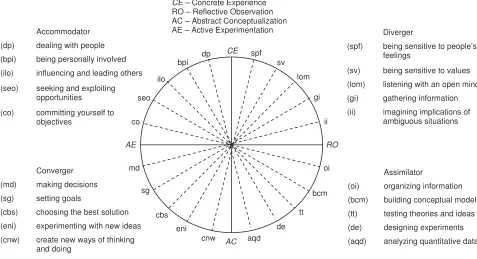
(1984) (see Figure 2.). Kolb (1984) noted that experiential learning is critical because
“the specialized development that characterizes most higher-educational experiences
usually carries forward into one’s early career” (p. 192). Virtually all coaches bring
experience as athletes prior to engaging in the practice of coaching. This athletic
experience may be inappropriate for the experiential learning component of their
development, depending on the morality that characterized their early sport development
as young players. However, by clearly defining ethical coaching practice, it should be
possible to separate viable athletic experience from that which is dysfunctional.
Schön’s (1987, 1991) work on reflective practice with teachers can also be
applied to coaching in an attempt to reduce the impact of athletic experience corrupting
appropriate learning as a coach (Gilbert & Trudel, 1999). Many coaches admit that they
coach the way they were coached and consequently very little changes over time (Gilbert
& Trudel, 2005). This can lead to coaches with one year of experience repeating their
mistakes many times over many years rather than developing several years of quality
experience through reflective practice. Understanding the process of reflection as well as
the extent to which coaches engage in critical reflective analysis of their experiences as
both athletes and coaches will aid in understanding how coaches make use of experiential
CE RO AE AC dp bpi ilo seo co md sg cbs eni
cnw aqd de tt bcm oi ii gi lom sv spf
CE – Concrete Experience RO – Reflective Observation AC – Abstract Conceptualization AE – Active Experimentation Accommodator
(dp) dealing with people (bpi) being personally involved (ilo) influencing and leading others (seo) seeking and exploiting
opportunities (co) committing yourself to
objectives
Converger (md) making decisions (sg) setting goals
(cbs) choosing the best solution (eni) experimenting with new ideas (cnw) create new ways of thinking
and doing
Diverger
(spf) being sensitive to people’s feelings
(sv) being sensitive to values (lom) listening with an open mind (gi) gathering information (ii) imagining implications of
ambiguous situations
Assimilator
(oi) organizing information (bcm) building conceptual models (tt) testing theories and ideas (de) designing experiments (aqd) analyzing quantitative data
Figure 2. The Competency Circle (adapted from Kolb, 1984, p. 96).
Most coaches conduct their practices within a fairly narrow envelope of concerns.
They worry about whether their athletes are properly prepared, about whether they have
injuries, about whether there are external issues in their lives and/or the competition, etc.
distracting them. Few coaches would articulate their need to think philosophically about
these issues; they may even question what philosophy has to do with everyday life.
However, coaches may hold a great many philosophical beliefs and when they start to
think philosophically and take a step back from their coaching they can begin to examine
the bigger picture. It is this bigger picture and a desire for understanding what drives the
moral-reasoning process that provided the impetus for my research.
Summary
This chapter considered the philosophical underpinnings for this research. An
more critical discussion of the interplay of these concepts in the context of competitive
sport. Ultimately, how coaches may learn about the application of these philosophical
approaches through the social learning theories (Bandura, 1977) of experiential learning
CHAPTER 3
LITERATURE REVIEW
Throughout the course of trying to understand the process of moral-reasoning as it
applies to coaches involved in competitive situations with developmental athletes, I
reviewed the literature related to moral development, moral decision-making, and ethical
conduct in sport. This chapter provides a survey of the broad expanse of literature on
moral development in order to situate this study within the narrower context of
moral-reasoning and is presented in four parts: situating the proposed study in the literature;
theories on moral development; application to sport; and theories on moral-reasoning.
Situating the Study in the Literature
Moral education is becoming an increasingly popular topic of instruction in the
fields of kinesiology and sport pedagogy. Media reports of hazing, sexual abuse,
increased violence, drug use, eating disorders, and abusive training methods have caused
many to call for government intervention into coaching. All of these sport concerns are
moral in nature, and most have multifaceted origins; there is a growing movement
towards linking the solutions to these moral sport problems to the teaching of sport ethics
in coach education programs. However, deliberations over the role coaches can and
should play in the moral development of youth are themselves the subject of controversy.
All too often, debate on this topic is reduced to posturing, reflecting personal views rather
than informed opinion. Following a W5 episode, which aired on CTV in 1992 and
exposed several male coaches who had allegedly engaged in inappropriate activity with
female athletes the Federal Government, through Sport Canada, released an edict that
as an enlightened government moving quickly to protect athletes. However, within a
couple of days my sister, a gymnastics coach pointed out that she was no longer able to
spot her athletes; a critical safety requirement. Fortunately, methodical research on ethics
has been going on for decades, and novice researchers wishing to attend to issues of
moral-reasoning and the relationship to coaching may make use of what has been learned
through that work.
In order to begin a discussion of moral-reasoning with any demographic
sub-group, it would be prudent to familiarize oneself with the seminal work that provides the
theoretical underpinnings to support the primary research. Sport ethics and coaching is a
broad topic requiring some choices regarding the focus of analysis. This contemporary
empirical study was grounded in the theories of moral development, which have emerged
from the area of cognition and learning in the academic discipline of educational
psychology.
With a focus on coaches of developmental athletes, my research sheds some light
on the moral-reasoning of coaches at a much earlier stage in their athlete’s career than
has been accomplished with previous studies that focussed on coaches of
high-performance/Olympic athletes.
Theories on Moral Development
The literature on moral development that provides the theoretical foundation for
this dissertation would most certainly include the theories and concepts of Lawrence
Kohlberg, who became one of the most widely published and influential moral
philosophers of the latter half of the twentieth century. Much of this research stemmed
work on children’s moral judgement as a function of cognitive development by
examining the specific process of moral development and laid the foundation for the
contemporary debate within education and sport on moral development. The vestiges of
Piaget’s research remain directly relevant to contemporary theories of moral
development. His research focused specifically on the moral development of children by
studying the way in which children played games in order to learn more about their
perceptions of right and wrong. Kohlberg researched the development of moral thinking
beyond the ages studied by Piaget, and concluded that the process of moral development
was both more protracted and gradual than Piaget’s original ideas had suggested.
Kohlberg interviewed participants and assessed their moral-reasoning based on
responses to hypothetical moral dilemmas. He believed that moral decision-making
progressed sequentially through six stages that could be broadly grouped into three levels
in a process that paralleled Piaget’s theory of cognitive development (Power, Higgins, &
Kohlberg, 1989). In his dissertation Kohlberg (1958) had originally proposed an eight
stage model that was reduced to six when he “later pooled” (p. 90) two of the stages with
the fourth stage. Kohlberg credited Anselm Strauss with “going over the raw data …in a
remarkably insightful way” (Kohlberg, 1958, p. iii). Although nearly a decade would pass
before Strauss would discover the qualitative research method, Grounded Theory, with
Barney Glaser2, aspects of the constant comparison process they developed are apparent
in the procedure section of Kohlberg’s dissertation.
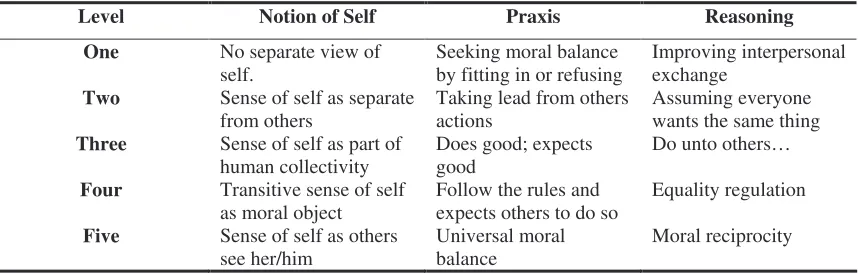
Norma Haan (1977) continued to refine Kohlberg’s taxonomy through her own
research. Unable to find a significant distinction between Kohlberg’s stages three and
four, she articulated a five level approach to understanding moral development. She
cautions: “it would be ill advised to call these levels ‘stages’ at this time since we have no
evidence about their homogeneity, sequentiality, or whether they are age graded
...however, that sequentiality is implied” (Haan, 1977, p. 120) (see Table 2.). Ultimately
Kohlberg revised his own taxonomy to five stages (Reed, 1987).
Table 2. Five Levels of Interpersonal Morality (adapted from Haan, 1977)
Level Notion of Self Praxis Reasoning
One No separate view of
self. Seeking moral balance by fitting in or refusing Improving interpersonal exchange Two Sense of self as separate
from others Taking lead from others actions Assuming everyone wants the same thing Three Sense of self as part of
human collectivity Does good; expects good Do unto others… Four Transitive sense of self
as moral object Follow the rules and expects others to do so Equality regulation Five Sense of self as others
see her/him Universal moral balance Moral reciprocity
Longitudinal studies conducted by Power, Higgins, and Kohlberg (1989), began
to uncover inconsistencies in Kohlberg’s original stage sequence. Two of Kohlberg’s
former graduate students, Carol Gilligan (1982) and Elliot Turiel (1983), have since put
forth major critiques of his work.
The chief critique of Kohlberg’s work put forward by Carol Gilligan (1982)
suggested that since only males were used in Kohlberg’s studies, his theories
inadequately represented women. Gilligan suggested that a morality of care can serve in
the place of the morality of justice espoused by Kohlberg. The morality of care is built on
a foundation of non-violence, whereas the morality of justice is built on a foundation of
equality. In order to distinguish these two moralities in a sport context, we must consider
the motivation for a coach’s intervention. If the intervention is to avoid treating others
intervention is in order to assist someone in need, they are more likely exhibiting a
morality of care. Beyond merely trying to ensure that my research adequately represented
both genders, Gilligan (1982) provided an opportunity for differentiating between them,
as well as offering an additional dimension for coding participant’s responses.
Another fruitful line of research to emerge from those longitudinal studies was
domain theory advanced by Elliot Turiel (1983). Domain theory draws a distinction
between concepts of morality, and other domains of social knowledge, such as social
convention. According to domain theory, the domain of morality is separated from the
domain of social convention. The concepts diverge in an attempt to account for
qualitatively differing forms of human interaction. A core feature of moral development
is centred on consideration of the effect of actions on the well-being of all people
involved in a social situation, whereas, actions that are matters of social convention, such
as shaking hands, have no intrinsic interpersonal consequences. What emerged from the
research was the participant’s attempt to account for varying forms of experience
associated with these two distinct domains of human interaction. Social conventions
provide a way for members of a group to harmonize their social exchanges through a set
of established modes of conduct. As exposure to sport becomes ever more global, these
conventions become less tangible and more problematic for coaches requiring more
advanced moral-reasoning. My research used this distinction between moral issues and
issues of convention to focus the study on a narrowly defined concept of morality.
Application to Sport
Maureen Weiss (1987) was the first to apply the moral development theories,
sport. Weiss (1987) further refined Haan’s five levels, adapted them to sport and stated
that they were in fact sequential stages as Kohlberg had suggested; a concept that had
been disputed by Haan.
Arguably one of the most prolific writers on the subject of sport ethics is Brenda
Jo Bredemeier, (Bredemeier, 1985, 1994; Bredemeier & Shields, 1984, 1985, 1986;
Bredemeier, Weiss, Shields, & Cooper, 1987). Her work, alone and with colleagues, has
generally focussed on athletic aggression within a youth sport context and the moral
justification used to support the action and how that same reasoning might be related to
contexts outside of sport. Although distinct, my research is intended to look at similar
issues but from a coaching perspective. While some ethics research has been conducted
with high-performance athletes, particularly with regard to cheating and the use of
banned ergogenic substances for performance enhancement (Kirkwood, 2002, 2004;
Simon, 2007), very little research has been conducted specifically with coaches,
particularly with those of developmental athletes.
Delimiting the Research
It is important, at this point, to clarify some fundamental concepts regarding
philosophical approaches and to delimit the ethical issues that were deemed to be beyond
the bounds of this research. The question of whether or not to follow the rules of the
game presents us with perhaps the most basic moral question. Do we follow the rules or
not? When people break the law to further a virtuous cause they deeply believe in, the
behaviour is referred to as civil disobedience3. Coaches and athletes may on occasion
choose to break the rules in an attempt to level the playing field against an athlete or team
3 A concept ascribed to Henry David Thoreau who pioneered the modern theory behind this
they feel is cheating and whom the officials are not sanctioning. However, it is important
to note that this rule-breaking occurs from a teleological perspective rather than an aretaic
one. For this research it was imperative to accept McNamee’s (1998) and Reid’s (1997)
contention that there is no place for civil disobedience in sport. This was key to limiting
the discourse on moral-reasoning to the study of moral dilemmas within the reach of the
current rules of sport4. Only then is it possible to focus on participant-identified ethical
situations in several broad categories that coaches often have to respond to such as the
following: (a) utilizing allowed ergogenic aids; (b) team selection issues; (c) tactical or
strategic innovations; (d) technical performance enhancement; and (e) gendered, raced or
sexualized coaching issues.
My current interest in moral-reasoning research is focussed on coaches’
perspectives on issues not governed by the rules or simply when the rules do not apply. In
order to refine the broad categories articulated above, some examples of situations facing
coaches where the rules do not apply can be seen in Sheryl Bergmann Drewe’s (2000b)
research. She found coaches struggling to make “a decision between doing something
which would be better for the team...or doing something which would be better for the
individuals involved - including the coach” (p. 148). She also considered a coach
supporting an athlete’s decision to participate in activities even though she/he thinks it is
morally wrong, but understands it may help produce a desired result. Additional
illustrations would include whether to play an injured athlete, refusing to play an athlete
who missed a practice, intentionally harming opponents, purposefully taking a penalty, or
pressuring athletes to function against their own ethical principles and/or moral values.
4 For example, this study specifically excludes examination of coaching decisions concerning
Athletes and coaches find there is often a grey area between playing hard and hurting
someone either physically or psychologically.
Other moral dilemmas, within the rules of sport, include the use of allowed
ergogenic aids to enhance performance such as creatine monohydrate, the unjustifiable
overuse of cold remedies for their stimulant effect as well as such tactics as the drawn
foul, where a player intentionally tries to cause an opponent to break the rules, drawing a
penalty for the opposing team. There are also a host of quasi-criminal activities employed
in sport under the guise of gaining a psychological advantage. Examples would include
threatening an opponent or passing incorrect or incomplete information, with the intent of
causing the opponent to under-perform, when similar actions (libel, slander, and so on)
outside sport would carry significant penalties.
Moral-reasoning and Ethicacy5
Moral-reasoning entails a systematic approach to solve identified problems
whereby various ethical approaches are analyzed, possible solutions are generated, and
value-based decision-making appropriate to the situation is applied “predicated on our
abilities to be impartial, consistent, and reflective” (Lumpkin, Stoll, & Beller, 2003, pp.
255-256). The purpose of this study was to investigate how coaches applied these
principles in competitive sport situations once they had ten or more years ofcoaching
experience. Butcher and Schneider (2001) offered “the bag-of-virtues approach [which]
takes a list of not necessarily related virtues, praiseworthy attributes, or behaviours and
associates them with, or applies them to, sport” (p. 23). It may be appropriate in different
cases for the coach to utilize a variety of approaches to the benefit of participants across a
5 Ethicacy – exhibiting a fluid moral-reasoning process bounded by moral philosophies yet not
range of sport contexts. Loland and McNamee (2000), and Ziegler (1984) also supported
this notion of an eclectic and fluid philosophical approach to sport ethics where the sport
context may complicate the ethical process. Lumpkin and Cuneen (2001) suggested,
“each person learns and develops morally through a process that is environmentally
influenced, constructing personal attitudes, beliefs, and values that are based on this
moral understanding” (p. 40). Bergmann Drewe (2003) presented sport contexts as a
continuum, which provides some insight into how the sport context might channel a fluid
philosophical approach (see Figure 3.). I coined the term ethicacy to illustrate this
somewhat fluid but bounded process of moral-reasoning.
Figure 3. Sport Contexts Continuum (adapted from Bergmann Drewe, 2003).
Background for the Research Question
Although not clearly articulated in the literature, there seems to be a division over
whether coaches make ethical decisions based on a foundation of moral philosophy that
is developed sequentially (Power, Higgins, & Kohlberg, 1989) or utilize an eclectic moral
philosophy that is fluid and changes based on the level of play of the participants (Loland
& McNamee 2000; Ziegler, 1984). As stated previously, the primary question guiding
this study is: How is the moral-reasoning of coaches, in competitive situations, mediated
by the specific sport-based context of their experience?
I explored coaches’ understanding of, and reaction to, specific real events that had
ethical implications. Through these observations and interviews, I was able to extract the
decision-makingapproach coaches used in these situations as well as some understanding PRIMITIVE SOPHISTICATED RECREATIONAL ELITE AND/OR
PLAY PLAY SPORT PROFESSIONAL