1693 | P a g e
Study of scattering cross sections for single and double
ionization of Cu by H
+
particles impact
Suresh Prasad Gupta
1, L.K.Jha
2,Raju Khanal
31
Patan Multiple Campus, Lalitpur, Tribhuwan University, Nepal.
2
Department of Physics, B.R.A. Bihar University, Muzaffarpur-842001, Bihar, India.
3
Central Department of Physic, Kirtipur, Tribhuwan University, Kathmandu,Nepal
ABSTRACT
Theoretical calculations of H+ impact single and double ionization cross sections for ground state Cu atoms have been performed in the binary encounter approximation(BEA) in the energies region ranging from 80 to 1440 keV/amu for single ionization and 125 to 1440 keV/amu for double ionization. The accurate expression for
E (cross section for energy transfer
E
) and Hartree –Fock velocity distributions for the target electrons have been used throughout the calculations. It has been concluded that the calculated results of H+ impact single and double ionization cross sections are in good agreement with the experimental data throughout the given energy range.Key words:
Binary Encounter Approximation, Proton impact, Single ionization, Double ionization,
Hartree-Fock velocity distributions
I. INTRODUCTION
Ionization of atoms and molecules is one of the basic processes in atomic physics. Thus it has been extensively
studied both experimentally and theoretically. Due to the broad range of applications and also due to its role in
the study of atomic collision dynamics, there have been great effort, both experimental and theoretical, to
improve our understanding of the ionization processes resulting from ion impact with atoms. From the academic
point of view , the studies of the dynamics of the electron atom inelastic scattering leads to a better
understanding of the physical structure of atoms and molecules and how energy and momentum are transferred
between atomic particles during the collision. The description of multiple ionization is far from a simple task
mainly due to the complexity of the many possible path ways leading to it. For example double ionization of
atoms by fast ions is usually understood in terms of three mechanisms [1].First one is the shake off process, in
which a fast electron is ejected in the direct ionization with the projectile, while the second electron is ionized
by the final state rearrangement second one is the two step process, in which both electrons are simultaneously
ejected by the direct interaction with the projectile and third one is the ionization of the inner shell electron with
a post collision Auger decay. Both the shake off and inner shell ionization plus Auger decay yields a double
ionization cross sections. The two step mechanism, which turnout to be dominant in the intermediate energy
region does not follow this pattern because it is based on the action of the projectile over the two active
1694 | P a g e
are significantly different from those of single ionization cross section. The statistical distribution of the variousavailable inelastic alternatives, as well as, the way the electrons dynamically correlates, significantly change the
dependence of the multiple ionization cross section on the projectile energy and the charge state with respect to
the single ionization.
A general used approach for interaction of the multiple ionization processes is the independent particle model
(IPM), where it is assumed that the ionization of one electron is independent of the other and the relative
probability are given by binomial distribution [2,3,4]. This method depends strongly on the quality of the
calculation of the single electron ionization probability. Although some general qualitative estimates can be
obtained through simple semi-classical calculations using hydrogenic wave function [4]. An alternatively
theoretical approach to the IPM is the statistical energy distribution model, which has also been used by several
authors [5-7]. It was formulated by Russek and Thomas [6] and further developed by Cocke [7] and Kabachnik
et al.[8]. It is based on the hypothesis that the probability of multiple ionization is directly related to the energy
deposited by the projectile on the target, which is, in a second step, statistically distributed among all atomic
electrons and one or more of which eventually auto ionize to the final state.
In parameter to which these calculations are highly sensitive, mainly in the intermediate velocity regime is the
projectile charge state. The simplest case, i.e. single ionization of light atoms and molecules by structure less
charged particles at high impact velocities, is well described within the frame work of Bethe theory [9].
Derivations of the charge state scaling from the first Born approximation are expected to be observed either if
the collision regime is non perturbative or if multiple ionization occurs. These studies, however, concern on the
single ionization of few electrons, ions and studies on the effect of partial screening on multiple ionizations are
practically on existence. To the best of our knowledge, there are no reliable calculations available for partial or
total multiple ionizations.
In case of different multiple ionization processes the double ionization is the most important as the main
contributions to the total ionization of the target is given by single and double ionization processes. Theoretical
calculations of double ionization cross sections are considered to be of much significance because contribution
from different physical processes e.g. simultaneous ejection of two electrons, inner shell ionization followed by
Auger emission, resonance excitation double auto ionization process etc. can be separately estimated at various
impact energies. Keeping in view the importance of the degree of ionization and convenience in calculations, we
have considered it worthwhile to estimate theoretically separate contributions from the relevant physical
processes leading to double ionization.
Rigorous theoretical calculation of direct double ionization cross section becomes extremely difficult as it is
related to a four body Coulomb potential in the final channel[10]. Recently, some interesting theoretical
calculations on single and multiple ionization of noble gases atom by fast proton impact have been reported
where contribution of electron capture to multiple ionization are negligible. Spranger and Kirchner [11]
investigated the ionization processes for Ne and Ar using independent particle model. They have also
considered time delayed Auger like electron emission processes on the basis of a straight forward statistical
model and have concluded that high projectile velocities multiple ionization is dominated by Auger like
1695 | P a g e
by bare atom. It is based on the solution of transport equation for an ion travelling through an inhomogeneouselectron density. Among different experimental investigations on metals, Mc Cartney et al.[13] of the Belfast
group have used a cross beam technique incorporating time–of- flight analysis and coincidence counting of the
collision products to carry out an interesting work on processes involving electron capture and multiple
ionization in collisions of fast H+ and He2+ ions with ground state Pb atoms. Measurements of this type are
complex and difficult and probably for this reason the experimental data have been obtained in the limited
energy ranges. They have also carried out calculations in an independent electron model for the processes
experimentally investigated but unfortunately the agreements of the theoretical result with the experimental data
is not satisfactory.
In the past, binary encounter approximation (BEA) has been used successfully to calculate charged particle
impact single and double ionization cross section for atoms and ions. Gryzinski [14] reasonably considered two
processes in a double binary encounter model to describe double ionization. In the first process the two electrons
may be ejected from the system by two successive encounters of the incident particle with the target electrons.
Alternatively, the incident particle may knock out only one target electron and the second electron is removed
by the first ejected electron. The corresponding double ionization cross sections are denoted by
Q
scii (scatteredpart) and
Q
ejii(ejected part) respectively. Kara et al. [15] also supported the idea of above mentioned two stepinteraction to describe the process of direct double ionization. In spite of certain unrealistic features and
unjustified simplification in Gryzinski`s mathematical formulation for the process of double ionization, the idea
of two double binary encounter process has physical justification (see Roy and Rai [16] , Vriens [17]).
Later on Roy and Rai modified Gryzinski`s theory of electron impact direct double ionization suitably. The
result of double ionization cross sections, based on the modified model including contribution of indirect
processe, was found to close agreement with the experimental data [118-19]. In these calculations, Hartree-Fock
(HF) and hydrogenic velocity distribution were used while considering ejection of the first and second target
electron respectively. Latter, Jha and Roy[20-21] and Minakshi et al.[22] used Hartree-Fock velocity distribution while considering the ejection of both electrons of the target in the calculation of direct double
ionization cross section. H+ and He2+ impact single and double ionization of Mg and Pb calculated in the BEA
shows good agreement with experimental data. Contributions to double ionization from the Auger effect
following vacancies in inner shells are theoretically substantiated by by these studies.
In the case of heavy charged particle impact ( like H+ and He2+), BEA of double ionization cross section of
atoms are few. Kumar and Roy [23, 24] pointed out errors and obsequies in Gryzinski`s theory for calculation of
the process mentioned above and modified the mathematical frame work suitably . In comparison of the two
distribution functions, Hartree Fock and Hydrogenic velocity distributions functions, they concluded that the
case of HF velocity distributions for the ejection of both electrons in calculation of direct double ionization cross
section will lead to improved agreement with the measured data. Keeping the facts mentioned above in mind,
we consider it worthwhile to carry out calculations of H+ impact single and double ionization cross sections for
1696 | P a g e
and direct double ionization cross sections and to examine the contribution to direct double ionization fromindirect physical process.
II. THEORETICAL METHOD
In terms of dimensionless variables s and t, the expressions of ionization cross section due to a projectile of unit
charge of particular incident energy and a particular velocity of bound electron are given by (see Kumar and
Roy [23])
)
(
4
1
;
0
)
(
4
1
)
(
4
;
)
1
(
2
3
2
)
(
4
1
2
)
(
4
1
;
)
(
4
1
3
2
1
4
)
,
(
2 / 3 2 3 3 2 2 2 2 2 2 2t
s
s
t
s
s
t
s
s
t
t
s
t
t
s
t
u
s
t
s
s
t
s
t
u
s
t
s
Q
i
(1)In our present work we have used the accurate expression of
E( cross section for energy transfer
E
) as given by Vriens [25] for heavy charged particles incident on atoms. Following Catlow and McDowell [26] thetwo dimensionless variables s and t are defined as
s
2
v
12/
v
02 andt
2
v
22/
v
02, wherev
1 andv
2are the velocities in atomic units of the incident particle and the target electron respectively andu
v
02 is the ionization potential of the target in rydbergs. All other energies involved are also expressed in rydbergs.Numerical integration of
Q
i(
s
,
t
)
has been carried out over Hartree Fock velocity distribution of the bound electrons to obtain the total ionization cross section. Thus the expression of total single ionization cross sectionfor heavy charged particle impact for a particular shell of the target is given by
0 2 0 2 / 1)
(
)
(
)
,
(
)
(
s
n
Q
s
t
f
t
u
dt
a
Q
i e i
(2)
where
n
eis number of electron in a shell andf
(
t
)
is the momentum distribution function of the target electron.Total double ionization cross section of an atom for charged particle impact can be given as
ii A ii D ii
Q
Q
T
Q
(
)
When ionization from Auger effect is not considered then heavy charged particle impact total direct double
ionization cross section
Q
Diiis given by iiej ii sc ii
D
Q
Q
Q
1697 | P a g e
In In accordance of the idea given by Gryzinski [14] in double binary encounter model, these cross sectionsinvolving integrals over energy transfer are given by
)
(
)
(
)
(
)
(
4
)
1
(
max max'
2
E
E
E
d
E
d
E
r
n
n
Q
E u q E E u q E e e ii sc ii i
(4) and)
(
)
(
)
(
)
(
4
)
1
(
' 2 ' maxE
d
E
d
E
E
r
n
n
Q
i ii ii i u E u E E u u q E e e iiej
(5)The symbols used in the above expressions have been defined by Gryzinski [14]. Here
E
and
E
' stand for energy transfer during the first and the second collisions respectively andr
denotes the mean distance betweenthe electrons in the shell given by
3 / 1 e
n
R
r
( R being the radius of the shell of the target atom),u
i andu
ii arethe ionization potentials corresponding to ejection of the electrons of the target. The symbol
E
q represents theenergy of the projectile. . The factor 2
4
)
1
(
r
n
n
e e
has been suitably modified considering the mode of ionization
in which the electrons are ejected from different shells. In this case
n
e(
n
e
1
)
has been replaced byn
e1
n
e2 ;where
n
e1 andn
e2 stand for number of electrons in the shells under consideration. The binding energies of the shells of Cu, the expectation values of the shell radii and HF radial wave functions have been taken from thedata reported by Clementi and Roetti [27]
In terms of dimensionless variables
s
andt
discussed earlier, the expression for
E in the case of a projectile of unit charge is given by (see Kumar and Roy [24])
)
(
4
;
0
)
(
4
)
(
4
);
(
)
(
4
);
(
)
(
t
s
su
E
t
s
su
E
t
s
su
E
Bd
t
s
su
E
E
Ad
E
d
E
(6) where
2 2 2 3)
(
3
4
)
(
1
4
E
u
t
E
u
s
A
and
2 3/21698 | P a g e
The above expressions of the scattered part and ejected part of the direct double ionization cross sectionsshowing the relevant integrals involving energy transfer and Hartree-Fock velocity distributions for the ejection
of the two electrons are given below.
) ( ) ( ) ( ) ( ) ( ) ( 4 ) 1 ( 2 0 4 1 0 4 1 ) ( 4 2 / 1 2 / 1 ) (
4 4 ( )
) ( 4 2 2 a dt E d u t f B dt u t f E d B E d A r Z n n Q s s t s s t t s su u i i t s su u t s su t s su e e ii sc i i i i i i
(7)when
(
s
1
/
4
s
)
is positive and)
(
)
(
)
(
4
)
1
(
2 0 4 1 ) ( 4 2 / 12
B
f
t
u
d
E
dt
a
r
n
n
Q
s s t t s su u i e e ii sc i i
when
(
s
1
/
4
s
)
is negative(8)
In the above expressions
(
,
)
(
)
1/2(
02)
0 ' '
a
dt
u
t
f
t
s
Q
i ii
(9)
and
s
' is given byimpact
H
for
u
E
E
s
iiq
1836
2 ' (10)Similarly equations for ejected part are
) ( ) ( ) ( ) ( ) ( ) ( 4 ) 1 ( 2 0 4 / ) 1 (
0 (1 )/4
) ( 4 2 / 1 ' 2 / 1 ) (
4 4 ( )
) ( 4
' '
2 A d E B d E f t u dt B f t u d E dt a
r n n Q s u u s t s u u s t t s su u u i i t s su u u t s su t s su e e ii ej i ii i ii i ii i i ii i i i
(11)when
s
u
u
s
i ii4
/
)
1
(
1699 | P a g e
)
(
)
(
)
(
4
)
1
(
2 0 4 / ) 1 ( ) ( 4 2 / 1 '2
B
f
t
u
d
E
dt
a
r
n
n
Q
s s u u t t s su u u i e e ii ej i ii i ii i
(12)when
s
u
u
s
i ii4
/
)
1
(
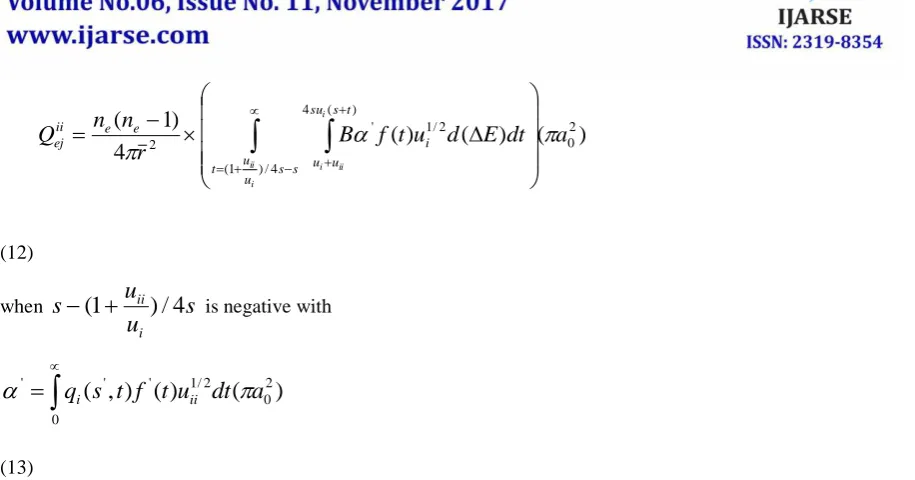
is negative with)
(
)
(
)
,
(
022 / 1 ' 0 ' '
a
dt
u
t
f
t
s
q
i ii
(13)
Here
q
i(
s
',
t
)
is the expression for electron impact ionization cross section of atoms (see Jha and Roy [21]) and'
s
is given byii i
u
u
E
s
'2
forH
.The integral appearing in
Q
scii andQ
ejii have been evaluated numerically. In the above equations thefunctions
f
(
t
)
andf
'(
t
)
are momentum distribution functions corresponding to the first and the second ejected electron respectively. These have been constructed from HF radial wave functions (see Catlow andMcDowell [26], Jha and Roy [20]). We have considered total cross section for heavy charged particle impact
direct double ionization of Cu as given by
Q
Q
(
4
s
,
3
d
)
Q
(
4
s
,
3
p
)
iiD ii
D ii
D
(14)where
Q
Dii(
4
s
,
3
d
)
andQ
(
4
s
,
3
p
)
iiD stand for the direct double ionization cross sections corresponding to ejection of one electron from
4
s
shell and the other either from the3
d
shell or from3
p
shell respectively.III. RESULT AND DISCUSSION
3.1 H
+impact single ionization cross section
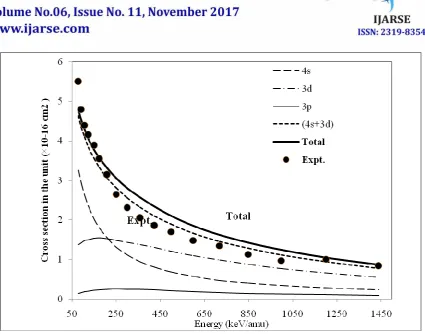
Our calculated cross section for single ionization along with experimental data of Patton et al.[28] due to H+
impact of Cu has been shown in Table 1 and Fig.1. In order to obtain single ionization cross section for Cu, we
have considered ionization from 4s, 3d and 3p shells only. Ionization from deeper inner shells (3s, 2p, 2s) have not been included in the present calculations as a single vacancy in the shells lead to Auger emission. In the
figure we have plotted the single ionization cross sections considering ionization from 4s shell including contribution due to only one electron from 3d shell and 3p shell respectively. The ionization from 4s and 3d shells has been shown separately in the Table1. First of all we would like to discuss our results by considering
ionization from 4s shell only. At low incident energies from 80 keV/amu to 175 keV/amu , the experimental
1700 | P a g e
increasing and at 1440 keV/amu the experimental result is about 3.3 times larger than the calculated value. Themagnitudes of calculated and experimental cross sections at this energy are 0.23×10⁻¹⁶ cm2 and 0.78×10⁻¹⁶ cm2
respectively.
If the contribution of 10 electrons of 3d shells is included in the calculation, the cross sections becomes 6 to 8 times larger than the experimental data at all incident energies below 500KeV/amu. In this connection it may be
mentioned that calculation of single ionization cross section in BE approach shows good agreement with
experimental data at high energy region, being always within a factor of 2. At this point it is worth mentioning
that the observation made by Lotz [28] who calculated electron impact ionization cross section of the atoms with
the help of empirical formula found reasonable agreement with experimental data in most of the cases. In
absence of the theoretical calculation, experimental data are generally compared with the results obtained by
Lotz formula. But in the case of electron impact single ionization of Cu, Lotz has pointed out that, he had to
reduce the cross section of 3d10 electrons drastically in order to get satisfactory agreement with the experiment.
Almost similar difficulties have been observed by Lotz in the case of silver [4d10, 5s1] which has electronic configuration of similar nature as that of Cu.
Keeping in view, the observation of Lotz, we have made an approximate assumption to include contribution of
one 3d electron in order to examine the results. It can be observed from the figure and table that the results so obtained are in excellent agreement with the experimental data throughout the energy range investigated.
From the fact given above it is apparent that one faces difficulties in calculation of 3d shell single ionization cross section of Cu. If contribution from all the 10 electrons is taken into account, similar difficulties have been
experienced by earlier worker in the case of other atoms and ions involving ionization from full occupied d shells. Jha and Roy [30] have observed similar difficulties in the calculations of electron impact ionization of In+
and Cu respectively. Bell el al. has obtained satisfactory agreement with experiment. The contribution to the ionization cross section from electrons in the 4d shell was added in at any one half of its calculated value in the configuration averaged distorted wave (CADW) approximation. Use of only half of the d sub shell contribution was proposed by Roger et al. [31] earlier and was found to fit the experimental data better in the case of other
experiments.
1701 | P a g e
Figure1: Proton impact single ionization cross sections of Cu in the unit of ×10-16 cm2.
[Here 4s, 3d and 3p stand for the ionization cross sections of the respective shells, Total stands for the total calculated single ionization cross sections and Expt stands for variations in experimental values.]
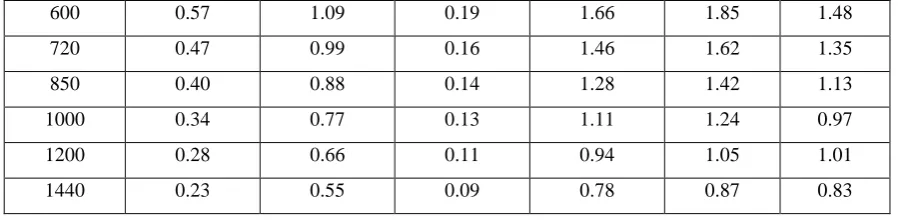
Table 1. Proton impact single ionization cross sections of Cu in the unit of ×10-16 cm2
E(keV/amu) Contribution
of 4s
Contribution
of 3d
Contribution
of 3p
Contribution
of (4s+3d)
Total Expt.[28]
80 3.26 1.38 0.14 4.64 4.78 5.50
93 2.92 1.43 0.16 4.35 4.51 4.80
108 2.62 1.48 0.18 4.10 4.28 4.40
125 2.34 1.50 0.2 3.84 4.04 4.15
150 2.03 1.53 0.22 3.56 3.78 3.88
175 1.79 1.54 0.23 3.33 3.56 3.54
210 1.54 1.52 0.25 3.06 3.31 3.14
250 1.32 1.49 0.26 2.81 3.07 2.65
300 1.12 1.44 0.25 2.56 2.81 2.30
360 0.94 1.38 0.24 2.32 2.56 2.05
425 0.80 1.30 0.23 2.10 2.33 1.85
1702 | P a g e
600 0.57 1.09 0.19 1.66 1.85 1.48
720 0.47 0.99 0.16 1.46 1.62 1.35
850 0.40 0.88 0.14 1.28 1.42 1.13
1000 0.34 0.77 0.13 1.11 1.24 0.97
1200 0.28 0.66 0.11 0.94 1.05 1.01
1440 0.23 0.55 0.09 0.78 0.87 0.83
Now we would like to discuss the general feature of the calculated results along with the experimental data.
From the energy range of 80KeV/amu to 175 KeV/amu the ratio varies from 0.84 to 0.94. Beyond this energy
range from 175 keV /amu to 1000 keV/amu the ratios are varying from 0.97 to 1.14 respectively. At the highest
energy of 1440 keV/amu the magnitude of calculated and experimental value of cross sections are 0.78 ×10⁻¹⁶
cm2 and 0.82 ×10⁻¹⁶ cm2 respectively and their ratio is 0.93.From the close observation of the calculated results it
shows that at the lowest energy 80 keV/amu the magnitude is 4.64×10⁻¹⁶ cm2 and at the highest energy 1440
keV/amu the magnitude is 0.78×10⁻¹⁶cm2. It means the variation of data is about six time in the case of
calculated cross section while in the case of experimental data almost similar features has been exhibited, which
is also 6.6 times. The theoretical results are in excellent agreement throughout the given energy range.
The discussion given above clearly explains why the inclusion of one 3d electron brings our calculated results in excellent agreement with the experiment. More elaborate theoretical investigation is required for quantitatively
understanding of the process of single ionization from the 3d shell of Cu. It is expected that this work will stimulates other theoretical workers. To take up further study of the problem more theoretical calculations are
required to understand the dynamics of the system properly.
3.2 H
+impact double ionization cross section
In the present work, an attempt has been made to obtain double ionization cross section by proton impact of Cu.
In this case direct double ionization cross sections have been calculated to take contributions from the ejection
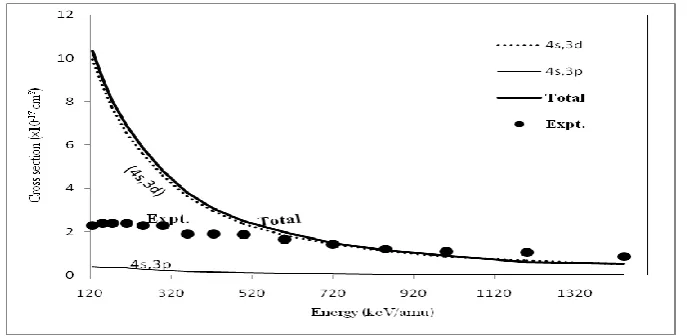
of (4s,3d) and (4s,3p) shells only. These calculations have been performed from 125- 1440 keV/amu impact energies using BEA. The calculated results along with experimental data have been presented in the Table 2 and
Fig. 2. In the energy range 125 – 300 keV/amu the calculated results differ by a factor of more than 2 from the
experimental data. Further it is observed that in the region 360 – 1440 keV/amu the theoretical and experimental
results differ by a factor 2. In this connection it may be mentioned that calculation of double ionizations in the
BEA using Hatree - Fock velocity distribution for target electrons show good agreement with experimental data
in high energy region being always within the factor of 2. It can be seen from the Table 2 that at impact energies
720 keV/amu and 850 keV/amu the calculated results agree well with the experimental data. At these impact
energies, the magnitude of the calculated cross sections are 1.49×10⁻¹⁷cm2 and 1.15×10⁻¹⁷ cm2 while the
experimental data for these impact energies have cross sections of magnitudes 1.43×10⁻¹⁷ cm2 and 1.21×10⁻¹⁷cm2
respectively. At the corresponding energies the ratio of these two cross sections are 1.04 and 0.95. From the
energy range 125 – 720 keV/amu the calculated results overestimates the experimental data. Beyond this energy
1703 | P a g e
magnitude of the lowest and the highest value of calculated cross sections are 10.3×10⁻¹⁷ cm2 and 0.52×10⁻¹⁷cm2respectively. It is further seen that the ratio of the lowest and highest values is about more than 19 times. This
shows that the theoretical value decreases very rapidly with the increase of the impact energies. But in the case
of experimental data the magnitudes of the lowest and highest cross sections are 2.3×10⁻¹⁷cm2 and 0.86×10⁻¹⁷cm2
and it differs more than 2 times. The experimental data decreases very slowly with the increase of impact
energy. At the impact energy 125 keV/amu, 150 keV/amu, 175 keV/amu and 250 keV/amu the calculated cross
sections are more than 5 times, 4 times, 3 times and 2 times greater than the experimental cross sections. The
increase of the impact energy both the results are coming closer to each other and at impact energy 720 keV it is
almost similar. In close inspection of the calculated results it seems that at higher energies range the possibility
of some other physical process may require. In view of the discussion given above, it is clearly seen that the
ionization of (4s,3d) shells dominates the cross section throughout the energy region we considered.
Figure2: Proton impact double ionization cross sections of Cu in the unit of ×10-17 cm2.
[Here (4s, 3d) and (4s,3p) stand for double ionization coss sections corresponding to ionization of 4s shell followed by ionization of 3d and 3p respectively, Total stands for total theoretical double ionization cross sections and Expt. represents variations in total experimental values.]
Table 2. Proton impact double ionization cross sections of Cu in unit of ×10-17cm2
E (keV/amu)
Contributions of
(4s,3d)
Contributions of
(4s,3p) Total Expt. [28]
125 9.94 0.39 10.33 2.30
150 8.74 0.37 9.11 2.40
175 7.71 0.34 8.05 2.40
210 6.54 0.34 6.88 2.40
250 5.58 0.26 5.84 2.30
300 4.58 0.22 4.80 2.30
1704 | P a g e
425 2.94 0.14 3.08 1.90
500 2.37 0.11 2.48 1.88
600 1.84 0.09 1.93 1.65
720 1.42 0.07 1.49 1.43
850 1.10 0.05 1.15 1.21
1000 0.85 0.04 0.89 1.09
1200 0.67 0.03 0.60 1.06
1440 0.50 0.02 0.52 0.86
IV. CONCLUSION
In the case of H+ impact single ionization of Cu the theoretical values throughout the given energy range is in
excellent agreement with the experimental values. Inclusion of 3d shell brings our results close to the
experimental results in the case of single ionization. In the case of H+ impact double ionization in BEA using HF
velocity distribution shows good agreement with experimental data in intermediate and high energy range from
360 to 1440 keV/amu.
REFERENCE
[1]J.H.McGuire,Double ionization of helium by protons and electrons at high velocities. Physical Review Letters, 49(16), 1982, 1153.
[2]J. H. McGuire, Atomic multi electron processes. Edited by Viatcheclav Shevelko and Hirotawara, Springer
Verlag, Berlin 1998
[3]M.Sant`Anna,.E.C.Montenegro,and J.H.McGuire, Inversion relations for exclusive and inclusive cross
sections within the independent electron approximation. Physical Review.A 58, 1998, 2148
[4]T.Kirchner, H.J. Lüdde, & R.M. Dreizler, Effective single-particle description of single and multiple processes in p±+ Ne collisions. Physical Review A, 61 (1), 1999, 012705.
[5]J.H.McGuire,,N.Stolterfoht, ,& P.R.Simony, Screening and antiscreening by projectile electrons in high-velocity atomic collisions. Physical Review A, 24(1), 1981, 97.
[6]A. Russek, & M.T. Thomas. Ionization produced by atomic collisions at keV energies. Physical Review A, 109(6), 1958, 2015.
[7]C.L.Cocke, Production of highly charged low velocity ion bombardment of rare-gas targets. Physical Review, A 20, 1979, 749
[8]N.M. Kabachnik, V.N. Kondratyav, Z. Roller-Lutz, and H.O. Lutz, Multiple ionization of atoms and
molecules in collision with fast ions: ion atom collision. Physical.Review, A 56 , 1997, 2848
[9]M. Inokuti, Inelastic collisions of fast charged particles with atoms and molecules—the Bethe theory revisited. Review of Modern Physics, 43(3), 1971, 297.
[10]J. Berakdar, Positron and electron impact double ionization of He at low and intermediate energies.
1705 | P a g e
[11]T. Spranger, & T.Kirchner, Auger-like processes in multiple ionization of noble gas atoms by protons. Journal of Physics B: Atomic, Molecular and Optical Physics, 37(20), 2004, 4159.[12]C.D.Archubi,C:C: Montanari & J.E.Miraglia, Many-electron model for multiple ionization in atomic collisions. Journal of Physics B: Atomic, Molecular and Optical Physics, 40(5), 2007, 943
[13]P:C:E:McCartney,M.B. Shah,J. Geddes &H.B. Gilbody, Processes involving electron capture and multiple ionization in collisions of fast H+ and He 2+ ions with lead atoms. Physical Review A, 60(6), 1999, 4582.
[14]M.Gryziński. . Classical theory of atomic collisions. I. Theory of inelastic collisions. Physical Review, 138(2A), 1995, A336.
[15]V.Kara,K. Paludan, J. Moxom, P. Ashley & G. Laricchia. Single and double ionization of neon, krypton and xenon by positron impact. Journal of Physics B Atomic, Molecular and Optical Phys.1997 [16] B.N. Roy & D.K. Rai. Application of classical collision theory to electron impact double ionization of atoms. Journal of Physics B: Atomic and Molecular Physics, 6(5), 1973, 816.
[17]L.Vriens, Case studies in atomic collision physics, Binary encounter and classical collision theory.
( North Holland, Amstordum). Vol. 1 pp-358. Proc. Phys. Soc., Vol. 89 1969, pp 113 – 120
[18]S.N.Chatterjee and B.N.Roy. Electron impact double ionization of Ca and Sr.Journal of Physics B: Atomic, Molecular and Optical Physics, 17 1984, 2527
[19]S.N.Chatterjee and B.N.Roy. Electron impact double ionization of Ar+ , Ar2+ and Xe+ Journal of Physics B: Atomic, Molecular and Optical Physics, 20 1987, 2291
[20]L.K. Jha & B.N. Electron impact single and double ionization of magnesium. The European Physical Journal D-Atomic, Molecular, Optical and Plasma Physics, 20(1), ,2002, 5-10.
[21]L.K. Jha and B.N. Roy. Double ionization of single and doublely charged Titenium ion by electron
impact. Phys.Scr.71, 2005, 185
[22]Minakshi, L.K.Jha,S.N. Chatterjee &B.N.Roy. H+ and He2+ impact single and double ionization of lead. The European Physical Journal D, 51(3), 2009, 331-339.
[23]A.Kumar, & B.N.Roy. Application of the binary-encounter theory to proton impact double ionisation of atoms. Journal of Physics B: Atomic and Molecular Physics, 10(15), 1977, 3047.
[24]A.Kumar &B.N. Roy. Proton impact double ionisation of noble-gas atoms. Journal of Physics B: Atomic and Molecular Physics, 14 (3), 1981, 501.
[25]L.Vriens . Binary-encounter proton-atom collision theory. Proceedings of the Physical Society, 90(4), 1967, 935.
[26]G.W.Catlow, & M.R.C. McDowell. CLASSICAL MODEL FOR ELECTRON AND PROTON IMPACT IONIZATION. University of Durham, 1967
1706 | P a g e
[28]C.J.Patton, M.B. Shah, M.A. Bolorizadeh,J. Geddes, & H.B.Gilbody . Ionization in collisions of fast H+ and He2+ ions with Fe and Cu atoms. Journal of Physics B: Atomic, Molecular and Optical Physics, 28(17), 1995, 3889.[29]W.Lotz . Electron-impact ionization cross-sections for atoms up to Z= 108. Zeitschrift fü Physik A Hadrons and nuclei, 232(2), 1970, 101-107.
[30] L.K.Jha,O.P.Roy and B. N. Roy, Electron impact single ionization of Cu, Pramana J.Phys.55, 2000, 447
[31]W.T.Rogars, G. Stefani, R. Camilloni, H.Gordon, Dunn, Z. Alfred, Msezane and J.W. Electron impact