78 | P a g e
Inverted Linear Quadtree: Efficient Top K Spatial
Keyword Search
S.Sai Teja
1,Mr. R.Dasharatham
2 1PursuingM.Tech (CSE),
2Working as an associate Professor,Department of CSE,
Sree Visvesvaraya Institute of Technology &Science
Chowdarpalle(vill),
Devarkadra (Mdl), Mahabubnagar (Dist), Telangana
509204
, Affiliated to JNTUH, (India)
ABSTRACT
With progresses in geo-situating innovations and geo-area administrations, there are a quickly developing
measure of spatio-literary articles gathered in numerous applications, for example, area based administrations
and informal organizations, in which a protest is portrayed by its spatial area and an arrangement of
catchphrases (terms). Subsequently, the investigation of spatial watchword look which investigates both area
and literary portrayal of the articles has pulled in incredible consideration from the business associations and
research groups. In the paper, we think about the issue of best k spatial watchword seek (TOPK-SK), which is
central in the spatial catchphrase questions. Given an arrangement of spatio-printed objects, a question area
and an arrangement of inquiry watchwords, the best k spatial catchphrase look recovers the nearest k protests
each of which contains all catchphrases in the question. In light of the modified file and the straight quadtree,
we propose a novel record structure, called reversed direct quadtree (IL-Quadtree), which is precisely intended
to misuse both spatial and catchphrase based pruning methods to adequately diminish the inquiry space. An
effective calculation is then created to handle top k spatial catchphrase look. What's more, we demonstrate that
the IL-Quadtree system can likewise be connected to enhance the execution of other spatial watchword
inquiries, for example, the course mindful best k spatial catchphrase look and the spatio-printed positioning
inquiry. Far reaching probes genuine and manufactured information unmistakably show the proficiency of our
strategies.
I. INTRODUCTION
With the expanding inescapability of the geo-situating tech-nologies and geo-area administrations, there are a
tremendous measure of spatio-literary items accessible in numerous applica-tions. For example, in the
neighborhood look benefit, online professional reference (e.g., business index) gives the area data and
additionally short depictions of the organizations (e.g., inns, eateries). In the GPS route framework, a POI
(purpose of intrigue) is a topographically tied down pushpin that somebody may discover valuable or
fascinating, which is typically commented on with surface data (e.g., portrayals and clients' audits). In addition,
in numerous informal community administrations (e.g., Facebook, Flickr), a colossal number of geo-labeled
photos are accu-mulated regular, which can be geo-labeled by clients, GPS-empowered cell phones or cameras
79 | P a g e
normally connected with numerous content marks. Accordingly, as of late different spatial catchphrase questionmodels and methods have risen with the end goal that clients can adequately misuse both spatial and printed
data of these spatio-literary articles. In the paper, we explore the issue of directing best k spatial catchphrase
seek (TOPK-SK) that is, given an arrangement of spatio-printed objects, an inquiry area question and answer set
of watchwords, we intend to recover the k nearest protests each of which contains all catchphrases in the
question. The best k spatial catchphrase seek is basic in spatial watchword questions and has a wide range of
utilizations. The following are two rousing cases.
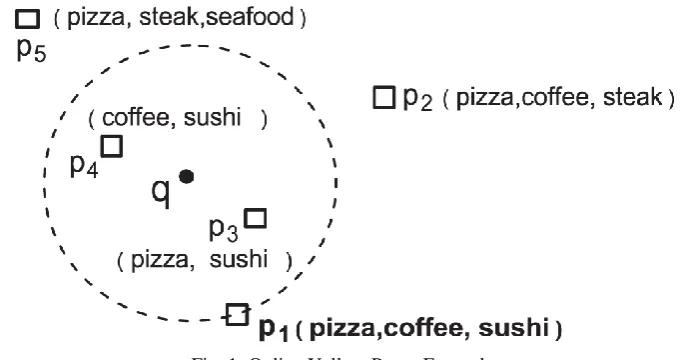
Fig. 1: Online Yellow Pages Example
In Fig. 1, assume there are an arrangement of organizations whose areas (spoke to by squares) and
administration records (an arrangement of watchwords) are enlisted in the online business repository of a nearby
pursuit specialist organization. At the point when a GPS-empowered cell phone client needs to locate an
adjacent eatery to have a bit of pizza and some espresso, she may send the neighborhood look server two
watchwords, espresso and pizza. In view of the client's present area (e.g., the point q in Fig. 1) got from the cell
phone and the two question watchwords, business p1 is returned by the server. Note that in spite of the fact that
organizations p3 and p4 are nearer to q than p1, they don't fulfill the catchphrase limitation.In numerous genuine
applications, the question workload may fluctuate occasionally, and the framework may experience a burst of
inquiries (e.g., questions conjured by a specific occasion). In this situation, the framework all through is poor if
countless are prepared one by one. Propelled by this, an expansive collection of existing work we have been
given to examine how to enhance the framework all through with the IEEE Transactions on Knowledge and
Data Engineering, July 2016 2 cluster inquiry preparing strategies to such an extent that countless in the line can
be handled with a sensible deferral. In the interim, these days, an extensive volume of spatial watchword
questions might be created in a brief timeframe period. For example, an extensive number of inquiries might be
forced to look for close-by eateries amid the supper and noon. A vital nearby occasion may bring about a
substantial number of important inquiries. As appeared in countless spatial watchword ventures might be issued
keeping in mind the end goal to secure the clients protection. This may prompt sensational debase of the
80 | P a g e
bunch spatial catchphrase question (BTOPK-SK) which expects to proficiently bolster an extensive number ofspatial watchword inquiries in the meantime.
II. RELATED WORK
In this subsection, we initially introduce the current systems for the issue of TOPK-SK question and also some
different variations of best k spatial catchphrase look. At that point other spatial catchphrase related questions
are presented. Considering the ordering plan utilized as a part of existing works, we group the files into two
classes, to be specific Keyword First Index and Spatial First Index. Watchword First Index Keyword First Index
right off the bat utilizes catchphrase file to extricate the related rearranged files, at that point abuses spatial list
for spatial separating. To productively facil-itate the spatial catchphrase seek, it is genuinely normal to utilize
the spatial list strategies to compose the articles for every watchword, rather than keeping them in a rundown. At
that point, for a given TOPK-SK inquiry, we can all the while apply the incremental closest neighbor seek on
the related spatial records until the point that k objects fulfilling the catchphrase limitation are recovered. Such
records incorporate transformed R-tree SFC-QUAD and S2I.
The altered R-tree is proposed in to sort out items for every watchword. For each unmistakable watchword t ∈ V, a different R-tree is worked for the articles in which t shows up. SFC-QUAD, which consolidates the space
filling bend and rearranged document, is proposed by Christoforaki et al. in. In light of the recurrence of relating
catchphrases, Rocha-Junior et al. proposed a record called S2I that consolidates R-tree/piece and altered
document. Spatial First Index Intuitively, the Keyword First Index is productive when there is just a single
inquiry watchword since we just need to issue a k closest neighbor look on the corre-sponding spatial list. In any
case, the execution of the Keyword First Index essentially corrupts against the quantity of catchphrases l in the
inquiry. This is on the grounds that the pursuit area of the TOPK-SK question will extend against the quantity of
catchphrases. To reduce the difficulty of Keyword First Index, Spatial First Index is proposed. Spatial First
Index right off the bat uses spatial list for spatial pruning, at that point utilize watchword list to get the
comparing reversed file. Such files contain IR2-tree KR∗-tree IR-tree and its variations WIBR-tree and SKI. Felipe et al. propose a list structure called IR2-tree, which incorporates signature record into every hub of the
R-tree. In Hariharan et al. propose the KR∗-tree structure to process the locale based spatial catchphrase look. Cong et al.and Li et al. freely proposed an IR-tree file, which basically files the information utilizing a R-tree,
however makes a transformed document for every hub of the tree. To recognize them, we allude IR-tree from Li
et al. as the IRLi-tree. The distinction between the IR-tree and the IRLi-tree is that the IR-tree stores the
reversed records for every hub independently while the IRLi-tree stores one coordinated upset document for
every one of the hubs. Some advanced variations of the IR-tree,such as DIR-tree and CDIR-tree, are presented
in. Cary etal.proposed SKI, which joins R-tree and reversed documents. The parent hub of a leaf node,which is
known as a super hub, is related with a bitmap modified record. WIBR-tree, which is additionally a variation of
IR-tree, is proposed in to effectively bolster a bunch of TOPK-SK inquiries. The structure of WIBR-tree is the
same as that of IR-tree where all items are sorted out by one increased R-tree. The principle distinction is that
the development of WIBR-tree exploits the term frequencies of the watchwords to encourage the joint
81 | P a g e
incessant terms t1, . . . ,th. In the I-th cycle, questions in a gathering g will be partitioned into two gatherings g1and g2 where protests in g1 contain ti and questions in g2 don't. At that point WIBR-tree is built in view of these
gatherings. Notwithstanding, WIBR-tree has two evident downsides for question preparing. Initially, contrasted
and other IR-tree assortments, the normal MBR territory of WIBR-tree is inconceivable huge. Also, just the
most high recurrence catchphrases have been considered in tree development. Variations of the best k spatial
catchphrase seek. Other than the best k spatial watchword seek, there are numerous imperative variations in the
writing with various core interest. Rather than applying the catchphrase limitation, the spatial watchword
rank-ing inquiry is proposed to rank articles in view of a scorrank-ing capacity which considers the separation to the
question area and also the printed pertinence to the inquiry watchwords. In Li et al. think about the issue of best
k spatial catchphrase seek in which the course imperative is considered. Different variations incorporate area
mindful sort ahead pursuit top k spatial watchword look on street arrange.
III. PROBLEM ANALYSIS
In the paper, a spatio-printed question o is depicted by a spatial point in a two dimensional space and an
arrangement of catchphrases (terms) from the vocabulary V, meant by o.loc and o.T individually. A best k
spatial catchphrase question, indicated by q, comprises of a characteristic number k, an inquiry area n and an
arrangement of inquiry catchphrases. The issue of best k spatial catchphrase look (TOPK-SK) is formally
characterized as takes after. TOPK-SK. Given a set O of spatio-literary items, an inquiry question q where q.loc
is the inquiry area and q.T is an arrangement of inquiry watchwords, we mean to locate the nearest k protests
each of which contains the greater part of the question catchphrases. We accept ties are softened self-assertively
up the paper.
In the paper from this point forward, at whatever point there is no vagueness, "spatio-printed protest" is
contracted to "question" and o (q) is utilized to speak to its area o.loc (q.loc). In this paper, a clump top k spatial
catchphrase question, signified by Q, comprises of an arrangement of best k spatial watchword inquiries. We
IEEE Transactions on Knowledge and Data Engineering, July 2016 3 utilize Q.mbr to mean the base jumping
rectangle of the areas of the inquiries in Q; Q.T speaks to the union of the watchword sets of the questions in Q;
and Q.μ is the littlest catchphrase set size of the questions in Q. BTOPK-SK. Given a set O of spatio-literary
articles, and a cluster spatial catchphrase inquiry (BTOPK-SK) Q, we mean to locate the best k comes about for
every individual best k spatial watchword question in Q.
IV. IL-QUADTREE
In this area, we present another ordering component called rearranged straight quadtree (IL-Quadtree) for the
best k spatial catchphrase seek. In Section 3.1 we depict the deficiencies of the current ordering approaches. To
address these inadequacies, Section 3.2 proposes the reversed straight quadtree based file structure.
4.1 Motivation
To manage the TOPK-SK issue, two extraordinary difficulties confronted by flow works: I) how to successfully
diminish the quantity of articles with the hunt area. ii) how to viably diminish the normal surviving likelihood of
82 | P a g e
to build up another file structure has following properties. Right off the bat, the record structure should fall inthe classification of reversed file i.e., related items are composed by a spatial file for every watchword, with the
goal that the articles which don't contain any inquiry catchphrase can be quickly disposed of. Furthermore, the
new file structure ought to be versatile to the dispersion of the items for every catchphrase. Thirdly, we have to
misuse the AND semantic, i.e., pruning a gathering of articles which don't fulfill the catchphrase limitation.
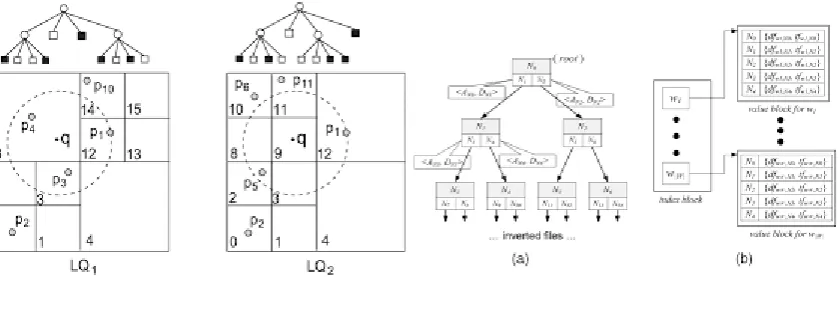
Fig. 2(a): Linear Quadtree Example Fig. 2(b): Linear Quadtree
In the paper, we embrace the straight quadtree structure on the grounds that the quadtree is more adaptable as in
the list is versatile to the dispersion of the items and we may prune the articles at abnormal amounts of the
quadtree. Unmistakably, the new structure proposed fulfills the previously mentioned three critical criteria of the
spatial catchphrase ordering technique.
4.2 IL-Quadtree Structure
A quadtree is a space parceling tree information structure in which a d-dimensional space is recursively
subdivided into 2d districts. Because of its effortlessness and consistency, the quadtree procedure has been
broadly connected in numerous applications. As an effective execution of the circle based quadtree, the straight
quadtree is proposed to keep the non-purge leaf hub of the quadtree in a helper plate based one dimensional
structure (e.g., B+ tree), where every hub can be encoded by the space filling bend strategies (e.g., Morton code
[19], Hilbert code and dim code.
In the paper, we encode the quadtree hubs in light of the Morton code (a.k.a. Z-arrange) in light of the fact that
the Morton code of a hub is encoded in view of its split succession, i.e., the way of the hub in the quadtree, and
the code of a specific hub (locale) in the space is novel. This is basic in light of the fact that numerous quadtrees
with various shapes are utilized as a part of the paper. Presently we portray how to determine the Morton code
of a hub in light of its split succession in 2-dimensional space. As appeared in Fig. 2(a), accepting that quadtrees
coming about because of a split are numbered in the request SW, SE, NW and NE, which are spoken to by 00,
01, 10 and 11 individually 1. At that point the code can be determined by connecting the part codes in every
subdivision. For instance, Fig. 2(b) and Fig. 2(c) demonstrate the space segment and the comparing tree
structure of a basic quadtree for a given arrangement of focuses {p1, . . . , p4} where leaf hubs are named by
their Morton codes. As appeared in Fig. 2(c), in the paper, we utilize a circle and a square to mean the non-leaf
83 | P a g e
contains no less than one point. Else, it is a white leaf hub. Assume the maximal profundity of the quadtree is 2,the split grouping of the hub 1 is "SW, SE" and subsequently its code is spoken to by 0001. For the hub at more
elevated amount, we utilize 0 to cushion the staying paired digits. For example, the split grouping of the hub 12 .
Note that SW is the contraction of South-West. Comparative definition goes to SE, NW and NE. Note that in the
paper the quadtree structure is kept as the space parcel based mark of the articles, and thus the level of a hub in
the quadtree is accessible amid the quer handling. Therefore, we can concoct the right hub (locale) in view of
the code and the level data. For the straight quadtree, we just keep the dark leaf hubs on the circle by one
dimensional list structure (e.g., B+ tree), which are requested by their Morton codes. Fig. 2(d) demonstrates a
requesting aftereffects of these dark leaf hubs and the articles occupant on them, where the hub codes are spoken
to as whole number numbers.
Fig4 Data Space Tree view
V. THE PROPOSED SCHEMES
In the paper, we consider two essential issues in the spatial catchphrase ask for: top k spatial watchword search
for (TOPK-SK), and bundle top k spatial watchword look (BTOPK-SK). Given an arrangement of
spatio-printed objects, a request zone and a strategy of demand catchphrases, the TOPK-SK recovers the nearest k
contradicts each of which contains all watchwords in the demand. BTOPK-SK is the social affair treatment of
sets of TOPK-SK ask. In context of the adjusted record and the immediate quad tree, we propose a novel archive
structure, called revamped straight quad tree (IL-Quad tree), which is effectively anticipated that would mistreat
both, spatial and watchword based pruning frameworks to adequately decrease the demand space.
An able figuring is then made to manage top k spatial watchword search for. To moreover update the sifting
limit of the normal for coordinate quad tree, we propose a task based technique. Also, to administer
BTOPK-SK, we plan another taking care of point of view which distribute investigation into social events in context of
both spatial locale and the printed importance between ask. We display that the IL-Quad tree procedure can in
like way helpfully fortify BTOPK-SK. Sweeping tests certifiable and manufactured information plainly show
the effectiveness of our frameworks
In the paper, we propose a novel file structure, in particular IL-Quadtree, to sort out the spatio-printed objects. A
proficient calculation is created to help the best k spatial catchphrase look by exploiting the IL-Quadtree. We
additionally propose a segment based technique to upgrade the adequacy of the mark of direct quadtree. To
encourage a lot of spatial watchword inquiries, we propose a BTOPK-SK calculation and also a question
assemble calculation to upgrade the execution of the framework. Our extensive trials convincingly show the
84 | P a g e
VI. ADVANTAGES
To enhance the performance of the system Less time to take process
More security
VII. CONCLUSION
The issue of best k spatial watchword ask for is essential because of the expanding measure of spatio-masterful
articles amassed in a broad assortment of vocations. In the paper, we propose a novel once-over structure,
especially IL-Quad tree, to frame the spatio-printed objects. An effective estimation is made to help the best k
spatial catchphrase search for by abusing the IL-Quad tree. We help propose a bundle based strategy to refresh
the reasonableness of the normal for straight quad tree. To help a significant measure of spatial watchword ask
for, we propose a BTOPK-SK figuring and besides a demand group checks to upgrade the execution of the
structure. Our broad tests convincingly demonstrate the benefit of our procedures.
VIII. FUTURE ENHANCEMENT
At some phase in the distinction in neural web classifiers the "preprocessing" organize; we may utilize a pushed
calculation. The figuring depends upon recursively isolating the space into quad tree pieces and separating for
this quad tree avoids in the B-tree. The estimation is significantly less requesting than starting at now proposed
calculations, and it works for ask for windows of discretionary shape and databases with covering spatial
articles. It utilizes change and go predicates to get to the B-tree, which gloriously sorts out the interfaces B-trees
usually give, and it investigates the B-tree left-to-right enabling us to constrain the measure of I/O's by utilizing
the fitting last-as a bit of first-out help association structure.
REFERENCE:
[1] D. Bogdanov, L. Kamm, S. Laur, P. Pruulmann-Vengerfeldt, R. Talviste, and J. Willemson, "Security
safeguarding factual information examination on unified databases," in APF'14, ser. LNCS, vol. 8450.
Springer, 2014, pp. 30– 55. Operation Time (RMIND) lm (straightforward) 3.80 s lm (2 factors, converse)
1.01 s lm (3 factors, reverse) 1.76 s lm (4 factors, Gaussian) 2.94 s lm (4 factors, LU decomp.) 2.96 s lm (4
factors, conj. graduate.) 3.58 s lm (7 factors, Gaussian) 6.84 s lm (7 factors, LU decomp.) 6.73 s lm (7
factors, conj. graduate.) 6.29 s lm (10 factors, Gaussian) 12.81 s lm (10 factors, LU decomp.) 12.82 s lm (10
factors, conj. graduate.) 10.74 s TABLE 4 Linear relapse runtime on 10000-component clusters (in
seconds).
[2] L. Kamm, D. Bogdanov, S. Laur, and J. Vilo, "another approach to ensure security in expansive scale far
reaching affiliation thinks about," Bioinformatics, vol. 29, no. 7, pp. 886– 893, 2013.
[3] K. Chida, G. Morohashi, H. Fuji, F. Magata, A. Fujimura, K. Hamada, D. Ikarashi, and R. Yamamoto,
"Execution and assessment of a productive secure calculation framework utilizing "R" for social insurance
85 | P a g e
[4] K. El Emam, S. Samet, J. Hu, L. Peyton, C. Earle, G. C. Jayaraman, T. Wong, M. Kantarcioglu, F. Dankar,and A. Essex, "A Protocol for the Secure Linking of Registries for HPV Surveillance," PLoS ONE, vol. 7,
no. 7, p. e39915, 07 2012.
[5] D. Wu, G. Cong, and C. S. Jensen, "A system for proficient spatial web question recovery," VLDB J., 2012.
[6] A. Cary, O. Wolfson, and N. Rishe, "Proficient and versatile technique for handling top-k spatial boolean
questions," in SSDBM, 2010, pp. 87– 95.
[7] Z. Li, K. C. K. Lee, B. Zheng, W.- C. Lee, D. L. Lee, and X. Wang, "Ir-tree: An effective record for
geographic archive seek," IEEE Trans. Knowl. Information Eng., vol. 23, no. 4, pp. 585– 599, 2011.
[8] D. Zhang, K.- L. Tan, and A. K. H. Tung, "Adaptable best k spatial watchword seek," in EDBT, 2013, pp.
359– 370.
[9] G. Li, J. Feng, and J. Xu, "Work areas: Direction-mindful spatial catchphrase look," in ICDE, 2012.
[10] S. B. Roy and K. Chakrabarti, "Area mindful sort ahead inquiry on spatial databases: semantics and
productivity," in SIGMOD Conference, 2011.
[11] J. B. Rocha-Junior and K. Nørv°ag, "Top-k spatial catchphrase questions on street systems," in EDBT,
2012.
[12] C. Zhang, Y. Zhang, W. Zhang, X. Lin, M. A. Cheema, and X. Wang, "Broadened spatial catchphrase look
on street systems," pp. 367– 378, 2014.
[13] I. Gargantini, "A compelling approach to speak to quadtrees," Commun. ACM, vol. 25, no. 12, pp. 905–
910, 1982.
[14] G. M. Morton, "A PC situated geodetic information base and another strategy in document sequencing,"
Technical Report, Ottawa, Canada: IBM Ltd, 1966.
Author Details:
1.
S.SaiTeja pursuingM.Tech(CSE)(15571D5813) from SREEVISVESVARAYA INSTITUTE OF TECHNOLOGY &
SCIENCE,Chowderpally (Vill),Devarkadra(Mand),Mahabubnagar (Dist) TS
– 509204..
1.
Mr. R.Dasharathamworking as aassociate Professor , Department ofCSE, SREE VISVESVARAYA INSTITUTE OF TECHNOLOGY
&SCIENCE,Chowderpally (Vill), Devarkadra (Mand),Mahabubnagar (Dist)