Cosmological Lithium Problems
C.A.Bertulani1,�,Shubhchintak1,��, andA.M.Mukhamedzhanov2,���
1Department of Physics and Astronomy, Texas A&M University-Commerce, Commerce, TX 75429, USA 2Department of Physics and Astronomy, Texas A&M University, College Station, TX 77843, USA
Abstract.We briefly describe the cosmological lithium problems followed by a summary of our recent theoretical work on the magnitude of the effects of electron screening, the possible existence of dark matter parallel universes and the use of non-extensive (Tsal-lis) statistics during big bang nucleosynthesis. Solutions within nuclear physics are also discussed and recent measurements of cross-sections based on indirect experimental tech-niques are summarized.
1 Introduction
The cosmological lithium problem has become one of the most intriguing open questions in cos-mology due to inconsistencies between observation and calculations based on the standard Big Bang nucleosynthesis (BBN) for the primordial elemental abundances. The BBN model contains a few parameters such as the baryon-to-photon ratioη=nb/nγ, the neutron decay timeτn, and the number of neutrino familiesNν(see, for instance, Ref. [1]). The parameterηrelates to the baryon density of the universe by means ofΩ0h2 �(η/10−10)/273, with the Hubble dimensionless parameterhdefined through the relationH0 =100hkm/s/Mpc, the index ‘0’ meaning present time. The anisotropies of the cosmic microwave radiation (CMB) independently determine the value ofη[2, 3] when the uni-verse was about 0.3 Myr after the Big Bang. Then photons decoupled and began steaming freely in the universe. Precise LEP experiments to deduce the number of neutrino families [4] lead to the value
Nν=2.9840±0.0082, and neutron lifetime measurements have inferred thatτn�880.2±1.0 s [5]. The observed abundances of light elements probe the universe at the very early stages, i.e., 3-20 minutes, of its existence. During this epoch, the light elements D,3He,4He, and7Li were produced and their abundances in selected astrophysical environments are telltales of the BBN epoch. The BBN model predictions also depend on the nuclear reaction network and magnitude of the nuclear cross sections. A few minutes (∼ 3 min) after the Big Bang, deuterons were formed by neutron capture on protons, by means of the reaction p(n,γ)d. The formation of deuterons is strongly dependent on the value ofη. Deuterons are promptly destroyed once they are formed leading to the formation of 3He nuclei by means of the d(p,γ)3He and d(d,n)3He reactions. Deuterons also synthesize tritium by means of the d(d,p)t reaction. 4He are then created by the3He(d,p)4He and t(d,n)4He reactions. In the end, the BBN model predicts that the universe should be composed of about 75% of hydrogen and
25% of helium with tiny traces of D,3He,7Li and6Li. The foundations of these results rely on the big bang prediction of the neutron-to-proton ratio n/p=1/7 when the nucleosynthesis started, i.e., the
BBN occurred in a proton-rich environment.
n↔p p(n,γ)d d(p,γ)3He d(d,p)t d(d,n)3He 3He(n,p)t t(d,n)4He 3He(d,p)4He 3He(α, γ)7Be t(α, γ)7Li 7Be(n,p)7Li 7Li(p,α)4He
The standard BBN model predicts the7Li/H abundance ratio of the order of 10−10and the6Li/H abundance ratio of the order of 10−14. Much after the BBN epoch, 6Li and 7Li can be produced in spallation processes by cosmic rays and7Li can be synthesized in novae or during AGB stars pulsations. In Ref. [6] it was reported that the7Li abundance is independent of the metallicity in metal-poor stars with small Fe/H abundances relative to the sun. Such stars are warm (5700≤ T ≤6250
K) metal-poor dwarf stars observed in the galaxy halo. For low metallicity stars the7Li abundance is nearly constant and this behavior is known as the “Spite plateau” [6]. 7Li is destroyed in red giants with core temperatures in excess of 106K via the reaction7Li(p, α)4He and that is why white dwarfs at moderate temperatures have been used in such observations. The Spite plateau provides a reasonable evidence that lithium is neither created nor destroyed in warm dwarfs and that such stars display the abundances of primordial7Li. On the other hand, it is worthwhile mention that recent observations in low-metallicity stars seem to contradict the conclusions drawn from the Spite plateau [7, 8]. The currently accepted value for the7Li BBN model abundance, calculated usingη=(6.07±0.07)×10−10 [3], corresponds to Li/H =(4.16−5.34)×10−10 [10] while the observations from metal-poor halo stars yields Li/H=(1.58+0.35−0.28)×10−10[8, 9]. This is approximately a factor of 3 lower than expected and is the source of the lithium puzzle.
The second lithium puzzle involves the abundance of6Li produced during the BBN by means of the2H(α, γ)6Li reaction.6Li nuclei formed in stars disappear quickly by means of other reactions.6Li is also created in cosmic ray interactions, and could also exist in the atmosphere of metal-poor warm dwarfs in the halo of the galaxy, surviving destruction by cosmic rays. But such assumptions are controversial, because they can also apply to7Li nuclei. The second lithium puzzle relates to the BBN predictions of the isotopic ratio6Li/7Li∼10−5[10, 12], while observations report6Li/7Li∼5×10−2 [14]. This puzzle is less robust because of the complexities involved in 3-dimension calculations involving convection and non-local thermodynamical equilibrium, in particular in the photo-sphere of metal-poor stars. Because they might have a large influence on the6Li/7Li isotopic ratio, such complexities weaken the arguments for the existence of the second lithium problem which in some scenarios yields a better agreement with BBN predictions [15].
2 Nuclear reaction cross sections
During the BBN, the most relevant nuclear reactions are listed in Table 1. This network of reactions resulted in the production of D,3H,3He, 4He, 6Li,7Li and7Be. Only very small traces of carbon, nitrogen and oxygen were produced at the 10−15 −10−25 abundance level. Therefore, there is no
25% of helium with tiny traces of D,3He,7Li and6Li. The foundations of these results rely on the big bang prediction of the neutron-to-proton ratio n/p=1/7 when the nucleosynthesis started, i.e., the
BBN occurred in a proton-rich environment.
n↔p p(n,γ)d d(p,γ)3He d(d,p)t d(d,n)3He 3He(n,p)t t(d,n)4He 3He(d,p)4He 3He(α, γ)7Be t(α, γ)7Li 7Be(n,p)7Li 7Li(p,α)4He
The standard BBN model predicts the7Li/H abundance ratio of the order of 10−10and the6Li/H abundance ratio of the order of 10−14. Much after the BBN epoch, 6Li and 7Li can be produced in spallation processes by cosmic rays and7Li can be synthesized in novae or during AGB stars pulsations. In Ref. [6] it was reported that the7Li abundance is independent of the metallicity in metal-poor stars with small Fe/H abundances relative to the sun. Such stars are warm (5700 ≤T ≤ 6250
K) metal-poor dwarf stars observed in the galaxy halo. For low metallicity stars the7Li abundance is nearly constant and this behavior is known as the “Spite plateau” [6]. 7Li is destroyed in red giants with core temperatures in excess of 106K via the reaction7Li(p, α)4He and that is why white dwarfs at moderate temperatures have been used in such observations. The Spite plateau provides a reasonable evidence that lithium is neither created nor destroyed in warm dwarfs and that such stars display the abundances of primordial7Li. On the other hand, it is worthwhile mention that recent observations in low-metallicity stars seem to contradict the conclusions drawn from the Spite plateau [7, 8]. The currently accepted value for the7Li BBN model abundance, calculated usingη=(6.07±0.07)×10−10 [3], corresponds to Li/H =(4.16−5.34)×10−10[10] while the observations from metal-poor halo stars yields Li/H=(1.58+0.35−0.28)×10−10[8, 9]. This is approximately a factor of 3 lower than expected and is the source of the lithium puzzle.
The second lithium puzzle involves the abundance of6Li produced during the BBN by means of the2H(α, γ)6Li reaction.6Li nuclei formed in stars disappear quickly by means of other reactions.6Li is also created in cosmic ray interactions, and could also exist in the atmosphere of metal-poor warm dwarfs in the halo of the galaxy, surviving destruction by cosmic rays. But such assumptions are controversial, because they can also apply to7Li nuclei. The second lithium puzzle relates to the BBN predictions of the isotopic ratio6Li/7Li∼10−5[10, 12], while observations report6Li/7Li∼5×10−2 [14]. This puzzle is less robust because of the complexities involved in 3-dimension calculations involving convection and non-local thermodynamical equilibrium, in particular in the photo-sphere of metal-poor stars. Because they might have a large influence on the6Li/7Li isotopic ratio, such complexities weaken the arguments for the existence of the second lithium problem which in some scenarios yields a better agreement with BBN predictions [15].
2 Nuclear reaction cross sections
During the BBN, the most relevant nuclear reactions are listed in Table 1. This network of reactions resulted in the production of D,3H,3He, 4He,6Li,7Li and7Be. Only very small traces of carbon, nitrogen and oxygen were produced at the 10−15 −10−25 abundance level. Therefore, there is no
5BCMF/VDMFBSSFBDUJPOTPGJNQPSUBODFGPSCJHCBOHOVDMFPTZOUIFTJT
Figure 1.Left: Calculated BBN abundances of H, D,3H,3He,4He,6Li,7Li and7Be as a function of time [1].
Right:7Be(n,α) cross section deduced using the THM experimental data for the7Li(p,α)4He mirror reaction (full
red circles) and using3He THM breakup data (full black circles) [29]. The data compiled by Hou [26] is shown
as empty blue circles, and data from Kawabata [28] are shown as full blue squares.
need to include reaction networks beyond those shown in Table 1, such as the famous CNO cycle, to tackle the lithium problem [9]. In Figure 1 we show the calculated BBN abundance of H, D, 3H,3He,4He,6Li,7Li and7Be as a function of time [1]. Our calculations were performed with an extended code based on the Wagoner code [16] and similar to NUC123 [17]. The dashed blue curve represents the4He mass fraction, the red dashed curve represents the deuterium abundance, the green dashed curve represents the3He abundance, the solid black curve is the3H abundance, the red dashed curve is the7Be abundance and blue dashed curve is the7Li abundance. Recently, new experimental measurements of reactions of relevance for the BBN have been reported based on the use of the Trojan Horse Method (THM) [10].
The reaction cross sections at the low astrophysical energies are enhanced due to the electrons in the plasma. The cross sections in the plasma are enhanced by a factor f(E) = σs(E)/σb(E), whereσs is the screened and σb the bare (non-screened) cross section. The Debye-Hückel the-ory predicts a screened Coulomb potential of the form V(r) = (e2Zi/r) exp (−r/RD), where the Debye radius is given by RD = (1/ζ)kT/4πe2n1/2, with n being the ion number density and
ζ=
i Xi(Z 2
i/Ai)+χ
i Xi(Zi/Ai)
1/2
, withXithe mass fraction of particleiand the temperatureT6in units of 106K.χis a factor correcting for electron degeneracy effects [19]. During the big bang, the electron number density decreased strongly with the temperature, being up to 104times larger than the number density in the core of the sun,nsun
e ∼1026/cm3. However, the baryon density was much smaller during the BBN epoch than at the core of the sun. The number of excess electrons during the BBN is nearly the same as those of protons. But most electrons were in balance with the number of positrons produced viaγγ → e+e− processes. In Ref. [20] the electron screening effects were included in the BBN reaction network. It was found that the modification of the BBN abundances are negligible. Evidently, it cannot be responsible for the lithium abundance deficiency. Worth men-tioning is that recently it has been shown that clustering effects in reactions involving light nuclei at
In Table 2 the BBN calculations are compared with observations. The mass fraction for4He, his-torically denoted byYp, is taken from Ref. [18], (b) the deuterium abundance D/H=(2.527±0.03)× 10−5[22, 23], compatible with 100Ωbh2 (BBN)=2.225±0.016 inferred from the measurements of the cosmic microwave background [3], (c) the3He abundance is taken from Ref. [24], and (d) the lithium abundance is taken from Ref. [8]. The BBN model result for the7Li abundance shown in Table 2 is in evident discordance (roughly by a factor 3) with the observation. One possibility for this discrepancy could be that7Be is further destroyed during the BBN. We recall that7Be decays in 53.22±0.06 days by electron capture to ground and first excited (0.477 MeV) states of7Li. There-fore, all7Be produced during the big bang will count towards the7Li primordial abundance. If7Be is substantially destroyed by, e.g., (n,p) or (n,α) reactions, it could possibly explain the observed lithium depletion. This possibility has been investigated in Refs. [25–29]. In particular, Lamia et al. [29] have experimentally determined the7Be(n,α) reaction cross section using the THM experimental data for the7Li(p,α)4He mirror reaction with corrections for Coulomb effects (see Figure 1). The new deduced data for7Be(n,α) using this technique lies within the Gamow window appropriate for BBN temperatures and the reaction rate using the new data is found to be lower by a factor≈10 relative to the one used by Wagoner [16]. The new reaction rate yields a7Li/H abundance ratio of 2.845×10⁻¹¹ and a7Be/H abundance ratio of 4.156×10⁻¹⁰, leading to a total cosmological lithium abundance of 4.441×10⁻¹⁰, and no appreciable change of the previously obtained BBN results is verified. More recently, a theoretical investigation of the impact of the7Be(α, γ) on7Be destruction was performed [30]. It was found that the7Be abundance would be compromised only if an unexpected strong res-onance exists very close to threshold in this reaction channel. All odds are that such a resonant state does not exist.
Table 2.BBN calculations using fits to recent experimental data for BBN reactions compared with observations. The mass fraction for4He, historically denoted byY
p, is taken from Ref. [18], (b) deuterium abundance D/H=(2.527±0.03)×10−5[22, 23], compatible with 100Ω
bh2(BBN)=2.225±0.016 inferred from the measurements of the cosmic microwave background [3], (c)3He abundance is taken from Ref. [24],
and (d) the lithium abundance is taken from Ref. [8].
Yields Calculation Observation
Yp 0.2485+0.001-0.002 0.2565±0.006(a) D/H (×10−5) 2.692+0.177-0.070 2.527±0.03(b) 3He/H (×10−6) 9.441+0.511-0.466 ≥11.±2.(c) 7Li/H (×10−10) 4.283+0.335-0.292 1.58+0.35 -0.28(d)
BBN predicts an isotopic ratio of6Li/7Li∼10−5, whereas observation yields6Li/7Li∼5×10−2 [14]. In Ref. [12] a re-analysis of the reaction4He(d, γ)6Li was performed, including new predictions for the gamma-ray angular distribution. This was done using a two-body potential model to calculate the S-factor for this reaction at the BBN energies [11, 12]. The potential parameters were chosen to reproduce experimental phase shifts and recently measured ANCs. A nice agreement was found with the experimental data of the LUNA collaboration [13]. This work reinforces BBN predictions for the lithium isotopic ratio and yields a new value of6Li/7Li=(1.5±0.3)×10−5. The second lithium puzzle seems to be alive although it is not impossible that lithium abundances might change appreciably due to astration.
In Table 2 the BBN calculations are compared with observations. The mass fraction for4He, his-torically denoted byYp, is taken from Ref. [18], (b) the deuterium abundance D/H=(2.527±0.03)× 10−5[22, 23], compatible with 100Ωbh2(BBN)=2.225±0.016 inferred from the measurements of the cosmic microwave background [3], (c) the3He abundance is taken from Ref. [24], and (d) the lithium abundance is taken from Ref. [8]. The BBN model result for the7Li abundance shown in Table 2 is in evident discordance (roughly by a factor 3) with the observation. One possibility for this discrepancy could be that7Be is further destroyed during the BBN. We recall that7Be decays in 53.22±0.06 days by electron capture to ground and first excited (0.477 MeV) states of7Li. There-fore, all7Be produced during the big bang will count towards the7Li primordial abundance. If7Be is substantially destroyed by, e.g., (n,p) or (n,α) reactions, it could possibly explain the observed lithium depletion. This possibility has been investigated in Refs. [25–29]. In particular, Lamia et al. [29] have experimentally determined the7Be(n,α) reaction cross section using the THM experimental data for the7Li(p,α)4He mirror reaction with corrections for Coulomb effects (see Figure 1). The new deduced data for7Be(n,α) using this technique lies within the Gamow window appropriate for BBN temperatures and the reaction rate using the new data is found to be lower by a factor≈10 relative to the one used by Wagoner [16]. The new reaction rate yields a7Li/H abundance ratio of 2.845×10⁻¹¹ and a7Be/H abundance ratio of 4.156×10⁻¹⁰, leading to a total cosmological lithium abundance of 4.441×10⁻¹⁰, and no appreciable change of the previously obtained BBN results is verified. More recently, a theoretical investigation of the impact of the7Be(α, γ) on7Be destruction was performed [30]. It was found that the7Be abundance would be compromised only if an unexpected strong res-onance exists very close to threshold in this reaction channel. All odds are that such a resonant state does not exist.
Table 2.BBN calculations using fits to recent experimental data for BBN reactions compared with observations. The mass fraction for4He, historically denoted byY
p, is taken from Ref. [18], (b) deuterium abundance D/H=(2.527±0.03)×10−5[22, 23], compatible with 100Ω
bh2(BBN)=2.225±0.016 inferred from the measurements of the cosmic microwave background [3], (c)3He abundance is taken from Ref. [24],
and (d) the lithium abundance is taken from Ref. [8].
Yields Calculation Observation
Yp 0.2485+0.001-0.002 0.2565±0.006(a) D/H (×10−5) 2.692+0.177-0.070 2.527±0.03(b) 3He/H (×10−6) 9.441+0.511-0.466 ≥11.±2.(c) 7Li/H (×10−10) 4.283+0.335-0.292 1.58+0.35 -0.28(d)
BBN predicts an isotopic ratio of6Li/7Li∼10−5, whereas observation yields6Li/7Li∼5×10−2 [14]. In Ref. [12] a re-analysis of the reaction4He(d, γ)6Li was performed, including new predictions for the gamma-ray angular distribution. This was done using a two-body potential model to calculate the S-factor for this reaction at the BBN energies [11, 12]. The potential parameters were chosen to reproduce experimental phase shifts and recently measured ANCs. A nice agreement was found with the experimental data of the LUNA collaboration [13]. This work reinforces BBN predictions for the lithium isotopic ratio and yields a new value of6Li/7Li=(1.5±0.3)×10−5. The second lithium puzzle seems to be alive although it is not impossible that lithium abundances might change appreciably due to astration.
We conclude this section by stating that it does not seem possible that both lithium puzzles can be solved by accurate measurements of nuclear reaction cross sections, combined with progresses in the theories for nuclear astrophysical reactions. There has been a considerable number of recent theoreti-cal efforts to elucidate the lithium puzzle using a plethora of different ideas based on the premise that
physics as we know today might have been different 13.8 billions years ago. New particles, new
in-teractions, changes in fundamental constants, non-standard BBN models, and various intriguing ideas have been used and published elsewhere.
3 Dark matter
Most of the matter in the universe consists of an obscure kind of Dark Matter (DM) which inter-acts very weakly with the visible matter. In fact, we only know that it interinter-acts gravitationally and large scale experimental searches are underway to identify if DM interacts with visible matter by other means [31–33]. The existence of DM is based on astronomical observations of galaxy clusters dynamics and on the anisotropies of the Cosmic Microwave Background (CMB). Perhaps Weakly In-teracting Massive Particles (WIMPs), supersymmetric particles, sterile neutrinos, or any other hitherto undiscovered particles are responsible for its composition. It has also been hypothesized that DM is a mirror sector of particles such as dark photons, dark electrons, etc., which interact in nearly the same way as Standard Model (SM) particles, but only within their own sector. They interact very weakly across sectors, i.e. between the DM sector and the visible sector [34–39, 41]. Besides, the particle copies in the dark sector do not need to have the same masses and couplings as in the visible sector, opening a huge number of possible scenarios for DM.
Astronomical observations yield the ratio of density parametersΩDM/Ωvisible =4.94±0.66. There-fore, DM is 5 times more frequent than visible matter. In Ref. [39–41] this feature was used to explore the possible existence of 5 dark sectors instead of the single ubiquitous dark sector. A Weakly Interact-ing Massive Gauge Boson (WIMG) was also proposed to couple all dark sectors and ordinary matter. The massive,E∼10 TeV, WIMG does not modify the properties of the SM and gravity. It has to be consistent with BBN predictions and CMB observations, except maybe with the lithium abundance. Much below the electroweak scale energy, we can assume particles to be massless and group them in matter/charge fields with a similar structure for DM. The WIMG mass is generated by a real scalar
field, with the condition that the WIMG has a short-range interaction. In this formalism, the number of dark sectors plays an important role which has been overseen in other BBN models. The new de-grees of freedom of particles in the dark sector modify the early universe expansion rate [42] and the elemental abundance predictions. Additional dark sectors increase the effective number of degrees of
freedom and their implications for BBN [39–41].
The basic idea of having additional dark sectors is that the radiation in the BBN epoch have densities and entropies given byρ(T)=(π2/30)g∗(T)T4ands(T)=(2π2/45)gs(T)T3with
g∗(T)=
B gB T B T 4 +7 8 F gF T F T 4
, and gs(T)=
B gB T B T 3 +7 8 F gF T F T 3 , (1)
whereg∗andgsare the number of degrees of freedom, withgB(F)being the fractions contributed by bosons (fermions) at temperaturesTB(F). In this notation,Tis the temperature of the radiation thermal bath.
For simplicity, we assume only two temperatures: T in the ordinary matter sector andT�in the dark sectors. By analogy, the energyρ�(T�) and entropy s�(T�) densities in the dark sectors are also obtained with Eqs. (1) withg∗(T)→g�∗(T�),gs(T)→g�
s(T�), andT → T�. An independent variable
x=(s�/s)1/3∼T�/T emerges if one assumes conservation of entropy in all sectors. If each dark sector has the same matter content as in the visible sector, thengs(T0)=g�s(T�
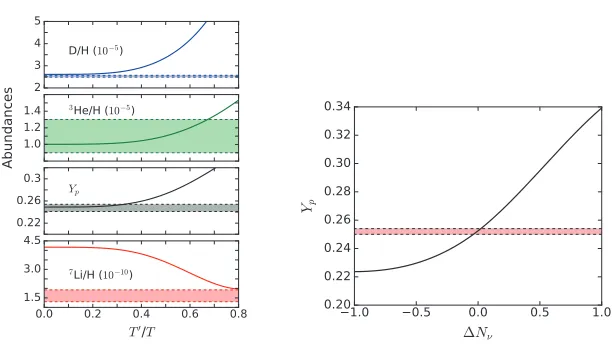
Figure 2.Left:Calculated relative abundances of D,3He,4He (mass fraction,Y
p) and7Li as a function ofT�/T, withNDM = 5 compared to observations. The bands represent uncertainties in the observations [44]. Right: Predictions for the primordial4He mass fraction as a function of extra neutrino families, withT�=0.3T
BBNand NDM=5. The horizontal band represents the observed mass fraction [44].
a not too smallT�/T [42]. At about 1 MeV, standard BBN assumesg
∗(T = 1 MeV) = 10.75, but with the additional dark particles it becomes ¯g∗ = g∗1+NDMx4
. We can study the bounds for
NDMandx, orT�/T, by comparing BBN calculations and the relative abundances of the light element isotopes (D,3He,4He, and7Li). This is shown in Figure 2 as a function ofT�/T with a fixed num-ber of dark sectors,NDM = 5. The shaded bands include the uncertainty in the observed values. In this case, we notice that observations of primordial elements of D,3He, and4He are compatible with
T�/T ∼0.2−0.3.
The7Li problem remains because ifT�/T ∼1 then7Li comes out right, but the other abundances will be completely offthe observations. ¯g∗(T) is much more sensitive toT�than it is toNDM. Using
T� = 0.3T for cold dark sectors, we obtain a large range of values forNDM = 1−50 compatible with the D,3He and 4He abundances [44]. Figure 2 also shows the predictions for the primordial 4He mass fraction as a function of extra neutrino families,ΔNν, withT� =0.3TBBN andNDM =5. The horizontal band represents the observed mass fraction [44]. The model is thus compatible with the number of neutrino familiesNν =3. We thus conclude that there is no incompatibility with the
observed primordial abundances and a universe composed with more than one sector of dark matter, e.g.NDM=5 and temperatures of the dark sectors of the order ofT�∼0.2−0.3T.
4 Non-extensive statistics
Figure 2.Left:Calculated relative abundances of D,3He,4He (mass fraction,Y
p) and7Li as a function ofT�/T, withNDM =5 compared to observations. The bands represent uncertainties in the observations [44]. Right: Predictions for the primordial4He mass fraction as a function of extra neutrino families, withT�=0.3T
BBNand NDM=5. The horizontal band represents the observed mass fraction [44].
a not too smallT�/T [42]. At about 1 MeV, standard BBN assumesg
∗(T =1 MeV) = 10.75, but with the additional dark particles it becomes ¯g∗ = g∗1+NDMx4
. We can study the bounds for
NDMandx, orT�/T, by comparing BBN calculations and the relative abundances of the light element isotopes (D,3He,4He, and7Li). This is shown in Figure 2 as a function ofT�/T with a fixed num-ber of dark sectors,NDM =5. The shaded bands include the uncertainty in the observed values. In this case, we notice that observations of primordial elements of D,3He, and4He are compatible with
T�/T ∼0.2−0.3.
The7Li problem remains because ifT�/T ∼1 then7Li comes out right, but the other abundances will be completely offthe observations. ¯g∗(T) is much more sensitive toT�than it is toNDM. Using
T� = 0.3T for cold dark sectors, we obtain a large range of values forNDM = 1−50 compatible with the D,3He and4He abundances [44]. Figure 2 also shows the predictions for the primordial 4He mass fraction as a function of extra neutrino families,ΔNν, withT� =0.3TBBN andNDM =5. The horizontal band represents the observed mass fraction [44]. The model is thus compatible with the number of neutrino familiesNν =3. We thus conclude that there is no incompatibility with the
observed primordial abundances and a universe composed with more than one sector of dark matter, e.g.NDM=5 and temperatures of the dark sectors of the order ofT�∼0.2−0.3T.
4 Non-extensive statistics
The Maxwell-Boltzmann (MB) distribution is widely known to reproduce extremely well the distri-bution of velocities of particles in a thermal bath. The MB distridistri-bution is a result of the Boltzmann-Gibbs statistics, based on the assumptions that (a) the time between collisions among particles is much larger than their interaction time, (b) the interaction is short-ranged, (c) no correlation exists between the particle velocities, and (d) the collision energy is conserved without transfer to internal degrees of freedom. These very constraining assumptions are not expected to be always valid in thermody-namical equilibrium. In fact, alternatives to the Boltzmann-Gibbs (BG) statistics are known to exist
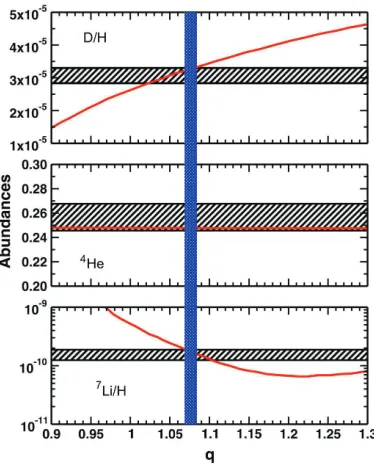
Figure 3. Left: Predicted abundances D,4He and 7Li (red curves) as a function of the Tsallis parameterq
[53]. The observed primordial abundances including 1σuncertainties are indicated by hatched horizontal bands [8, 54, 55]. The vertical (blue) band refers to the parameterqwithin the interval 1.069<q<1.082.
[45–47]. In Ref. [48], one of these non-extensive statistics, namely, the Tsallis statistics [46, 47] has been used to describe the relative velocities of particles during the BBN. The effect on the lithium
abundance was again the motivation for this work. The Tsallis statistics was used [46, 47], because it represents a family of entropies depending on a parameterq, which measures the departure from Boltzmann statistics. The Boltzmann statistics is recovered whenq=1.
In all previous applications of non-extensive statistics, it has been found that the non-extensive parameterqdoes not depart appreciably from the Boltzmann valueq=1. Non-extensive Maxwellian
velocity distributions have previously been applied to study stellar nuclear burning, e.g. in Refs. [49–52]. In Ref. [48] the Tsallis statistics was used to deduce reaction rates during the BBN and predictions were made for the4He, D, 3He, and7Li abundances which are based on the reaction rates for p(n,γ)d, d(p,γ)3He, d(d,n)3He, d(d,p)t, 3He(n,p)t, t(d,n)4He, 3He(d,p)4He, 3He(α, γ)7Be, t(α, γ)7Li,7Be(n,p)7Li and7Li(p,α)4He and their available experimental data [48]. The conclusion from Ref. [48] is that if eitherq>1 ofq<1, the abundances of all elements are affected but that of
7Li always increases. Therefore, it was inferred that the lithium problem always seems to get worse with the use of the Tsallis statistics.
the calculated and the primordial abundances observed for D,4He, and7Li for 1.069 <q <1.082, indicating that a possible solution to the cosmological lithium problem might arise from a fine tuning of the physics involved. This is shown in Figure 3 with the predicted abundances D,4He and7Li (red curves) as a function of the Tsallis parameterq. The observed primordial abundances including 1σ uncertainties are indicated by hatched horizontal bands [8, 54, 55]. The vertical (blue) band refers to the parameterqwithin the interval 1.069<q<1.082.
The work published in Ref. [53] was cited as a research highlight by the American Astronomical Society [56]. It attests the relevance of the lithium puzzle and the anxiety that its solution entails for the astronomical community. The puzzle has been around the literature for a few decades already. The exercise played in Ref. [53] shows that a solution might be the outcome of a fine tuning of the physics during the BBN. The Tsallis statistics might be one possible departure from the standard physics during the big bang epoch. The question remains on the physical meaning for the value of
q1, and its relation to other physical processes.
Acknowledgements
This work was supported in part by the U.S. DOE grant DE- FG02-08ER41533 and the U.S. National Science Foundation Grant No. 1415656.
References
[1] C.A. Bertulani and T. Kajino, Prog. Part. Nucl. Phys. 89, 56 (2016). [2] E. Komatsu, et al., Ap. J. 192, 18 (2011).
[3] P.A.R. Ade, et al., Astron. Astrophys. 594, A13 (2016).
[4] The ALEPH Collaboration, The DELPHI Collaboration, The L3 Collaboration, The OPAL Col-laboration, The SLD ColCol-laboration, The LEP Electroweak Working Group, The SLD Electroweak and Heavy Flavor Groups, Phys. Reports 427, 257 (2006).
[5] C. Patrignani, et al. (Particle Data Group), Chinese Phys. C 40, 100001 (2016).
[6] M. Spite and F. Spite, Nature 297, 483 (1982); F. Spite and M. Spite, A&A 115, 357 (1982). [7] W. Aoki, et al., Ap. J. 698, 1803 (2009).
[8] L. Sbordone, et al., A&A 522, A26 (2010). [9] A. Coc, et al., Ap. J. 744, 158 (2012). [10] R.G. Pizzone, et al., Ap. J. 786, 112 (2014).
[11] C.A. Bertulani, Comput. Phys. Commun. 156, 123 (2003).
[12] A. M. Mukhamedzhanov, Shubhchintak, and C.A. Bertulani, Phys. Rev. C 93,045805 (2016). [13] M. Anders et al., Phys. Rev. Lett. 113, 042501 (2014).
[14] M. Asplund, D. L. Lambert, P. E. Nissen, F. Primas and V. V. Smith, Ap. J. 644, 229 (2006). [15] K. Lind, J. Melendez, M. Asplund, R. Collet and Z. Magic, A&A 554, A96 (2013).
[16] R.V. Wagoner, Ap. J. Suppl. Ser. 18, 247 (1969).
[17] L. Kawano, “Let’s Go: Early Universe. Primordial Nucleosynthesis: The Computer Way”; NASA Technical Reports Server (NTRS): Hampton, VA, USA, 1992.
[18] Y.I. Izotov and T.X. Thuan, Ap. J. Lett. 710, L67 (2010).
[19] E.E. Salpeter, Aust. J. Phys. 7, 373 (1954); E.E. Salpeter and H.M. Van Horn, Ap. J. 155, 183 (1969).
[20] B. Wang, C.A. Bertulani, and A.B. Balantekin, Phys. Rev. C 83, 018801 (2011). [21] C. Spitaleri, et. al., Phys. Lett. B 755, 275 (2016).
the calculated and the primordial abundances observed for D,4He, and7Li for 1.069 <q <1.082, indicating that a possible solution to the cosmological lithium problem might arise from a fine tuning of the physics involved. This is shown in Figure 3 with the predicted abundances D,4He and7Li (red curves) as a function of the Tsallis parameterq. The observed primordial abundances including 1σ uncertainties are indicated by hatched horizontal bands [8, 54, 55]. The vertical (blue) band refers to the parameterqwithin the interval 1.069<q<1.082.
The work published in Ref. [53] was cited as a research highlight by the American Astronomical Society [56]. It attests the relevance of the lithium puzzle and the anxiety that its solution entails for the astronomical community. The puzzle has been around the literature for a few decades already. The exercise played in Ref. [53] shows that a solution might be the outcome of a fine tuning of the physics during the BBN. The Tsallis statistics might be one possible departure from the standard physics during the big bang epoch. The question remains on the physical meaning for the value of
q1, and its relation to other physical processes.
Acknowledgements
This work was supported in part by the U.S. DOE grant DE- FG02-08ER41533 and the U.S. National Science Foundation Grant No. 1415656.
References
[1] C.A. Bertulani and T. Kajino, Prog. Part. Nucl. Phys. 89, 56 (2016). [2] E. Komatsu, et al., Ap. J. 192, 18 (2011).
[3] P.A.R. Ade, et al., Astron. Astrophys. 594, A13 (2016).
[4] The ALEPH Collaboration, The DELPHI Collaboration, The L3 Collaboration, The OPAL Col-laboration, The SLD ColCol-laboration, The LEP Electroweak Working Group, The SLD Electroweak and Heavy Flavor Groups, Phys. Reports 427, 257 (2006).
[5] C. Patrignani, et al. (Particle Data Group), Chinese Phys. C 40, 100001 (2016).
[6] M. Spite and F. Spite, Nature 297, 483 (1982); F. Spite and M. Spite, A&A 115, 357 (1982). [7] W. Aoki, et al., Ap. J. 698, 1803 (2009).
[8] L. Sbordone, et al., A&A 522, A26 (2010). [9] A. Coc, et al., Ap. J. 744, 158 (2012). [10] R.G. Pizzone, et al., Ap. J. 786, 112 (2014).
[11] C.A. Bertulani, Comput. Phys. Commun. 156, 123 (2003).
[12] A. M. Mukhamedzhanov, Shubhchintak, and C.A. Bertulani, Phys. Rev. C 93,045805 (2016). [13] M. Anders et al., Phys. Rev. Lett. 113, 042501 (2014).
[14] M. Asplund, D. L. Lambert, P. E. Nissen, F. Primas and V. V. Smith, Ap. J. 644, 229 (2006). [15] K. Lind, J. Melendez, M. Asplund, R. Collet and Z. Magic, A&A 554, A96 (2013).
[16] R.V. Wagoner, Ap. J. Suppl. Ser. 18, 247 (1969).
[17] L. Kawano, “Let’s Go: Early Universe. Primordial Nucleosynthesis: The Computer Way”; NASA Technical Reports Server (NTRS): Hampton, VA, USA, 1992.
[18] Y.I. Izotov and T.X. Thuan, Ap. J. Lett. 710, L67 (2010).
[19] E.E. Salpeter, Aust. J. Phys. 7, 373 (1954); E.E. Salpeter and H.M. Van Horn, Ap. J. 155, 183 (1969).
[20] B. Wang, C.A. Bertulani, and A.B. Balantekin, Phys. Rev. C 83, 018801 (2011). [21] C. Spitaleri, et. al., Phys. Lett. B 755, 275 (2016).
[22] Signe Riemer-Sorensen and Espen Sem Jenssen, Universe 2, 44 (2017). doi:10.3390/universe3020044.
[23] R.J. Cooke, M. Pettini, and C.C. Steidel, arXiv:1710.02730. [24] T. M. Bania, R. T. Rood, D. S. Balser, Nature 415, 54 (2002). [25] C. Broggini, et al., JCAP 6, 30 (2012).
[26] S.Q. Hou, et al. 2015, Phys. Rev. C 91, 055802 (2015). [27] M. Barbagallo, et al., Phys. Rev. Lett. 117, 152701 (2016). [28] T. Kawabata, et al., Phys. Rev. Lett. 118, 052701 (2017). [29] L. Lamia, et. al., Ap. J. 850, 175 (2017).
[30] M. Hartos, et. al., to be published. [31] J. L. Feng, arXiv:1003.0904 (2010).
[32] G. Bertone, D. Hopper, and J. Silk, Phys. Rep. 405, 279 (2005). [33] G. Bertone, Nature 468, 389 (2010).
[34] T.D. Li and C. N Yang, Phys. Rev. 104, 254 (1956).
[35] Y. Kobzarev, L. Okun, I. Pomeranchuk, Yad. Fiz. 3, 1154 (1966). [36] M. Pavsic, Int. J. Theor. Phys. 9, 229 (1974).
[37] R. Foot, H. Lew, R. Volkas, Phys. Lett. B 272, 67 (1991).
[38] E. Akhmedov, Z. Berezhiani, G. Senjanovic, Phys. Rev. Lett. 69, 3013 (1992). [39] O. Oliveira, et al., arXiv:1108.2723 (2011).
[40] C.A. Bertulani, et. al., AIP Proc.1498, 134 (2013). [41] O. Oliveira, et al., Braz. J. Phys. 46, 721 (2016).
[42] Z.G. Berezhiani, A.D. Dolgov, R.N. Mohapatra, Phys. Lett. B375, 26 (1996).
[43] K.A. Olive (Particle Data Group - Review of Particle Physics), Chin. Phys. C 38, 090001 (2014). [44] C.A. Bertulani, V. Challa, J.J. He, S.Q. Hou, Ravinder Kumar, arXiv:1704.07803.
[45] A. Rényi, Proc. of the 4th Berkeley Symposium on Mathematics, Statistics and Probability, p. 547, 561 (1960).
[46] C. Tsallis, J. Stat. Phys. 52, 479 (1988).
[47] M. Gell-Mann and C. Tsallis, eds., “Nonextensive Entropy-Interdisciplinary Applications, (Oxford University Press, New York, 2004). For a regularly updated bibliography see URL: http://tsallis.cat.cbpf.br/biblio.htm
[48] C.A. Bertulani, J. Fuqua and M.S. Hussein, Ap. J. 767, 67 (2013). [49] M. Lissia and P. Quarati, Europhys. News 36, 211 (2005). [50] J. Haubold and D. Kumar, Astroparticle Phys. 29 ,70 (2008). [51] S. Degl’Innocenti et al, Phys. Lett. B 441, 291 (1998). [52] M. Coraddu, et al., Braz. J. Phys. 29, 153 (1999). [53] S.Q. Hou, et. al., Ap. J. 834, 165 (2017).
[54] E. Aver, K.A. Olive, E.D. Skillman, JCAP 5, 003 (2010).
[55] K.A. Olive, P. Petitjean, E. Vangioni, J. Silk, MNRAS 426, 1427 (2012).
![Figure 1. Left:red circles) and using Calculated BBN abundances of H, D, 3H, 3He, 4He, 6Li, 7Li and 7Be as a function of time [1].Right: 7Be(n,α) cross section deduced using the THM experimental data for the 7Li(p,α)4He mirror reaction (full 3He THM breaku](https://thumb-us.123doks.com/thumbv2/123dok_us/8037495.1337893/3.482.42.410.81.205/figure-circles-calculated-abundances-function-deduced-experimental-reaction.webp)
![Table 2. BBN calculations using fits to recent experimental data for BBN reactions compared withfrom the measurements of the cosmic microwave background [3], (c)abundance Dobservations](https://thumb-us.123doks.com/thumbv2/123dok_us/8037495.1337893/4.482.120.358.416.484/calculations-experimental-reactions-measurements-microwave-background-abundance-dobservations.webp)