Scholarship@Western
Scholarship@Western
Electronic Thesis and Dissertation Repository
8-18-2014 12:00 AM
Language, Mind, and Cognitive Science: Remarks on Theories of
Language, Mind, and Cognitive Science: Remarks on Theories of
the Language-Cognition Relationships in Human Minds
the Language-Cognition Relationships in Human Minds
Guillaume Beaulac
The University of Western Ontario
Supervisor
Christopher D. Viger
The University of Western Ontario Graduate Program in Philosophy
A thesis submitted in partial fulfillment of the requirements for the degree in Doctor of Philosophy
© Guillaume Beaulac 2014
Follow this and additional works at: https://ir.lib.uwo.ca/etd
Part of the Philosophy of Mind Commons
Recommended Citation Recommended Citation
Beaulac, Guillaume, "Language, Mind, and Cognitive Science: Remarks on Theories of the Language-Cognition Relationships in Human Minds" (2014). Electronic Thesis and Dissertation Repository. 2288. https://ir.lib.uwo.ca/etd/2288
This Dissertation/Thesis is brought to you for free and open access by Scholarship@Western. It has been accepted for inclusion in Electronic Thesis and Dissertation Repository by an authorized administrator of
(Thesis format: Integrated Articles)
by
Guillaume Beaulac
Graduate Program in Philosophy
A thesis submitted in partial fulfillment of the requirements for the degree of
Doctor of Philosophy
The School of Graduate and Postdoctoral Studies The University of Western Ontario
London, Ontario, Canada
ii
Abstract
My dissertation establishes the basis for a systematic outlook on the role language plays in human cognition. It is an investigation based on a cognitive conception of language, as opposed to communicative conceptions, viz. those that suppose that language plays no role in cognition (its only role being to externalize thought). I focus, in Chapter 2, on three paradigmatic theories adopting this perspective, each offering different views on how language contributes to or changes cognition.
In Chapter 3, I criticize current views held by dual-process theorists, and I develop a picture of the complex interaction between language and cognition that I deem more plausible by using resources from the literature on the evolution of the faculty of language. Rather than trying to find one general explanation for all cognitive processes, I take seriously the idea that our mind is composed of many subsystems, and that language can interact and modify each in different ways. There is no reason offered in the empirical literature—besides maybe parsimony—that suggest that language has to interact in the same ways with all cognitive processes. Yet, this is seemingly taken for granted, especially within dual-process approaches.
On my view, it is a central requirement for a theory of the role of language in cognition to explain how language might have effects, at once, on and within various parts of cognition. In Chapter 4, I explore how this framework can modify how we think about some experiments in psychology, specifically in research on categorization. My idea is that language, once it (or any possible primitive forms) evolved, changed how some cognitive capacities worked and interacted with each other, but did so in more than one or two ways. Cognitive systems are changed in very different ways—sometimes the transformation is very subtle, such as our way of forming categories by using how similar objects are, while other times it is deep and changes the very way the system works.
Keywords
iii
Co-Authorship Statement
Chapter 4, “"Concept" Heterogeneity and Definitions”, has been co-authored with Pierre Poirier, Associate Professor and former Director of the Institut des Sciences Cognitives at Université du Québec à Montréal. The basis for this paper was first written as a commentary published in a book symposium on Edouard Machery’s (2009) Doing without Concepts. This paper was published in Dialogue (Poirier & Beaulac, 2011). Following Machery’s reply (2011), we continued the project and expanded greatly on this initial paper, hence the numerous references to Machery’s work and to his replies to some of the arguments. I have taken lead on the current paper: a first, shorter draft was submitted as a term paper for the course PHILOSOP 9605A (Concepts) taught by Angela Mendelovici in the Fall 2011 term, which we then revised. It was accepted for a full paper presentation at the 2012 meeting of the Society for Philosophy and Psychology.
iv
Acknowledgments
Many would start by acknowledging the academic support they had during their PhD program but, in my case, this would be ignoring the person who suffered the most during the process leading to this dissertation. None of this would have been possible without the help, love and support that Evelyn McDuff has offered me since the beginning of this crazy adventure. Evelyn, thanks. I love you.
I want to warmly thank Chris Viger, my supervisor, for being open to the project and supportive of my twelve (plus) other projects these past four years. You allowed me to pursue academic freedom to its full extent, and I am grateful that you always were so confident I would get this done in time(!). I cannot stress sufficiently the impact of your ideas and your guidance on this project.
Gillian Barker and Robert J. Stainton, members of my prospectus committee, also played important roles in this process, and their comments during my defense of the project helped greatly shape the ideas in these pages. Thanks!
Thanks also to John Paul Minda who gave me detailed comments and suggested many references that deeply influenced the current version of Chapter 4.
Pierre Poirier, who taught me how to do (and love) research, is to be blamed for most of this (especially Chapter 4, which he co-authored!). Pierre, you convinced me that I had what it takes to embark on such enterprises and you offered me incredible support all the way through. Thanks for everything. Thanks for believing in me.
v
Thanks, finally, to my collaborators, people who offered comments on various parts of my work, who offered me support (emotionally and academically), who participated in reading groups (CRISCo and others), and who shared scotch and beer with me. So many more friends and colleagues should be named here but I promised myself to keep this short (I failed). I insist. I learned as much (if not more) from interacting with you, dear friends and colleagues, than I did collaborating with my advisor and other faculty members.
To anyone thinking about grad school: keep in mind that you are not only choosing a school, you are choosing colleagues who will play a huge role in your life as a grad student. And I’m happy that Western was a great choice in this regard.
Thanks also to the Rotman Institute of Philosophy for fostering an amazing research environment. My research also greatly benefited from research visits at the Department of Philosophy of the Graduate Center at City University of New York in the Spring 2013 term with Peter Godfrey-Smith and John D. Greenwood, at the Center for Philosophy of Science at the University of Pittsburgh in the Spring 2012 term with Edouard Machery and at the Université du Québec à Montréal’s Canada Research Chair in Cognitive Science during the Summer 2011 term with Stevan Harnad.
This research was supported by the Social Sciences and Humanities Research Council (Joseph-Armand-Bombardier Doctoral Scholarship 767-2010-2249, and Michael-Smith Foreign Study Supplement 771-2012-0007), the Ontario Graduate Scholarships program, and the Schmeelk Canada Foundation.
vi
Table of Contents
Abstract ... ii
Co-Authorship Statement ... iii
Acknowledgments ... iv
Table of Contents ... vi
List of Tables ... viii
List of Figures ... ix
Chapter 1: Introduction ... 1
1 Introduction... 2
1.1 A case motivating this research ... 5
1.2 The philosophical project ... 8
1.2.1 Language and cognition in Condillac ... 8
1.2.2 Language, cognition, and research on the origins of language ... 13
References ...17
Chapter 2: First paper ...20
2 The Role of Language and the Architecture of Cognition ...21
2.1 Introduction ...21
2.2 Four cognitive conceptions of language ...24
2.2.1 The scaffolding view ...24
2.2.2 Language as the vehicle for conscious thought ...28
2.2.3 Language as the vehicle for explicit thought ... 30
2.2.4 Language as transforming the mind ... 31
2.2.5 Explicit and conscious thought ... 34
2.3 Remapping the landscape for the roles of language in cognition ... 35
2.3.1 Language as a cognitive tool & contemporary Whorfian views ... 37
2.3.2 Language and intermodular communication ...42
2.3.3 The rewiring thesis ... 43
2.4 A hypothesis for the multiple roles of language in cognition ...46
2.5 Conclusion ...52
vii
Chapter 3: Second Paper ...58
3 Dual-Process Theories and Language ...59
3.1 Introduction ...59
3.2 The generalized accounts of dual-process theories ...61
3.2.1 Stanovich’s (2004) dual-process theory ...65
3.2.2 Criticisms of the generalized accounts ...69
3.3 Recent variations on the generalized accounts ...72
3.3.1 Evans & Stanovich’s recent proposal ... 73
3.3.2 Carruthers’ dual-process view ...76
3.4 Type 2 processes and their links to language ...81
3.5 Concluding thoughts ...86
References ...87
Chapter 4: Third paper ...92
4 “Concept” Heterogeneity and Definitions (Co-Authored with Pierre Poirier) .. 93
4.1 Introduction ... 93
4.2 A new landscape in concept science ...95
4.2.1 Rejecting the natural kind assumption ...96
4.2.2 Adopting a dual-process view of the mind ... 102
4.3 Type 2 concepts ... 105
4.3.1 What are Type 2 concepts? ... 107
4.4 The cognitive role of Type 2 concepts ... 111
4.5 Two projects for definitions ... 117
4.6 Methodological challenges for Type-2 concepts ... 121
4.6.1 Experiments in concept science ... 123
4.6.2 The theory theory approach and definitions ... 131
4.7 Yes, but why “definitions”? ... 136
4.8 Conclusion ... 138
References ... 138
Chapter 5: Conclusion ... 144
5 Conclusion ... 145
References ... 151
viii
List of Tables
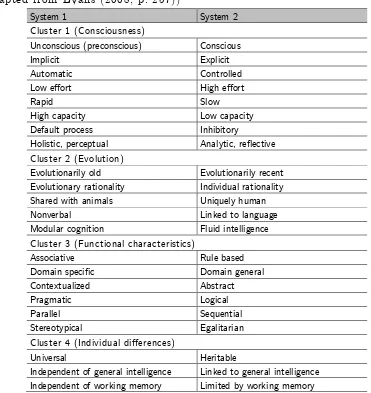
Table 1. Clusters of attributes associated with dual systems of thinking
(adapted from Evans (2008, p. 257)) ... 63
Table 2. Defining features of Type 1 and Type 2 processes
ix
List of Figures
Figure 1. Four-dimensional stimuli used in Minda & Smith (2001, p. 797) ... 124
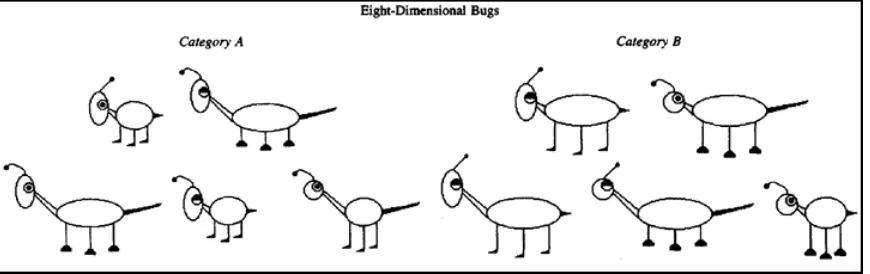
Figure 2. Eight-dimensional stimuli used in Minda & Smith (2001, p. 797) ... 124
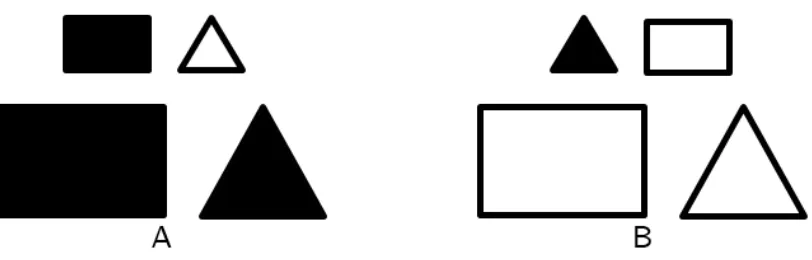
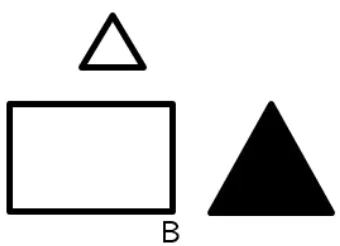
Figure 3. Example of a single dimension (SD) distinction ... 127
Figure 4. Example of a disjunctive rule (DR) distinction ... 127
Figure 5. Example of a nonlinearly separable (NLR) distinction ... 128
Chapter 1
: Introduction
War is what happens when language fails.
1
Introduction
While descriptions of the role of language in human cognition are often restricted
to its communicative role1, many theories suggest that it contributes to cognition
in various ways, and might even profoundly modify the way cognition works. This
is more than to say that “language is an internal "instrument of thought"”
(Berwick, Friederici, Chomsky, & Bolhuis, 2013, p. 91), however. It means that
language can indeed be an instrument, although not necessarily only an internal
one, but it can also be an instrument in a transformative sense, viz. its very use
can change how cognition works. How language makes such contributions, and
which capacities it interacts with—what it modifies, enhances or adds, however,
are questions that need to be examined more closely. This is, at least, the claim I
will be arguing for in these pages.
These are very broad issues, addressed by many approaches within philosophy (at
various moments in its history) and elsewhere, which can hardly be handled within
a single project. My intended goal is to contribute to the way these questions are
framed within contemporary work in cognitive science. I propose, first, an
examination of many theories of the role of language in cognition using the
perspectives provided by three paradigmatic views in philosophy. I don’t expect
these three views to represent all possible positions; I prefer to see this as a first
exploration of the landscape and some related, multifaceted, issues. This
exploration in itself is still valuable as I expect most theories to fall somewhere
within this landscape, and any theory that would not fit in this landscape would
be interesting in how it differs from these paradigmatic views.
The views I will be examining are Carruthers’ (2006, 2013a, 2013b) view of
language as the way modules interface in a global workspace, a version of Clark’s
(2008; see also Donald, 1991) scaffolding hypothesis where I also discuss
contemporary variations on Whorf’s (2012) seminal proposal, as defended by,
among others, Colombetti (2009), and Boroditsky & Prinz (2008), and Dennett’s
(1991, 1994, 2009a) rewiring thesis.
More than merely defining a landscape, I will argue that the weakness of the
aforementioned frameworks lies in their attempt to explain what the (single) role
of language in cognition is. I will make a case for a view where language plays
multiple roles, roles that are well described in one or more of these paradigmatic
approaches. Looking at some of the phenomena under study using this perspective,
I think, helps to reinterpret some experimental results and might make it possible
to see new dynamics emerge when it comes to understanding how the mind’s
processes are organized.
From this standpoint, I examine (Chapter 3) the dual-process theory framework
(Evans & Frankish, 2009; Evans & Stanovich, 2013; Evans, 2008; Gawronski &
Creighton, 2013; Kahneman, 2011; Stanovich, 2011) and discuss some of its
limitations on how language is understood therein.Rather than trying to find one
general explanation or one general framework for all cognitive processes, something
which the authors above spend much energy doing—as this is seen as one of the
major perks of dual-process views, I take very seriously the idea that our mind is
one in different ways. There is no reason offered in the empirical literature—besides
maybe parsimony—that would suggest that language has to interact in the same
ways with memory systems, categorization processes, reasoning skills, and other
cognitive processes. Yet, this is seemingly taken for granted. The dual-process
perspective is representative of such views—the macro categories (“Type 1 and
Type 2 processes”, “System 1 and System 2”)are themselves too vague. There are
very good reasons to think that there is more than one part to each of the categories
mentioned above; memory is well-known to have its own distinctions, and the same
goes for many other fields of inquiry within psychology.
On my view, it is a central requirement for a theory of the role language in
cognition to explain how language might have both effects, on and within various
parts of cognition. Then, in Chapter 4, I enquire how this framework might modify
how we think about some experiments in psychology. My idea is that language,
once it (or any possible primitive forms) evolved, changed how some cognitive
capacities worked and interacted with each other, but did so in more than one or
two ways. Cognitive systems are changed in very different ways—sometimes the
transformation is very subtle, such as our way of making categories by using how
similar objects are, while at other times it is deep and changes the very way the
system works, such as the trade-off that seemed to occur in memory, such that our
visual memory is very poor, unlike that of, e.g., chimpanzees, but our long-term
and episodic memory systems seem much more efficient and precise than that of
other species. Chapter 4 explores this hypothesis from the point of view of the
psychology of concepts, or concept science, as we refer to it in these pages. The
will not have all the necessary resources to explore the diversity of phenomena at
play under the general label “concept”.
The aim is not to settle what the role of language in cognition is—a task well
beyond the scope of a dissertation—rather it is to provide much needed conceptual
clarification. My approach suggests new possibilities for the relation between
language and thought that can inform research in philosophy of psychology and
cognitive psychology. Each of the chapters of this dissertation, written as a
standalone paper, accomplishes part of this overarching goal.
1.1
A case motivating this research
A case presented by Donald (1991), based on the description in Lecours & Joanette
(1980), can illustrate how ideas about the role language is supposed to play change
how we look at some of the data2. In their paper, Lecours & Joanette describe the
case of Brother John, a Francophone unilingual Québécois suffering from
paroxysmal aphasia, “without,” as the authors state, “modification of consciousness”
(Lecours & Joanette, 1980, p. 1), due to epileptic spells. Brother John’s aphasia is
characterized by short and long spells during which he loses the capacity to use
and understand language—the spells more or less (and a lot stands on this “more
or less”) shut down language processing. Brother John is still able, during those
spells, to carry out complex social interactions that seemingly require the use of
symbolic capacities, usually deemed to be among those that language is necessary
for. Moreover, he is aware of his disability and he is usually able to cope with the
situation, finding ways not to “inconvenience himself or others” (Donald, 1991,
p. 84).
Brother John had been having these spells for some time when Lecours & Joanette
started to work with him. He was used to the spells, was able to anticipate them,
and he was sometimes able to arrange for one of his colleagues to cover for him
when they happened. One striking example that Donald (1991) emphasizes
happened during a trip to Switzerland. During a train ride, Brother John realized
one of his long spells, one that can last up to 8 hours, was about to start. When
he got out the train, in a town he never visited before and despite being unable to
use language in any form, he was still able to get to a hotel, using mimes to get a
room. He ordered food by pointing at something at random (hoping he would like
it) in what he believed would be the hors-d’oeuvre section of the menu. When the
spell was over he remembered what happened during the spell in every detail.
For Donald, this case shows that “despite the complete absence of language,
internal or external” (Donald, 1991, p. 85), Brother John is able to act in ways that
seem clearly to be uniquely human: complex planning, coherent thought, memory
formation, ability to interact socially and to recognize faces, places and even some
things very specific and contextual such as sections on an unknown restaurant’s
menu. His episodic memory also remains intact, like some gestural abilities and
practical knowledge. Hence, despite the absence of language, Donald thinks Brother
John is able to exhibit abilities that go far beyond anything other primates can do.
Language, of course, can help cognition in many ways and has a strong role in
social transmission and in communication, but he believes that “[l]anguage was
obviously not the vehicle by which he assessed events, formulated plans, and
Dennett (1994), however, is not impressed by this example. Because Brother John
normally has language, Dennett argues that his cognition benefits from the shaping
of language even during his spells. In other words, it is not true, according to
Dennett, that we can talk about a complete absence of language in this case.
Brother John’s cognition, even when, e.g., inner speech is not available, is deeply
transformed by his use of language in normal circumstances. This, as I will discuss
in Chapter 2, is a marked difference between the rewiring and the scaffolding
theses. Moreover, since Brother John can anticipate his spells, it is possible that
he might do a lot of planning beforehand. Dennett insists:
These varieties of language-less thought, like barefoot waterskiing, may be possible only for brief periods, and only after a preparatory period that includes the very feature whose absence is later so striking. (Dennett, 1994, sec. 5)
Yet, it is not a decisive narrative which proves that language is transformative of
every cognitive ability in the way Dennett thinks it is.
Brother John’s story, however, might be harder to account for in Carruthers’ (2006,
2013a) framework since the rehearsal of inner speech actions plays a very large role
in how he explains the unique flexibility of human behavior. For Carruthers, who
does not (so far) discuss this specific case, explaining Brother John’s case requires
a modification to his view, where language could have lasting effects. Yet, some
aspects of the case do speak in favor of Carruthers’ view: Lecours and Joanette
(1980) also mention that Brother John uses some labels, even during his spells—
something Dennett (1994) notes to strengthen his own position—such as “turn”,
“push”, etc.
I believe that these theories, briefly introduced above, all point towards interesting
mind have trouble accounting for some other aspects of the same phenomena. The
task of this dissertation will be to shed some light on the issue and, hopefully, find
a way to better understand what is going in such cases.
1.2
The philosophical project
As this is a project in philosophy of psychology and, more generally, cognitive
science, I will proceed to analyze theories widely influential in cognitive science
concerning the relation between language and thought in terms of the concepts
they use, their methodological approaches, and the consequences this might have
on how we understand the human mind. I do not believe it is necessary to justify
this project as being philosophical in nature (cf. Dennett, 2009b), but I would like
to point out a few general implications I see down the road for this kind of project.
First, I would like to draw attention to an example in the history of philosophy
that illustrates the importance of such questions in the tradition by looking at
Condillac’s views on the matter. Although my main research question, viz. how
language modifies cognition, is rarely formulated in this exact way, I think there
are precursors in the history of philosophy; my example being from the modern
period. Then, I will mention a few questions—some from the evolution of language
literature and others from work in animal cognition—about how this is one but
many examples of how philosophy can be important within cognitive science.
1.2.1
Language and cognition in Condillac
In his attempt to understand the human mind, and to define human nature,
Étienne Bonnot de Condillac discusses evidence from observations of nonhuman
animal behavior. He recognizes the striking similarities in how humans and animals
and nonhuman behavior are useful and informative, and he uses them abundantly
in his work. He thinks the study of animals can be enlightening and help us to
understand human cognition because animal behavior can be informative of our
own—mostly because Condillac thinks both types of cognition work according to
some of the same principles, revealed in simpler forms in animals.
In his approach to the study of the animal mind, Condillac adopts Hume’s principle
of similarity enunciated in the Treatise (Hume, 2011, para. 2.1.12.2), that is “where
the structures of parts in brutes is the same as in men, and the operation of these
parts also the same, the causes of that operation cannot be different”. In the Traité
des animaux, Condillac (2004) explains that the idea of the animal-machine is
absurd for him: central to his views of both humans’ and animals’ mental life is
the idea that sensations are—to put it into contemporary words—functionally
relevant in behavior. Without sensations, behavior would not be the way it is.
From this foundation, and by stating the importance of sensations in his grasp of
both humans’ and animals’ lives, Condillac ties the views he develops in the Traité
des animaux to those of his Traité des sensations (Condillac, 1984), a treatise
where he offers a reconstruction of our understanding of human cognition building
on the principle that humans tend to maximize pleasure and minimize pain, and
that the only built-in processes are basic perceptions from the sense organs. That
is, he rejects that there are any innate abilities beyond those. Remembering,
reasoning, abstracting, even focusing attention are only learned, they are taught
by experience alone (Falkenstein, 2010). Development of a higher cognitive faculty
starts from the ability of focusing attention on various objects perceived. Sensations
are also richer than what is perceived: cognition then has a lot to do with the
7.2). By a complex process of learning and habituations (what Condillac calls the
acquisition of “habitudes” (habits)), animals and humans come to, e.g., anticipate
some events to follow their current sensations and act accordingly. This brings
Laupies to state that what comes naturally is “the habit of which we forgot the
origin” (Laupies, 2004, p. 116, my translation). It is important to emphasize the
following point: there is not any difference, of kind or of degree, between sensations
humans and animals have. Condillac goes even one step further. For him, the soul
cannot be distinguished from the body, the distinction being “neither conceivable
nor useful” (Laupies, 2004, p. 106, my translation).
Despite these numerous similarities, there is certainly the appearance of much
dissimilarity between humans and nonhuman animals, and Condillac has to
account for this as well. He invokes two general principles: the first one is tied to
the different needs of different species—intrinsically related to the cognitive
capacities developed—and the second one is explained by Condillac’s views on
language and communication. I will not, here, go into the details of the first reason,
but the second one is most interesting for my current purposes.
This second one has to do with language, a central feature of Condillac’s views on
humans. As Garrett explains, “the comparison of human and animal sensitive,
imaginative, and intellectual capacities resulted in a language-centered account of
human nature” (Garrett, 2006, p. 164) and this is the very element that sets human
beings apart from animals—this is where the difference in kind rises for Condillac.
It adds “an intersubjective social and historical medium” (Garrett, 2006, p. 164) to
the psychological theories proposed by earlier authors. This is a central and very
rich idea. This is not without tensions as, again, in principle, there is nothing that
the relevant needs as they also have some forms of language in Condillac’s view. In
practice, however, it does place humans into a different realm, a cultural and social
one—and Condillac brings forward the idea that humans are superior to animals.
Language, according to what Condillac says in his Logique (Condillac, 1780), is
what creates rational thought. The idea is not that no form of reflection is available
to animals, but language brings it to another level; thought in animals lacks
precision and consists mostly of instincts. Humans’ reflection goes beyond that of
animals mostly because it has this combination of instinct and reason, closely
interlinked; reflection in the human case is “solicited above and beyond habits by
the diversity of the needs, it can be abstraction” (Laupies, 2004, p. 124, my
translation) which also means that humans can think beyond what is directly in
their surroundings.
According to Coskies, in Condillac’s framework, “[i]f animals have less language
and less reason, it is only because their physical condition has not compelled them
to attain more” (Coskies, 2003, p. 69). Dagognet describes the difference between
humans and animals by the fact that “the animal is born with less organic means,
that are less differentiated, and—mostly—that are adapted to the animal’s
functions of autopreservation” (Dagognet, 2004, p. 125, my translation). He adds
that, in Condillac’s Traité des animaux, the complexity of human beings sensory
apparatus makes humans relatively less dexterous and more vulnerable early in
life. However, it allows for and encourages, ultimately, the human greater need for
more habits and—above all—encourages curiosity, “this insatiable need for
knowledge” (Condillac, 2004, para. 2.5.14, my translation). These are the conditions
Once human language arises, it allows for a whole different kind of cognition, a
“higher type of understanding” (Coskies, 2003, p. 66), theoretical knowledge.
Condillac even goes as far as identifying the ability of using language properly with
the capacity to reason correctly in his Logique; clear connections are made by
putting linguistic expressions together. Human language also permits information
sharing and the development of culture, but also the differentiation of individuals
within a society. One of the limitations of animals is that each individual has to
learn everything by itself: “[the beasts] are more or less limited to the pieces of
knowledge that each individual can acquire by itself” (Condillac, 2004, para. 2.4.17,
my translation). In human societies, knowledge can be shared—the examples of
such social learning in nonhuman species being impressive but still limited. Above
all, theoretical knowledge allows for the knowledge of God and for morality to
emerge, the clearest signs of the superiority of humans in the animal realm.
Condillac’s view is well summarized by Garrett:
Each animal, however social, begins anew and responds to experience no faster than previous generations, unable to learn from the species’s mistakes and successes through a common storehouse of language. Man, on the other hand, accumulates reflective knowledge, which, although derived from the senses, is able through language to expand and progress into an open-ended future. (Garrett, 2006, p. 164)
The difference in kind, therefore, emerges with the appearance of the capacity for
language. Its rise is explained by a difference in degree, but—once it is present—
creates the wide gap between humans and animals Condillac was looking for. What
exactly makes humans unique despite the similarities and the nature of the
differences (differences in degrees) that they observe? The answer, for Condillac,
This historical take on the kind of problem I am interested in shows two things:
first, the question has not changed much. What makes humans unique? If it is
language that makes humans unique in the animal realm, how does language
contribute to human uniqueness? The second thing it reveals is that there are
insights for contemporary problems in cognitive science to be found in the history
of philosophy. While this is not exactly a new observation, the way Condillac’s
views connect with contemporary problems is striking. As we will now see,
Condillac was defending a kind of view that is nowadays defended by the likes of
Toates (2006) and Fitch (2010), and he was doing so in light of his observations of
nonhuman species behavior. Although I will not be coming back to these historical
questions here, I think it will be useful to keep in mind how Condillac was
understanding and explaining these issues more than 200 years ago.
1.2.2
Language, cognition, and research
on the origins of language
In his recent overview of the research on the origins of language, Fitch holds that
there is no doubt that nonhuman animals have sophisticated cognition, viz.
sophisticated cognition without language (Fitch, 2010, pp. 171–172). In fact, Fitch
is so optimistic about recent discoveries in animal cognition that he suggests a new
take on the problem of the evolution of language.
Hauser, Chomsky and Fitch (2002) suggest an interesting distinction between the
Faculty of Language in the Broad (FLB) and in the Narrow (FLN) sense. FLN
refers to the part(s) of the language faculty that is (are) uniquely human and FLB
refers to the capacities necessary for language that are shared with nonhuman
also many cognitive capacities necessary for language, including memory,
categorization system(s), etc. More recently, Fitch (2010) suggests an interesting
take on this reflection: as first hinted at in Fitch, Hauser, & Chomsky (2005), FLN
might be an empty set, that is, nothing would be part in and by itself, of FLN, not
even recursion (which was the previous candidate for FLN). Yet, if FLN is empty
we still have to explain the—what appears to be unique in the animal realm—case
of language.
Fitch’s suggestion is that what is unique about human beings is not necessarily
any cognitive capacity but rather the particular combination of specific capacities.
If Fitch is right, this would mean that every part that is needed to have a
human-like language faculty could be found in a number of nonhuman animals in different
combinations, viz. no capacity would have to be unique to human beings, but these
parts are never found in the peculiar arrangement that happens to work in the
human case. This hypothesis calls for an investigation of the capacities necessary
for language and how they are found in nonhuman animals.
This is where my own research program comes in, as I add a twist to Fitch’s
suggestion. Here, the difficulty is that there is no framework to think about what
changed once language started to interact with, or to modify, cognition (or parts
of it). What I mean by this is that the ideas suggested by Fitch and his colleagues
do not provide us with tools to go in the details of the role language plays once it
appears in cognition. Put differently: how does language affect each part of FLB
and FLN once it sets in? Are these parts all affected in the same way?
My motivation is that there is an apparent incompatibility between Fitch’s
detail in Chapter 3). What is needed here is an account of the architecture of mind
that can make sense of Fitch’s idea, and I believe that a weakened version of
dual-process theories would do the trick. A proposition like Fitch’s would work with the
dual-process view only, here, some parts of FLB are akin to Type 1 processes while
other parts are closer to the characterization of Type 2 processes—or their closest
nonhuman version.
Let me illustrate this idea: even though Fitch holds the view that there is no
uniquely human process, he lacks an adequate explanation of how these
mechanisms all come together and what, once a species acquires language, changes.
For instance, it is not clear what a component of FLN (if FLN ends up not being
an empty class) would be like, and what effect it would have on cognition more
generally. If recursion happens to be the “missing piece” as suggested by Hauser
and his colleagues (2002), how does it affect or change the various components of
FLB? Would it be possible that, once FLN sets in, it radically changes the way
cognition works (in the way Dennett (1991) envisioned it)? This shortcoming opens
the door to more skeptical views of the cognition of nonhuman animals, such as
Penn, Holyoak & Povinelli’s (2008).
According to Penn and his colleagues (2008), there is a strong discontinuity
between humans and nonhuman animals. After listing many of the observed
differences, they add that, while there is a “profound biological continuity between
human and nonhuman animals”, in fact, this apparent continuity “masks an equally
profound functional discontinuity between the human and nonhuman mind” (Penn
et al., 2008, p. 110). Toates (2006) makes the opposite point as he thinks that we
only a few capacities are unique to human beings. This is especially interesting as
there seems to be an agreement on the data, but the interpretation varies wildly.
Yet, what appears to create the “profound functional discontinuity” described by
Penn and his colleagues, might not be so profound in the end. My worry is that it
is hard to compare and evaluate these interpretations of the data in a context
where we do not know what role language plays. What if the presence of language,
alone, explains all of these differences? Much about these unique abilities seems to
be, at the very least, dependent on the capacity to deal with abstraction and logical
relations—which are strongly tied to capacities that seem to depend on language.
Without having an idea of which parts of cognition language modifies, I hardly see
how the discontinuity can be assessed. It might be true that language radically
modifies the type of cognition observed, but the change could be smaller than what
Penn and his colleagues seem to suppose. Yet, Fitch might be wrong in thinking
that there is nothing crucial that differentiates humans from other animals; there
might be something missing from the FLB mechanisms, something—yet to be
identified—that would create a discontinuity. There might also be degrees of
interaction, and language might interact in different ways with different cognitive
subsystems.
This perspective helps identify problems and difficulties encountered in the animal
cognition and in the architecture of mind literatures. It might even bring about
some suggestions for changes in methodology, and more precision in the concepts
used to talk about these phenomena, especially when cognitive capacities (partly)
shared between humans and other animals are under scrutiny. This is what this
answers, it is my belief that the tools I lay out in the following pages are at least
helpful in advancing the discussion, and this is how the three following chapters fit
together. Their goal is to advance various aspect of these discussions. If I am right,
each of these chapters would contribute to make steps in the direction of solving
the very hard questions mentioned so far—or maybe some simpler, easier, ones
that will help in answering them.
References
Atwood, M. (1998). The robber bride. New York: Anchor Books/Doubleday.
Berwick, R. C., Friederici, A. D., Chomsky, N., & Bolhuis, J. J. (2013).
Evolution, brain, and the nature of language. Trends in Cognitive Sciences, 17(2), 89–98. doi:10.1016/j.tics.2012.12.002
Boroditsky, L., & Prinz, J. J. (2008). What thoughts are made of. In Embodied grounding: Social, cognitive, affective, and neuroscientific approaches (pp. 98–115). New York: Cambridge University Press.
Carruthers, P. (2006). The architecture of the mind : massive modularity and the flexibility of thought. New York: Oxford University Press.
Carruthers, P. (2013a). Animal minds are real, (distinctively) human minds are not. American Philosophical Quarterly, 50, 233–247.
Carruthers, P. (2013b). The fragmentation of reasoning. In P. Quintanilla (Ed.), La coevolución de mente y lenguaje: Ontogénesis y filogénesis. Lima: Fondo Editorial de la Pontificia Universidad Católica del Perú. Retrieved from http://faculty.philosophy.umd.edu/pcarruthers/The%20Fragmentation%20o f%20Reasoning.pdf
Clark, A. (2008). Supersizing the mind : embodiment, action, and cognitive extension. New York: Oxford University Press.
Colombetti, G. (2009). What Language Does to Feelings. Journal of Consciousness Studies, 16(9), 4–26.
Condillac, E. B. de. (1780). La Logique, ou les premiers développemens de l’art de penser. Paris: L’Esprit & Debure l’aîné. Retrieved from
Condillac, E. B. de. (1984). Traité des sensations. Augmenté de l’extrait raisonné. Paris: Fayard.
Condillac, E. B. de. (2004). Traité des animaux. (M. Malherbe, Ed.). Paris: J. Vrin.
Coskies, R. C. (2003). Condillac: Language, Thought, and Morality in the Man and Animal Debate. French Forum, 28(1), 57–75.
Dagognet, F. (2004). L’animal selon Condillac: une introduction au “Traité des animaux” de Condillac. Paris: Vrin.
Dennett, D. C. (1991). Consciousness explained. Boston: Little, Brown and Co.
Dennett, D. C. (1994). Language and intelligence. In J. Khalfa (Ed.), What is Intelligence? Cambridge: Cambridge University Press. Retrieved from http://ase.tufts.edu/cogstud/papers/rolelang.htm
Dennett, D. C. (2009a). The Cultural Evolution of Words and Other Thinking Tools. Cold Spring Harbor Symposia on Quantitative Biology.
doi:10.1101/sqb.2009.74.008
Dennett, D. C. (2009b). The Part of Cognitive Science That Is Philosophy. Topics in Cognitive Science, 1(2), 231–236.
doi:10.1111/j.1756-8765.2009.01015.x
Donald, M. (1991). Origins of the modern mind : three stages in the evolution of culture and cognition. Cambridge (MA): Harvard University Press.
Evans, J. S. B. T. (2008). Dual-Processing Accounts of Reasoning, Judgment, and Social Cognition. Annual Review of Psychology, 59(1), 255–278. doi:10.1146/annurev.psych.59.103006.093629
Evans, J. S. B. T., & Frankish, K. (Eds.). (2009). In Two minds : Dual processes and beyond. New York: Oxford University Press.
Evans, J. S. B. T., & Stanovich, K. E. (2013). Dual-Process Theories of Higher Cognition: Advancing the Debate. Perspectives on Psychological Science, 8(3), 223–241. doi:10.1177/1745691612460685
Falkenstein, L. (2010). Étienne Bonnot de Condillac. Stanford Encyclopedia of Philosophy (Fall 2010 Edition). Retrieved from
http://plato.stanford.edu/archives/ fall2010/entries/condillac/
Fitch, W. T., Hauser, M. D., & Chomsky, N. (2005). The evolution of the
language faculty: Clarifications and implications. Cognition, 97(2), 179–210. doi:10.1016/j.cognition.2005.02.005
Garrett, D. (2006). Human Nature. In K. Haakonssen (Ed.), The Cambridge History of Eighteenth-Century Philosophy (Vol. 1, pp. 160–233). New York: Cambridge University Press.
Gawronski, B., & Creighton, L. A. (2013). Dual-Process Theories. In The Oxford handbook of social cognition. New York: Oxford University Press. Retrieved from http://publish.uwo.ca/~bgawrons/documents/GC_Oxford.pdf
Hauser, M. D., Chomsky, N., & Fitch, W. T. (2002). The Faculty of Language: What Is It, Who Has It, and How Did It Evolve? Science, 298(5598), 1569– 1579. doi:10.1126/science.298.5598.1569
Hume, D. (2011). A treatise of human nature : a critical edition. (D. F. Norton & M. J. Norton, Eds.). Oxford: Clarendon Press.
Kahneman, D. (2011). Thinking, fast and slow. Toronto: Doubleday Canada.
Laupies, F. (2004). Traité des animaux d’Étienne Bonnot de Condillac: leçon philosophique. Paris: Presses universitaires de France.
Lecours, A.-R., & Joanette, Y. (1980). Linguistic and other psychological aspects of paroxysmal aphasia. Brain and Language, 10(1), 1–23. doi:10.1016/0093-934X(80)90034-6
Penn, D. C., Holyoak, K. J., & Povinelli, D. J. (2008). Darwin’s mistake: explaining the discontinuity between human and nonhuman minds. Behavioral and Brain Sciences, 31(2), 109–130; discussion 130–178. doi:10.1017/S0140525X08003543
Pinker, S., & Jackendoff, R. (2005). The faculty of language: what’s special about it? Cognition, 95(2), 201–236. doi:10.1016/j.cognition.2004.08.004
Stanovich, K. E. (2011). Rationality and the reflective mind. New York: Oxford University Press.
Toates, F. (2006). A model of the hierarchy of behaviour, cognition, and consciousness. Consciousness and Cognition, 15(1), 75–118. doi:10.1016/j.concog.2005.04.008
Chapter 2
: First paper
Le problème du langage se situe entre la philosophie et la psychologie.
2
The Role of Language and the Architecture
of Cognition
2.1
Introduction
In their 1999 introduction to philosophy of psychology, George Botterill & Peter
Carruthers discuss the place of natural language in thought (Botterill &
Carruthers, 1999, pp. 208–225) or, as I will put it, the role language plays in
cognition3—how language can transform aspects of cognition. They identify four
cognitive conceptions of language, i.e. conceptions of language that assume that
language’s role is not limited to communication. I will detail these roles shortly.
These conceptions are opposed to the classic Humboldtian view that language and
thought are identical. They also go beyond conceptions about the kind of role
language can have that were made popular by scholars such as Noam Chomsky.
For example, Berwick, Friederici, Chomsky & Bolhuis write that “language is an
internal "instrument of thought"” (Berwick et al., 2013, p. 91), but it is implied
here that language does not have a transformative role, beyond—in some cases—
the construction of a thought. It is theoretically possible in Berwick and colleagues’
model that the externalization of natural language modifies in some ways syntax
but not much is said, so far, in this type of linguistics framework about this
possibility. A similar idea about the role of language has been put forward by de
Sousa in a similar fashion: “As we shall see, language actually enlarges the domain
of possible thoughts.”4 (de Sousa, 2007, p. 72)
This is a controversial thesis. Whether the language faculty and some of its
apparatus has influence on thoughts, or whether the structure of thoughts influence
aspects of the language faculty is not an easy problem to solve. Now famously, a
good part of the debate between Everett (2005, 2012) and Chomsky (2013; Hauser
et al., 2002) has been whether or not recursion—the ability in a language to embed
part of a sentence or of a thought in another one—is a universal characteristic of
human languages and whether or not recursion as a cognitive ability is unique to
the human species. There is no question that recursion is a common human
characteristic. Recursive thinking is something we commonly do, and the Pirahã
people that Everett studied are no exception. The syntax of their language,
however, arguably does not have this property, although it is used in their stories.
Everett’s question, then, is whether or not “the linguistic engine room [is] the same
for all languages” (Everett, 2012, p. 281). Recursion, as a cognitive capacity, could
originate in cognition, and the recursion in natural languages would be—in a
sense—parasitic on it, or it could originate in grammar, or processes unique to the
4. This illustrates well how closely “cognition” and “thought” are related in the philosophical literature: just before embarking on a discussion of the modularity of mind, and after discussing how language changes intentionality (more on this below), de Sousa writes that he will be exploring “the relation of language to some of the other essential capacities of thought” (de Sousa, 2007, p. 76). Chief among these other capacities is “[mitigating] the isolation of our mental modules”.
human species and its faculty of language, and other cognitive processes would be
parasitic on this. If this latter option ended up being right, grammatical recursion
could modify how cognition works, and the lack of this cognitive capacity would
likely change how these people’s cognition works, since they are lacking linguistic
recursion. If the former option is right, we would likely find other examples, or at
least precursors, of recursion in nonhuman animal species. Although I will not go
into the details of this debate, I think it illustrates well what kind of issues depend
on having a clear account of the role of language in cognition—or at least good
guidelines!—to think about these questions. However, a related issue in this debate
between Everett and Chomsky, one that I go into in 2.2.1 and in 2.3.1, is to
investigate what kind of cognitive tool language might be.
In this paper, I first detail Botterill & Carruthers (1999) four cognitive conceptions
of language. I then develop (2.3) a different way of dividing the landscape of
possible positions. I argue that one of the distinctions—language as the vehicle for
conscious thought (second) and language for explicit conscious thought (third)—
should be grouped as one conception (represented, among others, by Carruthers’
(2006, 2013a, 2013b) view). I also include in the first view what I call contemporary
variations on Whorf’s (2012) controversial thesis that language modifies how we
think (an option considered by Carruthers (2012)). More generally, I argue that
the way these views are presented makes them incompatible although the authors
sometimes do not realize it. I offer an analysis of this incompatibility and then offer
a framework to resolve these tensions. Moreover, I suggest that Carruthers’ (2012)
idea that these different views are different points between two extremes—between
the idea that thought is fully language independent and the idea that it is fully
suggest a framework in which we can make compatible the different roles of
language reviewed in 2.3.
2.2
Four cognitive conceptions of language
Botterill & Carruthers (1999) present four options when it comes to understanding
the role of language in cognition. In this section, I detail these four options before
criticizing the way the distinction is drawn and show how I modify this initial
sketching of the landscape. I must first note that, for an unknown reason, this
initial, four-fold division excludes an influential perspective from the literature.
Although it is sometimes ridiculed, the Sapir-Whorf hypothesis has been the
grounds for many debates in the past century or so and, while most agree that it
might be too extreme, it brings some interesting elements to the forefront. Seuren
defines the Whorf hypothesis (WH) as the hypothesis according to which
language influences [weak WH] or determines [strong WH] thought and because any natural language is a shared property of a speech community, language influences or determines culturally bound ways of thinking with all the consequences thereof. (Seuren, 2013, p. 29)
I will come back to the Whorf hypothesis in 2.3.1 but it is in an important sense a
variation on Vygotsky’s (2012) view. For now, I will focus on the four options
presented by Botterill & Carruthers, ordered “from the weakest to the strongest”
(Botterill & Carruthers, 1999, p. 211): the scaffolding view, the consciousness view,
the explicit view, and the transformation view.
2.2.1
The scaffolding view
According to Botterill & Carruthers, “almost everyone” agrees with this view “to a
greater or lesser degree” (Botterill & Carruthers, 1999, p. 211), suggesting that one
of the scaffolding view—inspired by Vygotsky (2012)—is that words and symbols
can be used to help thought in various ways. Examples often given include
numbering systems to help process arithmetic, especially complex operations, the
process of writing down ideas to help memory5, the process of repeating, over and
over again, a sentence to remember it more easily, being told about a rule (e.g.,
instructions) or formulating one explicitly. On its face, this view is not very
controversial and seems to be obvious, but it can be adopted more or less radically.
The less radical perspective on the scaffolding view is that it makes some operations
easier or might help in realizing more complex versions of a task, or that it can
make it possible to gain access to different information6. Some concepts might even
be completely inaccessible without language—thinking about “July 13th, 1988” or
scientific concepts developed by the community of scientists are examples of this.
As Botterill & Carruthers explain, however, this only means “that language is
required for certain kinds of thoughts” but not that it changes how information is
processed, that it is “involved in” or that it serves as a “representational vehicle”
(Botterill & Carruthers, 1999, p. 212). In other words, it does not mean that the
5. One can hold this view without adopting the more radical claims from the extended mind approach.
6. Even Fodor (1975) thought that there could be such an influence of language on cognition. In
The Language of Thought, Fodor suggests that with words such as the logical terms introduced
with natural language, we have access more easily to some expressions in mentalese:
In the paradigm case—the use of terms in a natural language—this correspondence [between the use of certain words and a state of affairs] holds because the speaker knows and adheres to conventions that govern the language. For, as we shall see in Chapter 3, such conventions fundamentally are the rules which pair propositional attitudes like beliefs with the forms of words that express those attitudes. (Fodor, 1975, pp. 72–73)
way a given process works is changed by language. From a more radical
perspective, the view is that language makes possible new forms of thinking, i.e.
that some thoughts would not be possible without specific linguistic tools. Under
this more radical perspective, language makes it possible to build up thinking, as
well as increase its expressive power, viz. for this more radical view, more thoughts
can be thought once language is acquired.
Clark (2008) and Everett (Everett, 2005, 2012; Frank, Everett, Fedorenko, &
Gibson, 2008) adopt a view that Botterill & Carruthers (1999) claim is in between
these two extremes. They see language as a cognitive tool. Clark insists on our use
of outside resources to enhance the way some processes work, whether through
speech (saying something to remember it better), writing down ideas or building a
variety of cognitive tools—from arithmetic to the scientific method. Language can
“augment cognitive powers” (Botterill & Carruthers, 1999, p. 214). Everett
highlights this point by arguing that language is a tool that allows memory to
perform in better ways; in the experiment he conducted with Frank and colleagues
(2008), he shows that the Pirahã speakers can compare and match exactly large
sets equivalent in number, but that they have difficulties doing this task from
memory. In this experiment, when the participants compare sets and are asked if
they match, they are able to give the right answer if the sets in question are seen.
When they try to do this task from memory, they fail. Everett explains this by the
fact that the Pirahã do not have words for exact numbers—they can express small
and large quantities, but they do not have words to count (such as numerals).
They have basic numeracy abilities as well as the capacity to compare the sizes of
sets, but this capacity fails them when they try to remember how big the sets were.
compressive role” (Frank et al., 2008, p. 823) that helps remembering some
information in the long-run, although it does not change how said information is
first perceived (a change in perception would indicate a strong Whorfian approach,
cf. 2.3.1). We might want to be careful with this characterization, however, since
this view of language as a tool can be adopted from a different perspective.
Chomsky writes that
[l]anguages are not tools that humans design, but biological objects, like the visual or immune or digestive systems. Such organs are sometimes said to have functions, to be for some purpose. (Chomsky, 2013, p. 655)
This means that, for Chomsky, language is to be studied like an organ used as a
tool and not engineered for specific needs, and not as an adaptable tool transformed
by social interactions and situations. According to proponents of this latter view,
adopted by Everett (2012) and many others, including Tomasello (2014)—a
well-known anti-Chomskyan (Tomasello, 2009), that language is a cognitive tool means
that language is constructed, like other tools are, by human communities to fulfill
a variety of needs. I will come back to my own understanding of language as a
cognitive tool in 2.3.1.
Finally, the latter, more radical option for the scaffolding view, is inspired from
Vygotsky’s view, where language is presented as an integral part of thinking and
its development. By learning language, and receiving instructions, rules and other
varied indications, Vygotsky claims that a child’s development will be different.
This means, for example, that a child who is given specific instructions would be
able to learn things that would be inaccessible otherwise and do things which other
children cannot do. Some versions of this view can be constrained to certain parts
dependent upon language being present—a view close to Carruthers’ own (more
on this in 2.3.2).
The degree of involvement for language in the scaffolding process varies. In the
Frank and colleagues’ experiment, is memory merely enhanced by the presence of
language or is it constituted by language and the type of compression it makes
possible? Allen (2014), pursuing the metaphor, writes that language is sometimes
used, just like a scaffold is, to build cognitive structure and that it can happen,
once the structure is up, that the scaffold need not be there to perform some tasks.
His example is rote learning times tables in basic arithmetic. These are learned by
repetitions and, for some individuals, these tables become internalized. Once they
are, it is like a cognitive shortcut is installed in the mind of these individuals
making it just as easy to answer “three times four” as it is to answer “eight times
nine”. The well-drilled individual, Allen writes, becomes very good at answering
complex arithmetical questions without needing use of language to give an answer;
the times tables “are scaffolding in the primary sense of temporary processes or
materials that facilitate the construction of other structures” (Allen, 2014, p. 234).
I will use this example and other similar ones to address the difference between
two roles for language, one according to which it is used to enhance some thinking
processes and another one according to which language can transform these
processes in 2.2.4, and then further in 2.3.1 and 2.3.3.
2.2.2
Language as the vehicle for conscious thought
This idea, defended by Carruthers, is that “imaged natural language sentences, in
‘inner speech’ are the primary vehicles for conscious propositional thoughts”
Fodor’s (1975) account of mentalese / language of thought, is that most of
cognition happens via other means than natural language7. However, what is
conscious happens via tokened natural language sentences. According to this
position, this is the main contribution of language in evolution—inner speech plays
a causal role in making thought processes, carried out in mentalese, consciously
accessible. The view does not fall into epiphenomenalism, however, as this inner
speech can enhance some thought processes that would be too hard to carry out in
mentalese only. We saw examples of this in 2.2.1. As an example, repeating a
telephone number mentally—for those who do not have mobile phones!—can help
remembering it.
In recent work, Carruthers uses such a model to explain the difference between the
two systems posited by dual-process theories (Evans & Stanovich, 2013; Evans,
2008; Gawronski & Creighton, 2013), System 1, an automatic, fast, and
unconscious system having multiple parallel processes, and System 2, a controlled,
slow, and conscious serial system. For Carruthers (2009), this division of the mind
into two systems comes with multiple problems (see also Keren & Schul, 2009;
Samuels, 2009), one of which is to explain why there would be two systems. The
traditional perspective is the “default interventionist” where System 1 processes
handle information by default, mainly because they are much faster and require
less resources than System 2 processes, and System 2 processes will sometimes—
under appropriate conditions—intervene to replace an output that came from the
System 1 processes. The default interventionist approach thus posits that processes
from both Systems can be active at once, but they cannot both command behavior
(so they will not be used at the same time). Carruthers rightly sees this as a
problem. Why would, from the point of view of evolutionary constraints, two
systems evolve “alongside each other, competing for control of the person’s
behavior” (Carruthers, 2012, p. 395). Having a whole new system evolving to
monitor the first one seems a costly solution and Carruthers’ proposal has the
benefit of being more economical.
For him, then, the processes of System 2 are really “realized in those of System 1”
(Carruthers, 2012, p. 395), viz. System 2 does not exist in and by itself. It is a
result of the activation of numerous System 1 processes. The main advantage of
this view is that the two systems are intertwined, and it becomes easier to explain
how one can replace the other when it comes to process some pieces of information.
The main cognitive tool driving these multiple iterations of System 1 processes is
language, through the rehearsal of inner speech actions. By using inner speech,
information outside of a module’s domain is made available to it. This imaged
rehearsal of action happening through System 1 processes is broadcast in a global
workspace à la Baars (1997) where it then becomes available to other System 1
processes. Hence, the properties of System 2—including consciousness—are the
result of these iterations of System 1 processes done mainly through language. The
processing of System 1, in contrast, is done at a subpersonal level and, maybe,
through mentalese.
2.2.3
Language as the vehicle for explicit thought
On the previous view, mentalese can be involved in thinking but does not have to
be. The real vehicle of thought might be mentalese and, in such a case, natural
epiphenomenalism above). On this third view, however, both conscious and
non-conscious thought processes are carried out in natural language (and not in
mentalese), through logical form (Chomsky, 1995). This logical form, not related
to the kind of logical form we usually encounter in philosophy, is provided by the
resources of the language faculty and might vary depending on the language that
is learned. This variant of the view is thus stronger than the previous one, where
unconscious processes are not carried out in mentalese. Logical form, for Chomsky,
is “the level of linguistic representation […] where the language faculty interfaces
with central cognitive systems” (Botterill & Carruthers, 1999, p. 223), and thinking
simply is the manipulation of these logical form representations.
Proponents of this hypothesis will say that, when a thought is tokened only in its
logical form, it will be unconscious. It becomes conscious when, using a mechanism
similar to the one Carruthers’ has put forward (cf. 2.2.2), it is also tokened in
natural language and processed through the mechanism of inner speech actions
rehearsal—where a “full-blown phonological representation” (Botterill &
Carruthers, 1999, p. 223) is also triggered. Modules, or System 1 processes, are
posited by Botterill & Carruthers to be able to process these “natural language
representations (of LF) as input” (Botterill & Carruthers, 1999, p. 224) making
mentalese a superfluous theoretical construct. This is not without problems as we
will see in 2.2.5
2.2.4
Language as transforming the mind
This last view is the most radical according to Botterill & Carruthers’ (1999)
discussion. According to Dennett (1991, 1994, 2009), language is a complete game
parallel “distributed connectionist processors” (Botterill & Carruthers, 1999,
p. 216), and language acted as an operating system, a virtual machine, making it
possible to run new kinds of software. This virtual machine, or Joycean machine
as Dennett (1996) calls it, is entirely based on natural language. Using Dawkins’
(2006) meme idea, Dennett suggests that words, connections between them, ways
of thinking about problems, and so on are memes running on this virtual machine.
Language makes it possible, then, to “discover a new logical space, where you get
the sorts of different behaviors, the sorts of new powers, the sorts of new problems”
(Dennett, 1998, p. 130) that we associate with the kind of minds human beings
have.
Words, understood as memes, are parasites that infect language-ready brains and
modify them in a way that makes possible certain innovations we associate with
human minds. Brains, equipped with language, went from devices that would make
it possible to “[learn] new tricks” but only gave that creature a “short attention
span” and no ability to plan for novel “long-term projects” (Dennett, 1991, p. 189)
to devices making it possible to plan the construction of cathedrals (Dennett, 2009).
I will say more on Dennett’s view and the digitization of information for minds, an
idea also developed by de Sousa (2007, sec. 3.4), in 2.3.3.
I want to end this description of Dennett’s view with two notes—worries really,
before criticizing a distinction proposed by Botterill & Carruthers (1999). First,
while Botterill & Carruthers (1999) make clear that they endorse many claims
made from the three other perspectives, their treatment of Dennett is short and
they go straight to refuting it—this is why I am not going into more details here.