383 | P a g e
Comparative Study of Bubble Deck Slab
and Solid Deck Slab – A Review
Raj. R. Vakil
1, Dr. Mangulkar Madhuri Nilesh
2 1Department of Civil Engineering, Jawaharlal Nehru Engineering College, Aurangabad, (India)
2
Department of Civil Engineering, Jawaharlal Nehru Engineering College, Aurangabad, (India)
ABSTRACT
Bubble deck slab is a method of virtually eliminating all concrete from the middle of a floor slab, which is not
performing any structural function, thereby dramatically reducing structural dead weight. High density
polyethylene (HDPE) hollow spheres replace the in-effective concrete in the center of the slab, thus decreasing
the dead weight and increasing the efficiency of the floor. By introducing the gaps, it leads to 30 to 50% lighter
slab which reduces the loads on the columns, walls and foundations, and of course of the entire building, thus
having various advantages over the tradition slab system. The aim of this paper is to discuss about the various
properties of Bubble deck slab based on various studies and researches done in comparison with the
conventional deck slab.
Keywords
:
Advantages, Comparisons, Bubble Deck, Types.
I.INTRODUCTION
To reduce the dead weight of the slab many attempts were made from last few decades. Most attempts have consisted of laying blocks of a less heavy material like expanded polystyrene between the bottom and top reinforcement, while other types included waffle slabs and grid slabs. Due to the limitations in hollow-core slabs, primarily lack of structural integrity, inflexibility and reduced architectural possibilities, focus has been on biaxial slabs and ways to reduce the weight. Several methods have been introduced during the last decades, but with very limited success, due to major problems with shear capacity and fire resistance as well as impractical execution. Of these types, only waffle slabs can be regarded to have a certain use in the market. But the use will always be very limited due to reduced resistances towards shear, local punching and fire. The idea of placing large blocks of light material in the slab suffers from the same flaws, which is why the use of these systems has never gained acceptance and they are only used in a limited number of projects.
384 | P a g e
environmentally friendly than other concrete construction techniques. Bubble deck can achieve larger spans as compared to a site cast concrete structure without the need for post-tensioning or pre-stressed sections.
The Bubble deck creates a cushion of air between layers of concrete with the reinforcement of both the metal grid and the weight distribution across the plastic spheres. Now that’s a rather innovative concept that you don’t
often see. True enough, you might not initially see many differences between a building that has been constructed using in-situ casting and one that uses Bubble deck technology, but the differences are significant. One notable difference about Bubble deck technology is that it allows for stronger, and often thicker slabs of concrete that span larger areas, as well as the opportunity to architecturally design larger cantilevers. According to the Bubble deck Group, the hollow spheres at the core of this technology allow for an approximately 35% reduction of dead weight from the building’s concrete slabs. When those slabs cover a larger area, there is also
no requirement for supporting columns, walls, and down stand beams. These latter elements can often generate great limitations for an architect, not allowing them to create wide, open spaces with minimal supporting features.
1.1 Types of Bubbledeck Slab
All of the bubble deck versions come in three forms- Filigree elements, Reinforcement modules and finished planks as shown in Figure 1.1. They are depicted in the figure below.
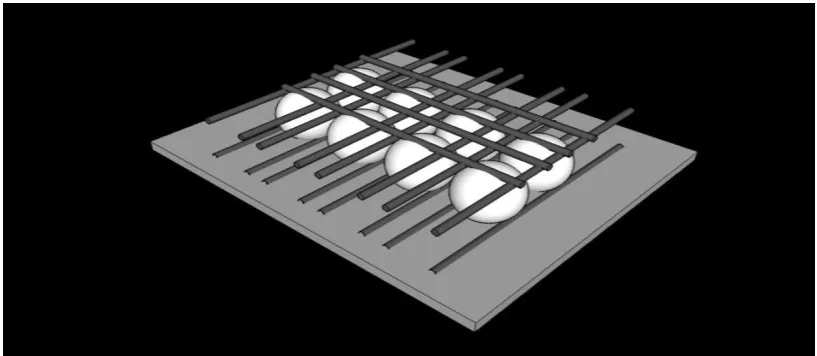
Type A- Filigree Elements :- Bubble deck type A is a combination of constructed and unconstructed elements. A 60mm thick concrete layer that acts as both the formwork and part of the finished depth is precast and brought on site with the bubbles and steel reinforcement unattached. The bubbles are the supported by the temporary stands on the precast layer and held in place by a honeycomb of interconnected steel mesh. Additional steel may be inserted according to the reinforcement requirements of the design. The full depth of the slab is reached by the common concreting techniques and finished necessary. This type of BubbleDeck is optimal for new construction projects where the designer can determine the bubble position and steel mesh layout.
Type B- Reinforcement Modules :- It consists of a pre-assembled sandwich of steel mesh and plastic bubbles, or “ bubble lattice”. These components are brought to the site, laid on traditional formwork, connected by the
additional reinforcement, and then concreted in place of traditional methods. This category of BubbleDeck is optimal for construction areas with tight spaces since these modules can be stacked on top of one another for storage unit needed.
385 | P a g e
Fig. 1.1- Types of BubbleDeck Slab
II. LITERATURE REVIEW
In the 1990's, Jorgen Breuning invented a way to link the air space and steel within a voided biaxial concrete slab. The Bubble Deck technology uses spheres made of recycled industrial plastic to create air voids while providing strength through arch action. See Fig 2.1 for a section cut of a Bubble Deck. As a result, this allows the hollow slab to act as a normal monolithic two-way spanning concrete slab. These bubbles can decrease the dead weight up to 35% and can increase the capacity by almost 100% with the same thickness. As a result, Bubble Deck slabs can be lighter, stronger, and thinner than regular reinforced concrete slabs. Currently, this innovative technology has only been applied to a few hundred residential, high-rise, and industrial floor slabs due to limited understanding.
386 | P a g e
In June, 2010, Tina Lai(1) studied the structural behavior of BubbleDeck Slab and Their Application to
Lightweight Bridge Decks at the Massachusetts Institute of Technology. Author stated that bubble deck slab system is a revolutionary concrete floor system developed in Europe. High-density polyethylene hollow spheres replace the ineffective concrete in the center of the slab, thus decreasing the dead weight and increasing the efficiency of the floor. These bi-axial slab have many advantages over the conventional solid concrete slab: lower total cost, reduced material use, enhanced structural efficiency, decreased construction time and is a green technology. Through tests, models and analysis from a variety of institution was proven to be superior than traditional solid concrete. Deflection of the slab is slightly more than the traditional slab and the shear and punching shear is significantly less than a solid deck slab since shear resistance is directly related to the depth of concrete.
The author modeled and analyzed the office floor slab and bridge slab using this technology by using SAP 2000. The results stated by the author proves that the Bubble Deck Slab performed better than a traditional solid concrete, bi-axial slab. This technology is more efficient in office floor system and the performance of the voided slab is not as successful in a bridge slab. The Continuous, Simply supported bay layout of this bridge was not optimal for this system since it generated a one way slab response rather than a biaxial one.
In 2012, Prabu Teja, P Vijay Kumar, S. Anusha, CH. Mounika, Purnachandra Saha(2) discussed various
properties of Bubble deck slab based on the various studies done abroad. Moment, deflection and stress distributions are verified using Finite Element Method (FEM) in SAP2000. And from their study, they
concluded that . Bending stresses in the bubble deck slab are found to be 6.43% lesser than that of a solid slab.
Deflection of Bubble deck is 5.88% more than the solid slab as the stiffness is reduced due to the hollow portion. Shear resistance of bubble deck slab is 0.6 times the shear resistance of the solid slab of same thickness. However required resistance can be achieved by providing vertical reinforcement. Weight reduction is 35% compared to solid slab. This innovative slab system with considerable reduction in self-weight and savings in materials combines all advantages of the other floor systems, solving all problems caused by their disadvantages in the same time. Besides that the new floor system enhances the structural possibilities in combination with an improved cost-effectiveness. Further on the floor system gives a tremendous contribution to sustainable development.
In 2009, Sergui Calin, Roxana Gintu and Gabriela Dascalu(3) stated the various tests and studies done on the Bubble deck slab. From their study they concluded that Bubble Deck will distribute the forces in a better way (an absolute optimum) than any other hollow floor structures. Because of the three dimensional structure and the gentle graduated force flow the hollow areas will have no negative influence and cause no loss of strength. Bubble Deck behaves like a spatial structure – as the only known hollow concrete floor structure, the tests reveal that the shear strength is even higher than presupposed, this indicates a positive influence of the balls. All tests, statements and engineering experience confirm the obvious fact that Bubble Deck in any way act as a solid deck and consequently. It will follow the same rules/regulations as a solid deck (with reduced mass), and further it leads to considerable savings.
In April / May 2014, Saifee Bhagat and Dr. K. B. Parikh(4), did research on Parametric Study of R.C.C Voided
387 | P a g e
plate slabs is calculated to compare the both systems. To evaluate the performance of the R.C.C voided and solid flat plate slabs, modelling of slabs is carried out using SAP 2000 having span ranging from 6x6 m to 14x14 m of 4x4 bay in both direction with thickness of the slabs 280 to 600 mm. The results drawn from the SAP 2000 are Reaction, Deflection, Moment and Reinforcement required for the voided and solid flat plate slabs.
From the results it may be conclude that, for all the cases of the voided flat slab, the results for deflection is almost same as compared to that of solid flat slabs under same loading and at the same point. Therefore, by applying the stiffness multiplication factor, we can obtain the deflection of the voided flat slab same as solid flat slab. Same as deflection, results of moment is also observed for various cases of voided and solid flat plat slabs. From the results, it may conclude that, due to reduced self-weight of the voided flat plate slab, the moment of the slabs is reduced from 7 to 10 % of the solid flat slab at the same point under same loading condition. As, the moment occur per unit width of the voided slab is less than that of solid flat slab; the reinforcement required for the voided flat slab is also reduced. Due to that, the self-weight of the voided slab further reduced up to 20% of the solid flat slab. Therefore, from this study we can conclude that, the voided flat plate slab can designed by using traditional design principles of solid flat slab by substitution of stiffness multiplication factor and modified self-weight of the voided flat slab.
In 2010 S Anusha, C.H Mounika and Purnachandra(5) conducted studies on the fire resistance of Bubble deck
slabs. The analysis was first done on a hollow core slab without fire, for two charges one that leads to elastic dynamic response and the other that causes plastic behavior and severe concrete cracking. The same blast analysis had been subjected to fire. There were many difficulties in obtaining a reliable result. A discussion of the experimental setup and experimental results are compared with simplified numerical models solved with the software LS-DYNA. Fire does not change the material and structural properties that fast as compared to an explosion. The most important conclusion of the analysis is that crack patterns and blast load dynamic responses are indeed altered by fires with temperature up to 4500C. Yet within the limitations of assumptions concerning boundary conditions, the examined slabs keep their blast bearing capacity after blast load scenarios up to 1.5kg C4 with at 1m standoff distance.
A study has been conducted by Amer M Ibrahim, Nazar K Ali, Wissam Di Salman(6) in 2012 on the flexural
388 | P a g e
on reinforced concrete structures and we use lots of cement, which indirectly affecting the environment due to emission of CO2 .
III.MATERIALS
Bubble deck slab is composed of three main materials; they are steel, plastic spheres and concrete:
3.1 Concrete:- The concrete is made of standard Portland cement with max aggregate size of 20 mm. No plasticizers are necessary for concrete mixture. Tests have proved that the characteristic compressive strength of concrete is achieved by bubble deck slabs in the same manner as that of solid slabs.
3.2 Steel:- The steel reinforcement is of grade Fe500 strength or higher. The Reinforced Steel mesh is created over the ball and below the ball so that the ball can be placed with out any movement. Proper locking of bubbles are only possible by placing them in reinforcements. Extra bars and shear bars are provided when required. Mostly shear bars are provided near the columns.
3.3 Plastic Hollow Spheres:- The hollow spheres are made from recycled high-density polyethylene or HDPE. Plastic Hollow Spheres are available in different sizes based on the size of structure. These balls can be reused again or recycled. Thus contributes to the green properties of bubble deck slab.
IV. ADVANTAGES
4.1 Material And Weight Reduction
The dominant advantage of a Bubble deck slab is that it uses 30-50% less concrete than normal solid slabs. The HDPE bubbles replace the non-effective concrete in the center of the section, thus reducing the dead load of the structure by removing unused, heavy material. Decreased concrete material and weight also leads to less structural steel since the need for reinforcement diminishes. Overall, due to the lighter floor slabs, The beams, columns, footing and foundation can be designed for the lower loads, thus reducing the weight of the overall structure.
4.2 Structural Properties
Due to the lower dead weight of the slab and its two-way spanning action, load-bearing walls become unnecessary. Bubble deck is also designed as a flat slab, which eliminates the need for support beams and girder members. As a result, these features decrease some of the structural requirements for the columns and foundations. Additionally, Bubble deck slabs can be designed and analyzed as a standard concrete flat slab according to research performed on its strength and ductility.
4.3 Construction And Time Savings
Bubble deck can be fully shop fabricated and transported on site for installation as well. On-site installation takes less time as there are no beams so the formwork will be just plane and the meshing of the reinforcement bars will be easily binded with of less diameter of bar and time savings can also be achieved through the faster erection of walls, columns and MEPs due to the lack of support beams and load bearing walls for this innovative
flat slab. Addition time may be saved from the quicker curing time since there is less concrete in the slab
.
389 | P a g e
In relation to the savings in material and time, cost reductions are also typical with the Bubble deck system. The decreased weight and materials mean lower transportation costs, and would by more economical to lift the components. With less on-site construction from the full and semi-precast modules, labor costs will decrease as well. In addition, money can be saved downstream in the design and construction of the building frame elements (columns and walls) for lower loads. There is a slight rise in production costs for the Bubble deck slab due to the manufacturing and assembly of the HDPE spheres. However, the other savings in material, time, transportation and labor will offset this manufacturing price increase
4.5 Green Design
The number of owners, designers and engineers who desire green alternatives is growing exponentially. Bubble deck is a fitting solution for lowering the embodied carbon in new buildings. According to the Bubble Deck company, 1 kg of recycled plastic replaces 100 kg of concrete. By using less concrete, designers can save up to 40% on embodied carbon
in the slab, resulting in significant savings downstream in the design of other structural members. Carbon emissions from transportation and equipment usage will also decrease with the use of fewer materials. Additionally, the HDPE bubbles can be salvaged and reused for other projects, or can be recycled.
V. COMPARISON BETWEEN BUBBLE DECK SLAB AND SOLID DECK SLAB
5.1 Shear strength and punching shear:
The results of a number of practical tests confirm that the shear strength depends on the effective mass of the concrete. The shear capacity is measured to be in the range of 72-91% of the shear capacity of a solid deck. In calculations, a factor of 0,6 is used on the shear capacity for a solid deck of identical height. This guarantees a large safety margin. Areas with high shear loads need therefore a special attention, e.g. around columns. That is solved by omitting a few balls in the critical area around the columns, therefore giving full shear capacity. 5.2 Bending Strength and Deflection Behavior:
BubbleDeck where compared to a solid deck both practically and theoretically. The results in the table below show that for the same deck thickness the bending strength is the same for BubbleDeck and for a solid deck and
that the stiffness of the BubbleDeck is slightly lower. But technical university of Denmark also carried out test
on stiffness of bubble deck slab. They verified the result and they found out, for same strength, bubble deck has 87% of bending stiffness of similar solid slab but only 66% concrete volume due to HDPE spheres.
5.3 Anchoring
The anchoring in the two types is identical. The balls do not influence the anchoring. 5.4 Sound
A comparison was made between BubbleDeck and one-way prefabricated hollow deck of similar height. The noise reduction with BubbleDeck was 1 db higher than the one way prefabricated hollow deck. The main criterion for reducing noise is the weight of the deck and therefore BubbleDeck will not act otherwise than other deck types with equal weight.
5.5 Creep
No significant difference between BubbleDeck and solid deck.
390 | P a g e
5.6 Comparison in Cost
Only differences in materials concerning the slabs are considered. For the same amount of steel and concrete, Bubble Deck has 40 % larger span and is furthermore 15 % cheaper. For the same span, BubbleDeck reduces the amount of concrete with 33 %, and reduces the price with 30 %.
5.7 Comparison in Weight between the Bubble and the same Sphere of Concrete.
Considering the HDPE Hollow Ball Thickness to be 150mm in diameter. And it replaces the middle concrete sphere of the same diameter. So the concrete sphere is of 150 mm in diameter. The weight of the HDPE Hollow Ball weighs 154 grams as shown in fig. 5.1.
Fig. 5.1:- Measuring Weight of Hollow HDPE ball on Weighing Machine
Calculation of the weight of the Concrete sphere.
Unit Weight (Density) of Concrete = 2500 kg/m3
Density = Mass/Volume
So we need Mass, i.e. formula is Mass=Density X Volume
Volume of Sphere of 150mm diameter =(4/3)πr3
Radius = 0.075m, π = 3.14.
Volume of Sphere = (4/3)X3.14X(0.075)3
= 0.001766 m3
Mass = 2500kg/m3 X 0.001766m3
Mass of 150mm Diameter Concrete Sphere = 4.415 kg.
The Difference between the weight of ball and weight of Concrete sphere = 4.261 Kg.
VI. CONCLUDING REMARKS
In the present scenario of the construction industries we need different types of methods which are more economical, easy to construct and environment friendly. The Bubble Deck Slab is one the technology which
helps us to achieve the economy, easy to construct and environment friendly. Bubble deck Technology is the
391 | P a g e
BubbleDeck eliminates up to 35% of the structural concrete. When coupled with the reduced floor thickness and facade, smaller foundations and columns, construction costs can be reduced by as much as 10%. In Comparison with weight of the structure, Bubble Deck Slab is lighter than the Solid Deck Slab.
The BubbleDeck system offers a wide range of advantages in building design and during construction. There are a number of green attributes including; reduction in total construction materials, use of recycled materials, lower
energy consumption and reduced CO2 emissions, less transportation and crane lifts that make BubbleDeck more
environmentally friendly than other concrete construction techniques.
BubbleDeck Slab is suitable for use in all building types especially open floor designs such as commercial, educational, hospitals and other institutional buildings.
In the end we can conclude that the future of construction is BubbleDeck Slab and more studies, researches and experiments for the various sizes of the HDPE Hollow ball and the thickness of the slab are required to gain its popularity and usage of this technology.
VIII. ACKNOWLEDGEMENT
This work has been carried out in Civil Engineering Department of Mahatma Gandhi Mission’s Jawaharlal Nehru Engineering College, Aurangabad, India. The author presents its heartiest gratitude towards Professor Dr. Madhuri N. Mangulkar, Department of Civil Engineering, Mahatma Gandhi Mission’s Jawaharlal Nehru Engineering College, Aurangabad, India, for constant encouragement, guidance and support.
REFERENCES
[1] Tina Lai ”Structural behavior of bubble deck slab and their applications to lightweight bridge decks” M.Tech thesis, MIT, 2009.
[2] P. Prabhu Teja, P. Vijay Kumar, S. Anusha, CH. Mounika- March-2012-“Structural behavior of bubble deck
slab”, JISBN: IEEE,Vol:81-pages:383-388 ISBN: 978-81-909042-2-3.
[3] Sergiu Călin, Roxana Ginţu and Gabriela Dascălu, ”Summary of tests and studies done abroad on the Bubble deck slab system”, The Buletinul Institutului Politehnic din Iaşi, t. LV (LIX), f. 3, 2009.
[4] Saifee Bhagat and Dr. K. B. Parikh Parametric Study of R.C.C Voided and Solid Flat Plate Slab using SAP
2000, IOSR Journal of Mechanical and Civil Engineering (IOSR-JMCE), e-ISSN: 2278-1684,p- ISSN:
2320-334X, Volume 11, Issue 2 Ver. VI (Mar- Apr. 2014), PP 12-16.
[5] Bubble deck design and detailing,BubbleDeck Voided Flat Slab Solutions- Technical Manual and Documents (2007).
[6] BubbleDeck Slab properties " Bubble Deck Voided Flat Slab Solutions- Technical Manual and Documents (2006).
[7] BubbleDeck-UK". "Lighter Flat Slab Structures with Bubble Deck." (2006).
[8] BubbleDeck Engineering Design & Properties" Overview." Bubble Deck Voided Flat Slab Solutions- Technical Manual and Documents (2007).
[9] BubbleDeck International. "The Light weight Biaxial Slab." Bubble Deck(n.d):1-4.
392 | P a g e
[11] Arati Shetkarand & Nagesh Hanche an Experimental Study On bubble deck slab system with elliptical balls, NCRIET-2015 &Indian J.Sci.Res. 12(1):021-027, 2015.
[12] Saifee Bhagat, Dr. K. B. Parikh Comparative Study of Voided Flat Plate Slab and Solid Flat Plate Slab, ISSN 2278 – 0211, Vol. 3 Issue 3, March, 2014.
[13] Saifee Bhagat and Dr. K. B. Parikh Parametric Study of R.C.C Voided and Solid Flat Plate Slab using SAP
2000, IOSR Journal of Mechanical and Civil Engineering (IOSR-JMCE), e-ISSN: 2278-1684,p-ISSN:
2320-334X, Volume 11, Issue 2 Ver. VI (Mar-Apr. 2014), PP 12-16.
[14] Amer M. Ibrahim, Nazar K. Ali, Wissam D. Salman “Flexural capacities of reinforced concrete two-way
bubble deck slabs of plastic spherical voids” Diyala Journal of Engineering Sciences, ISSN 1999-8716,
Vol. 06, No. 02, June 2013.
[15] L. R. Terec, M. A. Terec The bubbledeck floor system: a brief presentation, CS I, INCD URBAN-INCERC Branch of Cluj-Napoca, CONSTRUCŢII – No. 2 / 2013.