1078 |
P a g e
An Effective E-Learning Services using Different Web
Service Component Interfaces
Dr.M.Balakrishnan
1, Dr.A.B.Arockia Christopher
2Assistant Professor (SG)
1, Assistant Professor(SG)
2, Department of Information Technology,
Dr.Mahalingam College of Engineering and Technology, Pollachi, Tamilnadu (India)
ABSTRACT
A web service is defined as a software system which communicates with the applications over the network in an independent manner. At the present time, every type of communication has been taking place online. To efficiently use E-learning many online tutorial services have been developed. With this new online tutorial service in hand the students can therefore learn all of them through Internet. An earlier technique has been developed for intervention infrastructure which provides an E-learning system using Smart Space Learning System (SSLS). The main concern over SSLS is that it cannot be applied to an information technology mediated learning which has closed information environments. Another technique for E-learning service is that Open Smart Classroom (OSC), on open smart platform to facilitate intercontinental and intercultural class with superior features. The main flaw in OSC is that it provides E-learning services to only intercultural students which are highly unreliable to use. To overcome the above issues, a new framework is presented in the research paper, in order to provide efficient interface between web services and components, Online Tutoring Framework for learning system using Web Service technology (OTFWS) is introduced to present an E-learning system in a well-organized way.
Keywords:
E-Learning, Open Smart Classroom, Web Services, SSLS, OTFWS
.
I. INTRODUCTION
With the rapid increase in network applications, the main focus concerns with the vision by providing
computer-based media support, where no extravagant training is required. Among these applications, E-learning systems
are rapidly gaining the significant popularity. Some of the features that made E-learning technology worthwhile
are the easier-to-use development tools, cost optimization, extensive broadband channels and extraordinary
higher returns. The above said factors are obtained in the form of increased learner productivity, have made the
E-learning technology more attractive to a wider variety of institution and individual users.
Various studies conducted on learning confirm the fact that the type of computer-based media combined with
E-learning materials has a higher range of significant impact on the volume of information retained, received and
recalled by the learners. Several web-based techniques are used to develop online learning systems.
From an E-learning 2.0 perspective, traditional E-learning systems were usually designed on the basis of
instructional packets, which were provided to the students in addition to the assignments that were evaluated by
the teacher. When compared to the conventional method, the E-learning 2.0 maximized the emphasis on social
1079 |
P a g e
suitable user environment has not yet been found, but the individual interface are sufficiently enough to a certain
specific point when it becomes feasible to design systems capable of making a positive impact on the E-learning
experience. Center to such systems is a conversational interaction using speech recognition and text-to-speech
synthesis.
In conventional method, learning takes place between the students and teachers using face to face method which
was assumed as a better learning system. With the development of technology, new ways of communication has
expanded many new things i.e., now everything is based on the Internet. As a result, even the tutoring system is
also being performed online which is referred to as online tutoring. Many web services have been developed for
online tutoring system which requires certain electronic tools to deliver the information online.
In the past, online tutoring was performed using Email where a student sends a question to the tutor, with the
anticipation that the Email returned will consists of the answer. As an alternative, what happened was a
disconnection. Even though the student can expect and provide answers using face-to-face tutoring conference,
the Email format recommended the student to answer the question with a straight answer.
Though the web enables a student to select from different form of educational resources, but it is difficult for the
learners to find appropriate learning services such as courses, seminars, and web-based training applications.
Corporate learners and independent learners obtain the services of learning using the heterogeneous properties
and the sources are also obtained from heterogeneous in nature. But at the same time, the rationality with which
the process of selection is performed by a student is limited for the following reasons (i) the limited overview
availability of the learning services, (ii) limited capabilities of processing all the information describing learning
services.
II. BACKGROUND WORK
The online environment whenever applied in the field of education uses the learning environment in virtual
manner. Some of them includes are Modular Object Oriented Dynamic Learning Environment (Moodle), Sakai,
dedicated community who work together to develop a common collaboration and learning environment and
applying the conventional blackboard practices. The process of online tutoring can be either provided directly or
through a link. With the help of virtual learning environment, online tutoring is offered directly and with the
help of the learning management system, it is provided with the help of a link. In the specific case, the student
using the online tutoring process has to pay for the used tutoring time before actual delivery of service takes
place. But many educational institutions and popular publishers of major textbook sponsor on behalf of the
student, by sponsoring certain amount of tutoring without making a direct charge to the learner.
Yue et al (2009) developed a human-computing interaction named Component-based Open Smart Classroom
Model (COSCM). In this COSCM more and more natural human-computing interfaces were incorporated for
enhancing work efficiency. In the learning environment, human-computing interface assists the teacher to teach
in the class. It helps the students to learn and discuss with others. The progression of human-computing interface
was then integrated to improve the work efficiency in E-learning system. The major problem related to COSCM
1080 |
P a g e
RealXtend as fully executed using the new Tundra Software Development Kit (SDK) and also included an
add-on for the open simulator server. The designed framework treated the primary elements of virtual worlds by
(Alatalo 2011) as add-in functionality, with the overall architecture providing a wider range of virtual worlds.
The attribute values were automatically synchronized between the participants in a networked environment.
Mansour & Dillon (2011) proposed a service-oriented reliability model that dynamically calculates the
reliability of compound web services with rollback recovery based on the real-time reliabilities of the atomic
web services of the composition. In this case, the broker reception testing mechanism examined the results
returned from a particular web service. If it is acceptable, then the calculation continues to the next web service.
The interaction between the human and computer plays the key role for E-learning concepts. Munoz et al (2011)
proposed an interactivity model which is holds the main characteristic of tradition face-to-face teaching. It was
considered as the vital method in the design of such arbitrated instructional settings as Computer-Assisted
Instruction (CAI), computer-assisted learning. E-learning with the multimedia and graphical boundary is now
stylish in most of the effectual knowledge environments.
A large number of software component models were developed with different aims using different principles.
Crnkovic et al (2011) provided a comprehensible concept and differentiate component models more effortlessly
by classifying the large number of component model framework. The advantage of the system being the usage
of components and the limitation was the application of components-based model in only specific research
areas. The two most important subject of analysis in software engineering and parallel distributed systems are
the component-based system and program construction.
Brut et al (2011) provided a solution to enhance learning object model with ontology-based semantic
annotations for efficient use of learning objects. The data model was first presented. Followed by this, the
technique called as indexing was designed in order to acquire better measure of learning resources by
integrating both the methods for indexing based on structure and the WordNet-based text processing based on
the linguistic-oriented method. Two important activities were highly required during the transfer protocol which
included the web application and significant payload encoding for the successful accomplishment of embedded
web services. (Shelby 2010) analyzed the most promising payload encoding techniques and also introduced the
new Internet Engineering Task Force (IETF) Constrained REstful Environments (CoRE) standardization activity
which varied in large way according to the attitude and characteristic features of the student.
To overcome the scalability issue, Si et al (2010) designed an approach for disseminated Semantic Web Services
(SWS) discovery based on peer-to-peer and semantic web service technology. Adopting Ontology Web
Language System - Test Collection3 (OWLS-TC3) as untried data and testing continuously proved to be a
scalable, flexible and effective method to publish and discover SWS in distributed environment.The suitability
of the model designed by Si et al (2010) was designed to be scalable but only served for distributed environment
and not for heterogeneous type of network and finally quality of service was not provided.
Learning objects were classified in an automatic manner using dimensionality reduction and feature subset
selections in an E-learning system by Chellatamilan & Suresh (2012). The author collected the user query and
integrated it into different Learning Object Repository, (LOR). The LOR was then evaluated and interacted with
1081 |
P a g e
Metadata (LOM). Semantic Oriented Web Services (SOWS) considered the semantics of the web service as
developed by Khdour & Fasli (2010) for automating the process. The major hurdles in SOWS were that the
recent web service matchmaking checked the capabilities of the requested web service against the capabilities of
all advertised web service advertisements in the registry. Once the number of advertised web services in the
registry gets increased, the process of checking all advertised web services against a single client query becomes
consuming process.
Yiqun et al (2012) presented an application on smart phones for the sake of mobile learning in an interactive
manner. Image recognition technology is used to link physical objects seen through the camera, to pertinent
information through the built-in camera on the smart phone, visual interactive learning are realized. With the
Global Positioning System (GPS) sensor, the activation of learning based on the location was only possible with
the combination of both the camera and the GPS sensor on the phone.
III. DIFFERENT WEB SERVICE TECHNOLOGIES
3.1
Online Tutoring
Online tutoring is the process of tutoring in an online mode. It is a virtual environment or network environment
in which teachers or professors and learners or the students in an engineering institution are separated by time
and space. Online tutoring, as a reflection of the diversity of the wider Internet, is practiced using different
approaches and addressed to distinct sets of users. The distinctions are in online content and interface, as well as
in tutoring and tutor-training methodologies. While information system plays key role in several organizations,
their utilization is not limited to business domains. Nowadays, ‘information systems’ is a common term used to
depict any means of processing, storing and accessing information for all types of disciplines. The concern is to
provide online learning and in particular providing access to course information and learning material.
3.2 The Evolution of Online Resources
Though the initiation of online tutoring models started with Email, there has been increasing number of new
models both in the form of synchronous and asynchronous format. The following models are presented in the
context of the specific tool used, for example, web board or Net Tutor. For example, one of the most significant
models of tutoring online is the accounting faculty at Paradise Valley Community College (PVCC). The design
of this tutoring online includes web pages and the application of an asynchronous discussion forum, called web
board. Here the tutor began the web page by including the list of all the chapters present in the accounts
textbook and also included the FAQ related to each chapter. As a result, the students could refer to the answers
of the FAQs before making contact with a tutor. Tutors could follow up on questions on the web board for all
the students or chat individually with a student. This resource became so popular that students outside the
college soon started to use it.
3.3 Online Tutoring for Online Classes
Online tutoring is all about using web services or the Internet for tutorials or tutoring activities. Students would
be learning from their tutors through the use Internet. Online tutoring for online classes require certain types of
applications including instant messaging in order to make the discussions effective. Apart from the
1082 |
P a g e
Search
Found
Discover Lookup
Server level (Web services) Middleware component
framework
Service repository
Client level (tutor/student)
amount of quiz, publication of exam results and recommendations for other programs are also performed
through the Internet. The attitude of parents with respect to tutors changes according to the knowledge of
children. Some parents prefer regular and ethical tutors who follow the traditional model of teaching their
children often face to face. Some other parents on the other hand prefer online tutoring services because their
children may possess higher level of knowledge and productive.
3.4 Web Services for Online Tutoring Service
Web services for online tutoring service involves a method that efficiently communicates between two
electronic devices over the Internet. The concrete agent consists of the concrete piece of a specific service that
sends and receives messages, whereas the service comprises of resource that are in a way significantly
characterized and provided by specific set of functionality. In order to illustrate this, a specific web service is
deployed using one concrete agent one day written specifically in one programming language while another
concrete agent writes in a different language the following day. Although the agent may have changed, the web
service remains the same.
3.5 Server Layer –Web Services
The web services are hosed in the web services that mainly consist of different mainframe computer servers that
are located either in earth control centers or in a space station in the low earth orbit. These servers define the
execution of the web services, process tutor/student’ requests, execute business logic, and perform intensive
calculations on behalf of the tutor/student. The web services are of any type, protocol, or version and interact
with the middle component framework via web service interface. Each time a new web service is integrated into
the system, the middleware interactive components save itself inside an internal registry, along with other
important details. The middle component framework then exposes to the tutor/student allowing it to call
remotely all available functions.
3.6 Middleware Component Frameworks for Building Online Tutoring Framework
This section discusses in detail about the middleware component framework for building Online Tutoring
Framework for E-learning systems using Web Service technology (OTFWS) software components. The
OTFWS is a distributed model made out of loosely-coupled interoperable web services. The communication
between the client (tutor/student) and the web services is bi-directional and it is performed in a remote manner
with the help of the middleware.
1083 |
P a g e
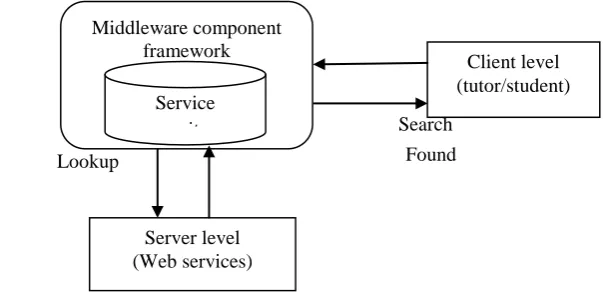
Figure 3.1 illustrates the middleware component framework using web service software components with its different levels.
Essentially, the middleware component framework is composed of three basic levels: The first level is the client (tutor /
student) level which invokes methods of web services to perform operations such as examining materials, analyzing learning
environment, studying and assessing the queries, and capturing and processing images for different types of applications.
The second level is the server represented by the web services. The web services provide the actual learning services. The
third and final level is the middleware represented by the standard interface and a unified data-path for both the client and
the server levels to interoperate efficiently and exchange the data regardless of their incompatible platforms and
implementation technologies. In fact, the service requester (Tutor/student from client level) is a client application requesting
a particular functionality from the service provider, and the service provider is usually a server that hosts and runs the actual
web service.
The middle component framework (interface) delivers a transparent communication between the different components of the
OTFWS allowing them to interoperate, despite their underlying incompatible technologies and platforms. The algorithm for
communication process is described as shown in Figure 3.2:
Algorithm:
Figure 3.2 Algorithm for middleware component communication process
The process of the algorithm is first tutor or student invoking the web services and the requested metadata to the
server. The middleware interactive components receive the request message and process it if the message is
validate then converted into destination web service. Once the process is complete the web services are
translated to the client requested format to the tutor/learner.
IV. EXPERIMENTAL RESULTS
4.1 Speed of Message Transfer
Message transfer refers to the rate at which the message is transferred and delivered to the students. The
outcome of the online tutoring framework for E-learning system using web service technology is compared with
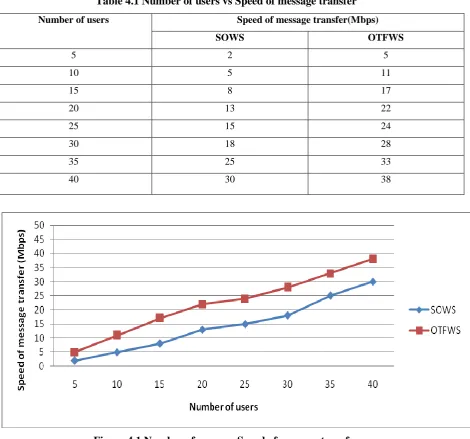
an existing semantic oriented web services. The table 4.1 describes the speed of message transfer after which Input: Tutor and Student
Process: Different Middleware Components Output: Transfer the message from Tutor to Learner Steps:
Step 1: The tutor/student invokes web service.
Step 2: The request encapsulates metadata describing the request message, including the source client, the destination service, and a set of parameters.
Step 3: Middleware interactive components receives request message
3.a: It first validates the correctness and then converted into the destination web service
3. b:Middleware interactive components uses an internal registry to lookup the technical details about the destination web service components.
Step 4: Middleware interactive components routes the converted request to the web service interface that is compatible with the addressed web service
Step 5: The web service interface then locates the corresponding web service and gets bound temporary to it and starts executing the requested function
Step 6: Once processing is done, a response is sent back from the destination web service to tutor/learner.
6.a:It is first sent to the web service interface, then to the middleware interactive components, then
translated to client requested format, and eventually routed to the tutor/learner.
1084 |
P a g e
have been applied through an web interactive component interface model. The outcome of the online tutoring
framework for E-learning system using web service technology is compared with an existing semantic oriented
web services.
Table 4.1 Number of users vs Speed of message transfer
Number of users Speed of message transfer(Mbps)
SOWS OTFWS
5 2 5
10 5 11
15 8 17
20 13 22
25 15 24
30 18 28
35 25 33
40 30 38
Figure 4.1 Number of users vs Speed of message transfer
Figure 4.1 describes the message transferring speed when more number of users involved in the E-learning
system. Since the proposed work used web service component interface for middleware common component
framework, the E-learning concepts outperforms well for both the students’ and the tutors. Compared to the
Semantic Oriented Web Services (SOWS), the Online Tutoring Framework for E-learning system using Web
Service technology (OTFWS) provides high speed of message transfer because of the fact that services
(contribution of faster E-learning services) are deployed in the design phase and there is not separate
1085 |
P a g e
4.2 Maintenance of Tutoring Sessions
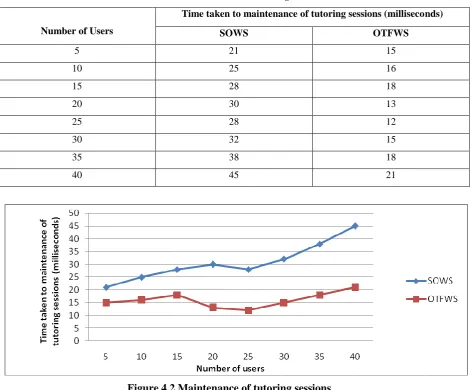
Maintenance of tutoring session describes how the tutoring sessions are maintained based on services, tutoring
process, and the time taken to analyze the skills of the students’ and to learn it. Table 4.3 describes the
maintenance of tutoring sessions and the function of number of users.
Table 4.2 Maintenance of tutoring sessions
Number of Users
Time taken to maintenance of tutoring sessions (milliseconds)
SOWS OTFWS
5 21 15
10 25 16
15 28 18
20 30 13
25 28 12
30 32 15
35 38 18
40 45 21
Figure 4.2 Maintenance of tutoring sessions
Figure 4.2 illustrate the amount of time taken to maintain the tutoring sessions in proposed OTFWS and
existing SOWS tutoring scheme. Since the services are built as components framework, the maintenance of
tutoring sessions are easy. When number of users (both learners and tutors) increases, the maintenance
efficiency of tutoring sessions is also being high and maintenance time is less in the OTFWS scheme. The
maintenance time is lesser due to the fact that an interface is built based on back end web service and
middleware interactive components embodied by unique code when compared to semantic oriented model.
4.3 Communication Efficiency
Communication efficiency refers to the effectiveness of the communication i.e., the communication between
the students and trainers while tutoring in the class using effective communication and resource tools. The
1086 |
P a g e
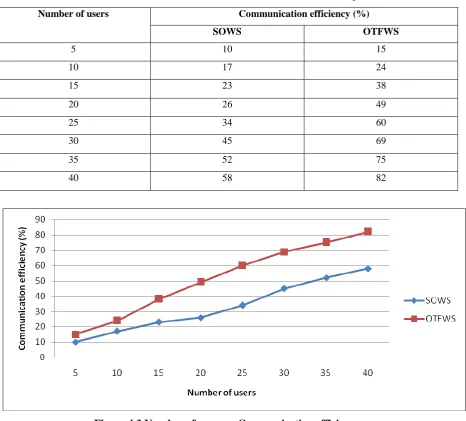
existing semantic oriented web services. The table 4.3 describes the efficiency of communication services after
which have been applied through an interface model. The outcome of the online tutoring framework for
E-learning system using web service technology is compared with existing semantic oriented web services.
Table 4.3 Number of users vs Communication efficiency
Number of users Communication efficiency (%)
SOWS OTFWS
5 10 15
10 17 24
15 23 38
20 26 49
25 34 60
30 45 69
35 52 75
40 58 82
Figure 4.3 Number of users vs Communication efficiency
Figure 4.3 describes the effectiveness of the communication between the tutor and student. In the proposed
OTFWS, the communication is performed through an interface and the students also get their response as soon
as possible from the tutor regarding the course, discussion forums, logistics, syllabus, videos, messaging
services with communication and resource tools in middleware component.
Communication efficiency is measured in terms of response obtained between the tutor and student. Compared
to existing semantic oriented web services, the online tutoring framework for E-learning system using web
service technology is efficient (contribution of communication ability of the research). As the communication
1087 |
P a g e
with the help of the middleware, results in the increased communication level and provides efficient web service
component framework for communication services.
V. CONCLUSION
New challenges and requirements increased by E-learning systems have been pointed out, in this study of work
and to meet them, anonline tutoring framework is developed using web service technology. The evolution of
online tutoring has shown that success may not depend so much upon the tool selected, but on the development
of an appropriate culture for online tutoring, an understanding of the process and parameters involved. Learning
services which make use of physical or human resources are offered according to the specific schedule since the
use of those resources need to be managed. The experimental results show that the proposed OTFWS
outperforms well in online tutoring scheme by providing better learning services. The performance is evaluated
and the experimental results show an improved performance of communication rate, speed of message transfer
and maintaining tutoring session which proved the efficiency of interactive web service tutoring scheme for
E-learning.
REFERENCES
[1.] Alatalo, T 2011 ‘An entity-component model for extensible virtual worlds’, IEEE Internet Computing,
vol. 15, no. 5, pp. 30-37.
[2.] Brut, M.M, Sedes, F & Dumitrescu S.D 2011 ‘A semantic-oriented approach for organizing and
developing annotation for E-learning’, IEEE Transactions on Learning Technologies, vol. 4, no. 3, pp.
239-248.
[3.] Chellatamilan, T & Suresh, R.M 2012 ‘Automatic classification of learning objects through
dimensionality reduction and feature subset selections in an E-learning system’, IEEE International
Conference on Technology Enhanced Education (ICTEE), Kerala, India, pp.01-06.
[4.] Crnkovic, I, Sentilles, S, Vulgarakis, A & Chaudronn, M.R.V 2011 ‘A classification framework for
software component models’, IEEE Transactions on Software Engineering, vol. 37, no. 5, pp. 593-615.
[5.] Gang Chen 2009 ‘Improving system usability model in E-learning based on system-reasonable theory’,
International Conference on E-learning, E-Business, Enterprise Information Systems, and E-Government,
Hong Kong, China, pp. 72-75.
[6.] Khdour, T & Fasli, M 2010 ‘A semantic –based web service registry filtering mechanism’, International
Conference on Advanced Information Networking and Applications Workshops (WAINA), Perth,
Australia, pp. 373-378.
[7.] Mansour, H.E & Dillon, T 2011 ‘Dependability and rollback recovery for composite web services’, IEEE
Transactions on Services Computing, vol. 4, no. 4, pp. 328-339.
[8.] Munoz-Merino, P.J, Kloos, C.D & Munoz – Organero, M 2011 ‘Enhancement of student learning
through the use of a hinting computer E-learning system and comparison with human teachers’, IEEE
Transactions on Education, vol. 54, no.1, pp. 164-167.
1088 |
P a g e
[10.] Si Huayou, Zhao Yun, Qi Hengnian & Chen Zhong 2010 ‘An approach to distributed semantic web
services publication and discovery based on chord’, International Symposium on Computational
Intelligence and Design (ISCID), vol. 1, Hangzhou, China, pp. 84-87.
[11.] Yiqun Li, Aiyuan Guo, Lee, J.A, Yan Gao & Yii Leong Ling 2012 ‘Visual interactive and location
activated mobile learning’, IEEE International Conference on Wireless, Mobile and Ubiquitous
Technology in Education (WMUTE), Takamatsu, Japan, pp. 235-237.
[12.] Yue Suo, Miyata, N, Morikawa, H, Toru Ishida & Yuanchun Shi 2009 ‘Open smart classroom:
Extensible and scalable learning system in smart space using web service technology’, IEEE