IJEDR1604139
International Journal of Engineering Development and Research (www.ijedr.org)914
Optimized Distributed Generation sizing and
allocation using a novel Human Opinion Dynamics
Garima Sharma, Dr. Gursewak Singh Brar
Assistant Professor , Head of Department Electrical Engineering BBSBEC Electrical Engineering Department
UGI, Lalru, India
________________________________________________________________________________________________________ Abstract - The objective of this paper is to solve the problem of optimal allocation and sizing of distributed generation unit by using Human Opinion Dynamics method relied on Optimisation approach. Moreover, the algorithm has been improved by using maximum likelihood estimator and Social Score was also proposed instead of social rank. The algorithm has been applied for two Bus systems IEEE-14 and IEEE-30 bus systems and its constraints of power flow equations have been applied. The experimental results have been found to be relatively satisfactory in terms of convergence and accuracy.
________________________________________________________________________________________________________
I.INTRODUCTION
Distributed Generation generate the electrical power by applying of little generator, scattered influence system. The DGs are integrated to the utility grid with the help of power electronic devices enhancing their individual as well as collective efficiency and reliability. This concept is being followed by various developed countries like European countries and developing countries like India. In some cases Distributed Generation suggests significantly lower value and improved responsibility than a client will get from the electrical grid. In others, it will enhance the grid in order that the mixture of grid and metric weight unit will provide better performance than either might alone. In the DGs technology the distributed generator units are placed near the load in the distribution system and if properly operated they are very beneficial and can have a variety of advantages like improved reliability, improved power quality, less fluctuations of the voltage. The integration of DG in distribution system would lead to improving the voltage profile and reduce active power loss in Power supply. Optimization is a mathematical tool which can be used to locate and size the DG units in the system, so as to utilize these units optimally within certain limits and constraints. The optimal power flow problem has been introduced by Carpentier in 1962. It has taken over decades to develop efficient algorithms for its solution because it is a very large, non-linear mathematical programming problem. Many different mathematical approaches have been applied for seeking its solution.
Recently, Distributed Generation (DG) is an interesting topic. New DG technologies are developed and researched widely. However, considering the past, DG is not quite new idea. (Driesen&Belmans, 2006; Zareipour et al., 2004).In the past, people need to produce their own energy because there is no centralized power transmitted via grid such as using cook stove and diesel engine. Then DC electricity has proposed but there is the limitation about voltage drop when DC electricity is transmitted over long distance. So, AC electricity were developed and widely used. Nowadays, the fossil fuel such as oil and natural gas which is the primary energy being used for conventional generation is running out. In addition, the environmental impact about carbon emission is highly concern. Therefore, renewable energy becomes the alternative choices due to its environmental friendly. Mostly DG is produced by renewable energy such as solar PV, wind and hydro power. This leads to widely development in DG technologies. IEA has confirmed that DG interest is renewed due to modern technology, economic issue and environmental concern (The international Energy Agency, 2002).In general, DG may be defined as small-scale electric generator located locally at customer site. Mostly DG is produced by renewable energy such as solar PV, wind and hydro power. Mostly they use generation capacity (MW), voltage level, or generation technology as criteria.
II.LITERATURESURVEY
In this paper, Kean and Omalley presented optimal distributed generation in Irish system. Linear programming technique has been used in this work. The main objective of this paper was to maximize the distributed generations. The proposed approach is tested and implemented on one of the section of Irish distribution network. The simulation result has been presented which indicates that appropriate placement of EG is critical to accommodate the increasing levels of EG on distribution network.
In this paper, Kashem proposed an approach to reduce the power losses by optimizing in a distribution feeder. In this paper, sentiment analysis has been performed. In terms of DG operating point and DG size. The proposed approach has been generated with the load characteristics. The result has been indicated that 86% of real power loss may be minimized with DG of optimal size and it is placed at appropriate place in feeder.
In this paper, Griffin et al. proposed an algorithm to find the system losses and sensitive on eastern Washington system. The goal of their studies was to reduce line losses. one in every of the conclusions of analysis was that best location of Distributed Generation that is very smitten by the load distribution on the feeder; important losses reduction would occur once. The result show that the significance of placement for reducing losses and capacity savings.
IJEDR1604139
International Journal of Engineering Development and Research (www.ijedr.org)915
Generation. They planned Associate in Nursing thoroughgoing search by applying the sensitivity issue on all the buses and hierarchical them consequently.In this paper, Ackermann T et al. proposed to solve best Distributed Generation power output. In general, DG may be defined as small-scale electric generator located locally at customer site. Mostly DG is produced by renewable energy such as solar PV, wind and hydro power. Mostly they use generation capacity (MW), voltage level, or generation technology as criteria. The result shows that proposed approach is appropriate for power distribution system.
In this paper, Rosehart and Nowicki proposed the optimal location portion of Distributed Generation integration downside. in this paper, two formulation has been proposed to assess the simplest location for hosting the Distributed Generation sources. The results of proposed formulations were employed in ranking the buses for Distributed Generation installations.
In this paper, Carmen et al.proposed a technique for best distributed generation allocation and filler in distribution systems. The proposed approach is used to minimize the electrical network losses. Moreover, genetic algorithms (GA) techniques is solved by using the optimisation method with different ways to judge the Distributed Generation impacts in system irresponsibleness, losses and voltage profile.
In this paper, Haesen and Espinoza proposed the optimal Distributed Generation downside for single and multiple Distributed Generation filler. In this paper, Genetic Algorithm methodology has been used for investigating the Distributed Generation filler and placement problems.
In this paper, Gandomkar et al.to solve best Distributed Generation power output. In general, DG may be defined as small-scale electric generator located locally at customer site. Mostly DG is produced by renewable energy such as solar PV, wind and hydro power. Mostly they use generation capacity (MW), voltage level, or generation technology as criteria. The result shows that proposed approach is appropriate for power distribution system.
III.PROBLEMFORMULATION
The objective of this study is to solve the problems of power scarcity using distributed generation by encountering the challenges to this field. The major challenge of reducing the power loss in transmission will be addressed by optimal selection of size of the DG unit and their optimal location. This optimality can be achieved by using non-linear state estimation techniques combined with heuristic algorithms which has been recently seen as an improvement over the Newton-Raphson load flow method. A meta-heuristc algorithm will be designed to estimate the size of the DG unit and the optimal location of the units will be found b y considering the power loss. The problem statement of this paper is to minimise this loss and improve the voltage stability by developing a novel meta-heuristic algorithm which would solve the problem of optimal sizing and allocation of the newly added DG unit.
IV.PROPOSEDMETHODOLOGY
The main problem of this paper is to find a solution to the problem of optimal size and allocation of Distributed Generation units which are applied on any bus system. The aim of this paper is to develop one such algorithm. First, Load Flow analysis is performed using Newton-Raphson method and then the algorithms are applied to optimize the power flow. This section discusses the methodology which is required to solve the problem discussed in the previous section.
Two Algorithms have been implemented and compared for performance, namely-PSO and MHOD. The PSO is based on the food search methodology of birds while the MHOD is based on the group discussion behavior of individuals. They are discussed below. First Newton Raphson is applied and then the algorithm is used for tuning the same.
A. Newton-Raphson Method
In order to solve the load flow problem, expansion of the Newton-Raphson method is done first. In mixed rectangular-polar form it is expressed in equation 8-9 as:
..(8) Or, in abbreviated form,
. .. (9)
IJEDR1604139
International Journal of Engineering Development and Research (www.ijedr.org)916
voltage profile. The objective function is minimised using an improved Particle Swarm Optimisation with a reflection feature for constraint handling. Since, our problem is converted to a constraint optimisation problem; the original Particle Swarm Optimisation is modified to handle unfeasible solutions. Also the problem of size is a numeric estimation problem while the problem of allocation is an integer estimation problem hence the solutions are checked for their validity in the search space.B. Modified Human Opinion Dynamics based Optimisation (MHOD)
The paper proposes a novel Modified Human Opinion Dynamics (MHOD) based optimisation technique to solve the problem of optimal sizing and allocation. The problem at hand is a multi-objective constraint optimisation problem and it is attempted to be solved by the proposed algorithm. The Human Opinion Dynamics based Optimisation technique is a novel meta-heuristic algorithm based on the group discussion behaviour of humans. As the humans interact with each other, their opinion about any particular topic starts varying. This has been utilised in this paper and opinions are formed about the optimal sizing and the allocation of the new DG unit. These opinions are updated using the below mentioned algorithm.
V.RESULTSANDDISCUSSION
The task which is targeted in this paper is to solve the problem of Distributed Generation unit in terms of their optimal allocation. Two parameters namely- size and the location of the additional unit is targeted to be optimised. The optimisation process is a complex problem as it involves tuning of two parameters at a time and the objective function may have a lot of local minimas and maximas.
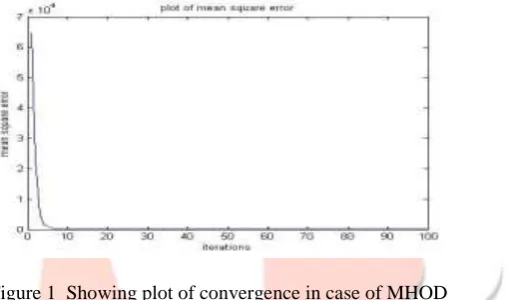
Figure 1 Showing plot of convergence in case of MHOD
The figure represents the value of mean square fitness function. The cost function needs to be optimised by the use of our proposed algorithm. As observed the mean square value is decreasing as the number of iterations increases and hence represents convergence towards the accurate solution. Also , it is observed that the convergence is achieved in around 15 iterations which is quite less as compared to that of the earlier applied PSO algorithm.
Figure 2: Showing plot convergence of opinions in case of MHOD
IJEDR1604139
International Journal of Engineering Development and Research (www.ijedr.org)917
Figure 3: Showing Comparison of convergence for MHOD and PSOAs observed from Figure 3, the results of MHOD are more or less comparable to that of PSO in terms of accuracy while it outperforms PSO in terms of convergence. Also the MHOD shows better search exploration capability due to the use of Maximum Likelihood Estimator.
Table 1: Different types of Load Flow Buses Classification Known
Parameter Unknown
Parameter
Load Bus or PQ bus
P, Q V,
Generator Bus or PV bus
P, V Q,
Swing or V, bus
V, P, Q
Table 2: Showing Results of PSO variants and MHOD Bus System
14 30
Optimal Bus No in MHOD 14
21
Loss(MW) using DG tuned by MHOD 2.8273
3.1271
Loss (MW) using DG tuned by PSO 3.3063
4.3789
Optimal Size (kW) in PSO 32.1839
27.8766
Optimal Size (KW) in MHOD 76.0211
51.5145
VI.CONCLUSION&FUTURESCOPE
This paper aimed at solving the problem of optimal allocation and sizing of Distributed Generation unit using a novel MHOD technique. The algorithm has also been modified using maximum likelihood estimator and a concept of Social Score was proposed instead of social rank. The algorithm has been applied for two Bus systems- IEEE-14 and IEEE-30 bus systems. A multi-objective cost function is formulated using the voltage information of each bus and the total line losses. Constraints of power flow equations have been applied and the results have been found to be quite satisfactory in terms of convergence and accuracy. A constrained multi-objective Particle Swarm Optimization has also been implemented and the results of both the algorithms were compared. The optimal performance of our proposed algorithm proves the efficacy of our technique. In future, a hybrid of PSO and MHOD can be implemented and the algorithm can be applied on other bus systems such as IEEE-14 and IEEE-30 bus systems. Also the system can be tested for performance against noise and stability analysis can be done.
VII.REFERENCE
[1] Kean A, Omalley M. Optimal allocation of embedded generation on distribution networks. IEEE Trans Power Syst 2006. [2] Kashem MA, Le ADT, Negnevitsky M, Ledwich G. Distributed generation for minimization of power losses in distribution
systems. In: IEEE power engineering society general meeting; 2008. p .8.
[3] Griffin T, Tomasovic K, Secrest D, Law A. Placement of dispersed generation systems for reduced losses. In: Proceedings of the 33rd annual Hawaii international conference on system sciences; 2000.
IJEDR1604139
International Journal of Engineering Development and Research (www.ijedr.org)918
Electr Power Energy syst 2007.[5] Ackermann T, Anderson G, Soder LS. Distributed generation: a definition. Electric Power Syst Res 2001;57(3):195–204. [6] Rosehart W, Nowicki E. Optimal placement of distributed generation. In: 14th power system computation conference,
Sevilla, Spain; 2007.
[7] Borges, Carmen LT, and Djalma M. Falcao. "Optimal distributed generation allocation for reliability, losses, and voltage improvement." International Journal of Electrical Power & Energy Systems 28.6 (2006): 413-420.