Scholarship@Western
Scholarship@Western
Electronic Thesis and Dissertation Repository
8-23-2013 12:00 AM
Neural circuits involved in mental arithmetic: Evidence from
Neural circuits involved in mental arithmetic: Evidence from
Customized Arithmetic Training
Customized Arithmetic Training
Christian Battista
The University of Western Ontario
Supervisor Dr. Daniel Ansari
The University of Western Ontario Graduate Program in Neuroscience
A thesis submitted in partial fulfillment of the requirements for the degree in Doctor of Philosophy
© Christian Battista 2013
Follow this and additional works at: https://ir.lib.uwo.ca/etd Part of the Cognitive Neuroscience Commons
Recommended Citation Recommended Citation
Battista, Christian, "Neural circuits involved in mental arithmetic: Evidence from Customized Arithmetic Training" (2013). Electronic Thesis and Dissertation Repository. 1560.
https://ir.lib.uwo.ca/etd/1560
This Dissertation/Thesis is brought to you for free and open access by Scholarship@Western. It has been accepted for inclusion in Electronic Thesis and Dissertation Repository by an authorized administrator of
NEURAL CIRCUITS INVOLVED IN MENTAL ARITHMETIC: EVIDENCE FROM CUSTOMIZED ARITHMETIC TRAINING
(Thesis format: Integrated Article)
by
Christian Battista
Graduate Program in Neuroscience
A thesis submitted in partial fulfillment of the requirements for the degree of
Doctor of Philosophy
The School of Graduate and Postdoctoral Studies The University of Western Ontario
London, Ontario, Canada
ii
Abstract
An arithmetic training study was conducted using a novel paradigm known as
Customized Arithmetic Training (CAT). Using the CAT system, self-reports obtained from the participants were used to generate individually tailored problem sets. These problem sets balanced strategy use such that each participant started with an equal amount of problems solved by fact retrieval (e.g., 2 + 2 = 4) and an equal amount of problems solved by procedural calculation (e.g., 34 + 37). Following the training period, participants solved trained and untrained problems from their customized arithmetic sets while undergoing an fMRI scan, after which they again provided self-reported strategy. Through the use of the CAT paradigm, which tracks (for the first time) arithmetic strategy both pre- and post-training, the neural correlates of arithmetic learning were examined by separating calculated problems which became memorized through training from problems that were rehearsed but did not show a shift in strategy. This analysis produced results consistent with previous studies of arithmetic training, namely a shift from widespread fronto-parietal activation to focal activation of the angular gyrus. However, it also produced several novel findings relating to neural correlates of mental arithmetic, namely an association between right anterior hippocampus in fact retrieval as well as evidence of a temporal gradient which affected brain activity when comparing new vs old arithmetic facts. Furthermore, analysis of training effects on calculated problems (which did not become memorized) revealed a modulation of activity in the putamen, a structure commonly associated with the procedural memory system.
Keywords
iii
Acknowledgments
To me, good science means walking the very fine line between the trivial and the impossible. I’d like to thank my supervisors; Dr. Daniel Ansari and Dr. Bruce Morton for helping me maintain a balance between these two extremes. I’d also like to
acknowledge the valuable input I received from the other members of advisory committee; Dr. Stefan Köhler and Dr. Brian Corneil, as well as my examination
committee; Dr. Roy Eagleson, Dr. Mark Fenske, Dr. Paul Gribble, and Dr. Ken McRae. Lastly, I must tip my hat to Dr. Ian Lyons, who indulged me in many passionate
discussions regarding the interpretation of my data set on what seems to have been countless Friday evenings at the Grad Club.
None of this very interesting data would have been collected without the help of several hard-working research assistants who never ceased to impress me with their diligence and dedication; Jordan Lass, Jordan Rozario, Michelle Hurst, and Heather Carlson. I wish you all the best and will surely come looking for favors once you become accomplished scientists yourselves.
There are many factors involved in the successful completion of one’s Doctorate, and some of these lie outside the walls of the academy, and so two other sources of
inspiration in my life must also be acknowledged. Christopher Wallace, whose words throughout the dissertation process were a constant reminder of the importance of work/life balance - your insights helped me to remain focused during the more taxing moments of my data analysis. And finally, Anthony Ray, who inspired me from a young age to pursue what I was interested in and attracted to, rather than to do what was
iv
Dedication
v
Table of Contents
Abstract ... ii
Acknowledgments... iii
Dedication ... iv
Table of Contents ... v
List of Tables ... x
List of Figures ... xi
List of Appendices ... xiv
Chapter 1 ... 1
1 Introduction to the study of mental arithmetic ... 1
1.1 Models of mental arithmetic ... 2
1.2 Studies of arithmetic learning/training... 5
1.3 Individual differences ... 6
1.4 Current project ... 10
1.5 Chapter 2 outline ... 11
1.6 Chapter 3 outline ... 11
1.7 Chapter 4 outline ... 12
1.8 References ... 13
Chapter 2 ... 17
2 The development of the Customized Arithmetic Training program ... 17
2.1 Introduction ... 17
2.1.1 Strategies for solving arithmetic problems ... 17
2.1.2 Assessing strategy ... 18
2.1.3 Heterogeneity of strategy use ... 18
vi
2.1.5 Current study ... 20
2.2 Methods – Experiment 1 ... 21
2.2.1 Objective ... 21
2.2.2 Participants ... 22
2.2.3 Procedure ... 23
2.3 Results - Experiment 1 ... 27
2.3.1 Pre-training – Voice production task ... 27
2.3.2 Pre-training – Choice task ... 30
2.3.3 Post-training – Voice production task... 31
2.4 Methods - Experiment 2... 33
2.4.1 Objective ... 33
2.4.2 Participants ... 34
2.4.3 Procedure ... 34
2.5 Results - Experiment 2 ... 35
2.5.1 Pre-training choice task... 35
2.5.2 Post-training – Choice task ... 37
2.6 Discussion ... 39
2.6.1 Limitations and improvements to the paradigm ... 40
2.7 References ... 42
Chapter 3 ... 44
3 Neural correlates of arithmetic fact retrieval ... 44
3.1 Introduction ... 44
3.1.1 The influence of training ... 44
3.1.2 The influence of strategy (retrieval vs. calculation) ... 45
vii
3.1.4 Current Study ... 47
3.1.5 Hypotheses ... 47
3.2 Methods... 48
3.2.1 Participants ... 48
3.2.2 Experimental procedure ... 49
3.2.3 Stimuli ... 52
3.2.4 fMRI data acquisition ... 52
3.2.5 fMRI data preprocessing ... 53
3.2.6 Thresholding ... 53
3.3 Results - Behavioral ... 53
3.3.1 Calibration... 53
3.3.2 Post training fMRI ... 55
3.4 Results - fMRI... 56
3.4.1 Strategy (no training) ... 57
3.4.2 Training effects ... 59
3.4.3 Temporal gradients ... 60
3.4.4 Difficulty effects ... 63
3.5 Discussion ... 67
3.5.1 Strategy effects (fact retrieval vs. calculation) ... 68
3.5.2 Training effects ... 68
3.5.3 Temporal gradients ... 69
3.5.4 Interpreting the MTL activation... 69
3.5.5 How arithmetic facts are stored ... 70
3.5.6 Limitations ... 72
viii
3.6 References ... 74
Chapter 4 ... 78
4 Strategy-specific training effects... 78
4.1 Introduction ... 78
4.1.1 Training ... 78
4.2 Current Study ... 79
4.3 Hypotheses ... 79
4.4 Methods... 80
4.5 Results - Behavioral ... 81
4.5.1 Main effect of Strategy ... 81
4.5.2 Main effect of Training ... 81
4.5.3 Training x Strategy interaction ... 81
4.6 Results – Post training fMRI... 82
4.6.1 Main effect of strategy ... 82
4.7 Discussion ... 89
4.7.1 Main effects of strategy and training ... 90
4.7.2 Interactions ... 91
4.7.3 Limitations and future directions ... 94
4.7.4 Conclusion ... 94
4.8 References ... 96
Chapter 5 ... 98
5 Conclusion ... 98
5.1 Fact Retrieval ... 101
5.2 Calculation ... 103
ix
5.3.1 Developmental differences ... 103
5.3.2 Dynamic systems ... 104
5.3.3 Structural correlates of arithmetic learning ... 105
5.4 Summary ... 107
5.5 References ... 108
Appendices ... 111
x
List of Tables
xi
List of Figures
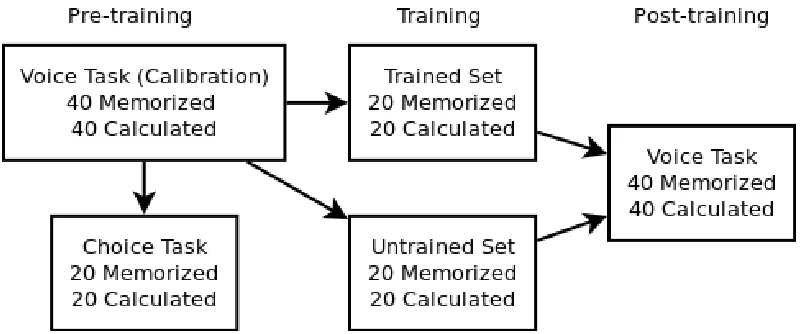
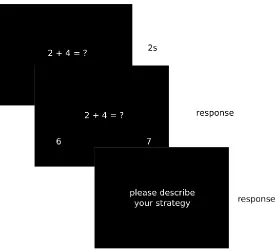
Figure 2.1: Flowchart of Experiment 1 procedure ... 22 Figure 2.2: Sample trial of choice task. Participants were presented with a problem for 2s and then asked to select the correct answer from a 2-item list. ... 25 Figure 2.3: Screenshot of the training website. Participants were shown an arithmetic problem and typed the solution in the box. ... 27 Figure 2.4: Relationship between pre-training reaction time and sum (i.e., the sum of the operands) for memorized and calculated problems, for the voice and choice tasks
(Experiment 1). ... 29 Figure 2.5: Post production reaction times and accuracies for various problems
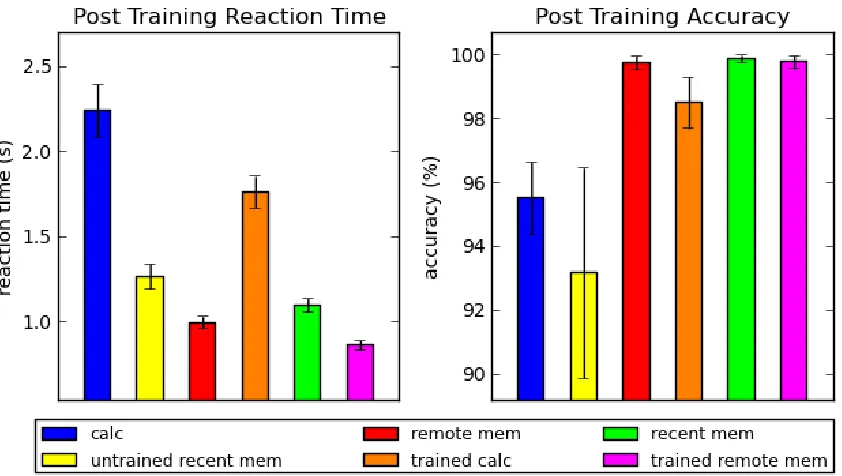
(Experiment 1, Voice Task) ... 33 Figure 2.6: Relationship between reaction time and sum for Experiment 2 pre training (Choice Task) ... 36 Figure 2.7: RTs and Accuracies for post training strategy conversions (Choice Task) .. 38 Figure 3.1: Flowchart of experimental procedure... 49 Figure 3.2: Bar charts showing average RT and ACC for the calibration session. ... 54 Figure 3.3: Scatter plot showing relationship between reaction times and sums for the calibration session. Red dots indicate memorized problems while blue dots indicate memorized problems. Gray lines connect dots belonging to the same participant. ... 54 Figure 3.4: Bar charts showing reaction times and accuracies during fMRI scanner
xii
Figure 3.5: Contrast of remote memory > calculated. Widespread frontoparietal
activation is seen for the calculated problems, while focal activation of left and right AG and SMG is seen for the memorized problems. ... 58 Figure 3.6: Regions of significant activity for the contrast of recently memorized
problems > calculated problems. ... 60 Figure 3.7: Beta weights for a cluster in right anterior hippocampus. Green bar shows recently memorized problems, pink bar shows trained remote memories. ... 61 Figure 3.8: Regions of significant activity for the contrast of recent memory > trained remote memory problems. ... 63 Figure 3.9: Results of median splits for recently memorized RTs (green) and untrained calculated sums (blue)... 65 Figure 4.1: Bar charts showing accuracy and reaction time for fMRI task. ... 82 Figure 4.2: Regions of significant activity for the contrast of memorized > calculated problems. ... 84 Figure 4.3: Regions of significant activity for the contrast of trained > untrained
xiii
Figure 4.6: Brain regions showing significant interaction effects of Strategy and Training in the left and right putamen and mid cingulate. Bar charts show beta weights for
xiv
List of Appendices
Chapter 1
1
Introduction to the study of mental arithmetic
Proficiency with formal mathematics is one of the prerequisites for successful
participation in modern society. Low math skills are related to an increased likelihood of unemployment, physical illness, depression, and even arrest (Parsons & Bynner, 2005). Proficiency with math has also been shown to be beneficial for both healthcare workers and patients in terms of interpreting appropriate dosages of medication and understanding health-related statistics (Golbeck, Ahlers-Schmidt, Paschal, & Dismuke, 2005). Given the importance of numeracy and basic math for everyday life, it is important to study what gives rise to individual differences in mathematical ability. Recently, neuroscience methods have been used to explain these processes, and these explanations can help constrain current theories on math education, leading to more efficient educational programs. The work described in this dissertation focuses on how differences in training and strategy use affect the neural correlates of mental arithmetic. In doing so it describes the dynamic nature of the neural systems and cognitive processes that are involved in mental arithmetic, a consideration which is currently absent from neural models of number processing.
In terms of the neuroscience of numerical abilities there has been a long association between numerical skills and the parietal cortex, beginning with neuropsychological work in the early 20th century (e.g. Henschen, 1919). Later, research singled out the angular gyrus (AG), a structure within the ventral parietal cortex, as being important for calculation, as lesions to the AG resulted in deficits in this and other domains such as finger gnosis and the ability to write(Gerstmann, 1940). The first functional
processes. For instance, some studies have reported activation of superior regions of the parietal lobe such as the intraparietal sulcus (IPS)(Dehaene et al., 1996; Rickard et al., 2000) and superior parietal lobe during calculation, while others have reported activation of the AG (Roland & Friberg, 1985; Rueckert et al., 1996). Despite this variability, a model explaining the neural basis of mathematical skill based on this and other data has emerged and has been influential in guiding research on the neural correlates of
numerical and mathematical skills.
1.1
Models of mental arithmetic
The most widely cited theoretical account for explaining human mathematical skill is the 'triple-code' model (Dehaene & Cohen, 1995; Dehaene, Spelke, Pinel, Stanescu, & Tsivkin, 1999). This model gets its name from its prediction that numbers are processed in three formats; a visual code, which stores visual number symbols such as Arabic digits, a verbal code, in which arithmetic facts are stored, and an analog magnitude code, which would be used to judge whether one number is larger or smaller than another. Each of these codes requires a different processing stream. The visual code is associated with activity in the bilateral interior ventral occipito-temporal areas, while the verbal codes are associated with activity in the left perisylvian areas. Finally, the magnitude code is associated with activity in the bilateral IPS. According to this model, solving a visually-presented addition problem (such as 2 + 3) would first require the transcoding of the operands from the visual code into the verbal code (two plus three). The verbal code would then be used to retrieve the memory (5), a process that draws on a left-lateralized corticostriatal loop consisting of the thalamus, basal ganglia, and left angular gyrus (Dehaene & Cohen, 1997). For a more difficult addition problem that could not be solved through retrieval of the solution from memory (such as 25 + 28), additional semantic manipulations would need to be performed (such as converting the 28 to a 25, retrieving the solution to 25+25 and then finally adding the remaining 3). These semantic manipulations are associated with activity in the inferior parietal areas (the magnitude code) such as the inferior parietal sulcus (IPS). The selection of the appropriate
are associated with activity in the superior parietal lobule (Dehaene, Piazza, Pinel, & Cohen, 2003).
The prefrontal contributions to mental arithmetic were not well described in the triple-code model, and it has been argued that elaboration is required in this and other areas (Arsalidou & Taylor, 2011). Results from a recent meta-analysis using activation
likelihood estimation (ALE) have led to some suggested updates to the triple-code model, particularly in its description of the working memory processes (e.g., storage and
procedures) that are involved in mental arithmetic. This meta-analysis considered experiments involving numerical tasks, grouped according to whether or not an
arithmetic task was involved. Non-arithmetic numerical tasks included number and/or size comparison tasks, while arithmetic tasks included things like addition and/or subtraction. Both of these types of task were associated with activity in the parietal cortex, but the arithmetic tasks were also associated with prefrontal activity, in particular the middle and superior frontal gyri (Arsalidou & Taylor, 2011). This led to the proposal that prefrontal contributions to mental arithmetic were hierarchically organized, with the inferior, middle and superior frontal gyri making up the main subdivisions. Inferior frontal activity was associated with tasks with minimal storage and procedural
requirements. Tasks with more moderate requirements, such as 2-digit addition problems, were associated with activity in the middle frontal gyri. High demand problems such as multi-step problems such as (14+19+21) were associated with activity in the medial and superior frontal gyri (Arsalidou & Taylor, 2011).
Clearly, there exists some difference in the neural systems implicated by these two models in mental arithmetic, which can be attributed to the different ways they were generated. The initial triple-code model was based on lesions studies (Dehaene & Cohen, 1997) and the IPS contributions were later updated using a meta-analysis of
neuroimaging studies that focused on the role of the parietal cortex and did not consider other brain structures in detail (Dehaene et al., 2003). The recommended updates by Arsalidou and Taylor also employed a meta-analytic approach, but focused on a whole-brain approach to mapping out the whole-brain regions associated with mathematics (Arsalidou & Taylor, 2011). One commonality, however, is that neither account was intended to provide commentary on the result of practice on these neural systems. In other words, the above discussed models take a static view of the brain regions underlying mental arithmetic. Much is known about how individual differences and training affect the neural correlates of arithmetic (Delazer et al., 2003; Grabner et al., 2007; Grabner, Ischebeck, et al., 2009; Ischebeck et al., 2006), but these studies are not yet integrated into models of mental arithmetic. For instance, a person who is well practiced at performing mental calculations might be able to do so without imposing the same cognitive demands as a person who rarely performs such calculations. Would these differences in performance be reflected in differential recruitment of the prefrontal cortex, as the meta-analysis might suggest, or the IPS, as is suggested by the triple-code model?
To answer questions such as these, the impacts of training on mental arithmetic can be examined. Skill acquisition is frequently accompanied by an anterior-posterior shift in activation, which has been interpreted to imply a shift from more domain-general prefrontal mechanisms to more task or domain-specific processes (Poldrack, 2000). In the case of mental arithmetic, this is commonly thought to reflect a shift from more working-memory intensive calculation-based strategies to stronger reliance on direct retrieval of specific arithmetic facts (Delazer et al., 2003; Imbo & Vandierendonck, 2008). However, it is unlikely that training effects are limited to a switch in strategy resulting from memorization. Practicing the retrieval of the solution to an arithmetic problem may decrease the time and resources required to retrieve said solution.
might have beneficial effects in terms of behavioral performance, even in the case that the solution to the problem does not become memorized. This effect is particularly interesting because it is often neglected within the training literature, and may involve neural systems beyond those covered by the models described above.
1.2
Studies of arithmetic learning/training
The first fMRI study to investigate functional brain activation changes associated with learning arithmetic compared trained and untrained multiplication problems (Delazer et al., 2003). During training, participants repeatedly solved the same set of multiplication problems across several sessions over the course of a week. Following training,
participants solved trained and novel, untrained problems as changes in brain activity were measured by means of fMRI. Greater activation was shown for trained versus untrained problems in the left angular gyrus (AG), inferior temporal gyrus, and anterior cingulate cortex. The reverse contrast (i.e., untrained > trained problems), revealed widespread frontoparietal activation. Since then, other training studies have consistently found either left or bilateral AG activity to be greater in the trained than the untrained condition (Delazer et al., 2003, 2005; Grabner, Ischebeck, et al., 2009; Ischebeck, Zamarian, Schocke, & Delazer, 2009) , with the other most consistent source of activity being in the anterior cingulate cortex (Delazer et al., 2003; Grabner, Ischebeck, et al., 2009; Ischebeck et al., 2009). Given that both of these regions are associated with a myriad of functions, the specificity of these training effects to arithmetic is of
considerable interest. One of these studies did examine this by training a figural-spatial task along with an arithmetic task (Grabner, Ischebeck, et al., 2009). The difference between the arithmetic and spatial training effects was that the mid cingulate was more active in the trained arithmetic > untrained arithmetic contrast and the precuneus was more active in the figural-spatial trained > figural-spatial untrained contrast. AG activity was seen in the contrast of trained > untrained for both the arithmetic and figural-spatial task. Thus, the figural-spatial task and the arithmetic task had a common element which recruited the AG. One account of AG function proposes that the angular gyrus subserves the mapping between a symbol and its referent (Ansari, 2008). In this case, the
the solution (8). The figural-spatial task required participants to count the number of faces on a variety of 3D polygons, and so one way to become proficient on this task was to create a mapping between a 3D image and a number. However, given that the AG is associated with many other functions , it remains possible that the AG serves other roles within mental arithmetic beyond symbol-referent mapping.
One way to determine whether the arithmetic training effects seen in AG are related to something other than symbol-number mappings would be to look at problems where the strategies did not shift. Solving by fact retrieval is made possible by having a particular number (the solution) mapped to a particular symbol (the arithmetic problem), while this is not the case when problems are solved using a procedural problem solving strategy. Thus, any training effects produced in conditions where changes in performance could
not be explained by a shift to fact retrieval (e.g., increased use of symbol-number
mapping) could be informative in determining the specificity of AG effects. This type of analysis would require the tracking of pre- and post-training strategy in order to group problems according to how they were solved.
However, none of the training studies performed to date tracked pre- and post-training strategy, so that for any given trial it is unknown whether a shift in strategy had occurred. This is important since individual differences in strategy use are known to be present in the population, with individuals high in math competence tending to solve more problems through fact retrieval, and individuals low in math competence tending to solve more problems through effortful calculation (Geary, Hoard, Byrd-Craven, & DeSoto, 2004). Thus, in any study of arithmetic training, participants may be using different strategies at the outset of training, and may not be starting from an equivalent point. Indeed,
individual differences in arithmetic knowledge and competence can make the interpretation of training data difficult.
1.3
Individual differences
performers (92% average accuracy) on an addition and subtraction task (Menon et al., 2000). Region-of-interest (ROI) analyses were used to measure activity in three parietal regions. One of these regions, the left angular gyrus, showed a significant group effect, with activity being lower in perfect than in imperfect performers. Another study which examined the numerical basis of mathematical competence found the opposite pattern, with more competent performers exhibiting more activation in the left AG while solving single- and double-digit multiplication problems (Grabner et al., 2007).
At first glance these two sets of findings appear to be at odds with each other; however, a critical difference between the two studies was the threshold used to separate high and low performers. In fact, both the perfect and imperfect performers from the study by Menon et al. (2000) would have been categorized as mathematically competent in the Grabner et al. (2007) study – thus the comparisons made by each study are not
equivalent. Thus, a preliminary conclusion from this data is that the AG is an important structure in arithmetic problem solving, but that within highly competent individuals, more efficient use (e.g., lower activation) of this structure is associated with better performance. In other words, the relationship between performance and AG activity is not necessarily linear.
Why, then, the difference between angular gyrus activity in high and low competence individuals? The triple-code model (Dehaene et al., 2003) suggests that AG activity is associated with arithmetic fact retrieval, and this is consistent with the training data discussed in the previous section as well as the notion that people with better arithmetic skills have more arithmetic solutions committed to memory (Geary et al., 2004). This association between fact retrieval and AG activity has been directly investigated by comparing problems solved by different strategy types. Specifically, in a recent study (Grabner, Ansari, et al., 2009), a group of adults were presented with arithmetic problems while undergoing an fMRI scan, after which they indicated what kind of strategy
retrieval of intermediate solutions, then the problems were labeled as calculated. A contrast of memorized > calculated problems revealed focal activity in the left AG, with the reverse contrast revealing widespread fronto-parietal activity (Grabner, Ansari et al., 2009).
Before proceeding, two key concepts must be clarified. The first is the nature of the difference between solving by calculation and solving by memory. At first glance this differentiation may appear to be dichotomous. However, this is not the case, because the process of calculation invariably relies on the process of fact retrieval. Even when using a simple strategy such as counting, a person must have the series of numbers they are counting through (i.e., 5, 6, 7, 8) committed to memory. Thus it must be stressed that the distinction between a memorized and a calculated problem is that solving through
memory is done without any awareness of intermediate operations being performed before the solution is produced, whereas calculated problems require one or more
intermediate steps (which will include the retrieval of arithmetic-related facts) in order to arrive at the solution.
The second key concept that must be clarified also relates to the retrieval of a solution from memory. The AG is typically associated with ‘reflexive’ retrieval from memory (Cabeza et al., 2008), and it is this term ‘reflexive’ which requires some discussion. Though pervasive in the literature, it is imprecise from a mechanistic standpoint. In this thesis, the terms reflexive or automatic have specific meanings when applied to the retrieval of arithmetic facts from memory. Specifically, the process of retrieval is said to be reflexive when it is prompted simply by exposure to a stimulus (2 + 2). By contrast, a retrieval operation may be non-reflexive (or effortful) when an arithmetic stimulus is recognized as familiar, but the solution does not come to mind immediately.
study outset. This may not have been the case due to heterogeneity of strategy use between individuals (Campbell & Xue, 2001; LeFevre, Sadesky, & Bisanz, 1996). In other words, a problem solved by calculation in one person may be solved by fact
retrieval in another. Thus, any training study which does not track strategy use is limited in its interpretability, because participants may not all be starting from the same point (e.g., some may already have problems committed to memory).
Developmental differences also play a role in modulating brain activity during mental arithmetic. One study compared brain activity in a group of participants from the ages of 9 to 18 by contrasting an arithmetic verification task (where the participant pressed a button when the correct answer appeared in a list of numbers) against a push-for-zero task (where the participant simply indicated whether zero was present in a list of numbers). The activation resulting from this contrast was then correlated with chronological age and it was found that parietal and temporal (e.g., AG and middle temporal) cortex activity positively correlated with age, whereas frontal and hippocampal activity correlated negatively with age (Rivera, Reiss, Eckert, & Menon, 2005). In other words, older children activated more parietal structures (consistent with the triple-code model), than did their younger peers (who activated more frontal structures). However, because this study also did not track strategy use, it is possible that some of these
differences can be explained by the fact that young children may rely more on procedural calculation, whereas older children, like adults, may rely more of fact retrieval to solve a set of arithmetic problems.
1.4
Current project
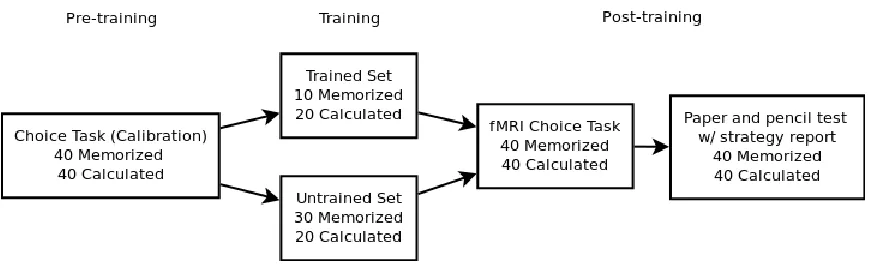
Controlling for individual strategy use in the context of a training study represents a crucial step for advancing the understanding of the neural basis of calculation. Such a research strategy would allow for the observation of how differences in functional brain activation arise as a function of strategy, learning, and individual ability level within the same study. To perform such an investigation, a novel paradigm called Customized Arithmetic Training (CAT) was developed for the purposes of the current thesis. The CAT paradigm generates individually tailored problem sets based on self-reported strategy, such that each participant begins the training using the same mixture of strategies (half calculated, half memorized). In other words, the problems solved will differ between participants but the balance of procedural and retrieval problems will be equated between participants. In this way the CAT approach controls for individual differences in strategy use in a way that was not afforded by any of the previous studies on the neural correlates of mental arithmetic. After these problem sets are generated, each set is divided, with a subset of these problems being assigned to training. Following a 6-day training period, the participants return to the lab for an fMRI scanning session, where participants solve each of the problems obtained on the first visit (e.g., both trained and untrained) twice. Following this, they provide a final strategy report for each
problem using a paper and pencil test (outside the scanner). In this way, pre- and post-training strategy measures are obtained for each problem, allowing for the separation of calculation problems that became memorized due to training from those that did not. Furthermore, training effects on memorized problems, which have been largely ignored in the literature, can also be investigated, as the CAT paradigm allows for the
identification of problems that were memorized pre and post training.
This design addresses several outstanding issues in the study of mental arithmetic. The first concerns the reliability and face validity of self-reported strategy, as well as whether it is possible to develop a computerized system which can balance strategy across
were identified by CAT as problems solved by retrieval prior to training (Chapter 3). Finally, by isolating memorized and calculated problems whose strategies did not shift through training, it can identify training-induced shifts in activation that specifically reflect optimizations of fact retrieval or procedural calculation (Chapter 4).
1.5
Chapter 2 outline
Chapter 2 describes the development the CAT paradigm. Because of the novelty of this approach, two behavioral experiments were conducted to assess the feasibility of the CAT protocol and then to ensure that the self-reported strategies collected were reliable and valid. In the first experiment, issues of reliability and face validity were explored by comparing strategy reports on two tasks, a voice production task where the participant spoke the solution aloud, and a choice task where the participant chose the appropriate solution from a two-item list of potential solutions. In this experiment the voice task was used (in addition to the choice task) to obtain the problem sets because it offered a more fine grained measure of reaction time, which was necessary to provide commentary on the face validity of the self-reports (memorized problems were expected to be solved more quickly, whereas calculated problems were expected to be solved more slowly). Having established the reliability and validity of these self-reports, a second experiment was conducted, where the choice task (which was better suited for fMRI research because it required minimal movement from the participant) was used to obtain the problem sets. In both of these experiments, the participants also underwent a 5-day training program using a subset (half memorized, half calculated) of these problems. Participants then returned to the lab for a post-training visit and performed the same tasks as they did pre-training, solving all the problems in both the untrained and trained problem sets. Strategy, reaction time, and accuracy were again collected, which provided information about learning rates and behavioral improvements induced by training.
1.6
Chapter 3 outline
Chapters 3 and 4. Chapter 3 focuses on the switch from effortful calculation to fact retrieval, which is known to be an important component of making arithmetic easier to perform by decreasing working memory demands (Imbo & Vandierendonck, 2008), and is also the most common explanation for training effects in previous studies of arithmetic training (Delazer et al., 2003). These recently memorized problems (i.e., problems that were previously calculated but became memorized as a result of training) are compared to calculated problems as well as to problems that were memorized before the study began (i.e., remote memories). Due to the novelty of the CAT paradigm, the first contrast presented in this Chapter is a comparison of untrained calculated and memorized
problems, to determine whether the results are consistent with previous research into arithmetic strategy (Grabner, Ansari, et al., 2009). Recently memorized facts are then compared with three other problems types; untrained calculated problems, untrained memorized problems, and trained memorized problems. Comparing recent memories to untrained calculated problems is very similar to the contrasts that are featured in most training studies (e.g., Delazer et al., 2003), and will confirm whether training effects previously reported reflect a shift in strategy. Finally, comparing recently memorized problems against both trained and untrained memorized problems (two novel contrasts afforded by this design), will determine whether there exists a temporal gradient between brain activity associated with older and newer arithmetic facts, as is frequently the case with semantic memories (Smith & Squire, 2009) .
1.7
Chapter 4 outline
1.8
References
Ansari, D. (2008). Effects of development and enculturation on number representation in the brain. Nature Reviews. Neuroscience, 9(4), 278–91. doi:10.1038/nrn2334
Arsalidou, M., & Taylor, M. J. (2011). Is 2+2=4? Meta-analyses of brain areas needed for numbers and calculations. NeuroImage, 54(3), 2382–2393. Retrieved from
http://www.ncbi.nlm.nih.gov/pubmed/20946958
Cabeza, R., Ciaramelli, E., Olson, I. R., & Moscovitch, M. (2008). The parietal cortex and episodic memory: an attentional account. Nature Reviews. Neuroscience, 9(8), 613–25. doi:10.1038/nrn2459
Campbell, J. I. D., & Xue, Q. (2001). Cognitive arithmetic across cultures. Journal of Experimental Psychology: General, 130(2), 299–315.
doi:10.1037//0096-3445.130.2.299
Cho, S., Metcalfe, A. W. S., Young, C. B., Ryali, S., Geary, D. C., & Menon, V. (2012). Hippocampal – Prefrontal Engagement and Dynamic Causal Interactions in the Maturation of Children's Fact Retrieval. Journal of Cognitive Neuroscience, 8, 1849–1866.
Cho, S., Ryali, S., Geary, D. C., & Menon, V. (2011). How does a child solve 7 + 8? Decoding brain activity patterns associated with counting and retrieval strategies.
Developmental Science, no–no. doi:10.1111/j.1467-7687.2011.01055.x
Dehaene, S., & Cohen, L. (1995). A model for number processing. Math Cognition. Dehaene, S., & Cohen, L. (1997). Cerebral pathways for calculation : Double dissociation
between rote verbal and quantitative knowledge of arithmetic. Cortex, 2(33), 219– 250.
Dehaene, S., Piazza, M., Pinel, P., & Cohen, L. (2003). Three parietal circuits for number processing. Cognitive Neuropsychology, 20(3), 487–506.
Dehaene, S., Spelke, E., Pinel, P., Stanescu, R., & Tsivkin, S. (1999). Sources of Mathematical Thinking: Behavioral and Brain-Imaging Evidence. Science,
284(970).
Dehaene, S., Tzourio, N., Frak, V., Raynaud, L., Cohen, L., Mehler, J., & Mazoyer, B. (1996). Cerebral activations during number multiplication and comparison: a {PET} study. Neuropsychologia, 34(11), 1097–1106. doi:http://dx.doi.org/10.1016/0028-3932(96)00027-9
Delazer, M., Domahs, F., Bartha, L., Brenneis, C., Lochy, A., Trieb, T., & Benke, T. (2003). Learning complex arithmetic—an fMRI study. Cognitive Brain Research,
18(1), 76–88. doi:10.1016/j.cogbrainres.2003.09.005
Delazer, M., Ischebeck, A., Domahs, F., Zamarian, L., Koppelstaetter, F., Siedentopf, C. M., Kaufmann, L., et al. (2005). Learning by strategies and learning by drill--evidence from an fMRI study. NeuroImage, 25(3), 838–49.
doi:10.1016/j.neuroimage.2004.12.009
Geary, D. C., Hoard, M. K., Byrd-Craven, J., & DeSoto, M. C. (2004). Strategy choices in simple and complex addition: Contributions of working memory and counting knowledge for children with mathematical disability. Journal of Experimental Child Psychology, 88(2), 121–51. doi:10.1016/j.jecp.2004.03.002
Gerstmann, J. (1940). Syndrome of fi nger agnosia, disorientation for right and left, agraphia and acalculia. Archives of Neurology and Psychiatry, 44, 398–408. Golbeck, A. L., Ahlers-Schmidt, C. R., Paschal, A. M., & Dismuke, S. E. (2005). A
definition and operational framework for health numeracy. American Journal of Preventive Medicine. [New York, NY]: Oxford University Press,[c1985-. Retrieved from http://www.ncbi.nlm.nih.gov/pubmed/16242604
arithmetic facts during problem solving. Neuropsychologia, 47(2), 604–8. doi:10.1016/j.neuropsychologia.2008.10.013
Grabner, R. H., Ansari, D., Reishofer, G., Stern, E., Ebner, F., & Neuper, C. (2007). Individual differences in mathematical competence predict parietal brain activation during mental calculation. NeuroImage, 38(2), 346–56.
doi:10.1016/j.neuroimage.2007.07.041
Grabner, R. H., Ischebeck, A., Reishofer, G., Koschutnig, K., Delazer, M., Ebner, F., & Neuper, C. (2009). Fact learning in complex arithmetic and figural-spatial tasks: the role of the angular gyrus and its relation to mathematical competence. Human Brain Mapping, 30(9), 2936–52. doi:10.1002/hbm.20720
Henschen, S. E. (1919). Uber Sprach-, Musik- und Rechenmechanismen und ihre Lokalisationen im Großhirn. Zeitschrift fuer die gesamte Neurologie und Psychiatrie, 52, 273–298.
Imbo, I., & Vandierendonck, A. (2008). Effects of problem size, operation, and working-memory span on simple-arithmetic strategies: differences between children and adults? Psychological Research, 72(3), 331–46. doi:10.1007/s00426-007-0112-8 Ischebeck, A., Zamarian, L., Schocke, M., & Delazer, M. (2009). Flexible transfer of
knowledge in mental arithmetic--an fMRI study. NeuroImage, 44(3), 1103–12. doi:10.1016/j.neuroimage.2008.10.025
Ischebeck, A., Zamarian, L., Siedentopf, C., Koppelstätter, F., Benke, T., Felber, S., & Delazer, M. (2006). How specifically do we learn? Imaging the learning of multiplication and subtraction. NeuroImage, 30(4), 1365–75.
doi:10.1016/j.neuroimage.2005.11.016
Menon, V., Rivera, S. M., White, C. D., Eliez, S., Glover, G. H., & Reiss, A. L. (2000). Functional optimization of arithmetic processing in perfect performers. Cognitive Brain Research, 9, 343–345.
Parsons, S., & Bynner, J. (2005). Does Numeracy Matter More?Education. National Research and Development Centre for Adult Literacy and Numeracy, Institute of Education, University of London.
Poldrack, R. A. (2000). Imaging brain plasticity: conceptual and methodological issues--a theoretical review. NeuroImage, 12(1), 1–13. doi:10.1006/nimg.2000.0596
Rickard, T. C., Romero, S. G., Basso, G., Wharton, C., Flitman, S., & Grafman, J. (2000). The calculating brain : an fMRI study. Neuropsychologia, 38, 325–335.
Rivera, S. M., Reiss, a L., Eckert, M. a, & Menon, V. (2005). Developmental changes in mental arithmetic: evidence for increased functional specialization in the left inferior parietal cortex. Cerebral Cortex, 15(11), 1779–90. doi:10.1093/cercor/bhi055 Roland, P., & Friberg, L. (1985). Localization of cortical areas activated by thinking.
Journal of Neurophysiology, 53(5), 1219–1243.
Rueckert, L., Lange, N., Partiot, A., Appollonio, I., Litvan, I., LeBihan, D., & Grafman, J. (1996). Visualizing Cortical Activation during Mental Calculation with Functional MRI. NeuroImage, 103(3), 97–103.
Smith, C. N., & Squire, L. R. (2009). Medial temporal lobe activity during retrieval of semantic memory is related to the age of the memory. The Journal of Neuroscience : the Official Journal of the Society for Neuroscience, 29(4), 930–8.
Chapter 2
2
The development of the Customized Arithmetic Training
program
2.1 Introduction
One of the main challenges of studying mental arithmetic is inter-individual variability in strategy use - one person may solve a given problem by retrieving its solution from memory, whereas another may need to solve the same problem through effortful
procedural calculation. To date, studies of mental arithmetic have largely relied on fixed problem sets. Despite the advantage of ease of implementation, use of fixed problem sets also carries critical disadvantages due to heterogeneity of strategy use present in the population. In other words, the use of a fixed problem fails to address wide individual differences in the way in which the problems are solved with no way of capturing this between-subject variability. This is of particular concern in studies of arithmetic
learning, where training effects such as shifts from effortful calculation to retrieval from memory are of critical importance. Therefore if different participants solve the problems with different strategies at the outset of the training, the effects of training will differ between participants with some undergoing shifts in strategy while others may
experience a training effect on an already memorized problem. This Chapter details the development of a novel arithmetic training program, known as Customized Arithmetic Training (CAT), which balances strategy use between individuals in a given sample in the context of an arithmetic training program. By doing so the training program can equate participants on strategies in order to more adequately compare participants with one another and to understand the effects of training on different strategies Ultimately, this training program will be put to use in an fMRI investigation of the neural correlates of arithmetic learning (see Chapters 3 and 4).
2.1.1
Strategies for solving arithmetic problems
complex problems (e.g., addition problems with large sums, such as 35 + 26,), other procedural strategies come into play, such as counting, transformation (e.g., adjusting the problem operands such that the solution can be retrieved from memory and then working from there), or the use of rules or heuristics (LeFevre, Sadesky, & Bisanz, 1996).
Distinguishing between these problem types is important because they make use of different cognitive processes - solving through recall relies solely on reflexive retrieval from memory while procedural solving involves retrieval as well other cognitive processes such as working memory, strategy selection and planning (Imbo & Vandierendonck, 2008).
2.1.2
Assessing strategy
The most viable way to measure problem-solving strategy is to use self-report measures, which are obtained by asking the participants themselves to describe the strategy they use to solve a given arithmetic problem. One of the first studies to use this method to glean insight in the mechanisms underlying arithmetic processing used trial-by-trial self-reports to assess arithmetic strategy use in adults (LeFevre et al., 1996). It was found that a retrieval strategy was used on 71.2% of trials, while procedural calculation was performed the remainder of the time. Since then, self-reported strategy has become a widely-used indicator of mental arithmetic processes, with some caveats. Most critically, task instructions can bias both self-reported strategy and response latencies (Kirk & Ashcraft, 2001). For instance, when instructions suggest that either procedural or
retrieval strategies are the most common types of strategies to use, people biased towards retrieval report more retrieval strategies but also produce solutions more quickly, whereas the opposite pattern emerges for those biased towards procedural strategies. Thus, task instructions must not be suggestive that a particular strategy should be used by the
participant. Provided that this is the case, however, self-reported strategy is a very useful measure in the study of mental arithmetic.
2.1.3
Heterogeneity of strategy use
2006), which imposes limitations due to heterogeneity in strategy use. One way this has been demonstrated was by comparing university students with different educational backgrounds and levels of arithmetic proficiency, specifically, students from China who had been educated in either China or Canada as well as non-Chinese Canadian students who were educated in Canada (J. I. D. Campbell & Xue, 2001). Two math tests were performed; one with simple arithmetic using all operations (e.g., 3 + 4, 7 - 3, 3 X 4, 12 / 3), and one with more complex, multi-step addition, multiplication and subtraction problems, and division problems. The complex arithmetic test was done in pencil and paper format, and it was found that Chinese students outperformed the non-Chinese Canadian students in terms of accuracy. For the simple arithmetic tests, problems were solved one at a time on using a computer based test, and participants reported their strategy after solving each problem. Chinese students who obtained their education in either China or North America relied more on retrieval strategies (87% and 85%) than did Canadian students (72%), and also outperformed North American students in terms of reaction time and accuracy. This highlights the heterogeneity of strategy use that can be present in any given population, which inevitably complicates the interpretation of results from studies of arithmetic learning if fixed problem sets are employed, because people are not necessarily starting using the same mixture of strategies when they begin the training program.
2.1.4
Training and strategy
important methodological improvement, because it will allow for more careful study of arithmetic training effects. Furthermore, it would enable the assessment of individual differences in learning rates (e.g., the amount of problems a participant may memorize through training), something which has not been widely discussed in the training literature.
2.1.5
Current study
The ultimate goal of the current study was to develop a novel paradigm that was suitable for use in an fMRI study of training effects on mental arithmetic. This paradigm, known as Customized Arithmetic Training (CAT), used individually tailored problem sets that were calibrated such that each participant, at the outset of training, solved an equal number of arithmetic problems by fact retrieval, and an equal amount of arithmetic problems through procedural calculation. In this way, strategy use was tracked pre- and post-training, and the balance of strategies would be equal between participants. Because of the novelty of this paradigm, two experiments were conducted with the aim of
assessing five critical issues present in this type of research.
The first aim was to assess the face validity of self-reported strategy use by using a voice production task where the participant spoke the solution aloud, allowing for a precise estimate of reaction time. The second aim was to determine whether the strategy reports were reliable both within and between task – that is, whether participants would
consistently report using the same strategy for a given problem, even if the response format differed. The third aim was to determine whether a task suitable for fMRI could be used to create the CAT sets. The fourth aim was to assess individual differences in strategy use as well as individual differences in learning rates resulting from the training problem. Finally, the fifth aim was to evaluate the effectiveness of the problem finding algorithm that was used to generate the CAT sets.
was used to obtain the problem sets because it offered a more fine grained measure of reaction time, which was necessary to provide commentary on the face validity of the self-reports (memorized problems were expected to be solved more quickly, whereas calculated problems were expected to be solved more slowly). Having established the reliability and validity of the self-reports, a second experiment was conducted, where the choice task (which was better suited for fMRI research because it required minimal movement from the participant) was used to obtain the problem sets (Aim 3). In both of these experiments, the participants also underwent a 5 day training program using a subset (half memorized, half calculated) of these problems. A post-training visit to the lab provided an indication of the stability of the self-reports over time, as well as information regarding the expected rates of memorization among the trained calculated problems (Aim 4).
2.2
Methods – Experiment 1
2.2.1
Objective
Following this, training effects were examined. Problems from the CAT sets were assigned to either the trained or untrained (control) condition. Participants performed the training (described in Methods) for 5 days and then returned to the lab for a follow-up test, using the voice production task. This allowed for the identification of problems which shifted from procedural calculation to retrieval as a result of training, as well as changes in reaction time and accuracy. It also allowed for the assessment of the reliability of the strategy reports over time by examining the strategy reports of the untrained problems before and after the training period (problems in the untrained set were not expected to be solved by a different strategy post-training).
2.2.2
Participants
Participants included 18 undergraduate and graduate students (10 males, 8 females, Mean age 22.33 yrs, StdDev, 2.40 yrs) enrolled at The University of Western Ontario, Canada. Participants were recruited through posters distributed on campus. All participants completed all experimental conditions and provided informed consent using documentation that was approved by the Psychology Research Ethics Board at the University of Western Ontario.
2.2.3
Procedure
2.2.3.1
Pre-training – Voice production task
The goal of this stage was to obtain a set of 80 arithmetic problems, 40 of which were solved by memory and 40 of which were solved through calculation. During pre-training participants solved a series of arithmetic problems (3 + 4 = ?). For each problem, participants spoke the solution out loud. Reaction times were measured by means of a voice-activated switch. Participants were then prompted to indicate whether they retrieved the solution from memory or performed a more effortful calculation (procedural problem solving strategy), again through voice response. The experimenter then inputted the strategy and the accuracy into the program using a key press. To assess the reliability of self-reported strategy, individual problems were presented twice over the course of pre-training. Only reliable problems, that is, problems which were responded to twice with the same strategy, were retained. For both Experiments 1 and 2, 40 memorized (MEM) and 40 calculated (CALC) problems were obtained.
2.2.3.2
Calibration
The calibration algorithm used to identify problems worked as follows. Initially, the program searched for problems solved by procedural calculation. It accomplished this by gradually increasing the size of the operands (starting from single digit problems, e.g., 2 + 3), until the participant began to respond that they were using the CALC strategy. The operands continued to increase until 10 CALC problems were collected. Once this point was reached, the program would also start to present some of the previously shown problems again to assess the reliability of the self-reports. Problems that were solved by the same strategy both times were included in the training sets, and the others discarded. Once the first 10 CALC problems were obtained, the program would search for either more CALC problems or more MEM problems, depending on which were in shorter supply in the program's database. If MEM problems were being sought out, the size of the operands was decreased from one problem to the next. If CALC problems were being sought out, the size of the operands was increased. This was done because it was
solutions from memory and would thus have to switch a procedural calculation based strategy (though the point at which this switch occurred was expected to vary from person to person due to individual differences). During the search process, the shift in operand size was more pronounced if one strategy was being sought out, but the previous trial's strategy had been the other strategy. That is, if the previous trial had been solved by the MEM strategy, and CALC was being sought out, the size of each operand was increased by 5 or 6. However, if a CALC strategy had been previously used, then the operands would only be increased by 1, 2 or 3. If an error was made, the problem was eliminated from inclusion in the training set and the size of the operands was also reduced. Ultimately, 40 reliable MEM and 40 reliable CALC problems were collected.
2.2.3.3
Pre-training – Choice task
Figure 2.2: Sample trial of choice task. Participants were presented with a problem
for 2s and then asked to select the correct answer from a 2-item list.
In the construction of a choice task, it is crucial to be mindful of the distractors used, to avoid the use of shortcut strategies not involving computation of the solution (e.g., participants make an educated guess based on the plausibility of the distractors). When shortcuts can be used, the retrieval processes involved may be different (Campbell & Tarling, 1996), as evidenced by the fact that error priming has different effects in
verification (determining whether a presented problem/solution pairing was correct, e.g., 2+4 = 7?), versus production (saying the answer to a presented problem, 2 + 4 = ?) tasks. To discourage the use of shortcut strategies, the distractor lists had to be carefully
constructed.
distractor of +- 10 was part of the list. This was carried out so that participants could not determine the solution by examining only the first digit in any of the 2-digit problems. For each problem, all plausible distractors were randomly selected, such that participants would not come to expect a certain type of distractor based on the size and parity of the operands. For instance, for the problem “34 + 36”, potential distractors would include +-2 and +-10. Thus, for any given presentation of “34 + 36”, the participant might see 68, 72, 60, or 80 as the distractor.
As in the voice production task, after solving each problem, participants indicated the strategy they used to solve the problem through voice response. The strategy was then inputted into the program by the experimenter using a button press. Measures collected were accuracy, reaction time, and strategy. Due to concerns over participant fatigue, a random selection of half the MEM and CALC problems obtained during from the calibration stage were used in this stage of the experiment.
2.2.3.4
Training – Keyboard production task
Figure 2.3: Screenshot of the training website. Participants were shown an
arithmetic problem and typed the solution in the box.
2.2.3.5
Post-training – Voice production
The post-training lab visit used the voice production task. Participants were presented with the 40 problems that made up their training set, as well as 40 untrained problems (20 CALC and 20 CALC) that were previously set aside. As during pre-training, each problem was shown to the participant twice, and a strategy report was obtained for each. This allowed for the measurement training effects – namely, any shifts in strategy and improvements in performance (RT and ACC). The order of problems was pseudo-randomized such that the same problem did not appear twice in a row.
2.3
Results - Experiment 1
2.3.1
Pre-training – Voice production task
2.3.1.1
Frequency of self-reports
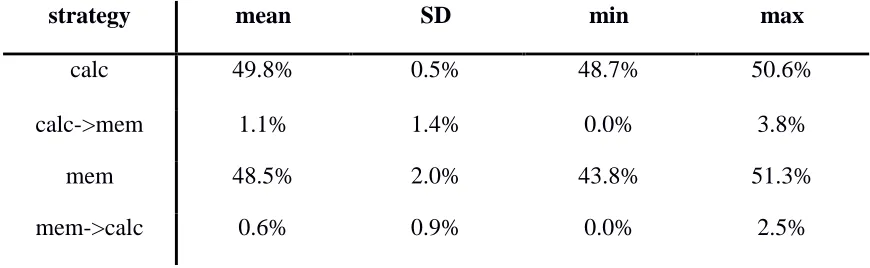
Table 2.1 shows the frequency of each strategy type obtained through self-report. As mentioned, each problem was shown twice to the participant, and each time they were prompted to indicate the strategy they used to solve the problem. Therefore, four strategy types were possible – calc (where the participant used a calculation strategy both times), mem (where the participant used a memory strategy both times), cm (where the
strategy). The majority of the problems presented were consistently solved with the memory or the calculation strategy.
strategy report mean SD min max
calc 49.3% 3.0% 44.9% 55.1%
calc->mem 4.6% 2.2% 0% 10.0%
mem 42.8% 2.9% 36.2% 47.4%
mem->calc 3.4% 2.4% 0% 9.6%
Table 2.1: Frequencies of strategy report in the Experiment 1 Voice Task. Each
cell represents the portion of the total problems shown to the participant.
2.3.1.2
Individual differences
Figure 2.4 shows the results of the calibration session for Experiment 1, done using the voice production task. While it was the case in participants that calculated problems took longer to solve than memorized problems (as well as having larger sums), the ranges of sums and reaction times for a given strategy varied between participants. Specifically, memorized problems varied in average sum from 11 to 40, while calculated problems varied in average sum from 30 to 77. In terms of mean reaction time, calculated
problems varied from 1.26s to 3.85s, while memorized problems ranged from .84s to 1.7s in mean reaction time. Thus, there was no clear dividing line between memorized and calculated problems that would apply to all participants, either on the grounds of absolute reaction time or absolute sum. These data therefore clearly speak against the utility of using fixed problem sets in studies of mental arithmetic and demonstrate the power of designing problem sets that are customized according to the individuals' strategies. Furthermore, they indicate that problem size should not be used as a proxy for strategy, unless it is considered in the context of a single participant’s data.
approximately 17 minutes (183 trials), and the longest session was approximately 30 minutes (222 trials).
2.3.1.3
Strategy effects (Pre-training)
To examine the effect of self-reported strategy, a paired t-test was performed to determine whether a difference existed between RTs for memorized (mem) and calculated (calc) problems. There was a significant difference in the response times between mem (M=1.10, SD=0.23) and calc (M=2.32, SD=0.62) problems;
t(17.0)=10.91, p<0.001, d=2.57. To examine the relationship between accuracy and strategy, a paired t-test was performed and there was no significant difference between the scores for mem(M=99.92, SD=0.32) and calc(M=99.64, SD=0.59) problems;
t(17.0)=-1.66, n.s.
It was also of interest to determine the relationship, if any, between strategy and sum. A paired t-test revealed a significant difference in the sums for mem(M=24.29, SD=9.12) and calc(M=47.81, SD=14.17) problems; t(17.0)=11, p<0.001, d=2.58. Consistent with previous research, memorized problems had smaller sums than calculated problems.
Figure 2.4: Relationship between pre-training reaction time and sum (i.e., the sum
of the operands) for memorized and calculated problems, for the voice and choice
tasks (Experiment 1).
2.3.2
Pre-training – Choice task
2.3.2.1
Frequency of self-reports
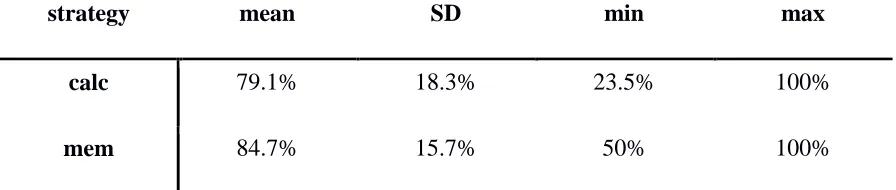
Table 2.2 shows the frequencies of the self-reported strategies obtained after the choice task was administered. As a reminder, a subset of the problems obtained in the
calibration phase were presented again using the choice task. Values from this table indicate the proportion of problems obtained during calibration (voice task) that were solved by the same strategy using the choice task. While reports were fairly consistent for both categories, memorized problems were more consistent than calculated problems. A potential reason for this could be that calculated problems were being committed to memory after repeated exposures.
strategy mean SD min max
calc 79.1% 18.3% 23.5% 100%
mem 84.7% 15.7% 50% 100%
Table 2.2: Consistency of self-reported strategies after the choice task
2.3.2.2
Strategy effects
Strategy effects on the choice task were also examined. Due to computer error data was lost for 2 participants (thus for this analysis N=16). A paired t-test revealed a significant difference between the scores for mem (M=0.75, SD=0.21) and calc (M=1.11, SD=0.50);
t(15.0)=3.40, p=0.004, d=0.85. Note that these RTs appear faster than those from the production task, because in the choice task participants were responding to the distractors after having seen problem for 2s. Given the low RT for memory problems obtained during the voice production task (M=1.10, SD=0.23), most participants had the solution to the memorized problems in mind before the distractors were even presented,
2.3.3
Post-training – Voice production task
2.3.3.1
Frequency of self-reported strategies
Upon post testing, three main problem-solving strategies were present – calculated (calc-calc), remote memory (mem-mem), or recent memory (calc-mem). Calculated problems were solved both pre and post by procedural calculation, remote memory problems were solved both pre- and post-training by fact retrieval, and recent memory problems were solved pre-training by calculation, and post-training by fact retrieval. Problems were further labeled by whether they were part of the training set or not. Table 2.3 shows the frequencies of the strategy reports, broken down by training and initial strategy. As would be expected, a greater proportion of recent memory problems appeared in the trained group than in the untrained group.
Initially memorized Initially calculated
Training remote mem mem->calc calc recent mem
Untrained M=95.4%, min=71.4%, max=100% M=4.6%, min=0%, max=28.6% M=79.7%, min=27.3%, max=100% M=20.3%, min=0.00%, max=72.7%
Trained M=99.5%, min=90%, max=100% M=1.6%, min=0%, max=16.7% M=25.6%, min=0%, max=81.3% M=74.4%, min=18.8%, max=100%
Table 2.3: Frequencies of various strategies used by participants. Cells show means
and ranges for each pre-post strategy, organized by training and initial strategy.
2.3.3.2
Strategy effects (Post-training)
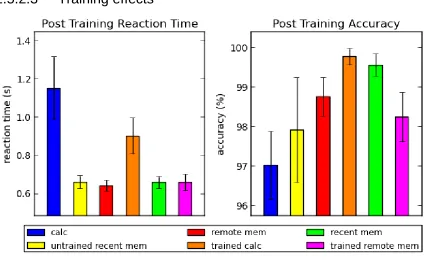
To examine the effects of strategy (on both trained and untrained problems), the initial strategy reports from the calibration session were used, because some conditions (such as untrained recent mem) did not occur in all participants. A main effect of strategy was found on both reaction time and accuracy. A paired t-test revealed a significant difference between the reaction times for remote memory (M=0.98, SD=0.14) and
a significant difference between the accuracies for calculated (M=97.14, SD=3.52) and remote memory (M=99.89, SD=0.47) problems; t(17.0)=-3.19, p=0.005, d=0.75. Thus, the problems that were memorized pre-training were still solved more quickly and accurately than were calculated problems, even post-training. This can be seen in Figure 2.5, which further subdivides the calculated problems into the categories of calc and recent mem. Initial strategy was used in the analysis of main effects rather than the strategy conversion because some conditions (such as untrained recent mem) did not occur in all participants. RTs and ACCs for the various strategy subtypes are shown Figure 2.5, which provide a description of the qualitative differences between them.
2.3.3.3
Training effects
Training effects were also evident. There was a significant difference between the reaction times for untrained (M=1.54, SD=0.37) and trained (M=1.05, SD=0.14)
Figure 2.5: Post production reaction times and accuracies for various problems
(Experiment 1, Voice Task)
2.4
Methods - Experiment 2
2.4.1
Objective
Experiment 1 assessed the utility of the CAT system using a task that involved the production of the solution to each problem by the participant. However the voice production task used to calibrate the CAT sets was known to be suboptimal for
Experiment 1. As in Experiment 1, shifts in strategy and behavioral improvements were examined post-training.
2.4.2
Participants
Participants included 15 undergraduate and graduate students (8 males, 7 females, Mean age 21.60 yrs, StdDev, 2.47 yrs) enrolled at The University of Western Ontario, Canada. Participants were recruited through posters distributed on campus. All participants completed all experimental conditions and provided informed consent using documentation that was approved by the Psychology Research Ethics Board at the University of Western Ontario.
2.4.3
Procedure
2.4.3.1
Pre-training – Choice task
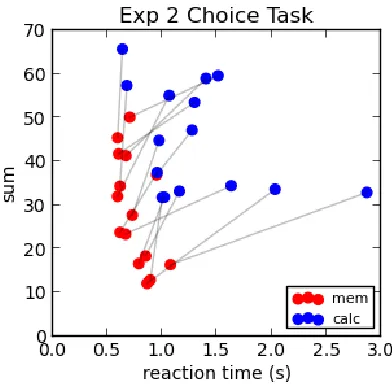
Experiment 2 followed the same logic as Experiment 1, but only the choice task was used during pre-training, thus the calibration of the problem sets was done using this task. The same number of problems was collected (40 MEM and 40 CALC). As in Experiment 1, each problem was shown to each participant twice to determine the consistency of the self-reports. Figure 2.2 shows a calibration trial using the choice task.
2.4.3.2
Training – Keyboard production task
The training in Experiment 2 was identical to Experiment 1 – 20 MEM and 20 CALC problems were rehearsed 10 times a day for 5 days, with participants accessing the training site on their home computer.
2.4.3.3
Post-training
The post-training lab visit used the same choice task as in the pre-training visit.