The SHiP physics program at CERN
Giovanni De Lellis1,2,3,a
1University of Naples "Federico II" 2CERN, Geneva, Switzerland 3INFN, Naples, Italy
Abstract.The discovery of the Higgs boson has fully confirmed the Standard Model of particles and fields. Nevertheless, there are still fundamental phenomena, like the existence of dark matter, the neutrino masses and the baryon asymmetry of the Universe, which deserve an explanation that could come from the discovery of new particles. The SHiP experiment at CERN is proposed to search for very weakly coupled particles in the few GeV mass domain where the existence of such particles is largely unexplored. A beam dump facility using high intensity 400 GeV protons is a copious source of such unknown particles in the GeV mass range. The beam dump is also a very intense source of neutrinos and, in particular, of tau neutrinos, the less known particle in the Standard Model. We report the physics potential of such an experiment. An ancillary measurement of the charm cross-section was carried out in July 2018 and the data are under analysis and we report preliminary results. Moreover, a prototype of the neutrino detector is being designed to possibly take data at the LHC in its Run3 of operation. We describe the proposed detector and the physics case.
1 Introduction
The discovery of the Higgs boson is certainly a big tri-umph of the Standard Model. In particular, given its mass, it could well be that the Standard Model is an effective theory working all the way up to the Planck scale. Never-theless, there are several phenomena deserving an expla-nation that the Standard Model is unable to provide: the existence of dark matter and its nature, the baryonic asym-metry of the Universe and neutrino masses. It is therefore clear the there is new physics and presumably several new particles have still to be discovered.
Searches for new physics with accelerators are being carried out at the LHC, especially suited to look for high mass particles with ordinary couplings to matter. Comple-mentary searches for very weakly coupled and therefore long-lived particles require a beam dump facility. Such a facility consists of a high density proton target, followed by a hadron stopper and a muon shield. Apart from resid-ual muons, the only remaining particles are electron, muon and tau neutrinos on top of hidden, long-lived particles produced either in proton interactions or in secondary par-ticle decays.
A new experiment, Search for Hidden Particles (SHiP), was proposed in 2015 [1], designed to operate at a beam dump facility to be built at CERN in the North Area and to search for weakly coupled particles in the few GeV mass range. The physics case for such an experiment is widely discussed in Ref. [2]. In five years, the facility will integrate 2×1020400 GeV protons, produced by the SPS
ae-mail: [email protected]
accelerator complex, impinging on a 12 interaction length (λint) target made of Molybdenum and Tungsten, followed
by a 30λintiron hadron absorber. Hidden particles in the
GeV mass range would be produced mostly by the decay of charmed hadrons produced in proton interactions. Ds
mesons, copiously produced among charmed hadrons, are a source of tau neutrinos through their fully leptonic de-cays. Therefore, the SHiP facility is ideal also to study the physics of tau neutrinos, the less known particle in the Standard Model.
Figure 1 shows the SHiP facility to be placed in the North Area at CERN: downstream of the target, the hadron absorber filters out all hadrons, therefore only muons and neutrinos are left. An active muon shield [3] is designed with two sections with opposite polarity to maximize the muon flux reduction: it reduces the muon flux from∼1010 down to∼105 muons per spill. 4×10¹³ protons are ex-tracted in each spill, designed to be 1s long to reduce the detector occupancy. A first successful test of the SPS cy-cle with a 1s long spill was performed in April 2015. The experimental facility is described in Ref. [4].
Figure 1.Layout of the SHiP facility.
taking is expected after the Long Shutdown 3 of the ma-chine.
The neutrino detector is made of a magnetised region, followed by a muon identification system, as shown in Figure 2. The magnetised region will host the neutrino target, a target tracker station and a charged particle spec-trometer. The magnet of the neutrino detector is shown in Figure 3 and its design is reported in Ref. [5]. The neutrino target is based on the emulsion cloud chamber technology successfully employed by the OPERA experi-ment [6], with a compact emulsion spectrometer, made of a sequence of very low density plates and emulsion films to measure the charge and momentum of hadrons in mag-netic field. A first prototype of this compact emulsion spectrometer was developed in 2008 [7] measuring mo-menta below 4 GeV/c. Its functionality is being extended to measurements of momenta up to about 10 GeV/c: a first attempt is shown in figure 4, showing a charge mis-identification at the percent level. Indeed, the measure-ment of the charge would allow to discriminate between tau neutrinos and anti-neutrinos also in the hadronic de-cay channels of the tau lepton. The emulsion target is complemented by high resolution tracking chambers in-side the magnetic field to provide the time stamp to the event, connect muon tracks from the target to the muon system and measure the charge and momentum for parti-cles (mostly muons) with momenta above 10 GeV/c. A muon system is located downstream of the magnet. It is based on alternating 20 cm thick iron slabs with Resistive Plate Chambers (RPC), providing the tracking within the slabs. The muon system will also act as upstream veto tag-ger for background processes to the hidden particle search. Two stations developed according to the technique of the multi-gap glass RPC [8] will act as a veto tagger with about 300ps timing resolution. The good timing perfor-mance is needed in order to avoid spoiling the signal effi
-ciency with opening a longer gate around possible candi-dates in the hidden sector spectrometer.
Figure 2.The neutrino detector upstream of the decay vessel.
The emulsion target will also act as the target of dark matter as well as of any feebly interacting particle pro-duced in 400 GeV proton-target collisions, when its mass is in the GeV range. The ongoing optimisation of this detector concerns the target material, the sampling fre-quency of the emulsion cloud chamber and the timing per-formances of the target tracker that would enable the sepa-ration between neutrinos and heavy particles based on the time-of-flight measurement.
Figure 3.The magnet hosting the scattering and neutrino detec-tor.
Figure 4.First measurement of 10 GeV/cpion momentum with a compact emulsion spectrometer: the sagitta is shown with its sign.
position resolution of 120 µm per straw, with 8 hits per station on average. This gives a momentum resolution of about 1%. The vessel will be surrounded by a liquid scin-tillator layer to tag charged particles coming from outside. Downstream of the spectrometer, an hadronic and electro-magnetic calorimeter and a muon filter are used to identify particles. A timing detector with a resolution better than 100ps complements the apparatus to reject vertices pro-duced by the chance coincidence of two tracks.
2 Search for hidden particles and physics
searches with the neutrino detector
Extensions of the Standard Model in the low mass region foresee the existence of particles as singlets with respect to the Standard Model gauge group. These particles couple to different singlet composite operators (so-called Portals) of the Standard Model. The SHiP detector has the poten-tiality to discover very weakly interacting and long lived
particles in a wide unexplored range of their masses and couplings, within these Portals. As an example, we re-port in Figure 5 the sensitivity to heavy neutral leptons, when only the muon couplingUµis considered [9]. For an overview of the sensitivity to different portals and corre-sponding particles, we refer to [1, 2].
Figure 5.SHiP sensitivity to heavy neutral leptons [9].
Figure 6. Improvement of the accuracy on s+with SHiP (red) compared to the present status (blue) in the 0.02 < x < 0.35 range.
The observation of tau neutrinos was confirmed by the DONUT experiment only in 2008 when 9 candidates events were reported [10]. The OPERA experiment [6] has detected ten tau neutrinos [11–16], leading to the dis-covery of tau neutrino appearance from muon neutrino os-cillations [15, 16]. The only leptonic decay observed by OPERA [13] shows negative charge as expected from aντ interaction. Therefore, so far there is no direct evidence for tau anti-neutrino scattering. The SHiP facility is aντ factory, with 6.6×10¹⁵tau neutrinos produced in primary proton collisions, equally divided in neutrinos and anti-neutrinos. Given the neutrino target mass of about 10 tons, one expects more than 10000 interactions of tau neutrinos and anti-neutrinos.
identify charmed hadrons only in their muonic decay chan-nel, when two opposite sign muons are produced in the final state. A cut of 5 GeV is applied to muons in or-der to suppress the background due to punch-through pi-ons. The nuclear emulsion technology, instead, identifies topologically the charmed hadron by detecting its decay vertex. Energy cuts are therefore much looser, thus pro-viding a better sensitivity to the charm quark mass. Mo-roever, a large statistical gain is provided by the use of hadronic decay modes [17]. Indeed, SHiP will integrate about 105 charm candidates induced by neutrino interac-tions, more than one order of magnitude larger than the present statistics [18–20], with a large (∼30%) contribu-tion from anti-neutrinos. Charm produccontribu-tion in neutrino scattering is extremely sensitive to the strange quark con-tent of the nucleon, especially with anti-neutrinos where the s-quark is dominant. SHiP will improve significantly the uncertainty on the strange quark distribution in the nu-cleon as shown in Figure 6 in terms ofs+=s(x)+s(x) in¯ the 0.02<x<0.35 range.
The neutrino detector is also very efficient in the de-tection of the scattering of any neutral and feebly interact-ing particle with the atoms (electrons or nucleons) of the emulsion detector. Hence the name of Scattering and Neu-trino Detector (SND). Indeed we have studied the sensitiv-ity to a dark matter produced in the decay of a dark photon. The widely used minimal framework foresees a (fermion or scalar) DM particle, χ, coupled to the SM via a dark photon mediatorA0. Such an extension and its interactions
are fully described by four parameters: coupling constant
αDbetweenA0andχ, mixing parameterbetween theA0
and the SM photon, and the masses of the two new parti-clesmχandmA0. With these parameters at hand, one can
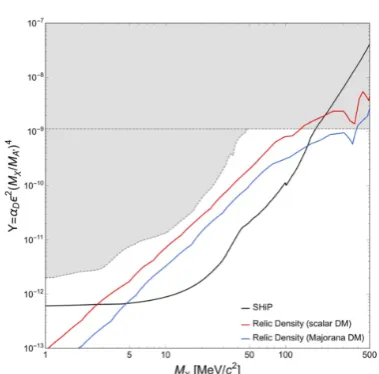
compare the reach of accelerator-based searches looking for a particle escaping detection (“missing energy” tech-nique) with those looking for the direct scattering of a DM particle offthe target atoms. Figure 7 shows the sensitivity of the SHiP experiment to a light (below 500 MeV) massχ particle in the coupling and mass plane. It is clearly visible that the reach extends well beyond the relic density curves for a large part of the parameter space and much beyond current existing limits (grey region).
2.1 The charm cross-section measurement
The tau neutrino yield as well as the yield of any hid-den particle produced by charm decays are affected by a large uncertainty: indeed, simulation studies of proton in-teractions in heavy and thick targets show that the charmed hadron yield is increased by a factor of 2.3 from the cas-cade production [21]. Charmed hadrons are produced ei-ther directly from interactions of the primary protons or from subsequent interactions of the particles produced in the hadronic cascade showers, including in particular the protons after a primary elastic collision. The available measurement of the associated charm production per nu-cleonσcc¯ =18.1±1.7µbarn [22] was indeed obtained with a thin target where the secondary production is negligible. The SHiP Collaboration proposed the SHiP-charm project [23], aiming at measuring the associated charm
Figure 7.Sensitivity to the dark matter search.
Figure 8. Setup of the charm measurement experiment built in 2018.
two custom developed large FE-I4 front-end chips [25] with a sophisticated readout architecture. The sensors are 200µm thick with an inactive edge width of less than 450
µm, translating into a geometrical acceptance of 97.8%. The pixel tracking station cover a transverse area of about 33.6×37 mm2, sufficient to contain the beam spot and the products of the interactions in the lead-emulsion target.
For the two downstream stations, denoted as T3 and T4 in Figure 8, a combination of two different technologies was used: Scintillating Fibre trackers (SciFi) with 250µm diameter in the central 40×40 cm2region, where the den-sity of tracks is higher, and drift tubes in the outer region. Two modules per station were used for the SciFi, each con-sisting of two planes, in such a way to provide XU and YU coordinates, where U has a stereo angle of about 2◦ with
respect to X and Y, respectively. While the SciFi were built on purpose, the drift tube chambers were adapted from the modules built for the OPERA experiment [26].
The muon tagger is the most downstream detector in the apparatus. It has the task of identifying muons with high purity to tag the muonic decay channel of charmed hadrons. At the same time, it has to reconstruct the muon track slope to match the corresponding track reconstructed in the upstream magnetic spectrometer (made of the four tracking stations described above) and assign the momen-tum to the muon track. The layout of the muon tagger is made of five concrete slabs, two 80 cm-thick and three 40 cm-thick, acting as hadron absorber, interleaved by five RPC planes, acting as trackers. The transverse size of the RPC planes is 195×125 cm2. The muon identification is done on the basis of the number of crossed layers in the detector. The RPC chambers were designed and con-structed on purpose. The RPCs were designed to operate in avalanche mode, with a time resolution of about 1 ns. Two orthogonal sets of strips, 1cm thick, were used for 2D measurements with a position resolution of about 3 mm in both directions.
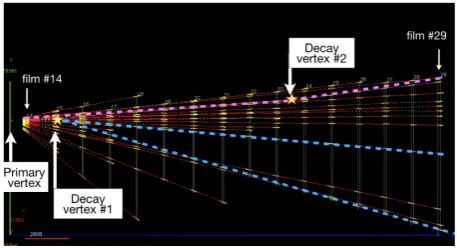
An optimisation run was performed at the H4 beam-line of the CERN SPS in July 2018 with an integrated number of protons on target of about 1.5×10⁶. Data are under analysis. Figure 9 shows one of the double charm candidate events found in the analysis. The event shows three vertices: the most upstream is the proton interaction vertex. There are two additional vertices: one shows a 2 prong topology without any charged parent particle while the other one shows a kink topology. Therefore, the first one is a D0 candidate while the other is most likely ei-ther a D or a Ds meson. The flight lengths of the
neu-tral and charged charm candidates are 2.1 mm and 12.7 mm, respectively. The impact parameter of theD0 daugh-ter tracks with respect to the primary proton vertex are 250 and 590µm. The kink of the charged charm candidate is 31mrad and the impact parameter of the daughter particle to the primary proton vertex is 390 µm. From the mea-sured flight length and average decay angle, one can infer an estimate of the lifetime of the particle [27]: this gives 1.4 ×10⁻¹²s for the neutral candidate and 1.3×10⁻¹²s for the charged one, both consistent with the hypothesis of charmed hadron decays.
Figure 9. A double charm candidate event produced in proton collisions with the lead target.
The measurement with larger statistics is planned after the long shutdown LS2 of the CERN accelerator complex, with 5×10⁷protons on target and a charm yield of about 1000 fully reconstructed interactions.
2.2 The SND detector at LHC
Neutrino interactions provide precise tests of the SM [17, 28–30], probes of new physics [31–33], and windows to otherwise veiled regions of the Universe [34]. They have been extensively investigated only for neutrino ener-gies below 350 GeV, and mostly for muon neutrinos only. The IceCube Collaboration recently reported a few tens of events with energies from about 10TeV to 1PeV [35]. A collection of all the available cross-section measurements is given in Ref. [36] which includes the IceCube shower events. The region between 350 GeV and about 10 TeV is totally unexplored. Recently, it was pointed out that LHC is an intense source of high-energy (about 1 TeV) neu-trinos of all kinds and a proper location was looked for, by measuring the background in different caverns under-ground with an emulsion detector [37]. The TI18 cavern was identified as the most suitable location in terms of en-vironmental and machine-induced background [37].
References
[1] M. Anelli et al.,A facility to Search for Hidden Parti-cles (SHiP) at the CERN SPS, arXiv:1504.04956. [2] S. Alekhin et al., A facility to search for hidden
particles at the CERN SPS: the SHiP physics case, Rep. Prog. Phys.79(2016) 124201.
[3] A. Akmete et al.,The active muon shield in the SHiP experiment, JINST12(2017) no.05, P05011.
[4] C. Ahdida et al., The experimental facility for the Search for Hidden Particles at the CERN SPS, JINST
14(2019) no.03, P03025.
[5] C. Ahdida et al., The Magnet of the Scattering and Neutrino Detector for the SHiP experiment at CERN, arXiv:1910.02952.
[6] N. Agafonova et al., The OPERA experiment in the CERN to Gran Sasso neutrino beam, JINST4 (2009) P04018.
[7] C. Fukushima et al.,A thin emulsion spectrometer us-ing a compact permanent magnet, Nucl. Instrum. Meth. A592 (2008) 56.
[8] E. Cerron Zeballos et al.,A New type of resistive plate chamber: The Multigap RPC, NIMA374(1996) 132 -135.
[9] C. Ahdida et al.,Sensitivity of the SHiP experiment to Heavy Neutral Leptons, JHEP 1904 (2019) 077. [10] K. Kodama et al.,Final tau-neutrino results from the
DONuT experiment, Phys. Rev.D78(2008) 052002. [11] N. Agafonova et al., Observation of a first ντ
can-didate in the OPERA experiment in the CNGS beam, Phys. Lett.B691(2010) 138.
[12] N. Agafonova et al.,New results onνµ→ντ appear-ance with the OPERA experiment in the CNGS beam, JHEP1311(2013) 036.
[13] N. Agafonova et al.,Evidence forνµ → ντ appear-ance in the CNGS neutrino beam with the OPERA ex-periment, Phys. Rev.D89(2014) 051102.
[14] N. Agafonova et al.,Observation of tau neutrino ap-pearance in the CNGS beam with the OPERA experi-ment, PTEP2014(2014) 101C01.
[15] N. Agafonova et al.,Discovery ofτneutrino appear-ance in the CNGS Neutrino Beam with the OPERA ex-periment, Phys. Rev. Lett.115(2015) 121802.
[16] N. Agafonova et al., Final results of the OPERA experiment on ντ appearance in the CNGS beam, Phys. Rev. Lett.120(2018) 211801.
[17] G. De Lellis et al., Charm physics with neutrinos, Physics Reports399(2004) 227.
[18] T. Adams et al.,Evidence for diffractive charm pro-duction in muon-neutrino Fe and anti-muon-neutrino Fe scattering at the Tevatron, Phys.Rev. D61 (2000) 092001
[19] A. Kayis-Topaksu et al., Measurement of charm pro-duction in neutrino charged-current interactions, New J.Phys. 13 (2011) 093002.
[20] G. Onengut et al., Measurement of charm production in antineutrino charged-current interactions, Phys.Lett. B604 (2004) 11-21.
[21] H. Dijkstra and T. Ruf,
http://cds.cern.ch/record/2115534/files/ SHiP-NOTE-2015-009.pdf.
[22] C. Lourenco, H.K. Wohri, Heavy flavour hadro-production from fixed-target to collider energies, Physics Reports433(2006) 127.
[23] A. Akmete et al.,Measurement of associated charm production induced by 400 GeV/c protons, CERN-SPSC-2017-033, SPSC-EOI-017 (2017).
[24] F. Hugging, The ATLAS Pixel Insertable B-Layer (IBL), Nucl. Instrum. Meth.,A650(2011) 45–49. [25] M. Garcia-Sciveres et al., The FE-I4 pixel readout
integrated circuit, Nucl. Instrum. Meth.A636 (2011) S155–S159.
[26] R. Zimmermann et al., The precision tracker of the OPERA detector, Nucl. Instrum. Meth.,A555 (2005) 435–450.
[27] S. Petrera and G. Romano,A method to evaluate the detection efficiency and the mean lifetime of shortlived particles, Nucl. Instrum. Meth.174(1980) 61.
[28] CTEQ collaboration, Handbook of perturbative QCD: Version 1.0, Rev. Mod. Phys. 67 (1995) 157. [29] J. M. Conrad, M. H. Shaevitz and T. Bolton,
Preci-sion measurements with high-energy neutrino beams, Rev. Mod. Phys. 70 (1998) 1341.
[30] J. A. Formaggio and G. P. Zeller, From eV to EeV: Neutrino Cross Sections Across Energy Scales, Rev. Mod. Phys. 84 (2012) 1307.
[31] A. Connolly, R. S. Thorne and D. Waters, Calcu-lation of High Energy Neutrino-Nucleon Cross Sec-tions and Uncertainties Using the MSTW Parton Dis-tribution Functions and Implications for Future Experi-ments, Phys. Rev. D83 (2011) 113009.
[32] C.-Y. Chen, P. S. Bhupal Dev and A. Soni, Stan-dard model explanation of the ultrahigh energy neu-trino events at IceCube, Phys. Rev. D89 (2014) 033012. [33] D. Marfatia, D. W. McKay and T. J. Weiler, New physics with ultra-high-energy neutrinos, Phys. Lett. B748 (2015) 113.
[34] M. Ackermann et al., Astrophysics Uniquely En-abled by Observations of High-Energy Cosmic Neutri-nos, Bull. Am. Astron. Soc. 51 (2019) 185.
[35] IceCube collaboration, Measurement of the multi-TeV neutrino cross section with IceCube using Earth absorption, Nature 551 (2017) 596.
[36] M. Bustamante and A. Connolly, Extracting the Energy-Dependent Neutrino-Nucleon Cross Section above 10 TeV Using IceCube Showers, Phys. Rev. Lett. 122 (2019) 041101.
[37] N. Beni et al., Physics Potential of an Experiment using LHC Neutrinos, J. Phys. G 46 (2019) 115008. [38] C. Ahdida et al., SND@LHC,

![Figure 5. SHiP sensitivity to heavy neutral leptons [9].](https://thumb-us.123doks.com/thumbv2/123dok_us/8110994.1352449/3.595.62.281.287.490/figure-ship-sensitivity-heavy-neutral-leptons.webp)