Gender Classification Technique Based on Facial
Features using Neural Network
Anushri Jaswante Dr. Asif Ullah Khan Dr. Bhupesh Gour
Computer Science & Engineering, Rajiv Gandhi Proudyogiki Vishwavidyalaya,
Bhopal, India.
Abstract— In this paper, we present a novel method to gender classification using a new simple feature extraction which extracts geometric features such as distance between eyebrow to eye, eyebrow to nose top, nose top to mouth, eye to mouth, left eye to right eye, width of nose, width of mouth. First to extract these features by using Viola Jones algorithm and then apply Artificial Neural Network. The features set is applied to three different applications: face recognition, facial expressions recognition and gender classification, which produced the reasonable results in all database. We described two phases such as feature extraction phase and classification phase. These features provide input to trained neural networks. The neural networks have been proposed for classification purpose. The networks have been trained to produce value 1 for male and 0 for female. Output of these neural network determines the gender of the person. The results using a training database of 100 male and 100 female images from CIPM institute.
Keywords— Feature Extraction, Gender Classification, Back Propagation neural network.
I. INTRODUCTION
Gender classification problem is an active research area which has attracted a great deal of attention recently. It is a challenging pattern recognition problem. Generally gender classification involves a process of determining the gender of a subject from face images. The face images analysis plays an important role in computer vision. Face images analysis has been successfully used in many applications ranging from biometric to robotic-human interaction. Current face detection applications operate with high accuracy as compared to gender classifications systems, because gender classification systems do not offer same level of performance and accuracy. Face is a very important biometric feature of human. Automatic recognizing and analyzing of face is one of challenging tasks in object recognition. Successful performing this task allows many applications in human computer interaction. Gender plays a significant role in our interactions in society and with computers [4]. Actually Gender classification is a binary classification problem in which one has to predict an image belongs to a man or woman. It is an easy job for a person but a challenging one for computers [5].
In this paper the gender classification problem is solved in an efficient manner. Face portion of the image is extracted from the image using Viola & Jones [1], this helps in reducing the
complexity of the proposed method. Then to apply the artificial neural network by using back propagation algorithm. The method is tested on CIPM institute of face images dataset. The results obtained are better than other methods in practice. The results using a training database of 100 male and 100 female images from CIPM institute. The gender is classified on the basis of distance between eye brow to eye, eyebrow to nose top, nose top to mouth, eye to mouth, left eye to right eye, width of nose, width of mouth by using the Artificial Neural Network. The features are extracted by using Viola Jones Algorithm and Leonardo Da Vinci principal is used for geometry of faces. We use a fast and reliable method that is capable of classifying genders based on a simple feature extraction. The efficiency of the proposed method makes it a good choice for real-time systems. The database was created by taking 100 images of males and females from CIPM institute. In the database there were some images of males appearing as a females and females appearing as males, this method successfully classified all the images into males and females. Gender classification is one of the more important visual tasks for an extremely social animal like us humans many social interactions critically depend on the correct gender perception of the parties involved. Visual information from human faces provides one of the more important sources of information for gender classification. A novel model for face detection and gender identification based on logistic regression. We allow the Gabor filter features to be selected arbitrarily in a large feature set. In this way, the features selection can be more discriminative, and hence our approach is more accurate for gender identification. Our approach is able to handle a wide range of variations in static color images, based on a lighting compensation technique and a nonlinear color transformation. The gender is identified from color images using logistic regression. In that method, first to detect the face, after detecting the face to extract the feature from face then to generate the face vector and at last to apply the logistic regression method.[1]
faces in an image and extract facial features from facial images.
In this paper, face detection and gender classification methods are combined. The face detection acts as a preprocessing operation to the gender classifier that determines the gender. The most important factors are usually the detection and classification accuracies. The other important factors are detection and classification speed.
II. METHODOLOGY
Complete algorithm can be divided in four categories. A. Face Detection
B. Feature Extraction
C. Back Propagation Neural Network D. Gender Classification
Fig. 1 Architecture of Gender Classifier
A. Face Detection
To achieve fast and efficient classification, we need to identify features which are most relevant for classification task. The face is detected by using Viola Joans Algorithm. This is well known and robust frontal face detection; its calculation is very fast. This detector extract faces from the image by starting from top left corner and ending at bottom right corner of an image. Face Detection one of the most important tasks of any facial classification method system.
Fig. 2 Face Detection
B. Feature Extraction
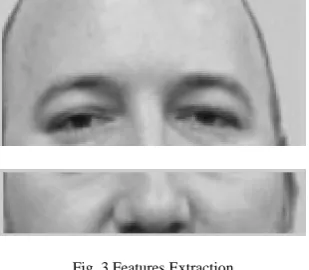
The Leonardo Da Vinci principal is used for feature extraction, which determines the geometry of the faces. The distance between head to chin, width of head, width of nose etc. are calculated for the geometry of the face.
Fig. 3 Features Extraction
C. Back propagation Neural Networks (BPN)
Back propagationneural networks are used for classifying the gender. Any network must be trained in order to perform a particular task. In training process, training data set is presented to the network and network’s weights are updated in order to minimize errors in the output of the network. Back propagation neural networks uses back propagation algorithm for training the network. Back propagation algorithm used can be divided in following three steps.
The Back Propagation Algorithm is described below. 1. Selection and Preparation of Training Data:-
Training set contains 100 images of male and 100 images of females.
2. Modification of connection weights:-
The training data set consists of input signals assigned with corresponding target. The network training is an iterative process. In each iteration weights coefficients of nodes are modified using new data from training data set. Modification is calculated using back propagation algorithm described below.
Step 1:- Choose an input data from training set and compute output of each node in hidden and output layer using activation function.
Step 2:- Output signal of the network is compared with the desired output value (the target), which is found in training data set. The difference is calculated using Mean Squared Error and called error signal of output layer nodes.
Step 3:- It is impossible to calculate error signals for nodes in hidden layer directly as desired output values. To calculate error signals to such nodes, idea is to propagate error signals in output layer nodes back to nodes of hidden layer which provide input to that particular node in output layer.
3. Repetitions:-
Once the above procedure is completed for all examples in training set, same procedure must be repeated many times until the Mean Square Error (MSE) drops below a specified value. When this happens, the network is performing satisfactorily and the training session is completed.
D. Gender Classification
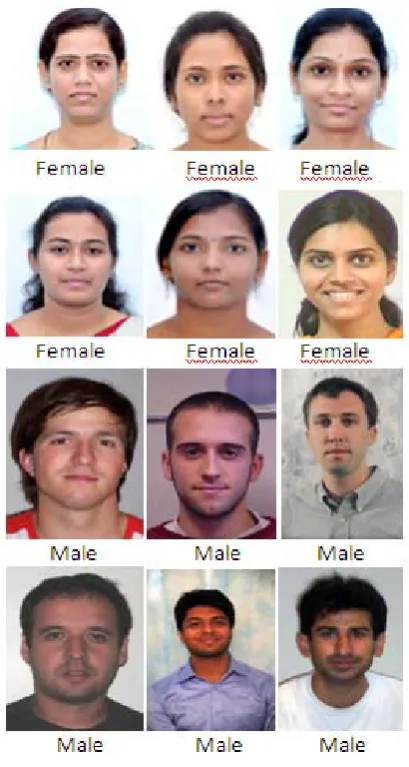
The gender classification procedure is described in this section. First step in any classification technique is the detection of face. Once all facial features are extracted, a classifier has been trained which can classify as a male or female. The Back Propagation Neural Network has been used for classifying the gender. The gender are classified on the basis of distance between eyebrow to eye, eyebrow to nose top, nose top to mouth, eye to mouth, left eye to right eye, width of nose, width of mouth.
Fig. 4 Gender Classified • Flow Chart of Proposed System:
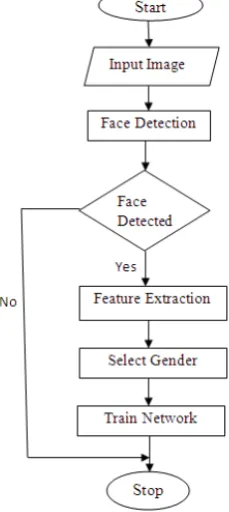
In the proposed system, there are two phase such as training phase and testing phase.
A. Training Phase:
Fig. 5 Training Phase
B. Testing Phase:
Fig. 6 Testing Phase
III. EXPERIMENTAL RESULT
The gender is classified on the basis of distance between eye brows to eye, eyebrow to nose top, nose top to mouth, eye to mouth, left eye to right eye, width of nose, width of mouth by using the Artificial Neural Network. The features are extracted by using Viola Jones Algorithm and Leonardo Da Vinci principal is used for geometry of faces. The threshold value set for male and female. If the calculated value is 1 then output is Male otherwise female. We use a fast and reliable method that is capable of classifying genders based on a simple feature extraction. The efficiency of the proposed method makes it a good choice for real-time systems.
A. Data Set
The database was created by taking 100 images of males and females from CIPM institute. In the database there were some images of males appearing as a females and females appearing as males, this method successfully classified all the images into males and females.
TABLE I:
COMPARISON RESULT OF DIFFERENT ALGORITHM
Fig. 8 Accuracy of Different Algorithm
IV. CONCLUSION
In this, we classify the gender on the basis of features. When to classify the gender, first to detect the face, once the face is detected then to extract the features by using Viola Jones Algorithm, once the features are extracted then to apply the back propagation neural network for classifying the gender. This paper presents the results with hundred male and hundred female images. The proposed system has a low complexity and is suitable for real time implementations. In the database there were some images of males appearing as a females and females appearing as males, this method successfully classified all the images into males and females.
Fig. 9 GUI panel for Gender Classification
Fig. 10 some output result of gender classification
REFERENCES
[1] Fida Hasan Md. Rafi and Abu Farzan Mitul “An Automatic Face Detection and Gender Identification from Color Images using Logistic Regression” IEEE Computer Vision and Pattern Recognition 978-1-4799-0400.March 2013.
[2] B. Moghaddam and M.-H. Yang, “Gender Classification with Support Vector Machines,” Proc. Int’l Conf. Automatic Face and Gesture Recognition, pp. 306-311, Mar. 2000.
[3] Z. Yang, M. Li, and H. Ai, “An Experimental Study on Automatic Face Gender Classification,” Proc. 18th IEEE Int’l Conf. Pattern Recognition, vol. 3, pp. 1099-1102, Aug. 2006.
[4] M. Nazir, Muhammad Ishtiaq, Anab Batool” Feature Selection for Efficient Gender Classification” Recent Advances in Neural Networks, Fuzzy Systems & Evolytionary Computing ISBN: 978-960-474-195-3.
[5] Hlaing Htake Khaung Tin “Perceived Gender Classification from Face Images” I.J.Modern Education and Computer Science, 2012, 1, 12-18.
[6] M. Arbib and T. Uchiyama “Color image segmentation using competitive learning” IEEE Transactions on pattern analysis and machine intelligence, 16:1197– 1206, 1994.
[7] Caifeng Shan “Learning local binary patterns for gender classification on real-world face images” Pattern Recognition Letters 33 (2012) 431–437.
Method Accuracy
SVM 76.82 Threshold Adaboost 75.26
[8] Fahim Mannan “Classification of Face Images Based on Gender using Dimensionality Reduction Techniques and SVM”
[9] Amit Jain, Jeffrey Huang and Shiaofen Fang “Gender
Identification Using Frontal Facial Images” 0-7803-9332-5/052005 IEEE.
[10] Md. Hafizur Rahman, Suman Chowdhury, Md. Abul Bashar“An Automatic Face Detection and Gender Identification from Color Images using Support Vector Machine” Journal of Emerging Trends in Computing and Information Sciences Vol. 4, No. 1 Jan 2013.
[11] Paul Viola and Michael Jones “Rapid Object Detection using a Boosted Cascade of Simple Features” Proceedings of the 2001 IEEE Computer Society Conference on Computer Vision and Pattern Recognition (CVPR’01) p. 511, Volume 1, 2001. [12] Valentin Schwind “ The Golden Ratio in 3D human face