A Method from Leakage Resilient Cryptography
Duong Hieu Phan1,2 and Viet Cuong Trinh1 1
LAGA, University of Paris 8
2ENS / CNRS / INRIA
Abstract. In the classical model of traitor tracing, one assumes that a traitor contributes its entire secret key to build a pirate decoder. However, new practical scenarios of pirate has been considered, namely Pirate Evolution Attacks at Crypto 2007 and Pirates 2.0 at Eurocrypt 2009, in which pirate decoders could be built from sub-keys of users. The key notion in Pirates 2.0 is the anonymity level of traitors: they can rest assured to remain anonymous when each of them only contributes a very small fraction of its secret information. This scenario encourages dishonest users to participate in collusion and the size of collusion could become very large, possibly beyond the considered threshold in the classical model. There are numerous attempts to deal with Pirates 2.0 each of which only considers a particular form of Pirates 2.0. In this paper, we propose a method for fighting Pirates 2.0 in any form.
Our method is based on the researches in key-leakage resilience. It thus gives an interesting and rather surprised connection between the rich domain of key-leakage resilient cryptography and Pirates 2.0. We first formalize the notion of key-leakage resilient revoke system and then identify sufficient conditions so that a key-leakage resilient revoke scheme can resist Pirates 2.0 in any form. We finally propose a construction of a secure key-leakage resilient identity-based revoke system that fulfills the required conditions. The main ingredient in the construction relies on the identity-based encryption with wildcards (WIBE) and our construction of key-leakage resilientWIBEcould be useful in its own right.
Keywords: Pirates 2.0, Leakage-resilience, wildcards, revocation.
1 Introduction
In a system of secure distribution of digital content, a center broadcasts encrypted content to legitimate recipients. Broadcast encryption systems, independently introduced by Berkovits [5] and Fiat-Naor [16], enable a center to encrypt a message for any subset of legitimate users while preventing any set of revoked users from recovering the broadcasted information. Moreover, even if all revoked users collude, they are unable to obtain any information about the content sent by the center.Traitor tracing schemes, introduced in [10], enable the center to trace users who collude to produce pirate decoders. Trace and Revoke systems [24,23] provide the functionalities of both broadcast encryption and traitor tracing.
In the classical model of tracing traitors, one assumes that a traitor contributes its entire secret key to build a pirate decoder. However, new practical scenarios of pirate has been considered, namely Pirate Evolution Attacks [19] and Pirates 2.0 [6], in which pirate decoders could be built from sub-keys of users. The notion of anonymity has been put forth in Pirates 2.0 and it is shown that if each user only contributes a very small fraction of its secret information, he can rest assured to remain anonymous. This scenario encourages dishonest users to participate in collusion and the size of collusion could becomes very large, beyond the considered threshold in the classical model.
There are some methods aiming to fight against pirates 2.0 attacks [11,27,30] but none of these works considers a general form of leakage of secret keys. In fact, it is assumed in these methods that the dishonest users leak the entire information of some sub-keys which could be used in the encryption procedure. It was also mentioned in these papers that a method for dealing with Pirates 2.0 in any form of leakage rather than contributing the whole information about some sub-keys is a open and challenging problem. We solve this problem by considering any strategy of contributing information. The key point in our analysis is to quantify the leaked information (via the conditional entropy) of the secret keys of the users before and after each round of contribution.
anonymous) by proving that if the traitors only contribute small parts of their keys, the built pirate decoder cannot be useful. This leads us to the consideration of key-leakage resilient in revoke schemes. Leakage resilient cryptography has been a very rich domain of research in the recent years, a non-exhaustive list of works can be found in [17,22,12,9,14,26,15,28,25,18,4,8,20]. Under this framework, the adversary is allowed to specify an efficiently computable leakage function and learn the output of the function applied to the secret key and possibly other internal state information at specified moments in the security game. Our idea is to reduce a Pirates 2.0 to an adversary that breaks the security of a key-leakage resilient revoke scheme in which the contributive function in Pirates 2.0 is used as the computable leakage function and the high anonymity level in Pirates 2.0 is linked to the level of leaked information.
1.1 Contribution
Theoretical result. We formalize the key-leakage resilient security model for a revoke system, which enhances its classical security model. We then prove that any key-leakage resilient revoke system satisfying the following conditions will resist Pirates 2.0 in any form:
– any user’s secret key is a high independent source, i.e., it has a high entropy even under the condition that all the keys of the others users are known.
– resilience to a sufficient high level of leakage at secret keys of users.
Intuitively, the first condition assures that the secret keys of users are sufficiently independent each from the others and the second condition implies that the users should contribute a high information about its key to produce an useful decoder. Combining the two conditions, the users have to contribute high information of their own independent sources and thus lose their anonymity.
Construction. In order to apply the above result, we present a secure key-leakage resilient identity-based revoke scheme that fulfills the required conditions to resist Pirates 2.0. Because our construction is based on the identity-based encryption with wildcards (WIBE) [2,1] in the similar way to [27], it turns out that the main obstacle is to construct a key-leakage resilientWIBEwhich could be useful in its own right. This is not a trivial work and is achieved in successive steps:
– The security model of a key-leakage resilient WIBE generalizes the full security of a WIBE by allowing the adversary to make additional leak queries. Our first step is then to construct an efficient fully secureWIBE. Fortunately, with the recent dual system encryption technique in [29], it’s relativelly simple to construct a variant of the Boneh-Boyen-Goh’s WIBE (BBG−WIBE) [2] scheme that is fully secure with a very efficient reduction that avoids a loss of an exponential factor in hierarchical depth as in the classical method of reducing the full security ofWIBEto the full security of the underlying HIBEin [2].
– Inspired by the security proof technique of the key-leakage resilientHIBE in [20], our second and main step is to transform this variant of fully secureBBG−WIBEto a secure key-leakage resilient
WIBE. Some carefulness should be taken into account in the security proof because WIBE is a generalization ofHIBEand the adversary has more freedom in attacking WIBEthan in attacking
HIBE. Our construction of the first key-leakage resilientWIBEcould have its own impact.
1.2 Related works
Identity-based traitor tracing scheme was proposed by Abdalla et al [3] in which one can distribute content to various groups of users by taking as input the identity of the targeted group.Identity-based trace and revoke schemes (IDTR) in [27] extended this model to allow the center to be capable of revoking any subgroup of users.
targeted set of users inWIBEfollows a pre-determined structure while a broadcast encryption should be able to target arbitrary group of users. Naturally, WIBE could then be used as a sub-structure to construct trace and revoke systems. This approach has been used in different ways, namely under the code-based framework [3,30], and under the tree-based framework [27]. Our construction is under the tree-based framework as in [27] but with a key-leakage resilientWIBE.
2 Sufficient Condition for Fighting Pirates 2.0
In this section, we identify the sufficient condition for a key-leakage resilient revoke system to resist Pirates 2.0 attack. We first introduce the formalization of a key-leakage resilient revoke system, the review the Pirates 2.0 in the information theory and finally establish a sufficient condition on the independent entropy of the secret keys in a key-leakage resilient revoke system to exclude the threat of Pirates 2.0 in any form.
2.1 Key-Leakage Resilient Revoke System
We recall the definition of a revoke scheme. Formally, a revoke scheme consists of four polynomial-time algorithms (Setup,KeyDer,Enc,Dec):
Setup(1k, Nu): Takes as inputs the security parameter 1kand the number of usersNu. This algorithm
generates a master public key mpk and a master secret keymsk.
KeyDer(msk, i): Takes as inputs an indicesiof user and the master secret keymsk, the key extraction algorithm generates a user secret key ski.
Enc(mpk,R, M): The encryption algorithm which on inputs of the master public keympk, a revoca-tion list Rof revoked users in the system, and a messageM outputs a ciphertext C.
Dec(ski, C): The decryption algorithm which on input of a user secret key ski and a ciphertext C
outputs a plaintext messageM, or⊥to indicate a decryption error.
For correctness we require that Dec(ski,Enc(mpk,R, M)) = M with probability one for all
i∈N\ R,M ∈ {0,1}∗, (mpk,msk)←$ Setup(1k, Nu) andski
$
←KeyDer(msk, i).
We now present the security model for a (`SK)-key-leakage resilient revoke scheme (each user leaks
maximum`SK bits on his secret keySK).
Setup: The challenger takes a parameterk, a maximum number of usersNu and runssetup(1k, Nu)
algorithm. The master public key mpk is passed to the adversary. Also, it sets the set of revoked usersR=∅,T =∅, note thatR ⊆ I, andT ⊆ {I × SK × N } (users indices - secret key of users - leaked bits). Thus initially, no leakage on each secret key.
Phase 1: The adversary can be interleaved in any possible way to request three types of query:
1. Create(i): The challenger initially scansT to find the indicesi. If this indices exists inT, it responds with⊥.
Otherwise, the challenger makes a call to KeyDer(msk, i) → ski and adds the tuple (i,ski,
0) to the setT.
2. Leak(i, f) In this query, the adversary requests leakage from a key that has indices i with a polynomial-time computable functionf of constant output size. The challenger scansT to find the specified indices. It is of the form (i,ski,L). It checks ifL+|f(ski)| ≤`SK. If this
is true, it responds withf(ski) and updates theLin the tuple withL+|f(ski)|. If the checks
fails, it returns⊥to the adversary.
3. Reveal(i): Now the adversary requests the entire key with indices i. The challenger scans T
to find the requested entry. Let’s say the tuple is (i,ski,L). The challenger responds with ski
and adds the indices ito the setR.
Challenge: The adversary submits two equal length messagesM0, M1. The challenger picks a random
Phase 2: This is identical to phase 1 except that the adversary is not allowed to askReveal(i) query in which i /∈ R.
Guess: The adversary outputs a guess b0 and wins the game ifb0 =b.
Definition 1. A revoke scheme is (`SK)-key-leakage resilient secure if all probabilistic
polynomial-time adversaries (called PPT adversaries for short) have at most a negligible advantage in winning the above security game.
2.2 Pirates 2.0
In the model of pirates 2.0 attacks [6], traitors collaborating in a public way and use the same strategy to display part of their secret keysin a public place at their discretion; pirate decoders are then built from this public information. The distinguishing property of pirates 2.0 attacks is that traitors only contribute partial information about their secret key material which suffices to produce (possibly imperfect) pirate decoders while allowing them to remain anonymous. Both pirates and traitors can keep track of all of the information that was contributed to the public.
The basic idea behind Pirates 2.0 attacks is that traitors are free to contribute some piece of secret data as long as several users of the system could have contributed exactly the same information following the same (public) strategy: this way, they are able to remain somewhat anonymous. The leakage information is formalized via extraction function which is any efficiently computable functionf
on the space of the secret keys and a traitor u is said to be masked by a user u0 for an extraction functionf iff(sku) =f(sku0). The anonymity level is meant to measure exactly how anonymous they
remain. This is defined in [6] as follows.
Definition 2 (Anonymity Level). The level of anonymity of a traitor u after a contribution
∪1≤i≤tfi(sku) is defined as the number α of users masking u0 for each of thet extraction functionsfi
simultaneously:
α= #{u0 | ∀i, fi(sku) =fi(sku0)} .
Useful pirate decoder An pirate decoder is useful if it can decrypt a very large set of ciphertexts for almost all the target sets chosen by the broadcastor. We only need a minimum condition of usefulness on the pirate decoder: the pirate has to be able to output a target set S so that the pirate decoder can decrypt ciphertexts for this target setS with a non-negligible probability (the probability is taken on the randomness used for generating a ciphertext for S). In fact, if it is hard to expose such a set
S then the pirate decoder can only decrypt with a negligible probability the ciphertexts outputted by the broadcaster and cannot be useful. Our objective is to construct a scheme that is immune even to these pirates of minimum usefulness.
Definition 3 (Pirates 2.0). A traitor tracing scheme is said to be vulnerable against a Pirates 2.0 attack if:
– there is a construction of a pirate decoder from information published by traitors in such a way that the traitor rest assured to have an anonymity level of α >1.
– the pirate is able to specify at least one target set S so that the produced pirate decoder can decrypt ciphertexts for this target setS with a non-negligible probability.
2.3 Pirates 2.0 viewed from the information theory
Definition 4. LetX be a random variable. The min-entropy ofX is
H∞(X) = min
x −log(Pr[X =x]) =−log(maxx Pr[X =x])
We say that X is ak-source if H∞(X)≥k.
The high min-entropy is used rather than the Shannon entropy in cryptography for describing good distributions for the keys. In fact, the conventional notion in cryptography is the intuitive notion of “guessability” and a distribution X has min-entropy of kbits if even an unbounded adversary cannot
guess a sample from X with probability greater than 2−k.
However, in context of Pirates 2.0, a high min-entropy is not enough because the keys could be correlated. We should thus need to define how many information of the key a user has that is independent to the keys of the others users. This is quantified via the conditional min-entropy.
Definition 5. LetX, E be a joint distribution. Then we define the min-entropy of X conditioned on
E-denotedH∞(X|E) as
H∞(X|E) =−log max
e [maxx Pr[(X|E =e)]]
We say that X is ak-independent source of E ifH∞(X|E)≥k.
For the purpose of randomness extraction, Dodis et. al. [13] observed that because E is not under adversarial control, it suffices to consider an average min-entropy asH∞(X|E) = log E[maxxPr[(X|E =
e)]]. In our setting, the users can choose some strategies to contribute their information, the distri-bution E is not totally independent from the adversarial control, we need therefore to consider the conditional min-entropy rather than the average min-entropy. Fortunately, we will see later in our construction that the secret keys of users are sufficiently independent each from the others, the use of the conditional min-entropy is appropriate. We define the independence between the secret keys in a revoke system as follows.
Definition 6 (Independent Source). In an revoke system of Nu users, let Xi be the distribution
outputted by the key generation for the user iand let E= (X1, . . . , Xi−1, Xi+1, . . . , XNu,pub) where
pubdenotes the distribution of the public parameters in the system. Then we say that the key of user
iis ak-independent source ifH∞(Xi|E)≥k.
The key of useriis ak-independent source if it hask-bit entropy independently from the keys of the others users and from all the public information of the systems.
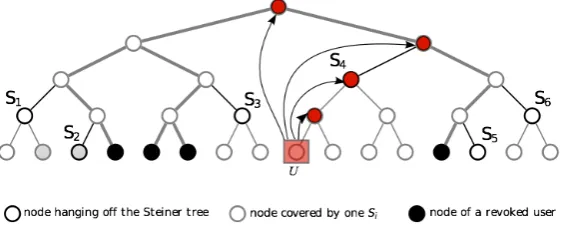
We now review the Pirates 2.0 in the context of Complete Subtree resumed in Figure 2.3. For a
D-level tree, each user’s key is a (D×λ)-source but only a λ-independent source because each user only has an independent sub-key at the leaf. Therefore, even if an user contributes ((D−1)×λ) entropy of its key, the remained information could still be a λ-independent source. Without leaking any independent entropy, the user could remain anonymous at a level α > 1 (because at least two different users can have the same contributive information). In the example in Figure 2.3, the user U
is assigned 5 sub-keys corresponding to the nodes from the root to the leaf. The userU can contribute a keyS4 and specifies the target set at S4 that covers 4 users of the sub-tree rooted at S4. An pirate
decoder with only one key at S4 can decrypt the ciphertext for the chosen target set S4 with
non-negligible probability while preserving an anonymity levelα= 4 for the contributor and therefore, the scheme is vulnerable against the Pirates 2.0.1
1 We note that an useful Pirates 2.0 in practice should do much more than this Pirates 2.0 with minimum usefulness
Fig. 1. An example of a complete subtree scheme where the center covers all non-revoked users with the nodes S1, . . . , S6. A user is a leaf on the binary tree where each node is assigned to a long-lived
randomly chosen key. Each user possesses all the long-lived keys of the nodes on the path from the user’s leaf to the root.
2.4 Key-Leakage Resilience vs. Pirates 2.0
We are now ready to prove a sufficient condition so that a key-leakage resilient revoke scheme is immune to Pirates 2.0 attacks. This is the main result of this section. In the next section, we will construct a key-leakage resilient revoke scheme that fulfills the required sufficient condition.
Theorem 7. Let Π be a (`SK)-key-leakage resilient revoke system of Nu users in which each user’s
key has length of m bit and is a m0-independent source. If α = Nu
2`SK+m0−m ≤1, thenΠ is immune to
any Pirates 2.0 attack.
Proof.
Proposition 8. In a Pirates 2.0 attack, if an user leaks k bits of his secret key to the public domain then his anonymity level is at most Nu
2k+m0−m.
Proof. Intuitively, as the key of the user u is a high independent source even when the others users contribute their whole secret keys, if u leaks too much information on its key then it will also leak many independent information and loses its anonymity.
Formally, following the definition 2 of anonymity level in pirates 2.0, assume that a user u con-tributes k bits information Lu of his secret key sku to the public domain, we need to compute the
probability for an useru0 to contribute exactly the same information as the useru, at each periode of timei.
– At time 0: u contribute nothing to the public domain. Let Ei = (∪w6=uskw,pubi) where pubi
denotes the public information at the timeiwhich contains the publics parameters of the system plus contributed information of the users after the time i−1. Because each user’s key is a m0 -independent source:H∞(sku|E0)≥m0.
– At timei:ucontributes his secret informationsLi
u =fi(sku,pubi) to the public domain by leaking
ki bits of his secret keys. If we denote kiin the number of independent bits that the user u losses
in time i,i.e.,kiin =H∞(sku|Ei)−H∞(sku|Ei−1), then the probability that u0 could contribute
exactly the same information Li
u is at most 1 2kini
. Note that E0 and thus Ei already contain
∪w6=uskw,i.e.,all the contributed information of the other users are already contained inEi (for
all i), the kiin independent bits are amongki bit that the useru leaks at the time i.
At the end, after the time t, the user u contributes to the public domain by totally leaking k =
k1+· · ·+ktbits of its secret information. By the above computation, the probability that an useru0
can contribute exactly the same total information like uis at most Qtj=1 1
2kinj
, and
t X
j=1
Because the bit length of the secret key sku is m and the user u leaks k bits, we deduce that
H∞(sku|Et) ≤ m −k and therefore Ptj=1kjin ≥ m0 −(m−k) = k+m0 −m which implies that
the probability that an user u0 can contribute exactly the same information like u as required in Pirates 2.0 is at most 1
2k+m0−m and the anonymity level of u cannot be assured to be higher than
Nu
2k+m0−m. ut
Proposition 9. Let Πbe a (`SK)-key-leakage resilient revoke scheme. If each user leaks no more than
`SK bits of his secret key to the public domain, then one can not produce a Pirates 2.0 decoder.
Proof. We suppose by contradiction that there is an Pirates 2.0AagainstΠ in which each user leaks no more than `SK bits of his secret key to the public domain, then we build an algorithm B that
breaks the security ofΠ in the context of key leakage resilience.
Algorithm B simulates Aand makes use of the outputs of A to break the security ofΠ. It works as follows:
– At time 0: users contribute nothing to the public domain.
– At time 1: suppose that an user u decides to contributeL1u =f1(sku) bits to the public domain
by using a strategy f1 where f1 is a polynomial-time computable function, B requests the leak
query (u, g1 :=f1) to his challenger and forwards the result toA.
– At any time i: suppose that an user u decides to contribute Lui = fi(sku, I) bits to the public
domain, whereI is the public collected information after the timei−1. At this stage,Bdefines a polynomial-time computable functiongi,I(sku) :=fi(sku, I), then requests the leak query (u, gi,I)
to his challenger and forwards the result toA.
– WhenAoutputs a pirate decoder and a targetSso that the pirate decoder can decrypt ciphertexts for S with a non-negligible probability, B simply outputs S∗ = S and two different messages
M0, M1 to his challenger. By using this pirate decoder, B can decrypt the challenge ciphertext
with a non-negligible probability and thus break the security of the scheme.
We note that, since each user contributes maximum`SK bits to the public domain,Bonly need to
ask in total at most `SK bits to his challenger. By definition,Π is then not`SK-key leakage resilient.
u t
The theorem immediately follows from the above two propositions. ut
3 Key-Leakage Resilient Revoke Scheme Immune to Pirates 2.0
This section is devoted to construct a key-leakage resilient revoke scheme that fulfills the condition in Theorem 7 and thus is immune to Pirates 2.0 attacks. The construction is achieved via the following steps:
1. we first propose a variant of BBG−WIBEscheme which is proven fully secure by using the dual system encryption technique.
2. we then construct a key-leakage resilient BBG−WIBE scheme by employing the proof technique in [20] to the aboveBBG−WIBE. This is the most important step in the final construction. 3. we finally apply the generic transformation from a WIBE to an identity based trace and revoke
scheme (denoted IDTR) in [27]. This results to a key-leakage resilient identity-based trace and revoke scheme (denotedKIDTR) that fulfills the condition in Theorem 7 and is immune to Pirates 2.0 attacks.
3.1 BBG−WIBE in Composite Order Groups
game and the final game gives no advantage for the adversary. Second, based on the three complexity assumptions 1,2,3 in Appendix A, step by step they prove that these games are indistinguishable, this automatically avoids a loss of an exponential factor in hierarchical depth as in the classical method. This is achieved via the main concept of the nominal semi-functionality in the dual system encryption technique.
We follow their approach by applying the dual system encryption technique to construct a fully secure variant of the BBG−WIBE scheme. The problem here is that the transformation from the
BBG−HIBE to the BBG−WIBE needs to introduce additional components (C3,i) in the ciphertext
and these components demolish the nominal property because they are not nominal with respect to components (Ei) in semi-functional key. In order to retain the nominality, we should manage to impose
the distribution of exponents of G2 part in C3,i and in Ei in a compatible way such that they are
nominalwith each other.
We provide the details about our construction of BBG−WIBEscheme in composite order groups and the proof of its full security in Appendix B.
3.2 KWIBE: Key-Leakage Resilient WIBE
In the construction of key-leakage resilient HIBE in [20], the user’s secret key is constructed from elements in subgroupsG1 andG3. This leads to secret keys that are relatively low independent sources
because they are only in subgroups G1 and G3. In order to enhance the independent sources of each
user’s secret key, in our construction of KWIBE, the secret keys are in the semi-functional form and each user’s secret key is now a high independent source as a main part of the secret key is in the whole group G = G1 ×G2×G3. Fortunately, this slightly change doesn’t affect the functionality and the
security of the scheme.
Construction from BBG−WIBE The main point in proving the key-leakage resilience ofHIBEin [20] is to show that the adversary cannot distinguish between two gamesKeyLeak0andKeyLeak1 which are briefly described as follow. In the gameKeyLeakb game (for both b= 0 andb= 1), the adversary can choose to receive a normal key or a semi-functional key from each leak and reveal query for all keys except one key- called the challenge key. Concerning the challenge key, it is set to be a normal key in the game KeyLeak0 and a semi-functional key in the game KeyLeak1. We can realize that, in this technique of proving the security, there is no a significant difference between aHIBEattack and a
WIBEattack. Indeed, the main difference betweenHIBEand WIBEis that an adversary againstWIBE
can ask more leak queries (for keys thatmatchthe challenge pattern) than an adversary againstHIBE
(who can only ask for keys which areprefixof the challenge identity). However, because the difference between two games KeyLeak0 and KeyLeak1 is only related to the challenge key which has the same form in bothHIBE andWIBE, the proof in HIBEis well adapted toWIBE.
In order to makeBBG−WIBEresilient to key-leakage, in the following construction, we first impose the distribution of exponents of G2 part in C3,i and in Ei in a compatible way such that they are
nominal with each other, then we choose compatibly some constants (as r1, r2, zk, zc) to keep the
following properties:
– if−→Γ is orthogonal to−→δ then the challenge key is well-distributed nominally semi-functional. – if−→Γ is not orthogonal to−→δ, then the challenge key is truly semi-functional and well-distributed.
The construction is detailed as follows.
Setup(1λ)→(mpk,msk) The setup algorithm chooses a bilinear group G =G1×G2×G3 of order
N = p1p2p3 (each subgroup Gi is of order pi). We will assume that users are associated with
vectors of identities whose components are elements ofZN. If the maximum depth of the WIBE
is D, the setup algorithm chooses a generator g1 ←$ G1, a generator g2 ←$ G2, and a generator
g3 $
← G3. It picks b, a1, . . . , aD $
n+1 random exponents hα, x1, x2, . . . , xni $
← Zn+1N . The secret key is msk = (α, a1, . . . , aD), and
the public parameters are:
mpk= (N, g1, g3, h, u1, . . . , uD, e(g1, g1)α, g1x1, g x2
1 , . . . , g xn
1 )
KeyderSF(msk,(ID1, ID2, . . . , IDj), g2,mpk) The key generation algorithm picks n+1 random
ex-ponents hr, t1, t2, . . . , tni $
← Zn+1N , −→ρ ←$ Zn+2N and zk, ρn+3, . . . , ρn+2+D−j ←$ ZN, and −→γ =
(γ1, . . . , γn+2) in which (γ1, . . . , γn, γn+2) $
← Zn+1N , γn+1 = γn+2(zk −Pji=1aiIDi). It outputs
the secret keySK = (−K→1, Ej+1, . . . , ED):
=
gt1
1 , g t2
1 , . . . , gt1n, g1α
h·Qji=1uIDi
i −r
Qn i=1g
−xiti
1 , gr1
∗g−→3ρ ∗g2−→γ, urj+1gρn+3
3 g
γn+2aj+1
2 , . . . , urDg
ρn+2+D−j
3 g
γn+2aD
2
Note that, to run the KeyderSF algorithm one doesn’t need to have g2, he only need to have
X2 ∈G2 orX2X3 in whichX2 ∈G2, X3∈G3.
Delegate ((ID1, ID2, . . . , IDj),SK’,IDj+1) Given a secret key SK’ = (
−→
K0, Ej+10 , . . . , ED0 ) for identity (ID1, ID2, . . . , IDj), this algorithm outputs a key for (ID1, ID2, . . . , IDj+1). It works as follow:
It picksn+1 random exponentshr0, y1, y2, . . . , yni $
←Zn+1N ,−→ρ0 ←$ Zn+2N , andρ0n+3, . . . , ρ0n+1+D−j $
←
ZN. It outputs the secret key SK= (
−→
K1, Ej+2, . . . , ED):
=
−→
K10 ∗
gy1
1 , g y2
1 , . . . , g yn
1 , h−r
0
(Ej+10 )−IDj+1
Qj+1 i=1 u IDi i −r0 Qn i=1g
−xiyi
1 , gr
0
1
∗g3−→ρ0, Ej+20 urj+20 gρ
0
n+3
3 , . . . , E 0 Dur
0
Dg
ρ0n+1+D−j
3
Enc(M,(P1, P2, . . . , Pj)) The encryption algorithm chooses s $
←ZN and outputs the ciphertext:
CT = (C0,
−→ C1, C2)
=
M·e(g1, g1)α·s, *
(gx1
1 )s,· · · ,(g xn
1 )s, gs1,(h· Y
i∈W(P)
uPi
i )s +
,(C2,i=usi)i∈W(P)
Dec(CT, SK) Any other receiver with identityID= (ID1, ID2, . . . , IDj) matching the pattern P to
which the ciphertext was created can decrypt the ciphertext CT = (C0,
−→
C1, C2) as follows
First, he recovers the message by computing
−→ C10 =
*
(gx1
1 )
s,· · · ,(gxn
1 ) s, gs
1,(h· Y
i∈W(P)
uPi
i )
s· Y i∈W(P)
(usi)IDi
+
Finally, compute
en+2(
−→ K1,
−→
C10) =e(g1, g1)αs·e(g1, uID1 1· · ·u IDj
j h)
−rs·e(g
1, uID1 1· · ·u IDj
j h)rs·
·
n Y
i=1
e(g1, g1)−xitis· n Y
i=1
e(g1, g1)xitis=e(g1, g1)αs
Notice that the G2 and G3 parts do not contribute because they are orthogonal to the ciphertext
Security of Key-Leakage Resilient BBG− WIBE We introduce the definition of the security model of a`SK-key-leakage resilientWIBE, calledLeak−WIBE security game, in Appendix C. In
or-der to facilitate the presentation, let us first discuss about some notions that will be used in the proof of security:
Normal Key Functionality
Keyder(msk,(ID1, ID2, . . . , IDj),mpk). To create the normal key algorithm picks n+1 random
ex-ponents hr, z1, z2, . . . , zni ←$ Zn+1N ,
− →ρ $
← Zn+2N and ρn+3, . . . , ρn+2+D−j ←$ ZN. It outputs the secret
key SK= (−K→1, Ej+1, . . . , ED):
=
gz1
1 , g z2
1 , . . . , g zn
1 , g1α
h·Qji=1uIDi
i −r
Qn i=1g
−xizi
1 , g1r
∗g3−→ρ, urj+1gρn+3
3 , . . . , urDg
ρn+2+D−j
3
Semi-Ciphertext Functionality
EncSF(M,−→P) →CTg. This algorithm first calls the normal encryption algorithmEnc(M,
− →
P) to get the ciphertextCT = (C0,
−→
C1, C2). Then it picks randomly zc∈ZN, and
− →
δ = (δ1, . . . , δn+2) in which
(δ1, . . . , δn+1)←$ ZNn+1,δn+2 =δn+1(zc+ P
i∈W(P)aiPi), and outputs
g
CT =
C0,
−→ C1∗g
− →
δ
2 ,(C2,i∗g2δn+1·ai)i∈W(P)
The parameters in p2 of CTg are
− →
δ0 = (−→δ ,(δn+1·ai)i∈W(P)). It is easy to see that a semi-functional
key will correctly decrypt a semi-functional ciphertext (i.e. it is nominal) if and only if −→γ ∗ −→δ∗ = 0 mod p2, where
− → δ∗ = −→ δ + D
0,· · ·,0,P
i∈W(P)δn+1·ai·IDi E
, and assuming the identity vector
(ID1, ID2, . . . , IDj) matchesthe pattern
− →
P = (P1, . . . , Pj).
If the identity vector of the secret key, say −→ID= (ID1, . . . , IDj), is a prefix of the challenge pattern
of the ciphertext, say −→P = (P1, . . . , Pk), then the user can use the delegate algorithm to get a secret
key for identity vector −−→ID0 = (ID1, . . . , IDj, IDj+1, . . . , IDk) where IDi = Pi if Pi 6= ∗ and choose
randomlyIDi ifPi =∗,i= (j+ 1, . . . , k).
Then the semi-functional parameters will become:
− →
γ0 =−→γ +
*
0,· · ·,0,−
k X
i=j+1
γn+2.ai.IDi,0 +
.
Thus, we say that this key is nominally semi-functional if−→γ0 ∗−→δ∗ = 0 mod p2,
where−→δ∗ =
−→
δ +
D
0,· · · ,0,P
i∈W(P)δn+1·ai·IDi E
.
Theorem 10 (Security of Key-Leakage Resilient BBG−WIBE). Under assumptions 1, 2, 3 in Appendix A and for `SK = (n−1−2c) log(p2), where c > 0 is any fixed positive constant, our
key-leakage resilient BBG−WIBEscheme is (`SK) - key-leakage secure.
The condition forcisp−c2 is negligible. The length of secret keySKat leveliis (n+2+D−i)(log(p1)+
log(p2) + log(p3)) where Dis the depth of WIBE. As we can see, the leakage fraction of secret key at
leaf node is the biggest.
Proof. We first define several security games as follows:
– KeyLeakWibegame is the same as the realLeak−WIBEgame except that all keys leaked or given to the adversary are normal key.
– KeyLeakCgame is exactly the same as theKeyLeakWibe∗game except that the challenge ciphertext is semi-functional ciphertext.
– KeyLeakCK game is exactly the same as the KeyLeakCgame except that all keys leaked or given to the adversary are semi-functional.
– KeyLeakb game is the same as theKeyLeakCK game except that in one key, we call the challenge key, the adversary can access viaCreate,Leak, orRevealqueries but cannot know it is normal key or semi-functional key. The others keys the adversary can choose normal key or semi-functional key to leak or reveal, if it chooses first leakage, reveal are normal or semi all subsequent Leak and Reveal queries act on the normal or semi version. We call KeyLeak1 game in the case this challenge key is semi-functional key, and KeyLeak0 game when this challenge key is normal key. Based on the three complexity assumptions 1, 2, and 3, we will prove the theorem by first showing that these games are indistinguishable, then prove that the adversary has no advantage in attacking the game KeyLeakCK, .
Leak−WIBE≈KeyLeakWibe: We letq denote the number of key queries the adversary makes. For
kfrom 0 toq, we defineGamek is the sameLeak−WIBEgame except that the firstkkeys are normal
keys and the rest are semi-functional keys. Game0 is Leak−WIBEgame and Gameq isKeyLeakWibe
game.
Gamek−1≈Gamek: We will prove based on the assumption 2. From the input values of Assumption
2: D2 = (N,
G, GT, e, g1,g3,gz1g2ν,g µ 2g
ρ
3) and a challenge termT, the challenger is able to generate mpk andmsk, and to answer allCreate,Leak, and Revealqueries in both versions normal or semi. Moreover, the challenger can use T to generate the k’th key. Depending on the nature ofT, the k’th
is either a normal or a semi-functional key or this is either Gamek−1 orGamek.
KeyLeakWibe ≈ KeyLeakWibe∗: It is easy to verify that the output of the Delegate algorithm is identically distributed to the output ofKeygen.
KeyLeakWibe∗ ≈ KeyLeakC: In KeyLeakC, the challenge ciphertext C is semi-functional, while all keys are normal. Notice that from the input values of Assumption 1 the challenger is able to generate
mpk and msk, and to answer allCreate, Leak, and Reveal queries. Moreover, the challenger can use T to generate C and, depending on the nature of T, C can be normal as in KeyLeakWibe∗ or semi-functional as inKeyLeakC.
KeyLeak0 ≈KeyLeak1: From the input values of Assumption 2: D2 = (N, G,GT,e,g1,g3, g1zg2ν,
gµ2gρ3) and a challenge term T, the challenger is able to generate mpk and msk, and to answer all Create, Leak, and Reveal queries in both versions normal or semi. Moreover, the challenger can use T to generate the challenge key instead of choosing randomly bit b and gives leakage to the adversary. Depending on the nature of T, the challenger gives leakage either from a normal or from a semi-functional secret key to the adversary.
Similar to the proof of fully secureWIBE,C2,iin semi-functional ciphertex andEiin semi-functional
key are nominal with each other. In the case the challenge key is not capable of decrypting the challenge ciphertext, the challenger depends on the difference of advantages in the gameKeyLeak0 andKeyLeak1
to determine the nature of T.
Assume that the challenge key identity vector is ID = (ID1, . . . , IDj), the challenge pattern
is P∗ = (P1, . . . , Pj). In the case the challenge key is capable of decrypting the challenge ciphertext
(adversary gets access viaLeakqueries) or ifIDi=Pimodp2andIDi 6=PimodN wherei∈W(P∗),
the semi-functional parameters are not properly distributed. However, based on two following lemmas we get that the change in the simulator’s advantage is only negligible.
In the case IDi = Pi mod p2 and IDi 6= Pi mod N, we can find a non-trivial factor of N with
non-negligible probability. This non-trivial factor can then be used to break Assumption 2 as in the proof of lemma 5 in [21]. If the challenge key is capable of decrypting the challenge ciphertex, the semi-functional challenge key is nominal with respect to the semi-functional challenge ciphertext.
of them is equal to a respective component from the challenge identity vector modulo p2 and not also
equal modulo N.
Proof. The proof is similar to the proof of the lemma 5 in [21].
Lemma 12. We suppose the leakage is at most (`SK = (n−1−2c) log(p2)), where c > 0 is a fixed
positive constant. Then, for any PPT adversary A, its advantage in the KeyLeak1 game changes only by a negligible amount when the truly functional challenge key is replaced by a nominal semi-functional challenge key whenever A declares the challenge key associated to an identity vector which matches the challenge ciphertext pattern.
Proof. As in [20], we suppose that there exists a PPT algorithm A whose advantage changes by a non-negligible amountwhen theKeyLeak1 game changes as described above. Using A, we will create a PPT algorithm B which will distinguish between the distributions (−→δ , f(τ)) and (−→δ , f(τ0)) from the corollary 6.3 in [20] with non-negligible advantage (where m =n+ 1 and p=p2).
B simulates the game KeyLeak1 with A as follows. It starts by running the Setup algorithm for itself, and giving A the public parameters. Since B knows msk and generators of all the subgroups, it can make normal as well as semi-functional keys. Hence, it can respond to all A’s non-challenge Phase 1 queries.
With non-negligible probability, Amust chose a challenge key inPhase 1 with its identity vector matches the challenge ciphertext’s pattern. (If it only did this with negligible probability, then the difference in advantages whenever it gave a matched identity would be negligible.) B will not create this challenge key, but instead will encode the leakage A asks for on this key inPhase 1 as a single polynomial time computable functionf with domainZn+1p2 and with an image of size 2
`SK. It can do
this by fixing the values of all other keys and fixing all other variables involved in the challenge key.
B then receives a sample (−→δ , f(−→Γ)), where −→Γ is either distributed as τ or asτ0, in the notation of the corollary. B will usef(−→Γ) to answer all of A’s leakage queries on the challenge key by implicitly defining the challenge key as follows.
B chooses r1, r2, zk ∈ Zp2 subject to the constraint Γn+1+r1 = r2(zk−
Pj
i=1aiIDi). We let g2
denote a generator ofG2.Bimplicitly sets theG2 components of the key to beg − → Γ0
2 , where
−→
Γ0is defined to be
− → Γ0 =
*
− →
Γ ,0, . . . ,0
| {z } D−j+1
+
+
*
0, . . . ,0
| {z } n
, r1, r2, r2aj+1, . . . , r2aD +
Note that −→Γ is of length n+1; thus r1 is added to the last component of
− →
Γ. B defines the non-G2
components of the key to fit their appropriate distribution.
At some point, A declares the pattern for the challenge ciphertext. If the challenge key had an identity vector which did not match the challenge ciphertext’s pattern, then B aborts the simula-tion and guesses whether −→Γ is orthogonal to −→δ randomly. However, the simulation continues with non-negligible probability. Suppose the challenge key’s identity vector is (ID1, ID2, . . . , IDj) and the
challenge ciphertext’s pattern is (P1, P2, . . . , Pk).
Bchooseszc∈Zp2 subject to the constraintδn+1r1+δn+1(zc+
P
i≤j,i∈W(P)aiPi+ P
i≤j,i∈W(P)aiIDi)r2=
0 modp2. It then constructs the challenge ciphertext by using
− →
δ0 =D−→δ ,0E+h0, . . . ,0,0, δn+1(zc+Pi∈W(P)aiPi)i,(δn+1ai)i∈W(P)
as the challenge vector (recall
that−→δ is of lengthn+1).
Note that if j < k, the user chooses whateverIDi ifPi =∗and chooses IDi =Pi ifPi 6=∗, where
i=j+ 1, . . . , k, to run the delegation algorithm and get the newG2 components of the key:
−→
Γ00=−→Γ0+
*
0, . . . ,0
| {z } n
,−
k X
i=j+1
The user also runs the algorithm to recover the corresponding ciphertext by using these identitiesIDi,
i= 1, . . . , k, and now the vectorG2 components of ciphertext is
− → δ∗ =
D−→
δ ,0
E
+
D
0, . . . ,0,0, δn+1(zc+Pi∈W(P)aiPi+Pi∈W(P)aiIDi) E
.
Now, if −→Γ is orthogonal to −→δ, then the challenge key is nominally semi-functional (and well-distributed as such). If−→Γ is not orthogonal to−→δ, then the challenge key is truly semi-functional (and also well-distributed).
It is clear that B can easily handle Phase 2 queries, since the challenge key cannot be queried on here when its identity vector matchesthe ciphertext’s pattern. Hence, Bcan use the output of A
to gain a non-negligible advantage in distinguishing the distributions (−→δ , f(τ)) and (−→δ , f(τ0)). This violates Corollary 6.3 in [20], since these distributions have a negligible statistical distance forf with this output size.
In conclusion, the challenger, depending on the difference of advantages in the gameKeyLeak0 and
KeyLeak1, can determine the nature of T. ut
KeyLeakC ≈KeyLeakCK: we denote by Qthe maximum number of queries that adversary makes. Thus, the total number of different secret keys is Q,Q is a polynomial in λ. For q ∈[0, Q] we define the gameSFq to be like theKeyLeakCgame, semi-functional versions for the firstq different keys, and
normal versions for the remaining keys. The order is defined by the first leakage or reveal query made on each key. So,SF0 is theKeyLeakCgame and SFQ is the KeyLeakCKgame.
If the advantage ofKeyLeakC6=KeyLeakCKwith a non-negligible value, then there exists aq∗ ∈[0, Q] such that the difference of advantage between two games SFq and SFq+1 is non-negligible.
Assume B is an adversary which attacks game KeyLeakb, B simulates A as follow and uses the output of A to distinguish the difference of advantage between two games KeyLeak0 and KeyLeak1
with a non-negligible value, this is a contradiction of the result above.
Brequests semi-functional keys for the firstq∗keys, chooses the (q∗+1)−thkey to be the challenge key, and requests normal keys for the remaining keys. Give those toA. If theKeyLeakbchallenger picked
b= 0, thenA plays theSFq∗ game. Otherwise, it plays the SFq∗+1 game.
KeyLeakCKgives no advantage to the adversary: we use Awith non-negligible advantage in break-ing KeyLeakCK game to build a PPT simulator B that breaks assumption 3. From the input of the assumption’s challenger, D3 = (N,G,GT,e,g1,g2,g3,g1αg2ν,gz1g
µ
2) and T which is either e(g1, g1)αz
or a random term of GT,B can answer all queries from A. When A gives the challenge key to B, B
uses T to create the ciphertext. Depending on the nature of T, this is a ciphertext of real message or ciphertext of random message. If this is a ciphertext of real message thenBstimulates theKeyLeakCK
game.
All in all, from the above reductions between the successive games, we deduce that Leak−WIBE
≈KeyLeakCK and therefore, the advantage of adversary inLeak−WIBEgame is negligible. ut
3.3 Key-Leakage Resilient Revoke Scheme Immune to Pirates 2.0
The definition and adaptive security model ofKIDTR scheme can be found in Appendix D.1 and D.2. The construction ofKIDTRis the same as in [27] except we useKWIBEinstead ofWIBEfor encryption. The construction and security of KIDTR are provided in Appendix D.3 and 21.
Proposition 13. In KIDTRscheme, if we callp1, p2, p3 are primes ofλ1, λ2, λ3 bits, then each user’s
secret key with length m= (n+ 2)(λ1+λ2+λ3) ism0-independent source where m0 = ((n+ 1)(λ1+
λ2+λ3) +λ2+λ3).
Proof. In our KIDTR scheme, we make use of a KWIBE scheme in which each user’s secret key is at leaf node 3.2, therefore an user’s secret key is of the following form:
SK =−K→1=
*
gt1
1 , g t2
1 , . . . , g tn
1 , g1α h· j Y
i=1
uIDi
i
!−r n Y
i=1
g−xiti
1 , g1r +
∗g3−→ρ ∗g−→2γ
where r, t1, t2, . . . , tn, zk $
← ZN, −→ρ ←$ Zn+2N , and −→γ = (γ1, . . . , γn+2) in which (γ1, . . . , γn, γn+2) $
←
Zn+1N ,γn+1=γn+2(zk−Pji=1aiIDi).
We realize that in each secret key, the elements corresponding to the indices 1, . . . , n, n+2 are randomly generated in the whole group G = G1 ×G2×G3, the element corresponding to the indice n+ 1 is
not independent inG1 but randomly generated inG2×G3. Therefore, it’s easy to see that each user’s
secret key is of (n+ 2)(λ1+λ2+λ3) bit length and is a ((n+ 1)(λ1+λ2+λ3) +λ2+λ3)-independent
source.
Theorem 14. The KIDTR scheme is immune to Pirates 2.0 attacks for any choice of parameters
n, c, λ1, λ2 such that2(n−1−2c)λ2−λ1 > Nu, where Nu is the number of subscribed users in the systems
Proof. From the theorems 10 and theorem 21, we decude that the KIDTR scheme is `SK−leakage
resilient with `SK = (n−1−2c)λ2 for any fixed positive constant c >0 (such that p−c2 is negligible).
From the theorem 7, one cannot mount a Pirates 2.0 attack with an anonymity level larger than
α= Nu
2`SK+m0−m =
Nu
2(n−1−2c)λ2−λ1 <1. ut
We note that there is no need to choose particular parameters for our system. For example, simply withc= 1, n= 5 andλ1 =λ2 = 512 (p−c2 = 2−512 is negligible) and suppose that there are Nu = 240
subscribed users, our system is immune to Pirates 2.0 because 2(n−1−2c)λ2−λ1 = 2512 > N
u and the
user’s secret key contains only 7 elements inG.
4 Discussion
4.1 Traceability in our scheme
The effectiveness of Pirates 2.0 in practice is to allow a very large scale of public collaboration of traitors. This relies on the anonymity of each contributor. By formally proving in Section 2 that the anonymity can not be assured, there is no risk for a large scale of public collaboration of traitors in our system. Concerning to the classical tracing where traitors contribute their whole secret keys, because our scheme which is based on the structure of complete-subtree scheme, it achieves the same level of traceability as the schemes in the subset-cover framework [23]: the tracer, having black-box access to a pirate decryption boxD, can outputs either a set of traitors or a way to render the illegal decryption
box useless.
4.2 Computational entropy and Pirates 2.0
We consider the information-theoretic notion of entropy and design a scheme where the keys of users are all high-independent source. One might ask a natural question if it suffices to use the computational entropy (a distribution X hask bit computational entropy if there is a distribution Y of k bit min-entropy such thatX anY and computationally indistinguishable). A positive result would imply that almost all known algebraic broadcast encryptions resist Pirates 2.0 attacks if they are key-leakage resilient. Unfortunately, it seems hard for us that the computational entropy is suitable in the context of Pirates 2.0. The main reason is that if an user has a key ofkbit computational entropy, the key can still remainkbit computational entropy even after the user contributes somek0 bit information about the key. Therefore, we cannot control the remaining computational entropy of the keys after each round of leaking information in Pirates 2.0, especially when the users choose the form to leak information. It seems thus an open problem to determine whether the other known broadcast encryptions resist Pirates 2.0. As a concrete example, in BGW scheme[7], the key of the useriisdi =vα
i
4.3 Active leakage in cryptography
In the last few years, theoretical foundations have been developed in order to formally address the problem of side-channel attacks - a very frequent and practical attack against implementations of cryptographic protocols. These led to the development of Leakage Resilient Cryptography with the objective is to deal with any form of side-channel attacks. The source of leakage comes from the possibility of an adversary to extract the information about the secret key. We would like to furthermore investigate the question of active leakage where users intentionally leak partial information of their secret keys. The main property is probably the anonymity of the colluded users: users want to leak information in discretion to break the security of the system. This scenario could be very relevant in multi-user cryptography. In fact, Pirates 2.0 exactly formalizes the active leakage in the context of multi-user encryption and the view of Pirates 2.0 as a form of leakage resilience led us to the research in this paper. We believe that the question of active leakage is deserved to be more studied in many scenarios of multi-user cryptography including secret sharing, threshold cryptography. As an example, we wonder whether there exist a threshold scheme that is secure against classical collusions of less thantusers but is vulnerable to a collusion of more thantusers in the active leakage model where the main requirement is that all the contributors rest assured to be anonymous even against an unbounded authority.
References
1. M. Abdalla, J. Birkett, D. Catalano, A. W. Dent, J. Malone-Lee, G. Neven, J. C. N. Schuldt, and N. P. Smart. Wildcarded identity-based encryption. Journal of Cryptology, 24(1):42–82, Jan. 2011.
2. M. Abdalla, D. Catalano, A. Dent, J. Malone-Lee, G. Neven, and N. Smart. Identity-based encryption gone wild. In M. Bugliesi, B. Preneel, V. Sassone, and I. Wegener, editors, ICALP 2006: 33rd International Colloquium on Automata, Languages and Programming, Part II, volume 4052 ofLecture Notes in Computer Science, pages 300– 311. Springer, July 2006.
3. M. Abdalla, A. W. Dent, J. Malone-Lee, G. Neven, D. H. Phan, and N. P. Smart. Identity-based traitor tracing. In T. Okamoto and X. Wang, editors,PKC 2007: 10th International Conference on Theory and Practice of Public Key Cryptography, volume 4450 ofLecture Notes in Computer Science, pages 361–376. Springer, Apr. 2007.
4. J. Alwen, Y. Dodis, and D. Wichs. Leakage-resilient public-key cryptography in the bounded-retrieval model. In S. Halevi, editor,Advances in Cryptology – CRYPTO 2009, volume 5677 of Lecture Notes in Computer Science, pages 36–54. Springer, Aug. 2009.
5. S. Berkovits. How to broadcast a secret (rump session). In D. W. Davies, editor,Advances in Cryptology – EURO-CRYPT’91, volume 547 ofLecture Notes in Computer Science, pages 535–541. Springer, Apr. 1991.
6. O. Billet and D. H. Phan. Traitors collaborating in public: Pirates 2.0. In A. Joux, editor,Advances in Cryptology – EUROCRYPT 2009, volume 5479 ofLecture Notes in Computer Science, pages 189–205. Springer, Apr. 2009. 7. D. Boneh, C. Gentry, and B. Waters. Collusion resistant broadcast encryption with short ciphertexts and private
keys. In V. Shoup, editor,Advances in Cryptology – CRYPTO 2005, volume 3621 of Lecture Notes in Computer Science, pages 258–275. Springer, Aug. 2005.
8. Z. Brakerski, Y. T. Kalai, J. Katz, and V. Vaikuntanathan. Overcoming the hole in the bucket: Public-key cryp-tography resilient to continual memory leakage. In51st Annual Symposium on Foundations of Computer Science, pages 501–510. IEEE Computer Society Press, 2010.
9. D. Cash, Y. Z. Ding, Y. Dodis, W. Lee, R. J. Lipton, and S. Walfish. Intrusion-resilient key exchange in the bounded retrieval model. In S. P. Vadhan, editor,TCC 2007: 4th Theory of Cryptography Conference, volume 4392 ofLecture Notes in Computer Science, pages 479–498. Springer, Feb. 2007.
10. B. Chor, A. Fiat, and M. Naor. Tracing traitors. In Y. Desmedt, editor, Advances in Cryptology – CRYPTO’94, volume 839 ofLecture Notes in Computer Science, pages 257–270. Springer, Aug. 1994.
11. P. D’Arco and A. L. P. del Pozo. Fighting Pirates 2.0. In Proc. of the 9th International Conference on Applied Cryptography and Network Security —ACNS 2011, Lecture Notes in Computer Science. Springer, 2011.
12. G. Di Crescenzo, R. J. Lipton, and S. Walfish. Perfectly secure password protocols in the bounded retrieval model. In S. Halevi and T. Rabin, editors,TCC 2006: 3rd Theory of Cryptography Conference, volume 3876 ofLecture Notes in Computer Science, pages 225–244. Springer, Mar. 2006.
13. Y. Dodis, L. Reyzin, and A. Smith. Fuzzy extractors: How to generate strong keys from biometrics and other noisy data. In C. Cachin and J. Camenisch, editors,Advances in Cryptology – EUROCRYPT 2004, volume 3027 ofLecture Notes in Computer Science, pages 523–540. Springer, May 2004.
14. S. Dziembowski and K. Pietrzak. Intrusion-resilient secret sharing. In 48th Annual Symposium on Foundations of Computer Science, pages 227–237. IEEE Computer Society Press, Oct. 2007.
16. A. Fiat and M. Naor. Broadcast encryption. In D. R. Stinson, editor,Advances in Cryptology – CRYPTO’93, volume 773 ofLecture Notes in Computer Science, pages 480–491. Springer, Aug. 1994.
17. Y. Ishai, A. Sahai, and D. Wagner. Private circuits: Securing hardware against probing attacks. In D. Boneh, editor,Advances in Cryptology – CRYPTO 2003, volume 2729 of Lecture Notes in Computer Science, pages 463– 481. Springer, Aug. 2003.
18. J. Katz and V. Vaikuntanathan. Signature schemes with bounded leakage resilience. In M. Matsui, editor,Advances in Cryptology – ASIACRYPT 2009, volume 5912 of Lecture Notes in Computer Science, pages 703–720. Springer, Dec. 2009.
19. A. Kiayias and S. Pehlivanoglu. Pirate evolution: How to make the most of your traitor keys. In A. Menezes, editor,Advances in Cryptology – CRYPTO 2007, volume 4622 of Lecture Notes in Computer Science, pages 448– 465. Springer, Aug. 2007.
20. A. B. Lewko, Y. Rouselakis, and B. Waters. Achieving leakage resilience through dual system encryption. In Y. Ishai, editor,TCC 2011: 8th Theory of Cryptography Conference, volume 6597 ofLecture Notes in Computer Science, pages 70–88. Springer, Mar. 2011.
21. A. B. Lewko and B. Waters. New techniques for dual system encryption and fully secure HIBE with short ciphertexts. In D. Micciancio, editor, TCC 2010: 7th Theory of Cryptography Conference, volume 5978 of Lecture Notes in Computer Science, pages 455–479. Springer, Feb. 2010.
22. S. Micali and L. Reyzin. Physically observable cryptography (extended abstract). In M. Naor, editor,TCC 2004: 1st Theory of Cryptography Conference, volume 2951 ofLecture Notes in Computer Science, pages 278–296. Springer, Feb. 2004.
23. D. Naor, M. Naor, and J. Lotspiech. Revocation and tracing schemes for stateless receivers. In J. Kilian, editor,
Advances in Cryptology – CRYPTO 2001, volume 2139 ofLecture Notes in Computer Science, pages 41–62. Springer, Aug. 2001.
24. M. Naor and B. Pinkas. Efficient trace and revoke schemes. In Y. Frankel, editor, FC 2000: 4th International Conference on Financial Cryptography, volume 1962 ofLecture Notes in Computer Science, pages 1–20. Springer, Feb. 2000.
25. M. Naor and G. Segev. Public-key cryptosystems resilient to key leakage. In S. Halevi, editor,Advances in Cryptology – CRYPTO 2009, volume 5677 ofLecture Notes in Computer Science, pages 18–35. Springer, Aug. 2009.
26. C. Petit, F.-X. Standaert, O. Pereira, T. Malkin, and M. Yung. A block cipher based pseudo random number generator secure against side-channel key recovery. In M. Abe and V. Gligor, editors,ASIACCS 08: 3rd Conference on Computer and Communications Security, pages 56–65. ACM Press, Mar. 2008.
27. D. H. Phan and V. C. Trinh. Identity-based trace and revoke schemes. In X. Boyen and X. Chen, editors,ProvSec 2011: 5th International Conference on Provable Security, volume 6980 ofLecture Notes in Computer Science, pages 204–221. Springer, Oct. 2011.
28. F.-X. Standaert, T. Malkin, and M. Yung. A unified framework for the analysis of side-channel key recovery attacks. In A. Joux, editor,Advances in Cryptology – EUROCRYPT 2009, volume 5479 ofLecture Notes in Computer Science, pages 443–461. Springer, Apr. 2009.
29. B. Waters. Dual system encryption: Realizing fully secure IBE and HIBE under simple assumptions. In S. Halevi, editor,Advances in Cryptology – CRYPTO 2009, volume 5677 ofLecture Notes in Computer Science, pages 619–636. Springer, Aug. 2009.
30. X. Zhao and F. Zhang. Traitor tracing against public collaboration (full version). InISPEC ’11: The 7th International Conference on Information Security Practice and Experience, Guangzhou / China, 2011.
A Composite Order Bilinear Groups
We recall three assumptions from [21].
Assumption 1 (Subgroup decision problem for 3 primes) Given a group generator G, we define the following distribution:
G= (N =p1p2p3, G, GT, e)← G$ ;g←$ Gp1;X3
$
←Gp3.
D= (G, g, X3); T1 $
←Gp1p2, T2
$
←Gp1. We define the advantage of an algorithm Ain breaking Assumption 1 to be:
Adv1G,A(λ) :=|P r[A(D, T1) = 1]−P r[A(D, T2) = 1]|.
We note thatT1 can be written (uniquely) as the product of an element ofGp1 and an element ofGp2. We refer to these elements as the ”Gp1 part ofT1” and the ”Gp2 part ofT1” respectively.
Definition 15. We say that G satisfies Assumption 1 if Adv1G,A(λ) is a negligible function of λ for
Assumption 2 Given a group generatorG, we define the following distribution:
G= (N =p1p2p3, G, GT, e) $
← G;g, X1 $
←Gp1;X2, Y2
$
←Gp2;X3, Y3
$
←Gp3.
D= (G, g, X1X2, X3, Y2Y3); T1 ←$ G, T2 ←$ Gp1p3. We define the advantage of an algorithm Ain breaking Assumption 1 to be:
Adv2G,A(λ) :=|P r[A(D, T1) = 1]−P r[A(D, T2) = 1]|.
We use Gp1p3 to denote the subgroup of order p1p3 in G. We note that T1 can be (uniquely) written as the product of an element of Gp1, an element of Gp2, and an element of Gp3. We refer to these as the ”Gp1 part of T1”, the ”Gp2 part of T1”, and the ”Gp3 part of T1”, respectively.T2 can similarly be written as the product of an element ofGp1 and an element ofGp3.
Definition 16. We say that G satisfies Assumption 2 if Adv2G,A(λ) is a negligible function of λ for
any polynomial time algorithm A.
Assumption 3 Given a group generatorG, we define the following distribution:
G= (N =p1p2p3, G, GT, e) $
← G;α, s←$ ZN;g $
←Gp1;X2, Y2, Z2
$
←Gp2;X3
$
←Gp3.
D= (G, g, gαX2, X3, gsY2, Z2); T1 =e(g, g)αs, T2 $
←GT.
We define the advantage of an algorithm Ain breaking Assumption 1 to be:
Adv3G,A(λ) :=|P r[A(D, T1) = 1]−P r[A(D, T2) = 1]|.
Definition 17. We say that G satisfies Assumption 3 if Adv3G,A(λ) is a negligible function of λ for
any polynomial time algorithm A.
B Construction of BBG-WIBE Scheme in Composite Order Groups
Setup The setup algorithm chooses a bilinear groupGof orderN =p1p2p3. We will assume that users
are associated with vectors of identities whose components are elements ofZN. We letD denote
the maximum depth of the WIBE, the setup algorithm chooses a generator g ∈ G1, X3 ∈ G3,
α, b, a1, . . . , aD $
← ZN. Denote u1 =ga1, . . . , uD = gaD, h =gb. The master key is msk = α, the
public parameters are published as:
mpk= (N, g, h, u1, . . . , uD, X3, e(g, g)α)
Keyder(msk,(ID1, ID2, . . . , IDj),mpk) The key generation algorithm chooses r ←$ ZN and also
chooses random elementsR3, R03, Rj+1, . . . , RD ofG3. It sets:
K1 =grR3, K2=gα
uID1
1 · · ·u IDj
j h r
R03, Ej+1 =urj+1Rj+1, . . . , ED =urDRD.
Delegate Given a key K10, K20, Ej+10 , . . . , ED0 for (ID1, . . . , IDj), the delegation algorithm creates a
key for (ID1, . . . , IDj+1) as follows. It choosesr0 $
←ZN and random elements ofG3 denoted, e.g.,
by ˜R3. The new key is set as:
K1 =K10gr
0 ˜
R3, K2=K20
uID1
1 · · ·u IDj
j h r0
(Ej+10 )IDj+1ur
0ID
j+1
j+1 R˜03,
Ej+2 =Ej+20 ur
0
j+2R˜j+2, . . . , ED =ED0 ur
0
DR˜D
Enc(M,(P1, P2, . . . , Pj)) The encryption algorithm chooses s $
←ZN and outputs the ciphertext:
C0=M·e(g, g)αs, C1 = (h· Y
i∈W(P)
uPi
i ) s, C
2=gs, C3= (C3,i=usi)i∈W(P)
Dec Any other receiver with identity ID = (ID1, ID2, . . . , IDj) matching the pattern P to which
the ciphertext was created can decrypt the ciphertext as follows First, he recovers the message by computing
C10 =C1· Y
i∈W(P)
(usi)IDi
then computes the blinding factor as:
e(K2, C2)
e(K1, C10)
= e(g, g)
αse(uID1
1 · · ·u IDj
j h, g)rs
e(g, uID1
1 · · ·u IDj
j h)rs
=e(g, g)αs
B.1 Security of BBG-WIBE Scheme in Composite Order Groups
Semi-functional Keys. We let g2 denote a generator of Gp2. To create a semi-functional key for identity (ID1, . . . , IDj), we first create a normal key K10, K20, Ej+10 , . . . , ED0 using the key generation
algorithm. We choose random exponents γ, zk $
←ZN and output
K1 =K10g γ
2, K2=K 0 2g
γ(zk+
Pj
i=1aiIDi)
2 , Ej+1=E
0 j+1g
γaj+1
2 , . . . , ED =ED0 g γaD
2 ,
Semi-functional Ciphertext. A semi-functional ciphertext is created for pattern (P1, . . . , Pj) as
follows: first, we use the encryption algorithm to form a normal ciphertext C00, C10, C20, C30. We choose random exponents x, zc∈ZN and output:
C0=C00, C1 =C10g
x(zc+Pi∈W(P)aiPi)
2 , C2=C
0
2g2x, C3= (C3,i=C3,i0 .g xai
2 )i∈W(P)
We note that when a semi-functional key is used to decrypt a semi-functional ciphertext, the de-cryption algorithm will compute the blinding factor multiplied by the additional term of
e(g2, g2)xγ(zk+ Pj
i=1aiIDi−zc−Pi∈W(P)aiPi−Pi∈W(P)aiIDi). If the identity (ID
1, . . . , IDj) matches the
pat-tern (P1, . . . , Pj) and zk = zc, decryption will still work. In this case, the key is nominally
semi-functional.
We recall three assumptions 1, 2, 3 in Appendix A.
Theorem 18. If Assumptions 1, 2, and 3 hold, then ourWIBE system is fully secure.
Overview of Proof of Security Our proof of security will be structured as a hybrid argument over a sequence of games. The first game, GameReal, is the real WIBE security game. The next game,
GameReal0, is the same as the real game except that all key queries will be answered by fresh calls to the key generation algorithm (the challenger will not be asked to delegate keys in a particular way). The next game, GameRestricted is the same asGameReal0 except that the attacker cannot ask for keys for identities which have at least a component is equal to a respective component of the challenge pattern (at positions not a wildcard) modulo p2 and not also equal modulo N. We will retain this
restriction in all subsequent games. We letq denote the number of key queries the attacker makes. For
k from 0 toq, we defineGamek as:
Gamek This is like GameRestricted, except that the ciphertext given to the attacker is
semi-functional and the first k keys are semi-functional. The rest of the keys are normal. InGame0, only
the challenge ciphertext is semi-functional. InGameq, the challenge ciphertext and all of the keys are
semi-functional encryption of a random message, not one of the messages provided by the attacker. We will prove the security of the scheme by showing these games are indistinguishable. Informally, we have:
GameReal ≈GameReal0: Keys are identically distributed whether they are produced by the key delegation algorithm from a previous key or from a fresh call to the key generation algorithm. Thus, in the attacker’s view, there is no difference between these games.
GameReal0 ≈ GameRestricted: Essentially, if the adversary is able to ask for key for identities which have at least a component is equal to a respective component of the challenge pattern (at positions not a wildcard) modulop2 and not also equal moduloN, then this means that the adversary
can find a non-trivial factor of N and can be used to break the Assumption 2 (the same proof of lemma 5 in [21]).
GameRestricted≈Game0: InGame0, the challenge ciphertextCis semi-functional, while all keys
are normal. Notice that from the input values of Assumption 1 the challenger is able to generatempk
and msk, and to answer to all secret key queries. Moreover, the challenger can use T to generate C
and, depending on the nature of T, C can be normal as in GameRestricted or semi-functional as in
Game0.
Gamek−1 ≈Gamek: Under Assumption 2, these two games are indistinguishable. From the input
values (g, X1X2, X3, Y2Y3, T) of Assumption 2, the challenger is able to generatempkandmskby using
g and X3. The challenger can answer the firstk−1 secret key queries, which are semi-functional, by
employing Y2Y3, g, X3. The last q−k queries, which are normal, can be answered by invoking the
key generation algorithm usingmsk. Finally, the challenger can generate the ciphertext by employing
X1X2 and generate thek−th secret key by employing T.
Now, if T ∈ Gp1p3, then the k−th secret key is normal and the joint distribution of the k−th secret key and the challenge ciphertext is as in Gamek−1. In contrast, if T ∈ Gp1p2p3, then the joint distribution of thek−thsecret key and the challenge ciphertext is as in Gamek, and the k−th key
is nominally semi-functional with respect to the challenge ciphertext. Hence, the simulator cannot test by himself the nature of T. Moreover, the nominality of k−th key is hidden to the adversary under the restriction of the game that the adversary cannot ask secret keys for identities matching with the challenge patterns, and under the restriction of GameRestricted. The nominality of semi componentsC3,iand semi componentsEi is also hidden to the simulator and the adversary under the
choosing compatibly the distribution of exponents ofGp2 components in the semi-functional key and the semi-functional ciphertext
Gameq ≈GameF inal: InGameq, the challenge ciphertext and secret keys are semi-functional. It
is easy to see that these two games are indistinguishable under Assumption 3.
GameF inalgives no advantage: From the input of the assumption 3, (N,G,GT,e,g1,g2,g3,gα1g2ν,
gz 1g
µ
2) and T which is either e(g1, g1)αz or a random term of GT, challenger can answer all queries.
When the challenger receives the challenge key it uses T to create the ciphertext. Depending on the nature ofT, this is a ciphertext of real message or ciphertext of random message. If this is a ciphertext of real message then challenger stimulates the GameF inal game. Hence the attacker can obtain no advantage in breaking the scheme.
C KWIBE Scheme
Security Model for KWIBE
Formally, the security model of a `SK-key-leakage resilientWIBE, we callLeak−WIBEsecurity game,
is defined as follows:
We let I∗ denote the set of all possible identity vectors,R denote the set of all revealed identities Setup : The challenger makes a call to Setup(1λ) and gets the master secret key msk and the
public parameters mpk. It gives mpk to the attacker. Also, it sets R = ∅ and T = ∅, note that
R ⊆I∗,T ⊆ {I∗,SK,N }(identity vectors - secret keys - leaked bits) thus initially no leakage on