How to Vote Privately Using Bitcoin
Zhichao Zhao
∗[email protected]
T-H. Hubert Chan
∗[email protected]
ABSTRACT
Bitcoin is the first decentralized crypto-currency that is cur-rently by far the most popular one in use. The bitcoin trans-action syntax is expressive enough to setup digital contracts whose fund transfer can be enforced automatically.
In this paper, we design protocols for the bitcoin voting problem, in which there arenvoters, each of which wishes to fund exactly one of two candidatesAand B. The win-ning candidate is determined by majority voting, while the privacy of individual vote is preserved. Moreover, the de-cision is irrevocable in the sense that once the outcome is revealed, the winning candidate is guaranteed to have the funding from allnvoters.
As in previous works, each voter is incentivized to follow the protocol by being required to put a deposit in the sys-tem, which will be used as compensation if he deviates from the protocol. Our solution is similar to previous protocols used for lottery, but needs an additional phase to distribute secret random numbers via zero-knowledge-proofs. More-over, we have resolved a security issue in previous protocols that could prevent compensation from being paid.
1.
INTRODUCTION
Private e-voting is a special case of secure multi-party (MPC) computation [13] which allows a group of people to jointly make a decision such that individual opinion can be kept private. Researchers have worked on designing voting protocols that do not rely on trusted third parties, while still provide, among other features, anonymity and verifia-bility [26].
However, the MPC framework can only guarantee that the outcome is received by everyone, whose privacy is also protected. However, when the decision is financially related, it is not obvious how to ensure that the outcome is respected. For instance, a dishonest party may simply run away with his money.
Bitcoin [23] provides new tools for tackling this problem. Although it was originally intended for money transfer, sur-prisingly it can also be used to enforce a contract such that money transfer is guaranteed once the outcome is known, without the need of a trusted third party.
Developing protocols based on bitcoin has been consid-ered by many researchers. For instance, a lottery proto-col [7] using bitcoin was proposed, in which a group of gam-blers transfer all their money to a randomly selected user among them. General secure multi-party computation pro-tocols [11, 20] were considered, in which bitcoin provides a way to penalize dishonest users.
Our Problem.We study thebitcoin voting problem. There arenvotersP1, P2, . . . , Pn, each of which wishes to fund
ex-∗
The University of Hong Kong
actly one of two candidatesAandBwith 1B1. The winning candidate is determined by majority voting (assumingn is odd) and receives the total prizenB. The voting protocol should satisfy the following basic properties:
• Privacy and Verifiability. Only the number of votes received by each candidate is known, while individual votes are kept private. However, each voter can still prove that he follows the protocol. For instance, no voter can vote for the same candidate twice.
• Irrevocability. Once the final outcome of the voting is revealed, the winner is guaranteed to receive the total sumnB. No voter can withdraw his funding even if the candidate he voted for does not win.
In order to incentivize voters to follow the protocol, each voter needs to put extra bitcoins in the system as deposit, which will be refunded if he follows the protocol, but will be used as compensation (for other voters and/or the can-didates) if he deviates from the protocol. The candidatesA
and B also need to participate in the bitcoin system such that the winner can collect the prize, but each of them just needs a bitcoin address without the need to own bitcoins initially.
1.1
Our Contributions
In this paper, we design protocols for the bitcoin voting problem described above. The design of our protocols have similar aspects with the lottery protocols [7, 11], in which each party generate a random integerRi(modn), and the winner is simplyP
iRi(modn) (whose distribution is uni-form, as long as at least one party generate his randomness correctly). In the voting problem, each voterPi has a pri-vate vote Oi ∈ {0,1} (where 0 means candidate A and 1 means B), and the sum P
iOi reveals the winning candi-date. However, we cannot directly use the lottery protocols to reveal the sum of votes, because the random integer Ri will be finally revealed to everyone. In the voting problem, we wish to protect the privacy of individual voters. Our first contribution is to design a protocol for the voters to commit to their masked votes.
Vote Commitment. This part of the protocol does not use the bitcoin network. On a high level, thenvoters par-ticipate in a distributed protocol (without a trusted third party) to generate n random numbers Ri’s summing to 0 (modN, for some large enoughN > n) such that for eachi,
Riis known only by voterPi, who commits to bothRi and the masked voteObi:=Oi+Ri. Zero-knowledge-proofs [10] are used to guarantee that each voter follows the protocol without revealingRi andObi. In particular, eachPi proves to everyone thatObi−Ri∈ {0,1}to prevent double voting. The protocol ensures that as long as at least one voter
gen-1
erates his randomness properly, theRi’s will be uniformly random numbers summing to 0. Hence, revealing all the voters’ masked votesObican determine the number of votes for each candidate without compromising the privacy of in-dividual voters.
The next part of the protocol utilizes the existing bitcoin system for the voters to reveal their Obi’s. Moreover, the
bitcoin system also guarantees that the winner can receive the prize and any voter that does not reveal his masked vote is penalized.
Vote Casting. In Section 3.2, as a warm up, we use the
claim-or-refund technique as in [11] to design a protocol in which the voters reveal their masked votes sequentially in the orderP1, P2, . . . , Pn. If every voter reveals his masked
vote, the winner is determined, and can collect his prize. Moreover, the first voter that does not reveal his masked vote before some specified deadline will cause the protocol to be terminated, but needs to pay a compensation to each voter that has already revealed his masked vote. However, this protocol takes Θ(n) rounds in the bitcoin system, and all the transactions can be described in Θ(n2) bytes.
In Section 3.3, we use the idea of ajoint transaction as in [7, 20] to let voters reveal their masked votes together. Hence, only a constant number of bitcoin rounds are needed, and all the transactions can be described in O(n) bytes. Moreover, thetimed-commitmenttechnique also allows more flexible compensation rules. For instance, if a voterPidoes not reveal his masked vote, his deposit can be used to com-pensate both candidates and/or all other voters.
Previous Security Issue. However, as pointed out in [7], the way timed-commitment is used presents a serious secu-rity flaw because the compensation is paid with a transaction whose creation depends on the hash of a joint transaction that has not been confirmed yet. In the protocol described in [7], an adversarial party could create an alternate joint transaction with a different hash by re-signing it with a dif-ferent (valid) signature. If this alternate joint transaction is confirmed on the blockchain instead of the original version, the transaction used for compensation will become invalid. Resolving Issue with Threshold Signature Scheme. The previous issue is that the joint transaction is signed by each voter individually, and hence any voter can produce another joint transaction with a different hash by re-signing with a different signature. Another major contribution of the paper is that we resolve this issue by using a threshold signature scheme [15] in which a valid signature can only be produced by alln voters together. In particular, a differ-ent signature cannot be efficidiffer-ently produced for a previously signed transaction, unless all n voters agree to re-sign it. Hence, an adversary can no longer perform the previous at-tack.
1.2
Related Work
Researchers have designed e-voting protocols [26, 21], which make use of cryptographic tools. Efficiency, verifiability and privacy are the most important concerns in such protocols. Other features have also been considered, such as deniablil-ity and receipt-freeness, which prevents vote-buying.
The bitcoin protocol [23] has inspired many lines of re-search since its introduction in 2008. Some rere-searchers have worked on identifying the protocol’s weakness [8]. Other re-searchers have designed new crypto-currency with more fea-tures. For instance, zero-knowledge proofs and accumulators
have been used to improve the currency’s anonymity [22, 9]. In [9], a new system is designed such that theproof-of-work
to mine new coins is achieved by storage consumption, as opposed to computation power in bitcoin.
Another line of research, including this paper, is to de-sign protocols that are compatible with the existing bitcoin system. Since bitcoin is still by far the most popular crypto-currency, protocols that can be deployed in the current bit-coin system have the most practical impact.
Basic functionalities can be implemented in the bitcoin system that can serve as building blocks for more compli-cated protocols. In [11], the claim-or-refund mechanism is designed to enforce the promise made by party P that that he will pay partyQa certain amount, provided thatQ
(publicly) reveals a certain secret before a certain time. As utilized in this paper, this mechanism allows a protocol in which parties reveal their secrets sequentially such that the first party that deviates from the protocol has to compensate the parties that have already revealed their secrets.
In [7], thetimed-commitment mechanism is designed to enforce the promise made by partyP that he will pay party
Q a certain amount, unless he (publicly) reveals a certain secret before a certain time. In [20], the timed-commitment mechanism is extended for multiple-parties to reveal their secrets together. However, as mentioned in [7], their imple-mentation of the timed-commitment mechanism has a secu-rity issue such that an adversary could prevent the compen-sation from being paid even when a party does not reveal his secret before the deadline. This issue and the way we resolve it are explained in details in Section 3.3.
In this paper, we also use zero-knowledge-proofs which, loosely speaking, allows one party to prove the correctness of a statement to another party, without revealing additional information. It is known [18] that any statement that can be represented by a boolean circuit can be proved efficiently by zero-knowledge-proof. Moreover, zero-knowledge-proof can be made non-interactive [24, 12, 10].
2.
PRELIMINARIES
2.1
Bitcoin
Bitcoin [23] is a peer-to-peer digital currency system pro-posed in 2008. We summarize features of bitcoin as in [7]. The system consists of transactions, which are stored in
blocks. Each peer maintains a chain of blocks known as the blockchain. The longest chain is accepted by all peers, which we assume to be publicly known without any delay. The process of extending the blockchain is called mining, which requires an enormous amount of computing power. Theminer is incentivized by receiving profit from the spe-cialcoinbasetransaction.
lock-time specifies the earliest lock-time at which the transaction can be put on the blockchain. Asimplified transactionis a trans-action excluding the input script. For a transtrans-actionT, we denote its simplified transaction by [T].
Validation. The output of a transaction can serve as only one input in a future transaction on the blockchain. If an output is referred (as input) in another transaction on the blockchain, we call itspent, otherwise we call itunspent. To validate a transactionTx, a miner checks that all its inputs are unspent, and the total input value is at least the to-tal output value. Any difference is collected by the miner as transaction fee, after he performs intensive computation to include the transaction on the blockchain. However, for simplicity, we assume in this paper that all transaction fees are zero. Then, for each input-scriptσand the correspond-ing referred output scriptπ, the miner runs the validation program π(σ). In the simplest case σ is a signature on
hash([Tx]), while π verifies its validity. For a detailed de-scription of bitcoin script and its power, please refer to the bitcoin wiki on contracts [3]. For simplicity of description, we treatπas a function that returns boolean values{0,1}. When we say a user owns a bitcoin, we mean that he knows a private key corresponding to an unspent output. When we talk about address, we mean some (hash of a) public key. We pay to an address by making a transaction with an output-script requiring the corresponding private key.
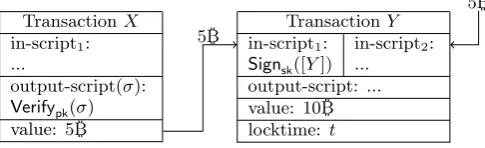
Example. We use the diagram notation from [7] to denote bitcoin transactions. In Figure 1, there is some userA asso-ciated with the public-private key pair (pk,sk). Transaction
Xessentially transfers 5B to userA. In the output-script of
X,Verifypk(σ) means that the following transaction referring
toX needs to be verified with a signature corresponding to the public keypk. Note that Verifypk implicitly takes an-other input which is the hash of the following transaction to be verified, e.g., hash([Y]). This is done automatically by the bitcoin script system, and hence we omit it from the parameters.
Suppose userAwishes to use the 5B from TransactionX
and another 5B from a different source. User A creates Transaction Y with two input transactions, each of which contributes 5B. In order for transactionY to be accepted in the blockchain, in the input-script referring to Transac-tionX, userAneeds to provide a signature for Transaction
Y signing with the private keysk. The ownership of the 10B is specified in the output-script, and the locktimet means that this transaction cannot be placed on the blockchain be-fore timet. If userAspends the 5B from TransactionXwith another transaction that appears on the blockchain before timet, TransactionY will not be accepted afterwards.
We use arrows with solid lines to indicate the normal flow of bitcoin between transactions when parties follow the planned protocol. We use dashed lines to indicate the flow of bitcoin between transactions when some party deviates from the planned protocol, in which case the transactions could represent penalty payment.
2.2
Security Model
In this paper, we assume that the blockchain is unique (no branching) and one block is grown at a fixed time in-terval known asround. The only ways to interact with the blockchain are submitting transactions and reading trans-action histories. No one can affect the blockchain by other
TransactionX
in-script1:
...
output-script(σ):
Verifypk(σ)
value: 5B
TransactionY
in-script1: in-script2: Signsk([Y]) ... output-script: ... value: 10B locktime: t
5B
5B
Figure 1: Example Transactions.
“nonstandard” ways. We assume that the blockchain is al-ways publicly accessible. However, we do not assume such access is private. At the time a transaction is submitted, it is publicly known. A submitted transaction may or may not appear on the blockchain, depending on its validity. If a transaction is valid, it will beconfirmed one round later, otherwise it will berejected. If conflicting transactions are submitted in the same round, only one of them will be con-firmed. Hence, if an adversary is able to create a different input-script for a (newly submitted) unconfirmed transac-tion. He could submit another transaction with the modi-fied input-script within the same round. In such case, either transaction could appear in the final blockchain.
One major threat to the bitcoin network is caused by sig-nature malleability [5]. It means that one (users and min-ers) has the ability to alter a transaction’s signature in a way such that: (1) it is still valid, and (2) the hash of the transaction changes. Note that malleability is not a seri-ous problem for normal users but a problem for (1) bitcoin trading companies; and (2) designing bitcoin contracts. The former may use hash of transactions (txid) to trace the sta-tus of a transaction, using a computer program. Failing to do so may result in incorrect accounting. In the design of bitcoin transactions [7, 11], one might rely on the hash of an unconfirmed transaction.
There are two major sources of malleability: (1) adding an extra operator in the input-script. (2) changing the signa-ture of a message directly. The former is a design weakness of the original bitcoin protocol, and is being fixed by BIP 62 [25]. While the latter weakness is due to the particu-lar signature scheme. E.g., given a valid ECDSA signature (r, s), (r,−s) is also a valid signature. BIP 62 also fixed this kind of malleability by having a rule to accept only one of them. These fixes are gradually being implemented in the bitcoin network, and will be forced with the block version 4 [1]. Hence, we assume that without the corresponding pri-vate key, one cannot produce modify a signed transaction with a different input-script. Note that with the correct pri-vate key, one can always sign the message again and get a different signature.
proto-cols that are realizable on the current bitcoin network with-out any modification. The details are in Section 3.1.
Peers (voters and candidates) need to communicate in the protocol. We assume there exists a secure private channel between any pair of participants. We also assume there ex-ists a public broadcast channel among all participants.
2.3
Cryptographic Primitives
Zero-knowledge proof. We utilize the zero-knowledge
Succinct Non-interactive ARgument of Knowledge (zk-SNARKs) [10]. On a high level, it proves a statement without revealing
the corresponding witness such as “I know anx such that
sha256(x) =y”. The use of zk-SNARKs is to guarantee that the voters cannot deviate from the protocol. We use the definition for zk-SNARKS from [10].
Given a boolean circuit C : {0,1}n× {0
,1}h → {0
,1}, a binary relation is defined as RC = {(x, w) ∈ {0,1}n× {0,1}h : C(x, w) = 1}, and its language is LC = {x ∈ {0,1}n:∃w, C(x, w) = 1}. Here, for everyx∈ LC, awitness forxis aw such that C(x, w) = 1. Zero-knowledge proof allows a party to convince others that he knows a secret witnessw such thatC(x, w) = 1, wherex is known by all parties. Note that this is also a proof thatx∈ LC.
Informally, zk-SNARKs is a triple of (randomized) algo-rithms (G, P, V):
• Generator G: (1λ, C)7→(pk,vk). Taking as inputs a security parameter 1λ and a boolean circuit C, it outputs a proving key pk and a verification key vk. Both keys are publicly known and can be used any number of times.
• ProverP: (pk, x, w)7→η. Taking as inputs a proving key pk, x ∈ LC and a corresponding witness w, it outputs a proofη.
• Verifier V : (vk, x, η) 7→ {0,1}. Taking as inputs a verification keyvk,xand a proofη, it outputs 1 if it is convinced thatx∈ LC.
We informally summarize the properties satisfied by zk-SNARKs. For the formal description, please refer to [10].
• Completeness. Given (x, w) ∈ RC, the proverP can produce a proofηsuch that the verifierV accepts (x, η) with probability 1.
• Soundness. No polynomial-time adversary can
gen-erate a proof η for x /∈ LC such that the verifier V
accepts (x, η) with non-negligible probability. • Efficiency. The randomized algorithms G, P and V
all run in time polynomial in the sizes of their inputs and some given security parameter.
• Zero-knowledge. There exists a (randomized) polyno-mial simulatorS, who first generates key pairs (pk,vk), such that for any x∈ LC chosen by a polynomial ad-versary, S generates a proof for x. The proof (and key pairs) generated byS is computationally indistin-guishable from honestly generated ones.
• Proof of knowledge. There exists a polynomial-time extractor E such that if a polynomial-time prover Pe
convinces the verifier V to accept some x∈ LC with non-negligible probability, then given oracle access to
e
P, the extractor can produce a witness w such that (x, w)∈ RC with non-negligible probability.
Commitment Scheme. A commitment scheme [16] is a two-party protocol between asenderand areceiver. A com-mitment scheme consists of (randomized) algorithmsCommit
andOpen, and involves two phases, acommitting phaseand
anopening phase.
• In the committing phase, the sender commits to a se-cret valuemby generating (c, k)←Commit(m), where
c is the commitment and k is the opening key. The commitmentcis sent to the receiver, while m andk
are secret.
• In the opening phase, the sender revealsk to the re-ceiver, who gets the original secret valuem←Open(c, k).
Open(c, k) returns⊥, if the pair (c, k) is considered to be invalid.
We informally summarize the properties of a commitment scheme. Please refer to [14] and [16] for formal description. • Correctness. An honestly generated (c, k)←Commit(m)
can always reveal the secretm←Open(c, k).
• Binding. No polynomial-time adversary can generate a commitmentcand two opening keyskandk0such that both (c, k) and (c, k0) are opened byOpento different valid messages with non-negligible probability. • Hiding. For any messagesmandm0, the distributions
of the corresponding commitmentscandc0 generated byCommitare computationally indistinguishable.
Compatibility with Bitcoin Protocol. As mentioned in [7], the current implementation of bitcoin protocol forbids some functions in the scripting language. In particular, calcu-lating hashes, verifying signatures and simple arithmetic operations are the only supported operations. We follow their method and define commitment schemes using hash functions. Supposeλis a publicly known security parame-ter. To commit to a non-negative integerm,Commit(m) = (hash(y), y), whereyis a random string of length (λ+m). Here,hashcan be any hash function supported by the bitcoin protocol; in this paper, we usesha256. Moreover,hash(y) is the commitment andyis the opening key. Then,Open(h, y) returns|y| −λifh=hash(y), and⊥otherwise.
3.
OUR PROTOCOLS
We present our protocol for bitcoin voting. Apart from a one-time setup using zk-SNARKs [10], our protocol works in a peer-to-peer fashion without a centralized server. The setup is run only once, and can be used for multiple vot-ings. SupposeN is the least power of 2 that is greater than the number n of voters. We use ZN to denote the group of integers moduloN equipped with modulo addition. We chooseNto be a power of 2 to simplify the implementation of modulo arithmetic.
On a high level, our protocol consists of two components. • Vote Commitment.In this phase, each voterPihas a private voteOi∈ {0,1}, where 0 indicates candidate
Aand 1 indicates candidateB. Each voterPireceives a secret random numberRi, which is constructed in a distributed fashion such thatP
jRj= 0.
At the end of this phase, each voterPimakes commit-mentCitoRi, and commitmentCbito his masked vote
b
Oi:=Oi+Ri. The commitmentsCiandCbiare broad-cast publicly, while the underlying values and opening keys remain secret.
Every participant convinces others that he follows the protocol using zero-knowledge proofs. In particular, everyone is convinced that for each i, the underlying value of the commitmentCbiminus that ofCiis either 0 or 1, and the sum of the underlying values ofCiover
overiis the number of votes candidateB receives. The details are in Section 3.1.
• Vote Casting. In this phase, the votes are cast us-ing transactions in the bitcoin protocol, which are re-sponsible for revealing the outcome and guarantee-ing money transfer to the winnguarantee-ing candidate. After each voterPireveals his masked voteObi, the outcome P
iObi (the number votes supporting candidateB) is known, and the winning candidate is guaranteed to receivenB.
Moreover, parties that deviate from the protocol are penalized. We have two versions for vote casting, which have different consequences for the penalty and the funding outcome for the candidates when a voter de-viates from the protocol.
(a) The first version is based on the lottery proto-col in [11] using aclaim-or-refund functionality. The voters reveal their masked votes in the order:
P1, P2, . . . , Pn. If voter Pi is the first to deviate from the protocol, he pays a penalty to each voter that has already revealed his masked vote. Every-one else gets his deposit back, and the protocol terminates while neither candidateA norB gets any money.
(b) The second version is an improvement over other protocols [7, 20] usingjoint transactionto incen-tivize fair computation via the bitcoin system. Each voterPiplaces (1 +d)B into the bitcoin sys-tem, where 1B is for paying the winning candidate anddB is for deposit. If a voter reveals his masked voteObi, he can get back the depositdB. For each
voter that does not reveal his masked vote within some time period, his depositdB will be used as compensation. For instance, with d = 2n, the deposit can be shared between the candidatesA
andB. Observe that if at least one voter does not reveal his masked vote, thenB for the supposedly winning candidate will be locked into the bitcoin system.
The details for the two versions are in Sections 3.2 and 3.3.
3.1
Vote Commitment
Recall that we wish to uniformly generate random num-bersRi’s that sum to 0 such that for eachi, only voterPi receives Ri. Moreover, the commitments to Ri and Obi = (Ri+Oi) are public. We first give a high level idea of the procedure.
We imagine that there is ann×nmatrix [rij] whose entries contain elements fromZN. The protocol can be described
in terms of the matrix as follows.
1. For eachi, voterPigenerates thei-th row whose sum
P
jrij is zero. This can be done by generating n− 1 random numbers in Zn and setting the last one to be the additive inverse of the sum of the first n−1 numbers.
2. For eachiandj, voterPi sends the numberrij toPj via the secret channel.
3. For eachi, voterPi knows thei-th column of the ma-trix. Hence, he computes and commits both Ri :=
P
jrji and the masked voteObi:=Oi+Ri.
This idea is standard in the literature (for instance, used
recently in [19][Section IV.A]). The twist here is that com-mitment schemes and zero-knowledge proofs are used to en-sure that every party follows the protocol, while maintaining the secrecy of the random numbers. The details are given in Figure 2.
Vote Commitment Protocol
This protocol runs amongn voters, where fori∈[n], partyPi has secret voteOi ∈ {0,1}. We assume the proving and verification keys for zk-SNARKs are al-ready generated and distributed to all voters. For each
i∈[n], the procedure forPiis as follows.
1. Generatensecret random numbersrij∈ZN, for
j∈[n], such that they sum to 0.
For j ∈ [n], commit (cij, kij) ← Commit(rij), wherekij is the opening key to the commitment
cij.
2. Generate zero-knowledge proofs that shows
P
jri,j= 0. Specifically, the circuitC takes two components. The input component is then com-mitments, while the witness component is then
corresponding opening keys. The circuitC eval-uates to 1 if the opened values sum to 0.
Broadcast the commitments and zero-knowledge proofs to all voters.
3. Receive commitments and verify the zero-knowledge proofs from all other parties generated in Step 2.
4. For allj∈[n]\ {i}, send toPj the opening key
kij.
Forj∈[n]\{i}, wait for the opening keykjifrom
Pj, and check thatrji=Open(cji, kji)6=⊥.
5. ComputeRi ← Pjrji and Obi ←Ri+Oi, and commit (Ci, Ki)←Commit(Ri) and (Cbi,Kbi)←
Commit(Obi), whereKi,Kbiare the opening keys.
Broadcast the commitmentCi andCbi publicly.
6. Generate and broadcast publicly the zero-knowledge proofs for the following:
(a) “Ri=Pjrji”. This is similar to Step 2. (b) “The committed value inCbi minus that in
Ci is either 0 or 1.” The input part of the circuit is the two commitmentsCi and Cbi,
and the witness part is their opening keys. The circuit evaluates to 1 if the opened val-ues differ by 0 or 1 as required.
7. Receive and verify all proofs from other parties generated in Step 6. The protocol terminates.
Figure 2: Vote Commitment Protocol
generatennumbers that sum to 0, but do not ensure that they are generated uniformly at random. However, as long as at least one party generate his random numbers uniformly at random, the resultingRi’s will still benuniformly ran-dom numbers summing to 0. From the definition of commit-ment schemes and zero-knowledge-proofs, eachPi commits to bothRi and the masked vote Obi :=Ri+Oi, and con-vinces everyone thatObi−Ri ∈ {0,1}, while keeping both values secret.
3.2
Vote Casting via Claim-or-Refund
This version of the vote casting protocol is based on the lottery protocol in [11] that makes use of bitcoin transactions to guarantee money transfer. The protocol is not symmetric among the voters, and the voters are supposed to reveal their masked votes in the order: P1, P2, . . . , Pn. In order to
participate in the protocol, fori∈[n−1], voterPineeds to place (i+ 1)B into the system, and voterPnneeds to place (3n−1)B into the system. This protocol requires a linear number of bitcoin rounds, as opposed to constant number of rounds in the protocol that is given in Section 3.3. The protocol in this section guarantees the following:
• If every voter reveals his masked vote, the net effect is that each voter pays 1B to the winning candidate. • If voterPi is the first that does not reveal his masked
vote, the net effect is that he pays 1B to each voter that has already revealed his masked vote. Observe that neither candidate receives any money in this case. Claim-or-refund. As in [11], we use the claim-or-refund (COR) functionality. Supposeπ is some boolean function. Informally, COR consists of several bitcoin transactions, whose effect is to allow a senderP to guarantee that if the receiver
Q reveals some secret w such that π(w) = 1 before some specified timeτ,P will transfer a certain amountqB toQ. Note that the revealed secret is publicly known afterwards. The claim-or-refund functionality consists of (potentially) three phases.
(a) Deposit Phase. SenderP creates adeposit transaction
whose output value is qB. In the output script, it requires either (i) signatures from bothPandQ, or (ii)
Q’s signature and a valuewsuch thatπ(w) = 1. The deposit transaction is kept secret for the time being. SenderP also creates a (simplified)refund transaction
with a timelockτ whose input is the deposit transac-tion just created. The simplified refund transactransac-tion is sent to receiverQ, who provides his signature. Sender
P also appends his own signature to complete the cre-ation of the refund transaction.
The deposit phase is completed, when senderP broad-cast the deposit transaction, and it appears on the blockchain.
(b) Claim Phase. ReceiverQcan create aclaim transac-tionto claim the amountqB from the deposit transac-tion by providing his signature and some wsuch that
π(w) = 1 in the input-script before timeτ.
(c) Refund Phase. IfQdoes not broadcast a valid claim transaction by time τ, P can get back the amount
qB from the deposit transaction by broadcasting the refund transaction created in (a).
We use following notation to indicate the claim-or-refund protocol as described above: P −−→π
q,τ Q.
Example. In our application, we need a claim-or-refund
protocol such thatP sendsQan amount ofqB, ifQreveals the opening keyKb to the commitmentCbof some secretOb
before time τ. We use the notation P Ob
−−→
q,τ Q to indicate such a protocol. Recall that we use hashing as the commit-ment scheme in Section 2.3. When we say Q reveals the secretOb, we meanQsubmits to the bitcoin network a claim
transaction whose input-script contains the opening keyKb.
The functionπin the deposit transaction takes the opening keyKb and accepts ifhash(Kb) =Cb. Observe that the secret
is revealed asOb=|Kb| −λ, where|Kb|is the length of the
key andλis some publicly known security parameter. We can also have more complicated claiming condition such asQ needs to provide the opening keys to reveal Ob1
andOb2such thatOb1+Ob2= 0. This is denoted as:
P Ob1,Ob2:Ob1+Ob2=0
−−−−−−−−−−−→ q,τ Q.
Vote Casting via COR. We show how the vote casting protocol can be implemented with a sequence of COR in-stances in Figures 3 and 4. The idea is similar to that in [20]. For n voters, there are 2n COR instances. The deposit transactions of the COR instances are placed in the reversed order as the claim transactions are broadcast to reveal the masked votes.
Correctness. The correctness of the protocol is analyzed in the same way as [20]. The voters are supposed to reveal their masked votes in the order: P1, P2, . . . , Pn. At the moment
just after voters P1, P2, . . . , Pi have revealed their masked votes in the corresponding claim transactions, the net ef-fect is that Pi+1 has paid each of the previous voters 1B.
Hence, if Pi+1 does not reveal his masked vote, eventually
all outstanding COR instances will expire and the protocol terminates.
On the other hand, if everyone follows the protocol, then at the end all the masked votes can be summed up to deter-mine the winner, who can collectnB fromPn.
3.3
Vote Casting via Joint Transaction
The protocol in Section 3.2 requires a linear number of bitcoin rounds. In this section, we give an alternative pro-tocol that only needs constant number of bitcoin rounds. Also, our protocol has the advantage of small total trans-action size. The total size of the transtrans-actions in the proto-col is Θ(n) bytes, instead of Θ(n2) from previous protocol. Loosely speaking, we achieve this by locking all bitcoins in-volved in a transaction that is jointly signed by all voters. The protocol is symmetric among thenvoters. To partici-pate in the protocol, each voterPineeds (1 +d)B, of which 1B is to be paid to the winning candidate if everyone reveals his masked vote and the remainingdB is for deposit that will be used for compensation ifPi does not reveal his masked vote. Thetimed-commitment technique in [7] can be used to handle the deposit and compensation.
The protocol guarantees the following:
• If a voter reveals his masked vote, he can get back the depositdB.
• If every voter reveals his masked vote, the sumP
iObi determines the winner who receivesnB.
Vote Casting: Deposit Phase
Assume that the commitments Cbi’s to the masked
votesObi’s are publicly known, and eachPiknows the opening key Kbi forCbi. Assuming thatn is odd, the
winner isB ifP
iObi> n2.
Assume that the timesτ1 < τ2< . . . < τn< τn+1are
spaced sufficiently wide apart, for they will be used as locktimes.
The protocol runs as follows.
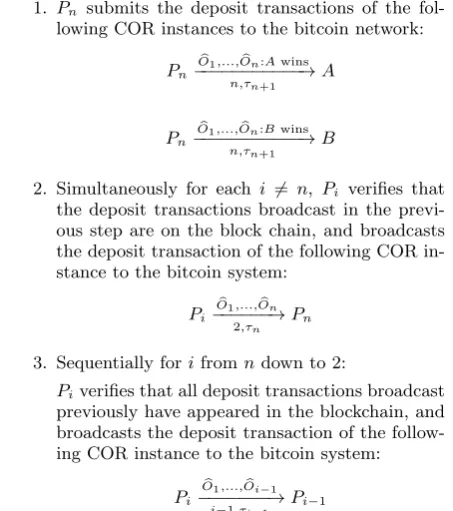
1. Pn submits the deposit transactions of the fol-lowing COR instances to the bitcoin network:
Pn
b
O1,...,Obn:Awins
−−−−−−−−−−−→ n,τn+1
A
Pn
b
O1,...,Obn:Bwins
−−−−−−−−−−−→ n,τn+1
B
2. Simultaneously for each i 6= n, Pi verifies that the deposit transactions broadcast in the previ-ous step are on the block chain, and broadcasts the deposit transaction of the following COR in-stance to the bitcoin system:
Pi
b
O1,...,Obn
−−−−−−→
2,τn Pn
3. Sequentially forifromndown to 2:
Piverifies that all deposit transactions broadcast previously have appeared in the blockchain, and broadcasts the deposit transaction of the follow-ing COR instance to the bitcoin system:
Pi
b
O1,...,Obi−1
−−−−−−−→ i−1,τi−1
Pi−1
Figure 3: Deposit Phase of Vote Casting
(a) For d = 2n, the deposit can be shared between candidatesAandB. We shall concentrate on this option in this section.
(b) For d=n, the deposit can be distributed among all voters in a similar way.
Problems with Joint Transaction in Previous Ap-proach. In [7, 20], a joint transaction is used to temporar-ily lock down deposits fromn parties such that if a party does not reveal his secret before some time, others can get compensated from his deposit. The idea is to use a joint transactionT, whoseninputs are the sources of then par-ties’ deposits. Each outputiofT can be redeemed by one of two ways: (1) a transaction signed by partyi revealing his secret, or (2) a transaction signed by everyone.
However, before transactionT is broadcast to the bitcoin network, for eachi, a transactionPAYi signed by everyone that can redeem thei-th output (as compensation after some locktime) needs to be created first. The issue is that to cre-ate the transactionPAYi,hash(T) of the signed transaction
T is required in the current bitcoin protocol. One way to resolve the issue is to modify the current bitcoin protocol
Vote Casting: Claim/Refund Phase
• For i6=n, if before timeτi, all previous secrets
b
O1, . . . ,Obi−1are revealed, thenPireveals his se-cretObi and use the claim transaction to receive
iB fromPi+1.
• If before time τn, all secrets Obi for i 6= n are revealed, Pn reveals his secret Obn and use the claim transactions to receive 2B from eachPifor
i6=n.
• If before time τn+1 all secrets are revealed, the
winner is determined and he can use the corre-sponding claim transaction to receive nB from
Pn.
• At any time when the locktime of a COR in-stance has passed, the sender can immediately use the corresponding refund transaction to get his amount back.
Figure 4: Vote Casting: Claim/Refund Phase
such thathash([T]) of the simplified (unsigned) transaction
T is used instead.
Another way to resolve the issue is thathash(T) is com-puted via secure multi-party computation. After all the transactions PAYi’s are created, then all parties can com-plete the creation of the transactionT by signing it (in ex-actly the same way as they compute hash(T) in the secure multi-party computation). However, in [7], it is mentioned that there is a serious security issue with this approach. An adversarial party can replace his signature with a different valid one to create another version T0 of the transaction, whose hash is different from that ofT. If he broadcasts this alternate version T0 and it appears on the blockchain be-fore the originalT, then all the transactionsPAYi’s become useless. Hence, the compensation will not be paid even if a party does not reveal his secret before the deadline, but could still claim back his deposit by revealing his secret even-tually after a very long time.
We resolve this issue by using an (n, n)-threshold signa-ture scheme [15] for a group of parties to sign a message together, such that no adversary can re-sign the same mes-sage again without all parties’ permissions.
Description of Vote Casting Protocol.
Key Setup. We use the threshold signature scheme [15] for Elliptic Curve Digital Signature Algorithm (ECDSA). The
n voters jointly generate a group address such that voter
Pi learns the group public key cpkand his share skbi of the private key. Observe that no party knows the underlying secret keyskb, which could be reconstructed from all parties’
secret shares. We use (pki,ski) to denote the address ofPi in the bitcoin system.
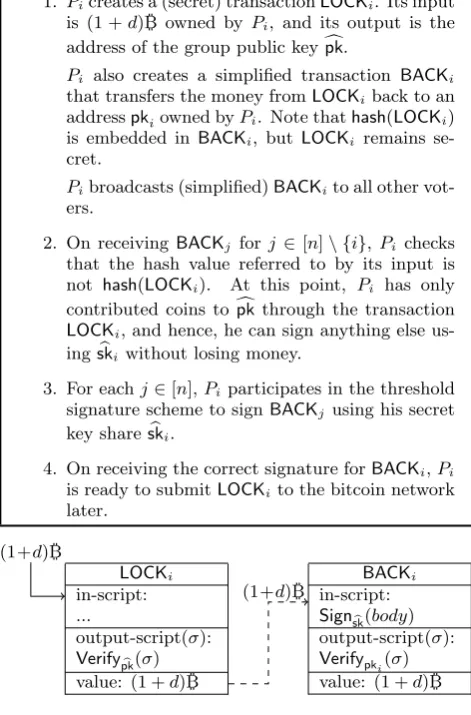
Coin Lock. Eventually, thenvoters will sign some trans-actionJOINtogether, whose inputs are contributed by then
let each voterPiget back his contribution with the transac-tionBACKi. The coin lock protocol is described in Figure 5.
Coin Lock Protocol
Each voter locks (1 +d)B into the system, where 1B is to fund the winner, anddB is for deposit; here, we set
d:= 2n. Each voterPi does the following:
1. Picreates a (secret) transactionLOCKi. Its input is (1 +d)B owned by Pi, and its output is the address of the group public keycpk.
Pi also creates a simplified transaction BACKi that transfers the money fromLOCKiback to an addresspkiowned byPi. Note thathash(LOCKi) is embedded in BACKi, butLOCKi remains se-cret.
Pibroadcasts (simplified)BACKito all other vot-ers.
2. On receivingBACKj forj∈[n]\ {i},Pi checks that the hash value referred to by its input is not hash(LOCKi). At this point, Pi has only contributed coins to cpkthrough the transaction
LOCKi, and hence, he can sign anything else us-ingskbiwithout losing money.
3. For eachj∈[n],Piparticipates in the threshold signature scheme to signBACKj using his secret key shareskbi.
4. On receiving the correct signature forBACKi,Pi is ready to submitLOCKito the bitcoin network later.
LOCKi in-script: ...
output-script(σ):
Verify
b
pk(σ)
value: (1 +d)B (1+d)B
BACKi in-script:
Sign
b
sk(body)
output-script(σ):
Verifypk
i(σ)
value: (1 +d)B (1+d)B
Figure 5: Coin Lock Protocol
Joint Transaction. In the next step, the n voters shall jointly sign a transaction JOIN using the threshold signa-ture scheme, each with his private key shareskbi. TheJOIN
transaction has ninputs referring to the LOCKi’s, each of which contributes (1 +d)B. It has (n+ 1) outputs, of which
out-prizedelivers nB to the winning candidate, while each
out-depositiof the remainingnoutputs handles the deposit
dB of each voter.
Using the timed-commitment technique as in [7], the out-putout-depositican be redeemed by a transaction that either (1) reveals the masked vote Obi and is signed with the key associated withPi, or (2) is signed with the group signature. Hence, beforeJOINtakes effect (by appearing in the block-chain), a transactionPAYiwith some timelock that can re-deemout-depositineeds to be created and signed under the threshold signature scheme, in case Pi does not reveal his masked vote and his deposit is used for compensation. The details are in Figure 6.
Joint Transaction Protocol
Assume that the Coin Lock Protocol has been run, and each Pi has created the (secret) transaction LOCKi, whose hash is publicly known. Suppose t1 < t2 are
times far enough in the future. Each voter runs the following protocol.
1. Each voter generates the same simplified trans-actionJOINas follows.
• It has n inputs, each of which refers to
LOCKithat contributes (1 +d)B. • It hasn+ 1 outputs:
out-depositi,i∈[n]: each has valuedB, and requires either (1) the opening keyKbi (re-vealing Obi) and a signature verifiable with Pi’s public key pki, or (2) a valid signature verifiable with the group’s public keycpk.
out-prize: has value nB, and requires all opening keys Kbi’s (revealing the masked
votesObi’s) and a signature from the winning
candidate (which can be determined from the sumP
iObi).
2. The voters jointly signJOINusing the threshold signature scheme, each with his private key share
b
ski. Observe that JOIN has n inputs, each of which requires its own group signature. (See [2] for details.) The signedJOINis ready to be sub-mitted.
3. Each voter generates, for eachi∈[n], the same simplified transaction PAYi with timelock t2
whose input refers to out-depositi. The output handles the compensationdB if voterPidoes not reveal his masked vote by timet2. For instance,
withd= 2n, the compensation can be shared be-tween candidatesAandB. Thenvoters jointly signPAYiusing the threshold signature scheme.
4. Each voterPiverifies that the above steps have been completed, and submit LOCKi to the bit-coin system.
5. After all LOCKi’s have appeared on the block-chain,JOINis submitted to the blockchain.
6. As long asJOINhas not appeared on the block-chain, say by timet1, any voterPican terminate the whole protocol by submitting BACKi to get back (1 +d)B.
Figure 6: Joint Transaction
Outcome Revealing Phase. After JOINappears on the blockchain, each voter Pi can collect his deposit dB (from the output out-depositi of JOIN) by submitting a CLAIMi transaction that provides the opening key Kbi to reveal his masked vote Obi. If all voters have submitted their
JOIN
. . . in-scripti: Sign
b
sk([JOIN])
. . .
out-depositi(Kbi, σ):
(Open(Cbi,Kbi) 6= ⊥ ∧ Verifypk i(σ))∨
Verify
b
pk(σ)
2nB
. . .
out-prize({Kbi}i∈[n], σ):
∀i,Open(Cbi,Kbi)6=⊥∧
((Verifypk
A(σ)∧ P
Open(Cbi,Kbi)≤ n2)∨
(VerifypkB(σ)∧
P
Open(Cbi,Kbi)>n2)) nB
. . .
Winner
nB
LOCKi (1+2n)B
CLAIMi in-script:
b
Ki,Signski([CLAIMi])
out-script: ...
PAYi input-script: ⊥,Sign
b
sk([PAYi])
out-scriptA(σ): out-scriptB(σ):
Verifypk
A(σ) VerifypkB(σ)
locktime: t2
2nB
2nB
On the other hand, if some voter i does not reveal his masked vote, then thenB fromout-prizecannot be accessed anymore. However, sincePAYiis publicly known, after time
t2, the dB from out-depositi can be redeemed by PAYi as compensation.
Correctness. After the coin lock protocol, all the trans-actions LOCKi’s remain secret, while their hashes and the
BACKi’s are publicly known. Observe that before the trans-actionJOINappears on the blockchain, any voter can termi-nate the whole protocol without losing any money by sub-mitting BACKi to the bitcoin system. On the other hand, onceJOIN has appeared on the block chain, no voter can terminate the protocol without either revealing his masked vote or losing his depositdB.
4.
EXPERIMENT
We describe our implementation of the protocols in Sec-tion 3.
Vote Commitment.We have implemented the zero-knowledge-proofs described in Section 3.1. For zk-SNARKs [10], we choose snarkfront [17], which is available online. We use snarkfront to implement the required zero-knowledge proofs. We run the program using a computer with 4G RAM and Intel Core i5-3570 CPU. The key generator typically takes 5 times longer than the time to generate proofs. However, since it only needs to be run once globally, we omit its run-ning time here as it is not a serious performance concern. In Figure 7, we report the time to generate proofs for
dif-ferent number of users. We consider three kinds of proofs: (1) to proven numbers sum to 0, (2) to prove n numbers sum to the (n+ 1)-st number, (3) to prove the subtraction of a number from another is either 0 or 1.
10 20 30 40 50
0 100 200 300
Numbernof voters
Ti
me
in
sec
on
d
s
Pn
1Open(Cbi,Kbi) = 0 Pn
1Open(Cbi,Kbi) =Open(Cbn+1,Kbn+1) Open(Cb1,Kb1)−Open(Cb2,Kb2)∈ {0,1}
Figure 7: Performance of zk-SNARKS
In zk-SNARKS, the time for verification is only linear in the size of the input (and the security parameter). Typically, it takes less than 0.1 second.
Vote Casting. As a proof of concept, we have executed the protocols in bitcoin (testnet) network [4]. We use bitcoinj Java library to create and send the transactions.
Below we present txid of the transactions. There are 9 voters in our protocol. One may read the full transaction data on chain.so website.
For the protocol using claim-or-refund in Section 3.2, we first create a transaction with multiple outputs, each of which acts as the source address of each claim-or-refund transaction. The source of each claim-or-refund transaction can be found with index 0−18 at:
d3f62d6dfd9722699938a3d7457e23ba786a3e8d14615d128847ad7ca56b7a1a.
All following transactions can be found following the out-puts. Another execution in which an adversary terminated the protocol and was punished is here:
8d4031dfa71bf9b1a296b6f67c3cb1d801e899d4ff7d1ee6dd6751622032b60f.
For the protocol using joint transaction in Section 3.3, the
JOINtransaction of a successful execution is here: ca42f58d2a7eadc4360029ea31e6f2224c9b7f47c18ef985a9b477ac869822c7.
All claim transactions can be found by following the out-puts.
AJOINtransaction of an unsuccessful (terminated by ad-versary) execution is here:
6506857a75b1f25b930a923e6bd8274cbccb42339425e21f29cf5ba2ce389738.
All CLAIMi and PAYi transactions can be found by fol-lowing the outputs.
5.
REFERENCES
[1] Bitcoin developer reference - block versions.
https://bitcoin.org/en/developer-reference# block-versions. Accessed: 2015-05-10.
[2] Checksig - bitcoin wiki.
[3] Contracts - bitcoin wiki.
https://en.bitcoin.it/wiki/Contracts. Accessed: 2015-05-10.
[4] Testnet - bitcoin wiki.
https://en.bitcoin.it/wiki/Testnet. Accessed: 2015-05-10.
[5] Transaction malleability - bitcoin wiki.https: //en.bitcoin.it/wiki/Transaction_Malleability. Accessed: 2015-05-10.
[6] Marcin Andrychowicz, Stefan Dziembowski, Daniel Malinowski, and Lukasz Mazurek. How to deal with malleability of bitcoin transactions.CoRR,
abs/1312.3230, 2013.
[7] Marcin Andrychowicz, Stefan Dziembowski, Daniel Malinowski, and Lukasz Mazurek. Secure multiparty computations on bitcoin. In2014 IEEE Symposium on Security and Privacy, SP 2014, Berkeley, CA, USA, May 18-21, 2014, pages 443–458, 2014.
[8] Simon Barber, Xavier Boyen, Elaine Shi, and Ersin Uzun. Bitter to better - how to make bitcoin a better currency. InFinancial Cryptography and Data Security - 16th International Conference, FC 2012, Kralendijk, Bonaire, Februray 27-March 2, 2012, Revised Selected Papers, pages 399–414, 2012.
[9] Eli Ben-Sasson, Alessandro Chiesa, Christina Garman, Matthew Green, Ian Miers, Eran Tromer, and Madars Virza. Zerocash: Decentralized anonymous payments from bitcoin. In2014 IEEE Symposium on Security and Privacy, SP 2014, Berkeley, CA, USA, May 18-21, 2014, pages 459–474, 2014.
[10] Eli Ben-Sasson, Alessandro Chiesa, Daniel Genkin, Eran Tromer, and Madars Virza. Snarks for C: verifying program executions succinctly and in zero knowledge. InAdvances in Cryptology - CRYPTO 2013 - 33rd Annual Cryptology Conference, Santa Barbara, CA, USA, August 18-22, 2013. Proceedings, Part II, pages 90–108, 2013.
[11] Iddo Bentov and Ranjit Kumaresan. How to use bitcoin to design fair protocols. InAdvances in Cryptology - CRYPTO 2014 - 34th Annual Cryptology Conference, Santa Barbara, CA, USA, August 17-21, 2014, Proceedings, Part II, pages 421–439, 2014. [12] Nir Bitansky, Alessandro Chiesa, Yuval Ishai, Rafail
Ostrovsky, and Omer Paneth. Erratum: Succinct non-interactive arguments via linear interactive proofs. InTCC, 2013.
[13] David Chaum, Claude Cr´epeau, and Ivan Damg˚ard. Multiparty unconditionally secure protocols (extended abstract). InProceedings of the 20th Annual ACM Symposium on Theory of Computing, May 2-4, 1988, Chicago, Illinois, USA, pages 11–19, 1988.
[14] Ivan Damg˚ard. Commitment schemes and zero-knowledge protocols. InLectures on Data Security, Modern Cryptology in Theory and Practice, Summer School, Aarhus, Denmark, July 1998, pages 63–86, 1998.
[15] Steven Goldfeder, Rosario Gennaro, Harry Kalodner, Joseph Bonneau, Joshua A Kroll, Edward W Felten, and Arvind Narayanan. Securing bitcoin wallets via a new dsa/ecdsa threshold signature scheme.
http://www.cs.princeton.edu/~stevenag/ threshold_sigs.pdf, 2015.
[16] Oded Goldreich.Foundations of Cryptography: Volume 1. Cambridge University Press, New York, NY, USA, 2006.
[17] jancarlsson. snarkfront: a c++ embedded domain specific language for zero knowledge proofs.
https://github.com/jancarlsson/snarkfront. [18] Marek Jawurek, Florian Kerschbaum, and Claudio
Orlandi. Zero-knowledge using garbled circuits: how to prove non-algebraic statements efficiently. In2013 ACM SIGSAC Conference on Computer and
Communications Security, CCS’13, Berlin, Germany, November 4-8, 2013, pages 955–966, 2013.
[19] Taeho Jung, Xiang-Yang Li, Zhiguo Wan, and Meng Wan. Privacy preserving cloud data access with multi-authorities. InProceedings of the IEEE INFOCOM 2013, Turin, Italy, April 14-19, 2013, pages 2625–2633, 2013.
[20] Ranjit Kumaresan and Iddo Bentov. How to use bitcoin to incentivize correct computations. In
Proceedings of the 2014 ACM SIGSAC Conference on Computer and Communications Security, Scottsdale, AZ, USA, November 3-7, 2014, pages 30–41, 2014. [21] Yehuda Lindell. Highly-efficient
universally-composable commitments based on the DDH assumption. InAdvances in Cryptology -EUROCRYPT 2011 - 30th Annual International Conference on the Theory and Applications of Cryptographic Techniques, Tallinn, Estonia, May 15-19, 2011. Proceedings, pages 446–466, 2011. [22] Ian Miers, Christina Garman, Matthew Green, and
Aviel D. Rubin. Zerocoin: Anonymous distributed e-cash from bitcoin. In2013 IEEE Symposium on Security and Privacy, SP 2013, Berkeley, CA, USA, May 19-22, 2013, pages 397–411, 2013.
[23] Satoshi Nakamoto. Bitcoin: A peer-to-peer electronic cash system,ˆa ˘A˙I http://bitcoin.org/bitcoin.pdf, 2008. [24] Bryan Parno, Jon Howell, Craig Gentry, and Mariana
Raykova. Pinocchio: Nearly practical verifiable computation. In2013 IEEE Symposium on Security and Privacy, SP 2013, Berkeley, CA, USA, May 19-22, 2013, pages 238–252, 2013.
[25] Pieter Wuille. Dealing with malleability - bip62.
https://github.com/bitcoin/bips/blob/master/ bip-0062.mediawiki, 2014.