Protected Data Sharing scheme with
Multi-Ownership for Non Static Groups in the Cloud
Chaitra C1, Dr. T. R. Mahesh2
1PG Student, Dept. of Computer Science & Engineering
T. John Institute of Technology, Bangalore, Karnataka, India. 2Professor& Head, Dept. of Computer Science & Engineering
T. John Institute of Technology, Bangalore, Karnataka, India
Abstract— Cloud computing offers an economical and efficient solution for sharing group resources among cloud users i.e. the individual can now run the application from anywhere in the world, as the server provides the processing power to the application and the server is also connected to a network via Internet or other connection platforms to be accessed from anywhere and with the character of low maintenance. But, due to frequent change of the membership, sharing data provided with multi-ownership, while protecting data and identity privacy of users from an untrusted cloud is a challenging issue. To overcome this problem a protected multi-owner data sharing scheme will be proposed for non-static groups in the cloud. By leveraging group signature and dynamic broadcast encryption techniques, any cloud user can anonymously share data with others without revealing identity to untrusted cloud and the data owner will be given with the option of traceability to reveal the identity of any user at time of disputes. In the interim, the storage overhead and encryption computation cost of the proposed scheme are independent with the number of revoked users.
Keywords— Cloud Computing, Data Sharing, Access Control, Non Static groups, Group Signature, Dynamic Broadcast Encryption.
INTRODUCTION
Cloud computing is recognized as best alternative to traditional information technology [1] due to its resource sharing and low-maintenance characteristics. In cloud computing, the cloud service providers, such as Amazon, are able to deliver various services to cloud users with the help of powerful datacenters. By migrating from local data management systems into cloud servers, users can enjoy high-quality services and save significant investments on their local infrastructures.
One of the most fundamental services offered by cloud providers is data storage. However, it also poses a significant risk to the confidentiality of the stored files. Specifically, the cloud servers managed by cloud providers are not fully trusted by users while the data files stored in the cloud may be sensitive and confidential, such as business plans. To preserve data privacy, a basic solution is to encrypt data files, and then upload the encrypted data into the cloud [2]. Unfortunately, designing an efficient and secure data sharing scheme for groups in the cloud is not an easy task due to the following challenging issues.
First, identity privacy is one of the most significant obstacles for the wide deployment of cloud computing.
Without the guarantee of identity privacy, users may be unwilling to join in cloud computing systems because their real identities could be easily disclosed to cloud providers and attackers. On the other hand, unconditional identity privacy may incur the abuse of privacy. For example, a misbehaved staff can deceive others in the company by sharing false files without being traceable. Therefore, traceability, which enables the group manager (e.g., a company manager) to reveal the real identity of a user, is also highly desirable.
Second, it is highly recommended that any member in a group should be able to fully enjoy the data storing and sharing services provided by the cloud, which is defined as the multiple-owner manner. Compared with the single-owner manner [3], multiple-single-owner manner is more flexible in practical applications. More concretely, each user in the group is able to not only read data, but also modify his/ her part of data in the entire data file shared by the company.
Lastly groups are normally dynamic in practice, e.g., new staff participation and current employee revocation in a company. The changes of membership make secure data sharing extremely difficult. On one hand, the anonymous system challenges new granted users to learn the content of data files stored before their participation, because it is impossible for new granted users to contact with anonymous data owners, and obtain the corresponding decryption keys. On the other hand, an efficient membership revocation mechanism without updating the secret keys of the remaining users is also desired to minimize the complexity of key management.
addressed in their scheme. Yu et al. [3] presented a scalable and fine-grained data access control scheme in cloud computing based on the key policy attribute-based encryption (KP-ABE) technique [9]. Unfortunately, the single-owner manner hinders the adoption of their scheme into the case, where any user is granted to store and share data.
To solve the challenges presented above, we propose a Protected Data Sharing scheme with Multi-Ownership for Non-Static Groups in the Cloud.
The main contributions of this paper include:
1. We propose a Secure Multi-ownership system for Data Sharing in Non-Static Groups in the Cloud. It implies that any user in the group can securely share data with others by the cloud.
2. Our proposed scheme is able to support dynamic groups efficiently. Specifically, new granted users can directly decrypt data files uploaded before their participation without contacting with data owners. User revocation can be easily achieved through a novel revocation list without updating the secret keys of the remaining users. The size and computation overhead of encryption are constant and independent with the number of revoked users. 3. We provide secure and privacy-preserving access
control to users, which guarantees any member in a group to anonymously utilize the cloud resource. Moreover, the real identities of data owners can be revealed by the group manager when disputes occur. 4. We provide rigorous security analysis, and perform extensive simulations to demonstrate the efficiency of our scheme in terms of storage and computation overhead.
I. RELATED WORK
In [5], files stored on the untrusted server include two parts: file metadata and file data. The file metadata implies the access control information including a series of encrypted key blocks, each of which is encrypted under the public key of authorized users. Thus, the size of the file metadata is proportional to the number of authorized users. The user revocation in the scheme is an intractable issue especially for large-scale sharing, since the file metadata needs to be updated. In their extension version, the NNL construction [10] is used for efficient key revocation. However, when a new user joins the group, the private key of each user in an NNL system needs to be recomputed, which may limit the application for dynamic groups. Another concern is that the computation overhead of encryption linearly increases with the sharing scale.
In [4], Kallahalla et al. proposed a cryptographic storage system that enables secure file sharing on untrusted servers, named Plutus. By dividing files into filegroups and encrypting each filegroup with a unique file-block key, the data owner can share the filegroups with others through deliver-ing the corresponding lockbox key, where the lockbox key is used to encrypt the file-block keys. However, it brings about a heavy key distribution overhead for large-scale file sharing. Additionally, the file-block key
needs to be updated and distributed again for a user revocation.
Ateniese et al. [6] leveraged proxy re encryptions to secure distributed storage. Specifically, the data owner encrypts blocks of content with unique and symmetric content keys, which are further encrypted under a master public key. For access control, the server uses proxy cryptography to directly re encrypt the appropriate content key(s) from the master public key to a granted user’s public key. Unfortunately, a collusion attack between the un-trusted server and any revoked malicious user can be launched, which enables them to learn the decryption keys of all the encrypted blocks.
Lu et al. [7] proposed a secure provenance scheme, which is built upon group signatures and ciphertext-policy attribute-based encryption techniques. Particularly, the system in their scheme is set with a single attribute. Each user obtains two keys after the registration: a group signature key and an attribute key. Thus, any user is able to encrypt a data file using attribute-based encryption and others in the group can decrypt the encrypted data using their attribute keys. Meanwhile, the user signs encrypted data with her group signature key for privacy preserving and traceability. However, user revocation is not supported in their scheme.
In [3], Yu et al. presented a scalable and fine-grained data access control scheme in cloud computing based on the KP-ABE technique. The data owner uses a random key to encrypt a file, where the random key is further encrypted with a set of attributes using KP-ABE. Then, the group manager assigns an access structure and the corresponding secret key to authorized users, such that a user can only decrypt a ciphertext if and only if the data file attributes satisfy the access structure. To achieve user revocation, the manager delegates tasks of data file re encryption and user secret key update to cloud servers. However, the single-owner manner may hinder the implementation of applications with the scenario, where any member in a group should be allowed to store and share data files with others.
From the above analysis, we can observe that secure sharing of data files in a multiple-owner manner for dynamic groups while preserving identity privacy from an untrusted cloud remains to be a challenging issue. In this paper, we propose a novel protocol A Protected Data Sharing scheme with Multi-Ownership for Non-Static Groups in the Cloud for secure data sharing in cloud computing. Compared with the existing works, the system offers unique features as follows:
1. Any user in the group can store and share data files with others by the cloud.
2. The encryption complexity and size of ciphertexts are independent with the number of revoked users in the system.
3. User revocation can be achieved without updating the private keys of the remaining users. 4. A new user can directly decrypt the files stored
II. PRELIMINARIES
A. BILINEAR MAPS
Let G1 and G2 be an additive cyclic group and a
multiplicative cyclic group of the same prime order q, respectively [11]. Let e: G1ХG1G2 denote a bilinear map
constructed with the following properties:
1. Bilinear: For all a,bZ*q and P,QG1, e(aP,bQ)=
e(P,Q) ab.
2. Nondegenerate: There exists a point P such that
e(P,P) 1.
3. Computable: There is an efficient algorithm to compute e(P,Q) for any P,QG1
B. GROUP SIGNATURE
The concept of group signatures was first introduced in [15] by Chaum and van Heyst. In general, a group signature scheme allows any member of the group to sign messages while keeping the identity secret from verifiers. Besides, the designated group manager can reveal the identity of the signature’s originator when a dispute occurs, which is denoted as traceability. In this paper, a variant of the short group signature scheme [12] will be used to achieve anonymous access control, as it supports efficient member-ship revocation.
C. DYNAMIC BROADCAST ENCRYPTION
Broadcast encryption is the main cryptographic problem of delivering encrypted content or encrypted files over a broadcast channel in such a way that only qualified or authentic users can decrypt the content. Broadcast encryption enables a broadcaster to transmit encrypted data to a set of users so that only a privileged subset of users can decrypt the data. As efficient revocation is the primary objective of broadcast encryption solutions are also referred to as revocation schemes. Besides the above characteristics, dynamic broadcast encryption also provides group manager the privilege to dynamically include new members if necessary while preserving previously computed information, i.e., user decryption keys need not be recomputed, the morphology and size of ciphertexts remain unchanged and no modification is required for the group encryption key. The first formal definition and construction of dynamic broadcast encryption are introduced based on the bilinear pairing technique in [14], which will be used as the basis for file sharing in dynamic groups
III.SYSTEM DESIGN AND GOALS
A. SYSTEM MODEL
We consider a cloud computing architecture by combining with an example that a company uses a cloud to enable its staffs in the same group or department to share files. The system model consists of three different entities: the cloud, a group manager (i.e., the company manager), and a large number of group members (i.e., staffs) as illustrated in Fig. 1.
Fig.1. System model
Cloud is operated by CSPs and provides priced abundant storage services. However, the cloud is not fully trusted by users since the CSPs are very likely to be outside of the cloud users’ trusted domain. Similar to [1],[3], [6], we assume that the cloud server is honest but curious. That is, the cloud server will not maliciously delete or modify user data due to the protection of data auditing schemes, but will try to learn the content of the stored data and the identities of cloud users.
Group manager takes charge of system parameters generation, user registration, user revocation, and revealing the real identity of a dispute data owner. In the given example, the group manager is acted by the administrator of the company. Therefore, we assume that the group manager is fully trusted by the other parties.
Group members are a set of registered users that will store their private data into the cloud server and share them with others in the group. In our example, the staffs play the role of group members. Note that, the group membership is dynamically changed, due to the staff resignation and new employee participation in the company.
B. DESIGN GOALS
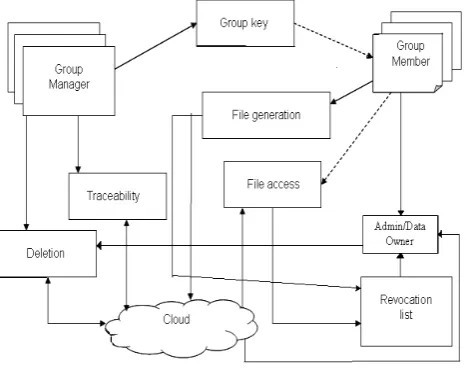
In this section, we describe the main design goals of the proposed scheme with architectural view as in fig.2 including access control, data confidentiality, anonymity and traceability, and efficiency as follows:
Access Control: The requirement of access control is two fold. First, group members are able to use the cloud resources provided for data operations. Second, unauthorized users can never access the cloud resource any time, and revoked users will be incapable of using the cloud again once they are revoked from group.
Traceability: To tackle the inside attack problem, the group manager should have the ability to reveal the real identities of data owners in case of any disputes.
Anonymity: Anonymity guarantees that group members can access the cloud without revealing their real identity to anyone in group. Although anonymity represents an effective protection for user identity, it also poses a potential inside attack risk to the system. For example, an inside attacker may store and share a malicious information to get benefited.
Efficiency: The efficiency can be defined as follows: Any group member can store and share data files with other group members by the cloud. User revocation can be achieved without involving the remaining users. That means, the remaining users need not update their private keys or re encryption operations. New granted users can learn and use all the content data files stored before his participation without contacting with the data owner but only with the secret key provided by group manager can download or view files in the cloud storage.
Fig.2.System architecture
IV.PROPOSED SCHEME
A. OVERVIEW
To achieve Protected Data Sharing scheme with Multi-Ownership for Non-Static Groups in the Cloud, we expect to combine the group signature and dynamic broadcast encryption techniques. Specially, the group signature scheme enables users to anonymously use the cloud resources, and the dynamic broadcast encryption technique allows data owners to securely share their data files with others including new joining users.
Unfortunately, each user has to compute revocation parameters to protect the confidentiality from the revoked users in the dynamic broadcast encryption scheme, which results in that both the computation overhead of the encryption and the size of the ciphertext increase with the number of revoked users. Thus, the heavy overhead and large ciphertext size may hinder the adoption of the broadcast encryption scheme to capacity-limited users.
To tackle this challenging issue, we let the group manager compute the revocation parameters and make the result public available by migrating them into the cloud.
Such a design can significantly reduce the computation overhead of users to encrypt files and the ciphertext size. Specially, the computation overhead of users for encryption operations and the ciphertext size is constant and independent of the revocation users.
B. SCHEME DESCRIPTION
This section describes the details of the system proposed including system initialization, user registration, user revocation, file generation, file deletion, file access and traceability.
System initialization
The group manager takes charge of system initialization as follows:
Generating a bilinear map group system.
Selecting two random elements along with two random numbers, and computing U and V In addition, the group manager computes H1 and H2.
Randomly choosing two elements P,GG1 and
number Z*q.
Publishing the system parameters including
(S,P,H,H0,H1,H2,U,V,W,Y,Z,f,f1,Enc()), where f is
one-way hash function; f1 is hash function and
Enc() is a secure symmetric encryption algorithm with secret key k.
User Registration
For the registration of user i with identity IDi, the group manager randomly selects a number xi Z*
q and computes Ai, Bi as the following equation: Ai=1/(+xi)PG1 (1)
Bi=xi/(+xi)GG1
Then, the group manager adds (Ai, xi, IDi) into the group
user list, which will be used in the traceability phase. After the registration, user i obtains a private key (xi, Ai, Bi),
which will be used for group signature generation and file decryption.
User Revocation
User revocation is performed by the group manager via a public available revocation list (RL), based on which group members can encrypt their data files and ensure the confidentiality against the revoked users. As illustrated in Table 1, the revocation list is characterized by a series of time stamps (t1 < t2 <,…,tr). Let IDgroup denote the group
identity. P1,P2 ,…,Pr and Zr are calculated by the group
manager with the private secret as follows: P1=1/(+x1)PG1 (2)
P2=1/(+x1) (+x2)PG1
Pr=1/ (+x1)(+x2)(+xr)PG1
Zr=1/(+x1)(+x2)(+xr)PG2.
Motivated by the verifiable reply mechanism in, to guarantee that users obtain the latest version of the revocation list, we let the group manger update the revocation list each day even no user has being revoked in the day. In other words, the others can verify the freshness of the revocation list from the contained current date tRL. In
addition, the revocation list is bounded by a signature sig(RL) to declare its validity. The signature is generated by the group manager with the BLS signature algorithm. Finally, the group manager migrates the revocation list into the cloud for public usage.
File Generation
To store and share a data file in the cloud, a group member performs the following operations:
1. Getting the revocation list from the cloud. In this step, the member sends the group identity IDgroup as a
request to the cloud. Then, the cloud responds the revocation list RL to the member.
2. Verifying the validity of the received revocation list. First, checking whether the marked date is fresh. Second, verifying the contained signature sig(RL). If the revocation list is invalid, the data owner stops this scheme.
3. Encrypting the data file M. This encryption process can be divided into two cases according to the revocation list.
Case 1. There is no revoked user in the revocation list.
Case 2. There are r revoked users in the revocation list.
4. Selecting a random number T and computing f(T). The hash value will be used for data file deletion operation.
5. Constructing the uploaded data file as shown in table 2.
Uploading the data shown in Table 2 into the cloud server and adding the IDdata into the local shared data list
maintained by the manager. On receiving the data, the cloud first invokes Algorithm 2 to check its validity. If the algorithm returns true, the group signature is valid; otherwise, the cloud abandons the data. In addition, if several users have been revoked by the group manager, the cloud also performs revocation verification by using Algorithm 3.
TABLE 2. MESSAGE FORMAT FOR UPLOADING DATA
Group
ID
Data
ID
Ciphertext Hash Time Signature
IDgroup IDdata C1,C2,C f() tdata
Finally, the data file will be stored in the cloud after successful group signature and revocation verifications
.
File DeletionFile stored in the cloud can be deleted by either the group manager or the data owner (i.e., the member who uploaded the file into the server). To delete a file IDdata, the
group manager computes a signature f1(IDdata) and sends the
signature along with IDdata to the cloud. The cloud will delete
the file if the equation e(f1(IDdata),P)=e(W,f1(IDdata)) holds. Algorithm (1). Signature generation
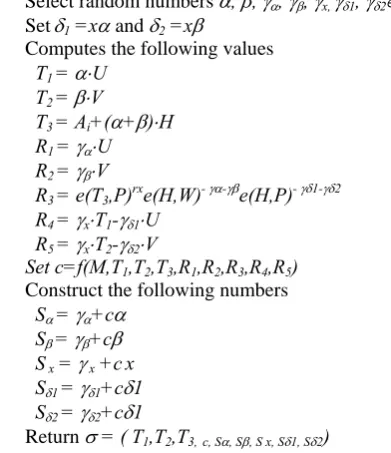
Input: private key (A, x), system parameter (P, U, V, H, W) and data M.
Output: generate a valid group signature on M. Begin
Select random numbers , , , , x, 1, 2Z*q
Set1 =x and 2 =x
Computes the following values T1 = U
T2 = V
T3 = Ai+(+)H R1 = U
R2 = V
R3 = e(T3,P)rxe(H,W)- -e(H,P)- 1-2 R4 = xT1-1U
R5 = xT2-2V
Set c=f(M,T1,T2,T3,R1,R2,R3,R4,R5)
Construct the following numbers S= +c
S= +c
S x = x +cx S1 = 1+c1 S2 = 2+c1
Return = ( T1,T2,T3,c, S, S, S x, S1, S2)
End
Algorithm (2). Signature Verification
Input: system parameter (P, U, V, H, W), M and a
signature = (T1, T2, T3,c, S, S, S x, S1, S2)
Output: True or False. Begin
Compute the following values R1=sUcT1
R2=sUcT2
R3=(e(T3,W)/e(P,P))c e(T3,P) sx e(H,W) s s1 e(H,P) s1 s2
R4=sxT1s1U
R5= sxT2s2V
If c=f(M,T1,T2,T3,R1,R2,R3,R4,R5)
Return True Else
Return False End
Algorithm (3). Revocation Verification
Input: system parameter (H0, H1, H2), a group signature, and a set of revocation keys A1,…,A
Output: Valid or Invalid. Begin
Set temp=e(T1,H1)e(T2,H2)
For i=1 to n
If e(T3-Ai, H0)=temp
Return Valid End if
In addition, proposed system also allows data owners to delete their files stored in the cloud.
File Access
To learn the content of a shared file, a member does the following actions:
1. Getting the data file and the details of revocation list from the cloud server.
2. Checking the validity of the revocation list. This operation is similar to the step 2 of file generation phase. 3. Validity verification of the file and decrypting it. The format of the downloaded file coincides with that given in Table 2. The operation can be divided further into three cases according to time stamp tdata and revocation
list details. If there are r revoked users in the list. Case 1(tdata<t1): There is no revoked user before the file is
uploaded.
Invoke algorithm 2 to check the group signature . If algorithm returns false, user will stop this protocol.
Using his Partial private key (A,B) to compute
=e(C1,A)e(C2,B).
Decrypting ciphertext C with the computed key .
Case 2(ti<tdata<ti+1): Indicates that i revoked users have been
revoked before the data file is been uploaded to the storage.
Verifying group signature by algorithm 2.
Input A1, A2,…Ai to call algorithm 3. If it returns
invalid, user terminates this operation.
Computes value Ai,r by using algorithm 4 with
input (A,x),(P1,x1),…,(Pi,xi).
Calculating the decryption key
=e(C1,Ai,r)e(C2,B).
Decrypt the ciphertext C with key .
Case 3(tr<tdata): Indicates that r revoked users have been
revoked before data file is been uploaded.
Verifying group signature by algorithm 2.
Input A1, A2,…Ai to call algorithm 3. If it returns
invalid, user terminates this operation.
Computes value Ar,r by using algorithm 4 with
input (A,x),(P1,x1),…,(Pr,xr).
Calculating the decryption key
=e(C1,Ar,r)e(C2,B).
Decrypt the ciphertext C with key .
Traceability
When a data dispute occurs, the tracing operation is performed by the group manager to identify the real identity of the data owner. Given a signature, the group manager employs his private key to compute Ai. Given the parameter
Ai, the group manager can look up the user list to find the corresponding identity.
Algorithm (4). Parameters Computing
Input: The revoked user parameters (P1,x1),…,(P, x), and
the private key (A,x).
Output: A, or NULL Begin
Set temp=A
For =1 to
If x=x
return NULL else
set temp=1/(x-x)*(P-temp)
return temp end
By the analysis above, we conclude that the proposed scheme Protected Data Sharing scheme with Multi-Ownership for Non Static Groups in the Cloud achieves the security goals including access control, data confidentiality as well as anonymity and traceability.
V. PROPOSED SCHEME
In this section, we first analyse the storage cost of proposed scheme, without loss of generality, we set q=160 and the elements in G1 and G2 to be 161 and 1,024 bit, respectively. In addition, we assume the size of the data identity is 16 bits, which yield a group capacity of 216 data files. Similarly, the size of user and group identity are also set as 16 bits.
Group manager: In Proposed scheme, the master private key of the group manager is (G, , 1, 2)G1Zq3
Additionally, the user list and the shared data list should be stored at the group manager. Considering an actual system with 200 users and assuming that each user share 50 files in average, the total storage of the group manager is (80.125+42.125*200+ 2*10000)*10-328.5 Kbytes, which is very acceptable.
Group members: Essentially, each user in our scheme only needs to store its private key (Ai, Bi, xi)G12+Zq, which is
about 60 bytes. It is worth noting that there is a tradeoff between the storage and the computation overhead.
The extra storage overhead in the cloud: In Proposed
scheme, the format of files stored in the cloud is shown in Table 2. Since C3 is the ciphertext of the file under the
symmetrical encryption, the extra storage overhead to store the file is about 248 bytes.
VI.SIMULATION METHODOLOGY
VII. CONCLUSION
In this paper, we design A Protected Data Sharing scheme with Multi-Ownership for Non Static Groups in the Cloud. In this system, a user is able to share data with others in the group without revealing identity privacy to the cloud. Additionally, it supports efficient user revocation and new user joining. More specially, efficient user revocation can be achieved through a public revocation list without updating the private keys of the remaining users, and new users can directly decrypt files stored in the cloud before their participation. Moreover, the storage overhead and the encryption computation cost are constant satisfying the desired security requirements and guarantees efficiency as well.
REFERENCES
[1] M. Armbrust, A. Fox, R. Griffith, A.D. Joseph, R.H. Katz, A. Konwinski, G. Lee, D.A. Patterson, A. Rabkin,
I. Stoica, and M. Zaharia, “A View of Cloud
Computing,” Comm. ACM, vol. 53, no. 4, pp. 50-58, Apr. 2010.
[2] S. Kamara and K. Lauter, “Cryptographic Cloud
Storage,” Proc. Int’l Conf. Financial Cryptography and Data Security (FC), pp. 136-149, Jan. 2010.
[3] S. Yu, C. Wang, K. Ren, and W. Lou, “Achieving Secure, Scalable, and Fine-Grained Data Access Control in Cloud Computing,” Proc. IEEE INFOCOM, pp. 534-542, 2010.
[4] M. Kallahalla, E. Riedel, R. Swaminathan, Q. Wang, and K. Fu, “Plutus: Scalable Secure File Sharing on Untrusted Storage,” Proc. USENIX Conf. File and Storage Technologies, pp. 29-42, 2003.
[5] E. Goh, H. Shacham, N. Modadugu, and D. Boneh, “Sirius: Securing Remote Untrusted Storage,” Proc. Network and Distributed Systems Security Symp. (NDSS), pp. 131-145, 2003.
[6] G. Ateniese, K. Fu, M. Green, and S. Hohenberger,
“Improved Proxy Re-Encryption Schemes with
Applications to Secure Distributed Storage,” Proc. Network and Distributed Systems Security Symp. (NDSS), pp. 29-43, 2005.
[7] R. Lu, X. Lin, X. Liang, and X. Shen, “Secure Provenance: The Essential of Bread and Butter of Data Forensics in Cloud Computing,” Proc. ACM Symp. Information, Computer and Comm. Security, pp. 282-292, 2010.
[8] B. Waters, “Ciphertext-Policy Attribute-Based
Encryption: An Expressive, Efficient, and Provably Secure Realization,” Proc. Int’l Conf. Practice and Theory in Public Key Cryptography Conf. Public Key Cryptography, http://eprint.iacr.org/2008/290.pdf, 2008.
[9] V. Goyal, O. Pandey, A. Sahai, and B. Waters, “Attribute-Based Encryption for Fine-Grained Access
Control of Encrypted Data,” Proc. ACM Conf.
Computer and Comm. Security (CCS), pp. 89-98, 2006. [10] D. Naor, M. Naor, and J.B. Lotspiech, “Revocation and
Tracing Schemes for Stateless Receivers,” Proc. Ann. Int’l Cryptology Conf. Advances in Cryptology (CRYPTO), pp. 41-62, 2001.
[11] D. Boneh and M. Franklin, “Identity-Based Encryption from the Weil Pairing,” Proc. Int’l Cryptology Conf. Advances in Cryptology (CRYPTO), pp. 213-229, 2001. [12] D. Boneh, X. Boyen, and H. Shacham, “Short Group
Signature,” Proc. Int’l Cryptology Conf. Advances in Cryptology (CRYPTO), pp. 41-55, 2004.
[13] D. Boneh, X. Boyen, and E. Goh, “Hierarchical Identity Based Encryption with Constant Size Ciphertext,” Proc. Ann. Int’l Conf. Theory and Applications of Cryptographic Techniques (EUROCRYPT), pp. 440-456, 2005.
[14] C. Delerablee, P. Paillier, and D. Pointcheval, “Fully Collusion Secure Dynamic Broadcast Encryption with Constant-Size Ci-phertexts or Decryption Keys,” Proc. First Int’l Conf. Pairing-Based Cryptography, pp. 39-59, 2007.