Highly-Parallel Montgomery Multiplication
for Multi-core General-Purpose Microprocessors
Selçuk Baktr1 and Erkay Sava³2
1 Bahçe³ehir University
Department of Computer Engineering Istanbul, Turkey
2 SabancUniversity
Faculty of Engineering & Natural Sciences Istanbul, Turkey
Abstract. Popular public key algorithms such as RSA and Die-Hellman key exchange, and more advanced cryptographic schemes such as Pail-lier's and Damgård-Jurik's algorithms (with applications in private in-formation retrieval), require ecient modular multiplication with large integers of size at least1024bits. Montgomery multiplication algorithm
has proven successful for modular multiplication of large integers. While general purpose multi-core processors have become the mainstream on desktop as well as portable computers, utilization of their computing re-sources have been largely overlooked when it comes to performing com-putationally intensive cryptographic operations. In this work, we propose a new parallel Montgomery multiplication algorithm which exhibits up to
39%better performance than the known best serial Montgomery
mul-tiplication variant for the bit-lengths of 2048 or larger. Furthermore,
for bit-lengths of4096or larger, the proposed algorithm exhibits better
performance utilizing multiple cores available. It achieves speedups of up to81%,3.37times and4.87times for the used general-purpose
micro-processors with2,4and6cores, respectively. To our knowledge, this is
the rst work that shows with actual implementation results that Mont-gomery multiplication can be practically parallelized on general-purpose multi-core processors.
Key Words: Montgomery multiplication, RSA, multi-core architectures, general-purpose microprocessors, parallel algorithms.
1 Introduction & Motivation
Developing faster multiplication algorithms for larger numbers becomes the focal point of many research activities due to the ever increasing need for higher security levels. Emergence of multi-core processors on common desktop, notebook and server computers with no additional cost proclaim both the research opportunity and motivation for developing parallel al-gorithms for cryptographic applications.
Paillier encryption scheme [12], based on a setting similar to RSA, provides one of the most ecient and practical homomorphic encryp-tion algorithms. Due to the fact that Paillier encrypencryp-tion scheme leads to message expansion after encryption Damgård and Jurik [3] generalize the algorithm for applications that require multiple encryption such as computationally-private information retrieval (CPIR) [10] and multi-hop homomorphic encryption scheme that encrypts already encrypted mes-sages introduced in the scenario given in [6]. Especially in CPIR [10], for instance, the binary tree which aims to privately extract one data item out of a total of 256 eventually leads to a modular multiplication where the modulus size is8192-bit for80-bit security. For 128-bit security level,
we have to perform multiplication operations with numbers as large as
24576-bit3 for the same application.
Multi-core processors can be eectively put into use in executing par-allelized multiplication operations of large numbers for accelerating afore-mentioned cryptographic applications. So far, the research on the subject has been focused on multi-core architectures [15], specically built for multiplication operations of moderate size such as 1024 or 2048 bits, since inter-core communication dominates the overall computation in general-purpose multi-core processors for these bit lengths. However, we nd out that this tendency starts changing for bit sizes of 2048-bit and higher if an ecient parallel multiplication algorithm is used.
Our Main Contributions:
We present for the rst time a practical parallel Montgomery multi-plication algorithm [11] for general-purpose multi-core processors and present ecient implementation results.
As in the case of single-core or hardware implementations, we show that the Montgomery multiplication algorithm turns out to render very ecient implementations on general-purpose multi-core processors due to its inherent parallelism. Our Montgomery multiplication algorithm 3 Recommendation for Key Management, Special Publication 800-57 Part 1 Rev. 3,
demonstrates up to 39% better timing performance than the most
common Montgomery multiplication algorithm in single-core software implementations for operand sizes of2048-bit and larger.
We analyze the timing performance of our algorithm on multi-core im-plementations on general-purpose core processors. Using multi-core processors with2,4and6cores, for operand sizes of4096-bit and
larger, we obtained speedups of up to81%,3.37times and4.87times,
respectively, compared with the most commonly used Montgomery multiplication algorithm.
2 Mathematical Background
2.1 Montgomery Multiplication
In many cryptographic algorithms, a chain of multiplication operations need to be performed at a time. The RSA algorithm [14] and the Die-Hellman key exchange scheme [4], and more recently the generalization of Paillier's probabilistic public-key scheme (with applications in private information retrieval) [3], require computing a sequence of modular multi-plications of large integer operands, e.g. at least1024bits in length. Hence,
ecient implementation of modular multiplication is crucial. For instance, in the RSA algorithm, an exponentiation is computed by a chain of modular multiplication and squaring operations [14]. Modular multiplica-tion/squaring is normally achieved by an integer multiplicamultiplica-tion/squaring followed by a modular reduction by a predened modulus.
In algorithms such as RSA, where the predened modulus is a random number, the required modular reduction of the result of an integer mul-tiplication is more costly than the mulmul-tiplication itself. The Montgomery residue representation and the resulting Montgomery multiplication algo-rithm have proven useful in reducing this complexity [11, 9]. In this repre-sentation, modular reductions are partially avoided and thus the overall computation is simplied.
In Montgomery multiplication, rstly the operands are converted to their respective Montgomery residue representations, then the desired se-quence of operations are performed using Montgomery multiplication, and nally the result is converted back to the normal integer representation. The Montgomery multiplication algorithm, given with Algorithm 1, com-putesA·B·2−mfor the input operandsAandBwhich are the Montgomery
residue representations of the two integersXandY such thatA=X·2m
intact, i.e., A·B ·2−m ≡ (X·Y)·2m (modn) which allows for further
computations avoiding extra operations.
Algorithm 1 explains the general Montgomery multiplication rithm. A detailed analysis of dierent Montgomery multiplication algo-rithms can be found in [1]. Among these Montgomery multiplication al-gorithms, the Coarsely Integrated Operand Scanning (CIOS) Method is considered the fastest one in most processor platforms and described in Section 2.2.
Algorithm 1 Montgomery multiplication
Input: A, B∈Znwherenis an odd integer,n′=−n−1mod 2mwherem=⌈log2n⌉.
Output: A·B·2−mmodn.
1: t←A·B
2: t←(t+ (t·n′mod 2m)·n)/2m
3: if t≥nthen
4: Returnt−n
5: else 6: Returnt
7: end if
2.2 Coarsely Integrated Operand Scanning (CIOS) Method for Montgomery Multiplication
Algorithm 2 CIOS method for Montgomery multiplication
Input: A, B ∈ Zn where n is an odd integer, n′ = −n−1mod 2s.w where w is the
processor word size ands=⌈⌈log2n⌉/w⌉.
Output: A·B·2−s·wmodn.
1: fori= 0→s−1do
2: C←0
3: forj= 0→s−1do
4: (C, S)←tj+aj·bi+C
5: tj←S
6: end for 7: ts←S
8: ts+1←C
9: C←0
10: m←t0·n′0mod 2w
11: (C, S)←t0+m·n0
12: forj= 1→s−1do
13: (C, S)←tj+m·nj+C
14: tj−1←S
15: end for 16: (C, S)←ts+C
17: ts−1←S
18: ts←ts+1+C
19: end for
20: if [ts ts−1 ts−1· · ·t0]2w ≥nthen
21: Return[ts ts−1 ts−1· · ·t0]2w−n
22: else
23: Return[ts−1 ts−1· · ·t0]2w
24: end if
All the Montgomery multiplication algorithms listed in [1], including the CIOS method, are word-based, inherently serial algorithms and do not allow parallelization in software realizations on general-purpose pro-cessors. In this work, we investigate the parallelization of Montgomery multiplication on general-purpose multi-core processors.
3 General-Purpose Multi-Core Architectures and Parallel Programming
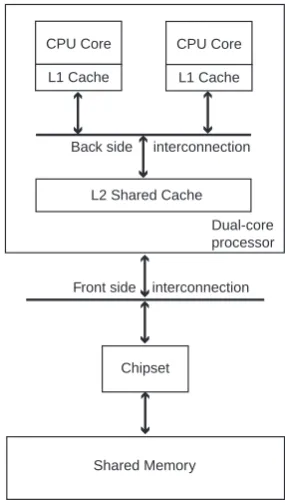
desktop computers or workstations but also almost all notebook comput-ers and even some smart phones are shipped with multi-core processors. In the foreseeable future, this trend will continue with ever increasing mo-mentum and we will see many-core processors that feature tens of cores of identical general-purpose and/or dierent specialized architectures.
CPU Core
L1 Cache
CPU Core
L1 Cache
L2 Shared Cache Back side interconnection
Dual-core processor
Front side interconnection
Shared Memory Chipset
Fig. 1. Architecture of a dual-core general-purpose processor.
cores are independent. However, L1 caches are synchronized through con-sistency protocols [13], which are implemented in hardware and therefore transparent to application developer, when cores require each other's data or need to process the same shared data. An ecient parallel program tries to minimize the number of synchronization points allowing cores to work independently for durations as long as possible.
OpenMP (Open Multi-Processing)4provides the necessary application
programming interface (API) for parallel programming in shared mem-ory multi-processor systems. It features many library routines, compiler directives, and environment variables to support multi-threaded applica-tion development, whereby threads can be scheduled on individual cores by the developer. OpenMP API can be protably utilized to accelerate cryptographic operation on multi-core processors. In this work, we utilize OpenMP for the parallel implementation of our proposed Montgomery multiplication algorithm.
4 Montgomery Multiplication Utilizing Multi Cores
All algorithms commonly proposed for Montgomery multiplication are word based algorithms, which perform the required partial product com-putations and modular reductions interleaved together and on a word by word basis, yielding the serial nature of these algorithms. In order to par-allelize Montgomery multiplication, for two and three core architectures, bipartite [7, 8] and tripartite [16] Montgomery multiplication algorithms, respectively, were proposed. In [15, 2, 5], specialized multi-core hardware architectures are proposed for parallel implementation of the Montgomery multiplication algorithm. However these algorithms are intended for hard-ware based implementations and not targeted for general purpose micro-processors. In [2], the authors give a theoretical analysis of possible paral-lelizations of the SOS version of Montgomery multiplication given in [1], and implementation results on prototype multi-core systems using soft-core processors on FPGA devices. The proposed design in [2] utilizes fast communication between the utilized softcores and local memories both of which are specically tailored to the proposed parallel implementation of the Montgomery multiplication algorithm. Therefore, their approach rep-resents a hybrid architecture that takes advantage of both software and hardware. In this section, we propose a novel parallel Montgomery multi-plication algorithm which is specically designed for software realizations
4 OpenMP Tutorial at Supercomputing 2008,
and thus is suitable for general-purpose microprocessors. For our parallel Montgomery multiplication algorithm, we exploit the inherent parallelism in integer multiplication.
4.1 Inherent Parallelism in Integer Multiplication
Remember the integer multiplication operation shown in Figure 2. As shown in Figure 2, integer multiplication has an inherent parallelism which could be exploited by running the multiple cores available on a processor in parallel. Note in Figure 2 that the partial products required for integer multiplication can be computed in parallel and then accumulated to give us the actual product.
Fig. 2. Inherent parallelism in the integer multiplicationA×B. Note thatA can be
represented as[as−1as−2 · · · a0]in base2
⌈log2A
s
⌉
.
We give the following algorithm for parallel integer multiplication on general-purpose multi-core processors.
4.2 Parallel Montgomery Multiplication
We adapt the inherent parallelism of Algorithm 3 to the original Mont-gomery multiplication algorithm given with Algorithm 1 for application on multi-core processors. The resulting parallel Montgomery multiplication algorithm is given with Algorithm 4 below.
Algorithm 3 Parallel Integer Multiplication
Input: IntegersA= [as−1 as−2 · · · a0]dand B of sizem=d·s bits wheresis the
number of cores available.
Output: ParallelMultiply(A, B) =A·B .
1: fori= 0tos−1do
2: ti←ai·B·2i·d{performed at corei+ 1in a multi-core implementation}
3: end for
4: fori= 1tos−1do
5: t0←t0+ti
6: end for 7: Return (t0)
Algorithm 4 Parallel Montgomery multiplication
Input: A, B ∈ Zn where n is an odd integer and n′ = −n−1mod 2m where m =
⌈log2n⌉.
Output: A·B·2−mmodn.
1: t←ParallelMultiply(A, B) {Algorithm 3}
2: u←ParallelMultiply(t, n′) mod 2m {Algorithm 3}
3: u←ParallelMultiply(u, n) {Algorithm 3}
4: u←(u+t)/2m
5: if u≥nthen
6: Return (u−n)
7: else
8: Return (u)
partial product accumulation can be achieved in a binary tree fashion, as shown below, with at most ⌈log2s⌉ steps wheres is the number of cores
available.
for i= 1 to log2s
for j = 0 to 2si −1
tj ←tj+tj+s
2i
end for end for
In the above setting, all the cores are exploited as evenly as possible with the maximal utilization which would result in the minimal latency. How-ever, this optimal chain of additions would not always be possible. In the rest of this section, we provide some addition chains for ecient imple-mentations of Algorithm 4 on processors with2,4and6cores as examples.
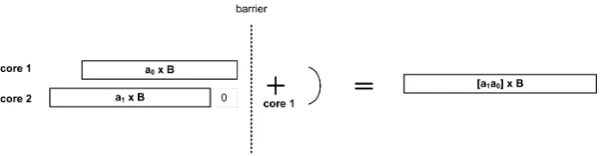
Partial Product Accumulation on a 2-Core Processor:
For performing the integer multiplicationA×Bon2cores, the operandA
is divided into two equal parts as [a1 a0]in base 2
⌈
log2A
2
⌉
and the partial products a0 ×B and a1 ×B are computed simultaneously on separate
cores. Finally, these partial products are accumulated as given below.
Fig. 3. Computation and accumulation of the partial products for the integer multi-plicationA×B on2cores. Note that Ais divided into two equal parts and denoted
as[a1 a0]in base2
⌈log2A
2
⌉
.
Partial Product Accumulation on a 4-Core Processor:
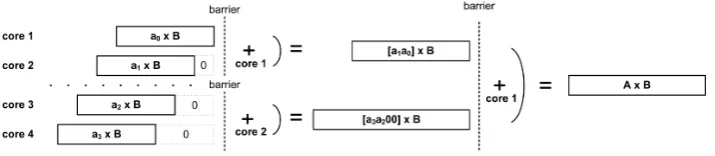
On a 4-core processor, for performing the integer multiplication A×B,
2
⌈
log2A
4
⌉
and the partial productsa0×B,a1×B,a2×B anda3×B are
computed simultaneously on separate cores. Finally, these partial prod-ucts are accumulated with the optimal addition chain given below.
Fig. 4. Computation and accumulation of the partial products for the integer multipli-cationA×Bwith4cores.Ais divided into four equal parts and denoted as[a3a2a1a0]
in base2 ⌈log2A
4
⌉
.
Partial Product Accumulation on a 6-Core Processor:
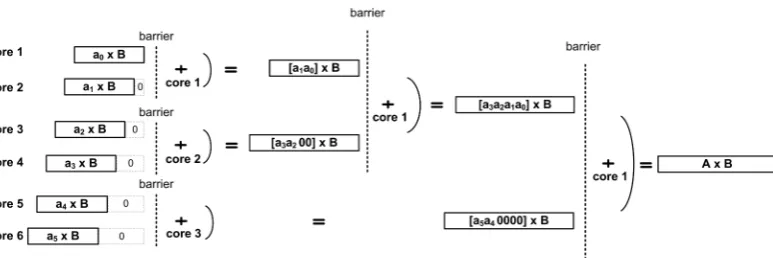
On6-core processor, for performing the integer multiplication A×B, the
operand A is divided into six equal parts as [a5 a4 a3 a2 a1 a0] in base 2
⌈log2A
6
⌉
and the partial productsa0×B,a1×B,a2×B,a3×B,a4×B
anda5×B are computed simultaneously on separate cores. Finally, these
Fig. 5. Partial product computation and accumulation of the partial products for the integer multiplicationA×Bwith6cores.Ais divided into six equal parts and denoted
as[a5 a4 a3a2 a1 a0]in base2
⌈log2A
6
⌉
.
5 Timing Performance
We implemented our algorithm for the operand sizes of 1024,2048,4096, 8192,16384and32768bits on general-purpose multi-core processors using
OpenMP and obtained the timings. We used 2, 4 and 6 core
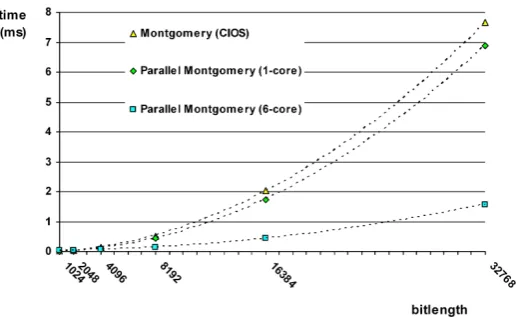
general-purpose processors for our implementations and made use of the ecient addition chains given with Figures 3, 4 and 5, respectively. The timing graphs for the implementation of our proposed Montgomery multiplication algorithm, as well as the CIOS method, on2,4and6core general-purpose
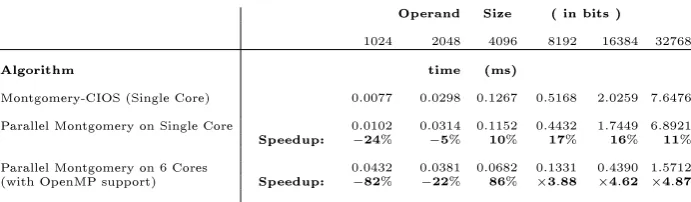
processors can be seen in Figures 6, 7 and 8, respectively. Detailed timings and achieved speedups (compared to the CIOS method) can be found in Tables 1, 2 and 3 (in Appendix).
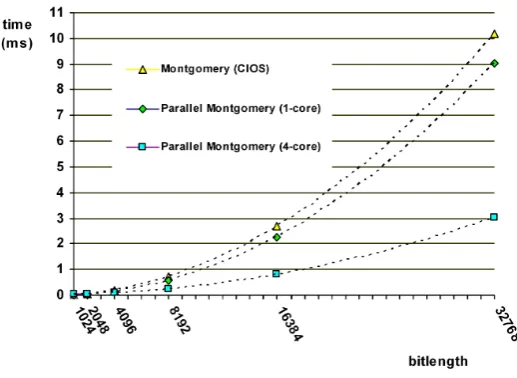
We observe in Figures 3, 4 and 5 that our algorithm performs signi-cantly better than the CIOS method, and furthermore eciently utilizes multiple cores for improved performance, for growing operand sizes. As seen in Tables 1, 2 and 3, it achieves up to 81%, 3.37 times and 4.87
times speedups for the used general-purpose microprocessors with 2, 4
and 6 cores, respectively. For the operand sizes of 2048 bit and smaller,
the multi-core performance of our algorithm is worse than its single-core performance due to the overhead from using the OpenMP library.
On the 2 and 4 core processors, the single-core performance of our
algorithm is better than the CIOS method for operand sizes of 2048 bit
and larger (see Tables 1 and 2 in Appendix). Whereas, on the 6 core
Fig. 6. Timings for the CIOS and Parallel Montgomery multiplication algorithms on the 2-core Intel Dual-Core Pentium E6500 processor running at2.93 GHz and with 2.96GB of RAM.
Fig. 7. Timings for the CIOS and Parallel Montgomery multiplication algorithms on the4-core Intel Core 2Quad processor Q8300running at 2.5GHz and with4GB of
Fig. 8. Timings for the CIOS and Parallel Montgomery multiplication algorithms on the6-core Intel Xeon W3670processor running at3.2GHz and with8GB RAM.
This discrepancy is most possibly due to the fact that the addition chains used for the partial product accumulations on 2 and 4 core processors
(given in Figures 3 and 4, respectively) are optimal whereas the one used for the6-core processor (as given in Figure 5) is not optimal. On the used 2,4and6core general-purpose processors, the single-core performance of
our algorithm is up to 39%,26%and 17%better, respectively, compared
to the CIOS method.
6 Conclusion
In this work, we presented for the rst time an ecient parallel Mont-gomery multiplication algorithm for software implementations on general-purpose multi-core processors. Our algorithm exhibits good timing per-formance in both single-core and multi-core implementations. We identify the utilization of our algorithm for ecient implementation of classical cryptographic schemes such as RSA and Die-Hellman, as well as more advanced schemes such the Damgård-Jurik's algorithm, as future work.
References
2. Zhimin Chen and Patrick Schaumont. A parallel implementation of montgomery multiplication on multicore systems: Algorithm, analysis, and prototype. IEEE Trans. Comput., 60:16921703, December 2011.
3. Ivan Damgård and Mats Jurik. A generalisation, a simplication and some appli-cations of paillier's probabilistic public-key system. In Proceedings of the 4th In-ternational Workshop on Practice and Theory in Public Key Cryptography: Public Key Cryptography, PKC '01, pages 119136, London, UK, 2001. Springer-Verlag. 4. W. Die and M. E. Hellman. New Directions in Cryptography. IEEE Transactions
on Information Theory, IT-22:644654, 1976.
5. Junfeng Fan, Kazuo Sakiyama, and Ingrid Verbauwhede. Montgomery modular multiplication algorithm on multi-core systems. 2007 IEEE Workshop on Signal Processing Systems, 10:261266, 2007.
6. Craig Gentry, Shai Halevi, and Vinod Vaikuntanathan. i-hop homomorphic en-cryption and rerandomizable yao circuits. In Tal Rabin, editor, CRYPTO, volume 6223 of Lecture Notes in Computer Science, pages 155172. Springer, 2010. 7. Marcelo E. Kaihara and Naofumi Takagi. Bipartite modular multiplication. In
Pro-ceedings of Cryptographic Hardware and Embedded Systems - CHES 2005, number 3659 in Lecture notes in Computer Science, pages 201210. Springer-Verlag, 2005. 8. Marcelo E. Kaihara and Naofumi Takagi. Bipartite modular multiplication
method. IEEE Transactions on Computers, 57(2):157164, 2008.
9. Ç. K Koç and T. Acar. Montgomery Multplication inGF(2k). Design, Codes, and
Cryptography, 14(1):5769, 1998.
10. Helger Lipmaa. First CPIR protocol with data-dependent computation. In Proceed-ings of the 12th international conference on Information security and cryptology, ICISC'09, pages 193210, Berlin, Heidelberg, 2010. Springer-Verlag.
11. P. L. Montgomery. Modular Multiplication without Trial Division. Mathematics of Computation, 44(170):519521, April 1985.
12. Pascal Paillier. Public-key cryptosystems based on composite degree residuosity classes. In IN ADVANCES IN CRYPTOLOGY - EUROCRYPT 1999, pages 223 238. Springer-Verlag, 1999.
13. David A. Patterson and John L. Hennessy. Computer Organization and Design: The Hardware / Software Interface. Morgan Kaufmann, Elsevier,4thedition, 2012.
(Revised printing).
14. R. L. Rivest, A. Shamir, and L. Adleman. A Method for Obtaining Digital Sig-natures and Public-Key Cryptosystems. Communications of the ACM, 21(2):120 126, February 1978.
15. Kazuo Sakiyama, Lejla Batina, Bart Preneel, and Ingrid Verbauwhede. Multi-core Curve-Based Cryptoprocessor with Recongurable Modular Arithmetic Logic Units overGF(2n). IEEE Transactions on Computers, 56:12691282, 2007.
16. Kazuo Sakiyama, Miroslav Knezevic, Junfeng Fan, Bart Preneel, and Ingrid Ver-bauwhede. Tripartite modular multiplication. Integration, 44(4):259269, 2011.
Operand Size ( in bits )
1024 2048 4096 8192 16384 32768
Algorithm time (ms)
Montgomery-CIOS (Single Core) 0.0091 0.0341 0.1488 0.6564 2.3043 8.7010
Parallel Montgomery on Single Core 0.0121 0.0321 0.1222 0.4708 1.8675 7.4530
Speedup: −25% 6% 22% 39% 23% 17%
Parallel Montgomery on2Cores 0.0372 0.0635 0.1227 0.3620 1.2953 5.0640
(with OpenMP support) Speedup: −75% −46% 21% 81% 78% 72%
Table 1. Timings (in ms) for the CIOS and Parallel Montgomery multiplication algorithms on the2-core
Intel Dual-Core Pentium E6500processor running at2.93GHz and with2.96GB of RAM.
Operand Size ( in bits )
1024 2048 4096 8192 16384 32768
Algorithm time (ms)
Montgomery-CIOS (Single Core) 0.0103 0.0402 0.1692 0.7321 2.6929 10.1625
Parallel Montgomery on Single Core 0.0111 0.0382 0.1499 0.5835 2.2798 9.0456
Speedup: −7% 5% 13% 26% 18% 12%
Parallel Montgomery on4Cores 0.0448 0.0554 0.0866 0.2394 0.8044 3.0140
(with OpenMP support) Speedup: −77% −27% 95% ×3.06 ×3.35 ×3.37
Table 2. Timings (in ms) for the CIOS and Parallel Montgomery multiplication algorithms on the4-core Intel Core2Quad Processor Q8300running at2.5GHz and with4GB of RAM.
Operand Size ( in bits )
1024 2048 4096 8192 16384 32768
Algorithm time (ms)
Montgomery-CIOS (Single Core) 0.0077 0.0298 0.1267 0.5168 2.0259 7.6476
Parallel Montgomery on Single Core 0.0102 0.0314 0.1152 0.4432 1.7449 6.8921
Speedup: −24% −5% 10% 17% 16% 11%
Parallel Montgomery on6Cores 0.0432 0.0381 0.0682 0.1331 0.4390 1.5712
(with OpenMP support) Speedup: −82% −22% 86% ×3.88 ×4.62 ×4.87
Table 3. Timings for CIOS and Parallel Montgomery multiplication algorithms on a6-core Intel Xeon W3670
![Fig. 2. Inherent parallelism in the integer multiplication A × B. Note that A can berepresented as [as−1 as−2 · · · a0] in base 2⌈ log2 As⌉.](https://thumb-us.123doks.com/thumbv2/123dok_us/7892794.1309914/8.595.147.471.306.431/fig-inherent-parallelism-integer-multiplication-note-berepresented-base.webp)