Biclique Attack of the Full ARIA-256
Shao-zhen Chen
Tian-min Xu
Zhengzhou Information Science and Technology Institute
Zhengzhou 450002, China
January 8, 2012
Abstract
In this paper, combining the biclique cryptanalysis with the MITM attack, we present the first key recovery method for the full ARIA-256 faster than brute-force. The attack requires 280chosen plaintexts, and the time complexity is about 2255.2 full-round ARIA encryptions in the processing phase.
keywords: Block Cipher; ARIA-256; Biclique structure
1
Introduction
found some 3-round integral distinguishers by counting methods, which also led up to a 6-round integral attack on ARIA-192 [5], recently, Li et al. [6] pre-sented the meet-in-the-middle(MITM) attacks on the round-reduced ARIA, which led to a 8-round attack on ARIA-256. For ARIA-256, the number of cryptanalyzed round did not increase since then.
ARIA with its wide-trail strategy was designed to withstand differen-tial and linear cryptanalysis. ARIA is an involution SPN cipher and has involution substitution and diffusion layers by using operations such as mul-tiplications in a finite field. In the diffusion layer of ARIA, a 16×16 binary matrix of the maximum branch number 8 is used to avoid some attacks well applied to the reduced round of Rijndael.
The basic concept of the MITM attack was proposed by Diffie and Hell-man [7]. So far, this attack has been applied to several block ciphers. Fur-thermore, over the past few years, this attack has been improved in a line of preimage attacks on hash functions and several novel techniques are intro-duced.
Biclique cryptanalysis was first introduced for hash cryptanalysis [8]. An-drey Bogdanov⋆ et al. carried over the concept of the independent bicilique to AES cryptanalysis [9], and constructed a 3 round biclique. Combining the biclique with the MITM attack, they presented the first key recovery method for the full AES-128 faster than brute-force. To construct the independent biclique, we need two independent related-key differentials. When it comes to the ciphers whose diffusion operation is fast, it is difficult to construct the biclique.
Our Contribution:
In this paper, we combine the Biclique cryptanalysis with the MITM attack, and present the first key recovery method for the full ARIA-256 faster than brute-force.
1. Four 128-bit valuesW0,W1, W2,W3 are generated from the master key
MK by using a 3-round 256-bit Feistel cipher. We select those types of differentials ofMK such that the difference ofW1 is 0. Then we can
construct a 2-round biclique for ARIA-256. However, those types of differentials of MK in other versions of ARIA are not exist.
3. The attack on ARIA-256 consists of two parts. Firstly, we construct a 2-round biclique of dimension 8 for ARIA-256. Then, we attack the remaining 14 rounds by using MITM method. By matching only on a single byte, the computation complexity can be reduced. Table 1 gives the comparison between our result and earlier best result.
Table 1 Summary of Attacks on ARIA-256
Rounds Data Complexity Type of attack Paper
8 256 2251.6 MITM Attack [6]
16 280 2255.2 Biclique Key Recovery Attack This paper
This paper is organized as follows. We introduce the biclique key recovery attack in Section 2 and give a brief description of ARIA in Section 3. In Section 4, we present a biclique key recovery attack for the full round ARIA-256. Finally, section 5 summarizes this paper.
2
Biclique Key Recovery Attack
The main idea behind the biclique key recovery attack is based on the biclique structure which can be used to decrease the complexity of the MITM attack. It is apparent to see that the construction of biclique is an important step. The following sections will describe the steps of the biclique key recovery attack.
2.1
Biclique Structure
Now we introduce the notation of a biclique. Letf be a subcipher that maps a plaintext P to the internal stateS: fK(P) =S.
The 3-tuple [{Pi},{Sj},{K[i, j]}] is called ad-dimensional Biclique, if
Sj =fK[i,j](Pi)
2.2
Biclique from Independent Related-Key
Differen-tials
Definition 2.If the trail of a differential do not share active nonlinear compo-nents (such as active S-boxes in ARIA) with the trail of another differential, we call them independent related-key differentials.
Let the keyK[0,0] map plaintextP0 to the internal stateS0, and consider
two sets of 2d related-key differentials each over f with respect to the base computation P0
K[0,0]
−−−→
f S0.
• ▽i-differentials. A differential in the first set maps input difference ▽i to an output difference 0 under key difference ▽K
i :
▽i
▽K
i
−−→
f 0, with▽ K
0 = 0, ▽0 = 0
• △j-differentials. A differential in the second set maps input difference 0 to an output difference △j under key difference △Kj :
0 △
K j
−−→
f △j, with △ K
0 = 0, △0= 0
If▽i-differentials and △j-differentials are independent, then we can con-struct 22d combined differentials:
▽i
▽K
i ⊕△Kj
−−−−−→
f △j, for all i,j ∈ {0, . . . ,2 d−1}
SubstitutingP0,S0, andK[0,0] to the combined differentials, one obtains:
P0⊕ ▽i
K[0,0]⊕▽K
i ⊕△Kj
−−−−−−−−−−→
f S0⊕ △j
Finally, we put:
Pi =P0⊕ ▽i,
Sj =S0⊕ △j,
K[i, j] =K[0,0]⊕ ▽K
i ⊕ △ K j
and get exactly the definition of a d-dimensional biclique.
2.3
Biclique Key Recovery Attack
For each set of keys the adversary builds a structure of 2d plaintexts P i and 2d intermediate states S
j with respect to the set of keys K[i, j] which satisfies the following condition:
Sj =fK[i,j](Pi)
The adversary asks the oracle to encrypt plaintexts Pi under the secret key Ksecret, and obtains the 2d ciphertexts Ci:
Pi oracle
−−−→
e Ci
If the texted keyK[i, j] satisfies the following condition:
Sj K[i,j]
−−−→
e1
−
→v =←−v K[i,j]
←−−−
e2
Ci (1)
We consider it is a key candidate.
2.4
Matching with Precomputations
Here we describe the idea of matching with precomputations. This can be seen as an efficient way of checking equation (1).
Firstly, the adversary computes and stores in memory 2d+1 full
computa-tions
for all j Sj K[0,j]
−−−→ −→v and for all i ←−v ←−−−K[i,0] Ci
Then for particulari,j he recomputes only those parts of state that differ from the stored ones. Hence, he can decrease the computational complexity.
3
Description of ARIA-256
The ARIA-256 block cipher is an involution SPN cipher and have involution substitution and diffusion layers. The diffusion layer uses a 16×16 binary matrix in GF(28). The substitution layer consists of sixteen 8×8 S-boxes.
The 128 bits state can be denoted as 4×4 matrix in GF(28) as shown in
Fig. 1.
0 x 1 x 2 x 3 x 4 x 5 x 6 x 7 x 8 x 9 x 10 x 11 x 12 x 13 x 14 x 15 x
Figure 1: The state of ARIA
1 1 S 2 S 1 2 S 1 S 1 1 S 2 S 1 2 S 1 S 1 1 S 2 S 1 2 S 1 S 1 1 S 2 S 1 2 S 1 S 1 1
S 1 2
S S1 S2 1 1
S 1 2
S S1 S2 1 1
S 1 2
S S1 S2 1 1
S 1 2
S S1 S2
Figure 2: Two types of S-box layer
Substitution layer: nolinear substitution, the Substitution layer con-sists of two types of S-box layers. Type 1 is used in the odd rounds and type 2 is used in the even rounds as shown in Fig. 2.
Diffusion layer: P: GF(28)16→GF(28)16 is given by
(x0, x1, . . . , x15)→(y0, y1, . . . , y15)
where
y0 =x3⊕x4⊕x6⊕x8⊕x9⊕x13⊕x14, y8 =x0⊕x1⊕x4⊕x7⊕x10⊕x13⊕x15,
y1 =x2⊕x5⊕x7⊕x8⊕x9⊕x12⊕x15, y9 =x0⊕x1⊕x5⊕x6⊕x11⊕x12⊕x14,
y2 =x1⊕x4⊕x6⊕x10⊕x11⊕x12⊕x15, y10=x2⊕x3⊕x5⊕x6⊕x8⊕x13⊕x15,
y3 =x0⊕x5⊕x7⊕x10⊕x11⊕x13⊕x14, y11=x2⊕x3⊕x4⊕x7⊕x9⊕x12⊕x14,
y4 =x0⊕x2⊕x5⊕x8⊕x11⊕x14⊕x15, y12=x1⊕x2⊕x6⊕x7⊕x9⊕x11⊕x12,
y5 =x1⊕x3⊕x4⊕x9⊕x10⊕x14⊕x15, y13=x0⊕x3⊕x6⊕x7⊕x8⊕x10⊕x13,
y6 =x0⊕x2⊕x7⊕x9⊕x10⊕x12⊕x13, y14=x0⊕x3⊕x4⊕x5⊕x9⊕x11⊕x14,
y7 =x1⊕x3⊕x6⊕x8⊕x11⊕x12⊕x13, y15=x1⊕x2⊕x4⊕x5⊕x8⊕x10⊕x15,
0 KL 1 KL 2 KL 3 KL 4 KL 5 KL 6 KL 7 KL 8 KL 9 KL 10 KL 11 KL 12 KL 13 KL 14 KL 15 KL 0 KR 1 KR 2 KR 3 KR 4 KR 5 KR 6 KR 7 KR 8 KR 9 KR 10 KR 11 KR 12 KR 13 KR 14 KR 15 KR
Figure 3: MK of ARIA-256
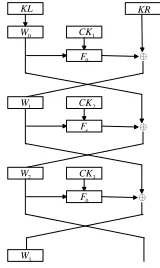
KL KR 0 W 0 F 1 CK 1 W 2 W 3 W 2 CK 3 CK e F 0 F
Figure 4: Initialization part of key schedule
is the state after AK in round 2,. . . , #31 is the state after the first AK in round 16, #32 is the state after the second AK in round 16.
The 256 bites initial keyMK of ARIA-256 can be rearranged as a 4×8 matrix as shown in Fig .3.
The key schedule of ARIA-256 consists of two parts, which are initializa-tion and round key generainitializa-tion as follows:
(1) Initialization
In the initialization part, the master key MK denote as follow: MK =
KLkKR. Four 128-bit valuesW0,W1,W2,W3 are generated from the master
key MK, by using a 3-round 256-bit Feistel cipher.
W0 =KL, W2 =Fe(W1, CK2)⊕W0
W1 =Fo(W0, CK1)⊕KR, W3 =Fo(W2, CK3)⊕W1
The initialization process is given in Fig. 4.
Here, Fo and Fe are even and odd round functions, respectively, The 128-bit keys CKi of the round functions are constants.
Figure 5: Initialization key MK[0,0]
In the generation part, combining the four 18-bits values W0, W1, W2,
W3 to obtain encryption round keys eki as follows:
ek1 = (W0)⊕(W1 >>>19), ek2 = (W1)⊕(W2 >>>19),
ek3 = (W2)⊕(W3 >>>19), ek4 = (W0 >>>19)⊕(W3),
ek5 = (W0)⊕(W1 >>>31), ek6 = (W1)⊕(W2 >>>31),
ek7 = (W2)⊕(W3 >>>31), ek8 = (W0 >>>31)⊕(W3),
ek9 = (W0)⊕(W1 >>>61), ek10 = (W1)⊕(W2 >>>61),
ek11= (W2)⊕(W3 >>>61), ek12= (W0 >>>61)⊕(W3),
ek13= (W0)⊕(W1 <<<31), ek14= (W1)⊕(W2 <<<31),
ek15= (W2)⊕(W3 <<<31), ek16= (W0 <<<31)⊕(W3),
ek17 = (W0)⊕(W1 <<<19).
4
Biclique Key Recovery Attack for the Full
ARIA-256
In this section, combining the Biclique cryptanalysis with the MITM attack, we present the first key recovery method for the full ARIA-256 faster than brute-force.
4.1
Key Partitioning
We define the key sets respect to the master key MK. The base keys
MK[0,0] =KLkKRare all possible 2240 32-byte values withKL
0 =KL9 =
0 whereas the remaining 30 bytes run through all values as shown in Fig. 5.
i j
- FoKL CK1 FoKL Ti, jCK1
Figure 6: Key set {MK[i, j]}
Ti,j, CK
1) (Ti,j denote the input differences ofKL) value respect to theKR
value of the base key MK[0,0] as shown in Fig. 6.
Hence, the ARIA-256 key space is partitioned into the 2240 sets of 216
keys each.
4.2
2-Round Biclique of Dimension 8 for ARIA-256
In this section, we aim to construct a biclique such that the number of rounds contained is as long as possible. Because the diffusion layer of ARIA-256 has the maximum branch number 8, 1 byte will transform to 16 active-bytes after 2 round. We only can construct a 2-round biclique from combined related-key differentials as described in section 2.2.
1. The adversary fixesP0 = 0 and derives S0 =fM K[0,0](P0)
Note that the diffusion layer of the last round is replaced by a round key addition, it is difficult to construct a long biclique on the bottom of ARIA-256. Hence, we choose the biclique on the top of ARIA-256 which differs from [9].
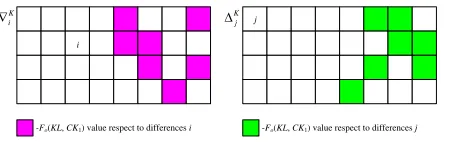
2. Constructing key differences ▽K
i and △Kj
The▽i-differentials are based on the key difference▽Ki , and△j-differentials are based on the key difference △K
j . The choice of▽Ki and△Kj is dominated by two aspects. On one hand, in order to construct two independent related-key differentials, the number of active-bytes of the first 2 round related-key should be as few as possible. Note that the round keys eki are generated byW0,W1,
W2, W3. we choose those kind of differences which can make the differences
of these four 128-bits values as simple as possible. On the other hand, note that the position of active-byte of the master key will affect the number of active-bytes of the round key, in order to decrease the number ofSLandDL
j
i
-Fo(KL,CK1) value respect to differences i -Fo(KL,CK1) value respect to differencesj
K i
K
j
'
Figure 7: Initialization Key differentials ▽K
i and △Kj
the round key have the least number of active-bytes in round 3 after round key generation.
According to the two aspects above, we choose the key as shown in Fig. 7. Key differences ▽K
i are enumerated by all possible byte differencesi with respect to theKLvalue and theFo(KL, CK1)⊕Fo(KL⊕Ti, CK1) (Tidenote
the input differences of KL) value respect to the KR value of the base key
MK[0,0]. Hence, the difference of W1 is 0 and the difference of W2 is the
same as the difference of W0. A similar property hold for△Kj . Furthermore, the number of active-bytes of ek3 in ▽i-differentials are determined by the position of the 7 active-bytes of W3, and the position of differences i affect
the position of the 7 active-bytes of W3. We found KL9 is the best position
of active-byte that can make ek3 have the least number of active-bytes.
3. Constructing▽i-differentials and△j-differentials
We can obtain two independent related-key differentials ▽i-differentials and △j-differentials from key differentials ▽Ki and △Kj respectively. Both sets of differentials are depicted in Fig .8.
We put:
Pi =P0 ⊕ ▽i, Sj=S0⊕ △j MK[i,j] =MK[0,0]⊕ ▽K
i ⊕ △
K j
and get a 2-round biclique of dimension 8 [{Pi},{Sj},{MK[i, j]}] for ARIA-256.
Since the ▽i-differentials affects only 10 bytes of the plaintext, all the plaintexts share the same values in P0,5,8,10,13,15. As a result, the data
SL DL SL DL
base computation
0
P
0
S
SL DL SL DL
0
P
j
S
-differential j '
SL DL SL DL
i
P
0
S
-differential i
Figure 8: ▽i-differentials and△j-differentials
4.3
Matching over 14 Rounds
Firstly, as shown in Fig. 11, we expand ▽i-differentials and △j-differentials to full-round differentials, and derive the overlapping byte from them. The tested key MK[i, j] is a key candidate of the secret keyKsecret if
Sj
M K[i,j]
−−−−→
e1
− →v (#25
0) =←−v(#250)
M K[i,j]
←−−−−
e2
Ci (2)
(#250 denote the first byte of #25). Here, only matching a single byte, the
computation complexity can be decreased. We first precompute Sj
K[0,j]
−−−→ −→v and ←−v ←−−−K[i,0] Ci for 0 ≤ i, j ≤ 28−1, and store the 29 values as well as the intermediate states and subkeys in
memory. Then let i and j run through {0,1, . . . ,28 −1} respectively and
check whether the condition (2) holds. In the matching process, we need only recompute those variables that differ from the ones stored in memory.
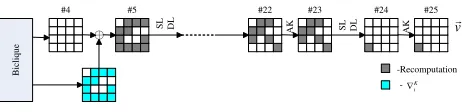
Next we evaluate the amount of recomputation in both directions. Be-cause the round from 3 to 11 does not decrease the computation complexity, we omit these rounds as shown in Fig. 9 and Fig. 11.
Recomputation cryptanalysis of forward direction:
As shown in Fig. 9, compute Sj
M K[i,j]
−−−−→ −→v differs from the stored bytes of Sj
M K[0,j]
#4 #5 S L D L A K #22 S L D L #23 #24 A K #25 vG - K i B ic li q u e -Recomputation
Figure 9: Forward direction
E n cr y p ti o n & B ic li q u e S L #32 #31 #30 A K A K #29 #28 D L S L D L S L D
L SL L L
#27 #26 #25
-v H K j ' -Recomputation
Figure 10: Backward direction
between keys MK[i, j] and MK[0, j]. The number byte of internal state which need not to be recomputed is 5 + 9 = 14.
Recomputation cryptanalysis of backward direction:
As shown in Fig. 10, compute←−v ←−−−−M K[i,j] Ci differs from the stored bytes of←−v ←−−−−M K[i,0] Ci for alli,j. It is determined by the influence of the difference between keys MK[i, j] and MK[i,0]. The number byte of internal state which need not to be recomputed is 15 + 9 + 15 = 39.
4.4
Complexities
Let us evaluate the full complexity of this approach. Since the full key space partition into the 2240 sets, we get the following equation:
Cf ull= 2n−2d(CBiclique+Cprecomp+Crecomp+Cf alsepas)
where:
• CBiclique is the complexity of constructing a single biclique.
• Cprecomp is the complexity of the precomputation.
SL DL SL DL SL DL SL DL SL DL SL DL SL DL SL DL SL DL SL DL SL DL SL DL SL DL SL DL SL DL SL DL SL DL SL DL SL DL SL DL SL DL SL SL SL #1 #2 #3 #4 #5 #23 #24 #25 #26 #27 #28 #29 #30 #31 #32 -Recomputation -i-differentials -%j-differentials
• Cf alsepasis the complexity generated by false positives, which have to be matched on other variables. If we match on a single byte, the number of false positives is about 28. Each requires only a few operations to
re-check.
The valuesCBicliqueandCprecomptogether do not exceed 28 calls of the full AIRA-256. The full key recovery complexity is dominated by 2n−2d·C
recomp.
SL and DL are the major part of the round transformation and the key schedule. The number of bytes which need to be recomputed is 256−32−
14−39 = 171 in the round transformation and 0 in the key schedule. And the total number of bytes is 16∗16 + 3∗16 = 304. As a result, Crecomp is equivalent to 216∗171/304 = 215.17 runs of the full AIRA-256.
Hence, the full computational complexity amounts to about
Cf ull= 2240(28+ 215.17+ 28) = 2255.2.
5
Conclusion
In this paper, we construct a 2-round biclique of dimension 8 for ARIA-256 by using a type of special master keys and tools like independent related-key differentials et al. We put forward the first related-key recovery attack on the full ARIA-256, and it has an advantage of 20.8 over brute-force. The data
complexity does not exceed 280. Alternatively, this paper may inspire work
on other block ciphers if the key schedule of them diffuse slowly.
References
[1] D. Kwon, J. Kim, S. Park and S.H. Sung et al. New Block Cipher: ARIA. ICISC 2003, LNCS 2971, pp.432-445, Springer-Verlag 2004.
[2] A. Biryukov, C.D. Canniere, J. Lano, S.B. Ors and B. Preneel. Security and Performance Analysis of Aria. Version 1.2. Jan 7, 2004.
[4] E. Fleischmann, M. Gorski and S. Lucks. Attacking Reduced Rounds of the ARIA Block Cipher. Cryptology ePrint Archive, Report 2009/334, 2009. http://eprint.iacr.org/.
[5] P. Li, B. Sun and C. Li. Integral Cryptanalysis of ARIA. In pre-proceeding of Inscrypt 2009.
[6] X.H. Tang, B. Sun, R.L. Li and C. Li. A Meet-in-the-Middle Attack on ARIA. Cryptology ePrint Archive, Report 2010, 2010. http://eprint.iacr.org/.
[7] W. Diffie and M.E. Hellman. Exhaustive Cryptanalysis of the NBS Data Encryption Standard. Computer 10, 74-84 , 1977.
[8] D. Khovratovich, C. Rechberger and A. Savelieva. Bicliques for preim-ages: attacks on Skein-512 and the SHA-2 family. Cryptology ePrint Archive, Report 2011, 2011 http://eprint.iacr.org/.
[9] A. Bogdanov⋆, D. Khovratovich and C. Rechberger⋆. Biclique Crypt-analysis of the Full AES. Cryptology ePrint Archive, Report 2011, 2011 http://eprint.iacr.org/.
[10] H. Demirci, A.A. Selcuk and E. Ture. A new meet-in-the-middle at-tack on the IDEA Block Cipher. SAC 2003. LNCS 3006, pp. 117C129. Springer, 2004.
[11] H. Demirci and A.A. Selcuk. A Meet-in-the-Middle Attack on 8-Round AES, FSE 2008, LNCS 5086, pp. 116C126, Springer, 2008.
![Figure 5: Initialization key MK[0, 0]](https://thumb-us.123doks.com/thumbv2/123dok_us/7895250.1310432/8.595.255.355.122.194/figure-initialization-key-mk.webp)
![Figure 6: Key set {MK[i, j]}](https://thumb-us.123doks.com/thumbv2/123dok_us/7895250.1310432/9.595.255.354.122.208/figure-key-set-mk-i-j.webp)