ISSN (Print) : 2320 – 3765 ISSN (Online): 2278 – 8875
I
nternational
J
ournal of
A
dvanced
R
esearch in
E
lectrical,
E
lectronics and
I
nstrumentation
E
ngineering
(An ISO 3297: 2007 Certified Organization)
Website: www.ijareeie.com
Vol. 6, Issue 2, February 2017
ARM Controller based Restaurant
Automation System using Zigbee Technology
Priyanka D. Patil1, Dr. Madhukar S. Chavan2
Assistant Professor, Dept. of E&Tc Engg, P.V.P.I.T. Budhgaon, Sangli, India1 Associate Professor, Dept. of E&Tc Engg, P.V.P.I.T. Budhgaon, Sangli, India2
ABSTRACT: Automation is the technology concerned with application of mechanical, electronics and computer based systems. Atomized vending machine serves a hot or soft drinks, chocolates and many things. In restaurants menu cards are available on each table. We can refer it and place our order to waiter. You need to wait for the waiter to attend to you. Even it becomes difficult for the restaurant manager to keep the changing prices on menu card. At the same time adding the new menu to the same card becomes tedious job for anyone who is responsible for this job since changing menu card within less time may result in cost rise. To overcome these problems, this system installed on every table for ordering the menu. This unit works as slave unit connected to central unit which can be kept at managers table. This system provides a low-cost, convenient and easy way for automation of order placement system for restaurants. Each table of restaurant has a menu display unit and client has to scroll menu list using keypad. The system is more convenient and reliable using ZIGBEE technology.
KEYWORDS: Zigbee, LCD, ARM controller, Embedded C programming.
I. INTRODUCTION
In restaurants, ordering is a process of customers specifying what they want, so that the order can be recorded and passed to relevant department for processing. Finally delivery of the service or products to the customer is based on the order. An ordering system is referred as a set of detail methods that is being used in handling the ordering process. Food ordering can be computerized or done manually. Ordering management system (OMS) can be defined in several ways. In a general restaurant the service process from reservation, making order from the menu, delivery of meal to paying the bill, requires waiter to make notes according to each customer’s order and then transmit them to the kitchen for preparation [1]. The bill amount is also calculated by the cashier according to the note. Though such a manner is very simple, it may significantly increase the workload of waiters or even cause mistakes in note-making or inconsistent priorities when the number of customers suddenly increases during dining hours. It degrades service quality. Therefore, how to effectively improve the service quality for customers by using advanced technologies has received much attention in recent years. In proposed system, we developed a digital system of ordering that provides a low-cost, convenient and easy way for automation of order placement system for restaurants. Each table of restaurant has a menu display unit and client has to scroll menu list using keypad. The system is more convenient and reliable using Zigbee technology. We have been provided order placement unit on each table. The unit has a keypad to browse through the menu. The menu items, their cost and information has been displayed on the LCD display. The order placed is transmitted to the central server (PC) which has a Zigbee module for data reception. Multiple such slave units can be installed.
II. DIGITAL MENU CARD SYSTEM
ISSN (Print) : 2320 – 3765 ISSN (Online): 2278 – 8875
I
nternational
J
ournal of
A
dvanced
R
esearch in
E
lectrical,
E
lectronics and
I
nstrumentation
E
ngineering
(An ISO 3297: 2007 Certified Organization)
Website: www.ijareeie.com
Vol. 6, Issue 2, February 2017
placement system for restaurants. Each table of restaurant has a menu display unit and client has to scroll menu list using keypad
.
Fig.1 (a) Table Unit Fig.1 (b) Central Server
Our aim is to design and build an automated ordering system. Each table will be provided with a microcontroller based order placement unit. The unit has a keypad to browse through the menu. The menu items, their cost and information is displayed on the LCD display. User can navigate through menu using provided keypad. The order placed is transmitted to the central server (PC) using wireless link [2], [3].
III. HARDWARE COMPONENTS
The overall system hardware is as shown in Fig.2 that includes LPC2138 controller board, 20 x 4 LCD, 4 x 4 matrix keypad, Zigbee module etc.
Fig.2 Hardware Components
ISSN (Print) : 2320 – 3765 ISSN (Online): 2278 – 8875
I
nternational
J
ournal of
A
dvanced
R
esearch in
E
lectrical,
E
lectronics and
I
nstrumentation
E
ngineering
(An ISO 3297: 2007 Certified Organization)
Website: www.ijareeie.com
Vol. 6, Issue 2, February 2017
47 GPIO lines with up to 9 edge or level sensitive external interrupt pins make these micro- controllers particularly suitable for industrial control and medical systems. The features of LPC2138 are:
32-bit ARM7TDMI-S microcontroller in a tiny LQFP64 package.
32kB on-chip Static RAM
64/512 kB on-chip Flash Program Memory.128 bit wide interface/accelerator enables high speed 60 MHz operation.
In-System Programming (ISP) and In-Application Programming (IAP) via on-chip boot-loader software. Flash programming takes 1 ms per 256 byte line. Single sector or full chip erase takes 400ms.
One/two (LPC2132/LPC2138) 8 channel 10-bit A/D converters provide total up to 16 analog inputs with conversion time as low as 2.44 microseconds per channel. Single 10-bit D/A converter deliver ability to generate variable analog output.
On-chip crystal oscillator with an operating range of 1 MHz to 30MHz.
Single power supply chip with Power On Reset (POR) and Brown Out Detection (BOD) circuits: CPU operating voltage range of 3.0V to 3.6V (3.3V +/- 10%) with 5 Volt tolerant I/O pads.
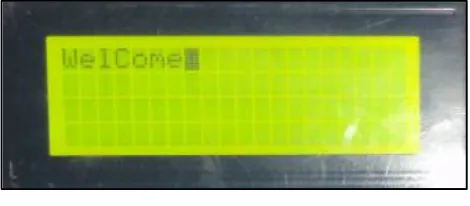
2. LIQUID CRYSTAL DISPLAY: The LCD used in the project is a 20X4 LCD which means 20 characters and 4 lines. These modules are not quite as advanced as the latest generation, full size, full colour, back- lit types used in today's laptop computers, but far from being “phased out,” character-based LCDs are still used extensively in commercial and industrial equipment, particularly where display requirements are reasonably simple. The modules have a fairly basic interface, which mates well with traditional micro- processors. Shapes and Sizes Even limited to character-based modules, there is still a wide variety of shapes and sizes available. Line lengths of 8, 16, 20, 24, 32 and 40 characters are all standard, in one, two and four-line versions.
Fig. 3 20X4 LCD Display
LCD modules conform to a standard interface specification. A 14-pin access is provided (14 holes for solder pin insertion or for an IDC connector) having eight data lines, three control lines and three power lines. The connections are laid out in one of two common configurations, either two rows of seven pins or a single row of 14 pins. Pins 1 and 2 are the power supply lines Vss and Vdd. The Vdd pin should be connected to the positive supply and Vss to the
ISSN (Print) : 2320 – 3765 ISSN (Online): 2278 – 8875
I
nternational
J
ournal of
A
dvanced
R
esearch in
E
lectrical,
E
lectronics and
I
nstrumentation
E
ngineering
(An ISO 3297: 2007 Certified Organization)
Website: www.ijareeie.com
Vol. 6, Issue 2, February 2017
single 8-bit byte or as two 4-bit “nibbles.” In the latter case, only the upper four data lines (D4 to D7) are used. This 4-bit mode is beneficial when using a microcontroller, as fewer input/output lines are required.
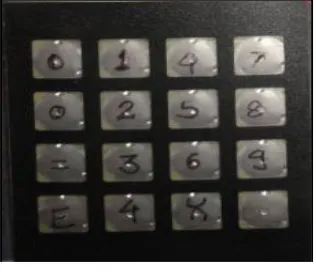
3. KEYPAD: Keypad is a Human Machine Interface and plays important role in a small embedded system where human interaction is needed.
Fig. 4 4X4 Matrix Keypad
Matrix keypads are well known for their simple architecture and ease of interfacing with any microcontroller. The outline of keypad is shown in Fig. 4.
4.ZIGBEE MODULE: ZIGBEE module is targeted at applications that require a low data rate, long battery life, and secure networking. ZIGBEE module supports bit rate of 250 kbits/s. It is best suited for data or a signal transmission from a sensor or input device. Applications include wireless light switches, electrical meters with in-home-displays, traffic management systems, and other consumer and industrial equipment that requires short-range wireless transfer of data [4],[5]. Zigbee operating voltage is 3.3V. Hence, LM317 regulator is used to provide voltage of 3.3V.
IV. SOFTWARE COMPONENTS
1.KEIL μ VISION: Keil Software provides software development tools for 8051 based microcontrollers. With the Keil tools, you can generate embedded applications for virtually every 8051 derivative. Keil Software development tools for the ARM microcontroller family supports professional applications engineer as well as new learners. The industry-standard Keil C compilers, macro assemblers, debuggers, real-time kernels, and single-board computers support all ARM-compatible derivatives. μVision is an IDE (Integrated Development Environment) that helps to write, compile, and debug embedded programs. It encapsulates the project manager, a make facility, tool configuration, editor etc.
2. MICROSOFT VISUAL BASIC 6.0: Visual Basic is event-driven programming languageand integrated development environment (IDE) developed by Microsoft. Visual Basic to be relatively easy to learn and use.
Visual Basic enables the rapid development application (RAD)of graphical user interface (GUI), access
to databasesusing data access objects, remote data objects, creation of ActiveX controls and objects. A
programmer can create an application using the components provided by the visual basic itself. Programs written
in Visual Basic can also use the Windows API which requires external function declarations. Furthermore, new
third party functions (which are open source) using VB6 source code and embedded machine code, make the Visual Basic 6.0 applications faster than those designed in C++. Visual Basic 6.0 has improved ability to create web-based applications.
3.FLASH MAGIC: NXP Semiconductors has produced a range of Microcontrollers that feature both on-chip Flash
ISSN (Print) : 2320 – 3765 ISSN (Online): 2278 – 8875
I
nternational
J
ournal of
A
dvanced
R
esearch in
E
lectrical,
E
lectronics and
I
nstrumentation
E
ngineering
(An ISO 3297: 2007 Certified Organization)
Website: www.ijareeie.com
Vol. 6, Issue 2, February 2017
software from the Embedded Systems Academy that allows easy access to all the ISP features provided by the devices. These features include:
Erasing the Flash memory (individual blocks or the whole device)
Programming the Flash memory
Modifying the Boot Vector and Status Byte
Reading Flash memory
Performing a blank check on a section of Flash memory
Reading the signature bytes
Reading and writing the security bits
Direct load of a new baud rate (high speed communications)
Sending commands to place device in Boot loader mode
4. PROTEUS: Proteus is software for microprocessor simulation, schematic capture, and printed circuit board (PCB) design. It is developed by Labcenter Electronics.
V. EXPERIMENTAL RESULTS
LCD modules conform to a standard interface specification. A 14-pin access is provided (14 holes for solder pin insertion or for an IDC connector) having eight data lines, three control lines and three power lines. The connections are laid out in one of two common configurations, either two rows of seven pins or a single row of 14 pins.
Fig.5 Menu-list displayed on LCD
ISSN (Print) : 2320 – 3765 ISSN (Online): 2278 – 8875
I
nternational
J
ournal of
A
dvanced
R
esearch in
E
lectrical,
E
lectronics and
I
nstrumentation
E
ngineering
(An ISO 3297: 2007 Certified Organization)
Website: www.ijareeie.com
Vol. 6, Issue 2, February 2017
Fig.6 Order placed on central PC
After selecting the items, user finalizes the order using keypad. The order placed is transmitted to the central server (PC) through wireless link using Zigbee module. Multiple such slave units can be installed. The format of the order placed on the central PC is as shown in the Fig.6.
Fig.7 Total bill displayed on LCD
The restaurants have maximum volume of orders is during peak hours. Usually the restaurant staff feels pressure for completing a lot of things in time. Automated ordering and payment process help to speed up ordering and payment process. Finally total bill amount is displayed on the LCD display as shown in Fig.7.
VI. CONCLUSION
The restaurants have maximum volume of orders during peak hours. The situation becomes more critical for those restaurants which need to handle a large amount of delivery orders. To overcome this issue, more staff is to be hired. Usually the staff will feel pressure for completing a lot of things in time. As a result, they cannot concentrate on their work and may make mistakes in taking or delivering orders. Automated ordering and payment system help to speed up ordering and payment process. The Restaurant automation is a revolutionary concept. It helps in increasing revenues and better customer satisfaction. A Experimental result reveals that the proposed system has potential for practical application and can be promoted in restaurants. Wireless technology is becoming more and more popular because of its low cost and ease-of-use. This technology allows us a faster and more convenient access to the world. ZIGBEE technology provides the world with a variety of wireless applications.
REFERENCES
[1] Bhargave, A., Jadhav, N., Joshi, A., Oke, P., & Lahane, M. S. (2013). “Digital Ordering System for Restaurant Using Android”, International Journal of Scientific and Research Publication, Vol.3, 2013.
[2] Guiling S, Song Q. Design of the Restaurant Self-ServiceOrdering System Based on ZigBee Technology. Wireless Communications Networking and Mobile Computing (WiCOM), 7th International Conference; 1(4): 23-25; 2012.
ISSN (Print) : 2320 – 3765 ISSN (Online): 2278 – 8875
I
nternational
J
ournal of
A
dvanced
R
esearch in
E
lectrical,
E
lectronics and
I
nstrumentation
E
ngineering
(An ISO 3297: 2007 Certified Organization)
Website: www.ijareeie.com
Vol. 6, Issue 2, February 2017
[4] Wahab, M. H. A., Kadir, H. A., Ahmad, N., Mutalib, A. A., & Mohsin, M. F. M. (2008, August).” Implementation of network based smart order system”, International Symposium on Information Technology, ITSim (Vol. 1, pp. 1-7). IEEE; 2008.
[5] Kohvakka M, Kuorilehto M, Hannikainen M, Hamalainen TD. Performance analysis of IEEE 802.15.4 and zigbee for large-scale wireless sensor network applications. Proc. The 3rd ACM international workshop on Performance evaluation of wireless ad hoc, sensor and ubiquitous networks, ACM Press, 48-57, 2006.