CSEIT1833216 | Received : 12 March 2018 | Accepted : 24 March 2018 | March-April-2018 [ (3) 4 : 366-371 ]
International Journal of Scientific Research in Computer Science, Engineering and Information Technology © 2018 IJSRCSEIT | Volume 3 | Issue 4 | ISSN : 2456-3307
366
Chat Server
Hemalatha K1, Karthik R1, Dr. R. Chinnaiyan2
1Master of computer Application/New Horizon College of Engineering/Bangalore, Karnataka, India 2Professor, Department of MCA , New Horizon College of Engineering, Bangalore, Karnataka, India
ABSTRACT
The chat server was created to allow the community of people to interact with each other on the Internet. This system provides a solution to most of the shortcomings of the traditional system. Teachers, students and the company derive equal benefits from the suggested system. The system also retains a great deal of time and effort for both. To chat, a new software called chat sever was introduced. This software plays a vital role in reducing the interaction gap between various people in a university, so it can be considered very important for the university.
Keywords : Chat Server, Open Source Tools, Bandwidth-Aware Application Tool , Neutral Architectural Language, TCP/IP, SSL
I.
INTRODUCTIONOnline meeting is a form of meeting in which clients collaborate remotely through the Internet in real-time. However, hosting online meetings with remote clients is often a nightmare when using South African Internet connections, notorious for unstable and low bandwidth. Commercial and Open source tools have been developed to host online meetings based on fast, stable connections with large amounts of bandwidth but these tools often fail due to the fact that they do not deal with low bandwidth environments. The aim of this project was to design and implement a bandwidth-aware application tool to host online meetings where multiple clients can share audio, video, presentations, desktop as well as send instant messages to one another in a low bandwidth and unstable Internet connections. Compressing audio and video, images , presentation slides and pre-fetching those slides can help improve the client experience as well as allow efficient downloading of slides, sharing desktop, sharing audio and video in a low bandwidth meeting environment causing no delays, no freezing of slides, no loss of
pre-loading presentation slides, the bandwidth required is 73238.05bps on average.
II.
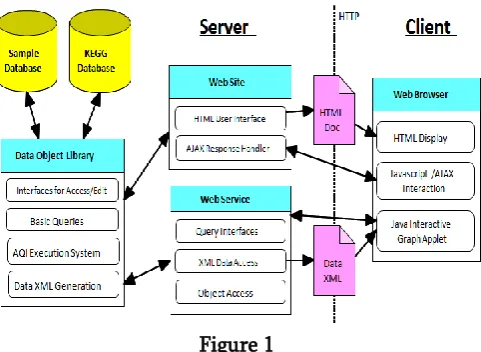
METHODS AND MATERIALThe client-server architecture model distinguishes Client (computing) systems from Server (computing) systems, which communicate over a Computer network. A client-server application is a Distributed system comprised of both client and server software. A client software process can initiate a communication session, while the server waits for requests from any client. Although programs within a single computer can use the client/server idea, it is a more important idea in a network. For example, a Web browser is a client program on the user‟s computer that can access information on any web server in the world. To verify your bank account from your computer, a web browser client program on your computer sends your request to a web server program at the bank. That program may in turn forward the request to its own database client program that sends a request to a database server at another bank computer to retrieve your account balance. The balance is returned to the customer of the bank database, which in turn returns itto the client of the web browser on his personal computer, which displays the information.
Figure 1
The neutral architectural term seems strange, but yes. Java is also a neutral architectural language. The growing popularity of networks suggests distributed developers. In the world of networks, it is essential that the applications can easily migrate to different
information systems. Not only to computer systems but to a wide variety of hardware architecture and operating system architectures as well. The Java compiler do this by generating byte code instructions, interpreted on any machine, and easily translated into native machine code. The compiler generates an object file format that is neutral to the architecture to allow a Java application to work anywhere on the network, and then compiled code is executed on many processors, given the presence of the Java runtime system. Hence, Java was designed to support applications on network. This Java feature has developed the programming language.
III.
CHARACTERISTICSof time to search the respective query thus increasing the response time.
Figure 2 A. Proposed System
The main aim of this project is to develop an application, which will help in communication between multiple users in real time. The system will allow users to chat with other users online in common room & privately. You are free to chat privately with one or more people at the same time, exchange text messages simultaneously in the same “session” over the network .User can broadcast the same message to many users at the same time.
It is the system, which only not allow users to send messages from one clients to all clients but even facilitate to send private message, and group chats with other clients. It is the system, which provides customers with details of other customers with information such as name, recording time, total duration and their message in the public section. The server side will be responsible for maintaining the user list, their messages, passwords and registration details. It is the application where the concept of data structure like linked list, array list has been used.
Server Application: -It will act as a broadcasting server, which will handle the sending and receiving of messages. It is the part, which have to deal with TCP/IP, port number and SSL techniques. Its predefined logic handles where to send messages, from where it has been received and what data has to carry.
Client Application: -Using the client panel, client can login to their account using their username and password. It is the panel where message exchange process will take place and their representation medium among other clients.
Figure 3
B. Problems
The key problems referred to time and again in the literature relate to technology as such, especially the need for reliable technology. A CHAT session will easily be spoiled if the software does not work or if any of the participant has connectivity problems. This can discourage participants from further experiments. However, growing familiarity with the medium outside the classroom is making this kind of problem less likely.
Some people also have problems with the abbreviated, highly colloquial kind of language used in CHAT sessions but this is not a universal concern. As a language teacher, Freiermuth expressed concern about the quality of students‟ language and warns teachers to try to curb excessive use of abbreviations. (Freiermuth 2002:40)
Phaedrus, uncovers a telling ambiguity in the myth of Thamus and Though, arguing that Plato sees the invention of writing, like the discovery of a new drug, as both „poison‟ and „medicine‟. If we extend the analogy to the new forms of communication … we might ask whether these new electronic forms are really dangerously addictive and corrupting, or whether they are innovations which open new ways of possibility.‟ (Merchant 2000: 305)
Whether the linguistic characteristics of CHAT are regarded as problematic or not, there are some features of the medium that may pose problems for the teacher. These are summed up in an article by Cathy Burnett (2003). They are:
contributions are likely to be very short, often just two or three lines, which can lead to a superficiality and lack of cohesion;
The lack of paralinguistic clues which can make it easy to misunderstand someone‟s tone or intention (this can also occur of course in asynchronous communication but is perhaps less of an issue in that contributors have more time to think about their message and how others may interpret it);
The fact that several participants can be composing and posting at the same time can lead to a multi-chain conversation with lack of focus and quick „fall of the topic‟.
All of these problems can be overcome, but they certainly need to be kept in mind when planning CHAT tasks or organising educational CHAT sessions.
As Melanie Heard-White points out, for CHAT the basic skill of typing is essential, and one is led to wonder whether lack of typing skills is a reason for the under-use of CHAT in education. Interestingly, the somewhat surprising result from the four questionnaires administered during this project was that the very students who had previously participated in CHAT lessons were the least able to touch type (48%). The majority of lecturers [61%], traditional campus students [57%] and online
students [56%] claim to have the skill. It is thus clear from this small survey that lack of typing skills may not be an issue.
Our questionnaires also found that the number of students taught via a CHAT virtual classroom has often been perceived as a problem area in terms ofbudget implications and classroom management. Teaching between five to twenty students, at any one time in a CHAT virtual classroom was the most popular number, i.e. 40% of lecturers indicated they taught this number of students at any one time.
In connection with the planning of CHAT seminars, a variety of approaches was revealed:-
Five lecturers planned lessons in advance
Seven lecturers held both planned and impromptu sessions
One lecturer held impromptu sessions
Two lecturers held “office hours” tutorial type sessions
One lecturer used CHAT as a forum for guest speakers
One lecturer gave students a topic and „turned them loose‟
One lecturer released a discussion question on the morning of the CHAT session.
The main problems associated with using the CHAT service as the local element in learning delivery (in addition to the technology problems outlined below) include:-
The threaded nature of CHAT sessions made responses sometimes difficult to match to the original question
Classroom management
Problems with those who are not used to CHAT culture
The speed of sending and receiving messages
It would seen then that learning delivery via CHAT is under-used in higher education and one of the main reasons for this was found to be difficulties associated with teaching and management strategies. Feinberg (1989) refers to the difficulty of replicating face-to-face teaching and management strategies. Some of these difficulties reinforce the problems outlined above and are articulated as:-
Lack of visual cues
The tedious nature of reading scrolls of computer text The threaded nature of classroom discussions The time taken to send/receive messages
Lack of opening and closing conversation cues.
Problems associated with lack of phatic signs and the threaded nature of classroom discussions have been further highlighted by Herring and Nix (1997) in their study of a social CHAT channel on the Internet. In this study it was revealed that nearly half (47%) of all turns were “off-topic” in relation to the turn which they followed. Indeed Herring (1999) found that violations of sequential coherence are the rule rather than the exception in computer mediated communication (CMC) more generally. Indeed, Paolillo (1997) reports a case on an India IRC channel of a response separated from its initiation by 50 messages.
As will be seen below, the key to avoidance of these problems is sensible structuring of any CHAT session, with the use of a method of communication that avoids the “free-for-all” randomness that, to a large extent, give rise to the above problems.
C. Goals
In this section, we provide more information about how we set about achieving aims 1-4 outlined in the previous section.to gather information on approaches currently taken on the use of CHAT in online learning in higher education, this was done by gathering information on the WWW and in professional journals. We focused particularly on
aspects of the topic relating to the aims of the project outlined in section A. Our findings from this survey of the literature are discussed in section below. To promote the use of CHAT in teaching and learning carried out online we did this by asking Melanie Heard-White to run a CHAT option several times during the Institute of Education‟s Online Education and Training Course. Indistance, mode 15 students took this but 167 further students on the same course also had the opportunity to read the materials and messages associated with the option. It was later also taken by seven students as an option on the blended delivery of the same training course, on which a further 42 students had access to the materials and messages relating to the option. To highlight examples of good practice in relation to the use of CHAT to enable and support learning amongst online students. This was done both through the literature review and by Melanie Heard-White and Gunter Saunders administering questionnaires to academic staff and students relating to their experience of using CHAT. The results of this survey are provided in Section E below. To develop a short, online, CHAT based staff training course in the use of CHAT and to pilot and evaluate its use before wider dissemination to the academic community. This was done through the two courses in Online Education and Training referred to in C.2. The option was devised and run by Melanie Heard-White, and proved to be a particularly popular and successful one that has considerably helped to inform this report. Very favourable and positive responses to the CHAT option were received from those who took them. They also responded to a specific questionnaire about the use of CHAT. Moreover, several students chose to write their coursework essays on the use of CHAT in education.
IV.
CONCLUSIONdeveloped with a technique optimized to make it faster and smaller. Although, it is a small application, but meets the customer‟s requirements. It is having two-page source code, one for the server and can be placed on any system, which you want to make a server. To function as a client, you need to place the client‟s code on another computer, which will act, as a client at the same time, there can be more than one client, which can be handle by the TCP connection. To manage network concepts, we used the number of built-in Java functions to get optimized codes such as sub processes, network consoles, input and output consoles, collection streams and much more. Among all, it is the application, which can be run, using the concept of LAN and all clients need to be connected to server or use their dedicated IP address to receive and send messages through broadcasting central server.
The main objective of the project is to develop a Secure Chat Application. I had taken a wide range of literature review in order to achieve all the tasks, where I came to know about some of the products that are existing in the market. I made a detailed research in that path to cover the loopholes that existing systems are facing and to eradicate them in our application. In the process of research, I came to know about the latest technologies and different algorithms.
I analysed various encryption algorithms (DES, AES, IDEA…), Integrity algorithms (MD5, SHA), key-exchange algorithms, authentication and I had implemented those functionalities in my application.
I had done a detailed research on Certificate Authority and key tool for the generation of certificates.
The portability of the application has been achieved by using some of the latest JSSE technologies. I implemented these functionalities using JSSE API‟s. I had examined the basic concepts and the security of
Java packages (JSSE, JCA) and to develop the GUI. I had implemented the java modifications.
As a result, the product has been successfully developed in terms of extendibility, portability, and maintainability and tested in order to meet all requirements that are
Authentication
Integrity
Confidentiality
Which are specified as the three basic concepts for the secure communication over a network.
V.
REFERENCES[1].The java complete reference by Herbert Scheldt [2].Head First java by O‟Reilly
[3].Software Engineering by Roger S. Pressman [4].http://securitydigest.org/tcp- ip/archive/1989/02 [5].http://en.wiki.org
[6].A web-programming book on HTML published by skyward publisher prescribed by Bangalore University
[7].HTML designing book published by chitra Ravi prescribed by Bangalore UniversityShephard, K. [8].The on-line tutorial; developing and evaluating
resources and disseminating experience AnESCalateproject,