Tuning Context Features with Genetic Algorithms
*Irena Spasi
ć
, Goran Nenadi
ć
, Sophia Ananiadou
Computer Science, University of Salford Newton Building, Manchester, M5 4WT, UK {I.Spasic, G.Nenadic, S.Ananiadou}@salford.ac.uk
Abstract
In this paper we present an approach to tuning of context features acquired from corpora. The approach is based on the idea of a genetic algorithm (GA). We analyse a whole population of contexts surrounding related linguistic entities in order to find a generic property characteristic of such contexts. Our goal is to tune the context properties so as not to lose any correct feature values, but also to minimise the presence of ambiguous values. The GA implements a crossover operator based on dominant and recessive genes, where a gene corresponds to a context feature. A dominant gene is the one that, when combined with another gene of the same type, is inevitably reflected in the offspring. Dominant genes denote the more suitable context features. In each iteration of the GA, the number of individuals in the population is halved, finally resulting in a single individual that contains context features tuned with respect to the information contained in the training corpus. We illustrate the general method by using a case study concerned with the identification of relationships between verbs and terms complementing them. More precisely, we tune the classes of terms that are typically selected as arguments for the considered verbs in order to acquire their semantic features.
* This research is a part of the BioPATH research project coordinated by LION BioScience (http://www.lionbioscience.com) and
funded by German Ministry of Research
1
. Introduction
The automatic discovery of new knowledge encoded in text documents relies heavily on the identification of concepts, linguistically represented by domain specific terms (Maynard et al., 2000). New terms representing newly identified or created concepts appear rapidly due to the rapid growth of new knowledge and textual data describing it. This makes the automatic term extraction tools essential assets for efficient knowledge discovery. However, automatic term extraction itself is not the ultimate goal since the large and ever growing number of terms calls for a systematic way to access and retrieve the information about the terms. Therefore, the extracted terms need to be placed in an appropriate framework by establishing relations to other content words, primarily to other terms and domain specific verbs. These relations, like terms themselves, need to be extracted from text.
In corpus-based knowledge acquisition methods, the hypothesis about terms and relationships between them are formed by analysing the contexts of the terms. Not all word types found in the context are of equal importance in the process of reasoning about the terms: the most informative are verbs, noun phrases (especially terms) and adjectives. (Maynard et al., 1998) used a fixed-size context window containing the three word types in order to incorporate the context factor into an automatic term extraction procedure. The method is further improved by using the semantic knowledge about context terms (Maynard et al., 2000). (Hatzivassiloglou et al., 2002) used gene and protein names to classify domain specific verbs by counting the frequencies with which they co-occur as well as the total frequency of the verbs. A number of authors have been using pattern-based methods to identify pre-defined types of the relationships between terms. (Hearst, 1992) focused on the extraction of hyponym relation existing between terms based on manually defined patterns describing the syntactic
structure of the word sequence encoding the relation. Similarly, (Thomas et al., 2000) used manually identified lexico-syntactic patterns as filters for extraction of protein interactions. (Agichtein et al., 2000), on the other side, extracted the patterns automatically from a corpus by providing the system with pairs of terms known to be in a considered relation, locating the word sequences in which the two terms appear in close proximity, and analysing the context connecting them. (Pustejovsky et al., 2002) differentiate between entity extraction and relation extraction. They use predicates (expressed by verbs and their nominalisations) as anchors in identifying relations. Complementation patterns are extracted from clustered predicate contexts based on their regularity.
In our previous work (Nenadic et al., 2001) we used a genetic algorithm (GA) based on a novel crossover operator to explore the context features of prepositions in Serbian by concentrating on case properties. The GA was able to automatically learn case constraints of noun phrases within specific preposition phrases by consulting non-disambiguated initially tagged corpus. In this paper we present a similar approach to identifying relationships between verbs and terms complementing them. We use a GA to perform reasoning about term classes allowed to be combined with specific verbs. The approach has been tested in the field of molecular biology. We aim at automatic tuning of the features of elements found in the context of such verbs (e.g. whether these elements are proteins or genes), by using an existing ontology as seed for learning. The results of the proposed methodology provide a platform for term clustering/classification, term sense disambiguation, verb subcategorisation, and verb class disambiguation.
denoting the existence of a certain relationship between two terms. Further, purely transitive verbs mainly follow two patterns depending on whether they are used in an active or passive form. The pattern for the verb used in active is the following:
<term> <verb> <term>
(e.g. C_terminal_tail inhibits the
Pitx2_protein)
The following pattern describes the passive usage of a verb:
<term> <verb> by <term>
(e.g. chain_promoters were inhibited by
C/EBPbeta_isoforms)
Finally, the verbs that have both transitive and intransitive sense are predominantly used in the former sense in the corpus, in which case the same patterns mentioned for transitive verbs are applicable.
# of verbs VI or VT example
2 VI compete, interact
8 VT activate, induce, repress
11 both bind, mediate, stimulate
Table 1: The distribution of domain specific verbs
We expected for each of the analysed verbs to be complemented by a term in both left and right context. However, it is not obligatory for a term to be a direct neighbour of a given verb, e.g.:
a protein that activates transcription
of a large number of viral_genes
We, therefore, did not limit ourselves only to extraction of terms immediately preceding/following a verb or identifying its subject/object, but have instead used a knowledge-poor approach in which we extracted the terms closest to the verb in its left and right contexts respectively without crossing the sentence boundaries. This is done by defining the appropriate local grammars in a text mining software developed within the BioPATH project. Here is an example of a local grammar according to which the terms are to be extracted, where we covered all morphological forms of the verb inhibit including its
nominalisation:
<right-context> → <verb> <non-term>* <term>
<verb> → inhibit( ε | s | ed | ing | ion )
Once the word sequences that match the defined pattern are identified in the corpus, the terms used in conjunction with the given verb are extracted and the duplicates are eliminated. These terms constitute the initial population of the GA.
3.3. Dominance relation
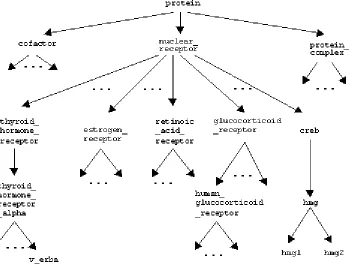
The output of the GA should be a sequence of terms corresponding to the concepts that include all other concepts denoted by terms in the initial population either as its (in)direct subclasses or instances. This output is obtained by iteratively applying a crossover operator based on a partial order relation induced by a domain specific ontology (Figure 1) developed within the BioPATH project.
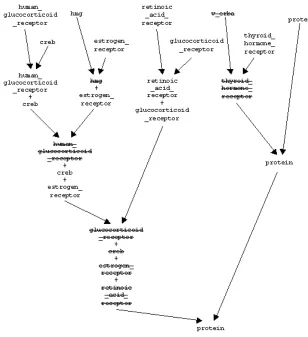
Figure 3: An example of crossover between the context terms for the verb bind
As an example, Figure 3 illustrates a sequence of generations of the GA, whose individuals represent terms that can complement the verb bind. The initial population
is extracted from the corpus in the way described earlier in this section. The crossover operator is applied to the pairs of individuals,2 as illustrated in Figure 3. Since the
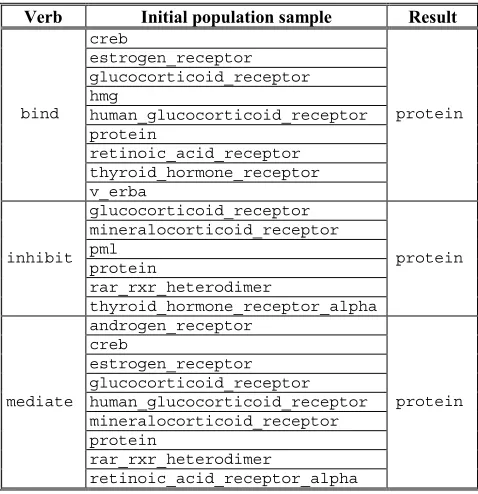
crossover operator is associative, the order in which we apply the crossover operator will not affect the result. We have run the proposed GA for the selected verbs (21 in total). In Table 2 we show the results for three of the verbs.
4. Applications
We have foreseen at least four potential applications of the described GA: term clustering and classification, term sense disambiguation, verb subcategorisation, and verb class disambiguation. Let us now discuss these applications in more detail.
4.
1
. Term
clustering/classification
Automatically recognised terms should be related to existing knowledge and/or to each other. This entails the fact that terms should be classified or clustered so that semantically similar terms are grouped together. Classification and/or clustering of terms are indispensable for improving information extraction, knowledge
2 When there is an odd number of individuals in the population,
one of them is simply passed to the next generation without being combined with another individual.
acquisition, and document categorisation. Classification can also be used for efficient term management and populating and updating existing ontologies in a consistent manner.
Maynard, D., Ananiadou, S., 1998. Acquiring Contextual Information for Term Disambiguation. In Proceedings of Computerm '98 Workshop on Computational Terminology (COLING/ACL '98), Montreal, Canada, 86-91.
Maynard, D., Ananiadou, S., 2000. Identifying Terms by their Family and Friends. In Proceedings of COLING 2000, Saarbrucken, Germany, 530-536.
MEDLINE, 2002. National Library of Medicine. Available at: http://www.ncbi.nlm.nih.gov/PubMed/ Nenadic, G., Spasic, I., Ananiadou, S., 2001. Reducing
Lexical Ambiguity in Serbo-Croatian by Using Genetic Algorithms. Fourth European Conference on Formal Description of Slavic Languages FDSL-4, Potsdam, Germany.
Nenadic, G., Spasic, I., Ananiadou, S., 2002. Automatic Discovery of Term Similarities Using Pattern Mining. Submitted.
Pustejovsky, J., Castaño, J., Zhang, J., Kotecki, M., Cochran, B., 2002. Robust Relational Parsing Over Biomedical Literature: Extracting Inhibit Relations. In Proceedings of The Pacific Symposium on Biocomputing (PSB 2002), Hawaii.
Reeves, C., 1996. Modern Heuristic Techniques. In: Rayward-Smith, V. et. al (Eds.) Modern Heuristic Search Methods. John Wiley & Sons Ltd.