CSEIT172379 | Received : 17 May 2017 | Accepted : 31 May 2017 | May-June-2017 [(2)3: 655-660]
International Journal of Scientific Research in Computer Science, Engineering and Information Technology © 2017 IJSRCSEIT | Volume 2 | Issue 3 | ISSN : 2456-3307
655
A Review on Mobile Cloud Computing
Manpreet Kaur, Jagjeet Kaur, Harpreet Kaur
Department of CSE, AIT Gharuan, Punjab, India
ABSTRACT
On demand or an pay per use of resources such as: network, storage and server these all facilities are provided by cloud. Although, cloud computing is facilitating the information Technology Industry, the research and development in this arena is yet to be satisfactory our contribution in this paper is an advanced survey focusing on cloud computing concept and most advanced research issues. This paper provide both understanding of the cloud computing and identifies important research issues.
Keywords : Mobile Cloud Computing, Mobile Computing, Cloud Computing, Research Directions
I.
INTRODUCTION
Over the past few years, advances in the field of network based computing and applications on demand have led to an explosive growth of application models such as cloud computing, software as a service, community network, web store, and so on. As a major application model in the era of the Internet, Cloud Computing has become a significant research topic of the scientific and industrial communities since 2007. Commonly, cloud computing is described as a range of services which are provided by an Internet-based cluster system. Such cluster systems consist of a group of low-cost servers or Personal Computers (PCs), organizing the various resources of the computers according to a certain management strategy, and offering safe, reliable, fast, convenient and transparent services such as data storage, accessing and computing to clients. According to the top ten strategic technology trends for 2012 [1] provided by Gartner (a famous global analytical and consulting company), cloud computing has been on the top of the list, which means cloud computing will have an increased impact on the enterprise and most organizations in 2012. Meanwhile, smart phones are considered as the representative for the various mobile devices as they have been connected to the Internet with the rapidly growing of wireless network technology. Ubiquity and mobility are two major features in the next generation network which provides a range of personalized network services through numerous network terminals and modes of
accessing. The core technology of cloud computing is centralizing computing, services, and specific applications as a utility to be sold like water, gas or electricity to users. Thus, the combination of a ubiquities mobile network and cloud computing generates a new computing mode, namely Mobile Cloud Computing. MCC aims to augment computing capabilities of mobile devices, conserve local resources - especially battery, extend storage capacity, and enhance data safety to enrich the computing experience of mobile users. The main difference between surrogate-based and cloud-based augmenting approaches is that surrogates offer free services without commitment to complete assigned jobs (they can leave a task anytime at any stage of computing), whereas clouds provide paid services with assured availability, quality, and commitment according to the negotiated Service-Level Agreement (SLA) between cloud vendor and mobile client [16].
While mobile cloud computing make a great contribution to our daily lives, it will also, however, bring numerous challenges and problems. In short, the core of such challenges and problems is just how to combine the two technologies seamlessly. On one hand, to ensure that mobile devices adequately make best use of advantages of cloud computing to improve and extend their functions. On the other hand, to overcome the disadvantages of limited resources and computing ability in mobile devices in order to access cloud computing with high efficiency like traditional PCs and Servers. Thus, in order to solve the mentioned challenges and point out further research, getting a thorough understanding of the novel computing paradigm - mobile cloud computing, is necessary. This paper introduces the basic model of mobile cloud computing, its background, key technology, current research status, and its further research perspectives as well.
II.
OVERVIEW OF MOBILE CLOUD
COMPUTING As a development and extension of Cloud Computing and Mobile Computing, Mobile Cloud Computing, as a new phrase, has been devised since 2009. In order to help us grasping better understanding of Mobile Cloud Computing, let‟s start from the two previous techniques: Mobile Computing and Cloud Computing.
A. Mobile Computing
Mobility has become a very popular word and rapidly increasing part in today‟s computing area. An incredible growth has appeared in the development of mobile devices such as, smart phone, PDA, GPS Navigation and laptops with a variety of mobile computing, networking and security technologies. In addition, with the development of wireless technology like WiMax, Ad Hoc Network and WIFI, users may be surfing the Internet much easier but not limited by the cables as before..
1) Features: the features of mobile computing are as follows:
a) Mobility: mobile nodes in mobile computing network can establish connection with others, even fixed nodes in wired network through Mobile Support Station (MSS) during their moving.
b) Diversity of network conditions: normally the networks using by mobile nodes are not unique, such
networks can be a wired network with high-bandwidth, or a wireless Wide Area Network (WWAN) with low- bandwidth or even in status of disconnected.
c) Frequent disconnection and consistency: as the limitation of battery power, charge of wireless communication, network conditions and so on, mobile nodes will not always keep the connection, but disconnect and consistent with the wireless network passively or actively.
d) Dis-symmetrical network communication: servers and access points and other MSS enable a strong send/receive ability, while such ability in mobile nodes is quite weak comparatively. Thus, the communication bandwidth and overhead between downlink and uplink are discrepancy.
e) Low reliability: due to signals is susceptible to interference and snooping, a mobile computing network system has to be considered from terminals, networks, database platforms, as well as applications development to address the security issue.
2) Challenges of MCC: Compared with the traditional wired network, mobile computing network may face various problems and challenges in different aspects, such as signal disturbance, security, hand-off delay, limited power, low computing ability, and so on. due to the wireless environment and numerous mobile nodes. In addition, the Quality of Service (QoS) in mobile computing network is much easier to be affected by the landforms, weather and buildings.
B. Cloud Computing
cluster system, called the Cloud. In this paper, we consider the cloud computing is a large scale economic and business computing paradigm with virtualization as its core technology. The cloud computing system is the development of parallel processing, distributed and grid computing on the Internet, which provides various QoS guaranteed services such as hardware, infrastructure, platform, software and storage to different Internet applications and users.
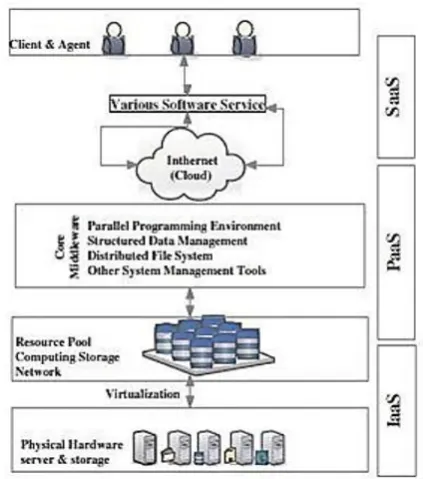
1) Framework: cloud computing systems actually can be considered as a collection of different services, thus the framework of cloud computing is divided into three layers, which are infrastructure layer, platform layer, and application layer (see Fig. 2).
Figure 2: The Framework of Cloud Computing
a) Infrastructure layer: it includes resources of computing and storage. In the bottom layer of the framework, physical devices and hardware, such as servers and storages are virtualized as a resource pool to provide computing storage and network services users, in order to install operation system (OS) and operate software application. Thus it is denoted as Infrastructure as a Service (IaaS). Typically services in this layer such as Elastic Computing Cloud of Amazon [6]. b) Platform layer: this layer is considered as a core layer in the cloud computing system, which includes the environment of parallel programming design, distributed storage and management system for structured mass data, distributed file system for mass data, and other system management tools for cloud computing. Program developers are the major clients of
the platform layer. All platform resources such as program testing, running and maintaining are provided by the platform directly but not to end users. Thus, this type of services in a platform layer is called Platform as a Service (PaaS). The typical services are Google App Engine [7] and Azure from Microsoft [8]. c) Application layer: this layer provides some simple software and applications, as well as costumer interfaces to end users. Thus we name this type of services in the application layer as Software as a Service (SaaS). Users use client software or a browser to call services from providers through the Internet, and pay costs according to the utility business model (like water or electricity) [9]. The earliest SaaS is the Customer Relationship Management (CRM) [10] from Salesforce, which was developed based on the force.com (a PaaS in Sales force). Some other services provided by Google on-line office such as documents, spreadsheets, presentations are all SaaS. users do not worry about the issues such as software updating, leak patching, virus attacks and data loss. If failure happens on a server or VM, the cloud computing systems transfer and backup those data to other machines, and then delete those failure nodes from the systems automatically in order to make sure the whole system has normal operation [12]. Meanwhile, cloud can be extended from horizontal and vertical [13] in a large-scale network, to process numerous requests from thousands of nodes and host. c) Large-scale: in order to possess the capability of supercomputing and mass storage, a cloud computing system normally consists of thousands of servers and PCs. Google Cloud Computing, for example, has already controlled 2% of all servers or about 1 million servers located in two hundred different places in the world, and will move upward to 10 million servers in the next decade [14]. d) Autonomy: a cloud system is an autonomic system, which automatically configures and allocates the resources of hardware, software and storage to clients on-demand, and the management is transparent to end users.
Agreement (SLA) is established between users and service providers in cloud computing, so the performance and analysis of services are necessary to be monitored. Last but not least, simple and convenient application interfaces are indispensable for service providers in cloud computing, thus a uniform standard is required eagerly.
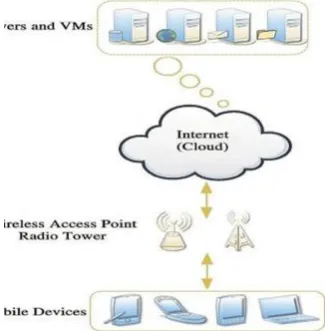
Mobile Cloud Computing and receive data from the cloud, such convenient and rapid The term “mobile cloud computing” was introduced not long after the concept of “cloud computing” launched in mid-2007. It has been attracting the attentions of entrepreneurs as a profitable business option that reduces the development and running cost of mobile applications, of mobile users as a new technology to achieve rich experience of a variety of mobile services at low cost, and of researchers as a promising solution for green IT [3]. This section provides an overview of MCC including definition, architecture, and advantages of MCC. A. Architectures and Principal of MCC Mobile cloud computing is a combination of mobile computing, cloud computing and mobile Internet. It can be stated as availability of cloud computing facilities in the mobile environment. It integrates the advantages of all the three technologies and can thus be called as cloud computing for mobiles. Mobile cloud computing is a new model where the data processing and storage is moved from mobile devices to powerful and centralized computing platforms located in clouds. These platforms can then be accessed through wireless connections via web browsers on the mobile devices. This is similar to cloud computing, but the client side has changed to make it viable for mobile phones, but the main concept behind it is still cloud computing. As shown is the Fig. 3, mobile cloud computing can be simply divided into cloud computing and mobile computing. Mobile users send service requests to the cloud through a web browser or desktop application, then the management component of cloud allocates resources to the request to establish connection, while the monitoring and calculating functions of mobile cloud computing will be implemented to ensure the QoS until the connection is completed.
Fig. 3: Architecture of Mobile Cloud Computing B. Challenges and solutions The main objective of mobile
cloud computing is to provide a convenient and rapid method for users to access method means accessing cloud computing resources effectively by using mobile devices. The major challenge of mobile cloud computing comes from the characters of mobile devices and wireless networks, as well as their own restriction and limitation, and such challenge makes application designing, programming and deploying on mobile and distributed devices more complicated than on the fixed cloud devices. 1) Limitations of mobile devices While discussing mobile devices in cloud the first thing is resource-constrain. Though smart phones have been improved obviously in various aspects such as capability of CPU and memory, storage, size of screen, wireless communication, sensing technology, and operation systems, still have serious limitations such as limited computing capability and energy resource, to deploy complicated applications. By contrast with PCs and Laptops in a given condition, these smart phones like iPhone 4S, Android serials, Windows Mobile serials decrease 3 times in processing capacity, 8 times in memory, 5 to 10 times in storage capacity and 10 times in network bandwidth TABLE I: Challenges and Solutions of Mobile Cloud Computing Challenges Solutions Limitations of mobile Virtualization and Image, devices Task migration
Quality of Bandwidth upgrading, communication Data delivery time reducing
processed by cloud, and those mobile devices are responsible for some simple tasks only. In this processing, the major issues affecting performance of mobile cloud computing are: data processing in data centre and mobile device, network handover delay, and data delivery time.
III.
BENEFITS OF MOBILE CLOUD
COMPUTING
Mobile cloud applications move the computing power and data storage away from mobile phones and into the cloud, bringing apps and mobile computing to not just smart phone users but a much broader range of mobile subscribers. In this section, we enlist the possible benefits of Mobile Cloud Computing [2]. • Mobile Cloud Computing will help to overcome limitations of mobile devices in particular of the processing power and data storage. • It also might help to extend the battery life by moving the execution of commutation-intensive application „to the cloud‟. • Mobile Cloud Computing is also seen as a potential solution for the fragmented market of mobile operating systems with currently eight major operating systems. • Mobile Cloud Computing can increase security level for mobile devices achieved by a centralized monitoring and maintenance of software, It can also become a one-stop shopping option for users of mobile devices since Mobile Cloud Operators can simultaneously act as virtual network operators, provide e-payment services, and provide software, data storage, etc. as a service. • A number of new technical functionalities might be provided by mobile clouds. In particular, provisioning of context- and location-awareness enables personalization of services is an attractive functionality. • Mobile Cloud Computing might open the cloud computing business that is currently almost exclusively addressing businesses to consumers since they will significantly benefit from the above described options.
IV.OPEN ISSUES AND FUTURE RESEARCH
DIRECTIONS
Although some projects of mobile cloud computing has already been deployed around the world, there is still a long way for business implementation, and some research aspects should be considered in further work. A. Data delivery: Due to the feature of resource- constrains, mobile devices have potential challenges in cloud accessing, consistent accessing, data transmission,
and so on. Such challenges can be solved using: special application (service) and middle-ware (provide a platform for all mobile cloud computing systems). B. Task division: Researchers divide tasks (applications) from mobile devices into multiple sub-tasks and deliver some of them to run in cloud, which is a good solution to the resource limited mobile devices. However, we do not have an optimal strategy or algorithm on how to divide these tasks, which one should be processed by cloud and which one by devices. C. Better service: The original purpose of mobile cloud computing is providing PC-liked services to mobile terminals. However, as the existing different features between mobile devices and PCs, we cannot directly transplant the services from PCs‟ platform to mobile devices. Therefore, further research should try to Identify the method on how to provide suitable and friendly interactive services for mobile devices. D. Standard interface : The current interface between mobile devices and cloud is based on web interfaces. These interfaces are not designed for the mobile devices and thus carry huge overheads. Also, compatibility among mobile devices may be an issue. To overcome this flaw, a standard protocol and interface needs to be designed. E. Quality of service : The original goal of mobile cloud computing is to provide PC-like services on the mobile devices. Since, there are a diverse features existing between PCs and mobile devices, we cannot directly shift the services from the computer‟s platform to mobile devices. In addition, mobile users may face delay in communication with the cloud because of congestion due to bandwidth limitation, network disconnection and signal attenuation. F. Trust, security, and privacy issues: Trust is an essential factor for the success of the burgeoning MCC paradigm. Constructing a trustable, secure environment is an open issue which is exacerbated when the Internet is utilized as the bridge between front-end and back-end devices (over wireless and wired networks). Provisioning security and providing data integrity and reliability besides delivering essential services (e.g. always on connectivity and cloud services) over the heterogeneous distributed systems, wireless networks, and the Internet require novel lightweight methods.
V.
CONCLUSIONS
ultimate goal of MCC is to provide rich mobile computing through seamless communication between front-users (cloud-mobile users) and end-users (cloud providers) regardless of heterogeneous, wireless environments and underlying platforms in global Roaming. With the high increasing of data computation in commerce and science, the capacity of data processing has been considered as a strategic resource in many countries. We conclude that there are some main optimization approaches in MCC, which are focusing on the limitations of mobile devices, quality of communication, and division of applications services, Standard Interface, Quality of service, Trust, Security & privacy Issues. Deploying an effective elastic application division mechanism is deemed to be the best solution to guarantee the application service in MCC; its complicated, but promising high impact results.
VI.
REFERENCES
[1]. M. Satyanarayanan,"Fundamental challenges in mobile computing," in Proceedings of the 5th annual ACM symposium on Principles of distributed computing, pp. 1-7, May 1996. [2]. Xinwen Zhang, Joshua Schiffman, Simon Gibbs,
Anugeetha, and Sangoh Jeong. Securing elastic applications on mobile devices for cloud computing. In CCSW ‟09: Proceedings of the 2009 ACM workshop on Cloud computing security, pages 127-134, New York, NY, USA, 2009. ACM.
[3]. C. Hewitt, "Orgs for scalable, robust, privacy-friendly client cloud computing," Internet Computing, IEEE, vol. 12, no. 5, pp. 96-99, 2008.
[4]. R. Buyya, C. Yeo, and S. Venugopal, "Market-oriented cloud computing: Vision, hype, and reality for delivering it services as computing utilities," in High Performance Computing and Communications, 2008. HPCC‟08. 10th IEEE International Conference on. IEEE, 2008, pp. 5-13.
[5]. L. Youseff, M. Butrico, and D. Da Silva, "Toward a unified ontology of cloud computing," in Grid Computing Environments Workshop, 2008. GCE‟08. IEEE, 2008, pp. 1-10.
[6]. M. Satyanarayanan, "Mobile computing: the next decade," in Proceedings of the 1st ACM Workshop on Mobile Cloud Computing &
Services: Social Networks and Beyond (MCS), June 2010.
[7]. A. Zahariev, "Google app engine," Helsinki University of Technology, 2009.
[8]. (2011) Microsoft azure homepage. Online]. Available: http://www. windowsazure.com/en-us/
[9]. M. Ali, "Green Cloud on the Horizon," in Proceedings of the 1st International Conference on Cloud Computing (CloudCom), pp. 451 - 459, December 2009.
[10]. http://www.mobilecloudcomputingforum.com/ [11]. White Paper, "Mobile Cloud Computing Solution