International Conference on Machine Learning and Computational Intelligence-2017
International Journal of Scientific Research in Computer Science, Engineering and Information Technology © 2017 IJSRCSEIT | Volume 4 | Issue 4 | ISSN : 2456-3307
Implementation of Fuzzy Logic Measures for Mobile Robot
Control
B. M. Bhairat1,M. R. Gosavi2, V. M. Thakare3
1Department of Mathematics, Br. Balasaheb Khardekar College, Vengurla, Sindhudurg, Maharashtra, India 2Department of Mathematics, Maharashtra Mahavidyalaya, Nilanga, Latur, Maharashtra, India
3Department of Computer Science and Technology, Sant Gadage Baba Amaravati University, Amaravati, Andhra Pradesh, India
ABSTRACT
Mobile robots are required to navigate in unknown and dynamic environments and in the present years the use of mobile robots in material handling has increased. In this work, on-line navigation for autonomous mobile robot in dynamic and unknown indoor environment using fuzzy logic measures is investigated. Four fuzzy logic measures are developed and used to navigate robot to its target. Goal Seeking Measure (GSM), Static and Dynamic Obstacles Avoidance Measure (SDOAM), Emergency Measure (EM), and Robot Setting Measure (RSM) are used to navigate mobile robot and obstacle avoidance. The target of this work is to use the autonomous mobile robot in warehouse with dynamic unknown environment.
Keywords : Autonomous Mobile Robot, Fuzzy Logic, Wheeled Mobile Robot, Robot Navigation
I.
INTRODUCTIONMany researchers have anticipated that mobile robots will take charge in various tasks in manufacturing plants, warehouses and construction sites. Recently, the use of mobile robots in material handling applications has considerably increased. For instance, in the warehouses, the mobile robots are used for material handling from stockrooms and also monitoring the inventory of different items. The dynamic environment and the insufficient information on the environment are the main challenge in the navigation operation of the WMR. The conventional mobile robot planning approaches remain not strong and unable to overcome these challenges. As a result, many reactive approaches were introduced allowing the use of artificial intelligence techniques, where problem solving, learning and reasoning are the main issues. Within this scope, fuzzy logic [1], neural networks and other
artificial intelligence techniques [2], became the basis of navigation systems in mobile robots.
the control between them. The author used Powerbot robot as a mobile robot platform to check the effectiveness of the proposed algorithms. This paper is organized as follows. In Section II, a previous work done is presented. Existing Methodology is explained in section III. Fuzzy logic description is presented in section IV. Section V explains the proposed methodology. Experimental results are presented in section VI. Conclusion is given in section VII.
II.
PREVIOUS WORK DONEVarious self-control techniques, such as fuzzy logic, neural network, and genetic algorithm are used to deal with dynamic and unknown environment. M. Cao et. al. [1] describes multiple types of inputs: sonar, camera and stored map with fuzzy logic system which is used to navigate the mobile robot. R. Rashid et. al. [2] explains fuzzy logic for indoor navigation. Nabeel K. Abid et. al.[3] describes how fuzzy logic control FLC can be applied to sonar of mobile robot. The fuzzy logic approach has effects on the navigation of mobile robots in a partially known environment that are used in different industrial and society applications. The fuzzy logic provides a mechanism for combining sensor data from all sonar sensors which present different information.
Antonio Gómez Skarmetaet. al.[4] describes the application of fuzzy logic to the navigational component of an indoor autonomous system implemented by means of intelligent agents. Oscar Castilloet. al.[5]addresses the problem of trajectory tracking control in an autonomous, wheeled, mobile robot of unicycle type using Fuzzy Logic. The Fuzzy Logic Control (FLC) is based on a back stepping approach to ensure asymptotic stabilization of the robot’s position and orientation around the desired trajectory, taking into account the kinematics and dynamics of the vehicle.
Abraham L. Howellet. al.[6] explains fuzzy logic which is a topic traditionally taught in artificial intelligence, machine learning, and robotics courses. Students receive the necessary mathematical and theoretical foundation in lecture format. The final learning experience may require that students create and code their own fuzzy logic application that solves a real world problem. Mester, Gyula [7] presents the sensor-based fuzzy logic navigation of autonomous wheeled mobile robots in the greenhouse environments. This paper deals with the fuzzy control of autonomous mobile robot motion in unknown environment with obstacles and gives the wireless sensor-based remote control of autonomous mobile robot motion in greenhouse environments using the Sun SPOT technology. K.S. Senthilkumar– [8] presents an Autonomous Mobile Robot (AMR) is a machine able to extract information from its environment and use knowledge about its world to move safely in a meaningful and purposeful manner.
III.
EXISTING METHODOLOGYNavigation system for mobile robot using fuzzy-neural network which explains learning abilities for navigation system using the fuzzy–neural network in dynamic environment. A neuro-fuzzy approach for real time mobile robot navigation is used to tune the membership function parameters. A dynamic neuro-fuzzy system for obstacle avoiding is presented in which robot can reach its target, but it does not show a good interaction behavior.
Genetic algorithm and fuzzy logic control are used to navigate mobile robot. This Genetic is used to tune the fuzzy logic by modifying the shape of membership function. The experimentation result showed that this Geno-Fuzzy system improved the navigation in many case but not for all case of the navigational. Geno-Fuzzy system for mobile robot navigation is used to improve the quality of control system and by finding the optimal parameters of control system.
IV.
ANALYSIS AND DISCUSSIONS
Kinematics Model of WMR:
In this research, Powerbot robot is used. Powerbot is aWMR with differential wheels are used. WMR has two driving wheels, which are mounted on forward of the chassis on the same axis and one castor wheel, which is mounted on backward of the chassis. The
castor wheel uses to balance the mobile robot during the motion. The kinematic model of this kind of mobile robot described by the following nonlinear equation:
where x and y are coordinates of the position of the mobile robot,
is the orientation of the mobile robot, i.e. the angle between the positive direction X-axis, vis the linear velocity and
is the angular velocity.Fuzzy Logic control: -L.A. Zadeh is the father of the fuzzy logic. He introduced the fuzzy logic in 1965, in University of California. Fuzzy logic control has been become an important technique in many areas. In this paper, we use the fuzzy logic technique to implement reaching the target and static and dynamic obstacle avoidance behaviors with mobile robot. In the Fuzzy Logic Process, there are four main steps. First step defines the linguistic variables for input and output system, second step defines the fuzzy set, the third step defines the fuzzy rules and the last step is about of defuzzification. The fuzzy logic process is shown in the following flowchart 1.
Flowchart 1
V.
PROPOSED METHODOLOGY
Four fuzzy logic measures are developed and used to navigate Powerbot to its target. Goal Seeking Measure (GSM), Static and Dynamic Obstacles Avoidance Measure (SDOAM), Emergency Measure
As in the flowchart 2, the algorithm starts with RSM measure. If the Powerbot reaches its target, it stops otherwise the control move to the emergency checking state. If the laser/ultrasonic sensors detect any near (distance between the obstacle and the robot is less than30 cm) movement obstacle the control switches over to the EM measure, otherwise the control checks the SDOAM state. If the laser or the ultrasonic sensors detect any far static or dynamic obstacle (distance between the obstacle and the robot is less than 100 cm and larger 30) the control switches over to the SDOAM measure. The output of GSM, EM, RSM, and SDOAM are the left and right velocities of each wheels of the Powerbot.
A. Goal Seeking Measure (GSM) -GSM uses to simulate the goal seeking behaviors, so it navigates the Powerbot robot to its target. The inputs of GSM are the angle between the direction of the robot to
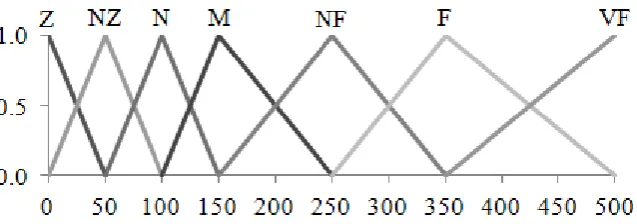
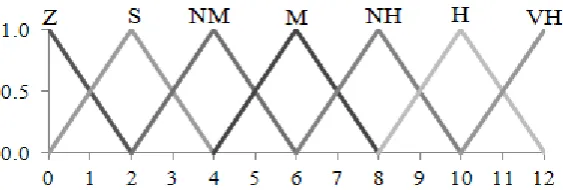
the target and the x-axis (error angle), and the distance between the robot and the target. The outputs of GSM are the velocities of the left and right motors. GSM has been implemented using seven membership functions for both input, see figures 3 and 4 (angle error and distance error). The linguistic variables of the distance error are: Very Far: VF, Far: F, Near Far: NF, Medium: M, Near: N, Near Zero: NZ, and Zero: Z. The linguistic variables of the angle error are: Positive: P, Small Positive: SP, Near Positive Zero: NPZ, Zero: Z, Near Negative Zero: NNZ, Small Negative: SN, and Negative: N. Left Velocity LV and Right Velocity RV of the motors are the output of the GSM. LV and RV in GSM have been implemented using seven membership functions. Figure 5 illustrates the membership of LV and RV. The linguistic variables of the LV and RV are: Z: Zero, S: Slow, NM: Near Medium, M: Medium, NH: Near High, H: High, and VH: Very High.
Figure 3. Membership functions for the Distance
Figure 5. Membership functions of LV and RV
B. Static and Dynamic Obstacles Avoidance Measure (SDOAM) - SDOAM uses to simulate the avoiding far obstacles (static or dynamic) behaviors. If its location less than 100 and larger than 30 from the robot, obstacle is far. The inputs to SDOAM are: the distance between the robot and the obstacles (Dis_to_obstacle), the position of the obstacle from the view of the robot (Obs_position) and the different in angle between the target and the obstacle from the robot view (Dif_angle). These distances are acquired using laser device and ultra-sonic sensors. The researcher combines both the laser to take the advantage of its high accuracy and the ultra-sonic to take the advantage of higher coverage area for any obstacle. The linguistic variables of the Dis_to_obstacle are Near: N and Far: F. The linguistic variables of the Obs_position are Lift: L and Right: R. The linguistic variables of the Dif_angle are Small: S and Far: F}.The outputs of SDOAM are the velocities of the left LV and the right RV of the motors. LV and RV in SDOAM have been implemented using three membership functions.
C. Emergency Measure (EM) -EM uses to simulate the avoiding emergency movement behavior (distance between the obstacle and robot is less than 30 cm). The inputs of EM are the distance between the left, front, and right sides of the robot and the obstacles (LD, RD, and FD). These distances, acquired using laser device and ultra-sonic sensors. The author uses the laser to take the advantage of its high accuracy and the ultra-sonic to take the advantage of higher coverage area for any obstacle. The notations
for the LD, RD, and FD are: {N: Near and F: Far}. The outputs of EM measure are the velocities of the left LV and the right RV of the motors. LV and RV in EM have been implemented using three membership functions. The linguistic variables of the LV and RV in EM are High Negative: HN, Negative: N, and High:
D. Robot Setting Measure (RSM) - RSM is used to overcome the problem of existence of close intermediate points (if the distance between the robot and the point <50 cm). RSM used to rotate the robot before the motion. The input of RSM is the rotate angle that the robot should rotate. The linguistic variables of the angle are Negative: N and Positive: P. The outputs of RSM are the velocities of the left and right motors. The linguistic variables of the LV and RV in RSM are Forward: FW, Backward: BW.
VI.
POSSIBLE OUTCOME AND RESULT
examined in unknown environment with static obstacles. In the third scenario, the robot is examined in unknown environment with dynamic obstacles. The author moved the robot from the initial point (inside the robotics laboratory room)to the target point, which is outside of the laboratory room via intermediate points.
VII.
CONCLUSION
In this work, author have distributed navigation and obstacle avoidance behaviors between four fuzzy logic measures and switching the control between them. The proposed work aims to use mobile robots for hospital, library and materials handling in instructed warehouse. In this work proposed method is able to navigate the mobile robots in such environment. The proposed method has been tested on PowerBot mobile robot and with three different scenarios, which are close to the scene in warehouse. Depending on the experimental results; the proposed method is effective and robust under varying obstacles scenarios. For the future work, the proposed motion method of robot has to be extended to a swarm of mobile robots.
VIII.
REFERENCES
[1]. M. Cao and E. L. Hall, "Fuzzy logic control for anautomated guided vehicle," Intelligent Robots andComputer Vision XVII:Algorithms, Techniques, andActve Vision, vol. 3522, no. 1, pp. 303–312, 1998.
[2]. R. Rashid, I. Elamvazuthi, M. Begam, and M.Arrofiq, "Differential Drive Wheeled Mobile Robot (WMR) Control Using Fuzzy Logic Techniques,"2010, pp. 51–55.
[3]. Nabeel K. Abid Al- Sahib* Ahmed RahmanJasim**, "Guiding Mobile RobotbyApplying Fuzzy Approach on Sonar Sensors", Department of Mechatronics Engineering/Al–Khwarizmi College of Engineering, University of Baghdad *
Email: [email protected]** Email: [email protected] Al-Khwarizmi
ngineering Journal, Vol. 6, No. 3, PP 36 - 44 (2010)
[4]. Antonio Gómez Skarmeta and
HumbertoMartínezBarberá, "Fuzzy Logic Based Intelligent Agents for ReactiveNavigation in Autonomous Systems", Dep. de Informática y Sistemas. Universidad de Murcia
[5]. Oscar Castillo, Luis T. Aguilar, and S´eleneC´ardenas," Fuzzy Logic Tracking Control for Unicycle Mobile Robots", Engineering Letters, 13:2, EL_13_2_4 (Advance online publication: 4 August 2006)
[6]. Abraham L. Howell, Roy T.R. McGrann, and Richard R.Eckert, "Teaching Concepts inFuzzy Logic Using Low Cost Robots", PDAs, and Custom Software, Binghamton, NY 13902 abe@abotics, [email protected], [email protected], 978-1-4244-1970-8/08/$25.00 ©2008 IEEE October 22-25, 2008, Saratoga Springs, NY, 38th ASEE/IEEE Frontiers in Education Conference T3H-7 t0 T3H-11.
[7]. Mester, Gyula,"Fuzzy-Logic Sensor-Based Navigation of Autonomous Wheeled Mobile Robots in the Greenhouse Environments", GyulaMester is with the Robotics Laboratory, Institute of Informatics, Department of Technical Informatics, and University of Szeged, Hungary Manuscript received June 15th, 2011.
[8]. K.S. Senthilkumar1 K.K. Bharadwaj2, "Hybrid Genetic-Fuzzy Approach to Autonomous Mobile Robot", 1 College of Arts and Science, King Saud University, Wadi Al Dawasir, Riyadh, KSA, 2 School of Computer & Systems Sciences, Jawaharlal Nehru University, New Delhi, India, [email protected]