122
Knowledge Based Tool for PO Attainment
Abhishek Koshti
1, Durvesh Kadole
2, Navnath Kamble
3, Pushkar Gadgil
4, Laxmi Bewoor
5 Department Of Computer Engineering, VIIT/SPPU, Pune, India1, 2, 3, 4, 5[email protected], [email protected], [email protected], [email protected], [email protected]
Abstract-Data mining is a new approach for education. NBA is outcome based learning education. Faculty has to assess the CO and PO attainment with respect to some direct and indirect tools, where a lot of clerical tasks get involved. Due to the time constraints and many other activities such efficient assessment may get hampered. There is no such existing system which will minimize these efforts. Our tool atomizes it.
Knowledge based tool for PO attainment is a tool which minimizes the complexity in PO attainment process of NBA. In this system classification algorithm and Bloom’s taxonomy helps in mapping COs with POs .This system helps us to evaluate mapping between COs and POs for each subject with the help of direct and indirect measures.
Index Terms- Classification model, student analysis, blooms taxonomy, Educational data mining
1. INTRODUCTION
Indian higher education system is the third largest system in the world. The challenge is to ensure its quality to the stakeholders along with the expansion. To meet this challenge, the issue of quality needs to be addressed, debated and taken forward in a systematic manner.
National Board of Accreditation (NBA) was originally constituted to assess the qualitative competence of educational institutions from Diploma level to Post-Graduate level in Engineering and Technology, Management, Pharmacy, Architecture and related disciplines. NBA conducts evaluation of programs of technical institution on the basis of laid down norms. NBA accreditation is a quality assurance scheme for higher technical education. It is open to all Institutions.
2. BACKGROUND
In engineering education it is frequently necessary to judge whether and how well students have learned a body of material or mastered a skill or how well an instructor has taught a course, or how well a product or process has met its design specifications, or how well an instructional program has met its educational objectives.
A two-step process should be used to make the judgment rationally:
2.1. Assessment
Decide on the data that will be used as a basis for making the judgment and the procedures
(observations, measurements, experiments, surveys) that will be used to obtain the data, then carry out the procedures and perform whatever analytical operations are needed to put the data into a form suitable for the next step.
Assessment tools are categorized into direct and indirect methods to assess the programme educational objectives, programme outcomes and course outcomes.
1) Indirect Measures
• Alumni Survey • Employer Survey • Student Exit Survey • Course Exit Survey
2) Direct Measures
124 Fig.1. .Notation
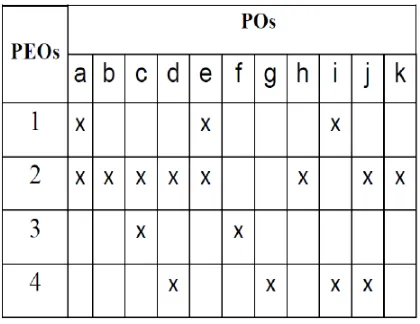
Fig.2. Mapping of COs with POs.
4. BLOOM’S TAXONOMY
Bloom's taxonomy is a way of distinguishing the fundamental questions within the education system.
Bloom's taxonomy is a classification system of educational objectives based on the level of student understanding necessary for achievement or mastery.
This technique is used to map question paper of university which is scanned and map to know the COs attainment of that subject.
Fig.3. Question Paper Analysis
5. RELATED WORK
Ms. Varsha Gupta et al [1] has described that they have Implemented C4.5 classification for finding out the trend for the system. They have made an automated system for department to analyze and predict student performance, their like and dislikes. A system to find out student trends on the basis of outcomes of indirect surveys. The analysis will summarize the outcome and will classify students based on the results. This system will recognize interest of student in particular areas.
Manmohan Singh et al [2] the classification task is used on student database to predict the students division on the basis of previous database.
Raj Kumar et al [3] has discussed how classification algorithm can be applied for data mining. He has concluded that these classification algorithms can be implemented on different types of data sets like data of patients, financial data according to performances. On the basis of the performance of these algorithms, these algorithms can also be used to detect the natural disasters like cloud bursting, earth quake, etc. .
Mr. Vipun Kumar et al [4] presents the top 10 data mining algorithms identified by the IEEE International Conference on Data Mining (ICDM) in December 2006: C4.5, k-Means, SVM, Apriori, EM, Page Rank, AdaBoost, kNN, Naïve Bayes, and CART. These top 10 algorithms are among the most influential data mining algorithms in the research community. With each algorithm, they provide a description of the algorithm, discuss the impact of the algorithm, and review current and further research on the algorithm. These 10 algorithms cover classification, clustering, statistical learning, association analysis, and link mining, which are all among the most important topics in data mining research and development.
Mr. Salmah Fattah et al [5] discussed the idea to develop application software that able to classify the examination question difficulty level based on the Bloom’s Taxonomy. The system will be able to display the overall presentation of the examination exam paper in terms of format and the distribution of question difficulty levels.
6. DATA MINING
125 of huge amounts of data in electronic form, and there
is a need for turning such data into useful information and knowledge for large applications. These applications are found in fields such as Artificial Intelligence, Machine Learning, Market Analysis, Statistics and Database Systems, Business Management and Decision Support.
We are using data mining techniques for mining the clean datasets.
7. PROPOSED METHDOLOGY
• To foster the learning by the students NBA adopted a systematic strategy for evaluation. • The performances of the students are
analyzed based on some direct and indirect measures.
• Our proposed system considers these two modules, direct measures includes quantitative methods for tangible outputs and indirect measures for qualitative methods. • Direct will include all the tangible outcomes
on student performance and indirect will include student’s personal agreements and disagreements.
• This will result in a summarized solution. This summarized solution will include a result from mapping of direct and indirect surveys and will give us trend.
• Mapping of question papers with COs of respective subjects will be done.
• There will be mapping between COs and POs which are already defined.
• There will be mapping between POs and PEOs which are already defined.
• The overall results will be compared with mission and vision.
8. SYSTEM FUNCTIONS
Faculty should perform following function:
• Subject details should be filled by each subject faculties.
• Input will be given by each subject’s faculty in the form of summary of answer sheets where marks are mentioned and End course survey.
Coordinator should perform following function:
• Subject Coordinator will provide different COs for each subjects
• It will provide already defined POs.
• Input will be given by each subject coordinator of respective subject question paper.
System tool following function should be performed:
• Mapping of objectives listed above and other internal process will be done by tool.
• Important data can be fetched and analyzed to show result in theoretical or tabular format.
Fig.4. Process Flow of PO attainment
9. CONCLUSION
This paper discussed the idea of an effective technique that is generated to reduce the tedious work of Institute faculties. A classification algorithm is used to classify the data and to get clear mine dataset. This system will reduce the time required by an institute to complete the process of NBA.
126 10. ACKNOWLEDGEMENT
Author takes this opportunity to express our deepest sense of gratitude and sincere thanks to all the faculties of VIIT, Pune and college for providing valuable assistance, resources and materials.
11. REFERENCE
[1] Anil Patthe, Komal Jirage, Rucha Choudhari, Varsha Gupta, Disha Maind (March 2015): “Student performance analysis based on learning”, 3rd National Conference on Innovative Research trends in computer science Engg, vol. 2.
[2] Manmohan Singh, Dr. Anjali Sant (June 2014): “Performance Analysis of Primary School Students Using Data Mining Techniques” , IJRAT, vol. 2, E-ISSN:
2321-963.
[3] Raj Kumar, Dr. Rajesh Verma (2 August 2012): “Classification algorithms for data mining: a survey”, IJIET, vol. 1, ISSN: 2319-1058.
[4] XindongWu, Vipin Kumar, J. Ross Quinlan, Joydeep Ghosh, Qiang Yang, Hiroshi Motoda, Geoffrey J. McLachlan, Angus Ng, Bing Liu, Philip S. Yu, Zhi-Hua Zhou, Michael Steinbach ,David J. Hand, Dan Steinberg (8 October 2007): “Top 10 algorithms in data mining”, Springer-Verlag London Limited 2007.
[5] Siti Hasnah Tanalol, Salmah Fattah, Mazlina Mamat: “Classification of examination questions difficulty level based on bloom’s taxonomy”, unpublished.
[6] Han, J. and Kamber, M (2006): “Data mining: concepts and techniques”, Elsevier. [7] Kantardzic, M (2011): ”Data mining:
concepts, models, methods and algorithms”. Wiley-IEEE press.
[8] J. Quinlan (1996): “Learning decision tree classifiers”, ACM Computing Surveys (CSUR), 28(1):7172,.
[9] Bhumika, Prof Sukhjit Singh Sehra, Prof Anand Nayyar (March 2013): “A review paper on algorithms used for text classification”, IJAIEM, vol. 2, ISSN 2319 – 4847.
[10]Shreenath Acharya, Madhu N (06 June 2012): “Discovery of students’ academic patterns using data mining techniques”, IJCSE, vol. 4.
[11] MySQL The world’s most popular open sourcedatabase,HYPERLINK
http://www.mysql.com/”http://www.mysql.co m/