National Conference on Engineering Innovations and Solutions (NCEIS – 2018)
International Journal of Scientific Research in Computer Science, Engineering and Information Technology
© 2018 IJSRCSEIT | Volume 4 | Issue 6 | ISSN : 2456-3307
IoT Based Smart Home Automation System
Ankith G*, Sandesh S
Department of CSE/MRIT/ Mandya, Karnataka, India
ABSTRACT
The high energy needed by home appliances (likewhite goods, audio/video devices and communication equipment’s) and air-con systems (heating and cooling), makes our homes one among the foremost essential areas for the impact of energy consumption on natural surroundings. AIM for the planning of a system which will minimize energy waste in home environments with efficiency managing devices operation modes. In our design we tend to use a wireless sensing element network to observe physical parameters (like light-weight and temperature) additionally because the presence of user’s reception and in every of its rooms. In order to optimize energy consumption and value while guaranteeing the specified comfort level. When users change their habits as a result of unpredictable events, the system is able to notice wrong predictions analysing in real time info from sensors and to switch system behaviour consequently. Parameters that might stop the introduction of home automation systems for energy saving into the mass market.
Keywords: Smart Automation, Sensors, Smart home appliances, smart home technology, Blue pill Development board, RFID Sensor.
I.
INTRODUCTION
While the cost of living is going up, there is a growing focus to involve technology to lower those prices. With this in mind the Smart Home allows the user to build and maintain a house that is smart enough to keep energy levels down while providing more automated applications. Smart homes connect all the devices and appliances in your home so they can communicate with each other and with you. A smart home will take advantage of its environment and allow seamless control whether the user is present or away. Smart home technology makes the automatic communication with the surroundings possible, via the Internet or mobile phones. Smart home technology gives a totally different flexibility
and functionality than does conventional
installations and environmental control systems, because of theprogramming, the integration and the
units reacting on messages submitted through the network.
Smart home is one in which all electrical equipment around the home technologically smart or intelligent or automated with highly advanced automatic system for security in other system. Smart home is useful for everyone and can also be used in everyday life at home. Smart home is
consisting of three parts- network, controlling device and home automation.
The Structure of IoT: The IoT can be viewed as agigantic network consisting of networks of devices and computers connected through a series of
intermediate technologies where numerous
technologies like RFIDs, wireless connections may act as enablers of this connectivity.
1. Tagging Things: Real-time item traceability andaddressability by RFIDs.
2. Feeling Things: Sensors act as primary devices tocollect data from the environment.
3. Shrinking Things: Miniaturization and Nanotechnology has provoked the ability of smaller things to interact and connect within the ―things‖ or ―smart devices.‖
4. Thinking Things: Embedded intelligence in devicesthrough sensors has formed the network connection to the Internet. It can make the ―things‖ realizing the intelligent control.
II.
VISION
In the 1950s, the Jetsons popularized the concept of home automation with automated doors and intelligent rooms that took care of their occupants.
Clearly, the idea of the smart home has been around for several decades, and every year we are getting closer: according to Business Insider, there will be 1.8
billion connected devices in homes around the world by 2019.
III.
LITERATION SURVEY
In recent year, there are many implementation is going for the smart home system for residential building to make it more efficient day by day.
Many researches are implementing to optimize the efficiency of the smart home automation system; through simulation we can also implement the smart home technology. But now a day’s mostly VB (visual basic) and PLCC is being used. Practically we can implement the smart home by many researchers to optimize the better result and to improve the technology for the less consumption of electricity.
IV.
MATERIALS AND METHODOLOGY
We use the 16F877A PIC microchip to feed the c language program in it. It will work only with the output voltage of +5V. We feed the coding in PIC microchip to run the system according to the feed coding.
V.
ARCHITECTURE
The overall structure parts are composing of hardware platforms, network system structure and the gateway, as shown in Fig 2. The home system achieves the following functions are:
1. Smart Burglar - is a system designed to detectintrusion.
2. Smart environment climate—the room
temperature, humidity and air quality
monitoring and control, auto open in the room and shut automatically when you are out.
3. Smart sound—turn on in the room, turn left when you out.
4. Smart phones—if don't have call, all the telephone shrilled, only asks a bell rang for the short distance of people.
5. Lighting system—according to the brightness and close automatically, automatic and get up at night. When you leave, shut automatically and manual controls with priority.
6. Remote function—use the internet and mobile phone remote.
7. Open of system—convenient connected with the
housing estate or a lane [6].
8. First Aid System-convenient connected with the house estate.
Figure 1. Architecture of the Smart home Application
Figure 2. Block diagram of the Blue pillSTM32F103C8 and USB to Serial Controller.
VI.
MODEL DESIGN
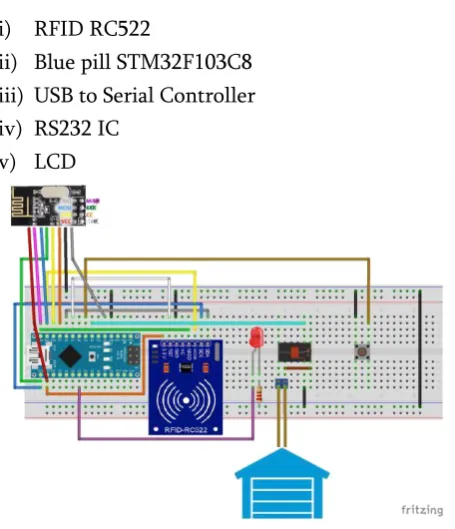
The below fig. shows the Basic Model design of the proposed paper, in which we can use following components.
i) RFID RC522
ii) Blue pill STM32F103C8 iii) USB to Serial Controller iv) RS232 IC
v) LCD
Figure 3. Basic Implementation Model Design
VII.
HARDWARE IMPLEMENTATION AND
WORKING
down transformer is used to step down the power from 220V to 5V to the circuit. It works smartly if anyone enters through the door than IR sensors which are placed in door to count the person, if person enter in the room then the starts working, it means it won’t work if there is no person inside the home then automatically the loads of the home is turns off. There are three control methods through which we can control it through three methods:
Manually control
DTMF Control
Computer control
VIII.
WORKING OF RFID MOTION SENSOR
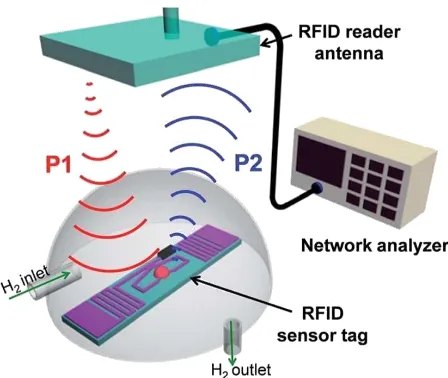
RFID methods utilize radio waves to accomplishthis. At a simple level, RFID systems consist of three components: an RFID tag or smart label, an RFIDreader, and an antenna. RFID tags contain anintegrated circuit and an antenna, which are used
to transmit data to the RFID reader.
IX.
WORKING OF PROTOTYPE
The prototype can be used in following two ways:
As a smart security system
As a smart home automation system
Figure 4. RFID Sensor working principle
WORKING OF
The prototype can be used in following two ways: i. As a smart security system
ii. As a smart home automation system
A. As a smart security system
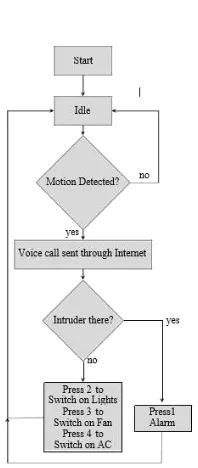
PIR motion sensors are installed at the entrances of a building. These sensors as explained earlier detect the motion of human beings. This signal which detects their presence becomes the input trigger for the micro-controller. The owner, who may or may not be present in that building, will be receiving a voice call on his mobile phone (whose number is predefined in the program) stating that ’There is an Intruder in the House’. To turn ON the lights and alarm at house so that the intruder will be warned, the owner can press ’1’ from his mobile keypad. Moreover, if the owner finds that his building is not safe, he can send an SMS [8] to the concerned authority in police department; explaining his situation. The module will turn OFF the alarm and lights after a fixed time delay. The call will be triggered again as soon as the module detects any unexpected motion and the owner will receive the call again and the process continues so on.
B. As a smart home automation system
security system again by pressing proper digits known to him. Since the appliances are connected to mains supply through a relay they can be easily controlled using micro-controller
X.
FLOW CHART
Figure 5. Flow chart of simple Smart Home Application.
XI.
SECURITY AND PRIVACY CHALLENGES
The major challenges with smart homes are the reliability of the sensors and surveillance systems,
their calibration, provision of reliable
communication from and to smart homes, granting security and integrity of data, provision of action plan or scenario in case of system failure or denial of services, security for the integration systems, including devices and decision taking software. In addition to the danger, related to the reliability and
security, which are of technological and
architectural design nature, there are also social dangers and also Smart Home can collect massive amounts of data, some of which can be sensitive.
Smart home systems can be manipulated, hijacked, or attacked impacting the private lives of user.XII.
PERFORMANCEELEMENT
We have measured temperature and humidity. Which we have set by which it continuously senses temperature and humidity. In the screenshot given below, it continuously senses temperature and humidity after every 5 sec.
Table 1. performance reading
Sl.no Parameter Reading
1 Temp 21
2 Humidity 27
Figure 6. Displaying current temperature and humidity.
XII.
APPLICATION
Lighting Control: Leaving the Dark Ages and Stepping into the Light
HVAC Regulation: No Longer Burned by Your Heating Bill
To help Handicapped people
Where less energy consumption is major factor
XIII.
DISADVANTAGE
HIGHER COST
Govt. Spend a lot of electronic facilities and new book.
NOT MUCH DEMOCRATIZATION IN
EDUCATION
Student have no choice on what to learn and when to sit for exam.
LACK OF TECHNOLOGICAL INFRASTRUCTURE AND TEACHING MATERIALS IN SCHOOL INRURAL AREA
Don’t have much chance to be expose to technology. Limited internet connectivity.
XIV.
CONCLUSION
This paper is based on the meaning of smart phones and all the details of smart home elements, projects and challenges. The use of modern technology is adding to a safe and comfortable living environment for everybody. For the disabled person, the benefits are even greater. Many new technologies are exploring more and more and day by day. Smart is the good and beneficial who is very much easy with their professional life and also for those who are about security and comfort but they want to save their electrical energy that is wasted by many people in regular span of time. With the introduction of smart home people are living and will obviously live more comfortable life. All the time home can be save from automation so that we will have much more time work on the other things or pursuits. The use of Blue pill development board will reduce around 70% of cost on Development board. In order to have security and to reduce the cost instead of RFID we can use PIR sensor and GSM Sim model by sending message to the controller.
XV.
REFERENCES
1. C Douligeris, Intelligent Home Systems, IEEE Communications Magazine.
2. R. J. C. Nunes and J. C. M. Delgado, An Internet Application for Home Automation, 10th Mediterranean Electro Technical Conference, MeleCon 2000, Vol. I
3. Adamu Murtala Zungeru 1*, Ufaruna Victoria Edu 2, Ambafi James Garba,‖ Design and Implementation of a Short Message ServiceBased Remote Controller‖ Computer Engineering
andIntelligent Systems ISSN 2222-1719 (Paper) ISSN 2222-2863 (Online) Vol 3, No.4, 2012.
4. Chetana Sarode, Prof.Mr.H.S.Thakar ,‖
Intelligent Home Monitoring System‖,