Harvesting Multi-Word Expressions from Parallel Corpora
Š
pela Vintar, Darja Fi
š
er
Dept. of Translation, Faculty of Arts, University of Ljubljana !"#$%&$'()*+),-1000 Ljubljana, Slovenia
[email protected], [email protected]
Abstract
The paper presents a set of approaches to extend the automatically created Slovene wordnet with nominal multiword expressions. In the first approach multiword expressions from Princeton WordNet are translated with a technique that is based on wordalignment and lexicosyntactic patterns. This is followed by extracting new terms from a monolingual corpus using keywordness ranking and contextual patterns. Finally, the multiword expressions are assigned a hypernym and added to our wordnet. Manual evaluation and comparison of the results shows that the translation approach is the most straightforward and accurate. However, it is successfully complemented by the two monolingual approaches which are able to identify more term candidates in the corpus that would otherwise go unnoticed. Some weaknesses of the proposed wordnet extension techniques are also addressed.
1. Introduction
WordNet (Fellbaum 1998) is an extensive lexical database in which words are divided by part of speech and organized into a hierarchy of nodes. Each node represents a concept and words denoting the same concept are grouped into a synset with a unique id (e.g. ENG2002853224n: {car, auto, automobile, machine, motorcar}). Concepts are defined by a short gloss (e.g. 4wheeled motor vehicle; usually propelled by an internal combustion engine) and are also linked to other relevant synsets in the database (e.g. hypernym: {motor vehicle, automotive vehicle}, hyponym: {cab, hack, taxi, taxicab}). Over time, WordNet has become one of the most valuable resources for a wide range of NLP applications, which initiated the development of wordnets for many other languages as well1.
One of such enterprises is the building of Slovene wordnet (Erjavec and Fišer 2006). The approach is based on extracting translation equivalents from parallel corpora with automatic wordalignment and disambiguating the polysemous words with wordnets that already exist for other languages. This paper is an extension of our previous experiment and tries to overcome the limitation of the alignment approach with a complementary method to add multiword expressions harvested from the JRCAcquis parallel corpus (Steinberger et al. 2006) to Slovene wordnet.
Multiword expressions (MWE) are lexical units that include a range of linguistic phenomena, such as nominal compounds (e.g. blood vessel), phrasal verbs (e.g. put up), adverbial and prepositional locutions (e.g. on purpose, in front of) and other institutionalized phrases (e.g. de facto). MWEs constitute a substantial part of the lexicon, since they express ideas and concepts that cannot be compressed into a single word. Moreover, they are frequently used to designate complex or novel concepts. As a consequence, their inclusion into wordnet is of
1See http://www.globalwordnet.org/gwa/wordnet_table.htm
[15.03.2008]
crucial importance, because any kind of semantic application without appropriate handling of MWEs is severely limited.
For the purpose of MWE identification, various syntactical (Bourigault 1993), statistical (Tomokiyo and Hurst 2003) and hybrid semanticsyntacticstatistical methodologies (Piao et al. 2003, Dias and Nunes 2004) have been proposed, to name but a few. Since the majority of MWEs included in the Princeton WordNet are nominal (see Table 1 below) and compositional, our approach is based on syntactic features of MWEs.
The rest of the paper is organized as follows: first, the Slovene WordNet Project is described. Section 3 describes the procedure used to extract multiword expressions from the corpus and their mapping to the wordnet hierarchy. The results are presented and evaluated in Section 4, and the paper ends with concluding thoughts and plans for future work.
2. The Slovene WordNet Project
We assumed that the multilingual alignment based approach can either convey sense distinctions of a polysemous source word or yield synonym sets based on the following criteria (cf. Dyvik 1998, Diab 2000 and Ide et al. 2000):
(a) senses of ambiguous words in one language are often translated into distinct words in another language (e.g. Slovene equivalent for the English word ‘school’
meaning educational institution is ‘šola’ and ‘jata’ for a large group of fish);
(b) if two or more words are translated into the same word in another language, then they often share some element of meaning (e.g. the English word ‘boy’ meaning a young male person can be translated into Slovene as either ‘fant’
or !"#$#%&).
In the experiment, corpora for up to five languages (English, Slovene, Czech, Bulgarian and Romanian) were wordaligned with Uplug (Tiedemann 2003) used to generate a multilingual lexicon that contained all translation variants found in the corpus. The lexicon was then compared to the existing wordnets in other languages. For English, the Princeton WordNet (Fellbaum 1998) was used while for Czech, Romanian and Bulgarian, wordnets developed in the BalkaNet project (Tufi. 2000) were used. If a match between the lexicon and wordnets across all the languages was found, the Slovene translation was assigned the appropriate synset id. In the end, all the Slovene words sharing the same synset ids were grouped into a synset.
The results obtained in the experiment were evaluated automatically against a manually created gold standard. A sample of the generated synsets was also checked by hand. The results were encouraging, especially for nouns with fmeasure ranging between 69 and 81%, depending on the datasets and settings used in the experiment. However, the approach had two serious limitations: first, the automatically generated network contains gaps in the hierarchy where no match was found between the lexicon and the existing wordnets, and second, the alignment was limited to singleword literals, thus leaving out all the multiword expressions.
3. Adding Multi-Word Expressions to
Slovene Wordnet
This section presents the three approaches we used to add multiword expressions to Slovene wordnet. The first approach is bilingual and uses a lexicon we extracted from the automatically wordaligned JRCAcquis corpus and lexicosyntactic patterns to find Slovene translations of English multiword expressions that are in Princeton WordNet (PWN).
The second two approaches are monolingual and aim to complement the translation approach by identifying additional multiword expressions that are not yet in PWN. Domainspecific MWEs were extracted from a fishing subcorpus of the JRCAcquis and filtered using fishingrelated seedwords found in Eurovoc2.
2http://europa.eu/eurovoc/ [15.03.2008]
In the final approach, we use lexicosyntactic patterns to extract semantically related expressions (hypernyms and hyponyms) from the corpus and then map them to Slovene wordnet.
3.1 Translation-Based Approach: Adding
MWEs Found in The Princeton WordNet
First, a list of multiword expressions PWN was extracted. As Table 1 shows, most of them were nouns. Since our alignmentbased approach proved to work best on nouns, we decided to limit our work to those (about 61,000). A large majority of the expressions do not belong to Base Concept Sets (about 64,000) that are the main constituents of the current version of Slovene wordnet. This means that this approach will generate a lot of new synsets, extending our wordnet even further (see Table 2).
POS Freq.
nouns 60,931 verbs 4,315 adverbs 955 adjectives 739 total 66,940
Table 1. The distribution of MWEs in PWN across POS
Group Freq.
other 64,205 BCS 3 1,470 BCS 2 926 BCS 1 339 total 66,940
Table 2. The distribution of MWEs in PWN across BCS
Table 3 shows that the polysemy of MWEs is not nearly as high as polysemy of singleword literals: a large majority of expressions were found in only one synset and very few were highly polysemous. This is why we were able to restrict the number of languages used in the experiment to English and Slovene only.
no. of synsets no. of MWE’s
1 56,989
2 3,335
3 453
4 108
5 40
6 6
total 60931 Table 3. Polysemy of MWEs in PWN
hypernyms used were too general to be of any informative value in taxonomy population (e.g. dejavniki, kot so poreklo, spol in starost [factors, such as origin, sex and age]).
4. Evaluation and Discussion of the Results
In this section we present the results of the experiment, which are evaluated manually. The evaluation consisted of checking whether a given MWE candidate is in fact an appropriate term and whether it was mapped to Slovene wordnet correctly. Each approach was first evaluated separately, then the findings were combined and compared.
4.1 Translation-Based Approach
The goal of this experiment was to find Slovene equivalents for MWEs found in the Princeton WordNet using the EnglishSlovene part of the JRCAcquis corpus (see Section 3.1). Since the equivalents proposed by the algorithm are ranked according to the average scores of their constituent singleword alignments, we set a threshold of 0.05 as the lowest possible similarity score. In this way we obtained a list of Slovene MWEs which were then checked by hand. Manual evaluation shows that 85% of MWEs were correctly translated into Slovene. These (1,059) were then all added to Slovene wordnet by retaining synset ids attached to each MWE we found in PWN (see Table 4).
English MWE Slovene MWE Equivalence
benzoic acid benzojska kislina 0.1551 economic and social
council ekonomskosocialni svet 0.1529 photographic
camera fotografska kamera 0.1516 republic of
mozambique republika mozambik 0.1485 tensile strength natezna trdnost 0.1452 red meat %/$&$)0$12 0.1448 brassica rapa brassica rapa 0.1437
Table 4: Example of translated MWEs
The advantage of this approach is that it is quite accurate, but also that it will extract less common translations for a source term as well (e.g. ‘milking cow’ is correctly translated as ‘krava mlekarica’ as well as ‘krava dojilja’). The quality of the results is however highly dependent on the quality of the word alignment, and – in turn – lemmatisation and POS tagging. Most errors that occurred during translation of an English MWE into Slovene were due to incomplete lexicosyntactic patterns for Slovene, thus extracting incomplete noun phrases. There were no errors in mapping synsets to Slovene wordnet.
4.2 Seed-Word-Based Approach
In this approach, we first extracted a list of multiword expressions from the fishing subcorpus, which was then filtered using a list of seed terms taken from Eurovoc (see Section 3.2). Here, all the expressions were extracted correctly and are indeed fishingrelated terms, because the restriction was that they must contain at least one seed word. We obtained however only 251 terms, 75 of which contain the seed word as the headword and thus directly imply their hyponymic relation to it, while 176 candidates contain the seed word either as a premodifier or postmodifier.
Hypernym assignment for terms that contain a seedword was almost perfect. All but 2 headwords were correctly identified in Slovene wordnet and the terms were added to them as their hyponyms. The two headwords that were missing in the wordnet (‘plovilo’ [vessel] and ‘mreža’ [net]) were compensated by finding one of their hyponyms in the network (‘ribiško plovilo’ [fishing vessel]
and ‘ribiška mreža’ [fishing net]) and treating the rest of the terms as their cohyponyms.
The approach was slightly less successful in cases where seedwords were pre or postmodifiers of MWEs. Wordnet contained hypernyms for 126 out of such 165 MWEs and 5 of the 175 hyponyms. However, in about a third of the cases there were more possible hypernym candidates. Since no automatic WSD was available, the correct hypernym was therefore selected by hand.
While our approach presupposes that MWE’s are compositional, i.e. that a MWE’s headword is at the same time its hypernym, this is not always the case, as the examples below show:
02%1#3)0$&)– *hyponym of –)0$& [sea sword (silver scabbardfish)] [sword]
morski pes – *hyponym of – pes [sea dog (shark)] – [dog]
It turned out that only 6 out of 175 MWEs were noncompositional. For these the appropriate hypernym could not be identified from their constituent words and could therefore not be correctly added to wordnet.
4.3 Pattern-Based Approach
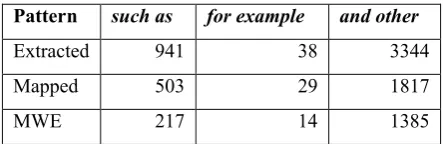
In the last approach we used lexicosyntactic patterns to extract words from the corpus that are in a hypernymhyponym relation. The extracted candidates were then mapped to wordnet (see Section 3.3). Table 5 gives the results of candidate extraction and mapping. It must be noted here that not all NP’s we harvested from the corpus were MWE’s and are therefore not included in evaluation and discussion in this paper.
Pattern such as for example and other
Extracted 941 38 3344
Mapped 503 29 1817
MWE 217 14 1385
The biggest drawback of this approach was the nature of
1,059 251 4,323 5,597
Ide, Nancy, Tomaž Erjavec & Dan Tufis (2002): Sense Discrimination with Parallel Corpora. In Proceedings of ACL'02 Workshop on Word Sense Disambiguation: Recent Successes and Future Directions, Philadelphia, 5460.
4%15$'+) 6'$5(7(+) 89) :(';2'3<=(>$53<+) ?9 Vitas & I. @A%(/2'3<) B*CCDEF) G137H) 5$I5J(;) %$12J%K$1) 37) developing Serbian wordnet. In: Romanian Journal of Information Science and Technology. (Volume 7, No. 12), pp 147161.
Malaisé, Véronique, Pierre Zweigenbaum & Bruno Bachimont (2007): Mining defining contexts to help structuring differential ontologies. In: IbekweSanJuan et al. ApplicationDriven Terminology Engineering. Amsterdam: John Benjamins, pp.1947.
Piao, S., Rayson, P., Archer, D., Wilson, A. & McEnery, T. (2003): Extracting Multiword Expressions with a Semantic Tagger. In Workshop on Multiword Expressions of the 41st ACL meeting. 712 July. Sapporo. Japan. 4957.
Steinberger Ralf, Bruno Pouliquen, Anna Widiger, Camelia -H7(5+) L20(>) M%N('$K+) ?(7) LJO3.) P) ?Q73$;) Varga (2006): The JRCAcquis: A multilingual aligned parallel corpus with 20+ languages. In: Proceedings of the 5th International Conference on Language Resources and Evaluation. Genoa, Italy, 2426 May 2006.
Tiedemann, Jörg (2003): Recycling Translations Extraction of Lexical Data from Parallel Corpora and their Application in Natural Language Processing, Doctoral Thesis. Studia Linguistica Upsaliensia 1. Tomokiyo, T. & Hurst, M. (2003): A Language Model
Approach to Keyphrase Extraction. In Workshop on Multiword Expressions of the 41st ACL meeting. 712 July. Sapporo. Japan. 3341.
Tufis, Dan (2000): BalkaNet Design and Development of a Multilingual Balkan WordNet. In: Romanian Journal of Information Science and Technology Special Issue (Volume 7, No. 12).