eXtended WordFrameNet
Egoitz Laparra, German Rigau
IXA NLP Group, University of the Basque Country, Donostia, Basque Country {egoitz.laparra, german.rigau}@ehu.es
Abstract
This paper presents a novel automatic approach to partially integrate FrameNet and WordNet. In that way we expect to extend FrameNet coverage, to enrich WordNet with frame semantic information and possibly to extend FrameNet to languages other than English. The method uses a knowledge-based Word Sense Disambiguation algorithm for matching the FrameNet lexical units to WordNet synsets. Specifically, we exploit a graph-based Word Sense Disambiguation algorithm that uses a large-scale knowledge-base derived from existing semantic resources. We have developed and tested additional versions of this algorithm showing substantial improvements over state-of-the-art results. Finally, we show some examples and figures of the resulting semantic resource.
1. Introduction
Building large and rich predicate models for broad– coverage semantic processing as FrameNet (Baker et al., 1998), VerbNet (Kipper, 2005) or PropBank (Palmer et al., 2005) takes a great deal of expensive manual effort involving large research groups during long periods of development. In fact, the coverage of currently available predicate-argument resources is still unsatisfactory. For example, (Burchardt et al., 2005) or (Shen and Lapata, 2007) indicate the lim-ited coverage of FrameNet as one of the main prob-lems of this resource. Currently, FrameNet1.3 covers around 10,000 lexical-units while for instance, Word-Net3.0 contains 206,941 word senses. Furthermore, the same effort should be invested for each different language (Subirats and Petruck, 2003). Following the line of previous works, we empirically study a novel approach to partially integrate FrameNet (Baker et al., 1998) and WordNet (Fellbaum, 1998). The method relies on the use of a knowledge–based Word Sense Disambiguation (WSD) algorithm that uses a large-scale graph of concepts derived from WordNet (Fell-baum, 1998) and eXtented WordNet (Mihalcea and Moldovan, 2001). The WSD algorithm is applied to coherent groupings of words belonging to the same frame. In that way we expect to extend the coverage of FrameNet (by including closely related concepts from WordNet), to enrich WordNet with frame semantic in-formation (by porting frame inin-formation to WordNet) and to extend FrameNet to languages other than glish (by exploiting local wordnets aligned to the En-glish WordNet).
WordNet 1 (Fellbaum, 1998) is by far the most widely-used knowledge base. It contains manually
1http://wordnet.princeton.edu/
coded information about English nouns, verbs, ad-jectives and adverbs and is organized around the no-tion of a synset. A synset is a set of words with the same part-of-speech that can be interchanged in a cer-tain context. For example,<premier, prime minister, chancellor>form a synset because they can be used to refer to the same concept. A synset is often fur-ther described by a gloss, in this case: ”the per-son who is head of state (in several countries)” and by explicit semantic relations to other synsets, in-cluding hypernymy/hyponymy, meronymy/holonymy, antonymy, entailment, etc.
FrameNet2(Baker et al., 1998) is a very rich semtic resource that contains descriptions and corpus an-notations of English words following the paradigm of Frame Semantics (Fillmore, 1976). In frame seman-tics, a Frame corresponds to a scenario that involves the interaction of a set of typical participants, play-ing a particular role in the scenario. FrameNet groups words or Lexical Units (LUs hereinafter) into coherent semantic classes or frames, and each frame is further characterized by a list of participants or Frame Ele-ments (FEs hereinafter). Different senses for a word are represented in FrameNet by assigning different frames.
Currently, FrameNet represents more than 10,000 LUs and 825 frames. More than 6,100 of these LUs also provide linguistically annotated corpus examples. However, only 722 frames have associated a LU. From those, only 9,360 LUs3where recognized by WordNet (around 92%) corresponding to only 708 frames. LUs of a frame can be nouns, verbs, adjectives and ad-verbs representing a coherent and closely related set
2http://framenet.icsi.berkeley.edu/
nouns verbs adjectives all
P R F P R F P R F P R F
wn-mfs 0.75 0.75 0.75 0.64 0.64 0.64 0.80 0.80 0.80 0.69 0.69 0.69 SSI-Dijkstra 0.84 0.65 0.73 0.70 0.56 0.62 0.90 0.82 0.86 0.78 0.63 0.69 SSI-Dijkstra+ 0.79 0.77 0.78 0.70 0.68 0.69 0.89 0.89 0.89 0.76 0.74 0.75
Table 1: Results of SSI algorithms on the GS dataset
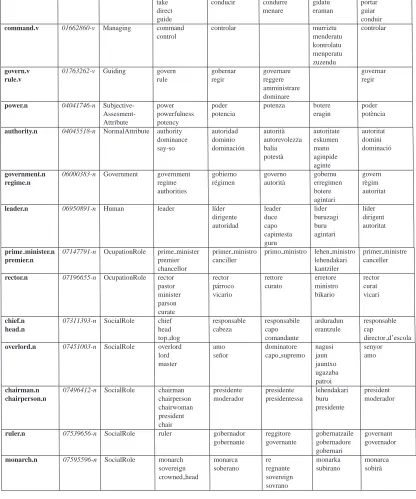
frame. In this case, 96 Spanish LUs have been associated to this particular frame, while the current version of the Spanish FrameNet does not contain this frame.
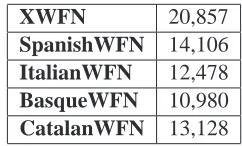
XWFN 20,857
SpanishWFN 14,106 ItalianWFN 12,478 BasqueWFN 10,980 CatalanWFN 13,128
Table 3: Multilingual WFN volumes
Furthermore, we have also transported to the disam-biguated LUs the knowledge currently available from other semantic resources integrated in the MCR such as SUMO (Niles and Pease, 2001), WordNet Domains (Magnini and Cavagli`a, 2000), etc. For instance, now the LU corresponding to premier.n can also have asso-ciated the SUMO label OccupationalRole and its cor-responding logical axioms, and the WordNet Domains person and politics. Note that when integrating mul-tiple semantic resources such as FrameNet, WordNet and SUMO, multiple discrepancies may arise. Possi-bly this process can also help to improve the involved knowledge resources.
4. Conclusions and future work
We have presented an ongoing work aiming to inte-grate FrameNet and WordNet. The method uses a knowledge based Word Sense Disambiguation (WSD) algorithm called SSI-Dijkstra+ for assigning the ap-propriate synset of WordNet to the semantically re-lated Lexical Units of a given frame from FrameNet. This algorithm relies on the use of a large knowl-edge base derived from WordNet and eXtended Word-Net. Since the original SSI-Dijkstra requires a set of monosemous or already interpreted words, we have devised, developed and empirically tested different versions of this algorithm to deal with sets having only polysemous words. The resulting new algorithms ob-tain improved results over state-of-the-art. The inte-gration of FrameNet and WordNet allows to extend the current LUs coverage. In fact, it also allows to locate
conceptual areas currently uncovered by FrameNet frames. We also expect to improve the performance of the disambiguation process by using the definitions associated to the LUs. We also plan to disambiguate the Frame Elements and its corresponding definitions of a given frame. Thus, the resulting resource will also integrate the core semantic roles of FrameNet. For example, for the frame LEADERSHIP we will asso-ciate the appropriate WordNet synsets to the Frame Elements LEADER or GOVERNED. Finally, we also plan to provide WordFrameNet versions aligned to WordNet3.0 by using also the relations from the se-mantically annotated ”gloss corpus”.
Acknowledgement
This work has been supported by KNOW-2 (TIN2009-14715-C04-01) and KYOTO (ICT-2007-211423). Egoitz Laparra’s work is funded by a PhD grant from the Spanish government (BES-2008-001989) associ-ated to the project KNOW (TIN2006-15049-C03-01). We want to thank the anonymous reviewers for their valuable comments.
5. References
J. Atserias, L. Villarejo, G. Rigau, E. Agirre, J. Car-roll, B. Magnini, and Piek Vossen. 2004. The meaning multilingual central repository. In Pro-ceedings of GWC, Brno, Czech Republic.
C. Baker, C. Fillmore, and J. Lowe. 1998. The berke-ley framenet project. In COLING/ACL’98, Mon-treal, Canada.
A. Burchardt, K. Erk, and A. Frank. 2005. A Word-Net Detour to FrameWord-Net. In Proceedings of the GLDV 2005 GermaNet II Workshop, pages 408– 421, Bonn, Germany.
M. Cuadros and G. Rigau. 2008. Knownet: Building a large net of knowledge from the web. In 22nd In-ternational Conference on Computational Linguis-tics (COLING’08), Manchester, UK.
J. Daud´e, L. Padr´o, and G. Rigau. 2003. Validation and Tuning of Wordnet Mapping Techniques. In Proceedings of RANLP, Borovets, Bulgaria.
FrameNet Synset SUMO WordFrameNet SpanishWFN ItalianWFN BasqueWFN CatalanWFN
lead.v 01364494-v Guiding lead llevar portare eroan dirigir
take conducir condurre gidatu portar
direct menare eraman guiar
guide conduir
command.v 01662860-v Managing command controlar murriztu controlar
control menderatu
kontrolatu menperatu zuzendu
govern.v 01763262-v Guiding govern gobernar governare governar
rule.v rule regir reggere regir
amministrare dominare
power.n 04041746-n Subjective- power poder potenza botere poder Assesment- powerfulness potencia eragin pot`encia Attribute potency
authority.n 04045518-n NormalAttribute authority autoridad autorit`a autoritate autoritat dominance dominio autorevolezza eskumen domini say-so dominaci´on balia manu dominaci´o
potest`a aginpide aginte
government.n 06000383-n Government government gobierno governo gobernu govern
regime.n regime r´egimen autorit`a erregimen r`egim
authorities botere autoritat
agintari
leader.n 06950891-n Human leader l´ıder leader lider l´ıder
dirigente duce buruzagi dirigent autoridad capo buru autoritat
capintesta agintari guru
prime minister.n 07147791-n OcupationRole prime minister primer ministro primo ministro lehen ministro primer ministre
premier.n premier canciller lehendakari canceller
chancellor kantziler
rector.n 07196655-n OcupationRole rector rector rettore erretore rector pastor p´arroco curato ministro curat minister vicario bikario vicari parson
curate
chief.n 07311393-n SocialRole chief responsable responsabile arduradun responsable
head.n head cabeza capo erantzule cap
top dog comandante director d’escola
overlord.n 07451003-n SocialRole overlord amo dominatore nagusi senyor lord se˜nor capo supremo jaun amo
master jauntxo
ugazaba patroi
chairman.n 07496412-n SocialRole chairman presidente presidente lehendakari president
chairperson.n chairperson moderador presidentessa buru moderador
chairwoman presidente
president chair
ruler.n 07539656-n SocialRole ruler gobernador reggitore gobernatzaile governant gobernante governante gobernadore governador
gobernari
monarch.n 07595596-n SocialRole monarch monarca re monarka monarca sovereign soberano regnante subirano sobir`a crowned head sovereign
sovrano
Table 4: Partial content of the frame LEADERSHIP in eXtended WordFrameNet
C. Fillmore. 1976. Frame semantics and the nature of language. In Annals of the New York Academy of Sciences: Conference on the Origin and Develop-ment of Language and Speech, volume 280, pages 20–32, New York.
K. Kipper. 2005. VerbNet: A broad-coverage, com-prehensive verb lexicon. Ph.D. thesis, University of Pennsylvania.
E. Laparra and G. Rigau. 2009. Integrating word-net and frameword-net using a knowledge-based word sense disambiguation algorithm. In Proceedings of
RANLP, Borovets, Bulgaria.
E. Laparra, G. Rigau, and M. Cuadros. 2010. Explor-ing the integration of wordnet and framenet. In Pro-ceedings of GWC, Mumbai, India.
B. Magnini and G. Cavagli`a. 2000. Integrating sub-ject field codes into wordnet. In Proceedings of LREC, Athens. Greece.
D. McCarthy, R. Koeling, J. Weeds, and J. Carroll. 2004. Finding predominant senses in untagged text. In Proceedings of ACL, pages 280–297.
word-net: Progress report. In Proceedings of NAACL Workshop on WordNet and Other Lexical Re-sources, Pittsburgh, PA.
R. Navigli and P. Velardi. 2005. Structural semantic interconnections: a knowledge-based approach to word sense disambiguation. IEEE Transactions on Pattern Analysis and Machine Intelligence (PAMI), 27(7):1063–1074.
I. Niles and A. Pease. 2001. Towards a standard upper ontology. In Proceedings of the 2nd International Conference on Formal Ontology in Information Sys-tems (FOIS-2001), pages 17–19. Chris Welty and Barry Smith, eds.
M. Palmer, D. Gildea, and P. Kingsbury. 2005. The proposition bank: An annotated corpus of seman-tic roles. Computational Linguisseman-tics, 31(1):71–106, March.
D. Shen and M. Lapata. 2007. Using semantic roles to improve question answering. In Proceedings of the Joint Conference on (EMNLP-CoNLL), pages 12– 21.
L. Shi and R. Mihalcea. 2005. Putting pieces to-gether: Combining framenet, verbnet and wordnet for robust semantic parsing. In Proceedings of CI-CLing, Mexico.
C. Subirats and M. Petruck. 2003. Surprise: Span-ish framenet! In Proceedings of the International Congress of Linguists, Praga.