Improving Chunking Accuracy on Croatian Texts by Morphosyntactic Tagging
Kristina Vu
č
kovi
ć
*, Željko Agi
ć
*, Marko Tadi
ć
**
*Department of Information Sciences **Department of Linguistics
Faculty of Humanities and Social Sciences, University of Zagreb Ivana Lučića 3, 10000 Zagreb, Croatia
{kvuckovi, zeljko.agic, marko.tadic}@ffzg.hr
Abstract
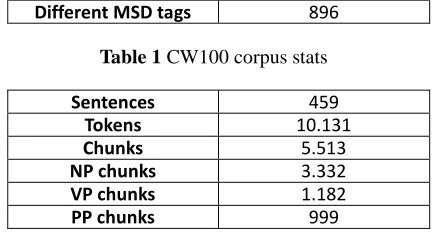
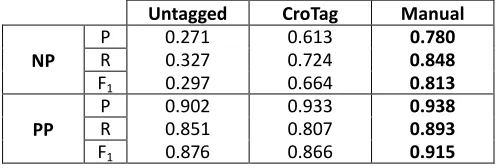
In this paper, we present the results of an experiment with utilizing a stochastic morphosyntactic tagger as a pre-processing module of a rule-based chunker and partial parser for Croatian in order to raise its overall chunking and partial parsing accuracy on Croatian texts. In order to conduct the experiment, we have manually chunked and partially parsed 459 sentences from the Croatia Weekly 100 kw newspaper sub-corpus taken from the Croatian National Corpus, that were previously also morphosyntactically disambiguated and lemmatized. Due to the lack of resources of this type, these sentences were designated as a temporary chunking and partial parsing gold standard for Croatian. We have then evaluated the chunker and partial parser in three different scenarios: (1) chunking previously morphosyntactically untagged text, (2) chunking text that was tagged using the stochastic morphosyntactic tagger for Croatian and (3) chunking manually tagged text. The obtained F1-scores for the three scenarios were, respectively, 0.875 (P: 0.826, R: 0.930), 0.900 (P: 0.866, R: 0.937) and 0.930 (P: 0.912, R: 0.949). The paper provides the description of language resources and tools used in the experiment, its setup and discussion of results and perspectives for future work.
1.
Introduction
Implementing procedures for automatic processing of morphology and syntax are seen today as one of the most important milestones in enabling advanced language technologies for any language (cf. Krauwer, 2003). This is mainly due to the fact that:
• language processing modules such as current state-of-the-art morphosyntactic taggers or partial and deep parsers (cf. ACLWiki, 2010) make possible the fast creation of large quantities of annotated language resources without imposing high demands on manual annotators and
• these modules are very efficient pre-processing tools in large-scale natural language processing systems as their demands on processing time and space are small when compared to more complex systems.
These facts are especially true for languages with less complex morphology and syntax, such as English, where tasks like morphosyntactic tagging and parsing are today considered as more or less resolved issues. However, morphologically and syntactically complex languages – such as Slavic languages or, more specifically, Croatian language – still pose a challenge, in terms of both accuracy and overall system efficiency, even in these basic tasks (cf. Agić et al., 2009; Buchholz and Marsi, 2006; Nivre et al., 2007). In addition, pipelining natural language processing tools has shown to be a well-investigated and straight-forward way to increase the performance in many basic tasks such as morphosyntactic tagging and parsing.
With an overall goal of enabling advanced language technologies for Croatian language (cf. Dalbelo Bašić et al., 2007) we have developed, among other modules, a stochastic morphosyntactic tagger (cf. Agić et al., 2008) and a rule-based chunker and partial parser (Vučković et
al., 2008; Vučković, 2009). In this paper, we present results of an experiment in the attempt to improve the performance of the chunker by using a morphosyntactic tagger as a pre-processing module for the chunker.
Development and improvement of parsers brought a belief that the role of morphosyntactic taggers as pre-processing tools is weakening (cf. Charniak et al., 1996; Charniak, 1997) and that modern parsers do not really benefit from pre-tagging the input, or at least not substantially. However, in our opinion, this claim may be shown to be valid mainly for languages with less complex morphology and syntax and not for morphologically complex languages. From this specific perspective, our experiment was also targeted to show whether such a claim is applicable to Croatian and whether pre-tagging of the input text provide better chunking results when compared to chunking previously untagged text. Other related work might include approaches such as (Pla et al., 2000), (Nasr and Volanschi, 2006) and (Domínguez and Infante-Lopez, 2008).
The following chapter of the paper presents the setup of the experiment or, namely, the language resources and tools we used in conducting it. Further, we discuss the obtained results and conclude by stating an outline for our future work plans.
2.
The experiment
In this chapter, we provide a brief description of language resources and tools used in the experiment, along with the experiment framework.
2.1
Morphosyntactic tagger
Lecture Notes In Artificial Intelligence 5221. Proceedings of the 6th International Conference on Advances in Natural Language Processing (ANLP).
Gothenburg, Sweden, pp. 126 - 137.
Erjavec, T. (2004). MULTEXT-East Version 3: Multilingual Morphosyntactic Specifications, Lexicons and Corpora. Proceedings of the Fourth International
Conference on Language Resources and Evaluation.
ELRA, Paris-Lisbon 2004, pp. 1535-1538.
Halácsy, P., Kornai, A., Oravecz, C. (2007). HunPos - an open source trigram tagger. Proceedings of the 45th
Annual Meeting of the Association for Computational Linguistics, Companion Volume, Proceedings of the
Demo and Poster Sessions. Association for
Computational Linguistics, Prague, Czech Republic, 2007, pp. 209-212.
Krauwer, S. (2003), The Basic Language Resource Kit (BLARK) as the First Milestone for the Language Resources Roadmap. Proceedings of SPECOM 2003. Moscow, 2003.
Nasr, A., Volanschi, A. (2006). Integrating a POS Tagger and a Chunker Implemented as Weighted Finite State Machines. Lecture Notes in Computer Science 4002 –
Finite-State Methods in Natural Language Processing.
Springer, pp. 167-178.
Nivre, J. (2006). Inductive Dependency Parsing. Text,
Speech and Language Technology, Vol. 34. Springer,
Dordrecht, The Netherlands.
Nivre, J., Hall, J., Kübler, S., McDonald, R., Nilsson, J., Riedel, S., Yuret, D. (2007). The CoNLL 2007 Shared Task on Dependency Parsing. Proceedings of the
CoNLL Shared Task of EMNLP-CoNLL 2007. Prague,
Czech Republic, pp. 915-932.
Pla, F., Molina, A., Prieto, N. (2000). Improving Chunking by Means of Lexical-Contextual Information in Statistical Language Models. Annual Meeting of the
ACL. Proceedings of the 2nd Workshop on Learning Language in Logic and the 4th Conference on Computational Natural Language Learning - Volume 7,
pp. 148-150.
Silberztein, M. (2004). NooJ: an Object-Oriented Approach. INTEX pour la Linguistique et le Traitement
Automatique des Langues. Muller, C., Royauté, J.,
Silberztein, M. (eds), Cahiers de la MSH Ledoux. Presses Universitaires de Franche-Comté, pp. 359-369. Silberztein, M. (2005). NooJ’s Dictionaries. Proceedings
of the 2nd Language and Technology Conference.
Poznan University, 2005.
Silberztein, M. (2006). NooJ Manual. Available at URL http://www.nooj4nlp.net/NooJ%20Manual.pdf. Tadić, M. (2000). Building the Croatian-English Parallel
Corpus. Proceedings of the Second International
Conference on Language Resources and Evaluation.
ELRA, Paris-Athens 2000, pp. 523-530.
Tadić, M. (2002). Building the Croatian National Corpus.
Proceedings of the Third International Conference on Language Resources and Evaluation. ELRA, Paris-Las
Palmas 2002, Vol. II, pp. 441-446.
Tadić, M., Fulgosi, S. (2003). Building the Croatian Morphological Lexicon. Proceedings of the EACL2003
Workshop on Morphological Processing of Slavic Languages. Budapest, ACL, 2003. pp. 41-46.
Tadić, M. (2005). The Croatian Lemmatization Server.
Southern Journal of Linguistics 29:1/2, pp. 206-217.
Tadić, M. (2006). Developing the Croatian National Corpus and Beyond. Contributions to the Science of
Text and Language. Word Length Studies and Related Issues. Kluwer, Dordrecht 2006, pp. 295-300.
Tadić M. (2007). Building the Croatian Dependency Treebank: the initial stages. Suvremena lingvistika 63, pp. 85-92.
Vučković, K., Tadić, M., Dovedan, Z. (2008). Rule Based Chunker for Croatian. Proceedings of the 6th
International Conference on Language Resources and Evaluation. Marrakech-Paris, ELRA, 2008.