© 2018 IJSRCSEIT | Volume 3 | Issue 5 | ISSN : 2456-3307
Detection of Emotions and mood using IoT, Android and
Machine Learning
Asst. Prof. Bhavana R M
Department of Computer Science & Engineering, Visvesvaraya Technological University, CPGS, Kalaburagi, Karnataka, India
Ms. Anusha U Pattan
PG Student, Department of Computer Science & Engineering, Visvesvaraya Technological University, CPGS, Kalaburagi, Karnataka, India
ABSTRACT
Understanding human thoughts since times always remained a mysterious challenge for the scientific discipline as is the circumstance with the emotions of human beings. The numerous techniques of Emotion detection has already been discovered, one among which we here have discovered is the detection of emotion which is here done using internet of things (IoT) and Machine learning technique. This paper is being proposed to present the scheme and execution of a emotion detection application, that has been calculate to detect the emotion and mood of a person for examining the triad physical constraints (temperature, pulsate, motion and skin electro-conductance) by means of algorithm that is related machine learning that is being trained with data set provided by an application called to be a mood detector. This application is tested redundantly unless the result which is produced by a learning algorithm that is confirmed to 100%, as a consequence affirming that the algorithms of machine learning offers the accurate results. An application coordinates a recommendation of music framework that recommends the client to pin their ears back to the vague music, which has been created to the recognized emotion. In this paper, we design a probabilistic data collection mechanism and on the collected data we perform a correspondence analysis. Finally we design a statistical model to anticipate the human temperament and recommend a music playlist in accordance with their current temperament.
Keywords : Internet of Things (IoT), GSR sensor, Motion sensor, Temperature and Humidity sensor.
I. INTRODUCTION
The emotions always characterize the specific mood of a particular individual. Emotions will affect a person’s behavior and temper. They can identify the nature of an individual that is firmly related by sensory methods. As defined by Daniel Schacter, the emotions can be categorized in both positive and negative aids that are linked with a specific form of psychosomatic action. In this environment, the
provided to the respective emotional state of an individual. Based on the medical science and sensibility, the emotional states are formed using the similar significant sensory method that effects all the parts of human creature, accordingly suppose an individual found to be undergoing with dissimilar types of tempers, then rise or drop in the oxygen ranks in the body takes place. This mechanisms like an involuntary process. A set of investigators has found that the heat fluctuates in the body based on the annoyance faced by a person owing with the reaction and sensations. Moreover, the study can be recommenced by the figure of a particular individual presenting alterations of heat within dissimilar tempers. Former studies bring together the emotional states and generate prototypes which measure the temperaments which in turn fit in some classes. The streamlined structure is applied in this paper to launch probable core moods which are Happy, Sad, Angry Depression and Surprise.
II. RELATED WORK
Related work is depicted in Table 1:
05 Hauke
III. PROPOSED MODELING
of client-server using the Internet of Things (IoT) and Android platform the development of application is done. To detect the mood of a user so that it helps if a detected mood is stressed than to calm down to normal mood, by which the user can take care of his health if the user is a patient who has some heart related diseases. The problem statement is to detect the probable four moods: Happy, Sad, Angry, Depression and Surprise. The proposed determines the mood of an individual by developing an application named as mood detector, the triad sensors provides the crucial physical parameters. Additionally, a recommender system with music, songs, videos, quotes, etc. are provided by this application depending on the current temporal state which is detected by this application. Functional requirements are the standard equipment that the client expects from software. The functionality that the system should deliver is,
Receive data from the sensors.
Analyzing the collected data.
Classify the data set.
Identify the emotional state.
Recommend the music list for detected mood.
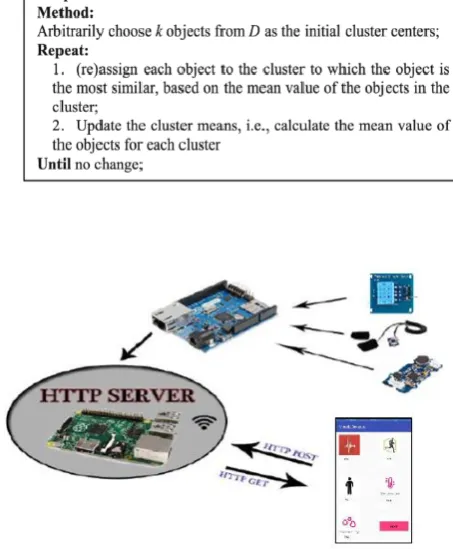
We have used the K-means clustering algorithm for clustering the sensor data which is based upon the Euclidian distances and a cluster head selection to be influenced by left over energies of the nodes, it is being principally constructed. The node which is at the center gathers a data set related to ID of a node, the position and a residual energy of all the nodes and also stocks the data in the list in a central node. Further on collecting this data set from each and every node which initiates in carrying out the algorithm of clustering (k-means clustering algorithm).The pseudo code for K-means clustering algorithm:
Figure 1: System Architecture
Figure 1 shows the system architecture in which the data is collected from the user wearing sensors that may be Galvanic skin response (GSR) sensor, Temperature & Humidity sensor and motion sensor, the sensor data is forwarded to the Android phone using Bluetooth module, using which the mood is detected, the communication between the android phone n server is done using internet to recommend the Music playlist to the user. Our proposed system has the following modules:
A. Module 1: Registration Module
This is the first module of our system. In this module the user of the body sensor network should register in the smart phone using the android app while registering user enters the relevant personalized info such as User ID, PINCODE, Name, E - mail Id, Mobile Numbers. The details used in registration are forwarded to a database.
B. Module 2: Data Collector Module
than sent to a server. This sensors used in this project are galvanic skin response (GSR) sensor, motion detector, temperature detector. The detectors are connected from an Arduino board and the details of the data collected by the server transferred using Bluetooth.
C. Module 3: Server Module
The server manages the resources at one end and to the other end admin. The mood detector recommends the music playlist from the server. The user can browse the resources to their respective mood which is detected by the mood detector. D. Module 4: Application Module
The application module is the user assistance module for the user interface directly. The application provides the assistance to the user to analize the mood of a person and recommend the music playlist.
IV.EXPERIMENTAL SETUP
The hardware setup of our proposed solution consists of Arduino board to which connect Bluetooth HC-05, different sensors like GSR sensor, Temperature and Humidity sensor and motion sensor for collecting data by physical parameters from user. The hardware setup of IoT devices are shown in figure 2.
Figure 2: Hardware setup of IoT devices.
V. RESULTS AND DISCUSSION
In our approach first we have collected the data from physical parameters of the user with the help of
various sensors like GSR sensor, Temperature & Humidity sensor and Motion sensor then we have paired the android phone with the Bluetooth. Next the user can register and login to find the mood into the mood detection application. The recommendation system is provided to the user for the various mood types.
Figure 3: The uploading of music playlist for a particular mood.
Figure 3 shows the process of browsing the video for a particular mood which is provided in the category followed by clicking on upload button to upload a particular video.
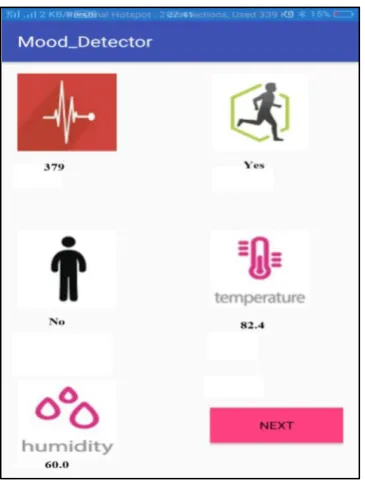
Figure 4 shows the sensor data which is collected from the sensors are being displayed accordingly.
Figure 5: Mood is detected using sensor data
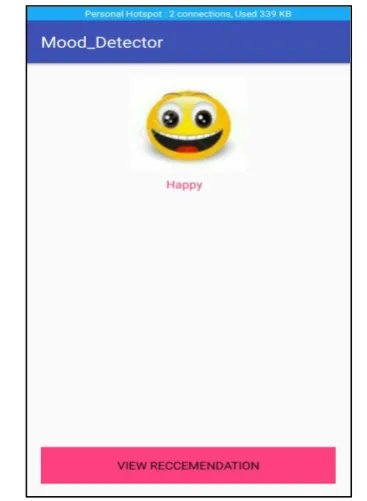
Figure 5 shows that the mood is detected for that particular sensor data.
Figure 6: Recommendation is provided.
Figure 6 shows the recommended video from the music playlist system for the respective mood.
VI.
CONCLUSION AND FUTURE SCOPE
An application for detecting the mood and emotions of a person is designed, by examining the physical parameters (temperature, pulsate, skin electro-conductivity and motion). Using IoT (Internet of things) sensors or detectors the data is collected and using Machine Learning Algorithm the data is classified and trained. This mobile application is being tested repeatedly until and unless the results produced by a learning algorithm (K-means clustering algorithm) is validated to 100%, thus approving that a Machine Learning Algorithms delivers accurate output.
The computing devices can be enhanced to achieve minor dimension, with the goal that it can be worn on the wrist, like fitness wrist trinkets or bracelets designed for sportspersons. This application can also be protracted out on other platforms, for example, web platforms or iOS. In addition, a music data base can also be protracted to a richer play-list, and this application can be reassessed to recommend things in diverse arenas like books, motion pictures, movie theaters, events or amusement places.
VII.
REFERENCES
1. David Watson, Lee Anna Clark and Auke Tellegen, “Development and Validation of Brief Measures of Positive and Negative Affect: The PANAS Scales”, Journal of personality and social phychology, Copyright 1988 by the American Psychological Association, Inc.1998. 2. Claudia Ferraris, Daniele Pianu, A. Chimienti,
Giuseppe Pettiti , V. Cimolin, N. Cau and R. Nerino, “Evaluation of Finger Tapping Test Accuracy using the LeapMotion and the Intel
https://www.researchgate.net/publication/2895 20148, August 2015.
3. Azeez Olusegun Odumosu, “Creation of an infracture of intelligent objects that sensorize the campus classrooms”, UPC eetac, 22 june 2017.
4. Andreas Aspernäs & Thommy Simonsson, “IDS on Raspberry Pi: A Performance Evaluation” Diploma thesis.
5. Hauke Petersen, Emmanuel Baccelli, and Matthias Wahlisch, “Interoperable Services on Constrained Devices in the Internet of Things”, Interoperable Services on Constrained Devices in the Internet of Things, https://hal.inria.fr/hal-01058636, 27 August 2014.
6. Dmytro Zubov, “An IoT Concept of the Small Virtual Power Plant Based on Arduino Platform and MQTT Protocol”, International Conference on Applied Internet and Information Technologies, 2016.
7. Muhammad Ali Shafique, Umer Shahid, Ijhar Khan, Arslan Waheed, Muhammad Arsalan and Hamza Omar, “Implementation of Wi-Fi based home automation using master slave communication”,
https://www.researchgate.net/publication/3039 87635 June 2016.
8. Schacter, Daniel L Psychology Second Edition”. 41 Madison Avenue, New York”, 2011.
9. Nummenmaa, Lauri, Enrico Glerean, Riitta Hari, Jari K. Hietanen, „Bodily maps of emotions”, December 30, 2013.
10. Thayer, Robert E, J. Robert Newman, and Tracey M. McClain, „Self- Regulation of Mood: Strategies for Changing a Bad Mood, Raising Energy, and Reducing Tension”, 1994.
11. Ekman, Paul, „Emotions Revealed, Second Edition: Recognizing Faces and Feelings to Improve Communication and Emotional Life”, March, 2007
12. Google – Emotient: http://www.emotient.com/, 2015.
13. IntelRealSense:
http://www.intel.com/content/www/us/en/arc
hitectureand-technology/realsense-overview.html, 2015. 14. AdruinoUno:
https://www.arduino.cc/en/Main/arduinoBoard Uno, 2015.
15. Adaptor WiFi: