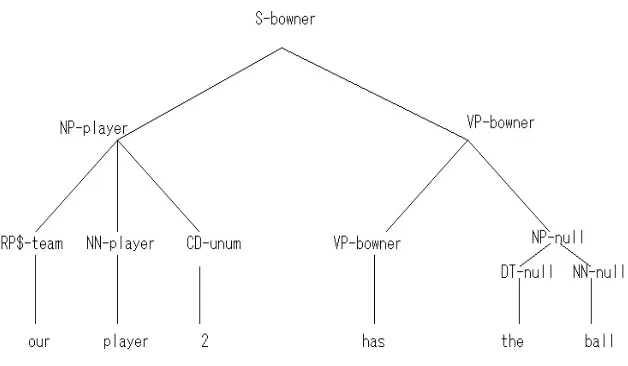
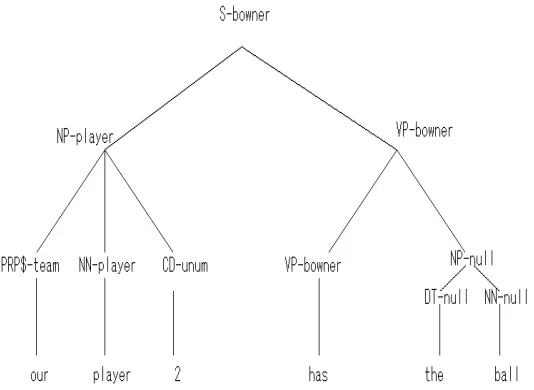
Figure 1. An Example of tree representation in SAPT
The general idea of producing a logical form using a SAPT structure is expressed as Algorithm 1. It generates a logical form based on a knowledge database K for given input node N. The GETSEMANTICHEAD determines which of node's children is its semantic head based on their having matching semantic labels. For example in Figure 2 N3 is determined to be the semantic head of the sentence, since it matches N8's semantic label. COMPOSEMR assigns their meaning
representation(MR) to fill the arguments in the head's MR to construct the complete MR for the node. Algorithm1 with an input which is the tree shown in Figure 1 yields the result in logical form as shown in Figure 2.
1: Ci=the ith child node of N
2: Ch=GETSEMANTICHEAD(N)
3: ChMR=BUILDMR(Ch,K)
4: for each other child Ciwhere i≠h do 5: CiMR= BUILDMR(Ci,K)
6: COMPOSEMR(ChMR,CiMR,K) 7: NMR =ChMR
Figure 2. Example of a logical form extracted from a SAPT (R.Ge:2005)
3.2.2 Structured SVM for Semantic Parsing
We obtained a set of sentences and their SAPT representation which are used for semantic parsing problem. As discussed in (Tsochantaridis, et.al., 2004), the major problem to apply the structured SVM is to implement the feature mapping ( , )ψ x y , the loss function ( , )∆ y yi , as well as the maximization algorithm.
3.2.3 Feature mapping
For semantic parsing, we can choose a mapping function to get a model that is isomorphic to a probabilistic grammar in which each rule within the grammar consists of both a syntactic rule and a semantic rule. Each node in a parse tree y for a sentence x corresponds to a grammar rule gj with a score wj. All valid parse trees y for a sentence x are scored by the sum of thewj of their nodes, and the feature mapping ψ( , )x y is a history gram vector counting how often each grammar rule gj
occurs in the tree y. The example shown in Figure 3 clearly explains the way features are mapped from an input sentence and a tree structure.
3.2.4 Loss function
In semantic parsing, a parse tree that differs from the correct parse tree in only a few nodes should be treated differently from a parse tree that is radically different. The correctness of the predicated parsed tree is measured by its F1 score, in which precision and recall are calculated based on the
overlap of nodes between trees. We used the F1 score as well as the zero-one loss for structured
support vector learning.
3.2.5 Maximization algorithm
Note that the learning function can be efficiently computed by finding the structure y∈Y that maximizes F x y w( ; ; )= w,δψi( )y via a maximization algorithm. Typically we used the variant
Figure 3. Example of feature mapping using tree representation
4. Experimental Results
We used the CLANG corpus which is the RoboCup Coach Language (www.robocup.org). In the Coach Competition, teams of agents compete on a simulated soccer field and receive advice from a team coach in a formal language. The CLANG consists of 37 non-terminal simples and 133 productions; the corpus for CLANG includes 300 sentences and their structured representation in SAPT (R.J.Kate, et.al., 2005). Below are some sample annotated statements from this corpus:
If player 4 has the ball, it should pass the ball to player 2 or 10. ((bowner our {4}) (do our {4} (pass {2 10}))))
No one pass to the goalie.
((bowner our {0}) (dont our {0} (pass {1}))))
If players 9, 10 or 11 have the ball, they should shoot and should not pass to players 2-8. ((bowner our {9 10 11}) (do our {9 10 11} (shoot)) (dont our {9 10 11} (pass {2 3 4 5 6 7 8})))
We used the standard 10-fold cross validation test for evaluating the method. NL test sentences were first tagged to a sequence of semantic tags, and those sequences were used to build trees in the form of SAPT via a structured support vector machine 1, then the MR's were built from the trees. We evaluated the accuracy of tagging a NL sentence to a sequence of semantic tags by computing the total number of correct semantic tags in comparison with the gold-standard. For this purpose, our CRF model obtained a very high result, with 98.5% accuracy after 24 iterations of training CRF by L-BFGs algorithm2. Figure 4 shows accuracy as a function of the number of L-BFGS training iterations. It indicates that the accuracy score increases smoothly with little fluctuation.
1
http://svmlight.joachims.org/
2
Figure 4. The relation of accuracy and iteration using L-BFGS estimation
To evaluate the method in parsing NL sentences to MR, we measured the number of test sentences that produced complete MR's, and the number of those MR's that were correct. For CLANG, an MR is correct if it exactly matches the correct representation, up to reordering of the arguments of commutative operators like "and". We used the exact the evaluation method presented in (R.J.Kate, et.al., 2005) in which the performance of the parser was then measured in terms of precision and recall as the formula below.
# c o rre ct-re p rese n tatio n P re cisio n
# co m p lete d -rep re sen ta tio n
# c o rre ct-rep rese n ta tio n R ec all
# co m p lete d -re p re sen tatio n
=
=
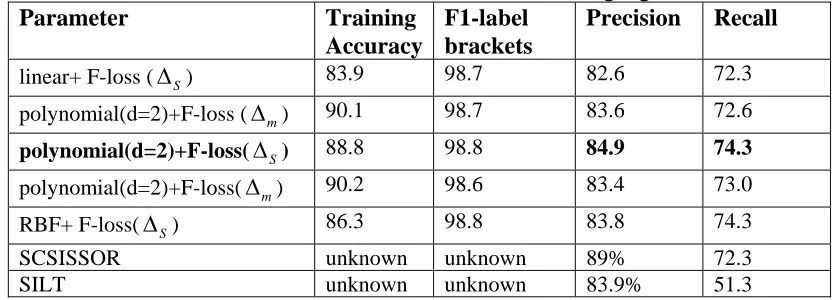
We conducted two experiments. The first was to investigate suitable parameters for structured support vector machines in the semantic parsing problem. The second experiment illustrated the performance of our method using the precision and recall measurements mentioned above. Table 2 shows the training accuracy when estimated on the CLANG corpus using a cross-validation test.
Table 2. Experiment results with CLANG corpus using cross-validation test with 20 iterations of training algorithm Parameter Training
Accuracy
F1-label brackets
Precision Recall
linear+ F-loss (∆S) 83.9 98.7 82.6 72.3 polynomial(d=2)+F-loss (∆m) 90.1 98.7 83.6 72.6 polynomial(d=2)+F-loss(∆S) 88.8 98.8 84.9 74.3 polynomial(d=2)+F-loss(∆m) 90.2 98.6 83.4 73.0
RBF+ F-loss(∆S) 86.3 98.8 83.8 74.3
SCSISSOR unknown unknown 89% 72.3
SILT unknown unknown 83.9% 51.3
Classification with Probabilistic Categorical Grammars, in the proceedings UAI 05.
Miller, et al. (1996): A fully statistical approach to natural language interfaces. Proceedings of the
34th Annual Meeting of the Association for Computational Linguistics, 55-61, 1996.
J.R. Mooney, 2004: Learning semantic Parsers: An Important but Under-Studied problem AAAI
2004 Spring Symposium on Language Learning: An Interdisciplinary Perspective, pp. 39-44, Stanford, CA. March.
L.R. Tang (2003): Integrating Top-down and Bottom-up Approaches in Inductive Logic Programming: Applications in Natural Language Processing and Relation Data Mining. Ph.D. Dissertation, Department of Computer Sciences, University of Texas, Austin, TX. J. Lafferty, A. McCallum, and F. Pereira (2001). Conditional random fields: probabilistic models
for segmenting and labeling sequence data. In proc. ICML, pages 282--289.
D. Liu and J. Nocedal (1989). On the limited memory BFGS method for large-scale optimization.
Mathematical Programming, 45:503--528.
F. Sha and F. Pereira (2003). Shallow parsing with conditional random fields. In Proc. HLT/NAACL, 2003.
I. Tsochantaridis, T. Hofmann, T. Joachims, and Y. Altun (2004). Support Vector Machine Learning for Interdependent and Structured Output Spaces, Proceedings of 21st International Conference on Machine Learning, Banff, Canada.
V. Vapnik 1998: Statistical Learning theory. Wiley and Sons Inc.
J.M. Zelle and R.J. Mooney (1996): Learning to parse database queries using inductive logic
programming. In Proceedings of the Third teen National Conference on Artificial Intelligence, AAAI-96, 1050-1055.