This also affects the context - Errors in extraction based summaries
Thomas Kaspersson, Christian Smith, Henrik Danielsson, Arne J¨onsson
Santa Anna IT Research Institute AB & Link¨oping University SE-581 83, Link¨oping, SWEDEN
[email protected], [email protected], [email protected], [email protected]
Abstract
Although previous studies have shown that errors occur in texts summarized by extraction based summarizers, no study has investigated how common different types of errors are and how that changes with degree of summarization. We have conducted studies of errors in extraction based single document summaries using 30 texts, summarized to 5 different degrees and tagged for errors by human judges. The results show that the most common errors are absent cohesion or context and various types of broken or missing anaphoric references. The amount of errors is dependent on the degree of summarization where some error types have a linear relation to the degree of summarization and others have U-shaped or cut-off linear relations. These results show that the degree of summarization has to be taken into account to minimize the amount of errors by extraction based summarizers.
Keywords:summarization, text cohesion, evaluation
1.
Introduction
An extraction based summary is created by extracting the most important sentences from the original text. Previous results have shown that broken or erroneous anaphoric ref-erences is a problem in extraction based summarizers (Has-sel, 2000) breaking the cohesion of the summarized text and in some cases even altering the meaning of the text, mak-ing them hard for readers to understand. Thus, cohesion and discourse relations play a vital role in understanding summaries (Louis et al., 2010). None of these studies have investigated how the occurrence of errors is distributed over the summarized texts or how different levels of summariza-tion are affected by the errors in terms of how the amounts of errors correlate with summary level.
In this paper we present results from investigations of the linguistic errors that occur in single document extract sum-maries. We focused mainly on discourse errors, such as re-ferring expressions with missed antecedent and fragments; how well the text units in the summaries are linked. This can be seen as a type of cohesion, which is an important part of coherence, i.e is the reader able to get a coherent meaning conveyed when reading the texts? By measuring distinct error types having to do with cohesion, an objective measure of a part of the coherent structure of the texts can be calculated.
The investigation further focused on the impact different text summary levels had on the amount of error types, and if different genres had any impact on the amount of error types.
The results will show what type of errors in the summary that is the most pronounced, and at what summary level and in what genres.
2.
The vector space model
Many extraction based summarizers utilize the vector space model. The vector space model (Eld´en, 2007), is a spatial representation of a word’s meaning where every word in a given context occupies a specific point in the space and has a vector associated to it that can be used to define its meaning.
The vector space can be constructed from a matrix where text units are columns and the words in all text units are rows. A certain entry in the matrix is nonzero iff the word corresponding to the row exists in the text unit represented by the column. The resulting matrix is very large and sparse, which makes for the usage of techniques for reduc-ing dimensionality and get a more compact representation. Random Indexing (Sahlgren, 2005; Kanerva, 1988) is one such dimension reduction technique that can be described as a two-step operation:
Step 1 A unique d-dimensional, sparse and high-dimensional index vectoris randomly generated and assigned to each context. Index-vectors consist of a small number,ρ, of randomly distributed +1s and -1s, with the rest of the elements of the vectors set to 0.
Step 2 Context vectorsare produced by scanning the text. Each time a word occurs in a context, that context’s index vector is added to the context vector for the word. A sliding window,w, defines a region of con-text around each word. Words are thus represented by
d-dimensional context vectors that are the sum of the index vectors of all the contexts in which the word ap-pears.
After the creation of word context vectors, the similarity between words can be measured by calculating the cosine angle between their word vectors.
The summarizer used in our investigations is a Random indexing based summarizer called COGSUM (Smith and J¨onsson, 2011). COGSUMalso uses the Weighted PageR-ank algorithm in conjunction to its Random Indexing-space to rank the sentences (Chatterjee and Mohan, 2007). The results however are valid for other vector space based sum-marization approaches e.g. HolSum (Hassel and Sj¨obergh, 2007), SummaryStreet (Franzke et al., 2005) and Gong (2001).
3.
Linguistic quality of summarizations
A variety of investigations on errors in summarizations have been done, for instance the evaluation of linguistic quality for summarizations used in the DUC (Document Understanding Conference) summarization track. Over et al. (2007) describe the following five aspects:1. Grammaticality; referring to the summary not having fragments or missing components
2. Non-redundancy; referring to the summary not having unnecessary repetitions
3. Referential clarity; meaning that pronouns and noun phrases should be properly referred to
4. Focus; meaning that the summary should have a focus
5. Structure and coherence; in that the summary should convey a coherent body of information.
Summarizers generally perform well in grammaticality and non-redundancy (Over et al., 2007). Grammatical errors may still arise in extraction based summaries, e.g. if lists or headings are not treated properly, but this more depends on how the summarizer converts documents to plain text. Otterbacher et al. (2002) further identify five major cat-egories on text cohesion related to multi-document sum-maries:
1. Discourse; relating to the relationships between sen-tences in a summary
2. Identification of entities; relating to resolution of ref-erential expressions
3. Temporal relationships, i.e. establish the correct tem-poral relationship between events
4. Grammatical problems
5. Location problems; where an event takes place
Otterbacher et al. (2002) aim to revise multi-document summaries and find that the first three categories comprise the majority (82%) of revisions done. For single document summaries, the third category, temporal relationships, is less prominent, as the temporal order, as given in the text, often is retained, which is not necessarily the case if the text is assembled from multiple-documents.
There are other studies on linguistic quality, e.g. Lapata and Barzilay (2005), and on automatic vs. human judge-ments (Pitler et al., 2010) that also stress the importance of cohesion, but none of them investigate the distribution between e.g. genres and summary lengths.
4.
Errors in extraction based summaries
We have conducted a pilot study to find error types in sum-marized texts that can have negative consequences on co-hesion, coherence and readability, making the summarized text difficult to read, or even incomprehensible. The task was to read summarized texts from three different genres with five levels of summarization, tagging everything in thetext that was considered an error with a description of the error.
We use three types of texts representing three different gen-res:
• DN. Newspaper texts from the Swedish newspaper ”Dagens Nyheter”; around 190 words per text
• FOF. Popular science texts from the Swedish Maga-zine ”Forskning och Framsteg”; around 650 words per article
• FOKASS. Authority texts from the Swedish Social Insurance Administration (Sw. F¨ors¨akringskassan); around 720 words per text
The texts were extracted from the concordances at Spr˚akbanken (2011), except for the authority texts which were taken from the Swedish Social Insurance Adminis-tration’s web page (F¨ors¨akringskassan, 2011). They were summarized to five different lengths: 17%, 33%, 50% 67% and 83%.
Tagging was done by four independent analyzers and each were given four summarized texts. The errors found were then grouped into different categories, resulting in three cat-egories and sub-catcat-egories:
1. Erroneous anaphoric reference (divided into three sub-types). When an anaphoric expression in the summa-rized text refers to an erroneous antecedent as the cor-rect antecedent has not been extracted. For an exam-ple of this see Figure 1. The sub-types of erroneous anaphoric references are:
(a) Noun-phrase (b) Proper names (c) Pronouns.
2. Absent cohesion or context. Sentences which in the summary lack any cohesion or context, necessary for understanding the extracted sentence.
3. Broken anaphoric reference, see Figure 2, (divided into three sub-types). When the summarized text con-tains one, or more, anaphoric expression(s) that has its antecedent in a sentence that has not been extracted. The sub-types of broken anaphoric references were:
(a) Noun-phrase (b) Proper names (c) Pronouns.
Typical examples of cohesion errors in extraction based summaries occur when the antecedent to an anaphora is not included in the summary, Figure 1.
The pronoun ”such” in the summary in Figure 1 does not have an antecedent in any previously extracted text, creat-ing a broken anaphoric reference. A slightly more difficult error type are erroneous anaphoric reference, when the cor-rect antecedent has not been extracted and at the same time altering the meaning and understanding of the text, as in Figure 2.
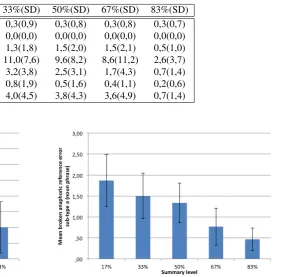
es-Table 1: Number of errors (and standard deviation (SD)) per one hundred sentences, based on sentence normalized data from all texts.
Error type 17%(SD) 33%(SD) 50%(SD) 67%(SD) 83%(SD)
1a 0,2(0,8) 0,3(0,9) 0,3(0,8) 0,3(0,8) 0,3(0,7) 1b 0,0(0,0) 0,0(0,0) 0,0(0,0) 0,0(0,0) 0,0(0,0) 1c 1,1(1,5) 1,3(1,8) 1,5(2,0) 1,5(2,1) 0,5(1,0) 2 9,9(6,0) 11,0(7,6) 9,6(8,2) 8,6(11,2) 2,6(3,7) 3a 3,8(3,9) 3,2(3,8) 2,5(3,1) 1,7(4,3) 0,7(1,4) 3b 1,1(3,2) 0,8(1,9) 0,5(1,6) 0,4(1,1) 0,2(0,6) 3c 3,1(3,4) 4,0(4,5) 3,8(4,3) 3,6(4,9) 0,7(1,4)
Figure 3: Error type 1c. Mean values of erroneous anaphoric references, sub-type pronoun. The effect on summary level is sig-nificantF(4, 108) = 2.87p< .05.
Figure 4:Error type 2.Mean values of absent cohesion or con-text. The effect on summary level is significantF(4, 108) = 14.01
p< .001.
F(4, 108) = 7.35p< .001.
Figure 5 shows the mean values of broken anaphoric ref-erences, sub-type noun phrase. The values show a linear decrease in errors from 17% summary level to 83% sum-mary level.
Error type 3c: Broken anaphoric references, pronoun. There was a significant effect of summary level. F(4, 108) = 10.04p< .001.
Figure 6 shows the mean values of broken anaphoric refer-ences, sub-type pronoun. The values show that summary levels 17%, 33% 50% and 67% have a fairly even amount of errors and that summary level 83% has significantly less errors.
Figure 5: Error type 3a.Mean values of broken anaphoric ref-erences, noun-phrase. The effect on summary level is significant
F(4, 108) = 7.35p< .001.
Figure 6: Error type 3c.Mean values of broken anaphoric ref-erences, pronoun. The effect on summary level is significantF(4, 108) = 10.04p< .001.
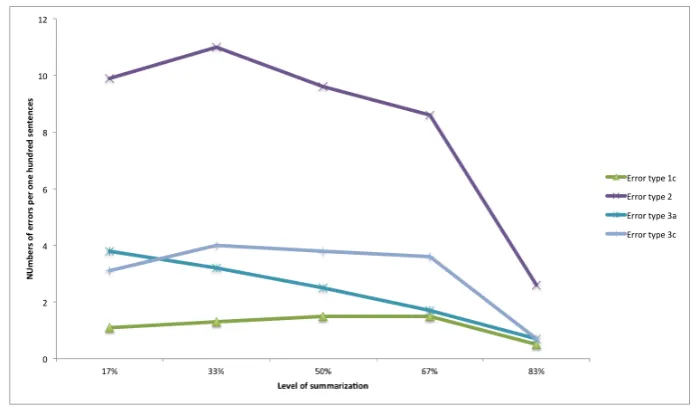
Figure 7 shows how the different error types with signifi-cant differences are spread over the five summary levels. As shown in Figure 7, Error type 2, absent cohesion or con-text, is the most dominant error type and occurs roughly once every tenth sentence depending on the summarization level.
Figure 7: Error type relations to summary level
whereas error types 3a and 2 show such behaviour.
7.
Discussion
Several differences could be observed across level of sum-marization. The following types of errors were found to be significant:
1c Erroneous anaphoric references, pronoun (Figure 3)
2 Absent cohesion or context (Figure 4)
3a Broken anaphoric references, noun phrase (Figure 5)
3c Broken anaphoric references, pronoun (Figure 6)
Furthermore, the error types with a significant effect also depend on summary level.
Error type 1c, erroneous pronoun reference, shows that the quantity of errors increase along with a decreased summary level, but only to a certain degree after which the quantity begins to decrease again. There is a significant difference between 17% and 33% compared to 50% and 67%, but also between 83% and 50%, 67%. A possible explanation for this is that at summary level 17% and 33% (the most sum-marized texts) the amount of extracted sentences are quite few, making the error decrease in amount as the sentences which make up the error are not extracted to the summary, and the extracted sentences at this level of summarization usually are adjacent. For summary level 83% however, the opposite happens as the amount of extracted sentences is high. The more extracted sentences, the lower the risk of erroneous anaphoric references as the risk of the correct antecedent not being extracted is much lower.
For Error type 2, absent cohesion or context, there is a sig-nificant difference in summary level between 17%, 33%, 50%, 67% and, 83%. This is interesting because the re-sults show that 17%, 33% and 50% have an almost equal amount of errors, after which the amount of errors start de-creasing almost linearly, and when passing 67% the differ-ence becomes significant. This means that it is not a linear increase or decrease in errors, but that the amount of errors
level out after a certain level of summarization. This sug-gests that in order to keep relevant cohesion or context, the level of summarization should be taken into consideration as a text summarized more than a certain given level will lose contextual information and lack cohesion. Error type 2 was also most dominant, Figure 7 which was expected as the cohesion of the text is expected to be affected by the extraction method, and is often the reason for errors like erroneous or broken references.
Error type 3a, broken anaphoric references sub-type noun-phrase, shows significant differences based on the level of summarization, and a trend of linear decrease when the summary level increased. This means that the fewer sen-tences extracted, the more noun phrases without an an-tecedent will occur, thus making it a broken anaphoric ref-erence. This kind of linear decrease in errors is the kind of result we expected to see in most error types.
Error type 3c, broken anaphoric references sub-type pro-noun, also shows a significant difference in level of summa-rization but the significance for this error is between sum-mary level 83% and 17%, 33%, 50%, 67%. This indicates a cut-off in the amount of broken anaphoric references where a pronoun does not have an antecedent. This means that this error type is persistent throughout a 17% level of summary up to 67% after which it seems to rapidly decrease. Thus, just like Error type 2, absent cohesion or context, Error type 3c, broken anaphoric references sub-type pro-nouns, follow the same pattern and show that the amount of errors is persistent until a certain cut-off point, after which the errors start to decrease linearly.