CSEIT1724202 | Received : 15 August 2017 | Accepted : 31 August 2017 | July-August-2017 [(2)4: 832-839]
International Journal of Scientific Research in Computer Science, Engineering and Information Technology © 2017 IJSRCSEIT | Volume 2 | Issue 4 | ISSN : 2456-3307
832
Internet of Things : A Survey
Jeyavarthni. M
*1, Dr. D. Ravindran
2, R. Stephan
3*1M.Phil Scholar, Department of Computer Science, St.Joseph’s College, Trichirappalli, Tamilnadu, India
2Associate Professor and Research Supervisor, Department of Computer Science, St.Joseph’s College, Trichirappalli, Tamilnadu, India 3Ph.D Scholar, Department of Computer Science, St.Joseph’s College, Trichirappalli, Tamilnadu, India
ABSTRACT
This is a survey about the Architecture of Internet of things(IoT) , the security reasons which are all the internet of things having yet , the terminologies and networking technologies are using in IoT, the gateway that are used for communications, what are all the hardware required for constructing internet of things. And the embedded Operating Systems, the cloud-platform being used for IoT, cloud vs fog computing are also been discussed. Then the 4g LTE the latest technologies has been facing the daily life combine with internet of things, Implementations of IoT in various fields were discussed by this survey. Then how these are all used in the various applications, what are the issues and challenges faced with IoT are discussed.
Keywords: IoT, Architecture, security, Terminology, Technologies, Applications
I.
INTRODUCTION
The IoT is a network of physical object or things that are embedded with electronics, software, sensors having ability to collect data all around the world. It is used in day-to-day life because of its size, ubiquity, security etc. IoT expands the interconnection between the personal, industrial are running through the cloud system and then the objects deliver the information and in some case they can change themselves to create overall management of large systems. The technologies of internet of things like security, the confidentiality, integrity, authentication and such things were discussed.
RPC (remote procedure call) is used to connect the nodes and let them to communicate with the edge. A procedure call is also sometimes known as a subroutine call. The edge is connected with the internet and communicates with the various devices for that 6LoWPAN is used. 6LoWPAN is an acronym of IPV6 over low power wireless personal area networks. It is the name of a concluded working group in the internet area of the IETF. Likewise, IEEE 802.15.4 devices provide sensing communication-ability in the wireless domain.
In embedded operating system, the platform on which the IoT being planted and the system which are all used for internet of things, then the cloud, fog platform are also used on IoT. Such hardware and software being used on IoT to construct and implement in day-to-day life are also discussed. The operating systems that are all used in internet of things and about the light weight operating system, emerging OS like android were proposed. The internet protocols such as IPV4 and IPV6 are the mobile protocol connectivity are also in the use of internet of things. The Implementation domain like WSN, RFID, M2M, SCADA are also been discussed in this survey. Applications such as home automation, cities, environment, energy, retail, logistics, industry, health care and agriculture were in use of internet of things.
II.
RELATED WORK
productivity, supply chain and logistics, customer experience, innovations, including time to market. ITU-T -Overview of the Internet of Things [2] Discussed about the interconnections, requirements, physical and virtual things, communication parameters etc.
Sutaria, R et al.[3] said about on making sense of interoperability. Protocols and Standardization initiatives in IoT, make sure that about the interoperability and communications with different operating systems and services. Avinash Devare et al.[4] discussed Internet of Things for smart vehicles proposed that the Wi-Fi- standards are used for the connecting the infrastructure to vehicle to vehicle (v2v) with short range and VANNET uses. Omar Said et al.[5] said about future vision proposed the two architectures are the 3-layer and the 5-layer architecture. William Stallings et al.[6] proposed on The Internet Protocol Journal about the terminologies such as communication networks, data carriers, data capture, services, gateway etc. ITU-T, Common Requirements and Capabilities of a Gateway for Internet of Things Applications [7] discussed about the occurrence of communication through the gateway used in internet of things.
Stage 1 Introduction to the Internet of Things[8] approached about the sensors, mapped input and output, microcontroller, aurdino kit etc. Friedrichet al.[9] approached a survey of operating system support for embedded system properties says about stand-alone embedded system, network embedded system and requirements of embedded system. Ala Al-Fuqaha et al.[10] discussed about Internet of Things: A Survey on Enabling Technologies, Protocols, and Applications, they proposed the various kind of operating systems that are using on internet of things and about the emerging operating system like android.
Amol Dande et.al.[11] proposed Industrial market place and analytics on IoT says about the hardware, software, cloud platform provided by industrial and how 4g LTE are beneficial over networks before that. Mohammed Aazam et.al.[12] stimulated on Cloud of Things: Integrating Internet of Things and Cloud Computing and the Issue Involved that about internet protocol version 4 and internet protocol version 6, its abilities etc. Vaquero, L et al.[13] on Finding Your Way in the Fog: Towards a Comprehensive Definition of Fog Computing discussed about the abilities of cloud and
fog, a comparison between the two things and the capabilities of fog computing.
Mohammad Abdur Razzaque et.al.[14] on Middleware for Internet of Things: A Survey proposed M2M, SCAD, WSN, wireless sensors, RFID tags etc,. Chetana Sarode et.al.[15] stimulated the smart home implement techniques proposed that the machine to man technology, embedded M2M smart home system and mobile IP-based setup for smart homes. Charith Perera et.al.[16] proposed emerging IoT market place from industrial perspective proposed that the wearable IoT solutions can be wearied by different part of the body like leg socks, hand glows, waist, eye glass, helmet, watches, finger rings etc and by that the heartbeat of the person also can be detected.
Prajakta pande et.al.[17], on International Journal of Advance Research in Computer Science and Management Studies stimulated the power efficiency, EV, HEV driving, smart metering, smart farming, ultralow power, wireless connectivity etc. Bahga et.al.[18],on Internet of things-a-hand-on-approach proposed about the applications of Internet of things such as home automation, cities, environment, energy, retail, logistics, industry, agriculture, health care and lifestyle etc and under these sections what are all the uses were running day-to-day life. Paul Fremantle et al.[19] explained about middleware of IoT proposed that the advantages of technologies including sensors, actuators, embedded, cloud computing etc., in our daily lives are becoming wireless attachments used as a passive wireless devices. Then the survey for the IoT proposed about the security and the privacy in IoT. Frahim, J et al.[20] discussed on Securing the Internet of Things: A Proposed Framework about the visibility control, trust relationship, threat countermeasures etc.
III.
INTERNET OF THINGS AN OVERVIEW
Figure 1 : Internet of Things
The new technologies and the sectors were raised, the interoperability of IoT helps to communicate with different standards such as IOS and Android OS. IoT used in the services such as IT and network, security/public safety, retail, transport, industrial, health care, home monitoring, building etc. [3].The internet of things is the electronic devices were interfaced by another device that the user having with them. The things were embedded with electronics, software, hardware and sensors. By this we user collect information from all over the world and can access the devices.The IoT in our day-to-day life and communication means of LAN, WAN, MAN etc. The thing object can be people, location, time and condition. By daily basis the wireless communication technology in different areas whereas in smart home, smart office, smart environment, smart enterprises being used and exclusively in bikes, cars, road-side infrastructure node[4].
IoT has two types of architecture: (i) 3-layer architecture and (ii) 5-layer architecture. The 3-layer architecture consists of the application layer, the network layer, the perception layer. The aim of the first layer is to identify each thing in IoT. It is collecting information through RFID tags, sensors etc. The second layer is the core of the internet of things. It contains hardware and software instrumentations. It sends the information which gathered through the perception layer. The third layer is preferred for the IoT social needs and industrial technologies.
The 3- layer architecture is not fulfilling all the needs so a 5- layer architecture is introduced. The 5-layer architecture consists of the business layer, the application layer, the processing layer, the transport layer and the perception layer. Here the first layer carrying responsible to the user privacy. The second layer is to built intelligence, authentication and safe to the IoT applications. The third layer is manage the
storing, analyzing and to handle the information collected by the perception layer. The transport layer sends and receives the information from the perception layer. And the perception layer was above explained[5].
Figure 2. 3-layer and 5-layer architecture
IV.
INTERNET OF THINGS TERMINOLOGIES
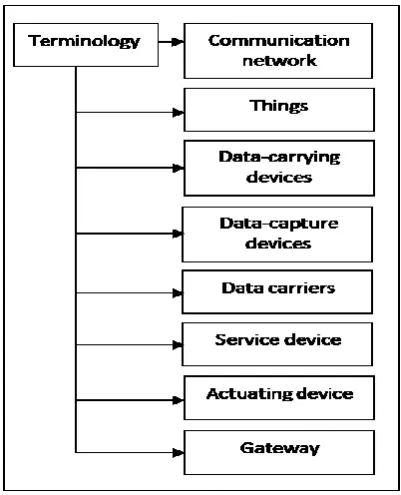
The communication network is an IP-based network. The things it may be physical or virtual. The data carrying devices that connect physical things into communication network for example RFID tags. Data capture devices that read/write device able to interact with physical things. Data carrier reads QR code, bar code and collects the information. Sensing devices sense the surroundings, environment temperature, humidity etc and convert them into signals. The actuating devices convert signals into operations. The gateway, is a unit that interconnects the devices with communication networks for example zigbee, Bluetooth, WiFi etc[6].
A. Gateway: It is a unit interconnects the devices with communication networks. Gateway supports device access technologies, networking technologies, interaction with application, network management, and security functions. The first occurrence for communication between devices is gateway. The second occurrence for communication is network without gateway. The third occurrence for communication is the device communicates directly with each other through local networks [7].
B. Embedded System: The embedded system consist of the sensors memory mapped input/output, microcontrollers, and controllers like relay, switches, display units, input, and notifications. The embedded platform like Arduino is the best starting point[8]. There are three operating systems being used, they are Window CE, embedded Linux, QNX.IC design and manufacture. The embedded system are two types, they are i) SES (stand-alone embedded system) such as low end devices, mid-range consumer devices, high-end devices. And ii) NES (network-embedded system) such as network system of embedded concept, network
embedded system technology, and real-time
embedded[9]. The embedded devices having
characteristics such as bandwidth, reputation data capture, low volume data usage and the appliance of IoT are such a high resolution cameras, phones, video voice IP etc.
C. Hardware: The internet of things hardware such as Raspberry, Raspberry-pi, Aurdino-uno, Seagle Bone, Wunder Bar, IoT development platform, ARMmebed, Waspnote, things EE one. These are the hardwares used for IoT and these are open source.
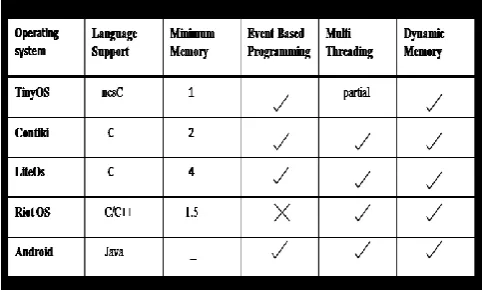
D. Operating System: Software is also playing a vital role in internet of things functionalities among the operating systems, RTOS that is real-time operating system are using in many places. Tiny operating system, lite operating system, kiot operating systems are some light weight operating systems and the emerging OS that plays very efficiently for the IoV (internet of vehicles) is android operating system.
Table 1: Operating systems used in Internet of Things
V.
INTERNET OF THINGS TECHNOLOGIES
A. Networking Technologies: Bluetooth is a short-range communication technology. It can be a wearable product connecting IoT via smart phones. The Zigbee is an industry-standards wireless networking technology. It has advantages in high levels of security, high scalability, and high node counts and can support wireless control and sensor networks in IoT application. The Thread is based on IPV6 networking protocol, it mean for the home environment. It supports a mesh network. It is capable of handling up to 250 nodes with high level of authentication and encryption. The Wi-Fi connectivity is especially within home environments and LAN. It provides fast data transfer and can handle high quality of data. The cellular, any IoT application that requires operation over a long distance can take advantage of cellular GSM, 3G, and 4G. Cellular is suitable for high volume of data, but the cost and power consumption for managing high volumes of data transfer are likely to be too high for most IoT applications.
B. 4G LTE and IoT: It uses packet switching and message switching. The service and applications are WI-FI and LTE. They are most flexible for internet of things. It supports IPV4 and IPV6, while for the 3G connectivity the IPV4 supports, when we are in need of 4G connectivity the IPV6 fulfills the support requirement. And now-a-days the IPV6 being used in large fields[11]. But IPV6 suppose to be an issue if it would be used for communication identification. Without a proper standardized and efficient mechanism of IPV4-IPV6 is adopted, object being allotted IPV6 would of big benefit[12].
network. Fogging is a decentralized computing infrastructure comparing these, cloud have capability to handle less number of users. The fog reach the ground level while the cloud is only on the high sky so the fog reaches number of users vast than the cloud. The cloud has low to high latency, the fog has low latency. The cloud has centralized/hierarchical control; the fog has distributed/hierarchical control. The cloud has fixed or wireless access; the fog has mainly wireless access. The clouds don’t accept support for mobility; the fog would accept support for mobility. The cloud has millions of users/devices; the fog has billions of users/devices. The cloud has central location on content generation, the fog has anywhere. The cloud has end device of content consumption, the fog has anywhere[13].
Figure 4 : Internet of Things centre to edge
D. Implementation: The implementation domains such as WSNs, RFID, M2M, SCADA. WSN are the wireless sensor networks. It consists of low-end and high-end microprocessor/microcontroller. The RFID (Radio frequency identification), it consist of two tags that are active and passive electronic tags. The RFID antenna divided into NFC (near-field communication) and FFC (far-field communication). SCADA is a supervisor control and data acquisition. It is a high-speed computing device[14]. The M2M is machine to
machine communication, man to machine
communication, mobile to man communication. Simcards, sensors, compact microprocessor are being used for this technology[15].
VI.
APPLICATIONS
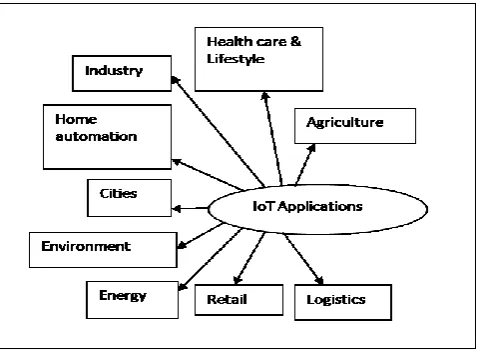
The internet of things is being used in wearables such as watches, glasses, clothes, shoes, or different embedded things can be hold with peoples by daily life. Likewise the smart homes using sensors like light sensor, humidity sensor are used for virtual assistance,
smart objects, digital relationship .In smart cities the smart traffic, platform, resource management, activity monitoring. In smart environment the traffics are been controlled and humidity like sensors help the blind peoples to cross the road, RF, compass, ultrasound sensors also being quality monitoring, natural disaster monitoring and smart farming by IoT day by day[16]. Applications of health care such as personal health care, driving used to infrastructure and safety, energy and monitoring, bio-sensors. In Transport by smart key, telemetries, automatic toll collection. In Energy such as power efficiency, ultra-low power, EV and HEV driving, smart metering. [17].
Figure 5. Internet of Things Applications
A. Home automation: Smart lighting system is used for energy consumption, it controlling energy by sensor. It sensing the human movements and environment according to that it automatically switch on and switch off the lights. It can be controlled by remote method also. In smart refrigerators RFID were used to control the system. A controller manages the devices; there is a configuration between the controller and the control panel used to interfere with the devise. Intrusion detection, this system consists of security cameras and sensor .user can get an SMS or mails as an alert. Smoke/gas detector detects smoke arise from the LPG/CO gases that an early sign of fire.
with the warning as earlier. Smart roads system provide the information about the condition of the road, traffic, safety driving roads, etc to the drivers and passengers as they before reach the place. By surveillance, videos were capture and footages were used for later investigations and emergency response monitoring used for detects the gas leakages, water pipelines, public transport, power substations etc.
C. Environment: In weather monitoring the
temperature, humidity, air quality, pressure, smoke level through the sensor and collects data from that it is based on wireless sensor network. Air pollution monitoring monitors the harmful gases such as CO, CO2, NO, NO2, etc through meteorological sensors. Noise pollution monitoring monitors the noise level in cities, urban areas. It monitors the hazards noise pollution which was harmful for the human’s health. Forest fire detection system detects the fire causing factors in the forest, including lighting, human negligence, volcanic eruptions and spark from rock falls. The river flood detection system detects the water level and flow rate that provides early from the floods.
D. Energy: Smart grid technology provides the information regarding electricity generation as centralized, distributed, consumption, storage distribution and equipment health data. In renewable energy system there are various kinds of Renewable energy sources such as solar and wind. The existing grids were created to manage the power flow from the centralized generation but when the distributed generation creates the bi-directional power flow.
E. Retail: The inventory management for retail, RFID tags was used to inventory management and maintain the right inventory level. RFID is used to track the real-time product. Smart payment solutions were run through the technology such as NFC and Bluetooth.
F. Logistics: Fleet tracking system using GPS technology to track the location of the vehicles and the tracking area location of the appropriate vehicle. Shipment monitoring system using sensors to sense the temperature, pressure, humidity to avoid the food spoilage. Remote vehicle diagnostics system can detect faults in engine RPM, control temperature, speed, fault code number etc.
G. Agriculture: Smart irrigation system, while saving water it improves crop yields. The IoT device detect soil moisture, required flow of water, weather condition etc and send the data to provide the solution for that.
H. Industry: The indoor air quality monitoring systems were employed for the health and safety of the workers. It diagnose the harmful gases such as CO, NO, NO2, etc which can cause health problem to the workers.
I. Health Care and Fitness Monitoring: IoT devices monitoring the physiological parameters such as health and fitness through the wearable devices like wrist band, belt etc. it monitors the body temperature, blood
pressure(BP), electrocardiogram (ECG),
electroencephalogram (EEG). RFID plays a vital role in health care and wearable electronics such as smart watches, smart glasses, clothes with integrated chip etc[18].
VII. ISSUES AND CHALLENGES
A. Security: Security should be providing on the aspects such as communication, confidentiality, authenticity, trustworthiness of communication partners, access control and non-repudiation[19]. And the IoT security framework consist of authentication that checks whether the device is accessing using the correct user name, password etc. the authorization manages the control access and enabling features to exchange the information between the devices. The secure analytics including visibility and control, patch updates, and threat countermeasures. The trust relationship is between authorization and authentication [20].
B. Authentication: It is the process of identifying, usually based on a username and password. In security systems, authentication is distinct from authorization, which is the process of giving individuals access to system objects based on their identity.
C. Authorization: it is the process of giving someone permission to do have something. It is the process of granting or denying access to a network resource.
or using. Permission to access a resource is called authorization.
E. Recovering Attacks: such as sinkhole attack, is a type of attack was compromised node tries to attract network traffic by advertise its fake routing update. One of the impacts of sinkhole attack is that, it can be used to launch other attacks like selective forwarding attack, acknowledge spoofing attack and drops or altered routing information. Wormhole attack, it can be easily be launched by the attacker without having knowledge of the network or compromising any legitimate nodes or cryptographic mechanisms. Selective forwarding attack, it is the one of the harmful attack against sensor networks and can affect the whole sensor network communication. Black hole attack is one of the well-known security threats in wireless mobile ad-hoc networks. The intruders utilize the loophole to carry out their malicious behaviour because the route discovery process is necessary and inevitable.
F. Interoperability: Different smart objects are having different conditions on availability and requirements of energy and communication bandwidth.
Software Complexity: Large software infrastructure will be needed on the network in conditional embedded system. Smart object have to be managed by the background and provide services.
G. Data Volumes: Vast volume of data required on central network nodes or services.
H. Data Interpretations: Different data that will be produced for the service provider’s profit, producing useful information from raw sensors data that can activate further actions.
I. Fault Tolerance: Things have to function properly. Structuring of IoT in a robust and trustworthy manner would require discharge on several levels. And to alter the condition charges automatically [16].
J. Sustainable Business Model: Sharing data open market can be adding more values on IoT solutions. HAT (Hub of all things) is a platform of a multi-shared market [17].
VIII. CONCLUSION
The objective of this paper is to explain the IoT concepts in comprehensive manner. However, the advantage and an emerging technology of IoT are being used in real time applications. Nowadays, IoT is the current research area for computing technologies. But, IoT faces different vulnerabilities due to constrained devices. IoT devices are based on battery powered, so IoT needs the energy efficiency for communication. Energy consumption and the heating of the devices are the main problem in IoT devices. Within that battery capacity and heating may be the big issue in future. To compensate that problem under the energy efficiency, battery capacity should retain more timer longer and to reduce the heating problem. In future, our research will focus on energy efficiency in IoT.
VII.
REFERENCES
[1]. Bradley, Joseph, Joel Barbier, and
DougHandler."Embracing the Internet of everything to capture your share of $14.4 trillion." White Paper, Cisco (2013).
[2]. ITU-T, "Overview of the Internet of Things," Recommendation Y.2060, June 2012.
[3]. Sutaria, Ronak, and Raghunath Govindachari. "Making sense of interoperability: Protocols and Standardization initiatives in IOT." 2nd International Workshop on Computing and Networking for Internet of Things. 2013.
[4]. Prof.Avinash Devare, Archana Hande,
Anandmohan Jha, Sandhya Sanap, Shweta Gawade," International Journal of Innovative
Research in Science, Engineering and
Technology", Vol. 5, Issue 2, pp:.1,2, February 2016.
[5]. Omar Said, Mehedi Masud," Towards Internet of Things: Survey and Future Vision",International Journal of Computer Networks (IJCN), Volume (5) , pages:1,3, Issue (1) : 2013.
[6]. William Stallings ,Ole J. Jacobsen,"The Internet Protocol Journal" ,vol.18, December 2015. [7]. ITU-T, "Common Requirements and Capabilities
of a Gateway for Internet of Things Applications," Recommendation Y.2067, June 2014.
[8]. Stage 1 Introduction to the Internet of Things: What, Why and How CodeProject,2016,page:2. [9]. Friedrich, Luís F. "A Survey on Operating
Properties." In Anais do Workshop de Sistemas Operacionais, VI 2009 pp:2,3.
[10]. Ala Al-Fuqaha, Mohsen Guzani, Mehdi
Mohammadi, Mohammed Aledhari, Mousse Ayyash, "Internet of Things: A Survey on
Enabling Technologies, Protocols, and
Applications", IEEE 2015, pp:5.
[11]. Amol Dande, Shaffi K. Pathan," Industrial Market Place Survey and Analytics on Internet of Things", International Journal of Advanced Research in Computer and Communication Engineering Vol. 5, Issue 5, pages:1,2,May 2016.
[12]. Mohammed Aazam, Imran Khan, Aymen
Abdullah Alsaffar, Eui-Nam Huh, "Cloud of Things: Integrating Internet of Things and Cloud Computing and the Issue Involved", IEEE 2014, pp:4.
[13]. Vaquero, L., and Rodero-Merino, L., "Finding Your Way in the Fog: Towards a Comprehensive
Definition of Fog Computing," ACM
SIGCOMM Computer Communication Review, October 2014.
[14]. Mohammad Abdur Razzaque, Marija Milojevic-Jevric, Andrei Palade, Siobhán Clarke", Middleware for Internet of Things: A Survey," IEEE INTERNET OF THINGS JOURNAL, VOL. 3, NO. 1, pages: 1,7, FEBRUARY 2016. [15]. Ms. Chetana Sarode, Prof.Mr.H.S.Thakar",
Smart Home Implementation Techniques: A Survey Approach," International Journal of Science, Engineering and Technology Research (IJSETR),Volume 1, Issue 6, page:2, December 2012.
[16]. Charith Perera, Chi Harold Liu Member, Srimal Jayawardena, Member, IEEE, "The Emerging Internet of Things Marketplace From an Industrial Perspective: A Survey", IEEE TRANSACTIONS ON EMERGING TOPICS IN COMPUTING, pages:2-5, JANUARY2015. [17]. Prajakta pande, Anand R.Padwalker,"
International Journal of Advance Research in Computer Science and Management Studies", Volume 2, Issue 2, page:3, February 2014. [18]. Arshdeep Bahga, Vijay Madisetti, "Intetnet of
Things: A Hands-on Approach", Universities Press Private Limited, India 2015.
[19]. Paul Fremantle, Philip Scott," A security survey of middleware for the Internet of Things",PeerJ PrePrints ,page:3 Jul 2015.