CSEIT1724177 | Received : 10 August 2017 | Accepted : 21 August 2017 | July-August-2017 [(2)4
-
679-687]International Journal of Scientific Research in Computer Science, Engineering and Information Technology © 2017 IJSRCSEIT | Volume 2 | Issue 4 | ISSN : 2456-3307
679
Enhancing the Lifetime in Wireless Sensor Networks uising
Non-Zero Sum Cooperative and Non-Cooperative Repeated Game
Theory
Dr. V. Vinoba. (Research Adviser), S. Sridevi (Research Scholar)
Department of Mathematics, K.N. Government Arts College, Thanjavur, , Tamil Nadu, India
ABSTRACT
Wireless sensor network (WSN) is still a popular research field, which can be applied to various emerging research topics such as internet of things and smart grid. The sensor nodes are responsible to detect the new environment and monitor the variable situation, but suffer from battery powered with energy limitation. In this paper, we define the power consumption problem in the overlapping area based on integer linear programming (ILP). Then, we propose a game-based model named non-zero-sum duty-cycle game (NZS-DCG) to express the cooperation between sensor nodes, and formulate the equilibrator equation based on Nash Equilibrium to decide the optimal strategy. The simulation results show that the cooperative scheme provides the lowest power consumption and the longest network lifetime than other related literatures. In conclusion, the power conservation and traffic relieving in WSN can be achieved by the proposed game model.
Keywords: Repeated Game, Cooperative And Non-Cooperative Game, Wireless Sensor Networks, Non-Zero Sum.
I.
INTRODUCTION
In this chapter, we look at the problem of maintaining energy level of the sensor node, Enhancing the lifetime in wireless sensor networks using non-zero sum cooperative and non-cooperative repeated game theory and multi-hop in WSN within an non-zero-sum game theoretic approach. The game theoretic scheme is based on models that express the interaction among players, in this case, nodes, by modelling them as elements of a social networks in such a way that they act as to maintain the maximum utility. Simulation results show the effectiveness of the proposed game with various path loss exponents and also the proposed games is able to maintain the energy level of the network life time.
II.
METHODS AND MATERIAL
2. Cooperative and Non-Cooperative Games
In the following discussion, we summarize the different game defence strategies against different attack types in
WSNs. A game can be chosen to be cooperative or non-cooperative game according to the attack type and the expected penalty.
2.1. Basics of Cooperative Game Theory
To reduce the whole WSN's energy consumption and prolong its lifetime, some nodes will cooperate and form a coalition. Coalitional game theory is one of the most important cooperative game theory, thus, cooperative game theory is sometimes denoted as coalitional game theory. For a WSN obeying the cooperative game theory, cooperating groups are formed and players choose strategies to maximize their own groups' utility. Coalitional game theory allows a reduction of power consumption in WSN by forming coalitions.
nodes for cooperation between nodes. In this formation, the nodes know nothing about the grouping. On the other hand, a group leader is assigned as a special node which processes the information of the newly entered sensor nodes and decides who will be their possible group member in a group.
We can group the nodes in two ways for different applications:
All the sensor nodes have similar sensed data could be placed in the same group, for example, sensing application.
The sensor nodes with shorter distances between them are allocated in the same group, for example, sending data from a source node to the sink. Apt and Wetzel proposed a generic approach for coalition formation through simple merge and split operations.
Cooperative game theory can be further categorized into two branches: Transferable-utility game (TU) and non-transferable-utility game (NTU). In TU game the payoff of the measurement allocation game is transferable. In NTU game the payoff for each agent in a coalition depends only on the actions selected by the agents in the coalition.
2.1.1. Coalition Formation
Agastya studied a dynamic social learning model by focusing on allocations and completely abstracts from coalition formation process. Coalition formed the WSN coalitions on the basis of Markov-process, and proposed the concept of absorption coefficient to measure the coalitional profiles and then use NE to determine the approximate data transfer strategies of the formed coalitions. Some nodes in a WSN form a coalition by transferring data co-ordinately instead of transferring independently in order to reduce energy consumption. The focused on how to select a proper transmission scheme for improving the energy efficiency. They modelled the transmission scheme selection problem as a non-transferable coalition formation game with the characteristic function based on the network lifetime. They further proposed a simple algorithm based on a merge-and-split rule and the Pareto order to form coalition groups among individual sensor nodes.
2.2. Basics ofNon-Cooperative Game Theory
Non-cooperative game theory studies strategies between interactions among competing players. In the game, a player is called an agent and his goal is to maximize its utility by choosing its strategy individually, in other words, each player is selfish but rational in a non-cooperative game. Non-cooperative game theory uses a utility function to find the NE. Non-cooperative game theory is mainly applied in distributed resource allocation, congestion control, power control, spectrum sharing in cognitive radio and many others. With the concepts from economics and game theory, Wu and Wei proposed a mechanism design to handle incentives of strategic agents. A power control model based on non-cooperative game theory. Gharehshiran and Krishnamurthy used cooperative game theory as a tool to devise a distributed dynamic coalition formation algorithm in which nodes autonomously decide which coalition to join while maximizing their feasible sleep times. The sleep time allocation problem is formulated as a non-convex cooperative game and the concept of the core is exploited to solve this problem. They solved two problems: (1) what are the optimal coalition structures for localizing multiple targets with a pre-specified accuracy? (2) How can nodes dynamically form optimal coalitions to ensure that the average sleep time allocated to the nodes is maximized? The two questions are solved nicely within the framework of coalition formation in a cooperative game.
2.2.1. Repeated Game Theory
game theory to prevent the non-cooperative selfish behaviours of decreasing the contention window without permission was proposed. Liu suggested a repeated game theoretic model. The model is based on cooperative packet forwarding under the conditions of selfish and rational nodes for improving energy efficiency and sensor networks payoff. The authors also formulated a payoff function on path reliability and energy consumption. Using the punishment mechanism, this repeated game model can propel a NE and decrease the defection possibility of selfish nodes. Pandana developed a self-learning repeated-game framework to enforce and learn the cooperation among the greedy nodes in packet forwarding. Zhou proposed a repeated game framework with a punishment mechanism to optimize packet forwarding probabilities by detecting, responding and punishing the nodes having selfish behaviours.
2.2.2. Zero-Sum Game
The zero-sum game is one of the types of non-cooperative games between two players. One layer is considered a maximize that strives to maximize its gain while the other is considered to be the minimizer that aims to minimize its losses. Consequently, it seems as a two-side conflict game or a one-side win game, at which the total utility/payoff of both players remains constant during the course of the game,∑
where s is a strategy profile.
Apparently, constant-sum game could be transformed to an equivalent zero-sum game; and zero-sum game is a special case of constant-sum game given that the players add up their gains or losses to a constant value for any strategy profile
2.2.3. Nonzero-Sum Game
Nonzero-sum game is played between two or more players where the sum of players‟ utilities is not constant during the course of the game. In nonzero-sum games, all players are considered maximizes or minimizers which have no constraints on the total utility as in the zero-sum game. Consequently, all the participants can gain or lose together.
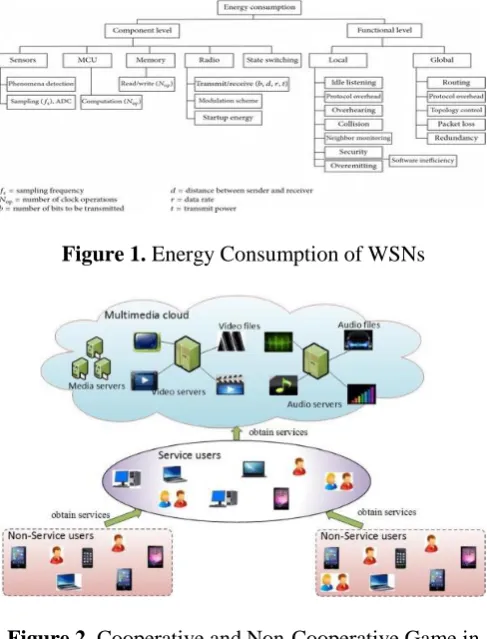
Figure 1. Energy Consumption of WSNs
Figure 2. Cooperative and Non-Cooperative Game in WSNs
Definition1.A game is a description of the strategic interaction between opposing, or cooperating, interests where the constraints and payoff for actions are taken into consideration.
Definition2.A player is a basic entity in a game, which is involved in the game with a finite set of players denoted by N that is responsible for taking rational actions, denoted by Ai, for each player i. A player can represent a person, machine, or group of people within a game.
Definition3.The Utility/Payoff is the positive or negative reward to a player for a given action within the game denoted by which measures the outcome for player i determined by the actions of all players where the symbol × denotes
Cartesian product.
Definition4.A strategy is a plan of action within the game that a given player can adopt during game play denoted by a strategic game ⟨N, (A), ( )⟩
and choosing another action. This can be translated in terms of the utility function as,
, where denotes the strategy of player i and denotes the strategies of all players other than player i.
Problem.1.
Repeated Sub game Perfection
Consider now an infinitely repeated game G(R) with the stage game is given below
( )
The Stage Game.
Are the following strategy profiles, as defined in the lecture notes, sub game perfect? Show
Your work and calculate the minimum discount factors necessary to sustain the Repeated sub game perfect equilibrium, if any.
• Hint: partition payoffs and try using
The game has four types of sub games, depending on the realization of the stage game in the last period. To show sub game perfection, we must make sure neither player has an incentive to deviate in any of these sub games.
The last realization was If player 1 follows then his payoff is.
(
……….. (1)
If player 1 deviates, the sequence of outcomes is (B, A), (A,B), (B, A), (A,B, . . .and his payoff will be
……….. (2)
(Here we make use of the hint. The payoff can be partitioned into two sequences, one in which the per-period payoff is 3, and another where the per-per-period payoff is 1. So we have (letting as suggested):
= ……… …….(3)
Which gives you the result above when you multiply it by to average it. I have not gone senile. The reason for keeping the multiplication by 0 above is just to let you see clearly how you would calculate it if the payoff from (A,B) was something else.)
Deviation will not be profitable when ⁄ or
whenever R
The last realization was (A,B). If player 1 follows the resulting sequence of outcomes will be (B, A), (A,B), (B, A), . . ., to which the payoff (as we just found out above) is ⁄ . If player 1 deviates and cooperates, the sequence will be (A, A), (A, A), (A, A ). . . to which the payoff is 2. So, deviating will not be profitable as long as ⁄ ,which means
R . (We are already in hot water here: Only R will satisfy both this condition and the one above!) The last realization was (B,A). If player 1 follows the resulting sequence of outcomes will be (A,B), (B, A), (A,B), . . .. Using the same method as before, we find that the payoff to this sequence is ⁄ ). If player 1 deviates, the sequence of outcomes will be (B,B), (B,B), (B,B), . . ., to which the payoff is 1. Deviation will not be profitable whenever ⁄ ).
. Which holds for R .
The last realization was (B,B). If player 1 follows TFT, the resulting sequence of outcomes will be (B,B), (B,B), (B,B), . . ., to which the payoff is 1. If he deviates instead, the sequence will be (A,B), (B, A), (A,B), . . ., to which the payoff is ⁄ Deviation will not be
profitable if ⁄ ), which is true only for
R .
It turns out that for to be repeated sub game perfect, it must be the case that R .a fairly hefty knife-edge requirement. In addition, it is an artefact of the way we specified the payoffs. For example, changing the payoff from (B,A) to 4 instead of 3 results in the payoff for the sequence of outcomes (B, A), (A,B), (B, A), . . . to be
⁄ ), to prevent deviation in case (a), we now
which is not possible. So, with this little change, the SPE disappears. For general parameters, is not sub game perfect, except for special cases where it may be for some knife-edge value of R.
Theorem 1.
Consider a sensor network N. Let ‟m‟ be the maximum number of node-disjoint paths between the virtual nodes s and t in the coverage game G(N). Also, let the lifetime of an individual sensor node be unity. If r < m < 2r then the Stint algorithm provides r-barrier coverage game for ⁄ units of time.
Proof: We first prove that no sensor in the sequence through completely exhausts its energy before the end of the for loop in Line 15 through Line 20. Then, we show that this loop provides r-barrier coverage game for ⁄ units of time.
To prove the first part, observe that the sets are disjoint. Whenever one of these sets is
active, all sensors in this set are active. Since each sensor has a lifetime of unity, the lifetime of each set is unity. In the for loop (Line 15 through Line 20), which runs g = ⁄ times, each set is inactive in Iterations. Therefore, the set is active in exactly g= iterations. Since each iteration lasts for units of time, no set completely exhausts its energy before the end of the loop.
To prove the second part, observe that sets are active in each iteration of the loop. Each of these node-disjoint sets provides x-barrier coverage. Hence, each iteration provides r- barrier coverage game. Also, since each iteration lasts for units of time and there are a
total of g= iterations, the for loop (Line 15 through
Line 20) provides r-barrier coverage for units of time.
Theorem.2.
The Stint algorithm is an optimal sleep wakeup algorithm for r-barrier coverage game.
Proof: Consider a sensor network N: Let „m‟ be the maximum number of node-disjoint paths between the virtual nodes s and t in the coverage graph G(N): Also, let the lifetime of an individual sensor node be unity. From Lemma 3.1, any sleep-wake up algorithm for
r-barrier coverage game can achieve a lifetime of at most .
To prove the theorem, we only need to prove that the Stint algorithm achieves a network lifetime of . Lines 10 through 12 in the Stint algorithm provide r-barrier coverage for ` units of time. If m mod r = 0; the proof is complete. Consequently, assume m mod r . This implies that r < R < 2r. The provide r- barrier coverage for units of time. Since r=m-l
Hence, the Stint algorithm provides r-barrier coverage game for units of time.
Theorem.3.
The Node-Disjoint Barrier Coverage Lifetime with non-zero Path Switches problem is NP-Complete.
Proof: It can be verified that the Node-Disjoint Barrier Coverage Lifetime with non-zero Path Switches problem is in NP in a way that is similar to the Barrier Coverage Lifetime with non- zero Sensor Switches in ( The Barrier Coverage Lifetime With non-zero Sensor Switches problem is NP-Complete).
.
We reduce the Partition problem to the Node-Disjoint Barrier Coverage Lifetime with non-zero Path Switches problem. Given an instance of the partition problem we construct a sensor network as follows: Let the deployment region be rectangular with the left bottom corner at the origin, i.e. with coordinate (0; 0). Let the right bottom corner be at the coordinate (2r; 0). Let
For every integer we place a sensor at
coordinate (R,(j-1)*(2R+ ))Set r = 2 and ∑ Notice that in the coverage graph of this sensor
network, all n paths between the two virtual nodes s and t are node-disjoint.
If the answer to the partition problem is “yes,” then
such that ∑ ∑ Now, the
for L units of time. This follows because any sensors that is turned on remains on until it exhausts its lifetime ( for some j). Also, every sensor completely exhausts its lifetime if the network provides 2-barrier coverage
Proof: Case (i) First to prove the Necessary condition:
Suppose the game
has the finite value
. For anyequation (4) & (5) we obtain the inequality
,
,
Case (ii) Next to prove the sufficient condition:
Since lim km 0
relationship equation (6) we obtain the inequality
,
P x y
; Hence
0
lim
P x y
,
. Thiscompletes the proof of the theorem.
III.
SIMULATION AND PERFORMANCE
ANALYSIS
The proposed algorithm has been simulated and validated through simulation. The sensor nodes are deployed randomly in a 100x100 meters square and sink node deploy at the point of (50, 50), the maximum transmitting radius of each node is 80 m, other simulation parameters are displayed in Table.1. In this section, we first discuss utility factor and pricing factor‟s influences on transmitting power, and then evaluate the algorithm with other existing algorithm.
Figure 4shows that the average delivery delays with increasing transmission rate.
The average delay means the average delay between the instant the source sends a packet and moment the destination receives this packet. When the transmission rate is 1 packet per second, we can see that the average delivery delay of DD, Flooding, and Energy Aware is lower than the proposed protocol.
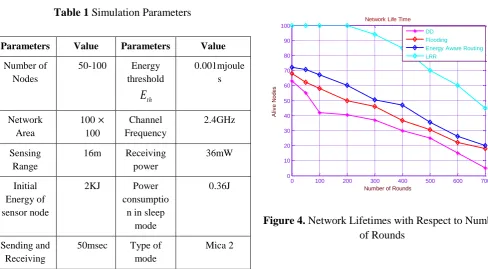
Table 1 Simulation Parameters
Parameters Value Parameters Value
Number of lower multiple strategies. In the forwarding node selection game, the probability that a great amount of
Figure 3. Average Delivery Rate with various Transmission Rate
Figure 5. Network Lifetimes with Respect to cooperation and non-cooperation
Network Lifetime: The network lifetime for each simulation is showed in Figure.4 These curves are showing that in direct diffusion (DD) protocol, after
400 rounds, about 80% of nodes in the network are died, but in proposed enhancing the lifetime in wireless sensor networks using non-zero sum cooperative and non-cooperative repeated game theory protocol, after a rounds the network is arrived to this point. So the network lifetime is increasing about 75% with using of our model and proposed routing algorithm.
The average delivery delay means the averaged time delay between the instant the source sends a packet and moment the destination receives this packet. When the transmission rate is 1 packet per second, we can see that the average delivery delay of enhancing the lifetime in wireless sensor networks using non-zero sum cooperative and non-cooperative repeated game theory is higher than the proposed protocol.
Routing
Protocols
Nodes Alive
Number of Nodes
100 Rounds
700 Rounds
20 Nodes
100 Nodes
Life time
(Proposed)
100
45
0.15
0.4
Flooding
59
18
0.05
0.07
DD
42
5
0.035
0.15
Energy Aware
68
20
0.1
0.34
The proposed enhancing the lifetime in wireless
sensor networks using non-zero sum cooperative
and non-cooperative repeated game theory
achieves a good performance in terms of Lifetime
by minimizing energy consumption for in-network
communications and balancing the energy load
among all the nodes.
IV.CONCLUSION
In this chapter, we introduce a Non-Zero-Sum
Game Theory for maintaining the sensor network
lifetime. In this network, connectivity of nodes
forwards any packets to its neighbour nodes. The
Direct Diffusion (DD), Flooding and Energy
Aware protocols after 400 rounds, about 25% of
nodes are alive in the network. But in our proposed
Enhancing life time energy protocol, after 550
rounds 40% of nodes are alive and so the Network
lifetime is increased about 75%. Path reliability for
Direct Diffusion (DD) protocol is random. The
Path reliability of our enhancing the lifetime in
wireless sensor networks using non-zero sum
cooperative and non-cooperative repeated game
theory protocol is more than 30%. Comparing with
other approaches through simulations, our protocol
can surely guarantee to prolong network lifetime
and improve the data transmission capacity up to
75% respectively. This shows that our proposed
model and algorithm increases the network
lifetime. Also, we will be optimizing the algorithm
to find the maximum usefulness function of all
nodes that cooperate in path.
V.
REFERENCES
Transactions on VLSI Systems, vol. 4, pp. 42-55, 1996.
[2]. Stefanescu and M. W. Stefanescu, "The Arbitrated Solution for Multiobjective Convex Programming," Rev. Roum. Math. Pure Applicat.,vol. 29, pp. 593-598, 1984.
[3]. T. Abdelzaher and C. Lu, "Schedulability Analysis and Utilization Bounds for Highly Scalable Real-time Services," in Proc. of the IEEE Real- Time Technology and Applications Symposium, 2001
[4]. E. N. Elnozahy, M. Kistler, R. Rajamony, "Energy-Efficient Server Clusters," in Proc. of the 2nd Workshop on Power-Aware Computing Systems, 2002. [12] J. Greenberg, The Theory of Social Situations: An Alternative Game-Theoretic Approach, Cambridge University Press, Cambridge, UK,1990.
[5]. S. Slijepcevic and M. Potkonjak, "Power efficient organization of wireless sensor networks," in IEEE International Conference on Communications, Helsinki, Finland, 2001, vol. 2, pp. 472-476.
[6]. M. Cardei, M. Thai, and W. Wu, "Energy-efficient target coverage in wireless sensor networks," in IEEE INFOCOM, Miami, FL, 2005.
[7]. T. He and et al, "Energy-efficient surveillance system using wireless sensor networks," in International Conference on Mobile Systems, Applications, and Services (ACM Mobisys), Boston, MA, 2004, pp. 270-283.
[8]. B. Liu, O. Dousse, J. Wang, and A. Saipulla, "Strong barrier coverage of wireless sensor networks," in Proceedings of the 9th ACM international symposium on Mobile ad hoc networking and computing. ACM, 2008, pp. 411-420.
[9]. K.-F. Ssu, W.-T. Wang, F.-K.Wu, and T.-T. Wu, "k-barrier coverage with a directional sensing model," International Journal on Smart Sensing and Intelligent Systems, vol. 2, no. 1, 2009. [10].S.Metha and K.S.Kwak, "Application of game
theory to wireless sensor networks"- Inha university, Korea.