Easy-read Documents as a Gold Standard for Evaluation of Text
Simplification Output
Victoria Yaneva
Research Group in Computational Linguistics
University of Wolverhampton
Abstract
This paper presents initial research into the use of easy-read articles written for people with cognitive disabilities as a gold standard for the evaluation of the output of text simplification systems. We investigate the compliance of the easy-read documents available on the Web with guidelines for development of easy-read material, as well as their suitability as a gold standard for simple documents for two types of populations in particular: adult readers with autism and readers with mild intellectual disability (MID). The results indicate an overall good level of compliance with the guidelines and suggest that easy-read documents are a suitable resource for evaluation of acces-sible documents produced for adults with autism or MID.
1
Introduction
Common reading materials on the Internet, in newspapers or in textbooks are generally under-stood by a large part of the population. However, there are readers with disabilities such as intel-lectual disability, autism, aphasia or dementia, among others, who struggle to comprehend most of these written materials.
To ensure the constitutional right of all individu-als to have access to information (WHO, 2011), there is a campaign for the production of “easy-read” documents, which are accessible documents produced by humans, following a set of guidelines for accessible writing, such as the ‘Make It Sim-ple’ guidelines (Freyhoff, 1998) or ‘Guidelines for Easy-to-read Materials’ (Nomura et al., 2010). The comprehensibility of the easy-read documents is also ensured by the inclusion of images to illus-trate the main ideas in the text, and by the evalua-tion of these documents on a focus group of disa-bled people. While many governmental and
healthcare organisations within the UK and the USA are required by law to produce accessible versions of important documents (Equality Act 2010), and many charity organisations produce such documents too, their writing and evaluation is time-consuming and expensive.
Another way to make text documents accessible for disabled readers is to convert them using au-tomatic text simplification. Text simplification (TS) is a process which aims to enhance the un-derstandability of a text by performing different linguistic transformations without changing its original meaning (Max, 2006). While automatic TS is promising in terms of time and financial cost, current TS systems are still not advanced enough to replace humans in the production of accessible documents. This problem is partially due to the scarcity of corpora of original and ac-cessible texts with aligned sentences (parallel corpora) on which to train TS systems, as well as the issue of deciding which texts are simple enough for particular groups of disabled readers to be used as a gold standard for the evaluation of the TS output.
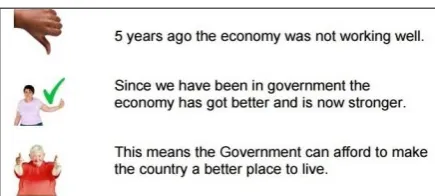
This paper describes initial research into the ques-tion of whether human-produced easy-read ver-sions of documents could be used as a gold stand-ard for accessible writing for particular user groups, such as readers with autism or intellectual disability. The compilation of such a corpus has now become feasible due to the already large number of existing easy-read documents produced between the early 2000s and now. Thus, for ex-ample, the original and easy-read versions of the UK political parties’ manifestos from the 2015 elections (Figure 1 and Figure 2) illustrate the progress of the easy-read campaigns in adapting documents from various genres and domains:
Five years ago, Britain was on the brink. As the outgoing Labour Treasury Minister put it with brutal candour, 'there is no money'. Since then, we have turned things around.
Figure 1: Conservative Party Manifesto (2015)
Figure 2: Conservative Party Manifesto Easy-Read Version (2015)
However, before accepting such easy-read doc-uments as the epitome of how an accessible text should look, we should keep in mind the variety of sources they come from, some of which may not be reputable. The current paper investigates two main aspects of easy-read documents on the Web: 1) their compliance with the guidelines according to which they were produced and 2) their suitability for particular target populations such as readers with autism or intellectual disa-bility. In particular, we investigate the following questions:
- Do the easy-read documents available on
the Web comply with the rules outlined in the guidelines for creation of easy-read doc-uments?
- Are the easy-read documents available
on the Web simple enough (or too simple?) for TS target groups such as people with mild intellectual disability or autism?
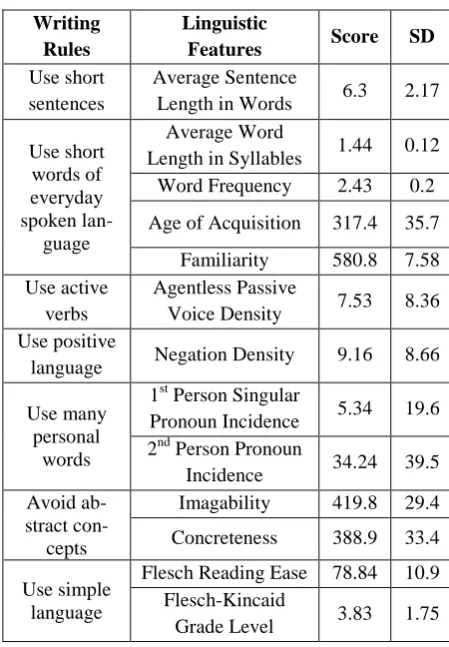
The first question is important because no offi-cial data for the evaluation of these documents has been published. We aim to assess compliance through, firstly, assigning linguistic features to the rules outlined in the guidelines for production of easy-read material and then analysing a sam-ple of easy-read documents based on these lin-guistic features (Section 3). This analysis of compliance is going to cast light on the question of whether the majority of the easy-read material coming from a variety of sources on the Web could actually be regarded as such.
The second question of suitability is no less im-portant due to the heterogeneity of conditions entailing reading difficulties. This means that a text at a certain readability level may be suitable for adults with mild intellectual disability (MID), but at the same time it could be too simplistic for adults with autism or too challenging for children with MID. This is an argument against the “one-size-fits-all” approach in creating accessible documents, where no distinction is made be-tween the different levels of ability in cognitively
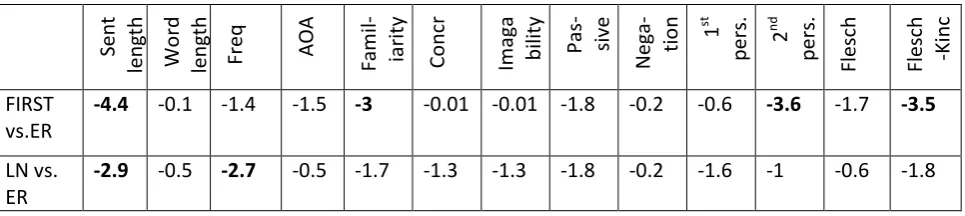
disabled people, in addition to their individual differences. In the context of this research we define suitability as the appropriate level of diffi-culty of texts for particular target populations. We investigate the suitability of easy-read docu-ments for adults with autism and MID by com-paring them with corpora developed for and evaluated on such readers based on 13 relevant linguistic features (Section 4).
2
Related Work
As mentioned in Section 1, automatic TS sys-tems make use of monolingual corpora, where the text pairs could be an original article and its simplified version (parallel corpus), or two arti-cles with different complexity levels collected based on similar criteria (e.g. topic or timespan) (comparable corpus).
2.1 Existing Corpora
For English there are several comparable corpo-ra, which have been used in TS tasks. Simple
English Wikipedia1 together with English
Wik-ipedia2 comprise probably the largest resource
used in automatic TS. However, the accessibility of articles in Simple Wikipedia has been disput-ed, with researchers appealing for “the communi-ty to drop it as the standard benchmark set for simplification” due to its many drawbacks (Xu et al., 2015). For example, Stajner et al. (2012) compare the corpus to articles from the genres of News, Health and Fiction on the basis of 4 read-ability formulae and 16 linguistically motivated features and find that the articles in Simple Wik-ipedia are more complex than the ones in the Fic-tion genre (Stajner et al., 2012).
Other corpora used for TS include the relatively small EncBrit (Barzilay and Elhadad, 2003), consisting of 20 articles from Encyclopedia Bri-tannica and their manually simplified versions for children from Britannica Elementary. Due to its small size, this corpus has been used as a test set only. WeeklyReader (Allen, 2009) and Liter-acyworks (Peterson and Ostenforf, 2007) also have manually simplified versions for language learners for, respectively, 100 and 104 of their articles. A larger and more recent TS resource is the parallel Newsella corpus (Xu et al., 2015), which consists of 1,130 news articles, re-written for children at 4 different grade levels.
Currently there are only two parallel corpora for English, which have been specifically compiled for people with disabilities. The FIRST corpus consists of 25 texts and their simplified versions for people with autism (Jordanova et al, 2013). While the simplification was performed by ex-perts working with autistic people who followed autism-specific simplification guidelines (Martos et al., 2012), the corpus was never actually eval-uated by autistic readers. The other corpus, com-piled by Feng et al. (2009), is called LocalNews and is comprised of 11 newspaper articles and their simplified versions for adults with mild in-tellectual disability (ID). Unlike FIRST, Local-News has been evaluated by 20 adults with mild ID.
2.2 Strengths and Limitations of the Exist-ing Corpora
A great advantage of using parallel corpora such as those mentioned above is that the original and simplified sentences are aligned, which allows automatic learning of simplification rules, hence the use of the corpora not only for evaluation but also for development of TS systems. However, currently there is no information as to whether manual simplification done with the primary ob-jective of producing aligned corpora is of a simi-lar quality to accessible documents produced with the reader in mind (e.g. easy-read docu-ments). At present, this question remains an ave-nue for future research into the quality of re-sources used in TS. In addition, few of these cor-pora have actually been evaluated on relevant reader groups and in some cases (e.g. FIRST) the sole fact that the simplification has been done by experts is used to ensure the quality of the re-source. Finally, a drawback of all corpora men-tioned above is the fact that they all come from one source only (e.g. Wikipedia or Encyclopedia Britannica) and are genre-specific (encyclopedic articles, newspaper articles in the case of Local-News, newspaper and informational articles in the case of FIRST).
Compiling a corpus of easy-read documents has the potential to overcome the issues related to source and genre, because: 1) easy-read texts come from a variety of sources (the credibility of some of them being uncertain, which is why we are first going to assess the compliance of these documents collected from the Web with their production guidelines) and 2) they cover a wider variety of genres such as newspaper articles, general informational articles, healthcare, poli-tics, literature, fun facts, etc. (Section 3). Finally,
easy-read documents are widely available and do not require the time-consuming rewriting of orig-inal articles.
3
Assessing Compliance of Easy-Read
Documents On the Web
As an initial step towards the development of a corpus of easy-read documents, we have first collected a sample of 150 easy-read documents in order to assess their compliance with the guidelines for their production.
3.1 Collecting a Sample of Easy-Read Doc-uments
The sample of 150 documents consists of 78,324 words and 12,692 sentences in total. The average number of sentences per document was 84.05 with standard deviation (SD) of 98.7 and average sentence length in words 6.3 (SD = 2.17). The average number of words per document was 518.7 (SD = 624.18). When collecting this sam-ple, we have tried to make it a balanced represen-tation of sources and genres. The documents in-cluded in the sample were obtained from various UK and US charity organisation websites (38 documents), government departments (26 docu-ments), healthcare services (32 docudocu-ments), as well as demos of adapted books from educational websites (3 documents) and online news web-sites for people with disabilities (50 documents). All documents were written in English. The top-ics of the documents were highly dependent on
their sources and thus they encompass
healthcare, news, literature, politics, policies, and general information for everyday life, which is typically provided by the charity organisations (e.g. how to shop for healthy food or how to make a doctor’s appointment). In Section 3.2 we analyse some characteristics of this sample, rele-vant to the initial guidelines for creating easy-read texts.
3.2 Linguistic Features
78.84 for the sample, where a score of 0 stands for “very difficult” and a score of 100 stands for “very easy”; the Flesch-Kincaid Grade Level goes in the opposite direction (the lower the score, the easier the text) and gave an average value of 3.83 for our sample.
Even though all measures indicate a very good level of accessibility of the documents, the SD measures vary greatly, which means that some of the documents score very highly in some of the measures, while others had very low scores. To investigate this further, we ranked all texts based on the scores of the Flesch Reading Ease formu-la. Focusing on the lower quartile, we identified 11 texts from miscellaneous sources, the Flesch readability of which was under the recommended threshold of 65 for documents written in plain English (Flesch, 1948), with some of them going as low as 43.1 or 48.77. The Flesch Reading Ease measure was consistent with the rest of the measures in identifying these 11 texts as deviant from the other 139 ones and thus we regard these as easy-read documents with lower compliance to the guidelines and thus with potentially lower accessibility.
As a whole, the results indicate that the select-ed sample of accessible texts complies with the standard set out in the easy-read guidelines. Only 7.33% of the texts (11 documents) showed read-ability under the threshold for what could be considered an accessible document. However, it is known that readability indices are an approxi-mation only and do not account for all aspects of the text and reader interaction (DuBay, 2004). Thus, we can conclude that easy-read documents randomly selected from various domains on the Web overall comply with the rules in the easy-read guidelines.
In the next section we compare the sample of 150 documents to other corpora, which have pre-viously been used as a gold standard in text sim-plification for people with disabilities.
4
Assessing the Suitability of Easy-Read
Documents for Different Target
Popu-lations
Knowing that the majority of the easy-read doc-uments available on the Web comply with the rules of easy-read production guidelines is not enough to accept them as apt for all types of readers with disabilities without evaluating their suitability: a text which is too simplistic or too challenging for a particular group of readers may cause them to lose interest in the text and may
diminish their motivation. We evaluate the suita-bility of easy-read documents with respect to readers with autism (Section 4.1) and readers with mild ID (Section 4.2) by comparing them with corpora evaluated by these readers (Local-News corpus in the case of ID) or developed by experts (FIRST corpus in the case of autism). If the easy-read sample is significantly more com-plex or simplistic than the texts in the FIRST and LocalNews corpora, its suitability as a gold standard for accessible texts for readers with au-tism might be disputed based on the level of simplification the users (LocalNews) and the ex-perts (FIRST) have perceived as suitable for the relevant populations.
4.1 Autism
Autism Spectrum Disorder (ASD) is a neurode-velopmental disorder characterised with impair-ment in social interaction and communication, which influences the language comprehension abilities of the affected individuals (APA, 2013). In previous research we evaluated the suitability of 7 randomly selected easy-read documents from the same 150 document sample used in this study on 20 adults with autism (without intellec-tual disability) and 20 non-autistic adults matched for age and level of education (Yaneva, Temnikova and Mitkov, 2015). The level of comprehension was assessed through: 1) multi-ple choice questions, 2) reading times and 3) self-reported difficulty measures for each docu-ment. The results indicate that all documents were well understood by all participants, with the autistic participants requiring significantly more time to read them compared with the non-autistic ones. In addition, the autistic participants rank the texts from predominantly “very easy” and “easy” to “moderate” and in a few cases “diffi-cult”, while the vast majority of the non-autistic participants rank them as “very easy”. The study concluded that easy-read documents are under-standable enough for adult readers with autism (without intellectual disability), while their per-ceived level of difficulty is not so trivial as to bore the readers.
disabili-References
David Allen, 2009. A study of the role of relative clauses in the simplification of news texts for learners of English. System, 37(4):585–599
American Psychiatric Association. 2013. Diagnostic and statistical manual of mental disorders: DSM-5. Washington, D.C: American Psychiatric Associa-tion.
Regina Barzilay and Noemie Elhadad. 2003. Sentence alignment for monolingual comparable corpora. In Proceedings of the Conference on Empirical meth-ods in Natural Language Processing (EMNLP), pages 25–32. ACL.
Conservative Party Manifesto Easy-Read Version. 2015[online] Available at:
https://www.mencap.org.uk/sites/default/files/docu ments/Easy%20Read%20Manifesto_Conservative_ V2.pdf. Last accessed: 23.06.2015
Conservative Party Manifesto.2015[online] Available at: https://www.conservatives.com/Manifesto. Last accessed: 23.06.2015
William Coster and David Kauchak. 2011. Simple EnglishWikipedia: A New Text Simplification Task. Proceedings of the 49th Annual Meeting of the Association for Computational Linguistics: shortpapers, pages 665–669, Portland, Oregon, June 19-24, 2011
William DuBay. 2004. The principles of readability. Costa Mesa, CA: Impact Information.
Equality Act 2010. UK. [online] Avaliable at: http://www.legislation.gov.uk/ukpga/2010/15/secti on/6. [Last accessed 26.06.2015]
Lijun Feng. 2009. Automatic readability assessment for people with intellectual disabilities. ACM SIGACCESS accessibility and computing, 93, pp. 84-91
Rudolf Flesch. 1948. A New Readability Yardstick. Journal of Applied Psychology, 32(3), 221-233.
Geert Freyhoff, Gerhard Hess, Linda Kerr, Bror Tronbacke and Kathy Van Der Veken (1998) Make it Simple. European Guidelines for the Production of Easy-to-Read Information for People with Learning Disability. ILSMH European Association
Ken J. Gilhooly and Robert H. Logie. 1980. Age-of-acquisition, imagery, concreteness, familiarity, and ambiguity measures for 1,944 words. Behavior Re-search Methods & Instrumentation. Volume 12 (4), pp: 395-427
Vesna Jordanova, Richard Evans and Arlinda Cerga-Pashoja. 2013. FIRST Deliverable – Benchmark report (result of piloting task). Technical Report D7.2, Central and Northwest London NHS Foun-dationTrust, London, UK.
J. Peter Kincaid, Robert. P. Fishburne, Richard. L. Rogers and Brad. S. Chissom. 1975. Derivation of new readability formulas (Automated Readability Index, Fog Count and Flesch Reading Ease Formu-la) for Navy enlisted personnel. CNTECHTRA Re-search Branch Report 8-75.
Juan Martos, Sandra Freire, Ana Gonz´alez, David Gil, Richard Evans, Vesna Jordanova, Arlinda Cerga, Antoneta Shishkova and Constantin Orasan. 2013. FIRST Deliverable - User preferences: Up-dated. Technical Report D2.2, Deletrea, Madrid, Spain.
Aurelien Max. 2006. Writing for Language-impaired Readers. CICLing'06 Proceedings of the 7th inter-national conference on Computational Linguistics and Intelligent Text Processing. pp. 567 – 570.
Danielle S. McNamara, Max M. Louwerse, Z. Cai and Art Graesser. 2013. Coh-Metrix version 3.0. Re-trieved [17.05.2015], from http://cohmetrix.com
Misako Nomura, Gyda Skat Nielsen, Bror Tronbacke and International Federation of Library Associa-tions and InstituAssocia-tions (2010) Guidelines for Easy-to-read Materials/rev. IFLA Headquarters, The Hague.
Sarah E. Petersen, and Mari Ostendorf. 2007. Text simplification for language learners: a corpus anal-ysis. In Proc. of Workshop on Speech and Lan-guage Technology for Education, pages 69–72
Sanja Štajner, Richard Evans, Constantin Orasan and Ruslan Mitkov. 2012. What can readability measures really tell us about text complexity? In Proceedings of the Workshop on Natural Lan-guage Processing for Improving Textual Accessi-bility (NLP4ITA), held in conjunction with LREC 2012. Istanbul, Turkey, May 27, pp. 14-21
World Health Organisation. 2011. World Report on Disability.[online]Available at: http://www.who.int [Last accessed 26.06.2015]
Wei Xu, Chris Callison-Burch and Courtney Napoles. 2015. Problems in Current Text Simplification Re-search: New Data Can Help. Transactions of the Association for Computational Linguistics, vol. 3, pp. 283–297.