An Incremental Entity-Mention Model for Coreference Resolution with
Restrictive Antecedent Accessibility
Manfred Klenner University of Zurich
Institute of Computational Linguistics
Don Tuggener University of Zurich
Institute of Computational Linguistics
Abstract
We introduce an incremental entity-mention model for coreference resolution. Our experiments show that it is superior to a non-incremental version in the same en-vironment. The benefits of an incremental architecture are: a reduction of the num-ber of candidate pairs, a means to over-come the problem of underspecified items in pairwise classification and the natural integration of global constraints such as transitivity. Additionally, we have de-fined a simple salience measure that - cou-pled with the incremental model - proved to establish a challenging baseline which seems to be on par with machine learn-ing based systems of the 2010’s SemEval shared task.
1 Introduction
With notable exceptions (Luo et al., 2004; Yang et al., 2004; Daume III and Marcu, 2005; Cu-lotta et al., 2007; Rahman and Ng, 2009; Cai and Strube, 2010; Raghunathan et al., 2010) super-vised approaches to coreference resolution are of-ten realised by pairwise classification of anaphor-antecedent candidates. A popular and often reim-plemented approach is presented in (Soon et al., 2001). As recently discussed in (Ng, 2010), the so called mention-pair model suffers from several design flaws which originate from the locally con-fined perspective of the model:
• Generation of (transitively) redundant pairs, as the formation of coreference sets (corefer-ence clustering) is done after pairwise classi-fication
• Skewed training sets based on pair generation mechanics which lead to classifiers biased to-wards negative classification
• No means to enforce global constraints such as transitivity
• Underspecification of antecedent candidates
Mention-pair systems operate in a non-incremental mode, i.e. all pairs are classified prior to the construction of the coreference sets. A clustering step is needed where, additionally, inconsistencies (e.g. transitively incompatible pairs) can be removed. This often is realised as an optimisation step, where scores derived from pairwise classification are used as weights in a decision taking process that incorporates linguis-tic constraints, e.g. (Finkel and Manning, 2008). Although this overcomes the limitations of the strictly local perspective of pairwise classifiers, it still suffers from the problem of unbalanced data (much more negative than positive examples are generated). The large number of candidate pairs, in general, is a problem, e.g. (Wunsch et al., 2009).
These problems can be remedied by an in-cremental entity-mention model, where candidate pairs are evaluated on the basis of emerging coref-erence sets. The amount of candidate pairs is re-duced, since only one (virtual prototype) example of each coreference set needs to be compared to a new anaphor candidate1. Moreover, the prob-lem of inconsistent decisions vanishes, since the virtual prototype of a coreference set bears all the known morphological and semantic information of the elements of the set. If an anaphor candidate is compatible with the prototype then it is compat-ible with each member of the coreference set. A clustering phase on top of the pairwise classifier no longer is needed.
1
We are aware of the fact that, linguistically speaking, anaphoric expressions depend on previously mentioned enti-ties (e.g. ’she’→’Clinton’), whereas coreferent expressions do not always (e.g. ’Hillary Clinton’ ... ’United States Secre-tary of State’). We use the terms ’anaphoric’ and ’anaphora’ to subsume both relations.
We have compared our incremental entity-mention model to a non-incremental entity- mention-pair version. The memory-based learner TiMBL (Daelemans et al., 2007) was used for pairwise classification. To define a simple baseline, we adopted previous work on salience-based mod-els for coreference resolution. It turns out that our salience measure coupled with the incremen-tal model performs quite well, e.g. it outperformes the systems from the 2010’s SemEval shared task on ’coreference resolution in multiple languages’ in our own post-task evaluation.
Our system uses real preprocessing (i.e. the use of a parser (Schneider, 2008; Sennrich et al., 2009)) and extracts markables (nouns, named enti-ties and pronouns) from the chunks based on POS tags delivered by the preprocessing pipeline.
We first introduce the incremental model, present constraints on buffer list access, discuss our filtering system and our approximation of the binding theory. We then turn to our simple salience measure initially used as a baseline. In the empirical section, the impact of the incremental entity-mention model on the number of candidate pairs is quantified and a comparison of the variants (incremental, non-incremental etc.) of our Ger-man system on the T¨uBa-D/Z (NauGer-mann, 2006) is given. We also describe our post-task evaluation with the 2010’s SemEval data, the results from the BioNLP shared task on coreference resolution in the biomedical domain and our results on the CoNLL 2011 shared task development set.
2 Our Incremental Entity-mention Model
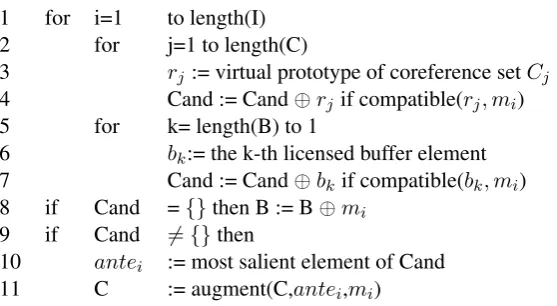
Fig. 1 shows the base algorithm. Let I be the chronologically ordered list of markables, C the set of coreference sets (i.e. the coreference parti-tion) and B a buffer where markables are stored, if they are not anaphoric (but might be valid an-tecedents). Furthermore, mi is the current
mark-able and⊕means concatenation of a list and a sin-gle item.
The algorithm proceeds as follows: a set of an-tecedent candidates is determined for each mark-able mi (steps 1 to 7) from the coreference sets
(rj) and the buffer (bk). A valid candidaterj or
bk must be compatible with mi. The definition
of compatibility depends on the POS tags of the anaphor-antecedent pair (in order to be coreferent, e.g. two pronouns must agree in person, number
and gender, while two nouns, at least in German, need not necessarily agree in gender).
If an antecedent candidate is already in a coref-erence set (rj),mi is compared to the virtual
pro-totype of the set in order to reduce underspecifi-cation. The virtual prototype bears information accumulated from all elements of the coreference set. For instance, assume a candidate pair ’Clinton ... she’. Since the gender of ’Clinton’ is unspeci-fied, the pair might or might not be a good candi-date. But if ’Clinton’ is part of a coreference set, let’s say: {’Hillary Clinton’, ’she’, ’her’, ’Clin-ton’}then we can derive the gender from the other members and are more safe in our decision. The virtual prototype here would be: singular, femi-nine, human.
In languages such as German, where morpho-logical information is much more discriminatory than in English and where at the same time under-specification appears quite often (e.g. the reflex-ive pronoun ’sich’ might refer to any third person noun phrase, be it singular or plural, masculine, feminine or neutral), this is particularly helpful.
If no compatible antecedent candidates are found, mi is added to the buffer (Step 8). If
there are compatible candidates in the candidate list Cand, the most salient antei ∈ Cand (or, in
the machine learning setting, the most probable) is selected (step 10) and the coreference partition is augmented (step 11). If antei comes from a
coreference set,miis added to that set. Otherwise
(antei is from the buffer), a new set is formed,
{antei, mi}, and added to the set of coreference
sets.
2.1 Restricted Accessibility of Antecedent Candidates
As already discussed, access to coreference sets is restricted to the virtual prototype - the concrete members are invisible. This reduces the number of considered pairs (from the cardinality of a set to 1).
Moreover, we restrict access to buffer elements: if an antecedent candidate,rj, from a coreference
set exists, then elements from the buffer, bk, are
only licensed if they are more recent thanrj.
1 for i=1 to length(I) 2 for j=1 to length(C)
3 rj:= virtual prototype of coreference setCj
4 Cand := Cand⊕rjif compatible(rj, mi)
5 for k= length(B) to 1
6 bk:= the k-th licensed buffer element
7 Cand := Cand⊕bkif compatible(bk, mi)
8 if Cand ={}then B := B⊕mi
9 if Cand 6={}then
10 antei := most salient element of Cand
11 C := augment(C,antei,mi)
Figure 1: Incremental model: base algorithm
lead to cognitively adequate models for coref-erence resolution, where cognitive burden deter-mines which antecedent candidates are valid at all. Clearly, future work must start with an evaluation of our current setting.
2.2 Filtering and Training Based on Anaphora Type
There is a number of conditions not shown in the basic algorithm in Fig. 1 that define compatibil-ity of antecedent and anaphor candidates based on POS tags: Reflexive pronouns must be bound to the subject governed by the same verb. Rel-ative pronouns are bound to the next NP in the left context. Personal and possessive pronouns are licensed to bind to morphologically compati-ble antecedent candidates (named entities, nouns2 and pronouns) within a window of three sentences. Named entities must either match completely or the antecedent must be longer than one token and all tokens of the anaphor must be contained in the antecedent (e.g. ’Hillary Clinton’ ... ’Clinton’). Demonstrative NPs are mapped to nominal NPs by matching their heads (e.g. ’The recent find-ings’ ... ’these findfind-ings’). Definite NPs match with noun chunks that are longer than one token3 and must be contained completely without the deter-miner (e.g. ’Recent events’ ... ’the events’). To li-cence non-matching (bridging) nominal anaphora, we apply hyponymy and synonymy searches in WordNet (Fellbaum, 1998) and GermaNet (Hamp
2To identify animacy and gender of NEs, we use a list of known first names annotated with gender information and look up Wikipedia categories to map NEs to Word-Net/GermaNet synsets. To obtain animacy information for common nouns, we conduct a WordNet search.
3If we do not apply this restriction, too many false posi-tives are produced - simple head matching appears to be very noisy.
and Feldweg, 1997) respectively.
For the machine learning approaches we used the standard features of mention-pair models (e.g. (Soon et al., 2001)). We trained individual classi-fiers per anaphora type, i.e. for nominal anaphora, reflexive, possessive, relative and personal pro-nouns. We manually tuned the feature selection of each classifier. Both the mention-pair and the entity-mention model share these features and fil-ters.
2.3 Binding Theory as a Filter
There is another principle that nicely combines with our incremental model and helps reducing the number of candidates even further: binding theory (e.g. (B¨uring, 2005)). We know that ’Clinton’ and ’her’ cannot be coreferent in the sentence ’Clinton met her’. Thus, the pair ’Clinton’-’her’ need not be considered at all. Furthermore, all mentions of the ’Clinton’ coreference set, say{’Hillary Clin-ton’, she, her, ’Clinton’}, are transitively exclusive and can be discarded as antecedent candidates.
Actually, there are subtle restrictions to be cap-tured here. We have not implemented a full-blown binding theory on top of our dependency parsers. Instead, we approximated binding restrictions by subclause detection. ’Clinton’ and ’her’ are in the same subclause (the main clause) and are, thus, exclusive. This is true for nouns and personal pro-nouns, only. Possessive and reflexive pronouns are allowed to be bound in the same subclause.
2.4 An Empirically-based Salience Measure
also taken into account in order to determine salience. Such approaches suffered from a proper empirical justification4. Consequently, machine-learning approaches have replaced manually de-signed salience measures. Now it is the classifier that determines ’salience’.
Our salience measure is a variant of the one in (Lappin and Leass, 1994). Instead of manually specifying the weights, we derived them empir-ically on the basis of the coreference gold stan-dard (for German, this is the coreference annotated treebank T¨uBa-D/Z ; for English, OntoNotes5was used). The salience of a dependency label, D, is estimated by the number of true mentions in the gold standard that bear D (i.e. are connected to their heads with D), divided by the total number of true mentions. The salience of the labelsubject is thus calculated by:
N umber of true mentions bearing subject T otal number of true mentions
For a given dependency label, this fraction indi-cates how strong is the label a clue for bearing a true mention. We get a hierarchical ordering of the dependency labels (subject>object>pobject ...) according to which antecedent candidates are ranked.
Clearly, future work will have to establish a more elaborate calculation of salience to be used for classification without machine learning. To our surprise, however, this salience measure per-formed quite well together with our incremental architecture.
3 Evaluation
We evaluate our system in two languages (Ger-man and English) and in two domains (newswire text and abstracts from the biomedical domain). We directly compare our incremental entity men-tion model to the generative menmen-tion-pair model on the basis of the German T¨uBa-D/Z corpus in a 5-fold cross-validation. We also investigate the competitiveness of the incremental model com-pared to other systems in two tasks and languages: SemEval6 (English and German) and BioNLP7 (English). Results of the CoNLL 20118 shared task development data (English) are also provided.
4There are notable exceptions, e.g. (Ge et al., 1998), where salience calculation is combined with statistics.
5
http://www.bbn.com/ontonotes/ 6
http://stel.ub.edu/semeval2010-coref/ 7
https://sites.google.com/site/bionlpst/home/protein-gene-coreference-task/
8http://conll.bbn.com/
3.1 Reducing the Number of Candidate Pairs
Anaphora Type Pos Neg
Mention-pair model (171526 instances)
Nouns 5626 5144
Relative pronouns 1428 2459 Reflexive pronouns 1372 728 Possessive pronouns 5346 21571
Personal pronouns 23025 104827
Total 36797 134729
Entity-mention model (40229 instances)
Nouns 1776 3787
Relative pronouns 1382 2330 Reflexive pronouns 462 530 Possessive pronouns 1416 8156
Personal pronouns 4023 16367
Total 9059 31170
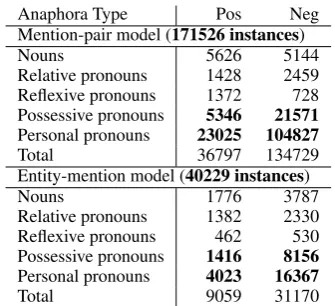
Figure 2: Number of training instances per anaphora type of Fold 1 of the T¨uBa-D/Z
Fig. 2 shows the number of training instances of the first fold (about 5’000 sentences) from the T¨uBa-D/Z both for the incremental and the non-incremental algorithm. Overall a huge reduction by a factor of 4 (131297 instances, -76.55 %) can be observed when moving from the non-incremental mention-pair to the incremental entity-mention model. As we use the same fil-ter set in all runs, no true mentions are deleted in the incremental approach. The reduction in pos-itives results from pairing an anaphor candidate with only one virtual prototype of the coreference set it belongs to as opposed to redundantly pairing it with all members of its set. As during testing only pairs consisting of the set’s virtual prototype and the anaphor candidate are considered, this is sufficient and the additional pairs are not needed. The reduction in negatives results from the same mechanism. Instead of pairing the anaphor with all mentions of a set it does not belong to, only one negative pair with the prototype is generated. Additionally, some pairs are created with compat-ible members from the buffer list.
3.2 T ¨uBa-D/Z Model Comparison
We can see from the results (Fig. 3) that the in-cremental entity-mention model outperforms the mention-pair model. The entity-mention model with the TiMBL classifier performed best by im-proving recall (+ 7.01%) and losing some pre-cision (- 0.79%) compared to the mention-pair model. To our surprise, the simple salience ap-proach performed quite well, losing only 0.85% precision and 1.88% recall compared to its ma-chine learning variant. Given that bridging anaphora is not resolved in the salience mode, a reduction in recall was to be expected. It still out-performs the mention-pair model that implements machine learning.
Model F1 P R
Mention-pair (TiMBL + ILP) 49.35 53.67 45.69 Entity-mention (TiMBL) 52.79 52.88 52.70 Entity-mention (salience) 51.41 52.03 50.82
Figure 3: CEAF scores of the 5-fold T¨uBa-D/Z cross-validation
Overall the results of the T¨uBa-D/Z evaluation are low, indicating that end-to-end coreference resolution with real preprocessing is still a diffi-cult problem. It is important to note that we im-plemented a version of the CEAF metric which does not account for singletons (i.e. coreference sets with only one mention) because we believe that finding singletons is not a crucial part of the coreference resolution task and that it improves re-sults artificially. We can see the difference of eval-uating with or without singletons if we compare these results with the ones from SemEval (Fig. 5), where singletons are considered in the eval-uation process. The SemEval German task also uses data from the T¨uBa-D/Z , allowing an ap-proximate comparison of the results to illustrate the effects of considering singletons in evaluation. The CEAF F1-measure of our incremental model reaches 76.8% on the SemEval data (Fig. 5), while without singletons, we reach 52.79% in the T¨uBa-D/Z evaluation (Fig. 3).
3.3 Error Analysis
We simulated perfect resolution of the individual classifiers of the best performing system (Entity-mention(TiMBL)) from the model comparison (Fig. 4). We ran the system on the first fold (ca. 5000 sentences) of the T¨uBa-D/Z , resolving one type of anaphora (e.g. nominal anaphora) using
gold standard information per run, while the other anaphora types were resolved by the system.This gives us an indication of the upper bounds of the system: How good would our system be, if it re-solved e.g. nominal anaphora perfectly?
with filters means that only pairs that pass the filters are resolved. In thewithout filtersmode, all pairs of the corresponding anaphora type are re-solved correctly, disregarding filter decisions. The other anaphora types are resolved by the system in both modes. The difference in performance be-tween the with and without filtering mode indi-cates how good our filters are: the smaller the dif-ference, the better the filters (compare values hori-zontally). The performance difference of the indi-vidual classifiers with perfect resolution compared to the overall system performance (right column, compare vertically) indicates the difficulty of re-solving that anaphora type.
For example, in the first row that indicates res-olution performances of nominal anaphora we can see that we roughly lose 10% in F1 measure due to our nominal filters (72.70% - 62.61%). Com-pared to the actual system performance in the last row in the right column (53.86%) we see that we lose an additional 9% in F1 measure because of imperfect resolution of nominal anaphora (62.61% - 53.86%). This sums up to a total loss of 19% in F1 measure compared to system performance with perfect resolution of nominal anaphora. Com-pared to the minor difference of 1.8% F1 measure between perfect and imperfect resolution of reflex-ive pronouns (-1.5% through filtering and -0.3% through imperfect classification) the difficulty of resolving nominal anaphora becomes obvious.
3.4 SemEval 2010, BioNLP 2011 and CoNLL 2011
To get an indication of the competitiveness of our incremental approach we carried out evaluations over recent shared task data sets. The SemEval coreference task (Recasens et al., 2010) focused on coreference resolution in multiple languages and comparing different evaluation metrics. The test data for German was composed of the T¨uBa-D/Z whereas the English data was gathered from the OntoNotes corpus.
Without filtering With filtering F1 Precision Recall F1 Precision Recall
Nouns 72.70 69.53 76.17 62.61 63.70 61.55
Personal pronouns 60.42 62.05 58.88 58.86 60.64 57.19 Relative pronouns 56.25 57.91 54.68 55.97 57.65 54.39 Possessive pronouns 56.06 57.35 54.82 55.81 57.18 54.51 Reflexive pronouns 55.68 57.11 54.32 54.16 55.64 52.77
System - - - 53.86 54.64 53.09
Figure 4: CEAF scores for the simulation of perfect classification (upper bounds) of the individual classifiers for the first 5000 sentences of the T¨uBa-D/Z .
and thereby improving overall recall of interaction extraction (i.e. the main task). The test data con-sists of abstracts gathered from PubMed.
As the SemEval training data for English and German were not available at the time of our post-task experiments, we were only able to evaluate the salience based classification.
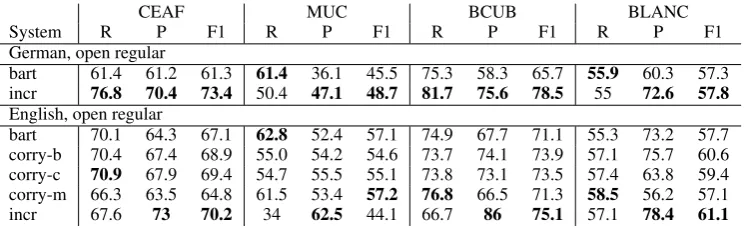
The SemEval coreference task offers many dif-ferent settings. Since we are interested in real end-to-end coreference resolution we evaluated theopen/regularsetting, meaning that real prepro-cessing components are used as opposed to perfect gold standard preprocessing data. Results of the SemEval task are given in Figure 5.
Except for the (recently questioned, e.g. (Luo, 2005; Cai and Strube, 2010)) MUC metric in the English evaluation, the incremental model (incr) achieved best results throughout the SemEval ex-periments in both languages. All other systems that competed in the task implemented a mention-pair model. Overall, an improvement can be ob-served compared to the other systems, mainly in precision.
The simple salience based measure is not suited for resolving bridging anaphora. Therefore, bridg-ing anaphora was not resolved by the system in these experiments (but still included in the evalu-ation) which might be a reason for the relatively low recall.
More recently, we have adapted our salience-based incremental architecture to the biomedical domain. Our results in the recent BioNLP 2011 shared task are competitive as well (see Fig. 6).
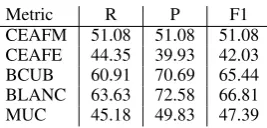
The results of our evaluation over the CoNLL 2011 shared task development set are given in Fig. 7. CEAF and BCUB scores are considerably lower compared to the SemEval results. We believe these differences originate from the updated scor-ing algorithms for CEAF and BCUB. They were modified for the CoNLL scorer according to sug-gestions by (Cai and Strube, 2010). The CoNLL
Team R P F1
A 22.18 73.26 34.05 incr 21.48 55.45 30.96 B 19.37 63.22 29.65 C 14.44 67.21 23.77
D 3.17 3.47 3.31
E 0.70 0.25 0.37
Figure 6: BioNLP 2011 Protein/Gene Coreference Task Results
scorer has stricter mention boundary handling than the SemEval scorer. Moreover, singletons were not marked in the CoNLL data.
Metric R P F1
CEAFM 51.08 51.08 51.08 CEAFE 44.35 39.93 42.03 BCUB 60.91 70.69 65.44 BLANC 63.63 72.58 66.81 MUC 45.18 49.83 47.39
Figure 7: CoNLL 2011 Development Set Results
4 Related Work
The work of (Soon et al., 2001) is a prototyp-ical and often re-implemented (baseline) model that is based on pairwise classification and ma-chine learning. Our non-incremental mention-pair model can be seen as an adaption of this sys-tem and its features. Coreference clustering is discussed e.g. in (Denis and Baldridge, 2009; Finkel and Manning, 2008). Our mention-pair model uses the Balas algorithm for clustering as discussed in (Klenner, 2007).
CEAF MUC BCUB BLANC
System R P F1 R P F1 R P F1 R P F1
German, open regular
bart 61.4 61.2 61.3 61.4 36.1 45.5 75.3 58.3 65.7 55.9 60.3 57.3 incr 76.8 70.4 73.4 50.4 47.1 48.7 81.7 75.6 78.5 55 72.6 57.8
English, open regular
bart 70.1 64.3 67.1 62.8 52.4 57.1 74.9 67.7 71.1 55.3 73.2 57.7 corry-b 70.4 67.4 68.9 55.0 54.2 54.6 73.7 74.1 73.9 57.1 75.7 60.6 corry-c 70.9 67.9 69.4 54.7 55.5 55.1 73.8 73.1 73.5 57.4 63.8 59.4 corry-m 66.3 63.5 64.8 61.5 53.4 57.2 76.8 66.5 71.3 58.5 56.2 57.1 incr 67.6 73 70.2 34 62.5 44.1 66.7 86 75.1 57.1 78.4 61.1
Figure 5: Our SemEval 2010 post-task evaluation results
mention-pair models. Also, in the recent SemEval 2010 and BioNLP 2011 shared tasks no entity-mention models participated.
Our work differs from the research mentioned above as it focuses on using an incremental entity-mention architecture to impose constraints on can-didate pair generation as opposed to generating cluster-level features for (machine learning-based) classification. Our hypothesis, also for future work, is that progress is possible by not only im-proving classifier performance but by imim-proving other steps of the coreference resolution pipeline that lead up to the classifier, namely pair genera-tion and antecedent candidate accessibility.
5 Conclusions
We have introduced an incremental entity-mention algorithm for coreference resolution and evaluated its impact on pair generation and the performance of architectural variants. A performance compari-son of our model to systems from different shared tasks produced good results. We also discussed a simple and very fast salience-based approach that performed quite well, i.e. it outperformed all sys-tems of the 2010’s SemEval shared task.
The benefits of an incremental model are:
• due to the restricted access to potential an-tecedent candidates, the number of generated candidate pairs can be reduced drastically
• no additional coreference clustering is neces-sary
• global constraints (e.g. transitivity) are easily integrated
• underspecification of antecedent candidates can often be compensated by other members of the emerging coreference sets
Our theory on how to restrict the accessibility of antecedent candidates has proven to be (em-pirically) successful, as it outperformed other sys-tems. However, we are aware of the fact that we need to explore in a more principled and empiri-cally grounded way, what the parameters of such an evolving discourse model are. We strive for a theory whose decisions, in the best case, relate to the restrictions of human cognitive capacity.
Finally, our implementation of a binding theory is incomplete. Since binding theory provides hard restrictions, it is a crucial component of any theory on antecedent accessibility.
Web demos of the salience based system for En-glish and German are available9.
Acknowledgements. Our project is funded by the Swiss National Science Foundation (grant 105211-118108). We are grateful to OntoGene10 for their help and advice regarding the BioNLP shared task.
References
Daniel B¨uring. 2005. Binding Theory. Cam-bridge Textbooks in Linguistics. CamCam-bridge Univer-sity Press, Cambridge.
Jie Cai and Michael Strube. 2010. Evaluation met-rics for end-to-end coreference resolution systems. In Proceedings of the 11th Annual Meeting of the Special Interest Group on Discourse and Dialogue, SIGDIAL ’10, pages 28–36, Stroudsburg, PA, USA. Association for Computational Linguistics.
Aron Culotta, Michael Wick, and Andrew McCallum. 2007. First-order probabilistic models for corefer-ence resolution. In HLT ’07: The Conference of the North American Chapter of ACL; Proceedings of the Main Conference, pages 81–88, Rochester, New York, April. Association for Computational Linguis-tics.
9
Walter Daelemans, Jakub Zavrel, Ko van der Sloot, and Antal van den Bosch. 2007. Timbl: Tilburg memory-based learner. Technical report, Induction of Linguistic Knowledge, Tilburg University and CNTS Research Group, University of Antwerp.
Hal Daume III and Daniel Marcu. 2005. A large-scale exploration of effective global features for a joint entity detection and tracking model. In HLT ’05: Proceedings of the conference on Human Language Technology and Empirical Methods in Natural Lan-guage Processing, pages 97–104, Morristown, NJ, USA. Association for Computational Linguistics.
Pascal Denis and Jason Baldridge. 2009. Global joint models for coreference resolution and named entity classification. InProcesamiento del Lenguaje Natu-ral 42, pages 87–96, Barcelona: SEPLN.
Christiane Fellbaum. 1998. WordNet: An Electronic Lexical Database (Language, Speech, and Commu-nication). The MIT Press, May.
Jenny Rose Finkel and Christopher D. Manning. 2008. Enforcing transitivity in coreference resolution. In
HLT ’08: Proceedings of the 46th Annual Meeting of the ACL on Human Language Technologies, pages 45–48, Morristown, NJ, USA. Association for Com-putational Linguistics.
Niye Ge, John Hale, and Eugene Charniak. 1998. A statistical approach to anaphora resolution. In Pro-ceedings of the Sixth Workshop on Very Large Cor-pora, pages 161–171, Montreal, Canada.
Birgit Hamp and Helmut Feldweg. 1997. GermaNet – a lexical-semantic net for German. InProceedings of ACL workshop Automatic Information Extraction and Building of Lexical Semantic Resources for NLP Applications, pages 9–15, Somerset, NJ, USA. As-sociation for Computational Linguistics.
Manfred Klenner. 2007. Enforcing consistency on coreference sets. InProceedings of the International Conference on Recent Advances in Natural Lan-guage Processing, pages 323–328, Borovets, Bul-garia.
Shalom Lappin and Herbert J Leass. 1994. An algo-rithm for pronominal anaphora resolution. Compu-tational Linguistics, 20:535–561.
Xiaoqiang Luo, Abe Ittycheriah, Hongyan Jing, Nanda Kambhatla, and Salim Roukos. 2004. A mention-synchronous coreference resolution algorithm based on the bell tree. InProceedings of the 42nd Annual Meeting of ACL, ACL ’04, Stroudsburg, PA, USA. Association for Computational Linguistics.
Xiaoqiang Luo. 2005. On coreference resolution per-formance metrics. In HLT ’05: Proceedings of the conference on Human Language Technology and Empirical Methods in Natural Language Process-ing, pages 25–32, Morristown, NJ, USA. Associa-tion for ComputaAssocia-tional Linguistics.
Karin Naumann, 2006. Manual for the Annotation of Indocument Referential Relations. SFS (Seminar f¨ur Sprachwissenschaft), http://www.sfs.uni-tuebingen.de/tuebadz.shtml.
Vincent Ng. 2010. Supervised noun phrase corefer-ence research: the first fifteen years. InProceedings of the 48th Annual Meeting of ACL, ACL ’10, pages 1396–1411, Stroudsburg, PA, USA. Association for Computational Linguistics.
Karthik Raghunathan, Heeyoung Lee, Sudarshan Ran-garajan, Nathanael Chambers, Mihai Surdeanu, Dan Jurafsky, and Christopher Manning. 2010. A multi-pass sieve for coreference resolution. In Proceed-ings of the 2010 Conference on Empirical Meth-ods in Natural Language Processing, EMNLP ’10, pages 492–501, Stroudsburg, PA, USA. Association for Computational Linguistics.
Altaf Rahman and Vincent Ng. 2009. Supervised models for coreference resolution. InProceedings of the 2009 Conference on Empirical Methods in Natural Language Processing: Volume 2 - Volume 2, EMNLP ’09, pages 968–977, Stroudsburg, PA, USA. Association for Computational Linguistics.
Marta Recasens, Llu´ıs M`arquez, Emili Sapena, M. Ant`onia Mart´ı, Mariona Taul´e, V´eronique Hoste, Massimo Poesio, and Yannick Versley. 2010. Semeval-2010 task 1: Coreference resolution in multiple languages. In Proceedings of the 5th International Workshop on Semantic Evaluation, SemEval ’10, pages 1–8, Stroudsburg, PA, USA. As-sociation for Computational Linguistics.
Gerold Schneider. 2008. Hybrid Long-Distance Func-tional Dependency Parsing. Doctoral Thesis, Insti-tute of Computational Linguistics, Univ. of Zurich.
Rico Sennrich, Gerold Schneider, Martin Volk, and Martin Warin. 2009. A New Hybrid Dependency Parser for German. InProc. of the German Society for Computational Linguistics and Language Tech-nology 2009 (GSCL 2009), pages 115–124, Pots-dam, Germany.
Wee M. Soon, Hwee T. Ng, and Daniel. 2001. A machine learning approach to coreference resolu-tion of noun phrases. Computational Linguistics, 27(4):521–544, December.
Holger Wunsch, Sandra K¨ubler, and Rachael Cantrell. 2009. Instance sampling methods for pronoun reso-lution. InProceedings of Proceedings of the Inter-national Conference on Recent Advances in Natural Language Processing, Borovets, Bulgaria.