Enriching Frame Semantic Resources with Dependency Graphs
Hagen F ¨urstenau
Dept. of Computational Linguistics, Saarland University Saarbr¨ucken, Germany
Abstract
We propose two general and robust methods for enriching resources annotated in the Frame Semantic paradigm with syntactic depen-dency graphs, which can provide useful additional information for applications such as semantic role labeling methods. One method incorporates information of a dependency parser, while the other one assumes the resource to be based on a treebank and uses dependency graphs converted from phrase structure trees. Coverage and accuracy of the methods are evaluated on the English FrameNet and German SALSA corpora. It is shown that large proportions of those resources can be accurately enriched by mapping their annotations onto dependency graphs. Failures to do so are found to be largely due to parser errors and can therefore be seen as an indicator of incorrect parses, which helps to improve parse selection. The remaining failures are analyzed and an outlook on ways of improving the results by adaptation to specific resources is given.
1.
Introduction
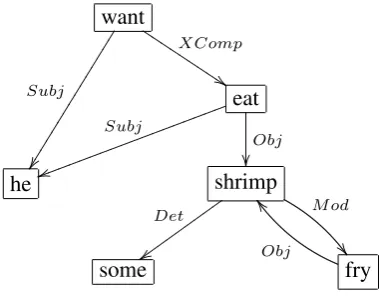
Recent years have seen a growing interest in resources an-notated within the Frame Semantics paradigm (Fillmore, 1982), e.g. the corpora created in the English FrameNet (Baker et al., 1998) or German SALSA (Burchardt et al., 2006) projects. Information about semantic roles contained in such resources has been employed to train semantic role labeling methods, which are then capable of providing se-mantic analyses for unseen sentences, a process that has been called “semantic parsing”. Applications of such anal-yses are manifold, e.g. in question answering (Shen and La-pata, 2007) or information retrieval (Moschitti et al., 2003). Semantic role labeling methods or similar applications, however, usually require syntactic analyses of the sentences in their training corpus as well, which can be either in-cluded in the resource, e.g. in the form of a treebank, or obtained by syntactic parsing. While most methods pro-posed so far use phrase structure trees as syntactic formal-ism, dependency graphs are increasingly recognized as a more natural syntactic representation for semantic role la-beling, promising improved performance of the latter (cf. e.g. (Hacioglu, 2004) or the CoNLL 2008 Shared Task on “Joint Parsing of Syntactic and Semantic Dependencies”1). Advantages of dependency graphs include the more imme-diate representation of predicate-argument structures and the possibility of abstraction from surface phenomena ir-relevant to Frame Semantics, e.g. auxiliary verbs or control structures. The existing Frame Semantic resources, how-ever, either lack deep syntactic structure altogether (like FrameNet) or are annotated on phrase structure trees rather than dependency graphs (like SALSA).
In this paper we present and discuss two general methods for enriching Frame Semantic resources with dependency graphs. We show that the methods can robustly and accu-rately enrich large proportions of such resources with de-pendency graphs. Section 2. introduces two Frame Seman-tic resources which we tested our approach on. The two methods for enriching them are described in Section 3. In
1http://www.yr-bcn.es/conll2008/
Section 4. we give evaluation results of several test settings, showing the robustness of the methods and evaluating the resulting resources. Section 5. concludes with a summary of the results.
2.
Data
2.1. FrameNet CorpusThe FrameNet corpus contains more than 135,000 frame annotations on example sentences drawn mostly from the British National Corpus. We only consider annotations with verbal frame evoking elements, since the advantage of dependency structures is more obvious for these and se-mantic role labelling methods as well as other annotation projects like SALSA have concentrated on them. There are 61,792 such annotations in the FrameNet data. Each an-notation contains a frame name, e.g. Motion noise and a markup of the textual extent of the frame evoking element (FEE) and each frame element (role), e.g.
[ThemeThey] [FEEclattered] [Goalinto the hallway].
There is a layer of syntactic annotation in the FrameNet corpus, but it is shallow and incomplete and we therefore only consider the spans of the annotated FEE and roles of each sentence, which are given as sets of character positions (e.g.{15, . . . ,30}for the roleGoalin the example).
2.2. SALSA Corpus
Dependency Graphs Mapping method Mappable Correct Parser Errors (of those mappable) (of those not mappable)
Best LFG parse Span Comparison 49.3% 76%(±9%) 82%(±8%)
Best RASP parse Span Comparison 44.4% 78%(±9%) 76%(±9%)
20 best LFG parses Span Comparison 61.1% 77%(±9%) 83%(±8%)
20 best RASP parses Span Comparison 65.1% 78%(±9%) 78%(±9%)
Table 1: Results for the English FrameNet sample
4.
Experiments and Results
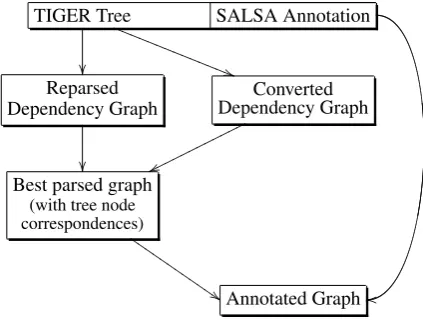
We applied the two methods described in Section 3. to en-rich the FrameNet and SALSA corpora with dependency graphs. The Span Comparison method of Section 3.1., not relying on syntax information in the resource, was ap-plied to both corpora, showing that it works independent of corpus and language. Results on the FrameNet corpus are discussed in Section 4.1., those on the SALSA corpus (stripped of its treebank information) in Section 4.2.1. The Node Correspondence method of Section 3.2., using anno-tated phrase structure trees, was applied to the SALSA cor-pus in two different approaches, detailed in Sections 4.2.2. and 4.2.3.
For the Span Comparison method, which relies on parser output, we considered both the best ranking and the 20 best ranking analyses provided by the parsers. In the latter case, the method was applied to the readings successively until it could annotate one or was found to fail on all of them. For each examined combination of mapping and depen-dency graph generation method the correctness of the re-sulting enriched resource was assessed by manually eval-uating a random sample of 100 annotated dependency graphs. Since complete correctness of a dependency graph is a very strict measure when parsing long and complex sentences, an evaluation oriented on typical applications such as semantic role labeling methods was carried out: An annotated dependency graph was classified as correct if the paths from the node annotated as FEE to each node annotated with a role were correct as judged by a human evaluator. Only when the role-bearing node represented a preposition or a coordination, its dependents, which in this case are the semantically significant head words of the role, were also checked. Arguments and adjuncts were not distinguished, since in Frame Semantics this distinction is supposed to be captured by the status of a role (i.e. core, peripheral or extra-thematic role).
To assess the reasons for failures of the methods, a random sample of 100 dependency graphs which could not be se-mantically annotated was examined in each setting and the proportion of failures due to (or partly due to) parser errors was determined.
4.1. FrameNet corpus
We parsed the 61,792 sentences of the FramNet corpus fea-turing verbal FEEs with both the English LFG developed in the ParGram project (Riezler et al., 2003), which is a hand-crafted grammar with statistical parse ranking, and with RASP (Briscoe et al., 2006), a statistical parser pro-ducing dependency graphs. The f-structures of the LFG
were converted to dependency graphs with rewriting rules by Tracy H. King.
The results of applying the Span Comparison method to the best and 20 best parses of both the LFG and RASP are shown in Table 1, with 95% confidence intervals for the sample-based evaluation figures. The results are quite sim-ilar between the two parsers, suggesting that our method does not depend on a specific format of dependency graphs.
While slightly less than half of the FrameNet corpus could be enriched with the best ranking parses alone, these figures increase significantly if the 20 best ranking parses are con-sidered. Since correctness does not seem to be affected, this indicates that the additional bracketing information, which is implicit in semantic role annotations in so far as it cor-relates with constituent boundaries, is able to improve the parse selection process considerably. This is because wrong higher ranking parses are discarded in favour of correct lower ranking ones if the annotation can be mapped to the latter but not the former.
The relatively high number of unmappable annotations was found to be largely due to parser errors, often attachment problems leading to mismatches with the subgraph spans. Since with the current state of the art in dependency parsing a certain proportion of errors cannot be avoided, our atten-tion is on how well our method can detect them and discard the problematic sentences. Ideally the method would pro-cess all correct parses and fail on all erroneous parses. The figures in the columns “Correct” and “Parser Errors” of Ta-ble 1 can therefore be seen as measures of how close to this ideal our method performs.
4.2. SALSA corpus 4.2.1. Reparsing
account-via Automatic Semantic Labeling. In Proceedings of FLAIRS 2003, St. Augustine, FL.
Stefan Riezler, Tracy H. King, Richard S. Crouch, and An-nie Zaenen. 2003. Statistical Sentence Condensation using Ambiguity Packing and Stochastic Disambigua-tion Methods for Lexical-FuncDisambigua-tional Grammar. In Pro-ceedings of the Human Language Technology Confer-ence and the 3rd Meeting of the North American Chapter of the Association for Computational Linguistics (HLT-NAACL’03).
Christian Rohrer and Martin Forst. 2006. Improving cov-erage and parsing quality of a large-scale LFG for Ger-man. InProceedings of the 5th Conference on Language Resources and Evaluation (LREC 2006), Genoa, Italy. Dan Shen and Mirella Lapata. 2007. Using Semantic