SKELETON: Specialised knowledge retrieval on the basis of terms and
conceptual relations
Judit Feliu, Jorge Vivaldi, M. Teresa Cabré
Institute for Applied Linguistics, Universitat Pompeu Fabra La Rambla 30-32, 08002 Barcelona, Spain {judit.feliu;jorge.vivaldi;teresa.cabre}@upf.edu
Abstract
The main goal of this paper is to present a first approach to an automatic detection of conceptual relations between two terms in specialised written text. Previous experiments on the basis of the manual analysis lead the authors to implement an automatic query strategy combining the term candidates proposed by an extractor together with a list of verbal syntactic patterns used for the relations refinement. Next step on the research will be the integration of the results into the term extractor in order to attain more restrictive pieces of information directly reused for the ontology building task.
1 Introduction
In this paper the authors show a strategy planned to obtain specialised knowledge fragments containing terms together with the conceptual relations among them, that is, the skeleton of a text that could be schematised by means of a concept map and hopefully reused in order to enrich a domain dependant ontology. These terms and relations will be detected in written texts from the genomics domain. The results presented in this paper have been obtained for the Catalan language but we are already working on the implementation of the same working methodology for specialised texts in Spanish and English will be also considered in a near future.
Roughly speaking, our proposal shows one of the methodologies used for the achievement of conceptual mapping from texts and it includes two different and complementary strategies:
On the one hand, we have used a term extractor (YATE) in order to obtain the term candidates in genomics domain texts. YATE has been tuned to cover the working specialised field by means of the enlargement and refinement of some domain dependant information. And, at the same time, the improvement of YATE has contributed to the enlargement of EuroWordNet (a wide-coverage general-purpose lexico-semantic ontology) with new synsets.
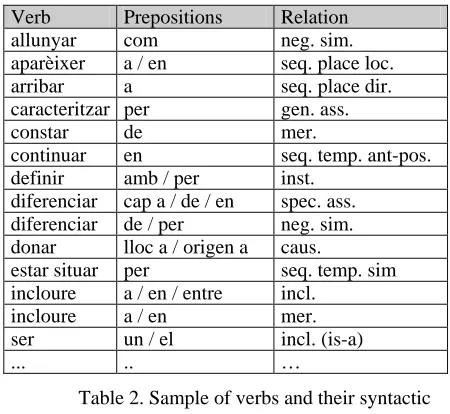
On the other hand, we have reviewed the traditional conceptual relations classification from the point of view of different (but closely related) disciplines, such as terminology, linguistics, ontologies and lexical semantics. After a validated experiment, we have proposed a closed typology of conceptual relations including seven main types of links that may relate the terms used in any domain, therefore also in genomics. These conceptual relations are reflected, in terms of language, by means of verbal markers usually accompanied with prepositions among other language specific mechanisms not used in our experiments. This patterns have been applied in order to compare the information contained between two different terms and to tag specialised knowledge fragments.
In this paper after a brief state-of-the-art about conceptual relations, and the automatic detection strategies of these links, it is included the preliminary analysis of the verbal markers concerning precision and noise. Manually
detected patterns from a sample corpus have allowed the authors to explore and implement an automatic query system which has been progressively refined. Some illustrating and relevant contexts are highlighted in the results section indicating some figures concerning precision for each verbal pattern conveying a particular conceptual relation. It is worth mentioning that the integration into YATE of the obtained results using a kwic query interface is described in the future research lines before briefly concluding the paper.
2
State of the art
This section includes a brief state-of-the-art about conceptual relations, focusing on the point of view of the terminology contributions in this issue, and also some comments on recent advances in the automatic detection of some of these types of links.
2.1 Terminology
subject of the verb expressing the relation and, in some others, the textual fragment appearing after the prepositional group does not include a term. The following example show these two inconveniences at the same time:
- El coneixement de l'estructura tridimensional de les #molècules# de classe I és degut als treballs d'estructura cristal·logràfica de les molècules HLA-A2, HLA-A68i HLA-B27. [The study of the tridimensional structure for type I #molecules# is due to the research works on the structure…]
The next fragments show some examples where the is-a relation is correctly detected:
- L'estrès oxidatiu ha estat implicat en nombroses #malalties neurodegeneratives humanes# com són la #SD#, les malalties d'Alzheimer, Parkinson i Huntington, l'esclerosi lateral amiotròfica (als), distròfies musculars, arteriosclerosi i els processos d'envelliment en general. [... human neurodegenerative diseases such as DS, Alzheimer’s diseases ...]
- Per fi, després de gairebé un segle d'història, el #cromosoma#, que és una #molècula contínua d'ADN#, es pot parcel·lar en les seues unitats discretes, els gens. [... the chromosome is a continuous DNA molecule ...]
- La #proteïna HMG-14# és una #proteïna nuclear# que podria modular l'estructura de la cromatina transcripcionalment activa. [The HMG-14 protein is a nuclear protein ...]
The following example is not valid due to the anaphoric reference present after the pattern instead of the desired term:
- Una de les tècniques més prometedores per definir xarxes de #gens# entrellaçats és la dels denominats bioxips .
6 Future
work
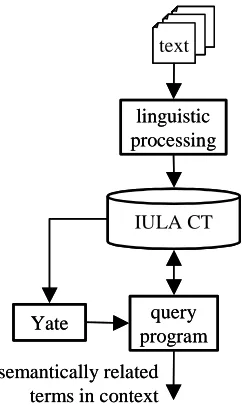
In order to facilitate the building task to the ontology engineer we foresee a tight integration of YATE in such way that the proposed system will be looking for the triplet (term1, relation, term2). On the basis of the information given regarding Figure 1, this improvement means that the extractor itself would be able to look for the sentences containing the highest ranked terms and only for these sentences it will try to find a valid semantic relation indicator.
In order to confirm these promising results we plan to apply the same procedures to other domains, as wells as to other languages like Spanish and afterwards English.
7 Conclusions
We have presented a research based on learning semantic relations from text in the domain of genomics. In particular, we investigate the use of verbs as semantic relations markers. Our model is based upon a previous work on the definition of a typology of conceptual relations and some experimentation using this set of markers. As a result of this experimentation it was decided to attach a specific preposition to every verb in order to refine the results and to avoid ambiguity derived from polysemous markers. A new experiment was designed introducing the use of a term extractor together with a
corpus query program. The result of this new experiment is very encouraging because an interesting number of text fragments can be considered as correctly detected concerning specialised knowledge retrieval. This result encourage us to go further in the integration of the proposed methodology with a term extractor.
To sum up, we conclude that the specialised knowledge retrieval using terminological information in order to get a semiautomatic ontology and term database enlargement may be possible with the use of the techniques that we have presented in this paper.
8 References
Agirre E., Martinez, D. (2004). Unsupervised WSD based on automatically retrieved examples: The importance of bias. In: Proceedings of the Conference on Empirical Methods in Natural Language Processing (EMNLP).
Barcelona: Spain.
Araya, R.; Vivaldi, J. (2004). Mercedes, A Term-In-Context Highlighter. In: Proceedings of Language and Resources Evaluation Conference (LREC2004). Lisbon.
Bloehdorn, S., Hotho, A. (2004). Boosting for Text Classification with Semantic Features. In Proceedings of the Workshop on Mining for and from the Semantic Web at the 10th ACM SIGKDD Conference on Knowledge Discovery and Data Mining, pp. 70-87.
Cabré, M.T. (1999). La terminología: Representación y comunicación. Una propuesta de base comunicativa y otros artículos. Barcelona: Institut Universitari de Lingüística Aplicada. Universitat Pompeu Fabra.
Cimiano, P.; Pivk, A.; Schmidt-Thiene, L.; Staab S. (2004). Learning Taxonomic Relations from Heterogeneous Evidence. In ECAI-2004 Workshop on Ontology Learning and Population.
Feliu, J. (2000). Relacions conceptuals i variació funcional: elements per a un sistema de detecció automàtica. Barcelona: Institut Universitari de Lingüística Aplicada [non-published].
Feliu, J. (2004). Relacions conceptuals i terminologia: anàlisi i proposta de detecció semiautomàtica. Barcelona: Institut Universitari de Lingüística Aplicada. (Sèrie tesis, 7) [PhD dissertation published in a CD-ROM].
Feliu, J.; Cabré, M.T. (2002). Conceptual relations in specialized texts: new typology and an extraction system proposal. In TKE 2002. Terminology and Knowledge Engineering Proceedings. 6th International Conference 28th-30th August 2002, Nancy, pp. 45-49.
Felber, H.; Picht, H. (1984). Métodos de terminografía y principios de investigación terminológica. Madrid: Instituto Miguel de Cervantes (CSIC).
International Conference on Computational Linguistics, pp. 539-545.
Iris, M.A.; Litowitz, B.E.; Evens, M. (1988). The problems of the part-whole relation. In: Relational models of the lexicon. Representing knowledge in semantic networks. Cambridge: Cambridge University Press, pp. 260-287.
Maedche, A.; Staab S. (2000). Discovering Conceptual Relations from Text. In ECAI 2000, Proceedings of the 14th European Conference on Artificial Intelligence, 2000. IOS Press, Amsterdam.
Marshman, E.; Morgan, T.; Meyer, I. (2002). French patterns for expressing concept relations. In:
Terminology, 8, 1, pp. 1-29.
Marshman, E. (2002). The Cause-Effect Relation in a Biopharmaceutical Corpus: English Knowedge Patterns. In TKE 2002. Terminology and Knowledge Engineering Proceedings. 6th International Conference 28th-30th August 2002, Nancy, pp. 89-94.
Missikoff, M.; Navigli, R.; Velardi P. (2002). Integrated Approach to Web Ontology Learning and Engineering.
IEEE Computer, November 2002.
Morin, E. (1999). Automatic acquisition of semantic relations between terms from technical corpora. In
Proceedings International Congress on Terminology and Knowledge Engineering-TKE-99.
Otman, G. (1996). Les représentations sémantiques en terminologie. París: Masson.
Vivaldi, J., (2001). Extracción de Candidatos a Término mediante combinación de estrategias heterogéneas. PhD dissertation. Universitat Politècnica de Catalunya.
Vivaldi, J.; Rodríguez, H. (2002). Medical Term Extraction using the EWN ontology. In In TKE 2002. Terminology and Knowledge Engineering Proceedings. 6th International Conference 28th-30th August 2002, Nancy.