EndtoEnd Evaluation of Multimodal Dialogue Systems
-can we Transfer Established Methods?
Nicole Beringer , Katerina Louka , Victoria Penide-Lopez
, Uli T ¨urk
Institut f¨ur Phonetik und Sprachliche Kommunikation Schellingstr. 3, D-80799 M¨unchen, Germany
BIOMAX Informatics AG.
Lochhamer Str. 11, D-82152 Martinsried, Germany
beringer,kalo,penide,tuerk @phonetik.uni-muenchen.de
Abstract
The goal of this paper is to define a methodology for the end-to-end evaluation of the multimodal dialogue system SmartKom along the lines of the DARPA guidelines for spoken dialogue systems. The methodology consists of an extended framework for the evaluation of a multimodal dialogue system, evaluation metrics for its various components, and an approach to compare the user satisfaction with the system’s technical performance.
1.
Introduction
The paper gives an outline of how to generalize task re-quirements from spoken to multimodal dialogues and it of-fers a possibility to compare dialogue strategies as well as to normalize performance for task complexity of different tasks. It also reports on the problems we had with transfer-ing the PARADISE (Walker et al., 1997) framework to our multimodal system and how we resolved them.
The following section describes shortly the function of the multimodal SmartKom dialogue system which has to be evaluated. Section 3 gives a general outline on end-to-end evaluation requirements. In section 4 we describe which task requirements can be used with regard to mul-timodality vs. unimodality and across tasks. Special at-tention is turned to the application of PARADISE on the SmartKom system. The most challenging problems due to multimodality are described in section 5. Section 6 reports our approach to solve the evaluation problems due to multi-modality: PROMISE. The last section gives an outlook on PROMISE.
2.
The SmartKom project
In the SmartKom project an intelligent computer-user interface is being developed which deals with various kinds of oral or physical input. Potential benefits of SmartKom include the ease of use and the naturalness of the man-machine interaction due to multimodal input and output. However, a very critical obstacle to progress in this area is the lack of a general methodology for evaluating and com-paring the performance of the three possible scenarios pro-vided by SmartKom:
SmartKom Home/Office to communicate and operate machines at home (e.g. TV, workstation, radio),
SmartKom Public to have a public access to public ser-vices, and
SmartKom Mobile as a mobile assistant.
The system understands input in the form of natural speech as well as in the form of gestures. In order to ”re-act” properly to the intentions of the user, the emotional
status is analyzed via the facial expression and the prosody of speech. One of the requirements of the project is to de-velop new modalities and new techniques.
3.
General Outline on
End-to-End-Evaluation
Because of the innovative character of the project, new methods for end-to-end evaluation had to be developed partly through transferring established criteria from the evaluation of spoken dialogue systems, and partly through the definition of new multimodal measures. These criteria have to deal with a fundamental property of multimodal di-alogue systems, namely the high variability of the input and output modalities with which the system has to cope.
The performance of the evaluation is very often driven by the characteristics of the system that has to be judged (Andenfilger, 1997). For the SmartKom Evaluation we have to take three aspects into account:
the needs of the developers,
users’ needs and
the constraints on the evaluation of multimodal sys-tems in general.
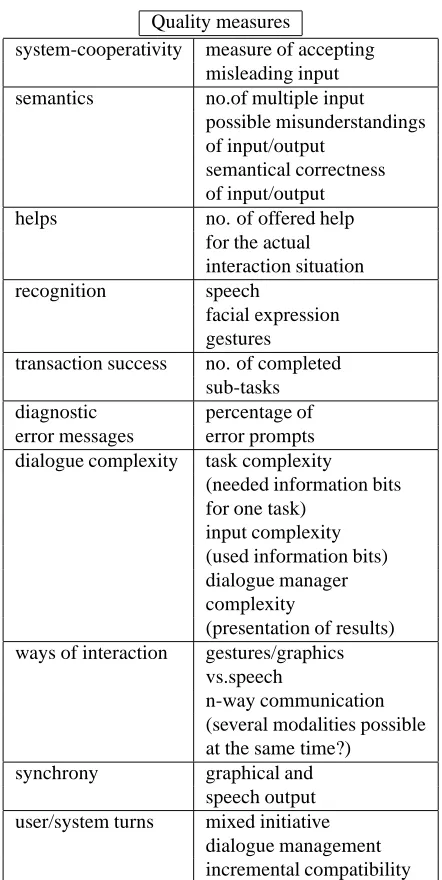
We tried to combine these three aspects in our concept as well as in the performance of the evaluation by comput-ing the efficiency of the system on the basis of objectively measurable criteria such as duration of the dialogue, as well as on the basis of subjective criteria, such as user satisfac-tion and acceptance by the user as follows:
3.1. The developers’ needs
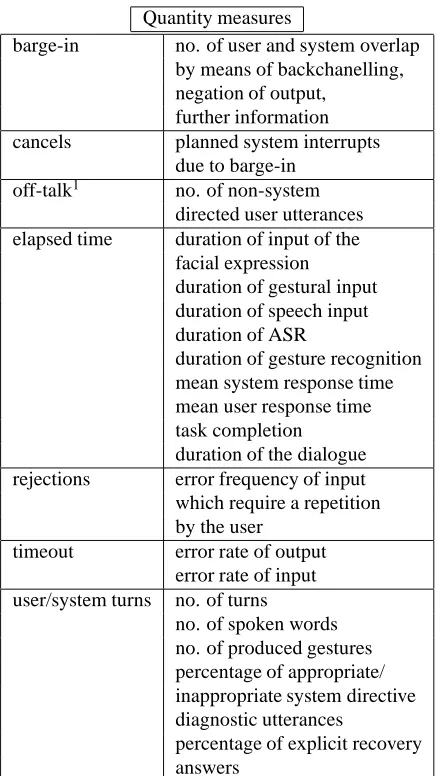
Quantity measures
barge-in no. of user and system overlap by means of backchanelling, negation of output,
further information cancels planned system interrupts
due to barge-in off-talk1 no. of non-system
directed user utterances elapsed time duration of input of the
facial expression
duration of gestural input duration of speech input duration of ASR
duration of gesture recognition mean system response time mean user response time task completion
duration of the dialogue rejections error frequency of input which require a repetition by the user
timeout error rate of output error rate of input user/system turns no. of turns
no. of spoken words no. of produced gestures percentage of appropriate/ inappropriate system directive diagnostic utterances
percentage of explicit recovery answers
Table 2: Quantity measures for the SmartKom evaluation
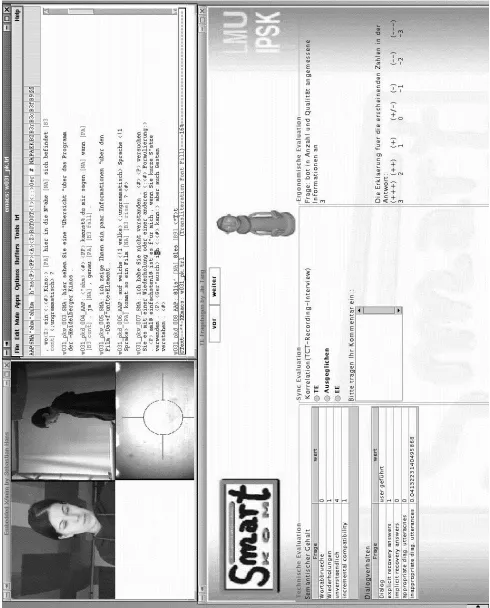
objectively via the graphical evaluation tool presented in figure 1 (for details please refer to (Beringer et al., 2002a)). An evaluator defines the force of the weight by compar-ing real data and cost information. This supplementcompar-ing tool allows to give a precise feedback to the developers in the preliminary evaluation phase. With this tool the developers can easily find out which evaluation part (user satisfaction of objective evaluation) to follow in each situation.
7.
Conclusion and Future Work
One objective was to provide a tool for judging the qual-ity of the SmartKom system according to objective and subjective efficiency in order to obtain the optimal bal-ance between the needs of the developers and those of the users. Therefore, we analysed the subjective user satis-faction components and compared them with the real be-haviour of the system. The output is a normalized balance between subjective and objective criteria.
Another objective was to design, build and test a set of tools that allow us to easily compare system proper-ties and evaluate them according to PROMISE (Beringer et al., 2002b) and PARADISE criteria (Walker et al., 1997). Therefore, we developed tools to analyse different potential
dialogue strategies for carrying out a task like finding a ho-tel, planning a guided tour or compiling a personal TV pro-gramme. We had to provide measures such as inappropriate utterance ratio, turn correction ratio, concept accuracy, im-plicit recovery and transaction success, performance over subdialogues and dialogues or normalization of the perfor-mance for task complexity along the lines of the PROMISE framework.
We defined an adequate evaluation strategy for multi-modal systems, taking into account established methods from spoken dialogue evaluations like PROMISE as well as methods to get along with the existing transfer problems of mono- vs. multimodality.
8.
Acknowledgements
This work was funded by the German Federal Ministry for Research and Technology (BMBF) in the framework of the SmartKom project (01IL905E/6).
9.
References
U. Andenfilger. 1997. Some remarks about the valida-tion of informavalida-tion systems development. in interdis-ciplinary foundation of systems design and evaluation. Seminar report, Center for Computer Science, edited by R. Keil-Slawik, Saarbr¨ucken Schloss Dagstuhl, Univer-sity of Saarland.
N. Beringer, S.Hans, K. Louka, and J. Tang. 2002a. How to relate user satisfaction and system performance in multi-modal dialogue situations? - a graphical approach. Nicole Beringer, Ute Kartal, Katerina Louka, Florian
Schiel, and Uli T¨urk. 2002b. Promise - a procedure for multimodal interactive system evaluation. Proc. of the
LREC Workshop on Multimodal Resources and Multi-modal Systems Evaluation (to appear).
L. Hirschmann, D.A. Dahl, D.P. McKay, L.M. Norton, and M.C. Linebarger. 1990. Beyond class a: A proposal for automatic evaluation of discourse. Proceedings of the
Speech and Natural Language Workshop.
D. Oppermann, F. Schiel, S. Steininger, and N. Beringer. 2001. Off-talk - a problem for human-machine-interaction. Proc. of EUROSPEECH 2001, Scandinavia,
Aalborg.
S. Steininger, B. Lindemann, and T. Paetzold. 2001. La-beling of gestures in smartkom - the coding system.
Springer Gesture Workshop 2001, London (to appear),
LNAI 2298.
M.A. Walker, D.J. Litman, C.A. Kamm, and A. Abella. 1997. Paradise: A framework for evaluation spoken di-alogue agents. Annnual Meeting of the Association of