MOOD: A Modular Object-Oriented Decoder for Statistical Machine
Translation
Alexandre Patry, Fabrizio Gotti and Philippe Langlais
RALI/DIROUniversit´e de Montr´eal Succursale Centre-Ville H3C 3J7 Montr´eal, Canada
{patryale,gottif,felipe}@iro.umontreal.ca Abstract
We present an Open Source framework calledMOODdeveloped in order to facilitate the development of a Statistical Machine Translation Decoder. MOODhas been modularized using an object-oriented approach which makes it especially suitable for the fast development of state-of-the-art decoders. As a proof of concept, a clone of the PHARAOHdecoder has been implemented and evaluated. This clone named RAMSESis part of the current distribution ofMOOD.
1.
Introduction
Ever since the pioneering work of IBM researchers (Brown et al., 1993), the number of Statistical Machine Transla-tion (SMT) practiTransla-tioners have constantly increased. One reason for this lies in the invaluable toolkits that are avail-able within our community. As a matter of fact, training an SMT engine from a bitext is (more or less) a matter of glu-ing together dedicated softwares. Word-based models, or the so-called IBM models, can be trained using the GIZA
or GIZA++ toolkits (Och and Ney, 2000). One can then train phrase-based models using the THOT toolkit
(Ortiz-Mart´ınez et al., 2005). For their part, language models cur-rently in use in SMT systems can be trained using pack-ages such as SRILM (Stolcke, 2002) and the CMU-SLM toolkit (Clarkson and Rosenfeld, 1997).
Last but not least, several available SMT decoders can ex-ploit trained models in order to perform translation. Most notably, the REWRITEdecoder (Germann et al., 2001) rec-ognizes an IBM model 4, while the PHARAOH decoder is especially handy for phrase-based SMT (Koehn et al., 2003). Such decoders are invaluable toolkits. For instance, they can serve as baseline or reference systems. Unfortu-nately, one major drawback of these two decoders is their licensing policy. Indeed, they are both available for non-commercial use in their binary form only. This severely limits their use in practice (Walker, 2005).
In this paper, we describe our efforts in designing a generic architecture called MOOD (Modular Object-Oriented De-coder) especially suited for instantiating specific SMT de-coders. The goal ofMOODis thus two-fold: offering Open Source, state-of-the-art decoders and providing an architec-ture to easily build these decoders.
We recall the role of the decoder in SMT in Section 2. In Section 3, we describe the main architecture ofMOOD. We then show in Section 4 how we used MOOD to instanti-ate RAMSES, a clone of PHARAOH. We evaluate RAMSES
against PHARAOHin Section 5. Finally, we conclude this work in Section 6.
2.
Decoding in SMT
The problem we are concerned with in this study is the maximization (argmax) — also called decoding — that arises in SMT and which is formulated in the following equation:
translation(s) =argmax t∈T
P(t|s) (1)
where s is the sentence to translate, t is a possible transla-tion and
T
is a set containing all the sentences of the lan-guage of t.Enumerating all the valid sentences in the target language, as Equation 1 suggests is impracticable. Therefore, the tar-get sentence is usually built incrementally by transforming partial translations using an algorithm that can be outlined as:
1. initialize the set of candidates
H
to a blank translation 2. select an incomplete candidate translation h fromH
3. for each transformation tr that applies to h(a) set hcopyto the result of applying tr on h (b) if hcopyis promising, add it to
H
(c) if
H
contains incomplete candidates, go to 2 4. return the best candidate inH
One research strategy to solve this problem is to use syn-tactic knowledge and work with parse trees instead of word sequences (e.g. see (Yamada and Knight, 2001; Quirk et al., 2005)).
The search space exploration strategy is a compromise be-tween the decoder’s speed and the quality of the translations produced. The search method decides which incomplete translations are promising, the order in which they are ex-plored and when a solution is good enough to stop search-ing. The problem is complex; Knight (1999) has shown that the search space exploration is NP-complete for word-based models.
Many different decoders have been implemented for dif-ferent models. An overview of some decoders available for word-based models can be found in (Tillmann and Ney, 2003). Several decoders have been published for phrase-based models (see for instance (Koehn, 2004)).
3.
The
MOODFramework
A decoder must implement a specific combination of a model representation and a search space exploration strat-egy. In this section, we present a framework that applies to any such combination. To do so, theMOODframework clearly separates the model and the search space explo-ration strategy. Algorithm 1 presents a functional view of how a typical decoder is implemented withinMOOD.
Algorithm 1 A typical decoder as implemented using the MOODframework. The algorithm takes as input hstart, the starting hypothesis and gen, a transformation generator.
1:
H
active← {hstart} 2:H
complete←/03: while
H
activeis not empty do4: retrieve a hypothesis from
H
activeinto h 5: if h.value() is high enough then 6:T
r←gen.find(h.partialTranslation()) 7: for all tr∈T
r do8: hcopy←h.clone() 9: hcopy.apply(tr)
10: if hcopy.isCompleted() then 11: add hcopyto
H
complete 12: else13: add hcopyto
H
active 14: returnH
completeThe key idea behind Algorithm 1 is to manipulate a col-lection of partial translations that will be transformed until they are completed or until no more transformation can be applied to them.
3.1. Model representation
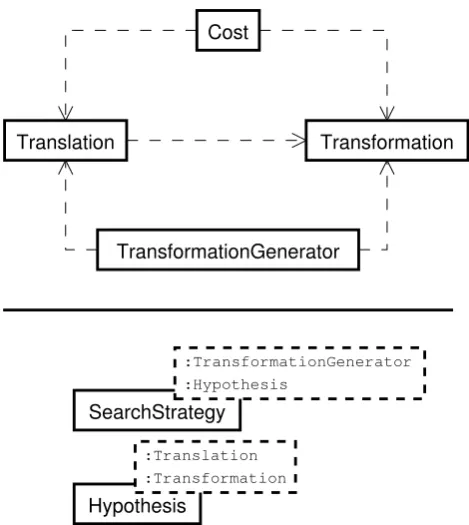
A model is implemented using four concepts : partial trans-lations, transformations, cost functions and transformation generators. The dependencies between those concepts are presented in Figure 1.
A partial translation represents a translation that is being built. It consists of a 3-tuple of the formhs,t,piwhere s is the sentence to translate, t is a partial translation of s and p is a progress indicator describing how t can be extended.
Cost
Transformation
SearchStrategy
:TransformationGenerator :Hypothesis
Translation
TransformationGenerator
Hypothesis
:Translation :Transformation
Figure 1: The different components of the MOOD frame-work. Arrows indicate dependencies and dashed boxes template parameters.
Incomplete translations are stored in a collection named
H
activeand complete translations are stored inH
complete. At each step, a transformation is applied to an incomplete partial translation (line 9). This transformation will mod-ify the target sentence and the progress indicator. Usually, the parameters of a decoder are rules like the translation of “wonderful” is “merveilleux” with a probability of 0.8. A transformation is such a rule, but instantiated on a specific partial translation, like the translation of “wonderful” is the ith word of the source with a probability of 0.8. As shown in Figure 1, the implementation of partial translations de-pends on the implementation of the transformations. This is so because a partial translation must know how to apply a transformation on itself.The quality of a partial translation must be quantified in order to prune
H
active (line 5) and to select the best trans-lation inH
complete. This quantification is carried out by a cost object, which associates a numerical value to a partial translation. Each time a partial translation is transformed, its cost must be updated. At the very least, the cost usu-ally reflects the target sentence fluency, the probability of the transformations applied as well as the word reordering between the source and the target sentences.The exploration algorithm does not need to know about the inner workings of the model, but it must be able to retrieve the transformations that are applicable to a partial transla-tion (line 6). The transformatransla-tion generator serves this pur-pose; it offers a find function that takes as input a partial translation and returns a set of applicable transformations. 3.2. Search space exploration
The principal role of a hypothesis is to synchronize a partial translation with its cost, but it is not limited to that. It can, for example, build a search graph that can be used afterward to extract n-best translations (Ueffing et al., 2002) or it can also compute statistics on the exploration. A hypothesis able to build the search graph of any combination of model and search strategy is available inMOOD.
All the concepts described so far are assembled in a search strategy to form a decoder. WithMOOD, a search strategy is an object that offers a decode method that takes as a param-eter the initial hypothesis and a transformation generator. The responsibility of the search strategy is the management of
H
active andH
complete, that is, to determine the order in which the hypotheses are explored and to establish a prun-ing policy (lines 4 and 5).As shown in Figure 1, the hypothesis and the search strat-egy are independent of the model because they are templa-tized. They can thus be reused with any other model imple-menting the concepts described in the previous section. The current distribution ofMOODimplements a multi-stack beam search strategy (see Section 4).
3.3. Object-oriented architecture at work
One of the key advantage of object-oriented architectures is an improved reusability of the different modules of the program. In order to illustrate this point, let us take a look at the problems an engineer faces when adapting an existing decoder to a new problem.
The first modification that must often be made during the lifetime of a decoder is changing the cost function. Be-cause with MOOD the different functionalities have been
separated, the task only consists of passing a different cost object when creating the starting hypotheses. No existing code needs to be changed or duplicated. It is noteworthy that the cost function can be anything. It can even encapsu-late an estimation of the future cost of a translation. Another useful modification of an existing decoder con-sists in adding new search strategies. Within MOOD, the
inner workings of the search algorithm is cleanly disjoint from that of the other modules, so one only needs to write a new search strategy class that defines a decode function that takes as a parameter a starting hypothesis and a trans-formation generator. The search strategy does not have to be aware of the implementation of the hypotheses or of the transformations, thus it can be used with any model (word-based, phrase-(word-based, hierarchical, etc.).
Creating a decoder for a new model representation demands more effort. Handling a new model representation means that new partial translation and transformation classes must be created. Because the cost and the transformation gen-erator depend on the translations and the transformations representation, new classes for these modules will have to be created as well. Currently,MOODonly supports phrase-based models, but other models will soon be supported. 3.4. Practical considerations
In practice, many different transformation sequences can lead to equivalent hypotheses; when this is the case, we say that the hypotheses are in the same state. When two or more hypotheses are in the same state, we can safely ignore them
all but the one having the highest cost value. To handle this strategy, MOODexpects each partial translation, cost and hypothesis to provide a compareState function that imposes a total ordering on their state.
3.5. Implementation
MOOD is implemented with the C++ programming lan-guage and is licensed under the Gnu General Public Li-cense (GPL).1 This license grants the right to anybody to use, modify and distribute the program and its source code. The only restriction is that if a modified version is dis-tributed, it must also be licensed under the GPL. As ex-plained in (Walker, 2005), this kind of license stimulates new ideas and research. MOOD is currently available at http://smtmood.sourceforge.net.
It is our hope that the availability of the source code and the clean design ofMOODwill make it a useful platform to implement and distribute new decoders.
4.
Creating a phrase-based decoder
As a proof of concept that our framework is viable, we reproduced the most popular phrase-based decoder: PHARAOH(Koehn, 2004). In this section, we describe how we implemented RAMSES, our clone, based on the com-prehensive user manual of PHARAOH. We followed this manual as faithfully as possible; the command-line syntax RAMSES recognizes mimics that of PHARAOH. The out-put produced by both decoders are compatible and RAM-SES can also output its n-best lists in the same format as PHARAOH does, that is, a format that the CARMEL
toolkit can parse (Knight and Al-Onaizan, 1999). There-fore, switching from one decoder to another should be easy. 4.1. Model representation
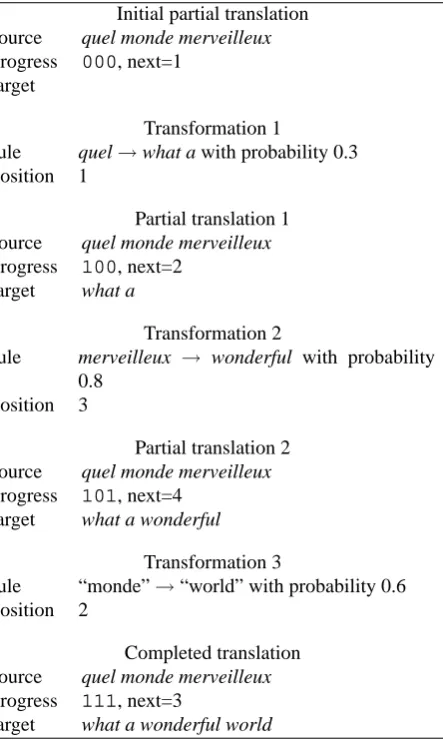
When a PBM decoder is launched, it takes as parameters a set of weighted rules and a language model. Each weighted rule consists of a sequence of source words, a sequence of target words and a probability. Before a source sentence is translated, all the rules that can apply to it are indexed and stored as transformations, which are tuples containing a rule and the position where it applies in the source. As we already said in Section 3.1, a partial translation corresponds to a source sentence, a target sentence and a progress indicator. The source and the target sentences are sequences of words. The progress indicator contains a mask indicating which source words have been translated and the position of the word after the last translated one (needed by the transformation generator). When a trans-formation is applied, the target words of its rule are ap-pended at the end of the target of the partial translation and the progress indicator is updated. An example of how a transformation is applied to a partial transformation can be found in Figure 2.
When a transformation is applied to a partial translation, the hypothesis ensures that its cost is updated. Each partial translation’s cost is implemented using the following costs: Language model The log-probability of the target created
(evaluated by a trigram model).
Initial partial translation source quel monde merveilleux progress 000, next=1
target
Transformation 1
rule quel→what a with probability 0.3 position 1
Partial translation 1 source quel monde merveilleux progress 100, next=2
target what a
Transformation 2
rule merveilleux → wonderful with probability 0.8
position 3
Partial translation 2 source quel monde merveilleux progress 101, next=4
target what a wonderful Transformation 3
rule “monde”→“world” with probability 0.6 position 2
Completed translation source quel monde merveilleux progress 111, next=3
target what a wonderful world
Figure 2: A possible transformation sequence that trans-lates a French sentence into an English sentence using a PBM model.
Translation table The sum of the log-probabilities of the rules that have been applied so far.
Distortion The number of source words that were skipped between two consecutive rules. For example, in Fig-ure 2, transformation 2 incurs a distortion cost of 1 because the French word monde is skipped.
Word penalty The number of words in the target sentence.
Heuristic An estimation of the cost to complete the partial translation. This estimation is the sum of the costs of translating each contiguous untranslated sequence as if it were a stand-alone sentence.
All these costs are weighted and combined in an exponen-tial:
cost(h) =exp
∑
c∈Cwcvaluec (2)
where h is the partial translation to evaluate,
C
contains the costs to consider, valuecis the value of a cost and wcis its weight. Even though equation 2 is a mix of other costs, it can be implemented in a cost object; inMOODa cost can be arbitrarily complex.The only remaining part of the model representation is the transformation generator. It consults the indexed formations and the progress indicator to return the trans-formations that only translate untranslated words. Like PHARAOH, it is possible to restrict the transformations re-turned to the ones for which the starting position is not more than dl words away from the position right after the last translated word, where dl is a distortion limit.
4.2. Search space exploration
The last building block of the decoder is the search strat-egy. Like in PHARAOH, we implemented a beam search strategy. Instead of treating all the hypotheses together, a beam search proceeds level by level. At each level, the hypotheses are pruned regardless of the hypotheses in the other levels. The ones that are kept are expanded and stored for treatment in a further level. The advantage of using dif-ferent levels is that we can group and prune together com-parable hypotheses.
In PHARAOHand RAMSES, the level of a hypothesis cor-responds to the number of source words that are translated in its partial translation. This is so because without a very good heuristic, it is difficult to compare a hypothesis where one word is translated with another where, for example, twenty words are translated.
The way it is designed, this search strategy can therefore be used by any model, as long as the latter provides a policy to establish the level of any given hypothesis.
5.
Evaluation
We evaluated whether the MOOD framework can be use to develop a state-of-the-art decoder. We thus compared RAMSESagainst PHARAOH.
Because there are some places in the PHARAOH manual that left us with implementation choices, we ended up with a clone which differs slightly from the original. To measure this difference, we evaluated the translation quality of the two decoders.
A good design is often a compromise between modularity, which increases code reuse, and execution speed. To mea-sure this compromise, we also compared the speed of the two decoders.
5.1. Corpora
The two decoders were tuned (on theDEVsections) to
op-timize the BLEU metric using the algorithm described in (Och, 2003). We used the implementation available in the training toolkit graciously made available by the WPT’06 shared task organizers (see http://www.statmt. org/wmt06/shared-task/baseline.html). The main characteristics of the corpus and the models we used in this study are reported in Table 1. Note that al-though the TESTsections we used here correspond to the test material that the participating systems had to translate, a direct comparison between our results and the ones re-ported during the workshop is not possible since, for some reason, we did not use the same evaluation toolkits (see next section).
pair corpus sentences parameters
TRAIN 688 031 13 190 285
fr2en DEV 200 203 760
TEST 2 000 663 042
TRAIN 751 088 11 852 331
de2en DEV 200 116 095
TEST 2 000 415 507
Table 1: Main characteristics of the corpora and models we used in this study. parametersindicates the number of parameters of the PBM that match the source material.
5.2. Metrics
We used theBLEU (Papineni et al., 2002) andNIST (Dod-dington, 2002) metrics to automatically rate the translation quality of the engines we compared, both computed by the script mteval. We used the versionv11aof the script which we downloaded fromhttp://www.nist.gov/ speech/tests/mt/resources/scoring.htm. To compare the decoding speed of the two decoders, we decided to compute the number of states they explored per second. It is indeed a better indicator of the potential of the decoder than the total number of states or the total running time, because those are mainly affected by pruning and tun-ing. Different tunings yield different scores, thus affecting the number of hypotheses that are pruned. We also report the total number of states considered during each transla-tion session. Note that because each decoder was tuned separately (on the sameDEVsections with the same tool), they eventually ended up with a different scoring function, thus affecting the number of hypotheses that were pruned. 5.3. Results
The tests were conducted on computers equipped with a 2 GHz AMD Opteron 246 processor and 8 gigabytes of RAM. The results of the French-to-English experiment are reported in Table 2. Expectedly, the translation quality of the two decoders is comparable. We observe that RAMSES
explores less states per second than PHARAOH. However, for this setting, RAMSES explored 20% more hypotheses than PHARAOH.
The performance of RAMSES and PHARAOH for the German-to-English task are reported in Table 3. As we
al-BLEU NIST states / sec states
RAMSES 0.2908 7.2672 375 708 1.39E+10
PHARAOH 0.2897 7.2969 587 704 1.16E+10
Table 2: Translation quality metrics and decoding speeds when translating from French to English.
ready mentioned, German is a lot more difficult to trans-late than French for a PBM decoder (Collins et al., 2005), and this results into lower scores. For BLEU, PHARAOH
ended up with a significantly higher score, even if RAM
-SESexplored 40% more hypotheses than PHARAOHfor this setting. The fact that we tuned both decoders on a rather small corpus (200 sentences) might explain the difference inBLEUscores we observe. However, note that the differ-ence inNISTscores is in favor of RAMSES.
BLEU NIST states / sec states
RAMSES 0.1994 6.4659 410 363 8.16E+9
PHARAOH 0.2262 6.4361 660 743 5.78E+9
Table 3: Translation quality metrics and decoding speeds when translating from German to English.
When analyzing these results, we must keep in mind that RAMSESwas designed for two different reasons. First, to offer the community an Open Source, phrase-based decoder and second, to assess the usefulness ofMOODwhen creat-ing state-of-the-art decoders.
There is no doubt that the first goal was reached. By re-leasingMOODand RAMSESsource codes, new SMT prac-titioners do not need to start from scratch anymore when they wish to test a new idea for the decoding process. An-other advantage of Open Source software is that since more people have the chance to read the source code, they are more likely to detect bugs and improve the code.
We also consider that the second goal was reached. We matched PHARAOH’s translation quality when translating from French to English, and we further think that the differ-ences observed in the results when translating from German are due to implementation details or maybe to overfitting during tuning.
Currently, PHARAOH is roughly twice as fast as RAM
-SES. If only the features of PHARAOH are needed, then PHARAOH should be preferred to RAMSES, but for re-searchers who want to experiment, RAMSESis a solid con-tender.
6.
Conclusion
Our main contribution has been to provide a general frame-work in order to implement a decoder. Our C++ implemen-tation of this framework is called MOODand it is released under an Open Source license.2Anyone can thus view, use and modify its source code freely. As a proof of concept that this framework can be used to build a full-fledged de-coder, we implemented RAMSES, a PBM decoder based on PHARAOH’s manual.
In its architecture,MOODcleanly separates the model from
the search space exploration strategy. It thus maximizes code reusability by allowing the same exploration strategy to be used with many different models. Code reusability has two major advantages over a complete rewrite: it is faster to develop a new decoder and reduces the risk of introducing bugs.
Even though RAMSESis not as fast as PHARAOH, it is a solid tool for research projects: the code is Open Source and the architecture is modular, making it easier for re-searchers to experiment with SMT. Also, the command-line interface of RAMSESis very close to that of PHARAOH, so switching from one to the other should be easy.
Currently,MOODonly supports PBM and the beam search strategy. We plan to support at least word-based models and hierarchical models. We will also add a greedy and a dynamic programming search space exploration strategy. Often, SMT is said to be language independant, but some-times, specific problems need specific solutions. We there-fore intend to add toMOODspecialized modules for some languages. For instance, we would like to create a transfor-mation generator that returns transfortransfor-mations that respect the structure of a sentence as well as specialized costs. Be-cause MOOD is modular, these modules will be easy to switch on or off, so the overall decoder will not lose its generality.
7.
References
Peter F. Brown, Stephen A. Della Pietra, Vincent J. Della Pietra, and Robert L. Mercer. 1993. The mathematics of statistical machine translation: Parameter estimation. Computational Linguistics, 19(2):263–311.
Philip Clarkson and Ronald Rosenfeld. 1997. Statistical language modeling using the CMU-cambridge toolkit. In Proc. Eurospeech ’97, pages 2707–2710, Rhodes, Greece.
Michael Collins, Philipp Koehn, and Ivona Kucerova. 2005. Clause restructuring for statistical machine trans-lation. In Proceedings of the 43rd Annual Meeting of the Association for Computational Linguistics (ACL’05), Ann Arbor, Michigan, June.
G. Doddington. 2002. Automatic evaluation of machine translation quality using n-gram cooccurrence statistics. In Proceedings of the HLT, pages 257–258, San Diego, USA.
Ulrich Germann, Michael Jahr, Kevin Knight, Daniel Marcu, and Kenji Yamada. 2001. Fast decoding and optimal decoding for machine translation. In ACL ’01: Proceedings of the 39th Annual Meeting on Association for Computational Linguistics, pages 228–235.
K. Knight and Y. Al-Onaizan, 1999. A Primer on Finite-State Software for Natural Language Processing, August. http://www.isi.edu/licensed-sw/carmel/carmel-tutorial2.pdf.
Kevin Knight. 1999. Decoding complexity in word-replacement translation models. Computational Linguis-tic, 25(4):607–615.
Philipp Koehn and Christof Monz. 2005. Shared task: Sta-tistical machine translation between european languages. In Proceedings of the ACL Workshop on Building and
Using Parallel Texts, pages 119–124, Ann Arbor, Michi-gan, June.
P. Koehn, F.J. Och, and D. Marcu. 2003. Statistical phrase-based translation. In Proceedings of the Human Lan-guage Technology Conference (HLT), pages 127–133. P. Koehn. 2004. Pharaoh: a beam search decoder for
phrase-based SMT. In Proceedings of AMTA, pages 115–124.
Daniel Marcu and William Wong. 2002. A phrase-based, joint probability model for statistical machine transla-tion. In Conference on Empirical Methods in Natural Language Processing.
F.J. Och and H. Ney. 2000. Improved statistical alignment models. In Conference of the Association for Compu-tational Linguistic (ACL), pages 440–447, Hongkong, China.
F.J. Och and H. Ney. 2004. The alignment template ap-proach to statistical machine translation. Computational Linguistics, 30:417–449.
Franz Joseph Och. 2003. Minimum error rate training for statistical machine translation. In Proceedings of the 41st Annual Meeting of the Association for Computa-tional Linguistics, Sapporo, Japan, July.
Daniel Ortiz-Mart´ınez, Ismael Garc´ıa-Varea, and Francisco Casacuberta. 2005. Thot: a toolkit to train phrase-based statistical translation models. In Tenth Machine Transla-tion Summit, pages 141–148, Phuket, Thailand.
Kishore Papineni, Salim Roukos, Todd Ward, and Wei-Jing Zhu. 2002. Bleu: a method for automatic evaluation of machine translation. In Proceedings of the 40th Annual Meeting of the ACL, pages 311–318, Philadelphia, Penn-sylvania.
Chris Quirk, Arul Menezes, and Colin Cherry. 2005. Dependency treelet translation: Syntactically informed phrasal SMT. In Proceedings of the 43rd Annual Meet-ing of the Association for Computational LMeet-inguistics (ACL’05), pages 271–279, Ann Arbor, Michigan, June. A. Stolcke. 2002. SRILM - an extensible language
model-ing toolkit. In Proceedmodel-ings of ICSLP, Denver, Colorado, Sept.
C. Tillmann and H. Ney. 2003. Word reordering and a dynamic programming beam search algorithm for sta-tistical machine translation. Computational Linguistics, 29:97–133.
Nicola Ueffing, Franz Josef Och, and Hermann Ney. 2002. Generation of word graphs in statistical machine transla-tion. In Proc. of the Conference on Empirical Methods in Natural Language Processing, Philadephia, PA, July 6-7.
Daniel J. Walker. 2005. The open ”a.i.” kitTM: Gen-eral machine learning modules from statistical machine translation. In Workshop on MT Summit X, ”Open-Source Machine Translation”, Phuket, Thailand. Kenji Yamada and Kevin Knight. 2001. A syntax-based