CSEIT1833139 | Received : 12 March 2018 | Accepted : 24 March 2018 | March-April-2018 [ (3 ) 3 : 470-475 ]
© 2018 IJSRCSEIT | Volume 3 | Issue 3 | ISSN : 2456-3307
470
Cyberbullying Detection Using Msda
J. Jelsteen1, K. Arjun2, P. P. Athul Babu2
1Assistant Professor, Nehru College of Management,Coimbatore, Tamil Nadu, India 2MCA Student, Nehru College of Management, Coimbatore, Tamil Nadu, India
ABSTRACT
Cyber bullying is any form of bullying which takes place online or through smart phones and tablets. The outcomes for victims under Cyberbullying may even be tragic such as the occurrence of self-injurious behaviour or suicides[1].One way is to provide a facility like “report abuse” to report abusive messages and behaviourisms in cyber bullying detection. But it focuses on assumption which reduces performance. And so we investigate one deep learning method named Stacked Denoising Auto encoder (SDA). SDA stacks several denoising auto encoders and concatenates the output of each layer as the learned representation. Each denoising auto encoder in SDA is trained to recover the input data from a corrupted version of it. The input is corrupted by randomly setting some of the input to zero. The denoising process helps the auto encoders to learn robust representation. We develop a new text representation model based on a variant of SDA: Marginalized Stacked Denoising Auto encoders (mSDA). An automatic extraction of bullying words based on word embeddings is proposed so that the involved human labour can be reduced. During training of smSDA, we attempt to reconstruct bullying features from other normal words by discovering the latent structure, i.e. correlation, between bullying and normal words. The intuition behind this idea is that some bullying messages do not contain bullying words.
Keywords: Cyber Bullying, Detection, Semantic, Denoising, Auto-Encoder
I.
INTRODUCTION
Cyberbullying can be defined as aggressive, intentional actions performed by an individual or a group of people via digital communication methods such as sending messages and posting comments against a victim. Different from traditional bullying that usually occurs at school during face to-face communication, cyberbullying on social media can take place anywhere at any time. For bullies, they are free to hurt their peers’ feelings because they do not need to face someone and can hide behind the Internet. For victims, they are easily exposed to harassment since all of us, especially youth, are constantly connected to Internet or social media.[1].
Cyberbullying victimization rate ranges from 10% to 40%. In the United States, approximately 43% of teenagers were ever bullied on social media. The same as traditional bullying, cyberbullying has negative, insidious and sweeping impacts on children. The outcomes for victims under cyberbullying may even be tragic such as the occurrence of self-injurious behaviour or suicides. One way to address the cyberbullying problem is to automatically detect and promptly report bullying messages so that proper measures can be taken to prevent possible tragedies.
colour spaces will be used to model skin pixels. Here, we present a communication platform that enables
efficient, decentralized social networks on
smartphones. Contrail is centred on a simple cloud-based messaging layer that enables basic connectivity between smart phones, letting them efficiently and securely exchange encrypted data with other devices.
II.
CREDENTIALS
As a side effect of increasingly popular social media, cyberbullying has emerged as a serious problem afflicting children, adolescents and young adults. Machine learning techniques make automatic detection of bullying messages in social media possible, and this could help to construct a healthy and safe social media environment. In this meaningful research area, one critical issue is robust and discriminative numerical representation learning of text messages. In this paper, we propose a new representation learning method to tackle this problem. Our method named Semantic-Enhanced Marginalized De- noising Auto-Encoder (smSDA) is developed via semantic extension of the popular deep learning model stacked denoising auto encoder. The semantic extension consists of semantic dropout noise and sparsity constraints, where the semantic dropout noise is designed based on domain knowledge and the word embedding technique. Our proposed method is able to exploit the hidden feature structure of bullying information and learn a robust
and discriminative representation of text.
Comprehensive experiments on two public
Cyberbullying corpora (Twitter and Myspace) are conducted, and the results show that our proposed
approaches outperform other baseline text
representation learning methods.
III.
LITERATURE SURVEY
Association between Bullying and Psychosomatic Problems: A Meta-analysis (2009)
Bullying has been defined as a proactive form of aggression repeatedly perpetrated by 1 or more peers
toward a weaker peer. Bully-victims, victims, and bullies had a significantly higher risk for psychosomatic problems compared with uninvolved peers. It represent a risk factor for children’s psychological well-being and social adaptation.[1]. First, computer literature searches from the year each database were conducted using Medline, Embays, and Psych Info. Second, review articles and book chapters regarding consequences of bullying were reviewed for possible relevant citations. Third, reference sections of the collected articles were searched for relevant earlier references. Self-report questionnaires. Peers, Parent’s, or Teacher’s reports. A clinical interview that resulted in a clinical rating of behaviours and health problems. It creates negative and antisocial behaviour during adolescence and risk for psychiatric disorders. School bullying is a widespread phenomenon in many countries around the world. It is a major factor affecting children’s health, and are often referred as psychosomatic problems.
Fast Learning for Sentiment Analysis on Bullying (2012)
Bullying is a serious national health issue among adolescents. Sentiment analysis has the
them.Applied the trained model to Twitter posts on bullying and discuss the findings.
Psychological Bulletin Bullying in the Digital Age: A Critical Review and Meta-Analysis of Cyberbullying Research Among Youth (2014)
Cyberbullying is typically defined as aggression that is intentionally and repeatedly carried out in an electronic context. Cyberbullying is occurring at widespread rates among youth and adults, nearly 75% of school-age children. Cyberbullying has been linked with a host of negative outcomes for both individuals and organizations. Performed a search for 14 Databases.[2] The search terms included variants of online behaviour and variations on perpetration or victimization. Used limiters to exclude any studies dealing with stalking or sexual victimization. Provide a narrative review on cyberbullying including a look into the prevalence cyber victimization, and meaningful behavioural and psychological variables. Critique the existing research, noting areas where findings conflict and gaps remain, for future researchers. The articles consisted of review or conceptual articles, articles reporting the results of an intervention. It included a self-report measure of Cyberbullying or Cyber Victimization. Participants reported general experiences with bullying in the past rather than in regard to a specific incident or a hypothetical situation.[2]
IV.
METHODOLOGY
System architecture can comprise system
components, the externally visible properties of those components, the relationships (e.g. behaviour) between them. Here the Whole process which takes place is illustrated. Both text filtering and media filtering have different modes of finding bullying. But after finding them the process of avoiding them and the user management is of the same, method.
V.
TECHNOLOGIES
SQL
Structured Query Language is a special purpose programming language designed for managing data held in a relational database management system(RDBMS).Originally based upon relational algebra and tuple relational calculus, SQL consist of a data definition language and a data manipulation language. The scope of SQL includes data insert, query, update and delete, scheme creation and modification, and data access control. Although SQL is often described as, and to a great extend is, a declarative languages (4GL), it also includes Procedural elements.SQL was one of the first commercial languages for Edgar.F.Codd’s relational model..
C#.Net
As an object-oriented language, C# supports the
concepts of encapsulation, inheritance, and
Text Filtering
Figure1. Text Filtering Image Filtering
Figure2. Image Filtering
FLOW ARCHITECTURE
Figure3. Flow Structure of MSDA
ELEMENTS Social Network
A social network has to be created this social network will be maintained by the admin Users have to register in this social network. Registered users can socialize with other users using this.
Filtering
All the content in this social network will be filtered and only after that it will reach the user. For filtering rules are kept. The filtering is of 2 types Image filtering and text filtering. Text filtering is a collection of words called bag of words is constructed and the words included in this are filtered. These words are filtered directly and are also extracted from their latent structure. Based upon the percentage of the bullying content in that word the behavior of the user is defined. Such users are enlisted in the blacklist and based upon their future activities they may be either added to the block list or may be removed from the black list. Image Filtering is done by pixel extraction. Based upon the percentage of skin tone present in a picture the picture is filtered. A specific value would be set for the percentage of skin tone that can be shown and if the percentage is more than this threshold value then that picture will be filtered from the user.
VI.
REQUIREMENT SPECIFICATION
FUNCTIONAL REQUIREMENTS
The functional requirements in cyber bullying are: 1. Registration and Login
2. Making Posts
3. Commenting on Posts 4. Reporting and Blocking
Registration and login: Any user or admin needs to be registered to access an account which does have a corresponding id and password, using which he/she could enter into the registered account and enjoy the facilities provided by the application.
are visible for all other registered users who are following this user.
Commenting on Posts: Users can make comments on the posts of other users who they are following.
Reporting and Blocking: Users can report about other users if they find them annoying or disturbing. They can also block other users whom they find as a problem to them.
NON-FUNCTIONAL REQUIREMENTS
A non-functional requirement is a requirement that specifies criteria that can also be used to judge the operation of a system. The following are the non-functional requirements of this application:
1) Performance 2) Security 3) Reliability 4) Maintainability
Performance : It is faster than the existing system. Security: Provides high security by preventing unauthorized access.
Reliability : The system can able to perform its required functions.
Maintainability : Any new changes can be accommodated easily.
VII.
RESULTS
Home Page
Figure4. Home Page
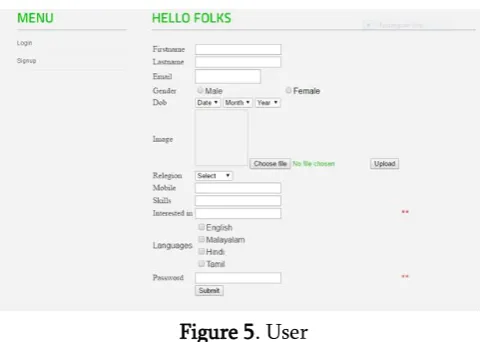
User
Figure 5. User
VIII.
FUTURE ENHANCEMENT
We expect to make a whole lot of modifications to our project in the future. The features can be advanced and the working of app can be made better. Groups and many such extra features can be introduced in to the current features in the future. There are possibilities for bringing new features to take our project to another level. The data rate and speed of uploading or downloading can be increased and the ease of availability of the app can be enhanced. New techniques of filtering with maximum quality of accuracy can be made possible with adding more features.
IX.
CONCLUSION
X.
REFERENCES
[1]. Association Between Bullying and
Psychosomatic Problems: A Meta-analysis (2009)by, GianlucaGini, PhD, TizianaPozzoli, MA
[2]. Fast Learning for Sentiment Analysis on Bullying(2012) by,Jun-Ming Xu, Xiaojin Zhu and Amy Bellmore